ACoAs MANIPULATING Self & Others (Part 3a)

Manip chartPREVIOUS:
Manipulating ourselves (#2d)

SITE: Motivation & Manipulation (<—- Graph )

BOOK : “In Sheep’s Clothing”
~ Dr. Geo. Simon, PhD
Ways to deny personal accountability & manipulate others  (Extensive outline of book)


ACoAs MANIPULATING (M.) OTHERS
Most of us learned to manipulate (based on CDs) by watching/ living with manipulative parents & other family members, but some people come by the skill naturally. All of us had to use it, one way or another, to cope with the painful, complicated environment we grew up in.

M. is a form of ‘acting out’ (Freudian def). Translation for ACoAs:  Compulsively taking actions or ‘forgetting’ to act, as a substitute for expressing painful emotions we have but don’t consciously feel

REASONS for manipulating others:

envyBy now, having lived in the world for some decades, we’ve had the opportunity to watch how others function, & envy their ability to get their needs met, while we feel stuck in the mud of our damage.
But we’ve also had many life experiences of our own – some even positive – so we DO know something about how to manage, but rarely if ever apply that info to ourself – while using our extensive care-taking skills for others

This causes intense deprivation in PMES ways, since we are:
• Not allowed to have needs & not allowed to ask for anything
• Deeply convinced no one will ever provide for us if we ask directly, will be angry & punish us, & worst of all being Abandonment – withdrawing their connection to us
• Don’t have a right to give to ourself (we think it’s arrogance)
• Believe we don’t know how to – not having seen it from role models & not taught directly

confusedThis leaves us confused, ‘starving’, desperate – so we resort to the default position of manipulating – to reach goals. WE :
• cover up Self-Hate, Shame, Loneliness
• get needs met from others instead of from self
• prevent others from having power over us
• make connections the only way we know how (people-pleasing….)  to keep from getting abandoned – ever again (FoA)
• show our contempt for everyone, especially authority

FORMs of Manipulation
1. Direct / Overt (“Throwing others on the defensive”)
Bullies come in many guises, sometimes like a spiked hammer, sometimes like a Southern rose, sometimes covered in sheep’s clothing.
Each type has gathered an extensive repertoire of techniques used to gain power & to deny any accountability for their actions.

The Workplace Bullying Institute defines it as “repeated, health-harming mistreatment of one or more persons (the targets) by one or more perpetrators”

verbal bullyThe overt style uses deliberate, intense confrontation – to challenge people’s personal legitimacy, validity of their ‘performance’, or eradicate the value of their point, issue or complaint.
The goal is to put others on the defensive, & nothing works better than intimidation. Tactics can be fired off so fast that they’re hard to identify or separate, & the slickest perpetrators use several at once

Most ACoAs hide their aggressive side, sometimes from themself, but definitely towards others, behind the many faces of co-dependence.  (MORE in 3b)
Sometimes it only comes out toward strangers, but more often toward their intimates – mates, children & closest friends.
bylly typesBut even so – the bully/sadist is hidden there, created in response to the humiliation we suffered for so long. The greater the original abuse, the more intense is our sadist/bully.

In Recovery we can make friends with this aspect of ourself by acknowledging that “It really was that bad!”. We can safely vent our rage, & never letting the bully/sadist act out on others or ourself using the healthy UNIT ego-states.

EXP: Drama is a sign of manipulation, used to bury the real issues (personal or relational) in a giant pile of noise.  Includes:
• constantly bragging & showing off, to make others feel small
• escalating arguments, not ‘letting go’ ….
• knowing how to get their way & insisting on it
• not good at sharing – anything
• pushing their point of view rather than asking questions
• pushing their way ahead of others, like in line
• taking over every conversation, taking up too much space
• talking over someone, ignoring all types of boundaries
• yelling & screaming, threatening or doing physical harm
• writing / texting attack messages, all verbal abuse

Add your own

NEXT: Manipulating (Part 3b)

ACoAs MANIPULATING Self & Others (Part 2d)

 PREVIOUS: Manipulating self #2c


INNER CHILD :  WIC’s manipulation  (cont.)
a. ACTION/practical (Part 2c)
b. EMOTIONAL self-con (cont.)
As a result of avoiding feelings :
• We keep putting off the Es we are aware of, including any which crop up as a result of life’s interactions (painful or happy ones)
• AND stay unaware of the backlog we’ve hidden from ourself. SO – when we start thawing out, the Es that surface are very intense. We may be shocked & ashamed of how we act them out.

So, by allowing the WIC to con us into not acknowledging & getting our feelings out – now – old & more recent Es keep piling up. At some point the kettle boils over & we explode or we implode, which turns the Es inward into paralyzing depression.
Since our WIC is choking on all the unprocessed pain we’ve accumulated thru the years – when we’re triggered by a person or event similar to our early experiences , WE : hide from Es

• Either we go numb, & compulsively find things to distract us, often for hours on end (TV, Facebook, self-pleasuring, sleeping, isolating, drinking, spending, cleaning, exercising ….)
This is a way the WIC cons us into not recognizing Es, assuming it’s not safe to do so – while in fact that just makes us more stuffed up (like not being able to breathe from a bad cold), & therefore more weighed down, more distressed.

• OR our Es go from 0 to 100 (instant rage, overwhelming sadness, hopelessness, OR ecstatic fantasy highs), & over-react internally or to people around us without considering the consequences to ourself or others. raging Es
The KID just wants to vent, convinced that if it doesn’t it will burst. It doesn’t want to be reined in – assuming that any restriction represents being told to not have its feelings – the same as in our childhood.

• AND, Some of us are more emotionally oriented (dramatic Ennea 4s, Water Signs….). We are flooded with Es & assume we can’t modify or keep them in.
But in Recovery we learn that intense Es come from sitting on decades of pain – no matter what our Natural type is. And we come to understand that impulsively venting them willy-nilly is neither healthy for us nor an acceptable way of treating others.

dramaticAttacking, blaming, snarling at, insulting, yelling at, cold-shouldering…. may feel ‘normal’ to the WIC, but it’s actually acting out, ‘throwing up’ & copying one or more of our family members
— on to innocent victims, who are not responsible for our damage, & can’t heal us, OR
— on to the original perpetrators, trying to force them to acknowledge our suffering & their abuse – to no avail.

RECOVERY
This is when using “influence/ persuasion” (normal manipulation) is required. The WIC has been running our inner world, which has given it a sense of power, no matter how illusory.  Now we’re saying – No – do it this new way, & the kid says “F-U”.  So we need to find ways around the resistance to disobeying Bad Rules <—- > to find the chink in the wall of defenses
BY:
• Providing logical & accurate arguments to counter the cognitive distortions (mental cons / mind-games) of the WIC or PP
EXP: “You don’t have the power to harm another person (parents) by just feeling your feelings – in an appropriate place & in WALL 2a safe way” //  “You cannot be both damaged (fixable) & defective (un-fixable)”

• Making a bargain with the WIC for something legitimate it wants very much, & so will give in a little to get it
EXP: I’ll take you to the movies/comedy show/ dance…. if you quietly let me do my Adult work first. THEN – you, the grownup, must keep your promise as soon as possible – or you lose all credibility.

• Regularly using E. exercises for the Right Brain, to bypass or reprogram our negative thinking, with new info, insight & understanding (Left brain)
EXP:  drawing, music & dance, prayer, making collages…..& things like Brain Gym & Bio-Feedback to reorganize & restore the mind’s natural balance.  Studying & then using NLP for ourself helps correct actions, beliefs & emotional reactions  (MORE...)

AND Inner Child visualizations – try several from Yahoo – for any you’d like.

NEXT:  Manipulating OTHERS #3a

ACoAs MANIPULATING Self & Others (Part 2c)

se;f-conPREVIOUS: Manipulating OURSELVES (2b)

SITEs: ‘How Do Alcoholics Manipulate Others?’
• “Manipulation: Why are Addicts so Good at It?”


POSTS :“Weak decision styles”
(1-3)
•  Over-controlling ourselves (1-5)
ALL post on Es in May & June 2011  and  Jan 2012  (go to Menu)


DEF: Con / conning – to persuade by deception, cajolery….

REMINDER : PP – The Negative Introject (see Part 2a = PP against WIC)
• Freudian: Introjection is “The internalization of authority” – the demands & expectations of our parents, & so by extension society, which become part of our personality structure. This creates a conflict between externally imposed rules against our own needs as well as repressed, socially unacceptable desires (“Shadow”)

INNER CHILD : WIC’s manipulation (cont.)
Re. the OUTSIDE //  Re. our INSIDE

SELF-‘conning’ is a long-standing pattern of functioning from the False Self, & both forms of sabotage (a. actions & b. emotional) come from the interactions of the PP & the WIC

give up on actionsa. ACTION/practical self-con
As mentioned in other posts, even when we try to move toward a legitimate goal, such as physical self-care, talking to the Wounded Child, going for a better job….
we may take a few steps in that direction, & then either we hit a snag (don’t get the response we want from others…)
or we blank out,  sidetrack ourself, feel too tired, “why bother’…. & give up. ——->

So – yet again the WIC has conned us into NOT leaving ‘home’, even tho’ that home was horrible, & is now mainly in our head. It keeps us from starting or sticking to healthier ways of functioning.
TOXIC RULE: “I must always struggle but never get there”

After a few attempts we hit a brick wall & can’t go any further – but rarely know why. No matter how many times we try, it seems impenetrable, no way to break thru’!
To continue toward any positive goal would mean S & I, & that can trigger terror in the kid, so much so that it prevents us from even trying to push past the resistance.

Actually getting to our goals would represent a disconnect from everything we’ve ever known. This can create a feeling of separation-anxiety, by re-experiencing our childhood sense of devastating aloneness.
AND according to the Toxic Rules, it would mean having ‘the gall to focus on ourself’ instead of everyone else (really our parents) – which the WIC can not bear to risk.

• One reason we don’t break thru’ the ‘resistance wall’ is IF we haven’t developed a strong enough (or any) rapport between the WIC & our UNIT.WALL 1
• Another is IF we don’t allow ourself to feel because we  haven’t learned how to cope with intense emotions. To do so would require doing a lot of emotion-release work, sharing them in the right place so we’re not alone with the pain, along with soothing & comforting the Child in ways that suit us.

The PP is so strong in us & the WIC so devoted to our early training that – in the early stages of FoO recovery – we cannot go directly toward worthwhile goals. So we need to find indirect ways to approach both — the way we talk to the WIC, & how we go about taking healthier actions 

b. EMOTIONAL self-con
Most human emotions (Es) are located in the Child Ego State, with some – the more mature ones – in the Healthy Parent, & none in the Adult state, which is more like a computer.

However, our WIC will try to avoid all Es
= mainly old pain stored in our body (muscles, organs, brain chemicals…) which have not been processed out by doing trauma release work via crying, pounding, shaking…. AALSO
= the WIC is uncomfortable with good feelings, anxious that we’re not allowed to be comfortable, to not say anything legitimately positive about ourself, to not relax
As kids WE :
• were not allowed to safely express ALL our feelings
• never learned from family how to process Es, via labeling & ‘understanding’ them correctly
• were not comforted or validated, so we don’t have a right to be acknowledged or soothe ourselves
• did’t develop an internal monitor that governs our reactions, which must come from the UNIT – the healthy adult & loving parent components

NEXT: Manipulating OTHERS (Part 3a)

ACoAs MANIPULATING Self & Others (Part 2b)

child in chargePREVIOUS: Manipulating OURSELVES (#2a)

DEF: Con / conning – to persuade by deception, cajolery…..

POSTs: Negative Benefits
• Emotions & the Body
• Dealing with the PP (healing)


REVIEW
It’s important to remember that we all have an Inner Parent, but for us as ACoAs & addicts, one part of this Ego State (voice) is usually contemptuous & cruel, while another part may be kindly but weak, both sides neglectful in important ways.

“Introjections involve attitudes, behaviors, emotions & perceptions that are usually gathered from influential or authoritative people in one’s life. They are neither digested nor analyzed, they’re simply adopted as a part of one’s personality as concepts that one considers should be believed or behaviors that one thinks ought to be followed.” (MORE…..)

Except for psychotics / sociopaths / malignant narcissists, the super-ego (Introject) provides an endless self-policing process, to reinforce family restrictions long after the original authority is changed, unavailable or gone.

• Object Relations Theory : D. W. Winnicott said that when we use the defense mechanisms of projection or introjection …. we (temporarily) hand over omnipotence to another person, letting them be our manager – even tho’ they may never be aware of it!

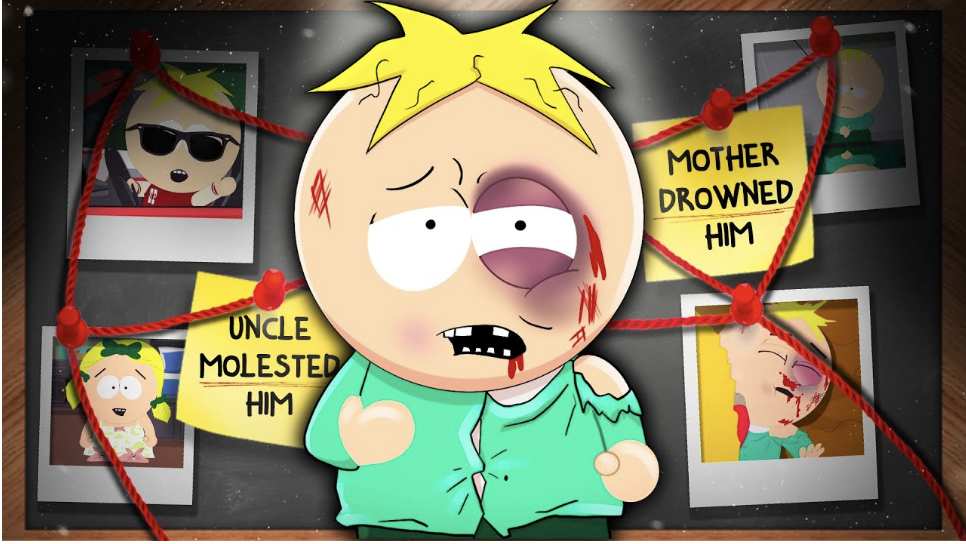
A classic example of Introjection is Butters Stotch, in SOUTH PARK, who seems to have completely internalized his alcoholic father’s frequent use of grounding as a punishment.

INNER CHILD : WIC’s manipulation
As laid out in other posts (ACoAs & S-H), the WIC is so used to having to do everything itself, with little or no resources & info, that it believes it still has to be that way – even tho’ it’s terrified & full of self-loathing. What an awful double bind!

Originally, being in a powerless situation as children we got a little sense of power & control by doing everything on our own AND doing without. So NOW – the WIC will try to sabotage any attempt by our healthier Voice (True Self) to be in charge, so it can stay attached to the PP!

Re. the OUTSIDE
A-P-CThe WIC cons us about our dealings with the whole world, especially at work :
• that showing up/ being visible always means that we’ll be judged
• that we have to work extra hard & do the impossible to not get fired
• that we have to know everything, or we’ll be humiliated
• that being ‘perfect’ is the only way we’re allowed to live
• that we have to give others whatever they want so they won’t leave ….

FALSE : ALL forms of self-conning are lies! We need to regularly remind the WIC that he/she —
• is NOT the one who is supposed to work, that’s only for the adult part of us
• is NOT seen by other adults, they only see us the grown-up
• is NOT responsible for the company’s agenda, the demands of bossed, the plight of co-workers…..
• is NOT supposed to be in charge of every-day functioning. That’s the job of the UNIT – Healthy Adult/ Loving Parent.he world.

Re. our INSIDE: The WIC cons us with Self-Hate, to not have to be our own motivator & be in charge of our life –
• I’m stupid, stupid, bad, bad, wrong, wrong, weak, weak…..
• I don’t know how to do anything, & too dense to learn
• No one loves me, and no one ever will
• I can’t love anyone, I don’t know how to connect
• No one is safe & I can’t trust anyone
ANDS-H results
• No one will ever help me or be there for me
• I’d be better off dead, they’d be happier
• I’m boring, in the way, too much trouble
• I’ll never safe, happy, have my dreams
• I don’t have a right to ….
• If I let go of them I’ll die -OR- they’ll die! AND when they do die I’ll actually die as well (symbiosis)
• I wouldn’t recognize a healthy person if I fell over them
• I have to rescue them. I’ll do anything to make them feel better, not feel abandoned, stop drinking, be happy…..

NEXT: Manipulating OURSELVES (Part 2c)

ACoAs MANIPULATING Self & Others (Part 2a)

heart-conned

PREVIOUS: Manipulation & Needs (Part 1)

SITE:   8 Negative Thoughts That Manipulate Your Mind

REMINDER: See ACRONYM page for abbrev.


ACoAs MANIPULATING OURSELF

While we think of ourselves as victims – which we were as children BUT are no longer – we are now victimized internally by our Negative Introject as well as our damaged Adapted Child, (WIC) who desperately clings to the old ways.
Fed by the PP & constantly reinforced by the WIC, Self-Hate carries a powerful energy – to prevent us from being able to S & I, in order to have a better, more satisfying life.kid-whipped

Even in Recovery, some find it very hard to shift out of paranoia, self-destructiveness, hopelessness & procrastination. These & many other ‘character defects’ are expressions of our WIC, who is looking for parents to take care of her/him,
& is adamantly opposed to having our own positive UNIT be that caretaker! (inner parent & adult). In truth, the WIC only wants the original parents – to love us unconditionally.

A kids in our most vulnerable years, we were continually around addicts, abusers, neglectors – who were Wounded Children themselves. So we had no choice but to absorb their distorted view of us, themselves & the world. Most of what they passed on to us are manipulations – anything to not look at themself or take responsibility for their words & actions. Sadly, we are doing exactly the same thing – which many of deny & are insulted at the very suggestion.

WIC-PP allianceProgram & others Personal Growth modalities tell us that all Recovery & emotional maturity is “an inside job”, yet many of us keep focusing outside of ourself. So, while we only think of Manipulation as something done to others, for us as ACoAs, the most intense manipulation is internal, coming from the PP who controls the WIC.
In turn, this ego-state is constantly trying to convince our weak Rational Adult Self of what the PP is saying. The PP is especially loud when we try to take the power away from it – to take care of ourself with boundaries, by loving our Inner Child (wounded & healthy parts) in all the ways our original family never did or could.

PP’s Manipulation (Negative Introject)
Everything the WIC believes now originally came from the important * influential people we grew up with. Now the PP is in our head, continuing the barrage of lies. To keep us attached to the Toxic family system, it uses every dirty trick in the book to paralyze us.  It’s made up of the ‘us/we’, a composite of the original adults who programmed our thinking & outlook on life.
It tells the WIC :
• it was never that bad, you’re just being a drama queen/king
• you’re crazy, over-reacting, too sensitive
• you don’t know what you’re talking about
• you can’t do it without us, you’re too weak
ANDStep on the WIC
• WE NEED you, only WE count, we’re suffering
• you don’t really feel that way
• you’ll be sorry when we’re gone
• you’re ungrateful – look at everything we’ve done for you
• you owe us, we did the best we could

PROBLEM – We are Physically an Adult, but IF still emotionally immature :
1. We believe the WIC & PP’s manipulative lies, so consistently, persistently do not object nor counter the distortions they’re selling, perpetuating our S-H

2. In reality we do have intuition, we’ve accumulated a great deal of knowledge & experiences, had moments of clarity, have very real choices & opportunities…. which the WIC ignores, forgets or completely negates

3. There have been a few people who have helped us along the way, we have had a few pleasurable moments, there have been a few opportunities to heal & grow, but we undervalue or deny them completely! And for some us – there have been more than a few. Yet we let the underlying Toxic Messages keep winning.

NEXT: Manipulating OURSELVES (Part 2b)

ACoAs MANIPULATING Self & Others (Part 1)

controling manipulatorPREVIOUS: Type of Answers

SITE: “Steve Jobs” – biography by Walter Isaacson  & Commentary by Dave Smith

See ACRONYMS for abbrev.


DEFs
: Manipulation (M) is made up of a series of statement &/or actions, always indirectly trying to &/or succeeding in get one’s needs/wants met, in round-about ways

Normal – must be used sparingly, & only when there is no other legitimate option. When used for good, it can be used  to help others or a worthy cause, but even when well-intended, for M to be effective the focus always targets people’s weakness

Unhealthy  – Because M is never straightforward, it’s hard to spot, especially when used by an experiences & skilled perpetrator, for strictly selfish reasons (narcissistic).
The subtle control of M can easily be overlooked or denied – our awareness buried under obligation, love, guilt, fear of abuse, FoA & long-term exposure

Severe – A perpetrator / bully forcefully controls another person or group who feel or actually are powerless to resist to satisfying the manipulator’s ‘sick’ needs (child, battered spouse, sex slaves, gang members, war victims….)

PURPOSE – ACoAs, addicts & other wounded people use M. :
• to try getting needs/wants met by underhanded tactics, to extract from other PPT something they may or not want to give
• OR try to force PPT (person, group, environment) to provide something we need/want which they actually do not have to give
mental fitness pyramid• AND which in many cases we can provide for ourself, OR could find a more direct way of obtaining something we lack – from appropriate sources

Re. NEEDS 
Without deep FoO work we compulsively, slavishly insist on reinforcing unhealthy childhood patterns.
This insures that we stay deprived the same ways we were back then.
🔸 Normal needs
a: which EVERYONE has, & which we can’t get rid of because they’re fundamental to being human
b: specific to YOU, based on your native personality
PTSDEXP: need to be/live near water, or other outdoor nature // to be artistic/creative // to be orderly/organized….
c. AND to some degree your specific needs in response to repeated harmful childhood events & severe trauma
EXP: — need to live in one location for the rest of one’s life after moving 10-20 times as kid
— need to not be around crazy/angry people – at all, ever!
— need for a great deal of predictability, from early chaos, or neurodivergence (autism, ADD, dyspraxia….)

🔹 Unhealthy ‘needs’ / compulsive desires TO —
• always be one-up on others, to show off, to act superior
• always inappropriately be the center of attention
• grab & hang on to position, power, status…. at any cost to others or oneself
• hang on to negative thinking & actions, believing it’s ‘safe’  so we don’t have to face the pain underneathsqueeze my brain
TO
• keep chasing people who don’t want to connect with us, & always finding the one person in the group who will reject us
• keep trying to fix other people, especially those who don’t want to change/grow/improve- OR don’t need our help
• keep using addictions (sex, food, spending, internet, chemicals….) 
• please & be approved of by parents who can’t be pleased
• stay in unhappy, unsuitable or abusive relationships, jobs…. from fear of abandonment & disobeying Toxic Rules

MANIPULATION
General:  serving a hidden agenda, to coerce others into giving in. Perpetual manipulators present themself as strong & in control. Underneath – there is insecurity with a deep sense of powerlessness to get their needs met – directly, which they never admit to. They can’t connect to or keep healthy, loving relationships
influencevs Influence
In general, used on others to advance a goal, a mark of normal social interactions a way to Personally. used to function effectively in the world, by direct & honest communication, recognizing the integrity, boundaries & rights of others, including the right to not go along with someone’s attempted persuasion

B invadevs Boundaries (Bs)
Knowing our Rights & personal Needs so well that we can set Bs by telling others what’s acceptable & what’s not – for ourself. Like Influence, it’s also direct, but a way of getting our needs met without depending on other people’s help or co-operation. Comes from having permission to provide for oneself, & having access to choices

vs
Personality Disorders (PDs)

In PDs, manipulation is a defensive style permeating a person’s every interaction, even tho’ they may hide their true intention, & act in ways that look ‘normal’, which in itself is a manipulation.

NEXT : Manipulating OURSELVES (Part 2a)

TYPES of ANSWERS

answer types I’M MUCH LESS CONFUSED
when I know what kind of answers I’m hearing

PREVIOUS: Types of Qs (Part 1d)

QUOTES: “You can tell whether a man is clever by his answers. You can tell whether a man is wise by his questions” ~ Naguib Mahfouz, Egyptian writer

“The reason I talk to myself is that I’m the only one whose answers I accept.” ~ George Carlin


3 WAYS to RESPOND

3 ways to answ.UGLY – not responding at all.
• ‘Legitimate’ only if protecting yourself or someone important to you, a legal matter or matter of national security.
• Uncomfortable – not responding when asked an impertinent, rude or sensitive Qs

BAD – forcing the person asking the Q to work hard to figure out what your answer actually is. It’s not getting to the point, making things too complicated, or leaving out vital info…. which leaves the listener confused, uncertain & frustrated – even if they finally figure out what the point was.

GOOD – making clear, declarative statements right away.
Especially in business settings, the most effective type of answer summarizes the bottom line succinctly first, and then gives supporting or background information if needed.

Response CATEGORIES
• Direct Info (“I won’t be able to go with you on Wednesday”)
• Yes (“Yes, I do need to know what time you’re leaving…”)
• No (“No, I don’t understand what you’re asking…”)
• Maybe/ I’m not sure (“I might not be able to finish that in time…”) .
TIP : if MAYBE, it’s good to continue with (“…but what I do know is…”)

PROCEDURE for Answering
• Ask for clarification if you don’t understand the Q posed to you
• Ask questioner if they understood your answer. Don’t be afraid to clarify or repeat your point
• Be positive,  say how you feel, or mention your skills & accomplishments
• Consider any Q an opportunity to provide information about yourself
• Pause a couple of seconds before responding, even if you know exactly what you want to say, to put your thoughts in order – to be clear & avoid misunderstandings

RESPONDING to :
💁🏽‍♀️ Qs of Fact or Procedure
Their purpose is to gather/share knowledge, & answers are a matter of rule, requiring evidence & reasoning. FACTS: rely on evidence & witness proof – of what, who, where.  PROCEDURE : governed by rules, steps, official guidelines   Either answers are in Right or Wrong form.
types of responses🤷🏽‍♂️ Qs of Judgment
They require you to weigh multiple factors, apply logic, & choose the most reasonable or ethical action based on a specific event or situation.  They can show how you use safety rules, & good sense to solve tough work problems. Or they can involve expressing moral or spiritual choices.
Because Qs of J tend to cause debate to identify best solution, answers must be based on evidence & reasoning from multiple viewpoints. There are no single correct answers, only Better & Worse ones
🙋 Qs of Preference
Answers indicate one’s likes, styles or options. so are subjective, since the purpose of these Qs is to elicit personal opinions & tastes & so have no single factual answer (Dr. L. Elder & Dr. R. Paul)

* * * * * * * *
MAIN TYPES of Answers
🔹 AVOIDING
Used when asked a ‘difficult’ or sensitive Q that would reflect badly on the responder or their ‘party’.  Tactics include answering a Q with a Q, drawing attention to some positive feature of the topic, or totally changing the subject… especially used by politicians

🔹 DIRECT & HONEST
This is what the questioner is looking for when asking a Q. Usually given in declarative sentences.  “Keep it simple —”

🔹 DISTORTING
Sdistorted answ.Different from lying, Answers change, twist or misrepresent facts – eliminating True Reality. Often based on the responder’s ‘understanding’ of social norms, stereotypes & bias, which leads to prejudice, or exaggerations that seem ‘normal’ or are successful. Can be from Cognitive Distortions = negative & irrational thought patterns 

🔹 LYING
Ultimately a form of protection, no matter how unnecessary, ‘unhealthy’ or harmful. A questioner / listener may be able to pick up on a lie – based on how plausible the answer is, but also on non-verbal communications used immediately before, during &/or after the answer being given.

🔹 OUT of CONTEXT
The respondent will say something totally unconnected or irrelevant to the Q, or try to change topics. An answer may seem ‘logical’ to them because first they’ve silently processed it in their head,  but only verbalize the end result.
So the answer won’t make sense to the questioner. However, if the issue is important enough – they have to bring the responder back to the original point – by repeating or rewording the Q.

🔹 PARTIAL – providing some correct or relevant info, without competing the whole ‘story’. Seen in partial-credit class, surveys to save partial data, or when information is limited. ALSO – when someone only wants to give incomplete info about themself or a sensitive topic.

scary Qs🔹 REFUSING – The person deliberately refuses to respond, either by remaining silent, declining a request “I won’t…”, invoking their legal right such as taking “the 5th”, or simply saying, ‘I’m not answering that’.

🔹 STALLING – Although similar to Avoiding, it’s deliberately  used when more time is needed to stay calm during a hard conversation or test, or figure out an acceptable or safe answer.  May stall by answering the Q with another Q.

NEXT: Manipulating (Part 1)

TYPES of Questions (Part 1c)

5 simple Qs

ASKING Qs THE RIGHT WAY
is a way of respecting someone

PREVIOUS: Types of Qs (Part 1b)

SITE: “Mutual Inquiry: 8 Steps to Deepen & Shift Thinking”

QUOTE: “Most misunderstandings in the world could be avoided if people would simply take the time to ask, “What else could this mean?”  ― Shannon L. Alder


TYPES of Questions
– Subsidiary (cont) …. Informational // Inventive // Irrelevant  // Irreverent

LEADING
🔎 Qs that are phrased in such a way that sets a person up to answer the way the questioner wants – to agree with their point of view or point the listener in a certain direction. It’s not always done deliberately but is an easy trap to fall into.  EXP: “How much do you think this investment will grow?” indirectly implies that it will grow, but the issue is only by how much. If the responder doesn’t catch the logic error, they’ll likely give a biased answer.leading Qs

OPEN-ended
🔎 Qs that allow for much longer responses (than Closed ones), so are potentially more creative & informative, encouraging responders to be in control of how much they say. They’re not ‘Why’ Qs, but rather ‘What or How’. These deal with unresolved issues that have not been finally determined, so ask the responder to reflect, give opinions & feelings. (“What are your personal strengths & weaknesses?”) (MORE…..)

ORGANIZING
🔎 Qs that group info into categories, forming logical structures. They find patterns & relationships among & between collected fragments of info to create meaning & understanding. Whenever new valuable info surfaces, it can be added correctly to the structure already in place. (“How can I make sense of all my confusing thoughts? // what categories do they fit into?”)

questionnaireQUESTIONNAIRE
🔎 Qs in list form, for research or survey designed to gather specific info. They have 4 basic purposes: (1)  to collect appropriate data
(2) make data compare-able & suitable for analysis (3) minimize bias in formulating & asking other Qs (4) make Qs engaging & varied (“Please fill out this Questionnaire about your dining experience”)

PLANNING
🔎 Qs that depend on a specific focus, covering a core baseline evaluation. They require thinking about how to structure the search for info, where to look for it & what resources will be needed, such as time, location, people…. It’s standing back & looking at the big picture before starting out, but also can provide a way to look ahead to identify possible obstacles & consequences (“ Who ha written the best book on this subject? // What clothes will I need for this trip? // MORE….)

PROVOCATIVE
🔎 Qs that are meant to challenge, push or throw conventional wisdom off-balance. They give free rein to doubt, disbelief & skepticism, often used in satire, parody or as an expose. These Qs are not always welcomed, they’re like the court jester whispering unpleasant truths in the king’s ear. The fool could often get away with Qs never allowed a legitimate member of the council, but he might also lose his head if the monarch took offense. (“Where’s the beef? // What’s you point?”)

probing QsPROBING
🔎 Qs that look below the surface to the heart of the matter, so that every answer leads to another one. Continually searching for more insight, the best results come from joining 3-4 relevant elements of a subject, to get something far more pointed & powerful (“Why did you want to go to the Middle East at that time”? // MORE….)

They’re best used when dealing with someone who is being evasive, or when trying to understand a deep issue. They’re usually CLOSED, looking for clarity about what someone’s saying, or good for getting to the root cause of a problem – by drilling down fast. Probing the cause of a problem may require going down several layers. Asking “WHY” after each answer – 5x – can be very revealing. Most people don’t consciously know they have deeper & deeper ‘reasons’ until asked.

NEXT: TYPES of Qs #1d

TYPES of Questions (Part 1b)

Qs re MEI WANT TO FIND OUT
all I can about myself!!

PREVIOUS: Types of Qs (Part 1a)

SITE: The Incredible Power Of The Right Qs


TYPES of Questions – Subsidiary (Qs)
ESSENTIAL // SUBSIDIARY == Closed, Convergent, Divergent

ELABORATING
🔎 Qs that extend & stretch the meaning of info being gathered. They take straightforward (obvious) facts & see where they lead, searching below the surface to find implications in the original content (explicit –> implicit). (Reading between the lines, “what does this text really mean?”)

EVALUATIVE
🔎 Qs that determine the importance, effectiveness, or worth of something or someone. Answers usually require sophisticated levels of thinking & feeling, wasting the responder (person asked) to make evaluations & judgements based on analyzing info – at multiple levels & from different perspectives. (“What kind of a teacher was Mr Smith?”)factual Qs

FACTUAL
🔎 Qs that ask for reasonably simple, straight forward responses based on obvious facts or awareness. Usually aimed at the most basic level of thinking or feeling (“Did you go to a City College or an Ivy League School”?)

FUNNELING
🔎 Qs that channel the respondent’s answers with a series of Qs that get narrower at each step, starting with Open Qs, & ending with Closed ones, or vice-versa:
a. From SPECIFIC to BROAD (Deductive)specifics first
Starts by asking a person to remember as many specifics of a situation as possible, & then work toward more general observations (“You saw that hit-&-run accident. What can you tell me about the man & his car?”)

b. From BROAD to SPECIFIC (Inductive)general info first
Here the responder is asked for an overview of a situation, & then using the big picture, try to remember as many specific details as they can (“If everyone has the ability to learn, then why do you think you can’t?”)

HYPOTHETICAL
🔎 Qs designed to explore possibilities & test relationships. They usually project a theory or an option out into the future, wondering what might happen IF… Especially helpful when trying to decide between a number of choices, trying to solve a problem, or deciding IF hunches, suppositions or hypotheses that have any merit (“What do you think would happen of you let yourself be successful?”)

INFORMATIONAL
🔎 Qs that ‘power’ all learning, designed to gather facts, searching for info needed in a specific context, re. some aspect, concept, issue, or problem.  (“How many inches in a mile?”)
EXP : categories to focus = Day-to-Day Tasks, Career Paths, Industry Trend

INVENTIVEinventive Qs
🔎 Qs that turn findings inside out, upside down – shattering routine thinking, open up deep conversation, or fresh paths to problem solving. They adjust, alter, distort, modify & rearrange bits & pieces of info – until they produce a Eureka moment – the discovery of something brand new (“If I combine these 5 yarns, I wonder if it would make a beautiful sweater?”)

IRRELEVANT
🔎 Qs that are off-topic inquiries that don’t connect to the current discussion –  made to distract, sidetrack or divert from the task or conversation at hand. This may be a tactic to keep others off-balance, get away from a sensitive topic or protect the speaker from being caught out.They can distract from goals, create awkward moments, or test how people handle unexpected situations (“So, what were you saying about your relationship?”)
✔️However, this type of Q can also be beneficial, since the creating new knowledge almost always requires some wandering off course.
“The search for Truth requires the courage to venture out & away from the familiar & the known ….” From Moby Dick (”How can we understand the unconscious”?)

IRREVERENT
🔎 Qs that explore ideas or facts generally considered off-limits or over-the-top. maybe weird & slightly unhinged – to break the ice, defy polite convention & force people to rethink beliefs. They challenge far more than conventional wisdom, holding no respect for authority, institutions or myths, leaping over, under or through walls, rules & regulations. They are considered disrespectful, or at the very least impolite, but are often used in comedy routines (“Why is the Emperor not wearing any clothes?”)

NEXT: Types of Qs – Part 1c

TYPES of Questions (Part 1a)

Types of Qs


I NEVER KNEW HOW MANY WAYS
there were of asking questions

PREVIOUS: ACoAs & Questions (Part 4)

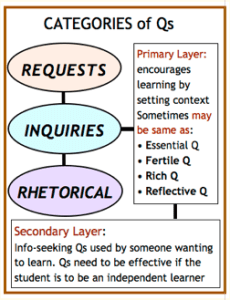
CHART ⬆️  based on material from http://www.edutopia.org

QUOTES: 36 Quotes from Successful People re. the Wisdom of Asking


TYPES of Questions
(Qs) – mainly from the “Q Tool Kit”
Each category gives us a wider framework & clarity for the process of finding out things.
Asking is essentially about being curious. It’s the only way of accessing knowledge directly from other people, so asking the right ones, in the right way, is crucial. When approached correctly, Qs can motivate & inspire people, generate new ideas & change the perception of a problem or situation.

ACoAs rightly say we don’t know what to ask, what word to use….. No matter what the circumstance – where it’s trying to find out something from a loved one, dealing with a work issue, questions a religious doctrine or trying to unravel what our politicians are saying – it’s helpful to know what we’re trying to accomplish.. It’s also important to know which kinds of Qs may potentially get us the answers we’re looking for – and which kinds won’t!

While the following list is primarily focused on research in academic settings, it offers a variety of approaches when we’re trying to find answers or solve a dilemma in our daily life. Many of these Q types are part of the skill of a good psychotherapist.

ESSENTIALpersonal needs
These are Qs at the center of info gathering. They’re at the heart of the search for truth, probing the deepest issues confronting us, those complex & baffling matters which elude simple answers (the meaning of Birth, Death, Love, Relationships…..).  All other Qs, when used appropriately, enhance & illuminate the learning process. (EXP: “What does it mean to be a good friend? // MORE….)

SUBSIDIARY
🔎 Qs which combine to help build answers to the Essential Qs – which naturally spawn families of smaller ones – leading to insight. The more skillful we are at formulating & then categorizing these Qs, the more successful we’ll be at building new knowledge.

All of the following categories are Subsidiary types

CLARIFICATION
🔎 Qs designed to make sense of confusing or complex info. They can define words & concepts, examine the logic & continuity of a topic, & determine if an underlying assumption is valid. (“What did you mean when you said you were tired of trying?” // More….)

CLOSED
🔎 Qs that only require YES or NO answers, which can be a conversation stopper – but not necessarily. (“Are you cold?”). They can be Qs that one has to choose from a list of possible options, to identify a piece of info, to help with a new dialogue, to encourage participation, or when fact-finding.
Since answers can be True or False, context is important. “Why” Qs are good for soliciting info, but can make people defensive, so they have to be worded carefully (“Do you want to eat right now?”, as opposed to “Why are you always hungry?”)

CONVERGENT
🔎 Qs ask for standard information, such as on multiple-choice tests for intelligence. They usually start with ‘What, Where, When’ & lead to expected results. Answers that are looked for don’t require a great deal of creativity. But they emphasize speed, accuracy & logic, focusing on recognizing the familiar, re-applying techniques & accumulating stored information (“What is the second largest country in the world: A– / B–/ C– or D–? // What’s in that container?”)diverge vs converge

DIVERGENT
🔎 Also called ‘lateral thinking’, these are Qs that are used in the process of creating multiple, unique ideas or solutions related to a problem one is trying to solve. They Qs use existing knowledge as a base from which to explore territory ‘next to’ to something already known or understood, & perhaps help to avoid other people’s mistakes (“What other options do we have for saving money this month?” // How might life in the year 2100 differ from today?”)

NEXT: Types of Qs – Part 1b