ACoAs & ASKING QUESTIONS (Part 3)

5 easy questions I’M LEARNING THAT
I have lots of options

PREVIOUS: ACoAs & Asking Qs (#2)

SITE: “The Value of Questions” monograph by Professor B.F. Plybon

• Importance of Asking Questions – Steve Jobs


HEALTHY:
ASKING Qs. FROM the ADULT

On the other hand, asking Qs from the Adult Ego State (ES) means we’re fully IN present reality, interacting with the person or situation in front of us, not to someone from our past.
The Adult ES knows:
• other people are not a carbon copy of us
• we have options we didn’t have as a child
• that not everyone is as emotionally or physically dangerous as our family
• that everyone has their own personality & experience – separate & usually difference from our own
• that other adults are not responsible for taking care of us, nor are they responsible for healing our wounds – ie. not replacement parents

PURPOSE of ASKING
differencesAppropriate, clear Qs is a legitimate, normal part of good communication skills. Children ask a lot of Qs, mainly about facts, to find out about the world around them. But they also don’t have to ask for emotional needs because healthy parents know & provide those. Ours didn’t, so we don’t know we can to ask for them now.

Legitimate, healthy Qs may be a way TO:
• connect with a person you’ve been thrown together with for a short time. It cuts down on loneliness, makes you part of the larger world, you can learn something new & interesting, & you may even get unexpected help.
EXP : Sitting next to a person on a bus, or standing in line :  “How has your day been so far? “/// “That’s a great bag, Did you get that on vacation?”
TO
• find out about the other person – who they really are, instead of what we’re projecting on to them from our past, or what we want them to be
• find out HOW someone thinks / feels about a current situation
• to find out what someone has already done, or what they already know about a need, a situation or experience
• get clarity if you don’t understand something
TO
• go deeper (How do feel about that”) — OR —
• keep things LIGHT!! (“How was your vacation?”)
• respond to what they’re saying, not what we are thinking or feeling
• use the Socratic method, to help someone draw on their inner knowledge, to think thru a problem by figuring out who they are or what’s right for them….

EFFECTIVE Questioning
Re. info – there is no such thing as a stupid question – except if you aren’t interested in the answer. However, not all Qs are created equal. Different situations call for different types. Along with learning how to use Qs, effective questioning is also the ability to listen to the answer, & suspend judgment. Letting go of our preconceived needs & opinions make it possible to get the most info possible in a situation.

This requires being intent on understanding what the other person is really saying when they talk about something. What’s behind their words?
No matter how smart or experiences we may be, much of the time we’ll never guess what a person will say if we just ask “What do you mean?”

The following sets of Qs can help improve communication & understanding of anyone we want to stay connected to, whether family, friends or in business. Modify the Qs according to the situation.
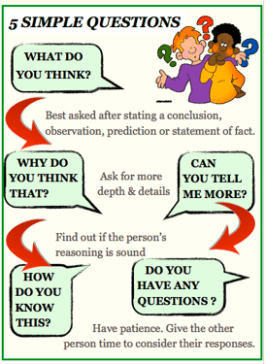
1. What do you think / feel?
This Q stops the questioner from talking too much.
2. Why do you think / feel that?
Once the person shares what they think or feel, this follow-up encourages them to provide the reasoning behind their thinking/ feeling. It’s ok if it’s not “deep”. It’s still info. I wonder
3. What leads you to believe this? (How do you know this?) This Q encourages the responder to make connections between their ideas / feelings & things they’ve experienced, read & seen.
4. Can you tell me more?
Most people always have more to say, but need encouragement to ‘spill’. This Q can extend their thinking & share added evidence for their ideas
NOTE : sometimes just being quiet allows them to say more.  However,  – this works best with Extroverts. With Introverts, we do have to ask – if we’re genuinely interested
5. Do you have any questions for me?
Use a friendly tone with ALL Qs, so the person doesn’t feel attacked or pressured to give the ‘right’ answer.  (Edutopia.org)

NEXT: ACoAs & Qs #4

ACoAs & ASKING QUESTIONS (Part 2)

defending selfPREVIOUS: ACoAs & Qs #1


AS ADULTS
(cont.)

NOTE: One of many effects of not having direct guidance, not being taught skills or appropriate socialization is a very deep belief that anything we figured out for ourself was at best wrong, at worst absolutely worthless.

An antidote to this is to have at least one person who is knowledgeable in our area of activity & who we respect – to review what we’ve accomplished or created on our own. They can validate its accuracy, skill level & value.mentoring

If that ‘mentor’ is fair & respectful, they can let us know the positive truth about our action or accomplishment. If the ‘verdict’ is less than stellar, we can look for ways to improve. If positive, the WIC part of us will be satisfied, & we can continue to flourish in whatever medium we’re best at.

BROAD categories of Questions (Qs)
a. Negative: to attack, to challenge, to embarrass, to stir things up
b. Positive: to connect, to encourage, get info, make you think, to teach

2 Inappropriate forms
From Narcissism 
• Questions that are controlling (“Why don’t you do it THIS way?”)
• Qs from the WIC, in the victim position, if you’re asking for info about things we DO know, as a way of feeling taken care of (How do I….?)

• Qs coming from the assumption that others are like us
— PP: “Why would you even consider that?” (that’s not the way Would….) OR
— WIC: “Don’t you think this color is the most?” (If I do, you must too)
symbiotic• Asking (insisting) others go with you or do something that only you like, or even that you know they dislike (so you won’t be alone)

• Qs that are rude &/or insensitive, because we don’t think about other people’s feelings – just impulsively ask whatever comes to mind without considering the consequences. This is a copy of our parents, who never acknowledged our emotions, so we act the same way
EXP: At a church dinner, teenage Jane notices that Sarah (in her 30s) is not wearing her engagement ring. Across the table, in a rather loud voice she asks about it (“Where your ring?”) but Sarah doesn’t answer, so Jane asks again – twice more before giving up. She doesn’t get the hint that her Q is not well received, although it’s obvious to everyone else.
Some others at the table know that Sarah’s engagement has been called off, so the Q is painful. Jane hasn’t gotten the 411 yet, but that’s not the point. Her Q is insensitive & intrusive – especially in such a public way – being in total immature mode, oblivious to another person’s reaction (silence) , especially after the initial rebuff.

With Anger
These are Qs with an attitude, which put people off. Ironically, it’s always because the Abandonment angry QWound got bumped. We feel disconnected, which scares the WIC, making him/her angry. If we lash out we create more distance, which is the opposite of what we want.

Anger Qs can come:
• in the form of accusing, blaming, shaming (“Who took my pen?”)
• as an attack on an authority figure (“Why don’t you do something about this problem?”)
• as challenging someone’s belief system (“How can you believe in that mythology – the Bible”?)
• showing someone up, insulting them  (“You didn’t know that?”)

UNHEALTHY: ASKING Qs from the WIC – in the present
• asking for what you need from the wrong person or venue, specially when you already know they’re not able or willing (like going to an unavailable parent for comfort // trying to get emotional support in a school or business setting…..)
• not using “I” statements, when trying to get info. EXP: “Why can’t you be more attentive?”, instead of: “I’d like you to pay attention when I’m talking. Would you be willing to do that?”
• talking from emotions : “I feel like I can’t trust her”, instead of : “ I know I can’t trust him”. The former implies you have a feeling about  her /him, but don’t trust your perceptions – even tho’ you do actually know that person is not trustworthy – from experience
• talking around an important subject, rather than asking a direct Q
• whining, begging, bugging, not taking ‘no’ for an answer

NEXT: ACoAs & Qs Part 3

ACoAs & ASKING QUESTIONS (Part 1)

asking QsIT NEVER DAWNS ON ME
to ask about the other person

PREVIOUS: Reverse Laundry List & Healthy version

PROBLEM
Another indicator of ACoA damage is the fear of asking questions or worse – not even realizing it’s necessary, appropriate, even imperative.
At the core of this issue is the unconscious but ingrained perspective that we should not hold other people responsible for their words & actions. As emotionally immature adults, we are still going on the assumption that everything is our fault (narcissistic S-H), & therefore it’s all up to us to correct misunderstandings & fix whatever is causing us pain (narcissistic grandiosity).

In CHILDHOOD
Most ACoAs stopped asking Qs because of the messages & reactions we got from our dysfunctional family, as well as from outside sources such as school & religious institutions. “Children should be seen & not heard”. They :
• didn’t want their authority questioned
• didn’t want their bad behavior pointed out or abuse objected to
• didn’t want their hypocrisy & neglect uncovered
not allowed to ask• didn’t know the answer…
AND they —
• couldn’t be bothered to listen or explain things
• didn’t have the patience to show us what they did know how to do
• made it sound like we’re dumb for not knowing things they knew
• told us we were disrespectful for questioning their authority
• punished us with a smack or with guilt – for wanting to know what’s going on around us
• made fun of us for exploring & being curious ……

NOTE: Curious & clever children may seem to be ‘challenging’ the adults “WHY … WHY…” But if we got a bad reaction from them (“you’re arrogant, you’re being difficult, you’re disrespectful”) it was almost always because the person did NOT know the information & was ashamed to admit it

No matter what Toxic family Role were fell in to as kids (Hero, Scapegoat, Lost Child, Mascot), ultimately we were on our own, because our wounded parents we unable to connect with us in healthy loving ways. We got the message that we were a burden to them – or worse – hated (“You’ll be the death of me yet!”). We understood that if we were to figure things out it would have to be from other sources, like school & our peers, but mainly by just watching other people & events. Quietly, secretly observing the world around us helped, but it didn’t encourage asking questions.

being muteAs ADULTS
Our early trauma, distorted mirroring & lack of good role models has left holes in our ability to think of what to say. This is because of missing information, rather than stupidity. It literally means not having the vocabulary for legitimate questioning – what words to use, what point of view we need to come from, or what to expect if we do ask.
BUT this can be learned from books such as “The Gentle Art of Verbal Self-Defense”, & from others who already know how.

Many of us believe that any form of Qs is impertinent, boundary invasive, & just plain rude – which is not true when Qs come from our Adult ES. (ego state).
And when someone says or does something unkind, inappropriate, narcissistic or flat-out mean – we justify, over-explain, excuse ourself        (Sorry, Sorry), instead of lobbing the ball back at the other person by saying something like:“What did you mean? // Why did you say it that way? // Is that what you would do / want?… (See “Useful & Clever Responses”).

ACoAs were not allowed to defend, protect or stand up for ourself, didn’t have the right to object to abuse, & never to know what our true needs are. So we continue to live in a quasi-world of not really belonging, not having rights, not being heard, not having access to our personal power, & most of all – never truly feeling safe.
Others of us will bite back when we feel neglected, dismissed or accused, a version of the PP &/or WIC trying to protect ourself, but this is simply ineffective & can serve to escalate a bad situation.

NEXT: ACoAs & Asking Qs – Part 2

REVERSE Laundry List & Healthy Version

drunk narcissists I HATE KNOWING
how much I’ve copied them!

PREVIOUS:

 Original LL

SITE: ACoAs – Qualities & Traits

REVIEW: “Variation of ACoA Laundry List” post

NOTE: Reprinted from the ACoA World Service Org.

REVERSE Laundry List – acting out the Introject (the PP)
1. To cover our fear of people and our dread of isolation we tragically become the very authority figures who frighten others and cause them to withdraw
2. To avoid becoming enmeshed and entangled with other people and losing ourselves in the process, we become rigidly self-sufficient. We disdain the approval of others
3. We frighten people with our anger and threat of belittling criticism
4. We dominate others and abandon them before they can abandon us or we avoid relationships with dependent people altogether. To avoid being hurt, we isolate and dissociate and thereby abandon ourselves

5. We live life from the standpoint of a victimizer, and are attracted to people we can bad attitudemanipulate and control in our important relationships
6. We are irresponsible and self-centered. Our inflated sense of self-worth and self-importance prevents us from seeing our deficiencies and shortcomings
7. We make others feel guilty when they attempt to assert themselves
8. We inhibit our fear by staying deadened and numb
9. We hate people who “play” the victim and beg to be rescued
10. We deny that we’ve been hurt and are suppressing our emotions by the dramatic expression of “pseudo” feelings

11. To protect ourselves from self punishment for failing to “save” the family we project our self-hate onto others and punish them instead
12. We “manage” the massive amount of deprivation we feel, coming from abandonment within the home, by quickly letting go of relationships that threaten our “independence” (never get too close)
13. We refuse to admit we’ve been affected by family dysfunction or that there was dysfunction in the home or that we have internalized any of the family’s destructive attitudes and behaviors
14. We act as if we are nothing like the dependent people who raised us.

OPPOSITE of Reverse Laundry List
1. We face and resolve our fear of people and our dread of isolation and stop intimidating others with our power and position
2. We realize the sanctuary we have built to protect the frightened and injured child within has become a prison, and we become willing to risk moving out of isolation
3. With our renewed sense of self-worth and self-esteem we realize it is no longer necessary to protect ourselves by intimidating others with contempt, ridicule and anger
4. We accept and comfort the isolated and hurt inner child we have abandoned and disavowed, and thereby end the need to act out our fears of enmeshment and abandonment with other people

5. Because we are whole and complete we no longer try to control others through manipulation and force, and bind them to us with fear in order to avoid feeling isolated and alone
healing heart6. Through our in-depth inventory we discover our true identity as capable, worthwhile people. By asking to have our shortcomings removed we are freed from the burden of inferiority and grandiosity

9. We have compassion for anyone who is trapped in the “drama triangle” and is desperately searching for a way out of insanity.
10. We accept we were traumatized in childhood and lost the ability to feel. Using the 12 Steps as a program of recovery we regain the ability to feel and remember and become whole human beings who are happy, joyous and free.
11. In accepting we were powerless as children to “save” our family we are able to release our self-hate and to stop punishing ourselves and others for not being enough.
12. By accepting and reuniting with the inner child we are no longer threatened by intimacy, by the fear of being engulfed or made invisible.
13. By acknowledging the reality of family dysfunction we no longer have to act as if nothing were wrong or keep denying that we are still unconsciously reacting to childhood harm and injury.
14. We stop denying and do something about our post-traumatic dependency on substances, people, places and things to distort and avoid reality.

NEXT: Asking Questions (#1)

ORIGINAL Laundry List + Healthy Version

bad family IT’S GOOD TO HAVE CLARITY
about the source of our damage

PREVIOUS:
 Multiple Learning Styles, #6

SITE:  Psychological Characteristics of ACoAs – article

NOTE
: Part 1 & 2 Reprinted from the ACoA World Service Org.
— The Laundry List serves as the basis for ‘The Problem’ statement – the intro read at every ACA meeting

BASIC LAUNDRY LIST – acting out the Wounded Child
1. We became isolated and afraid of people and authority figures
2. We became approval seekers and lost our identity in the process
3. We are frightened by angry people and any personal criticism
4. We either become alcoholics, marry them or both, or find another compulsive personality such as a workaholic to fulfill our sick abandonment needs
5. We live life from the viewpoint of victims and we are attracted by that weakness in our love and friendship relationships

6. We have an overdeveloped sense of responsibility and it is easier for us to be concerned with others rather than ourselves. This enables us not to look too closely at our own faults,….broken heart
7. We get guilt feelings when we stand up for ourselves instead of giving in to others
8. We became addicted to excitement
9. We confuse love and pity and tend to “love” people we can “pity” and “rescue”
10. We have “stuffed” our feelings from our traumatic childhoods and have lost the ability to feel or express our feelings because it hurts so much (Denial)

11. We judge ourselves harshly and have a very low sense of self-esteem
12. We are dependent personalities who are terrified of abandonment and will do anything to hold on to a relationship in order not to experience painful abandonment feelings, which we received from living with sick people who were never there emotionally for us
13. Alcoholism is a family disease. We became para-alcoholics and took on the characteristics of that disease even though we did not pick up the drink.
14. Para-alcoholics are reactors rather than actors.
Tony A., 1978

OPPOSITE of the LAUNDRY LIST – healthy version
1. We move out of isolation and are not unrealistically afraid of other people, even authority figures
2. We do not depend on others to tell us who we are
3. We are not automatically frightened by angry people and no longer regard personal criticism as a threat
4. We do not have a compulsive need to recreate abandonment
5. We stop living life from the standpoint of victims and are not attracted by this trait in our important relationships

6. We do not use enabling as a way to avoid looking at our own shortcomings
7. We do not feel guilty when we stand up for ourselvesrepaied heart
8. We avoid emotional intoxication and choose workable relationships instead of constant upset
9. We are able to distinguish love from pity, and do not think “rescuing” people we “pity” is an act of love
10. We come out of denial about our traumatic childhoods and regain the ability to feel and express our emotions
11. We stop judging and condemning ourselves and discover a sense of self-worth
12. We grow in independence and are no longer terrified of abandonment. We have interdependent relationships with healthy people, not dependent relationships with people who are emotionally unavailable
13. The characteristics of alcoholism and para-alcoholism we have internalized are identified, acknowledged, and removed
14.We are actors, not reactors.

NEXT: REVERSE L.L. (Part 2)

OUR SENSES & Learning – Combos (#6)

PREVIOUS: Other Learning Styles, #5


SITEs: Learning Styles Affects How You Play GOLF

• 3 Reasons to Use Multi-sensory Teaching Techniques

• ‘LEARNING STYLES’ myth // MODALITIES – & theory  // Links to OTHER QUESTIONNAIRES

MULTI-SENSORY Learning
Multi-modal absorption is the ability of the nervous system to combine the input from all our senses, making it easier to detect & identify available information. This happens when multi-modal neurons receive stimuli that overlap the various modalities, & kicks in when no one particular sense responds to an event.

Most people – about 60% – use a combinations of the 3 main types (sight, hearing, body movement). While some may have a strong preference, it’s normal for all the other senses to be used as well. Because it involves more Brain areas, multi-sensing allows more mental connections & associations when learning any new concept. This makes it more efficient & effective, providing redundancy & strengthens reinforcement.

Combining all the senses becomes a powerful tool for encouraging Language Arts learning, in important ways. Key Benefits:
Much more knowledge is transferred, with the possibility of more being absorbed. Student engagement is more likely, which can improve attitudes towards learning, & therefore higher student achievement. (MORE….Research study).

Multi-sensory learning is particularly helpful for kids with learning & attention issues, such as having trouble with visual or auditory processing. They can tap into learning strengths which form memories, & lets them use a wider range of ways to show what they’ve learned& absorbed.
It helps students:
• collect information & make connections between new info & what they already know
• understand & work through problems, using nonverbal problem-solving skills., giving every kid a chance to succeed

Audio-Visual-Kinesthetic: A-V-K students – definitely need a combination of stimuli – handling material, along with seeing & hearing words & numbers.  They grasp & retain info best by doing & experiencing, touching & handling whatever they’re learning – being totally personally involved. Best study tools  Flashcards, highlighters, mind maps, and watching videos.

TECH Learners (visual-haptic-kinesthetic)
technical type• are mechanically oriented
• can read technical manuals without intensive training
• communicate with others via text, e-mail & Internet
• enjoy & use the video camera
• know how to work with and use hardware and software
• like integrated learning activities
• spend excessive time on computer and/or video games
• want to learn everything via the computer
• understand how to integrate various technologies
• understand technology tools without formal instruction

LEARNING STYLES info & Qs
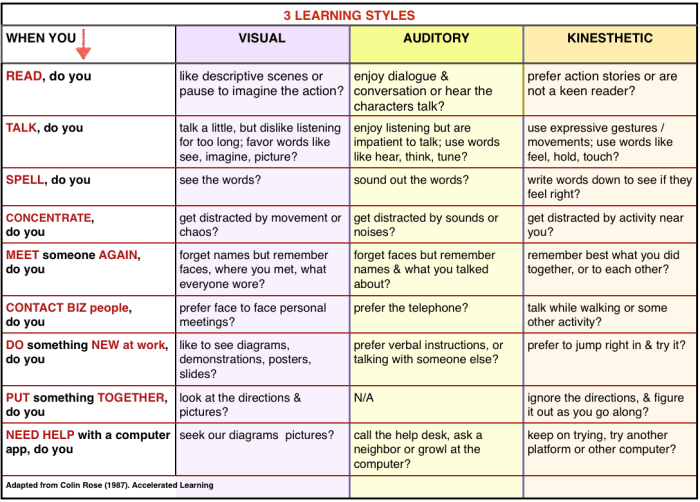
CHART: See which column fits you the best. OR – some of each?

Qs re Learning Tpes

«
INTERESTING:

In terms of MBTI – there’s a wide gap between Sensate & Intuitive Learners.

INTUITIVE (iN) vs. SENSORY (S) Learning
♦︎ Intuitives – 30% of the population, important as TRAIL BLAZERS
INFO: They prefer speed & depth of insight. They learn to trust pattern recognition to help them understand info quickly & see things that aren’t ‘there’. Can extrapolate from large amounts of facts & experiences with only a few data points

TIME: iNs are already comfortable seeing what ‘isn’t there’, theorizing or speculating on what could be in both the here-and-now & in the future. The past is only useful as a reference for future predictions
VALUES: They’re focused more on possibilities, memes, paradigms, perspectives & concepts. Conversation generally revolves around these things, with little interest in small talk.

♦︎ Sensates – 70%, important for “HOLDING DOWN the FORT”
INFO: Sensates need info to be reliable – using the 5 senses to learn things. They have the same intuitive ability as iNs, but don’t trust it, so they ignore it. Instead, they look for anything that can be verified in the Real World, becoming masters of historical facts & fantastic at manipulating objects in real time. If it’s right in front of you, it’s reliable. Speculation is not.

TIME: Sensors can’t count on something that hasn’t happened yet, so the future is not interesting
VALUES: are about things like family, tradition, actions, old friends..… trustworthy because they’re all rooted in the known & knowable.
(MORE…..in POST: S vs N)

NEXT: Laundry list

OUR SENSES & Learning – Taste (#4a)

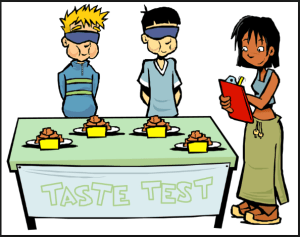
taste testPREVIOUS: SMELL (Part 3b)

SITE: Acetylcholine & Olfactory Perceptual Learning

GUSTATORY Learning (Taste)
In some ways understanding taste is more complex than the other senses because even though taste, smell & sight are separate areas of the brain, they overlap significantly in how we experience things in our environment.
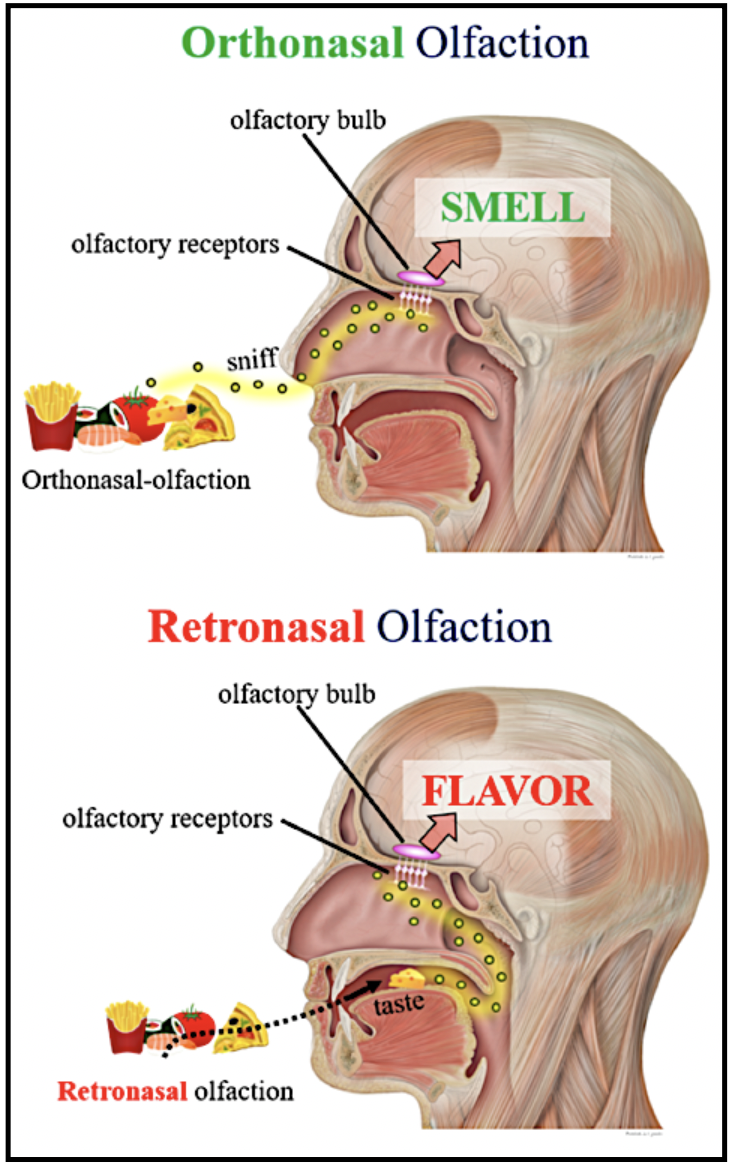
All our senses work together, but smell & taste are special partners. When we eat, our tongue gives us the taste & our nose the smell of food. Approximately 80–90% of what we perceive as ‘taste’ is in fact due to our sense of smell, so when the nose is congested, food tends to lose its taste.

Taste & smell are essential for survival, helping to identifying what’s edible & what’s toxic material. Together, these two neural-peripheral systems lets us identify flavors. They’re being used in the development of food, beverages & pharmaceuticals, to enhance or mask their tastes & smells.

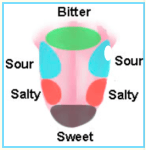
tongue tastes• The ancient Greeks believed that the 2 most basic tastes were sweet & bitter, but Aristotle (c. 350 BC) was one of the first to develop a list of others.
• Ayurveda, an ancient Indian healing science, has its own tradition of basic tastes: sweet, salty, sour, pungent, bitter & astringent
• The Ancient Chinese regarded spiciness as a basic taste
• Now we know the mouth can distinguish sweet, salty, sour, bitter & umami (flavor of certain glutamates, described as savory, meaty or as broth), long known in Asian cooking, & which only recently has been found to have its own taste receptors.

Taste is often experienced as a mixture of both temperature & texture. Its produced when something put into the mouth reacts chemically with receptor cells on taste buds that are mainly on the tongue, but also in the roof of the mouth & near the pharynx. (BUDS)
The number of taste buds can vary greatly from person to person. Average is about 10,000, each one having about 1,000 taste cells, acting as receptors. In general, women have more than men, & as is the case of color blindness, some people are insensitive to some tastes.
smell process

People develop taste preferences based on what they’re fed in early life. Giving children a chance to think about which tastes they do or don’t like encourages them to try new types and/or new combinations of foods.

While our senses of taste & smell may seem less involved in learning, they are our oldest ones, built into the oldest structures of the brain, so are often more deeply ingrained & intact than the other, ‘newer’ senses.

Although most researchers assume that no one is a Gustatory Learner, those who do favor ‘taste’ as a way to express themself tend to use words such as bitter, chocolate, minty, sour, spicy…. (“Variety is the spice of life”)
Article : “I Taste Words.. Bob is like a milk chocolate Easter egg…..”

However, some do acknowledge the importance of this sense. The Forest School in a woodland setting (UK) have incorporate Gustatory & Olfactory education. They believe smells & tastes provide valuable links to learning & remembered experiences. (as in the “Proust Effect”)
Students of all ages & learning levels benefit from activities that require them to use these senses, such as having a drink & snack while key information or explanations are made on forest trips, & cooking on campfires which lend their own special flavor to the food. food choices

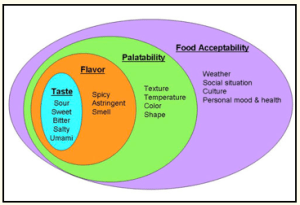
DIAGRAM: People use a wide variety of  factors to decide if something is acceptable to eat. These include types of flavor, like how spicy a food is, how it smells, its texture, temperature & whether it’s something they want to eat for personal, cultural or religious reasons.

The Monell Chemical Senses Center (PA) is the world’s only independent, non-profit scientific institute dedicated to basic research & publications on taste & smell. Their scientists come from many disciplines, working to understand the mechanisms & functions of taste & smell, to define the wider importance of these senses in human health & disease. They also conduct studies on chemesthesis – chemically induced skin sensations, such as the burn of capsaicin (in hot peppers) or the tingle of carbonation. Their experts are available to comment on how taste and olfaction relate to any aspect of our daily lives.

NEXT: Overview (#4b)

OUR SENSES & Learning – Smell (#3b)

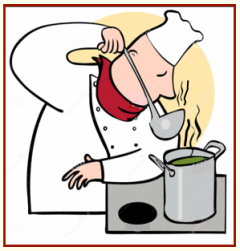
chef smelling soup

PREVIOUS: Olfactory Learners (#3a)

SITEs: The World Though our Senses

• Learning Styles Affects How You Play GOLF


OLFACTORY Learning

According to Dr. Ira Greene, in “The Nose Knows : A Nasal-Based Curriculum Development Guide”, there are 3 distinct types of nasal learners:, which need to be treated differently : Goal-oriented, Activity-oriented & Learning-oriented.
“…while activity & goal oriented learners may be sufficiently motivated by the prospect of an olfactory reward at the end of a task, the learning-oriented students needs something more to sustain their interest.”

Research shows that smell has a unique relationship to words & images. Scents are normally experienced as purely visceral, subjective experiences, hard to put into words, yet writers often describe them. smell & images

Since 2000, Scholastic Scents in Cambridge, MA. has been working to fill the void in materials geared towards nasal learners, by providing scratch-and-sniff textbooks & variety of educational packets such as the Oregon Trail fragrance set, & “Speak and Smell” language workshops.  (Scented Children’s books)

In “What does purple smell like?” (Child-Ed) L. Stanley describes one of the few studies to examine smell as part of a multi-sensory approach to helping children learn – by investigating & discovering the world around them.happy grapes
EXP: In one – teachers of 2-year-olds matched colors to familiar objects, like purple with the smell & taste of grapes, & then played the blindfold game “Smell the Color.” The children enthusiastically & successfully learned those colors presented, & paid closer attention to other colors in their environment.

In “They Snooze, You Lose : The Educator’s Guide to Successful Presentations “,L. Burmark,  recommends going beyond auditory or visual forms to more engaging lessons to keep students interested. Studies show that multi-media events increase effectiveness in learning by 300%.

Burmark is particularly interested in incorporating smell. A powerful tool for gathering info, it’s strongly related to memory & emotion, with 75% of emotional responses being based on smell. This connection makes it possible to use scents for memory improvement

The bi-annual Summer School on HUMAN OLFACTION is held in Dresden, Germany.  Its aim is to provide participants with up-to-date info on various aspects of human chemical senses, through lectures, experiments carried out by participants & practical demonstrations.
In 2025 – some included ——> acoustic rhino-metry, blood flow, endoscopy of the nasal cavity, rhinomano-metry,  recordings of electro-olfacto-grams & event-related potentials, and clinical aspects of olfactory dysfunction (diagnosis, treatment).

CAR CARE COUNCIL,  Bethesda, Md., May 18, 2020 : “Unusual smells can be a sign of serious, & potentially costly trouble for your vehicle”
6 Vehicle Warning SMELLS 
1. Burning Carpet – cam be a sign of brake trouble, a serious safety hazard, noticeable even under normal driving conditions
2. Burnt rubber – could mean slipping drive belts, or a misplaced loose hose rubbing against rotating accessory drive pulleys.

3. Gasoline – likely a gas leak, possibly from a fuel injector line, or the fuel tank. Check right away, as any gas leakage is a potential fire hazard
4. Hot oil – could mean oil is leaking on to the exhaust system.  Look for oil on the pavement, or smoke from the engine area

5. Rotten eggs – could mean the catalytic converter is not properly converting hydrogen sulfide into sulfur dioxide in the exhaust. Can cause converter to overload & break down
6. Syrup – could be that the car is leaking engine coolant from some component of the cooling system. 

ANOSMIA – is the clinical term for the inability to smell – is a little-known & invisible but serious problem. Olfaction is a vulnerable sense, & smell disorders or total loss are more common than realized.
Few people appreciate the range of info provided by the sense of smell. We do notice it’s loss when we have a cold or allergies, but rarely consider what would happen if it disappeared altogether.  (“A Sense of Hope” – Monell Center. PA)  (SMELLS: Consumer preferences)

The “PROUST EFFECT” – from Marcel Proust’s influential multi-volume novel “In Search of Lost Time” – illustrates literature’s role in shaping our understanding of how smell works. The ‘effect is when sensory cues (taste & smell) trigger sudden, vivid &  highly emotional involuntary memories from the past.

NEXT: SENSES  & Learning (Part 4a)

OUR SENSES & Learning – Smell (#3a)

 olfactory circuitPREVIOUS:
Kinesthetic Learners (#2c)

SITEs: Learning styles & Memory (scroll down)

• Memory For Different Smells: Synaptic Memory Found In Olfactory Bulb


OLFACTORY Learning
(Smell)

Our sense of smell is 10,000 times more sensitive than our sense of taste. In childhood all of us gradually learn which smells are comforting, exciting, scary, yummy… Smell warns us of dangers, like smoke & poisonous gases, as well as helping to appreciate the full flavor of food & drink.
Some smells – from food, air fresheners, perfume & even some essential oils – can interfere with concentration, distracting to the point of inhibiting our brain’s ability to learn something (studying, practicing….).

Olfactory memory plays an important role in many kinds of human behavior, including mother–infant interactions, food-finding & preferences, emotional states, sexual attraction, & mate choice. Subconsciously we associate smells with things that are important to us, such as family members, & happy or dangerous events & places. (MORE….)

Studies tell us that the average person can detect at least one trillion different smells, a far cry from the previous estimate of 10,000. We now know the nose can out-perform eyes & ears which discriminate between several million colors & about half a million tones.
“It’s time to give our sense of smell the recognition it deserves,” said Leslie Vosshall, at Rockefeller U (Her NYC talk on Smell vs vision & hearing)

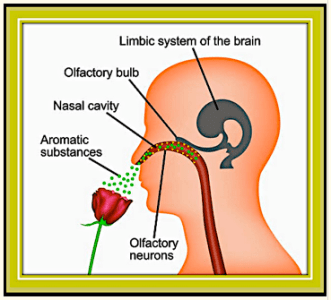
Neuro-anatomy validates that our olfactory system is especially set up to ‘understand’ smells. Odor molecules picked up by the nose travel from sensory neurons to the olfactory bulb at the base of the forebrain.  They relay the signal to other brain areas for additional processing, but doesn’t shunt its data to the brain via spinal cord or cranial nerves.

Smells transmit impulses to areas directly connected to the limbic system, the part that deals with emotions. The orbito-frontal cortex processes olfaction & the amygdala is the brain area critical for assigning emotional value to stimuli.

Experiences that connect odors with emotions (learned responses) explain how odors come to be liked or disliked, as well as how their later presence can call up emotion, influencing thinking & behavior.
EXP: A ‘lucky’ survivor of a devastating apartment fire reacts with some anxiety whenever she smells wood burning from fireplaces in the buildings near hers, or a match being lit, even after 20 years.

Olfactory stimulation can change our brain waves & mood in powerful ways. Studies examine chemical reactions – to various substances – of the nerve endings in the nose, identifying how that data is conveyed to the cortex & then coded
So there’s good scientific evidence for the validity of aromatherapy.
 (“Women nose ahead in smell tests”). (“Smell & the Brain”) // (Essential Oils = scroll to 11/2014)

perdume creatorWhile these facts apply to everyone, smells have a very special meaning for Olfactory Learners. They grasp info best when incorporating both smell & taste, easily distinguishing substances from one another, often connecting a particular smell with a specific past memory

Such learners can be found in Chemistry, Botany, Biology & other scientific/ technical fields (perfume & wine makers, chefs, sommeliers ……)  PICTURE: Jaques Polge, French perfumer, head of Parfums Chanel

Since these people represent a small percentage of the population, there is relatively little info about the importance of Olfactory Learning, even though this sense is a valuable part of absorbing info, & is especially needed by children with visual impairment or other disabilities.

As smell & taste learning are not usually thought of as scholastically important, most educators have been slow to recognize such students, so their needs are not addressed.
In standard learning settings Olfactory Learners have trouble concentrating, dislike doing homework, often having low grades in math, reading, & science. They are not stupid or ‘slow’ – they just need a different style of education.  (Olfactory perception in children) (SMELL: Learning & Emotion)

Reyna Panos (Brown U.) writes: “In the early years of educational psychology, children were believed to fall into one of two camps – visual or auditory. Eventually, kinesthetic & tactile learning styles were recognized as well, but to this day nasal learning continues to go unacknowledged.” Panos’s studies suggest that 10-20% of all students fall into this category, children indicating nasal needs as early as 1st grade.

SITE: “Effects of diversity in olfactory environment on children’s sense of smell”

NEXT: Smell (Part 3b)

OUR SENSES & LEARNING – Touch (#2c)

kinestheric learningPREVIOUS: Auditory (#2b)

SITEs: “Learning Style Preferences & ESL Students“ (Study)

• 6 important things you should know about how your brain learns


KINESTHETIC  (somatic / physical actions) Learning

About 35% of children &  5 – 15% of Adults learn most easily while moving (kinesthetic) or handling (tactile) things, which helps them understand the world around them.
Physical movement: The Cerebellum & motor cortex, at the back of the frontal lobe, are mainly in charge of much of the body’s activity
Kinesthetic touch : lets us experience bodily sensations, feelings & emotions, which come from immediate experience, memories or imagined situations

“Children enter kindergarten as kinesthetic/ tactile learners, moving & touching everything as they go. By 2nd or 3rd grade, some have become visual learners. During the late elementary years, some – mainly girls – become auditory learners, while many males keep their kinesthetic/ tactile strengths throughout their lives.” Rita Stafford and Kenneth J. Dunn; Allyn and Bacon, 1993)

antsy in schoolWhen young, ‘touch’ learners are life’s little wiggle worms, often mis-diagnosed with ADD or ADHD.
They’re smart & eager to learn, but first need their attention captured. Then their energy can be directed by drawing on their natural curiosity & offered hand-on activities.
They do best when they have something in front of them they can physically handle, & even better if they made it themself.

This is how they come to understand how to use their bodies & how to communicate with others, most of which is through feet & hands. So activities that focus on those body parts help them learn how to write, share their toys, button shirts, tie shoes, hold a fork…

Kinesthetic learners express themself through movement, with the distinct ability to control the body’s actions & handle objects skillfully. Through interacting with the space around them, they ‘re able to remember & process information, which allows for a good sense of balance & eye-hand co-ordination.

learn by doingDOING something active lets them learn, which helps them stay focused & retain information. This can include noticing (an action), but use their own language to express what they’re hearing.

They need external stimulation, or they may lose interest, preferring to think broadly before going in-depth. It doesn’t mean they act before thinking or are reckless, but that they understand things better by getting immersed in a situation or lesson, in order to evaluate facts for themself.

Learning a physical skill by first visualizing the activity (dance, a sport, driving…. ) makes it much more successful.
EXP:
Focus on the sensations you would expect for each activity or experience. So, for a tack (turn) on a sailboat, feel the pressure against your hand as you turn the rudder & the tension lessening on the ropes. Feel the wind change to the other side, feel the thud as the sail swaps with the wind, feel the boat speed up as you start the new leg….

Phrases used by Kinesthetics :
” I can’t get a grip on this // Stay in touch // That doesn’t sit right with me // I have a good feeling about this // My gut is telling me // I get your drift….”

Re. INTUITION (Clear sensing)
 This is actually getting vibes in the body such as Tingles, goosebumps, electricity, lump in throat, tickle in ear….

Gut Instinct
(Clear knowing)
Harder to describe – more of a crystal clear ‘I just know!”, like a ring or ping, but coming from the belly rather than the mind. Not so thick or dense as many deliberate thoughts.

abuse muscle painNOTE: All experiences of physical, sexual, verbal & emotional abuse are stored in the body (muscles, organs, energy centers….), and need to be released in movement, talking & crying.
Such history can be from childhood battering &/or incest, domestic abuse, war-time trauma, severe physical-illness-treatments or accidents…..

The physical expression of stored pain (getting it out) is necessary for all learning types, but especially for Kinesthetics – using experiential modalities, such as
Core Energetics, Psychodrama,
Trauma release exercises……
ASLO: Some books & LINKS to many therapies

KINESTHETIC Characteristics – pick the ones you identify with

kinestetic char
«
NEXT:
SMELL (2d)