
 PREVIOUS: Other Learning Styles, #5
SITEs: Learning Styles Affects How You Play GOLF
• 3 Reasons to Use Multi-sensory Teaching Techniques
• ‘LEARNING STYLES’ myth // MODALITIES – & theory // Links to OTHER QUESTIONNAIRES
MULTI-SENSORY Learning
Multi-modal absorption is the ability of the nervous system to combine the input from all our senses, making it easier to detect & identify available information. This happens when multi-modal neurons receive stimuli that overlap the various modalities, & kicks in when no one particular sense responds to an event.
Most people – about 60% – use a combinations of the 3 main types (sight, hearing, body movement). While some may have a strong preference, it’s normal for all the other senses to be used as well. Because it involves more Brain areas, multi-sensing allows more mental connections & associations when learning any new concept. This makes it more efficient & effective, providing redundancy & strengthens reinforcement.
Combining all the senses becomes a powerful tool for encouraging Language Arts learning, in important ways. Key Benefits:
Much more knowledge is transferred, with the possibility of more being absorbed. Student engagement is more likely, which can improve attitudes towards learning, & therefore higher student achievement. (MORE….Research study).
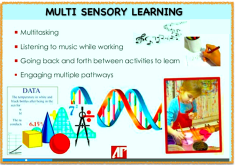 Multi-sensory learning is particularly helpful for kids with learning & attention issues, such as having trouble with visual or auditory processing. They can tap into learning strengths which form memories, & lets them use a wider range of ways to show what they’ve learned& absorbed.
It helps students:
• collect information & make connections between new info & what they already know
• understand & work through problems, using nonverbal problem-solving skills., giving every kid a chance to succeed
Audio-Visual-Kinesthetic: A-V-K students – definitely need a combination of stimuli – handling material, along with seeing & hearing words & numbers. They grasp & retain info best by doing & experiencing, touching & handling whatever they’re learning – being totally personally involved. Best study tools Flashcards, highlighters, mind maps, and watching videos.
TECH Learners (visual-haptic-kinesthetic)
 • are mechanically oriented
• can read technical manuals without intensive training
• communicate with others via text, e-mail & Internet
• enjoy & use the video camera
• know how to work with and use hardware and software
• like integrated learning activities
• spend excessive time on computer and/or video games
• want to learn everything via the computer
• understand how to integrate various technologies
• understand technology tools without formal instruction
LEARNING STYLES info & Qs
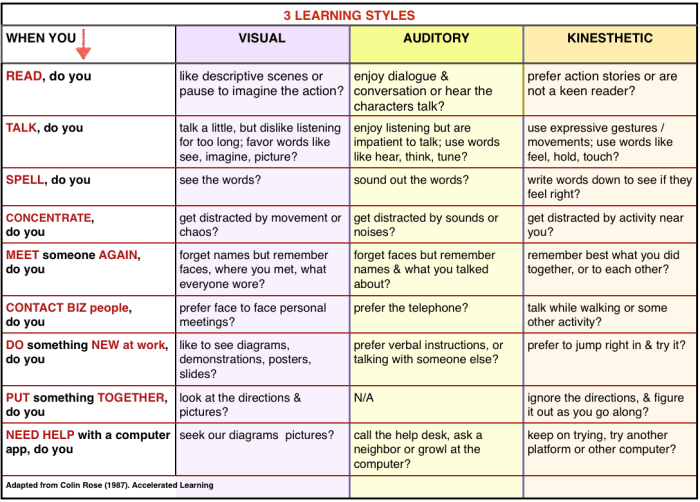
CHART: See which column fits you the best. OR – some of each?
«
INTERESTING:
In terms of MBTI – there’s a wide gap between Sensate & Intuitive Learners.
INTUITIVE (iN) vs. SENSORY (S) Learning
♦︎ Intuitives – 30% of the population, important as TRAIL BLAZERS
INFO: They prefer speed & depth of insight. They learn to trust pattern recognition to help them understand info quickly & see things that aren’t ‘there’. Can extrapolate from large amounts of facts & experiences with only a few data points
TIME: iNs are already comfortable seeing what ‘isn’t there’, theorizing or speculating on what could be in both the here-and-now & in the future. The past is only useful as a reference for future predictions
VALUES: They’re focused more on possibilities, memes, paradigms, perspectives & concepts. Conversation generally revolves around these things, with little interest in small talk.
♦︎ Sensates – 70%, important for “HOLDING DOWN the FORT”
INFO: Sensates need info to be reliable – using the 5 senses to learn things. They have the same intuitive ability as iNs, but don’t trust it, so they ignore it. Instead, they look for anything that can be verified in the Real World, becoming masters of historical facts & fantastic at manipulating objects in real time. If it’s right in front of you, it’s reliable. Speculation is not.
TIME: Sensors can’t count on something that hasn’t happened yet, so the future is not interesting
VALUES: are about things like family, tradition, actions, old friends..… trustworthy because they’re all rooted in the known & knowable.
(MORE…..in POST: S vs N)
NEXT: Laundry list

