
 PREVIOUS : GRIEF –
SITE :
1. NEGATIVES
♦︎ “I see you’ve moved on to the _____ grief stage”
The reality of grieving is that we will go thru the many stages higglety-pigglety, never in a straight line.
The common distortion is that you’re supposed to be on the right track to closure.
So – if the bereaved person doesn’t react at all, or slips back & forth between the stages, even overlapping them – they’re not on that imagine path to the ‘correct’ way of healing. They’re considered to be doing grief wrong, & somehow resistant, weak or stubborn.
If you treat them that way – you cruelly add stress to the already overwhelming pain of their loss.
♦︎ “I haven’t seen you cry, so I didn’t think you were that upset”
How dumb – like you can read the griever’s heart! Unfortunately – in our culture many people judge how well others are doing only by outward appearances (EXP: If you’re successful & happy – you must have grown up in a healthy loving family! BUT Recovering people know there’s no correlation)
This ‘rule’ then gets applied to anyone experiencing a loss – if they’re acting fine, they must be fine. It’s another way for observers to reinforce the message to not feel emotions, & definitely not to show the ‘unpleasant’ ones.
♦︎ “If you ignore it, it will get better”
No it will not! Anyone who has ignored physical signals for a long time that something’s not right – is later shocked to find themself with a long-term debilitating immune-deficiency or terminal illness. Suppressing grief emotions also have severe physical effects.
♦︎ “Time is a great healer”
While there is truth in this, saying it to someone who’s feeling miserable is insensitive & unhelpful. Grieving is a process and yes, it does take time. But how long is individual to the person, & will be affected by who has died, & how they died.
♦︎ “You’ll get over it”
There are some losses one will never be able to get over – like the murder of your child….. & other events that will take many years to recover from – like your home burning down around you, where you lose everything, especially devastating is losing the things that can never be replaced….. At best you’ll have to “learn to live with it”.
♦︎ “You must be strong”
This advice is meant to sound encouraging (like a pep talk) but again – it actually means you should NOT have any of those ‘weak’ things called emotions (about this horrendous loss).
You wouldn’t want to embarrass yourself – in public – would you? Besides, if you fall apart – I’ll have to take care of you, which I can’t/ don’t want to. So be strong!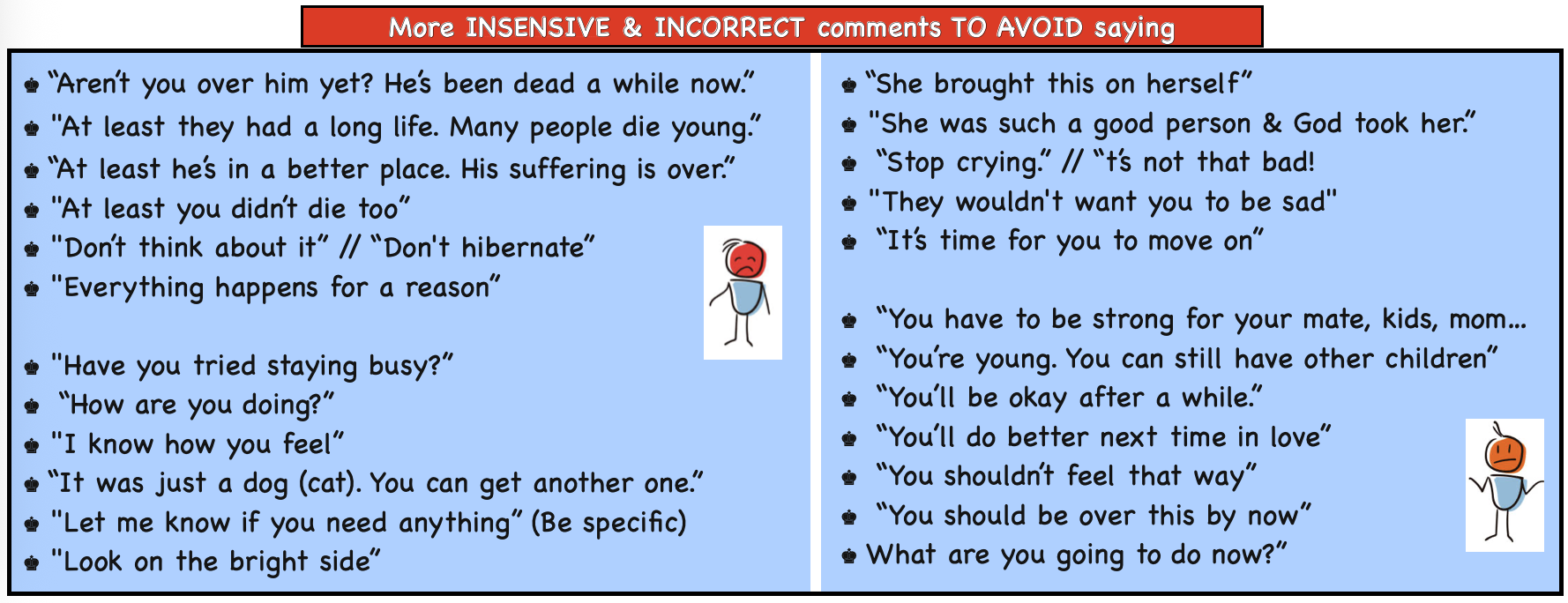
«
2. POSITIVES
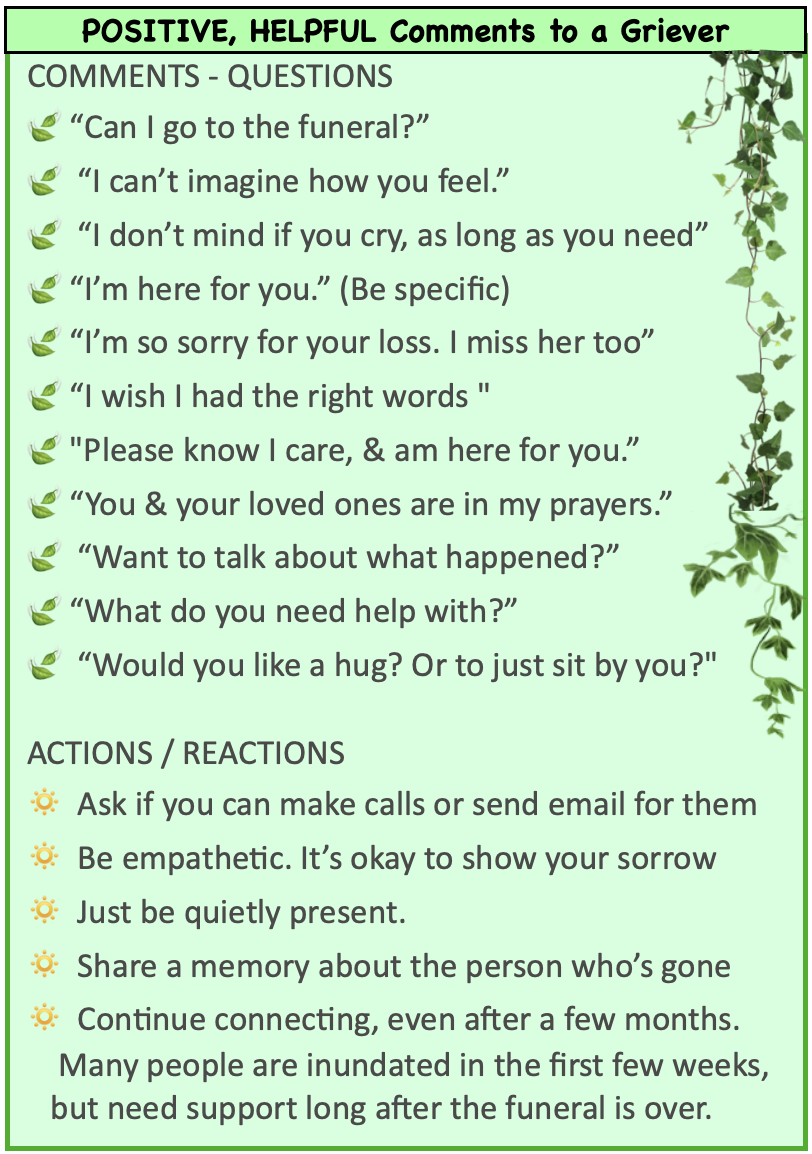
Whether you’ve been bereaved yourself at some point, or are with someone who’s just lost their soul mate, child, sibling or friend, there are things you can do to be comforting.
Sometimes silence is good. Don’t feel the need to fill every moment with sound. Touch can say just as much as words, sometimes more. Simple actions such as making a cup of herbal tea, leaving a bunch of flowers…. or harder ones, like going with them to the mortician, to identify the body or to the memorial service. …. can speak volumes. You can’t take the pain away, but you can share a little in the acceptance of being human.
« «
«
NEXT : GRIEF –

