
 I’M LEARNING THAT
I have lots of options
PREVIOUS: ACoAs & Asking Qs (#2)
SITE: “The Value of Questions” monograph by Professor B.F. Plybon
• Importance of Asking Questions – Steve Jobs
HEALTHY:
ASKING Qs. FROM the ADULT
On the other hand, asking Qs from the Adult Ego State (ES) means we’re fully IN present reality, interacting with the person or situation in front of us, not to someone from our past.
The Adult ES knows:
• other people are not a carbon copy of us
• we have options we didn’t have as a child
• that not everyone is as emotionally or physically dangerous as our family
• that everyone has their own personality & experience – separate & usually difference from our own
• that other adults are not responsible for taking care of us, nor are they responsible for healing our wounds – ie. not replacement parents
PURPOSE of ASKING
 Appropriate, clear Qs is a legitimate, normal part of good communication skills. Children ask a lot of Qs, mainly about facts, to find out about the world around them. But they also don’t have to ask for emotional needs because healthy parents know & provide those. Ours didn’t, so we don’t know we can to ask for them now.
Legitimate, healthy Qs may be a way TO:
• connect with a person you’ve been thrown together with for a short time. It cuts down on loneliness, makes you part of the larger world, you can learn something new & interesting, & you may even get unexpected help.
EXP : Sitting next to a person on a bus, or standing in line : “How has your day been so far? “/// “That’s a great bag, Did you get that on vacation?”
TO
• find out about the other person – who they really are, instead of what we’re projecting on to them from our past, or what we want them to be
• find out HOW someone thinks / feels about a current situation
• to find out what someone has already done, or what they already know about a need, a situation or experience
• get clarity if you don’t understand something
TO
• go deeper (How do feel about that”) — OR —
• keep things LIGHT!! (“How was your vacation?”)
• respond to what they’re saying, not what we are thinking or feeling
• use the Socratic method, to help someone draw on their inner knowledge, to think thru a problem by figuring out who they are or what’s right for them….
EFFECTIVE Questioning 
Re. info – there is no such thing as a stupid question – except if you aren’t interested in the answer. However, not all Qs are created equal. Different situations call for different types. Along with learning how to use Qs, effective questioning is also the ability to listen to the answer, & suspend judgment. Letting go of our preconceived needs & opinions make it possible to get the most info possible in a situation.
This requires being intent on understanding what the other person is really saying when they talk about something. What’s behind their words?
No matter how smart or experiences we may be, much of the time we’ll never guess what a person will say if we just ask “What do you mean?”
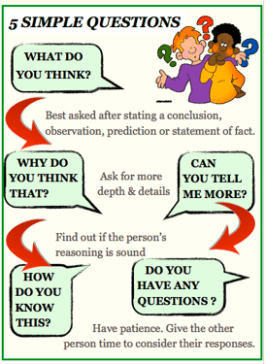
The following sets of Qs can help improve communication & understanding of anyone we want to stay connected to, whether family, friends or in business. Modify the Qs according to the situation.
1. What do you think / feel?
This Q stops the questioner from talking too much.
2. Why do you think / feel that?
Once the person shares what they think or feel, this follow-up encourages them to provide the reasoning behind their thinking/ feeling. It’s ok if it’s not “deep”. It’s still info. 
3. What leads you to believe this? (How do you know this?) This Q encourages the responder to make connections between their ideas / feelings & things they’ve experienced, read & seen.
4. Can you tell me more?
Most people always have more to say, but need encouragement to ‘spill’. This Q can extend their thinking & share added evidence for their ideas
NOTE : sometimes just being quiet allows them to say more. However, – this works best with Extroverts. With Introverts, we do have to ask – if we’re genuinely interested
5. Do you have any questions for me?
Use a friendly tone with ALL Qs, so the person doesn’t feel attacked or pressured to give the ‘right’ answer. (Edutopia.org)
NEXT: ACoAs & Qs #4
 HEAL & GROW for ACoAs