
 «
«
PREVIOUS: CatastrophiZing – a CD, #2
POSTS: Cognitive Distortions – OVERVIEW
⚡️ Cognitive Distortions – Intro #2, — NOTE to ACoAs
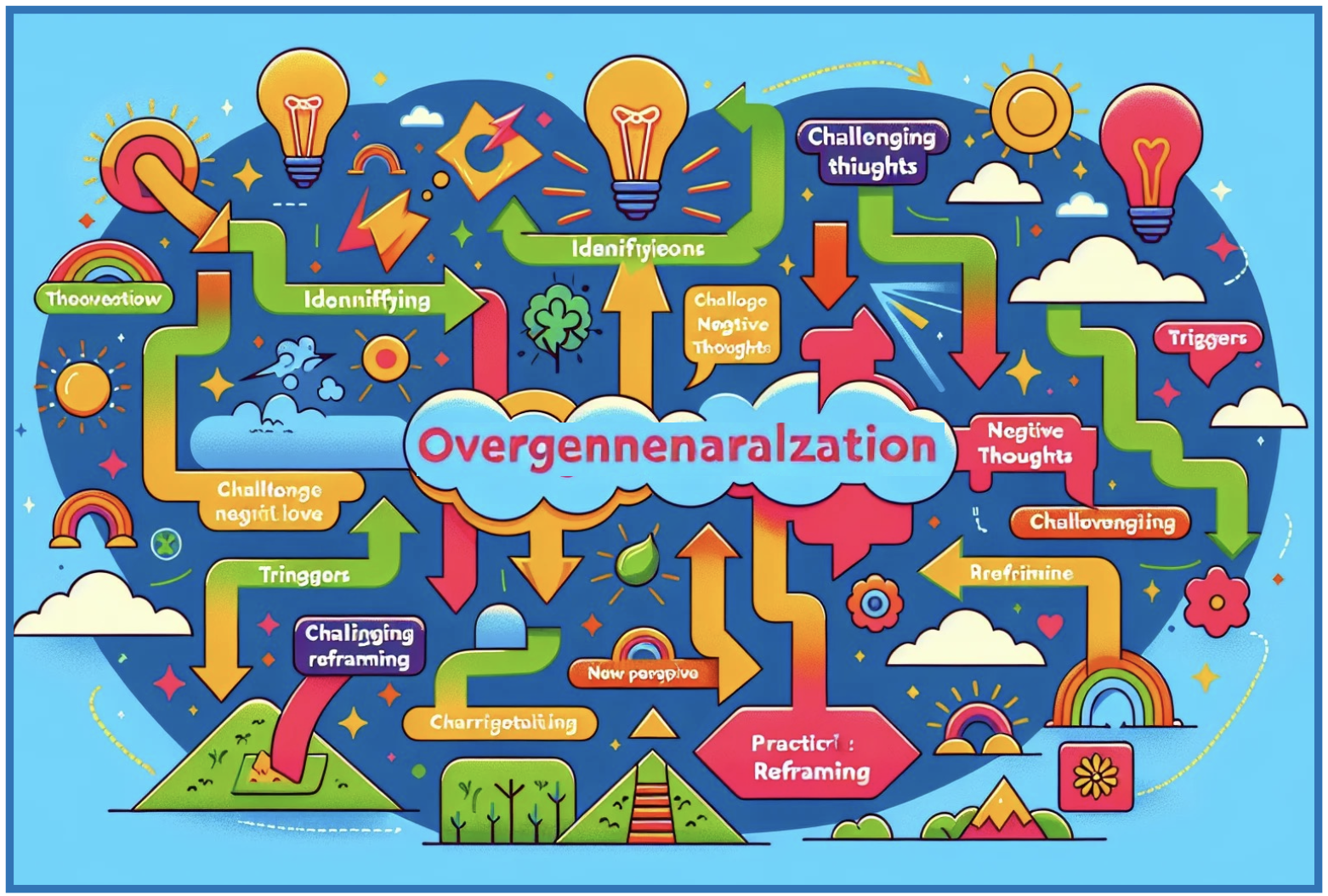
OVER-GENERALIZATION (O-G) – a basic CD
Positive version : when a person makes broad, optimistic assumptions based on a limited set of positive experiences. This can lead to the belief that certain favorable outcomes will always occur or apply universally.
While this form may encourage confidence & motivation, it’s more likely to cause unrealistic expectations & therefore disappointment when future experiences don’t turn out well. So it’s not just the outcomes that matter but also the expectations.
Negative O-G is consistently associated with depression & anxiety. Further research found that even those with tendencies toward positive O-G are also prone to depression.
This version is that we decide after only a single event or a series of coincidences that every situation of this specific category (PPT) will inevitably turn out – in future – the same way, as in the parable of the blind man & the elephant.
More damaging is when we use one very unpleasant situation to assume there will be an endless repetition of the same frustrating, disappointing, hopeless, dangerous…..events.
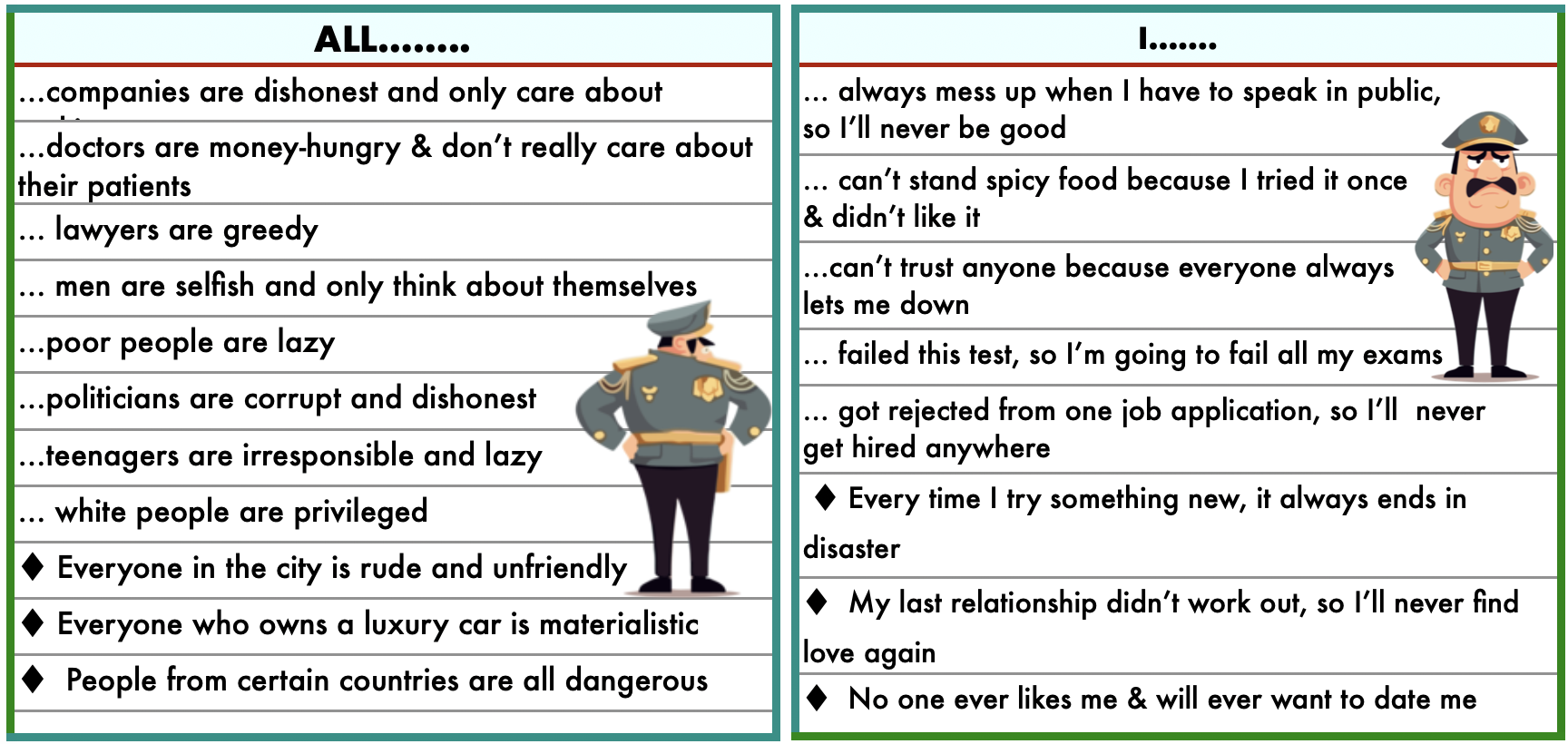
A hint to this distortion is when we use such words as ‘always’ or ‘never’ to describe our life experiences. This shows a lack of psychological adaptability & mental flexibility.
Related Fallacies: Arbitrary influence & Selective Abstraction
Stereotyping
One bad = All bad
🔻 O-G is when we use one or two negative experiences of a particular kind (getting fired, getting dumped as a teen) as a reason to conclude that all future situations – in that category – will inevitably turn out just as badly
a. So, a painful or traumatic event gets grafted on to an entire category of events or group of people. We over-simplify reality, ignoring important details that are available (like in this Gestalt image ⬆️ = ape, lion)
b. We then make up this rule on the basis of one specific type of experience & apply it across the broad to other situations, even if they’re not actually the same. “It doesn’t matter what my choices are, they will all fall flat” // “A dog bit me when I was a kid, so all dogs are dangerous”
c. At the extreme, we can O-G anything, from saying that “all poetry is dull, going to college is a waste of time & money, all Democrats are war-mongers” – to – “I don’t have any useful abilities or good personality traits, I’ll never find love again, Everyone hates me…..”
All bad = a single bad
🔻 A reverse over-generalization is the assumption that all the items in a group must share the same characteristics as the one thing or person we know, and dislike  So,
So,
— “All librarians are shy & boring” – because I once dated one like that
–“Every product made by X company is made poorly” – because the one item I bought from them broke
— “All men are selfish pigs”- because I was married to one.
😵💫 When we assume that our unexamined thinking is reliable, we fall for stereotypes, assuming they’re valid. The less we actually know about a certain group or situation, the stronger & firmer is the distortion.
HOW O-G happens
• CDs are a form of ‘Automatic Thinking’, based on memories of past experiences, which we categorize into groups (generalizations) for ease of recall. But if we stop there & accept our superficial ideas without checking for more info, our understanding of what we observe & experience in the present may very well be wrong
 • Generalization, as a stage we go through in learning anything new, is not only acceptable, but necessary. The baby just learning to talk may call all men “Da-Da” or all animals “bow-wow”, but will eventually come to know the differences. We get into trouble when we stop at the generalization stage. All men are not Dad. All animals are not dogs & all dogs are not the same.
• Getting stuck at this stage can come from a variety of sources: from being traumatized in the early years of our cognitive development, copying the way our parents / teachers thought, from limited experience or education, being over-exposed to stereotypes in books, TV, computer games…
«
«
NEXT : Over-Generalization (#2)

