OUR SENSES & LEARNING – Touch (#2c)

kinestheric learningPREVIOUS: Auditory (#2b)

SITEs: “Learning Style Preferences & ESL Students“ (Study)

• 6 important things you should know about how your brain learns


KINESTHETIC  (somatic / physical actions) Learning

About 35% of children &  5 – 15% of Adults learn most easily while moving (kinesthetic) or handling (tactile) things, which helps them understand the world around them.
Physical movement: The Cerebellum & motor cortex, at the back of the frontal lobe, are mainly in charge of much of the body’s activity
Kinesthetic touch : lets us experience bodily sensations, feelings & emotions, which come from immediate experience, memories or imagined situations

“Children enter kindergarten as kinesthetic/ tactile learners, moving & touching everything as they go. By 2nd or 3rd grade, some have become visual learners. During the late elementary years, some – mainly girls – become auditory learners, while many males keep their kinesthetic/ tactile strengths throughout their lives.” Rita Stafford and Kenneth J. Dunn; Allyn and Bacon, 1993)

antsy in schoolWhen young, ‘touch’ learners are life’s little wiggle worms, often mis-diagnosed with ADD or ADHD.
They’re smart & eager to learn, but first need their attention captured. Then their energy can be directed by drawing on their natural curiosity & offered hand-on activities.
They do best when they have something in front of them they can physically handle, & even better if they made it themself.

This is how they come to understand how to use their bodies & how to communicate with others, most of which is through feet & hands. So activities that focus on those body parts help them learn how to write, share their toys, button shirts, tie shoes, hold a fork…

Kinesthetic learners express themself through movement, with the distinct ability to control the body’s actions & handle objects skillfully. Through interacting with the space around them, they ‘re able to remember & process information, which allows for a good sense of balance & eye-hand co-ordination.

learn by doingDOING something active lets them learn, which helps them stay focused & retain information. This can include noticing (an action), but use their own language to express what they’re hearing.

They need external stimulation, or they may lose interest, preferring to think broadly before going in-depth. It doesn’t mean they act before thinking or are reckless, but that they understand things better by getting immersed in a situation or lesson, in order to evaluate facts for themself.

Learning a physical skill by first visualizing the activity (dance, a sport, driving…. ) makes it much more successful.
EXP:
Focus on the sensations you would expect for each activity or experience. So, for a tack (turn) on a sailboat, feel the pressure against your hand as you turn the rudder & the tension lessening on the ropes. Feel the wind change to the other side, feel the thud as the sail swaps with the wind, feel the boat speed up as you start the new leg….

Phrases used by Kinesthetics :
” I can’t get a grip on this // Stay in touch // That doesn’t sit right with me // I have a good feeling about this // My gut is telling me // I get your drift….”

Re. INTUITION (Clear sensing)
 This is actually getting vibes in the body such as Tingles, goosebumps, electricity, lump in throat, tickle in ear….

Gut Instinct
(Clear knowing)
Harder to describe – more of a crystal clear ‘I just know!”, like a ring or ping, but coming from the belly rather than the mind. Not so thick or dense as many deliberate thoughts.

abuse muscle painNOTE: All experiences of physical, sexual, verbal & emotional abuse are stored in the body (muscles, organs, energy centers….), and need to be released in movement, talking & crying.
Such history can be from childhood battering &/or incest, domestic abuse, war-time trauma, severe physical-illness-treatments or accidents…..

The physical expression of stored pain (getting it out) is necessary for all learning types, but especially for Kinesthetics – using experiential modalities, such as
Core Energetics, Psychodrama,
Trauma release exercises……
ASLO: Some books & LINKS to many therapies

KINESTHETIC Characteristics – pick the ones you identify with

kinestetic char
«
NEXT:
SMELL (2d)

OUR SENSES & LEARNING – Vision (#2a)

visual learningI GET MOST OF MY INFO
through my eyes

PREVIOUS: Sensory Learning #3

SITE: MANY links re learning
• “5 things to know about how the brain learns”

QUOTE: “To develop a complete mind, study the science of art & the art of science. Learn to see. Realize that everything connects to everything else.“ ~ Leonardo DaVinci

VISUAL Learning Style
According to Dr. David Sousa, 45% or more of student in most American classrooms prefer to receive information visually. This includes pictures, video tapes & charts, as well as reading, because the interpretation of symbols translate into mental pictures (“How the Brain Learns”).
Visual stimulation helps to shape children’s minds in powerful ways.  80-90% use their eyes to learn about the world, so they’re able to gather information nearby (what can be touched) as well as at a distance (beyond arm’s reach).

Our brain prefers processing information by vision compared to our other senses. The Visual Cortex, in the Occipital Lobes, is the largest system in the human brain, responsible for higher-level processing of visual images. It’s at the back of the brain, above the cerebellum. The neurons that handle visual processing make up about 30% of the brain’s cortex – more than double that of hearing & touch combined.

Both occipital & parietal lobes of the brain manage spatial orientation to make sense of what we take in, as the eyes take in images from visible light to build models of the world around the body. All imprints have a deep & lasting effect on the way we learn & think, as we store both negative & positive impressions at conscious & subconscious levels (images of AK-47s as well as beautiful waterfalls).
eye preference & dominance Hubel and Weisel showed that the primary visual cortex consists of cells responsive to both simple & complex features of whatever we’re seeing. Interestingly, most of these cells have a preference for one edge of an angle over another, called ‘orientation preference’, & to inputs from one eye over the other, called ‘ocular dominance’.

These 2 patterns (preference & dominance) are not fixed genetically, but develop from visual experience, mostly soon after birth.

The eyes & the visual cortex form a massive parallel processor that provides the highest band-width channel into the human cognitive centers. Processing, perception & cognition are closely interrelated, which is why the words “understanding & seeing’ are synonymous.” ~ Colin Ware (slide 17)
EXP : The average human attention span is 8 seconds, while the brain processes visual images 60,000 times faster than text, in roughly 1/10 of a second.

Most of our activities involve ‘seeing’, so the importance of this sense can easily be taken for granted, yet sight is crucial to learning. Visual learners take what is spoken or heard & make it into something they can see in their mind’s eye. They get the most out of visual aids, & put a lot of effort into observing / listening so they can turn info into notes, charts, graphs, pictures….
EXP: Imagine being in an open field. How far can you see? About 50 miles. How far can you hear? Maybe a mile or two. How about smell? 10-20 yards, assuming that the wind isn’t blowing. How about touch? Just an arm’s length. Taste? A couple of inches.

“Seeing”  by INTUITION (Clear Seeing) =  Being able to visualize possible scenarios in the mind’s eye, as if recalling a memory or imagining an actual picture.

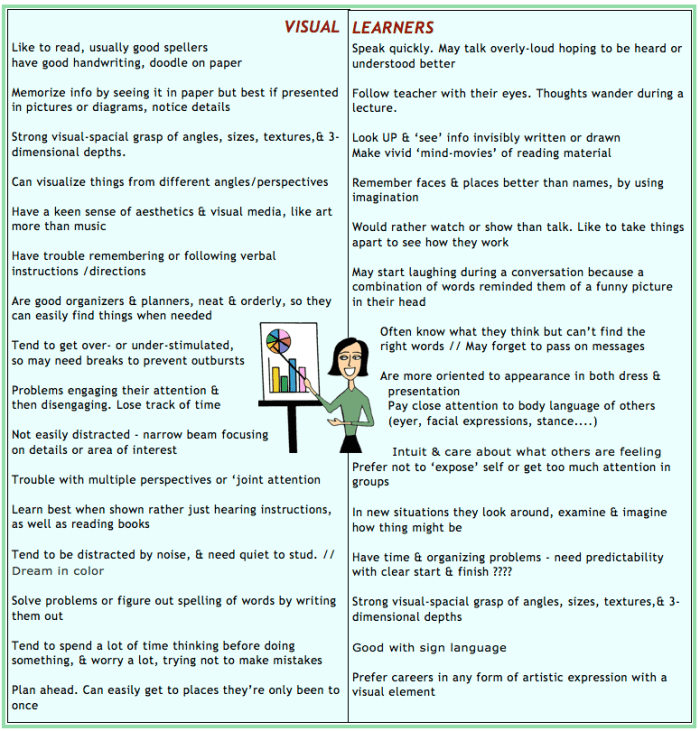
VISUAL Characteristics
KEEP IN MIND that whichever style you prefer you’re not going to identify with everything  listed. That will depend on other factors, such as mixing in other learning styles with your primary one, your educational background & your native personality.
«visual Lern - charact
«
NEXT: Auditory Learners (Part 2b)

Weak DECISION Styles (Part 3)

I’LL RISK EVERYTHING –
to feel that ‘high’

PREVIOUS: Bad Decision Styles – #2


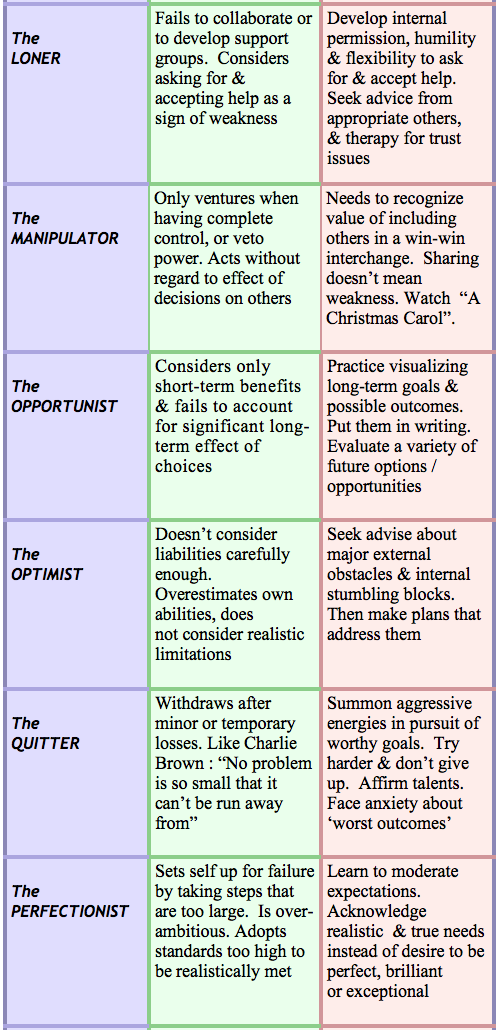
PART 3: Last 6 of 18 types of unsound decision-making (D.M.) styles & their corrections (no known source).  While these types represent dysfunction, they’re based on each person’s native approach to life, with the addition of an unhealthy upbringing.

Some EFFECTS of bad D.M. = WE :
• compromise ourself – our self-worth, values, needs….
• don’t get what we say we want, so we can obey our Toxic Rules
• do get what they want, but at the expense of others, damaging our relationships
• experience physical symptoms, aches and pains, major illness
• have to learn lessons the hard way instead of making life easier
• we hurt, disappoint, ‘abandon’ people we care about & love
• get in trouble with authorities, the law, go to jail
• suffer unnecessary financial distress, debt, loss of valuable property
AND THEY
• are a waste of our precious life, talents, abilities, potential….
• can cause many lost important opportunities, with some that can’t be retrieved
• can create  unnecessary financial distress, debt, loss of valuable property
• they generate anxiety, distress, shame, guilt, self-hate….
• may lead to accidents, permanent injuries, death
• waste a lot of time, either doing unnecessary things or having to cleanup a mess later

Allowing for NUANCESconsequences

🔆  Most decisions are NOT written in stone, so they’re not forever, even tho’ some do have far-reaching consequences, so it’s wise to strive for ‘sane’, healthy, adult choices as often as possible.
• ACoAs tend to lump all types of decisions together – all are huge, impossible, overwhelming, undo-able — we think ALL have equal importance & equal consequences. NOT SO!

REALITY : D.M. is inherently circular, since most are made by moving back & forth between available alternatives.
These are influenced by the criteria we apply to them, & vice versa = the criteria we set influence the alternatives we consider. EXP  :
a. the characteristics we want our choice to meet (the ‘new’ car should be small, used & inexpensive but not worn out)
b. identifying the possibilities we can choose from  (where we live, how much money we have, our knowledge about used cars…)

We can divide decisions into (at least) 3 levels of importance & intensity. It can be argued than any choice can cause a big problem OR have a great benefit, but if we use our Adult observations & experience we can have a general sense of what to expect, as long as we don’t limit our thinking to what happened in our childhood.

Use these suggestions to make your own outline.
♠︎ SMALL-ish Decisions: where to do for dinner, what to wear, when to talk to someone, to go or not go to a party, which errands to do when, buying something for the house…..
♠︎ MEDIUM Decisions: Where to go on vacation, what diet to use, to go back to school, change accountants, redecorate, get a new car….
♠︎ BIG Decision: change careers, get married or leave a relationship, move to a different city or country, stop using drugs / alcohol / cigarettes, start going to therapy, have a needed operation…..

✶ The more we come to believe “I KNOW WHAT I KNOW”, trusting our intuition & judgment, the easier the process of D.M. becomes.
«


«
NEXT :  Our Sense & Learning, INTRO #1a

Weak DECISION Styles (Part 2)

IT’LL ALL TURN OUR GREAT –
no matter what they say!

PREVIOUS: Bad Decision Styles – #1


PART 2: Next 6 of 18 types of unsound decision making (D.M.) styles & their corrections. (No known source).
While these types represent dysfunction, they’re based on each person’s native approach to life, with the addition of an unhealthy upbringing.

4 general Categories of D.M.
✥ By Command – made without input from anyone else
✥ By Consultation – inviting & include input from others
✥ By Vote – discuss options & then call for a vote, majority rules
✥ By Consensus – keep talking until everyone agrees on one outcome

Warning SIGNALS that:
a. you’re about to make a weak, unhealthy or dangerous decision (interchange a. & b.)  = WHEN YOU : 
• are exhausted, sick, emotionally distressed or overwhelmed
• are not willing to change your mind when a situation changes
• base your choice only on fear, anxiety & low-self-esteembad choices
• don’t plan for dealing with difficult people or unexpected events
YOU :
• don’t consider the bigger context, or the possible consequences to you or to others
• ignore available information (newer, easier) that would help you make a better choice about a person or situation
• only think of what you want & how you feel, ignoring everyone else
• twist yourself to fit other people’s expectations of how you should behave, conform to peer pressure or automatically agree with the majority (being overly dependent on others)

b. you have made a weak, unhealthy or dangerous decision = WHEN YOU :
• acted before you were ready or before the time was right
• based a decision on what you thought you should do, rather than what was right for your True Self & the current situation
• chose a way of doing something so you wouldn’t have to ask for help
• didn’t do anything even tho’ it was important to act
YOU :
• ignored glaring problems or important factors that you did know about a situation
• ignored hints that told you something was wrong or there was too much uncertainty
• made a choice using familiar CDs, such as B & W thinking
• picked an action based on “well at least I” ……have a job, don’t look stupid, have a boyfriend, am safe, to available information — which comes from a poverty or victim mentality
»


NEXT :  Weak  Decisions , #3

Weak DECISION Styles (Part 1)

NO MATTER WHAT I PICK –
it’ll always be wrong!

PREVIOUS: Procrastinators Anon Tools

POST : Purpose of Emotions : DECISIONS


PART 1 = First 6 of 18 types of un-sound decision-making (D.M.) styles & their corrections. (No known source).
While these types all represent dysfunction, people gravitate to one of these as a reflection of their inborn approach to life, along with an unhealthy upbringing.
❣️ Healthy (adult ego state) D.M. is the process of :
— identifying & choosing alternatives, based on our core values & preferences, and
— reducing enough uncertainty & doubt about our options to give us the freedom to pick the best one at the momen

• ACoAs have a lot of trouble making decisions – no matter what our personal style is . This deficiency has nothing to do with our basic intelligence, only our damage.
An apparent exception are those in the Hero / Rescuer family role – who seem to be able to make decisions easily & continuously. But the hidden worm in the fruit is that :
— they only do it on behalf of others , as co-dependents / people pleasers
— decisions made for themself are rare & usually unhealthy

❀  WHY we have trouble with D.M.
NOT :  

• having a clear identity (who am I, how do I present myself, what do I need or want….)
• having enough or the correct information to decide accurately!
• having permission to change our mind – about anything!
•  realizing we have options to choose from, or better options than we think we have bad decisions
• trusting the knowledge, judgment & experience we’ve gathered throughout our adult life
AND
• afraid of taking risks, asking for help, getting good things
• being in denial about what we know regarding a person or situation
• co-dependence = wanting to please everyone, all the time
• fear of making the wrong choice – thinking that the wrong one will have life & death consequences, or result in severe punishment or self-hate,
• growing up with a series of double-binds (paralyzes us)
• letting the WIC (wounded inner child) be in charge of considering what to do, who either acts impulsively or is stuck / paralyzed
• using CDs (cognitive distortions) in thinking about a problem

➼ As we Recover, some of these reasons melt away, some diminish & some we struggle with throughout life – & which is which will be different for each of us..
«


NEXT : Weak Styles, #2

Procrastinators Anon TOOLS

PREVIOUS: RE-ORGANIZED pages


THESE TOOLS ARE GREAT.
I’ll try them later!

PREVIOUS: ACoAS & Procrastination (#5)

POSTS:  “ACoAs & Procrastination” / / “Weak Decision Styles”


Procrastinators-Anonymous.org
– “a fellowship of men and women who share their experience, strength and hope with each other that they may solve their common problem and help others to recover from chronic procrastination.”
TOOLS for RECOVERY
1. Break It Down: Break down projects into specific action steps. Include preparation tasks in the breakdown

2. Visualize: Plan what to do, then imagine yourself doing it. The more specific & vivid the visualization, the better. See yourself doing the task, and doing it well.

3. Ask Yourself Why: While you’re visualizing doing the task, see if you can detect what it is about it that feels awful  to you, & what uncomfortable emotions you’re avoiding. Knowing what’s behind the avoidance can help you get past it so you can address real problems & ignore irrational fears.

4. Focus on Long-Term Consequences: Procrastinators have a tendency to focus on short-term pleasure, & shut out awareness of long-term consequences. Remind yourself how panicked & awful you’ll feel if the task isn’t done, then imagine how good it will feel when the task is finished.

5. Avoid Time Binging: One reason procrastinators dread starting is that once they start they don’t let themself stop. Plan to work on a task for a defined period of time, then set a timer. When the timer goes off, you’re done for now. putting it off

6. Use Small Blocks of Time: Procrastinators often have trouble doing tasks in incremental steps, SO wait for big blocks of time that never come. When you have small ones, use them to work on the task at hand

7. Avoid Perfectionism: Procrastinators have a tendency to spend more time on a task than it requires,  SO tasks that should be quick to do take an agonizingly long time. Notice this tendency & stop yourself. Some things require completion, not perfection.

8. Keep a Time Log: Increase your awareness of time by logging what you are doing throughout the day. This is a great diagnostic tool for discovering where your time went, & an excellent way to become better at estimating how long tasks take.

9. Develop Routines: To help structure your day and make a habit of things you always need to do, develop routines for what to do when you wake up, regular tasks of your workday, & what needs to be done before bedtime.

10. Bookend Tasks and Time: Use the Bookending board on the P.A. Web site to check in throughout the day, or at the beginning or end of specific tasks you are dreading.

Please visit Procrastinators-Anonymous.org for more info.  Details are at the top of the Bookending board.  AS A REMINDER:

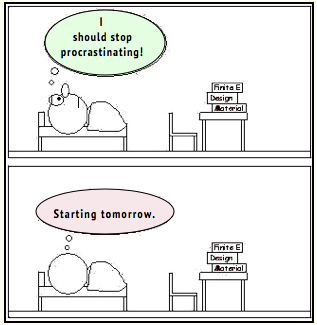
putting off cartoon

«
NEXT
: WEAK Decision Styles, #1

ACoAs & PROCRASTINATION (Part 5)

make notes I CAN GET THINGS DONE –
& feel good about it!

PREVIOUS: Putting things off #4


SITE: ‘Overcoming Procrastination’

BOOK: “Willpower: Rediscovering the Greatest Human Strength” by John Tierney, New York Times science writer, & psychologist Roy F. Baumeister.
An unconventional “self-help” book that, much like Timothy Wilson’s ‘Redirect’, grounds its insights & advice in 30 yrs of serious academic research into willfulness & self-control. While the book is fascinating in general, its 3rd chapter “A Brief History of the To-Do List, From God to Drew Carey,” is particularly interesting. (NY Times)

PROCRASTINATION (cont)
3. What makes it hard // 4. Good Stuff

5. BOTTOM LINE
“WHY BOTHER?” underlies all our indecision & procrastination. We don’t take genuine care of ourself, no matter how busy or cocky we seem to others. On a deep level we’re paralyzed by:
a. Not knowing or having access to our healthy True Self, SO we believe we don’t know what we want or like, nor what our rights are!

b. Not being allowed to be our own internal motivator – SO our only reason to take actions has to come from outside. We have to use family, a boss, teacher, a cause, religion, a career, friends & lover relationships, AND ultimately our terror of abandonment & punishment to push ourself. Left to our own devices, we just collapse inward

c.
Our Internal Conflicts :conflict
• feeling ‘safe’ vs. losing someone, being hurt or punished  (even if that safety is an illusion or self-destructive)
• the Healthy & the UNIT vs. WIC & PP
• disobeying the Toxic Rules vs. obeying them
• new ways of doing things vs. old patterns
• what we want vs. what we’re ‘supposed’ to be, do, think, feel

d. Double messages, originally forced on us by one or more adults, we had no choice but to internalize the resulting Double Binds* (simultaneous but opposing demands, with a penalty for whichever one we can’t fulfill).
EXP:
• As kids, they expected us to do for them (which may still be going on with an elderly parent), taking advantage of us to be their parent substitute – using hints, guilt, shaming, manipulation, demands, threats…. AND were angry / abusive if we did nothing (the penalty)

• BUT THEN were totally dissatisfied with & critical of whatever we did do for them, no matter how much effort we put in, what it cost us, what we had to sacrifice, how clever we were at it….
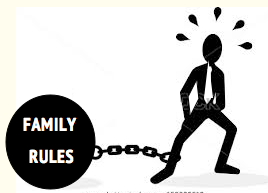
chained to rules*EITHER WAY we were/are punished. If they’re still live we compulsively keep trying – to please them, over & over. If they’re not around anymore we often find some other needy, critical person to mollify /satisfy – always with the same impossible, painful results!
YES, we’re addicted to the rejection, while maintaining the illusion that we have the power to change them, if only we try hard enough, long enough!

Ultimately, we do stopped trying – but only for ourself, because:
• we’re still waiting for them to approve of us, & give us permission to have a life of our own (to free us of their bondage, because we don’t believe we can do it ourself!)
• we’re convinced that if we failed with them (the family, also school, religion), it’s inevitably that we’ll fail with everything & everyone else, so there’s no point in trying
• we’re waiting for someone -anyone- to come & rescue us so we don’t ever have to be our own parent!

6. FACING our INNER REACTIONS
• Unfortunately, delaying inevitable responsibilities (as well as ones we’ve taken on voluntarily) creates endless obsession & self-recrimination. “”I’m just lazy by nature, I can’t do anything right, I’ll just mess it up – again” ….procratination

So why would we rather worry ourselves sick than ‘just do it’? Because WE :
• SAY it’s just a habit – but it’s really our self-hate
• think we don’t know how, even tho’ we actually do
We’re
• used to longing for things, rather than having them
• waiting to be taken care of /rescued
• staying loyal to the family by copying how those adults ‘handled’ daily actions & problems
• not allowed to do things easily, because suffering is the norm (if it’s too easy it doesn’t count)

NEXT: Procrastination #6

ACoAs & PROCRASTINATION (Part 4)

self-motivationTHERE REALLY ARE THINGS
I can do to get going

PREVIOUS: Putting things off, #3

See ACRONYM page for abbrev.

SITE: ‘Beating Procrastination’


2. NOW we put things off because of…. (in Part 3)
3. WHAT makes it HARD to act (cont)
a. Internal FEAR of // b. External FEAR of….

c. Internal & external fears can show up as :
• Putting off tasks. Many of us find that our whole life is permeated with the ‘habit’ of waiting to the last-minute to do things. It doesn’t seem to matter whether the ‘thing’ is something we would like to do or something we dread. We just put it off & off & off.

— Then comes crunch time – the deadline has caught up to us. We’re in a panic, scrambling to do the task, but now it’s going to be half-baked. We don’t have enough time to do a thorough job, don’t read the instruction correctly (or at all), leave out or miss something. And by leaving it to the last minute it can never be done right
— OR the deadline has past & we don’t get the benefit of a discount, miss a class or a needed product, a reunion, a party….

worried▶ Of course we’re painfully aware of all this, but as long as we’re stuck:
— we’re full of anxiety & S-H for not doing it Perfectly
— we scare ourself with dire projections & predictions about how we’re going to get judged, punished, fired…. &
— hate ourself for letting a desired or favorable opportunity pass by

💔 But, like any good addict, we’ll do it the same way all over again, & again! WHAT? How can this be an addiction? WELL…. in this case it’s the addiction to: Fear + Adrenalin + S-H = Drama. This formula has become so much a part of our life since childhood that we keep doing things (or not) to re-enforce the chemical surges it creates.

Yet under this self-inflicted ‘excitement’, the WIC is just trying to protect itself the only way it knows how – by NOT doing anything. Yet it’s not enough to just label it as part of our ACoA damage, which it is. We need to know how it all got started (Past) & how we perpetuate it (Present).

4. GOOD Stuff can deter us too – we often sabotage ourself when things get too good! from:
• fear of success, since that would disobey basic Toxic Rules, & we’d have a lot of grownup responsibility, which the WIC believes it can not handle – even tho’ our adult part can/could

• not allowed to be happy, based on the belief that life is -only & always- hard, AND that we aren’t worthy of having good things anyway
• stay loyal to the family by not out-doing them, SO we must also be a failure, don’t show them up, stay in the family mobile, don’t rock the boat…

• can’t be decisive : sometimes there are places we think we should go to but really didn’t like, or we don’t feel well, or want to do something else, or do nothing at all…. even when it’s potentially pleasurable or beneficial

But we aren’t allowed to say NO to the inner Pressure-er (“what will they think if I don’t show up? / what if I miss out on something / maybe this will have the perfect answer to all my problems?….”). SO instead of firmly deciding Yes or No, we dither & obsess, do nothing & then hate ourselvesindecisive

• are never supposed to say NO to what someone else suggests, offers, wants – especially if it’s good for us. Besides “Why do they want to be with me? Why are they being so nice?” So for those times we don’t rush to people-please, we make promises we eventually flake out on, make excuses or just lie, until people get angry &/or give up on us.
— That comes both as a relief – of pressure, and a big pain – of yet again feeling ‘abandoned’! Trapped in our own no-win game, we blame others AND are filled with self-abuse

NEXT: ACoAs & Procrastination #5

ACoAs & PROCRASTINATION (Part 3)

mananaMAÑANA, MAÑANA
I want to, but just can’t get going!

PREVIOUS: “Putting things off” Part 2

SITE : Procrastination CYCLE   (& chart)

POST: “Why are you Stuck?”


2. NOW we put things off because of:
❓Feelings  // ❓ Knowledge

✳️ ULTIMATELY – we put things off :
a. so we won’t feel so alone – that inner loneliness of not having nurturing parents growing up! Being our own caretaker, being competent – even in small things – is an emotional reminder of how terribly empty we always felt as kids – no one to guide (only bully), no one to comfort (only control), no one to encourage (only shame)…. inner aloneness

• Instead of doing something positive now, all that wasted time spent worrying, obsessing about things we’re not getting done actually serves a purpose for the WIC : it fills up the hole inside – where good parents should be – the Inner Supporters we never had (early abandonment).

EXP: Pre-Recovery, Tina needed to replace a knob for her radio that had fallen off & was lost. She knew she had the manufacturer’s purchase list in her files, but felt a general lethargy about taking the action = all of 5 minutes to find, make the call & order the tiny part. It was several months before she did this simple task.

• In the mean time Tina had to turn the radio on & off by awkwardly using 2 fingers on the sound stub. When the part finally arrived, in a little pouch, it sat on her night table several more weeks. Eventually she ‘faced’ the great task of taking the knob out of the package & clicking it into place = less than 1 minute!
We put things off :
b. because we have a deep (usually unacknowledged) feeling of hopelessness. After all – the WIC believes that our actions are supposed to get us the love & attention we’re always craved, specifically from our parents (dead or alive!). The Child’s logic says – “since they hurt me & hated me, it has to be my fault, so I have to find a way to fix it.”

drowningBut no matter how hard we work at being the perfect son or daughter, we rarely achieve this wish. So eventually taking actions gets harder & harder. Scapegoat & Lost Child ACoAs give up trying a lot sooner than Heroes & Mascots, but they stop wanting to be loved & accepted! They just pretend they don’t care!

c. because we feel powerless to have any effect on our environment (being efficacious). We could never get our parents (& sometimes siblings) to notice us, listen to us, take us seriously, consider or feelings & needs. So why would we be able to influence anyone else in the world? If we have no ability to influence, then why even try to DO anything?

3. WHAT makes it HARD to act
a. Internal FEAR of —
• not knowing how to do something (even tho we’re actually very smart, clever, creative, knowledgeable)
• not knowing what to say when challenged or attacked
• looking weak, needy, incompetent, lazy, stupid…..
• not doing everything Perfectly (a form of S-H)
• having to stand up for ourselfstandup
• making the ‘wrong’ choice, when having several options, or many demands on us at the same time
• having to feel the loneliness & pain of our original abandonment

b. External FEAR of —
• asking for help when we really need it
• being judged harshly by anyone (the way we do to ourself)
• being interrupted & lose our train of thought /activity
• getting disappointed, hurting or angering someone
• having to deal with difficult people
• having to make everyone else happy (not be in pain) but resenting it

These can show up as:
•
Can’t motivate ourself – to have a life of our own, following our dreams, leaving bad relationships, moving to a better location….!
• Not being able to decide what to do first, when we have several options, or what to do at all (like with free time)
• Starting things (refinishing a pc. of furniture, art work, a book, even relationships…) but never / rarely finishing anything – IF it’s for ourself

NEXT: Procrastination  Part 4

WHY ARE YOU STUCK?

unstuck LITTLE BY LITTLE
dismantle your prison

PREVIOUS: What to do when Confused – #7

See ACRONYM page for abbrev.


WHY
we’re stuck
There may be several reasons. Here we’re concerned with the many Toxic Beliefs* we carry with us from our childhood experiences.

✶ Our fear is strong & pervasive, but the main cause for that in the present is what we are THINKING! Change that & we’re free!
Not being able to pursue & reach our needs & desires is caused by intense inner conflict between what we consciously desire VS the family rules coming from the Introject (PP = bad parent voice), whispering or screaming at the WIC, causing our S-H

• Obeying the Toxic Beliefs guarantees that we stay trapped, continually failing, feeling more & more hopeless, even suicidal. BUT, they’re so much a part of us, we may not even know we’re being coerced by ideas that were created for us (deliberately or not, it doesn’t matter).

To get UNSTUCK – we need to know & own these self-destructive Rules, counter them & then slowly change our actions, ie. Only follow the New Rules!
painIronically, these old beliefs are very hard to give up, because:
• the Inner Child actually believes them!
• following them represents loyalty to our family

GIVING them up would mean:

• getting in touch with the PAIN of our damage
• seeing what we missed out on (a loving, healthy family)
• having to give up what we thought was our ‘identity’ (our False Self
& one or more Roles)
• having to become our own person (S & I ), grow up emotionally, make our own choices, be responsible for ourselves & our actions  – stop waiting to be rescued.

⬇️ Here is one form to use whenever you want to know what’s going on in your head – what toxic beliefs are keeping you from getting what you want in life (use it separately for each topic or issue that’s bothering or confusing you), & another form to make your corrections

➼ Please DON’T just say “I don’t understand this”, or “I don’t know how to do it” & give up.  That’s mainly resistance, even if you’ve never done this particular exercise before.  Anyone who has read self-help books & done therapy will definitely be able to fill these out, given some thought, but even if you never have, you can always ask for help from someone who knows you well.  Don’t worry if your answers are similar each time you use the forms. That’s to be expected.
resistSTART by identifying a problem you want to correct OR a goal you want to achieve, but haven’t been able to, so far. Suggested ‘Issues’ “What‘s stopping me from:
• starting a new career?  • looking for a new job ?  • leaving a harmful relationship?  • standing up for myself?  • letting go of my damage?  • cleaning up my apartment?  • studying my artistic passion? ….”

1. FORM A – What’s familiar: using T.E.A. (Thoughts, Emotions & Actions), to ‘hear’ the damaged part of our thinking
•  Column 1. “Emotions” can be filled in right away if you’re very upset & know what you are feeling, otherwise —

— go to Column 2, filling in as many negative thoughts as you can (one for each category is ok if that’s all you can think of). Make sure you separate out what you’re thinking about yourself VS what you’re assuming about others (projecting)

•  If you left the first column empty, now add any emotions you’ve become aware of relating to the beliefs
• Then list the ways you ACT in response to those beliefs

2. FORM B – What is possible: Reversing patterns of thoughts & behavior will modify fear & greatly improve your experiences in life.
Use the same procedure as in Form A. but change the harmful beliefs to healthy, positive & hopeful ones, & then keep the list with you at all times so you can review & internalize them

• Based on that –  you can practice changing you ACTIONS, starting in small ways, whenever you can. Plan ahead how you’re gong to change an old pattern & try it out.

• In this case the Emotions column is last because you may not know how you feel until you try our new behaviors & get some positive results. Don’t be surprised if you have uncomfortable emotions (as well as pleasant ones), which come from your WIC and/or PP.  Just let them be. Comfort your kid, tell the PP (Introject) to leave your kid alone, & focus on enjoying the relief & pleasure of living well (the best revenge!).

Sample PROBLEM :
“Why can’t I make & keep friends / lovers / bosses who are healthier, compatible & supportive??”

You may need help from a therapist, friend, sponsor or healer – to IDENTIFY the NEGATIVE and POSITIVE beliefs. Don’t be ashamed to ask!


MAKE several BLANK copies of these 2 FORMS,  and try it out on one of YOUR issues

NEXT : ACoAs & PROCRASTINATION (Part 1)