
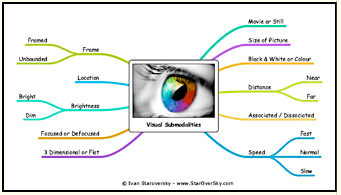
 I GET MOST OF MY INFO
through my eyes
PREVIOUS: Sensory Learning #3
SITE: MANY links re learning
• “5 things to know about how the brain learns”
QUOTE: “To develop a complete mind, study the science of art & the art of science. Learn to see. Realize that everything connects to everything else.“ ~ Leonardo DaVinci
VISUAL Learning Style
According to Dr. David Sousa, 45% or more of student in most American classrooms prefer to receive information visually. This includes pictures, video tapes & charts, as well as reading, because the interpretation of symbols translate into mental pictures (“How the Brain Learns”).
Visual stimulation helps to shape children’s minds in powerful ways. 80-90% use their eyes to learn about the world, so they’re able to gather information nearby (what can be touched) as well as at a distance (beyond arm’s reach).
Our brain prefers processing information by vision compared to our other senses. The Visual Cortex, in the Occipital Lobes, is the largest system in the human brain, responsible for higher-level processing of visual images. It’s at the back of the brain, above the cerebellum. The neurons that handle visual processing make up about 30% of the brain’s cortex – more than double that of hearing & touch combined.
Both occipital & parietal lobes of the brain manage spatial orientation to make sense of what we take in, as the eyes take in images from visible light to build models of the world around the body. All imprints have a deep & lasting effect on the way we learn & think, as we store both negative & positive impressions at conscious & subconscious levels (images of AK-47s as well as beautiful waterfalls).
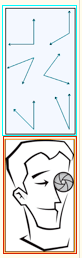 Hubel and Weisel showed that the primary visual cortex consists of cells responsive to both simple & complex features of whatever we’re seeing. Interestingly, most of these cells have a preference for one edge of an angle over another, called ‘orientation preference’, & to inputs from one eye over the other, called ‘ocular dominance’.
These 2 patterns (preference & dominance) are not fixed genetically, but develop from visual experience, mostly soon after birth.
The eyes & the visual cortex form a massive parallel processor that provides the highest band-width channel into the human cognitive centers. Processing, perception & cognition are closely interrelated, which is why the words “understanding & seeing’ are synonymous.” ~ Colin Ware (slide 17)
EXP : The average human attention span is 8 seconds, while the brain processes visual images 60,000 times faster than text, in roughly 1/10 of a second.
Most of our activities involve ‘seeing’, so the importance of this sense can easily be taken for granted, yet sight is crucial to learning. Visual learners take what is spoken or heard & make it into something they can see in their mind’s eye. They get the most out of visual aids, & put a lot of effort into observing / listening so they can turn info into notes, charts, graphs, pictures….
EXP: Imagine being in an open field. How far can you see? About 50 miles. How far can you hear? Maybe a mile or two. How about smell? 10-20 yards, assuming that the wind isn’t blowing. How about touch? Just an arm’s length. Taste? A couple of inches.
“Seeing” by INTUITION (Clear Seeing) = Being able to visualize possible scenarios in the mind’s eye, as if recalling a memory or imagining an actual picture.
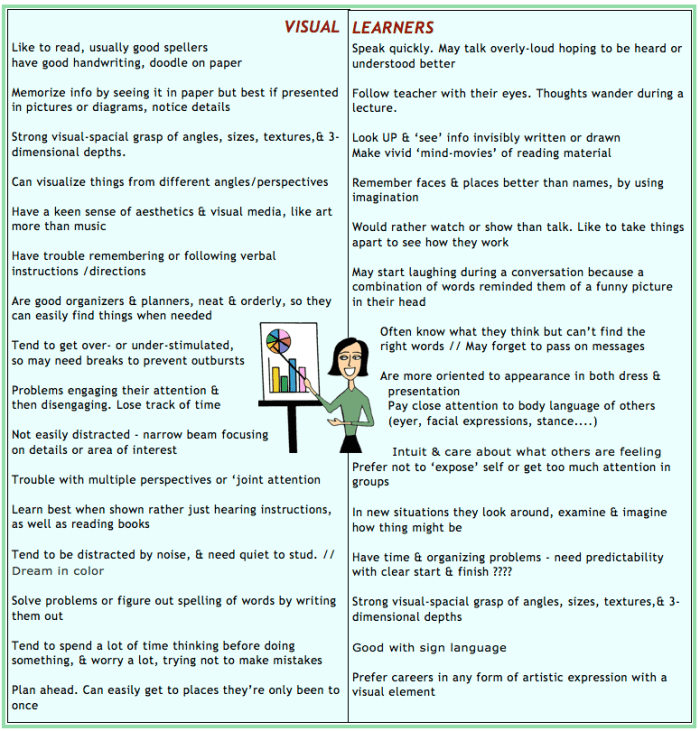
VISUAL Characteristics
KEEP IN MIND that whichever style you prefer you’re not going to identify with everything listed. That will depend on other factors, such as mixing in other learning styles with your primary one, your educational background & your native personality.
«
«
NEXT: Auditory Learners (Part 2b)

