Why RESIST talking to the Inner Child? (Part 2)

love the kid
I JUST DON’T HAVE TIME
to stop & talk to the kid!

PREVIOUS: Talking to the Inner Child (#1)

POST: “How to Dialogue with your I.C.”


🗣 FORMS of Self-Talk (Part 1)

1. OUR PROCRASTINATION to Dialoguing
Putting off talking WITH our Inner Child (inconsistently OR not at all) is another example of the insidious delaying tactic many ACoAs are plagued by. It represents resistance to self-care, either from the WIC or PigP.
Many times we put off taking actions, even ones we would like to do, because we can’t make a decision. Our thinking is thoroughly confused by having several conflicting points of view about something & we don’t know how to parse them out. Which one is right?

🔸 This hamster-in-the-wheel thinking can include :
🗣 the real ‘voice’ of a mentor, friend or relative, ➕our own —hamster wheel
• the PigP, society’s rules & religious beliefs as CDs
• the WIC’s fear, hopelessness & self-hate
• possibly the Healthy Child’s intuition / wishes
• sometimes even the rational Adult voice….
…… all at the board meeting in our head, vying to be heard & trying to win over the others

When this happens on a regular basis it does NOT means we’re crazy. It DOES mean we don’t have an clear sense of our own identity & permission to ‘know what I know’.

However, as we connect with our True Self – our general human rights &  specific needs – we can separate out the various internal voices, choosing the one most fitting to us & the current situation, via the healthy Adult. The others we ignored as irrelevant, incorrect or harmful

When ACoAs in Recovery are asked “Why don’t you talk to your Inner Child at all, OR if you do occasionally, then why not every day?” –  the most common response is “I don’t know” – with a lilt & a shrug. We know we’re supposed to but we have so many ‘reasons’ for not doing it!

RESISTANCE
✳️ MAIN excuse
for refusing to talk to our Inner Child is:
⚠️ I don’t woma & circleswant to connect with the pain that will come up: “I hate the kid – it only causes me trouble. It’s always messing things up for me! I want it to go away because it hurts when I do let it surface, AND I’m terrified I’ll uncover some deep dark trauma I can’t handle”

ANS: Re.causing trouble’ – as long as we ignore that younger, hurt part of us, it’ll keep jumping up & down, & biting us in the butt. Only when we consistently dialogue with the WIC will it stop causing us problems
Re. fear of ‘uncovering – actually, we already know all our deepest darkest horrors. Originally we had to shove it under a mental carpet or lock it away in the dungeon of our subconscious, but we never really forgot the main events.
What we’ve resisted knowing / feeling is how truly abusive & damaging our family was, & so we ‘cope’ by cutting off & distracting ourselves.

Re. the Pain – We can only fully face early trauma when we have enough self-soothing skills via a good Inner Parent, a decent support system for guidance & comfort, & internal permission to feel all our Es without S-H.
❗️AND – not all our emotions are painful. We also feel excitement, pleasure, enjoyment, relief….
With Recovery comes a deeper, clearer understanding of what happened TO us & why! We must believe in our bones that we did not cause our damage, which will allow us to go deeper.
It takes a certain amount of healing to tolerate re-feeling the backlog of old pain, which is provided by Ego Strength : “the ability to maintain emotional stability while coping with internal & external stressors”.

In any case, (whether able to face old pain or not), we need to develop a rapport with the Child, which means talking with it throughout the day about anything & everything – the weather, the colors we like, what we’re going to do after work, what book to read or show to watch…. No topic is too trivial! It’s time to heal our sad little one & the angry teen, & only love heals. Information is important, but love is the medicine.

NEXT: Resist Talking to the I.C. (Part 3)

Why RESIST talking to the Inner Child? (Part 1)

many voicesI CONFUSE MYSELF WITH
many conflicting points of viewHealthy Adult & Healthy Adult &

PREVIOUS: Resist dialoguing, #2

SITE : “Importance Of Internal Dialogue In Leading A Happy & Successful Life

POST:“Ego States – Basics” (Adult, Parent, Child)

TOPIC: TOOL for Recovery / healing IS
Healthy Adult & Loving Parent <–> Inner Child dialoguing

For ACoAs, the GOAL of this process is to shift the WIC’s focus away from believing all the harmful, distorted & untrue things it hears from the Introject – to stop the Child from relying on that voice for it’s identity & way of functioning in the world.
We need to woo the WIC away from the PigP & redirect it’s attention to our Healthy Adult & the newly developed Loving PARENT. To do that we use written & verbal dialogues, gradually replacing the harsh voice which originally created our self-hate

EVERYONE has inner dialogues all the time – called self-talk. We argue pros & cons, debating: “Should I or shouldn’t I?”, we obsessively argue with a ‘real’ person about something that bothers us – but only in our head, we hear the ‘voice’ of our parents or a religious figure scolding or lecturing…. AND no one thinks that’s crazy. SO – why not conversations with our younger self??

A common Q about talking with the Inner Child: “Is it supposed to grow up, go away or what?”
ANS: We want to heal the wounded child & bring forward the Natural one, which is our essence. Then they interact with the other 2 E.S. to make a whole person. (Review ADULT #2)

 🗣FORMS of SELF-TALK
a. Most of the time we think in the ‘I’ form, which is either the Adult, Part or the Inner Child, positively or negatively.
➕ If the statements are positive “I’d rather not do that – thanks all the same, I need more sleep, I’ll study for that exam today…” that’s the Healthy Adult
OR
“I want to see that movie, I looove my cat, give me some more ice cream, I don’t want to be around that —, it doesn’t feel good….” you’re hearing the healthy Child

➖ If the statements in the “I” form are negative, harsh, painful…. then we know it’s the Wounded Inner Child (WIC) who is in self-hate or hopeless mode: “I can’t do anything right, no one likes me, I can’t stand being ignored!, I’ll never get anywhere – I might as well give up….”TAs P:A:C

b. However, when we talk to ourselves in the “You” form, our Inner Parent is talking to the Inner Child, probably without realizing it.
➕ If the statements are positive, then our Loving / Nurturing Parent may say: “You can do it, you’re so smart – I’m proud of you, I know you’re in pain & I’m here with you, you’ll do better next time….”

➖ If the ‘You’ statements are mean, discouraging, judgmental… we know it’s the Introject (PigP / Bad Parent) talking to the Child part of us:
”You should have known better than to —, You could have done that if you’d tried harder, You blew it, you — !, You’re in trouble now! You’re so stupid, No one’s ever going to like you” ….

ACoAs: Notice that our self-talk is rarely if ever positive**, supportive, congratulatory…. Instead, we have perpetual toxic internal voices, with either the PigP haranguing the WIC or the WIC attacking itself, in agreement with the PigP

Some of us have a fairly well-developed Adult (from life experience & native intelligence) but only use it at work &/or to benefit others. Most of us are skating by on the WIC’s version of an Adult – which is very limited & full of CDs (cognitive distortions).
Even when we have a competent Adult ego state, we’re still missing the Good Parent – the main thing we’re trying to create with this tool.

**POSITIVE: Emotions are NEVER negative or positive – are just to be acknowledged, not changed or eliminated.
Only thoughts or actions (T.E.A.) can be helpful or harmful, encouraging or discouraging, useful or wasteful, valuable or worthless, producing growth or stagnation…. SO they can be corrected when they’re self-defeating.
(POST: Being Negative means….)

NEXT: Resist Talking to the IC (#2)

ACCEPTANCE & ACoAs (Part 2)

accept-serene 

ACCEPTANCE ISN’T SO BAD
once I understand it

PREVIOUS:
Acceptance & ACoAs (# 1)


1. The PROBLEM (cont)
🔹 Negative MEANING (cont)
We (self-destructively) ACCEPT that we deserve / or must endure:
• being controlled, verbal abuse, disrespect,
• being treated like a dumb kid (we were never dumb, even as kids!)
• being over-looked, unappreciated, ignored
• having to let others use, manipulate & torture us
• having to deny / destroy ourselves in order for others to be OK
AND TO
• not be able to have a positive impact on our world (be effectual)
Hansel & Grethel• never finding love & validation, since our parents didn’t (narcissists attach, but don’t actually love others)
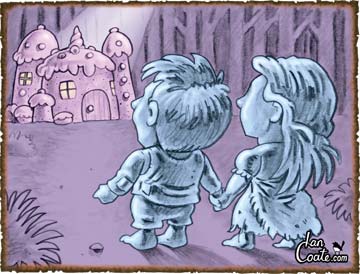
• only staying with unavailable, distant, cruel & selfish people (note the parents in Hansel & Grethel).
• staying small & ‘weak’, not knowing how to take care of ourselves

Our Toxic Rules are so deeply ingrained that even when we start having useful, valid new information about ourself & the people in our life (A1), we still skip over A2, automatically going to A3.
Whenever we have any new Awareness, ACoAs immediately ask: “What can I / should I DO about it?” (Action is not Acceptance) . This Chart shows why :
NEG 3 As
We compulsively SKIP the middle ‘A’ because:

• it’ll make us safer, considering the harmful CD we think it means
• our whole culture focuses on Action (just DO it!)
• our culture does not value process, ONLY immediate gratification
AND
• we’ve been waiting so long for something better to come along, we don’t want it to take time. The WIC is convinced that if we’re told to wait, it means it’ll never happen / never get our needs met
• our dysfunctional family made their approval conditional (if at all) – based on our actions that suited them. If you act bad, you’re bad, if you act good, we ‘love’ you – sort of.  YUCK. Healthy love is unconditional!

We think we have no choice, trapped in a double bind:
• on the one hand – we hate the rules we grew up with
• on the other hand – we’re terrified to disobey them, ever.
So, since OUR version of acceptance is so painful & debilitating, we keep trying to ignore it altogether, as if we could control the truth away!

♦️                                   ♦️                                ♦️
2. HEALTHY ACCEPTANCE
ALL Acceptance is simply acknowledging the TRUTH about things, without any makeup or mask. It’s ONLY about what actually is or was! It’s about reality, not what we wish things were like, what we think they should be, what others say things are, or even what could potentially be.

Acceptance is only about WHAT IS, such as:
• being damaged in childhood, whether from an alcoholic family or not
• that it caused us great harm
• that we are NOT the source of that damage
• that we’re responsible for working toward healing that damage, no matter how unfair
• that people aren’t always what we want them to be
• that we don’t have the power nor the right to try changing others
• seeing who people ACTUALLY are, not ignoring the parts that hurt us….

ACCEPTING good things requires that we slowly:
• leave behind all our ratty, smelly baggage & garbage in the old internal universe, carrying that broken down spooky old mess we grew up in, dropping the rags of our False Self , a piece at a time
• patiently move our God-given True Self into a beautiful new Inner Universe, with a castle that we have the full deed to, which has level floors, clearly defined halls, stairs & comfortable rooms, with cozy furnishings just to our taste!

NEXT: Healthy A2 – Cont. (#3)

ACCEPTANCE & ACoAs (Part 1)

'acceptance' stampACCEPTANCE – BAH!
I don’t like it, so I’ll ignore it

PREVIOUS: Healthy Give & Take

QUOTE: “Most men would rather deny a hard truth than face it.”
G.R.R. Martin, Game of Thrones

😁 Calvin: “Now what state do you live in?”
Hobbes: Denial.” ― Bill Watterson 

1. The ‘PROBLEM’
ACCEPTANCE is the middle ‘A’
 of Al-Anon’s 3 As (2. Awareness — 3. Action).  Correctly understanding & using this concept will make our life much clearer & saner.
For ACoAs this pesky A2 is the most misunderstood & the one many ACoAs HATE!  We don’t even want to acknowledge it’s something we need to deal with, because of thinking that “I can’t accept anything I don’t like or is too painful”, which is a CD – cognitive distortion

DEF : A2 does NOT mean –
• liking or not liking something! – a MAJOR misconception
• staying a victim, accepting our lot in life, being resigned
• giving up, not trying, not looking for a way up & out
• putting up with ‘crap’ from people, including our Introject’s bad voice
• sitting around waiting for things to happen or for someone to rescue us

Parts 2 & 3 will explain what it IS. Sadly, as in other areas of life, ACoAs will turn almost anything against themself, even good things. But first let’s see how we do use the 3 As, in the service of our dis-ease, a shorthand for all of our toxic thinking.
Negative MEANING of the 3 As
To put Acceptance in context, the unside downalcoholic / narcissistic family message given children is —
You are Bad, We are Good, the World is Bad”.
And the WIC understands this triple threat to mean:
Neg. A-1 = “I’m so bad, no one will ever love me”, &
Neg. A-2 = “I try to ignore it, but believe it absolutely”
Neg. A-3 = so – “I must be perfect, (or dead!), to make up for it” 

These 3 became the foundation of our world view – being stuck with this awful protocol without any possibility of escape. Negatives EXPANDED :
A1 = Awareness re. US – the deep-seated belief of the WIC that we’re unworthy, not entitled, beyond redemption! (S-H)

A2 = Acceptance re. THEM – that our family was right about everything, which we absorbed from their overt / covert brain-washing. Guess whose opinions we still hold on to!? We believed them because :
• all humans are intensely loyal to their upbringing – it’s our most basic connection to others
• it’s the way our brain got programmed – every experience created the neural pathways which formed our understanding of life (“How we Learn“)
• AND ‘they’ constantly made it clear that we were un-acceptable. Some parents even used God, spirituality & religion to convince us of their beliefs!

As a result we were trained to accepted all sorts of terrible things as normal & inevitable for the rest of our life, in obedience to our family & community’s lessons

dangerous worldA3 = Action re. the WORLD – everything & everyone who’s not part of our distorted & insulated family mobile is considered dangerous, unhelpful, unwelcoming, indifferent…. since our family (& community) forced on us their narrow, alcoholic, bigoted view of the world. Our actions reflects this.

Unhealed ACoAs deal with the ‘A3‘ BY:
Defiance of all authority & systems, which have become substitutes for our parents.
We can hate outside forces instead of admitting our rage at the family.
AND since the world is SO-O-O dangerous – we’re NOT going to give in or let them get us! OR —
Compliance – we have to give in, keep our head down, hide in the shadows, so no one will get us!

NEXT: Acceptance & ACoAs (#2)

ACoAs – Healthy GIVE & TAKE (Part 2)

reciprocity
THE MORE I KNOW ABOUT MYSELF
the more I can enjoy what I’m offered

PREVIOUS: Give & Take (#1)


WHAT TO TAKE from others – or NOT

👎🏽 Saying ‘NO’ requires that we know enough about ourselves & our rights – to make the best choices.
In some cases it also depends on who’s offering & why. If the giver is a relative, a boss or important client, taking the gift may be the kindest, or wisest thing to do, regardless of our taste. We can always regift

But if it’s close family or friends who are supposed to know who we are – & they insist on giving us things that are clearly not appropriate or suited to us – it’s legitimate to say “No thank you!”

EXP: Paula & Sharon were BFFs who lived in adjacent buildings & spent a lot of time in each other’s place. Paula was ‘earthy’ & preferred antiques, while Sharon liked everything bright, shiny & new. For their B/days (one day apart) they exchanged lovely gift BUT Paula always gave Sharon things that were her taste & totally NOT Sharon’s.

After a few years of this Sharon finally spoke up, asking to be considered accurately. The following gift again did not fit Sharon clothes or decor, so with regret, she gave the gift back!
PS. Years later Sharon developed another close friendship, also an ACoA, who admitted not knowing how to give appropriate gifts. They solved it by exchanging a short list of what each would like, to choose from. It worked great.accept good

Say YES to:
• complements about anything – looks, skills, style, accomplishments, knowledge, talents,  creativity
• freely given generosity – of money, help, provisions, short-term free services, lending something you need
•  kindness, respect, positive attention, appreciation….. any time
• offers of aid when you most need it
• new ideas, suggestions, other people’s experiences we can learn from
• something frivolous & fun – just because!

CONSIDER: Rejecting someone’s good-faith offers of time, kind words or small objects – is a way to dismiss the person as unimportant, & can un-necessarily hurt their feelings. It implies that what they’re not good enough for you

EXP
: In early Recovery Sean was reminded to appreciate whenever he was complemented, rather than negate it by explaining at length why he didn’t deserve the acknowledgement. His sponsor said: “It’s insulting to the person who is giving you a gift, by throwing it back in their face. Just say ‘thank you’ & then zip the lip.”
He remembered thinking: “OK, I’ll just say thank you, but privately I don’t have to agree!”  Oh well, Progress – not Perfection! Eventually he was able to appreciate genuine praise.

HEALTHY RECIPROCITY
IMP: Being reciprocal means that we are supposed to receive something in return for our efforts – it can be a Thank You, a smile, a vacation or even a house! It means we ‘allow’ others to give to us in return for something positive we have done (once or regularly) – OR just because they like us! Can you imagine?

Being able to receive is a normal part of life. This is hard for many ACoAs to believe & grasp – if we’ve been blindly obeying Toxic Rules such as “Only other people’s needs count”. Do-ing for others is all we know & taking anything makes us feel guilty! Because we don’t feel worthy of anything good, we’re not comfortable receiving – even when it’s done freely & with pleasure.

Beneficial EXCHANGES of any kind DEPEND ON:
know thyselfa. Knowing our needs. Directly or indirectly, we were taught to ignore & deny them. So now – how can we know what to take & what to reject, if we can’t tell what’s good for us or what we need?
TOXIC rules: “No one wants to help me, nor ever will” , “I should never be comforted when in pain”….(Post : Our Rights)

b. Trusting ourselves. We learned that we could never believe our own thoughts, experiences, emotions, good judgement or intuition!
They told us everything we felt was wrong, stupid or the opposite! So now – how can we identify what feels right for us or not?
TOXIC Rules: “It’s weak & dangerous to have needs, ask for help, have our emotions”

NEXT: Give & Take (#3)

ACoAs – Healthy GIVE & TAKE (Part 1)

taking in love
I CAN TAKE IN GOOD THINGS –
& I decide what they are or are not

PREVIOUS: Give & Take (#2)

SITEs: The UNDER-Receiving OVER-Giver
• 5 reasons why it’s HARD to RECEIVE


WHAT TO TAKE from others – or NOT

ACoAs have a tendency to do everything in extremes, black & white, no room for fitting an action or emotion to the current situation. This applies to the issue of ‘receiving’.
🔻 Because we think that taking anything is a form of manipulation, we don’t want to seem greedy or taking advantage of others.
🔺 But, as with all mental health, we need a balance. Not everyone is like our family, many of whom were selfish & stingy or insensitive & oblivious.

👍🏽 👎🏽 People GIVE – based on their state of mental health:
healthy ones only offer what they legitimately have, can & want to do
co-dependents usually give others what they want for themselves but aren’t allowed to have. They want to fix you (whether you nsharingeed it or not) so you’ll be well enough to take care of them in return, hoping you’ll intuitively know to do that

narcissists only extend themselves to give whatever they like to do or give, which has nothing to do with you
– If their offer doesn’t suit you, say “no thanks & don’t give it a second thought
– If it does suit, don’t agonize & wonder why they’re doing it & what you have to do in return – just take it & smile.
AND – they do love to be appreciated & fawned over!

1. START from the assumption that IF someone volunteers something, they have the ability & the willingness to give you what’s offered. Take it at face value. In general, people like to share what they know, what they have & what they create. They feel good about it & we have the right to take it

NOTE: It’s usually best to accept what’s offered as a way of respecting the positive motivation of the giver. This is not co-dependence, as long as you also feel free to refuse, when appropriate

2. EXCEPTIONS to taking something offered. You can say “no thanks” :
👎🏽 taking what’s suggested would in any way harm you or someone else
👎🏽 because you don’t like / can’t stand it
👎🏽 if it truly does not fit your genuine needs & tastes – especially if you ask for something specific but offered something completely different
👎🏽 when a gift or action is inappropriate for the current situation (‘too soon’, not ‘that kind of friend’, not age-appropriate….)
👎🏽 if you already know that the ‘offerer’ is manipulative, sneaky or will use it against you – based on experience reject the bad

Say ‘NO’ to anything which retards Recovery, & is:
• against your principles & spiritual beliefs
• generally harmful / abusive
• mentally repetitive &/or boring
• not your right to have
• not what you need at the moment
• not suited to your personality or your taste
• something you’ve outgrown
• something you don’t want, ever
• useless & a waste of your time

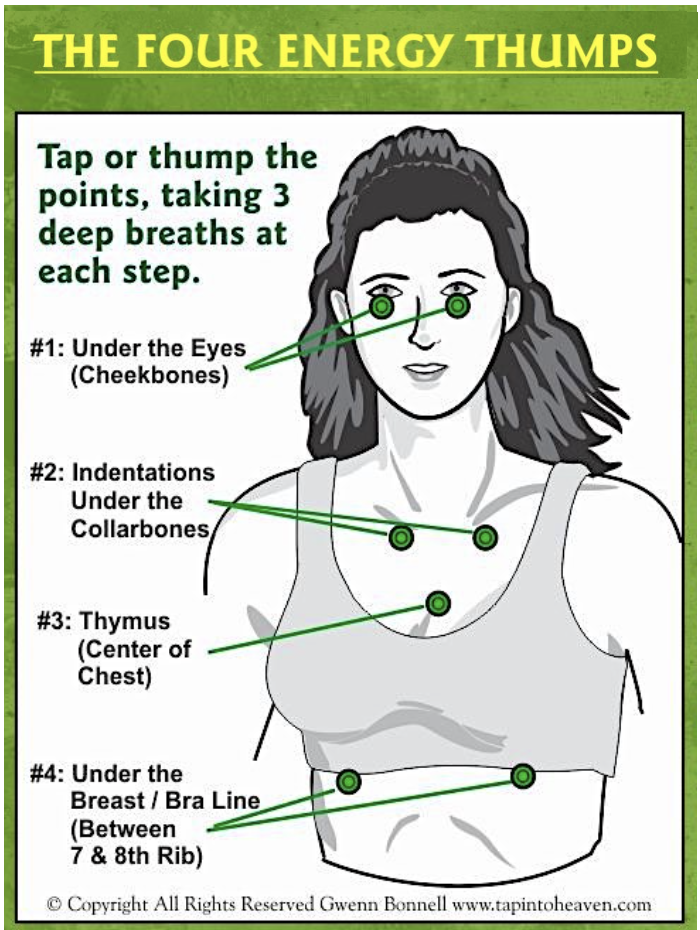
Use EFT to make a shift –
for each step, tap or thump the points while breathing IN thru the nose & OUT thru the mouth – 3X

😩 BEGIN with the negative BELIEFS you want to change / undo.
EXP: “I can’t receive. It’s not ok to get things. I’m only supposed to give”
Specific aspects of the main self-defeating statement are combined with tapping parts of the face & body : eyebrow, side of & under eye, under nose, on chin, collarbone, under arm & top of head

💚 REVERSE: New statements are combined with tapping the same face & body parts, in the same sequence, refining the desired outcome with each successive area. (MORE….)
EXP: While tapping Collarbone, say: “I’d like to receive respect, honest responses & encouragement from those I love, & from those who work with me”….. AND

❤️ END with – Top of the Head: I am so happy to receive; I receive divine gifts of time, energy, playfulness, joy, laughter, delight, but especially love. Love is the best gift to receive. I receive love now.” (Also Fear of being loved)

NEXT: Healthy Give & Take (Part 2)

ACoAs – NOT allowed to RECEIVE (Part 3)

giving infoNOTHING IS FOR FREE!
I know I’m going have to pay a high price!

PREVIOUS: Not allowed to Receive – #2


ACoA REASONS 
1. ABOUT US
(cont)
c. Backlash – Most ACoAs believe that if we ever got the good things we long for – we would be SOOO happy (right away) & all our problems would vanish.  It’s true that over time being with healthier people, pursuing our dreams, being loved… is healing, but not always right away!

Of course there may be some negative or mistrustful reactions from other people (bosses, friends, family, spouse, even adult-children).  But since we assume everyone will reject us for changing, we’re surprised when some respond positively

IRONY: We need to keep in mind that when we first start receiving emotional & practical benefits of Recovery, we may actually feel worse – for a while! This seems counter-intuitive, until we understand what’s at work, & can prepare ourselves to manage the discomfort, until it fades.backlash

• Moving toward positive things in our life – going on vacation, going into Recovery / therapy, finding a loving friend or mate, getting compliments & validation …. can produce internal backlash – from ourself.

Our discomfort is confusing & unexpected, especially when nothing seems to be wrong on the outside (it’s actually tooo good). It makes us think we’ve done something wrong because:
• the PigP’s voice will get louder “Who do you think you are…”
• we feel depressed, fearful, unsettled….  which is so ‘normal’, we don’t make the connection
• we may feel angry at the person who has been helpful, complimentary….

Actually, the ANXIETY comes from: • breaking the Toxic Rules
• feeling disloyal to our parents, even though they were neglectful & cruel, because the WIC thinks they were right! so we feel unworthy of receiving
• the contrast HURTS – compared to all we’ve suffered as kids & since then – at the hands of family, teachers, mates, sometimes even healers
• rage at being duped by our ‘disease’, when we “Could’a had a V8” (Love) all this time!

REMINDER : There are still people who insist (from ignorance, denial or control) that: “The past is over & done with & has nothing to do with now – let it go & get on with your life”!

Unfortunately those of us who experienced abuse & trauma as kids have a toxic programming deep in our bones. So, being conditioned to believe we’re unworthy of receiving, we can’t properly nourish ourselves or let others help us. To ‘let go’, we need the right info! To heal takes courage & time
🧤
2. Assumptions ABOUT OTHERS
• ACoAs project onto others all the overt & covert experiences we had with our dysfunctional parents (see list in Part 1). Since they were absent, careless, crazy, controlling, depressed, incompetent, demanding, violent, incompetent….
we unconsciously assume everyone else in the whole world is like that too, even though, as adult, we have definitely seen, heard of or met capable, functional people.
Emotionally, we simply ignore this knowledge & automatically react to everyone as if they’re a carbon copy our family

a. Actually, many people we run across will not be like our family, yet we treat them unfairly. Such people will be confused by the way we act & react to them. They inwardly just shake their heads & stay away!

b. More commonly, because ACoAs are talented at sniffing out people who indeed are similar to our background – we feel pulled to them, drawn in by their familiar dysfunctionality.

They have little or nothing to offer – but all the while we’re wanting, expecting, even demanding to have a different kind of interaction with them – better, more satisfying!

• We try to create a different outcome because we think it was somehow our fault that family relationships didn’t work out – & therefore we can change it, fix it, even if it has to be with substitutes! This is clearly impossible, but we keep trying – until we ‘get it’ that we didn’t cause the original problems and that we’re powerless to change other people.

NEXT: Not Allowed to Receive #4

ACoAs – NOT allowed to RECEIVE (Part 1)

attitudes 

NO, THAT’S OK –
I don’t need anything!

PREVIOUS: Bad Decision Styles – #3

REVIEW: Abandonment Pain Now


DEPRIVATION & TRAUMA

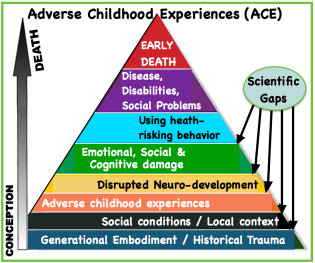
THIS CHART  ↘️ is in reverse order of Maslow’s hierarchy of Needs. Instead of going from most basic to highest, this tragic deterioration is an all-too-common repeated life cycle of trauma victims – without Recovery – causing great distress & tragedy

• While many wounded people manage to carve out a life without emotional healing, they can only manage by using rigid defense mechanisms to hold their world together (addictions, bullying, controlling, cutting off all emotions, rescuing, illness, isolation, narcissism, rescuing….).
If they ever do begin a Recovery process, all the pain hidden under these defenses surfaces, causing an avalanche of anxiety, confusion & rage.

• In A.A. based on over 50 years experience, the general wisdom is that it takes a newly sober alcoholic the first 5 yrs in the Program just to get their ‘brains out of hock’. Then they can start developing a sober life!

ACoA ASSUMPTIONS about Receiving
1. ABOUT OURSELF
✦ Co-Dependence – because of the ACoA rule ‘Other people needs are always more important than mine’, we have to keep on giving to everyone else, without ever considering our own requirements & desires
✦ Control – We had to figure out how to manage on our own – way too young – and take care of others in the family (Inner Child as little adults) – “To give is better than to receive”. AND we survived! This was the only ‘power’ we had at the time, so to give up a little of it to ‘receive’ feels vulnerable & weak

Envy / Jealousy – We’re afraid to take in good thing from others & let ourselves be successful, because either we’ll be forced to share it or it’ll be taken away. We were raised with an envious parent, always in competition or ‘stealing’ our accomplishments : “What’s your is mine & what’s mine is nobody’s business”
Screen Shot 2015-09-07 at 6.36.54 PM✦ Failure – ACoAs are “human doing, rather than human beings”.  The focus was always on what we did wrong – on actions, not personal value. And since we never seemed to do anything well, right or good enough – we haven’t ‘earned’ being treated well, receiving respect & consideration, much less love

✦ Loyalty
– staying connected to the family system as adults – to not feel rejected, abandoned, alone (even though that’s exactly what they did to us!) – we unconsciously decided that it’s NOT ok to have more or better connections, in any life-category, than we’ve had with our family. That way we can all continue to suffer together :“Misery loves company”
✦ Payback – If we DO take anything, we automatically feel obligated to that person or group. While reciprocity is a normal human expectation, ACoAs believe what we have to give back is our time, money, total attention…. our very life blood! No wonder we’re reluctant!

✦ Punishment
– to try for more of anything could get us deliberately ignored, a slap, a disgusted look, being humiliated in public or an abusive tirade. Some of us had to ask over & over for anything, even basics, before they reluctantly gave in
✦ Scarcity – based on real experiences, we concluded that the universe has very limited resources, so to get anything for ourselves automatically diminishes someone else – usually a parent or sibling
✦ Selfishness – to ask for more is not just futile, it’s presumptuous & arrogant. Many of us were taught that wanting for yourself is a sin.

✦ Self-Hate
– it’s not hard to see then why we gathered that we aren’t worthy of beinsufferingg given to! Not only because we’re bad, unlovable, selfish, greedy – “Children should be seen & not heard” – but that we haven’t ‘earned’ it, in some mysterious way!
✦ Suffering is the rule of the (alcoholic) universe: ”Life is hard!” and “You’re always supposed to struggle, but never ‘get there’”. So – don’t bother trying!

Re. Others in Part 3-4

NEXT: Can’t Receive #2

UNIT: Healthy Adult/Parent (Part 3)

PREVIOUS: Healthy Adult & Loving Parent #1


3.  BUILDING the UNIT (cont)

♥  INNER DIALOGUES
❀  Everyone’s INNER CHILD combines emotions, experiences, memories & thoughts from childhood. It’s made up of:
• every age & developmental stage we’re lived thru
• our interactions with family, school, friends, religion…
• our version (conscious interpretation/ ‘understanding’) of all the people who were important to us, good or bad
• what we picked up from them subliminally.  Kids are very intuitiveego states

Depending on the content of a voice, we’re hearing from:
❧ a good parent or a bad inner parent
❧ a healthy child or a wounded inner child
❧ a sane adult or a fake inner adult

The 1st in each duality are soothing, informative, helpful, humorous, even spiritual

The 2nd causes us great pain, a feeling of hopelessness or futility….. & some of those voices are louder, carry more weight, are meaner….than others

❤️ We need to be talking WITH the kid every day, as often as possible, about everything – no matter how trivial.
It can be about what you feel like eating or wearing, what someone is doing, the colors around you – anything from : ‘It’s time for bed, now…” , “No, we can’t go there today – not enough time” – to – “I can tell something’s bothering you. How are you feeling?”…

It never has to be a big deal. You can do it on a bus, in the bathroom, walking down the street… Yes, the written version takes a chunk of time, but not the everyday chit-chat

DON’T WAIT until you’re in a crisis, to start. If you haven’t already established a good link with the kid, & then something upsets you – you will not have the UNIT available to handle it.

?? How often do you talk to anyone you live with or see every day? Only when there’s some difficulty?
The more you interact with your kid —-> the stronger the bond —> the more you prove your reliability —> the more the UNIT can take care of things & make your life WORK!!

⬇️ UNIT conversations with the Inner Child ⬇️

♥  Week before an operation:
IC: ‘I want a new red blanket to take with me to the hospital’
LP: ‘OK, honey, let’s go shopping.’
In the store:
IC: ‘I want that one! ‘ (the most expensive)
HA: ‘We only have $– to spend on this.  We need some money for groceries too’
LP: ‘I’ll get you one of these – the smaller one. We already have 2 red blankets at home – & yes I know they’re old!”

Sensing the WIC’s anxiety:
LP: “I know you’re worried & scared about the procedure. I’ll be with you the whole time & Jerry’s picking us up afterwards.”
HA: “You know I trust this doctor.  We’ll be ok.”
IC: (Pouts but understands)

Waiting to get on a plane
IC: (A little antsy but not talking)
LP: (Noticing, waiting – knows kid is not afraid of flying, so it can’t be that)
IC: (Not saying anything but seems concerned)
LP: (Finally gets an ‘image’ of the issue) — “OK, OK, I’ll take you!”
(Kid doesn’t have to ‘go’ but is worried about needing the bathroom on the plane before seat belt light is off!
They go to the restroom & the kid is happy.😘

After a social gathering with casual friends
IC: (In a lot of pain) “They don’t like me, I talked too much, no one came over to me afterwards, I can’t go back there, I know they’re saying bad things about me …
HA: OK, I hear you.  But what we know about these particular people is that they have shown ways that they like you. You’ve talked a lot before & they’re still nice to us”
IC: “Yeah, but…”

HA:
“Yes, we aren’t their age or have the same core beliefs & not in their inner circle, but that’s not a negative reflection on you – or them. It’s just a reality. Different is different, not bad.”
LP: “Honey, the bottom line is that you are who you are & not everyone fits with us. That doesn’t make you undesirable.  We have to find places that suit all parts of us – the mental Adult, the feeling kid (You, little one) & the spiritual Parent.
IC: Reluctantly “OK”. It took a few days, but the pain went away.
*The next time at that same gathering  – everyone was as friendly as usual.   (“See, honey?” >”I know”)

NEXT: Healthy Adult/ Loving Parent – #3

UNIT: Healthy Adult/Parent (Part 2)

IT’S SORT OF LIKE MY:
Adult is  = the good Dad
Parent    = a good Mom
&  Child  = little ME

PREVIOUS: The UNIT – Part 2

POSTs: Why resist talking to the Child?
Bookending with the IC

🦻🏼 WHY you may not ‘hear’ the IC 🦻🏼(cont)
1. Being ‘kid whipped’!

2. The Introject:  Some people mainly hear the Bad Parent voice – in the form of ‘shoulds’ & judgments, about themselves & others (you know who you are). They’re the ACoAs who know it all, are controlling, bossy, demanding, pushy….  channeling the Introject! (“Ego States – Parent #4“)

• So – when you’re with such a person, you’ll be talking to their PigP.
EXP: When Mike asked: “Hi, how are you doing?” He got back: “None of your business!” And when Sara thought about writing a book, she heard inside “Who do you think you are?”

• It can be very enlightening to dialogue with the PigP, to find out more about it’s point of view, what it’s telling the kid all the time, what it wants, what its concerns are…. so we can counter with truth & logic! 🥺

3. BUILDING the UNIT
a. Read & re-read the extensive list of characteristics of each Ego State
• Print 2-3 copies, & keep 1 each where you’ll see it every day – bathroom mirror, bag, tablet, cell….
• Little by little – write something about each characteristic  = what you think it means, how you do or don’t use it, how you see others doing it…
• Pick 1 characteristic of the L.P. & focus on it for a week.  Use the same Qs as in your writing, as you go thru each day of the year
• Take notes about your observations & talk it over with trusted people. Ask for suggestions & feedback on how to improve

The UNIT (HA + LP) needs to interact with both the NC & the WC :
• Get IC dialogue-writing workbooks, & practice until it becomes natural. Listen to “Self-Parenting” videos
• Watch how kind, loving real-life or TV parents talk to their children  (especially when the kids mess up!)
• Visualize holding your WIC & NC – what do they need & want to hear? what would you have liked your parents to say to you?
✶  Make sure to leave time for the kid to answer, comment, feel, react… It’s not a dialogue if you do all the talking!

👥 The UNIT has to consistently be in play. As grownups, we have to prove to the WIC we’re worthy of being in charge, since the ones who raised us were not.
As kids we had to either hide or be super-kid, but all of us were on our own. So now – developing a functional UNIT is the only way the kid will trust us enough to turn over its power, the only way to show the WIC is Safe & Valuable!

This is done by the UNIT’s healthy internal communication + appropriate external actions – which takes time & dedication to develop.  Our ONLY job is to take care of our Kid. If we do – everything else falls into place.

b. Actions to develop the ….. ADULT ES :
INTERNAL
• catch S-H thoughts & stop them as soon as possible
• do drawings of how you feel emotionally
• learn about your damage (WIC #1 post)
• learn healthy ways of thinking
• read everything about your issues & about growth
write some of your thoughts down every day
• try things you always wanted to do (school, travel, move…)
EXTERNAL
• listen carefully to kind people & copy them
• talk to smart, sane people regularly
• stick with the winners (others on the same path)

….& the PARENT ES:
• daily dialoguing with the WIC & the NC
• do more good things for yourself
• do less bad things to yourself
• hold your Kid, pat your chest, sing, say soothing things
• let yourself cry & do rage work as often as needed, but only in safe ways
AND —
• practice standing up for yourself, say what you want & don’t want
• stay away from people who consistently cause you pain
• nurture a spiritual life that suits you
✶  If you do your best to follow some or all these suggestions you will see improvement & get lots of satisfaction!

NEXT: The UNIT- #4