ACoAs – Set GOALS to MEET NEEDS (Part 3)

positive peoplePREVIOUS: Meeting our NEEDS #2

SITE: “Asking to have your needs met

POST: #3 = “Damage Needs

1. GOALS
2. IMPLEMENTATION

3. PEOPLE
The third component to reaching our goals has to do with who we surround ourselves with.
Everyone on the planet needs a support system to function well, from family, friends, teachers… to mates, colleagues & partners, psychological helpers & spiritual leaders. And everyone needs help to implement goals – from time to time – whether it’s a store clerk or house wife, the boss who hires us or the mate we live with……

Yet ACoAs find it shameful, terrifying & enraging to have to ask for help & let anyone get too close. For us, closeness is automatically associated with physical / emotional abuse or outright abandonment. Better to do everything ourself, or simply do without.
Even so, we still do need connection, cooperation, information, intimacy, guidance, validation….. So when we try to get Help or Love, the WIC (wounded part of us) automatically go to unhealed people who are the least likely to provide it, but who can ‘feel right’ at the time, because they’re familiar – like family. We keep going to the desert to quench our thirst!self-centered

These are people who are —
— either too narcissistic to actually care about us, so we spend a lot of our time trying to get their approval, pleasing them, hanging on for fear of losing them……needy man

— or are blatantly needy, so they don’t have much to contribute, & we end up spending a lot of time, money & energy taking care of them, worrying about their feelings, trying to ‘heal’ them….

Sadly, we know how to play the game with them using all our old defenses, but never being our True Self. Their lack of emotional/spiritual health guarantees that we continue to starve in PMES ways, continuing to not S & I – staying loyal to our family’s dysfunction.

REVIEW
We grow up, we have lives, jobs, our own families, friends, interests…. but are not supposed to want anything for ourself.
So any time we actually try to, we have to ensure that we fail – to continue obeying the Toxic Family Rules. We can’t afford to know how toxic they are, so we think we’re free of our past. We insist that we’re nothing like ‘them’, it was all a long time ago, it didn’t really effect us all that much anyway……YET the WIC is still totally dependent on the PP, attached & loyal to our early training & trauma.WIC & PP

With this dependence on dysfunctional beliefs & patterns, everything we try is done with one hand tied behind our back & dragging a dead weight on our back. So any time we actually think about pursuing someone or something that can make us genuinely safe, appreciated, happy, respected…. we either put it off endlessly, or we give it a shot, but in a distorted way & with inappropriate people.
And then wonder why we never get anywhere. Most if us blame others God, the world, our spouse & children…. as well as beating ourselves up for not knowing how to do things others seem be to able to, effortlessly.

REALITY: The only way to change this ugly, self-defeating pattern is to stop obeying the PP in the way we live our lives & treat the WIC, & instead get the help we need to develop compassion for ourselves.

STAGES of GROWTH
DEPENDENCE
Stage 1 WISDOM is about tradition, belonging, power and survival

Less healthy adults set up relationships with the main objective to get another person meet all their needs. It’s trying to use others as a substitute Mother, instead of becoming their own Loving Parent.

INDEPENDENCE
Stage 2 WISDOM is about the journey of the self, and the power of personal experience & rational thinking.

We escape from the heartbreak of childhood by becoming independent. This allows us some self-sufficiency & autonomy, with more freedom & success in the short-term, but avoids admitting the pain of our original Dependence. By burying early feelings of anger & fear, we end up damaging current relationships, & rob ourself of long-term happiness.

This stage includes outgrowing:
√  the demand to be perfect, & how others should do things our way – so we can reach our goalsgrowth stages

BY letting go of having to be seen in a specific way, & by taking responsibility for the outcome of our actions

√  being controlling, which creates arguments & power struggles because of the demands we put on others
BY healing deep-seated anxiety which minimizing the need for it – with trust in ourself, in others & in the H.P. of our understanding

√ self-focused emotional disconnection (dissociation), leading to emotional & mental boredom in relationships

BY reconnecting Physically, Mentally, Emotionally & Spiritually (PMES) to ourself

INTER-DEPENDENCE
Stage 3 WISDOM is about the interconnection of everything and the mysteries of existence.

With PMES maturity , we form a stable inner core we can rely on, no matter what. This allows us to have relationships with other self-caring adults we can rely on, learn from  & enjoy. We work together to benefit our personal relationships, as well as for the good of others & the world.
We can then:
1. Reveal our True Self, full of creativity, confidence & wisdom. We have faith in a positive future, rather than living in the past
2. Respond appropriately to the emotional needs of those around us with love & compassion AND avoid self-attacks
3. Have a true sense of ‘belonging’ in the world, linked with everyone / everything else by love, experiencing the calm of Spiritual Dependence (MORE…..)

Inter-dependence makes getting our needs met & reaching our goals more likely, more often & easier – a natural part of living well.  (CHART )


NEXT: Discomfort & Comfort, #1

ACoAs – Set GOALS to MEET NEEDS (Part 2b)

PREVIOUS: Set Goals to meet needs, #2a

QUOTE: “Alas for those that never sing, but die with all their music in them.”
~ Oliver Wendell Holmes


2. IMPLEMENTATION
(cont.)

Acting on Goals: ACoAs try our best to survive without the right kind of information & training about what’s ‘normal’ – healthy & appropriate in general, & suitable for us personally. As unhealed wounded people – no matter how intelligent, educated & accomplished – we are inevitably governed by the cruel push of the PP & the desperate fearful / rebellious WIC.

To truly provide for ourselves in the best possible ways – we need to use of one of the many aspects of True Self —> being Self-motivated. It means doing positive things or stop doing negative ones because WE WANT to, because it suits who WE are! This seems impossible to ACoAs, but can definitely be changed. It will include correcting our CDs, connecting with & loving our Inner Child, mourning the deprivation of childhood needs, & re-feeling all the old pain we still hold in our body. We need to teach the WIC that we are allowed to take center stage in our own life!

Being our own self-motivator is about Self-Efficacy – a deep-seated, in our bones belief in our ability to complete tasks & reach goals. It includes:
— Seeing challenging problems as tasks to be mastered
— Developing a thorough interest in the activities we’re involved in
— Having a strong sense of commitment to our interests & activities, because it benefits ourself
— Recovering quickly from setbacks & disappointments

➕ Self-efficacy is developed, in part, from being efficacious growing up – allowed & encouraged to have age-appropriate effects on the people around us & on our environment. This means having some sense of control, which all children need.

➖ BUT – in a chaotic, narcissistic & abusive family we rarely if ever had any impact on others, no matter how hard we tried. This has left many ACoAs with the belief that we cannot & will never have an actual on our environment or other people.why bother

So we don’t try, OR we try to be seen & heard but in unproductive / self-destructive ways, or we get started in the right direction but quit — just when we’re getting somewhere.  Most importantly we go to PPT (people, places & things) who cannot provide our needs because they don’t have the ability or willingness – which guarantee that we won’t get our needs met. This keeps us from providing for ourself whatever we can (MORE..)

GROWTH : Once we’re able to identify a legitimate goal, “Implementation Intention” is needed – which specifies the When, Where & How of our actions, spelling out in advance how we want to move forward. It’s a self-regulating strategy in the form of IF-THEN plans: “When situation X arises, I will perform response Y”, connecting an opportunity for reaching a goal with a specific behavior to guarantee success.

EXP: In one study, students with test anxiety were encouraged to increase their Goal Intention to perform well: “I will correctly solve as many test items as possible”, by adding the Implementation Intention: “And if I start a new test item, then I’ll tell myself – I can solve it”, in order to increase a sense of self-efficacy.

• Healthy, self-motivated people keep pursuing their goals, even when those are hard & take a long time to reach. They are prepared to deal with 4 stages : Getting started, Staying on track, Stop pursuing any goal or plan that isn’t working, & Preventing over-extending oneself. (MORE…..)motivation parts
They improve the possibility of success because they:
— are internally allowed to do well
— plan & act in realistic ways
— take small steps, & get help when needed
— correct mistakes or lack of knowledge along the way
— try out different jobs / plans / styles…. to see what fits them best
— AND never, never give up  (MORE…..)

VISUALIZATIONS (Ben Yoskovitz)
1. Daily Visualization
– an active process. These are made up of bite-sized short-term goals that can be pictured while eating, traveling, waiting on hold or on line…..

2. Long-Term Visualization – imagine big things you want to achieve that take time, careful planning & persistence. It’s harder because success seem so far off. But mix in a bit of Dreamer, Egotist, & Courageous parts to help you persevere, to sustain you while you wait for results

3. Constant Visualization. It isn’t something you do consciously, but will evolve over time by consistently doing #1 & 2. Visualizing is only the first step to success, not the last. People who don’t act on ideas/ hopes/wishes waste their lives away. Entrepreneurs & other successful types are the best combination of Dreamer & Doer.
NEXT: Goal to meet needs #3

ACoAs – Set GOALS to MEET NEEDS (Part 2a)

implemeting goalsPREVIOUS: Meeting our NEEDS (Part 1c)

SITE: Develop Self-Efficacy Beliefs

QUOTEs: “Most men lead lives of quiet desperation” ~ David Thoreau


1. GOALS

2. IMPLEMENTATION
DEF: “Carrying a plan forward and making it work”
Once we’ve picked a goal & written it down, we can start figuring out how to accomplish it. Breaking it down into small chunks is vital, & will tell us if the goal is actually do-able, if we already can do it, or if we need to learn something first. The next steps include finding the right kind of help, being flexible in our thinking for making adjustments, & having contingency plans for the unexpected.

• How do we ACoAs try to ‘provide’ for our own needs? Not very well. Most of the ways are in the form of being controlling, isolating, lying, manipulating, over-work, people-pleasing, self-sacrifice, using others…. and most of us find it very hard to do actual PMES self-care.
We’re afraid to fully commit to being happy & fulfilled, because we:
— can’t afford to risk going all out for our core ‘love’ or talent, in case we fail. Then we’d have nothing – the loss would be crushing.
— and, the PP’s message is that we’re too stupid, unlovable, unworthy to get anything right, which the WIC agrees with,  so why try. Implementing goals? “Who do you think you are – anyway? / So you think you’re better than us???”

• Therefore, some of us :
— don’t know what we want, what to pursue, what to try out, drifting without any goals, just taking whoever or whatever comes our waypassive
— don’t even try to get our needs met, eeking out a survival based in scarcity mentality – barely enough money, companionship, sex, attention, accomplishment, minimum shelter /clothing / food…. even tho’ we actually have the ability to find & provide some or all of these things
— don’t take risks, sticking to the ‘safest’ route possible, living lives of boredom or ‘quiet desperation’, like working in a post office for 35 yrs, marrying someone we don’t like but will provide for us, being an active addict….

Others of us who are ambition / driven:
— are high achievers, either based on what our family pushed us into – which we hate, or from some natural gift we were born with, but which we continue to feel insecure about
— will succeed early in life (get a lead on Broadway, work on Wall Street, write a great first novel…. & then do something to ruin it so it slowly disintegrates – over the next 20-30 yrsambitious
— will make the effort in some arena, & may even succeed to some degree – BUT either can’t get beyond a certain level OR
— have to keep messing it up / failing / causing drama & problems / losing everything….
— work our butt off trying to be ‘the best’ so we can finally get the approval we’ve always longed for, but not ever to validate ourselves

WHY don’t we live in the power of our True Self?
➼ Because of the Double Bind: we’re not allowed to actually have our needs met BUT we can’t NOT have them. (ACoA Double Messages)
So, many of us try & fail, try & fail – over & over….. ending up hopeless, depressed & wanting to give up. Because of our childhood training, the brain becomes wired to only see ourselves & the world thru the eyes of dysfunction. We sabotage any goal which doesn’t conform to that training, which Freud called the “repetition compulsion”.

Our WIC thoroughly believes our only option is to stay attached to the family because they say they love us – of course – & the WIC is desperate to believe it, even tho’ we have years & years of proof to the contrary. To deny what we know, we keep obeying the PP voice & it’s toxic rules, (“If you don’t like it you have to stay”), since we assume that:
— the world isn’t safe AND we are sure that we are basically bad!
— if only we could be ‘perfect’ they’d finally, truly approve & love us

self-argumentSO – what are our deepest, most pervasive beliefs (Part 1)? What drives our goals & our actions?
Most of the time it’s the WIC’s cognitive distortions. Even if ACoAs can identify appropriate goals, we either sabotage our progress or can’t implement them at all. This is because it would mean disobeying the PP in our head & being disloyal to still-living family members. So instead, we’ve been using all sorts of dysfunctional PPT as a reason to act – on anything except our own need, dreams, desires & feelings! (motivators)

NEXT: Goals to meet needs #3

ACoAs – Set GOALS to MEET NEEDS (Part 1c)

PREVIOUS: Goals to needs met (1b)

SITE: The Ladder of Progress (6/15/2012)


1. GOALS (cont.)
ACoAs
We need to be sure we’re working toward the correct goals – ones that can help us grow into our True Self.
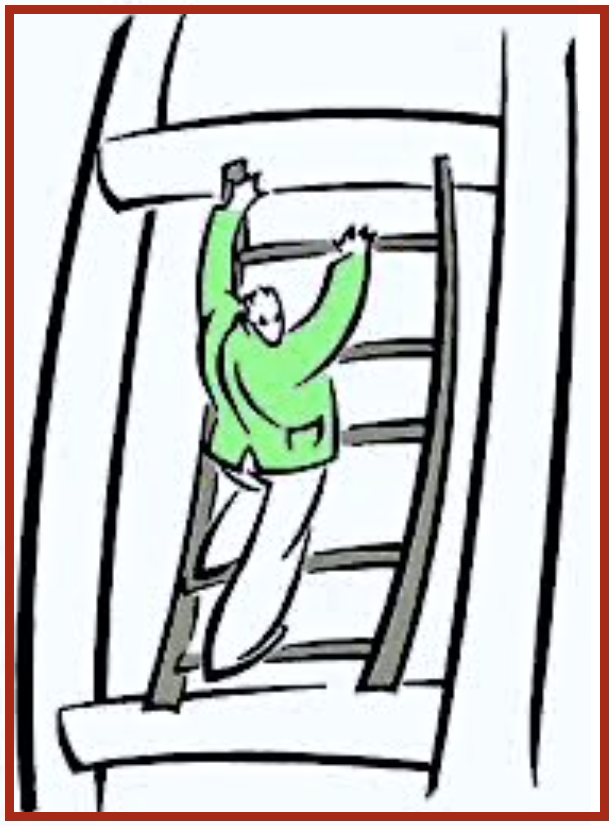
Using the ladder-analogy of making progress, many of us find half way thru life that our ladder was up against the wrong wall the whole time!

Even so, if we’ve been able to scaling the business or social ladder with some success, for sure we’ve done it by our own abilities.
Yet the area chosen may not be what we deep-down wanted, but rather unconsciously a copy of our parent’s work-style, or maybe what was chosen for us by family, or something we’re doing to spite them, or something to show off.

• When we DO have an idea of what to do, ACoAs need to ask ourself:
— “Whose goal is this anyway – my PP, the WIC ?”  When a need/goal comes from either one, it’s not safe to follow through
— OR do I have a strong enough UNIT (Healthy Adult/Loving Parent) to do the very best I can for my True self, overriding the unhealthy voices?

EXPs of some inappropriate goals:
• when the WIC wants that ‘special’ man or woman for themself, but that person is an addict, married, ‘crazy’, &/or just not interested. The child will obsess, chase, cling, beg, or withdraw from life, sulking & wounded, OR be angry & demanding, just wanting-what-it-wantsin live with shrink

• when our WIC thinks we have to become the most powerful / famous person, no matter what it takes & who we step on, & that will get the approval of the PP + the attention / validation from everyone else in the world as compensation for parental rejection – to feel OK about ourself

• when we stay attached to abusive parents to insure getting their money, or an abusive mate to prevent losing security, money, position, sense of identity…..afraid to leave people or jobs, to risk going after what’s most natural for us & would make us happy ….

GOALS that benefit us require KNOWING:
✧ enough about our True Self (which is always there from birth, no matter how buried & denied)
✧ that we’re basically safe, which lessens anxiety (free-floating terror), so we can take reasonable risks
✧ that nothing we do is perfect, can’t be perfect (because humans aren’t) & should not even be thought of in those terms
KNOWING:
✧ there are a variety of options to choose from
✧ and believing in a positive, achievable future for ourself
✧ we’re allowed to follow our own path, even if others don’t approve or understand
✧ we have a right to use our talents, strengths, experience & knowledge
✧ it’s OK to be positively powerful, effective & productive

It’s well known that people who write down their goals accomplish much more than those who do not. But for ACoAs, putting this off not unusual or surprising. WE have to make a determined effort to go against our inertia, perfectionism, procrastination, toxic family rules….. & start somewhere!many choices
For some encouragement: 
In 1979, interviewers asked new graduates from the Harvard’s MBA Program about having written goals:
— 84% no specific goals // 13% had goals, but not written
3% had clear, written goals & plans to accomplish them

In 1989, the same graduates were interviewed
— The 13% were earning about twice as much as the 84%
— Amazingly, the 3% were earning about 10x as much as the other 97%

FROM “Beginner’s Guide to Goal Setting” ~ Michael Hyatt 
1. Only focus on a few goals. Productivity studies show you really can’t deal with more than 5–7 items at any one time. Concentrate on the aims you can repeat from memory

2. Make them “S.M.A.R.T.”: Specific, Measurable, Attainable, Realistic, Timely (Explanation…)
write goals3. Write them down. Even without an action plan – yet – it states your intention & can get things moving (Book…)

4. Reviewing them often turns them into reality. Ask: “What’s the next step to move me toward this goal?”, which can inspire & be part of your daily activities

5. Share the goals selectively. While some authors suggest taking them public, Derek Sivers, in his 2010 TED talk, pointed out that airing your goals indiscriminately makes them less likely to happen. So it’s best to only tell those people committed to encouraging &/or helping you achieve them.

NEXT:  Goals to get needs met #2a

ACoAs – Set GOALS to MEET NEEDS (Part 1b)

lots of ideasPREVIOUS: Getting needs met (1a)

SITE:Understanding Self-Sabotage

POST : Category #2 = “Personality Needs

☀︎ ACoAs Manipulating Self & Others – #1
1. GOALS (cont.)
ACoAs : Needs 
In order to get our needs met we must first identify what those are, have internal permission to pursue them, & then search out & use as many resources as are available to us to  provide them. We can not wait for or depend on others to meet all our needs – others are only meant to be a support & company on our life’s journey – not substitute parents!

While we may not always know what we want to do “when we grow up”, taking any positive action can get our engine started – especially if the activities are things we have been interested in since childhood we stopped or never pursued. Taking a class or joining a ‘topics’ group (such as in MeetUp) may lead us to new ideas, possibilities & friends or mentors.
Setting goals is a fundamental part of getting our needs met, first the cognitive component (idea), managing our anxiety (emotions), & then taking the necessary actions. (T.E.A.)

Most ACoAs either :no needs for WIC
⇒ have a lot of trouble making decisions – we aren’t allowed to know or admit what we really need & want
⇒ can’t afford to risk making a mistake lest we get punished, & we want to avoid being disappointed yet again
⇒ OR make decisions impulsively, without considering results – the possible consequences to ourselves or others – ☂︎ all based on childhood brain-washing.

• So many of our childhood needs were not met – correctly – which left us with the clear message that we’re not supposed to want or need anything for ourself! Even if we did get some Physical ones (roof, food, clothes, schooling….) – which was a plus & allowed us to survive – the good things were undermined by all the neglect & abuse in the other PMES categories, especially Emotional. And for many of us even the P category was contaminated by beatings, incest, lack of basic provisions….

• This damaging background has created a great dilemma for us, a double bind that keeps many of us stuck WE:
a. are not allowed to have needs, especially emotional ones, BUT
b. still have them ALL – we can not get rid of needs – no matter how hard we try to ignore & suppress them!
EXP: As mentioned before, a newcomer to Al-Anon figured out in a 4th-Step meeting that her belief was: “My biggest character defect is my need for love!” WHY? because she grew up feeling unloved, yet still desperately longed for it. Wasn’t it foolish to want something she was sure she had no right to & would never get?  (See “Unrealistic Expectations”)

what goals?• Our childhood experience was of endless ‘sameness’ – the same drinking, the same unfairness, the same neglect, the same loneliness, the same terror…..
NOW we still live as if we have no options.
So to form deliberate, conscious goals is not easy for many ACoAs – even for those of us who’ve achieved some success in career, yet also subtly recreate early family patterns in both work & personal life.
Ironically, most ACoAs are best at what we like to do the least! There is less threat of it being taken away.

As Adults we’re still trapped in the hopelessness of ever being able to reach our TRUE goals, whatever they may be. For many of us, the idea of possibilities was not part of the mental vocabulary in our family , WE:
— didn’t have the option of using our imagination for ourself, except maybe as a way to escape the pain we were constantly in, AND
— used our creativity to figure out ways to keep our parents, siblings, mates, children… from total self-destruction

This makes it imperative to remember “I know what I know”, since we have our own native wisdom! The Healthy Child has always known a great many things which never got acknowledged or have been too painful to remember. Now in Recovery the Good Parent we are developing can listen to our still small voice, available to redirect the decision process to help us get the best outcomes. (See RIGHTS & Self-esteem posts)

Robert Sharma’s 5 Steps for Goal Setting
1. Celebrate: write down – in detail – things you’ve done in the past year you can appreciate yourself for. What are your big AND small achievements?

2. Education // 3. Clarification  // 4. Graduation // 5. Visualization

NEXT: Goals to meet needs  (1c)

ACoAs – Set GOALS to MEET NEEDS (Part 1a)

GOALSPREVIOUS:
ACoAs Manipulating
Self & others, #3b


SITE: LIST of Personal Needs

SEE ACRONYM page for abbrev.


Process
includes 3 PARTS : GOALS, Implementation &
People.
In terms of T.E.A., this topic focuses on the A. (actions), since just thinking (T) about what we want is not enough, althought it is the starting point.  THEN we have to act on our own behalf.
1. GOALS
Psychologist tell us that people who make consistent progress toward meaningful goals live happier, more satisfied lives than those who don’t.

PURPOSE: Goal-setting is absolutely necessary & appropriate in order for us to be  successful – when it’s grounded in our Rights as human beings AND in our own personal interests. Goals are a normal part of Adult thinking, providing long-term vision & short-term motivation.
Clearly defined goals:
bulls eye- goal• potentially minimizes procrastination & confusion (but doesn’t eliminate it, since they still has to acted on)
• can help to organize our time & resources
• let us know what additional info we need to gather, if any
• allow us to observe & acknowledge progress as we go along, even if the process is hard work & it takes a long time to ‘arrive’
• help us measure & take pride in successful outcomes, which raises self-confidence

Before taking an action, especially when the outcome is important to us, the questions we need to be clear about are : —> “What is my surface goal? then —> what’s under that? & then —> what’s my motivation? then —> under everything, what’s my deepest, perhaps unconscious, desire/wish/hope in this situation?”
Every action we take – or inaction – is driven by a goal – to find food, to not get fired, to buy something we want or need, to hang on to a relationship, to avoid pain, to please an authority, to learn something new, to entertain ourselves, to express creativity, to be accepted, protect loved ones……
and all goals are based on some need, normal human needs such as acceptance, attention, achievement, comfort, connection, knowledge, love, safety, shelter, validation….. needs in all 4 PMES categories.

Each action aimed at reaching a goal:
• is a decision, often unconscious (3 Posts)
• which is based on our individual idea about how to achieve that (procedure)
• which in turn is formed by our most basic beliefs / rules about ourselves & how things function in the world.

EXP: Goal : To cross the street
〰️ Beliefs / rules — I can get to the other side safely, always look both ways, don’t run into traffic or you can get hurt or killed, jay-walking will get you a ticket (in some places), if you’re with someone else make sure they’re safe too …..
〰️ Procedure – Stop at the corner, wait until the light is green, then go

• Appropriate goals & healthy ways of achieving them are based on knowing who we are & our Human Rights .
Recovery EXP: 15 minutes before an evening lecture in a big auditorium a janitor is buffing the front vestibule floor, with the door wide open – so the noise is quite disruptive to the waiting audience. Bev goes out to ask the man to close the door. He completely ignores her, even though she stands there briefly to make sure he’s heard her. Nothing. She goes back to her seat. A minute later a man from the audience does the same – & the janitor closes the door!

noiseQs: ACoAs – If you were Bev:
— How would you be feeling – anger, resentment, S-H, shame…. ? and,
— What would you be thinking? “That <**☹︎**>, how dare he ignore me?…. / I should have been more forceful / I shouldn’t have bothered him / he’s a chauvinist pig….”
— Would your goal have been to get the noise down PLUS be validated, respected, honored – as a female, by a hostile male?

What was Bev’s goal? ONLY to dampen the noise. She was willing to make the effort, which was appropriate, but how it got done did not matter to her!
When we function from our True Self, with enough validation & support in our life from ourselves & from legitimate sources, we don’t try to get it (or demand it) from people who can’t or won’t give it!

NEXT: Getting needs met (1b)

ACoAs MANIPULATING Self & Others (Part 4b)

in chargePREVIOUS: Manipulating #4a

SITE: TED talk by Dan Pink : The puzzle of motivation 

See ACRONYM page for abbrev.


RECOVERY
Manipulation consists of 3 basic parts, a negative effort to fill-in the missing 3 positive needs of Safety, Belonging, & Mattering:
a. Scheming – To get, get out of, or have someone else do something
b. Calculating – Being dishonest, devious, conniving
c. Controlling – Wily, sly, crafty

Of course
– many ACoAs will rigorously deny using these tactics, especially a & b, especially those of us who feel powerless & depressed. But S-H, co-dependence, boundary invasion, lying, withholding….. are definite examples of them

REVIEW of Recovery Tools:
To grow, these harmful & useless patterns need to be addressed honestly (like the AA / inventoryAl-Anon 4th Step or other inventories), to keep track of how we manipulation ourselves & others.

More than likely we’ll need help identifying behaviors & attitudes, since they’re so deeply woven into the fabric of our daily lives we don’t even realize what they are. “Does a fish know it’s wet?”

Then going on to Step 5, we can begin overcoming shame & loneliness, by speaking out loud the specific ways we’ve been using this defense ‘game’. Program has a saying: “You’re only as sick as your secrets”, so sharing our 4th Step is important, if it’s done with compassion, in the right place, with safe people.

All manipulation is a way to con ourselves into believing we should not have any needs, while conning others into providing them (or we do without) – because we can’t eliminate having them! SO, in order to heal:

• In every situation – start by remembering you have one or more needs, on different PMES levels. Identify them – first on the physical level (help to pick out a present, cleaning the house, getting a job, health issues….), & then on a deeper level – the emotional need (validation, comfort, respect, support…..).

This is only do-able if we accept that all our needs are legitimate, & then practice providing them, both from ourselves & from appropriate outside sources

• Use book-ending to prove to your WIC that getting your needs met now IS possible.
As adults, our efforts are successful more often than not – as long as we “go to the food market for food rather than the hardware store!”take astionc

• Be willing to sit with uncomfortable Emotions your WIC feels, when you:
— ask for help AND get it!
— try on a new behavior
— take better care of yourself
— stop an old pattern …..

• Build self-esteem – changing S-H messages into compassion, patience & self-kindness. If you KNOW you’re a worthwhile person, then you KNOW you have a right to your needs

• Make a daily effort to go to the right PPT for help to get your needs met legitimately – in non-exploitative ways

• Accept – graciously – that sometimes people can’t provide what you ask for – either at that specific time for their own reason – or not at all, because they don’t have it to give.
This is not a reflection on your worth or how they feel about you. Nor does it automatically make them bad or selfish. Either wait until they’re available, or go find another resource.

SOME IDEAS to WORK ON: GO —
FROM “I want everyone else to do what I want” all needs
TO “Others have the right to do things their own way”

FROM “Everyone is or should be just like me”
TO “I can see that others have their own identity separate from mine, who deserve as much respect & care as I want for myself”

FROM “Everyone else is only a source for provide my needs”
TO “I admit that others don’t owe me what I didn’t get from my family”

FROM “Everyone else is the solution to my problems”
TO “I’m responsible for finding answers & solving my problems”

FROM “Everything is THEIR fault”
TO “I’m responsible for my own actions”

FROM “I always have to be right, about everything”
TO “I can only know what’s right for me at this very moment, & it’s OK to be wrong, or not know something

FROM “I have to have my way, or else (I’ll die or I’ll kill you!)”
TO “I take care of myself, so I’m rarely desperate”

FROM “I’ll do anything to keep others from being angry at me (experienced as abandonment = separation, aloneness & death)

TO “Other people have a right to their emotions, including anger. I’m not a helpless child anymore. I have experiences & options – to take care of myself – even IF the other person temporarily withdraws, or is permanently gone.”

Manipulation is NOT a successful way to survive & feel safe.

NEXT: Goals to Meet NEEDS #1

ACoAs MANIPULATING Self & Others (Part 4a)

re-frameMPREVIOUS: Manipulation #3c

SITE: Response Options to a Controlling/ Manipulative Person

See ACRONYM page for abbrev.


RE-CAP – Manipulation (M) is the resort of :

a. the legitimately powerless (consider Children, Women, Poor & homeless, the Chronically ill, Minorities….), usually in small ways

b. anyone who internally believes themselves to have no options (the Learned Helplessness of ACoAs, addicts, victims….) BUT who actually do have the capacity to empower themselves – with the right help & persistent work in Recovery

c. AND, ironically, high achievers who’ve clawed their way into positions allowing them to be high-level manipulators, usually on a large-scale.

MOTIVATION: By definition, such people shouldn’t need to manipulate – their whole life is about getting exactly what they want, BUT at any cost.
These externally powerful bosses, politicians, parents, church leaders, salespeople…. have to be one-up, using every dirty trick in the book

This tells us that the seemingly ‘lucky ones’we envy also grew up in very damaging circumstancsuperiorityes, leaving them with a great need to compensate. Hidden under many layers of intelligence, determination & deviousness, they do not feel OK ‘just as they are’, with both strengths & limitations, so they rarely let their vulnerability show, even to themselves

They’ve suppressed the awareness of their basic needs (safety, unconditional love & acceptance, mirroring, help….. AND having emotions!), which they consciously consider as weaknesses.
Instead they settle for being feared, having power of others, looking good on the outside, & accumulating as much money & ‘stuff’ as they can manage.

So like the rest of us, whatever childhood needs were punished or neglected – will become the focus of their life’s activities, & how those are expressed will depend on their individual native personality, combined with the social environment of their upbringing.

M. RE-FRAMED
a. In order to change the need to manipulate, we need to start by identifying our specific ways of ‘getting over’, looking at the harm they do when used, & their long-term effects

b. Instead of simply considering Manipulation as an evil thing (motivation ideasbad, arrogant, narcissistic), we need to also understand it as a defensive maneuver. It’s used by the WIC in an attempt to provide for itself what our family & community should have but didn’t.
We began using it to survive as kids, & we’ve continued it as adults, fed by toxic family messages & bad examples.

c. On the surface this character defect is made up of conscious or unconscious BEHAVIORS, but to get anywhere we need to focus on MOTIVATION, rather than on visible actions.
Motivation is goal-oriented energy which moves us to action, using mental focus & physical exertion to reach specific outcomes.

Motivation Types
1. PRIMARY / basic = unlearned & common to both animals and humans (food & shelter, sex, fear & aggression, avoidance of pain….)
or SECONDARY / learned = which can differ from person to person (need for achievement, need for power….)type of motives

2. EXTRINSIC M.= when somebody else tries to make you do something
or INTRINSIC M. = when you want to do something

3. PULLING M. = external goals that influence how we act in order to achieve them
or PUSHING M. = internal changes (emotions, beliefs, hunger, illness….) that trigger a specific desire to act

4. POSITIVE M. = having the desire and the willingness to get or achieve something good
or NEGATIVE M. = to avoid undesirable or threatening situations

As for all human being, our primary motivation is survival – in any way possible. And for ACoAs – the over-riding need is for SAFETY – by avoiding possible abandonment & punishment (which feel like the same thing!)

SAFETY, BELONGING & MATTERING are essential to good brainbelonging functioning, allowing us to live well:
• the greater the feeling of safety, both emotional & physical, the more easily we can take appropriate risks
• the greater the feeling of connection with others, the more we can feel we’re in this together & belong
• the greater the feeling that we personally matter, that we can make a difference, & are contributing to the greater good, the greater the success in all parts of life (MORE….)
SO, since our upbringing did not provide us with these 3 fundamental needs – manipulation is the way we think we’ll be safe. Unfortunately it doesn’t work!

Motivation: The Why’s of Behavior(7 theories)
Study of Motivation”(Scroll down)

NEXT: Manipulation #4b

ACoAs MANIPULATING Self & Others (Part 3c)

in your head PREVIOUS: Manipulation #3b

SITE: 8 Ways to spot Manipulators

See ACRONYM page for abbrev.


Manipulative TACTICS (cont.)
Foot-in-Door
Start by asking someone for a small favor they don’t mind doing, then when they’re in the middle of it, add on other things or ask for the big thing you really wanted – making it hard for them to say nofoot in door

Guilting
Telling a conscientious victim they don’t care enough, are too selfish or have it easy, to keep them in a self-doubting, anxious, submissive position. OR make someone feel bad that you don’t have qualities, people or things the way they do (you’re jealous /envious), so they’ll feel sorry & volunteer to help you

Judgmental – the (T) form of T.E.A.
— all the time about everything, which is narcissistic
— occasionally, when old abandonment terror is triggered by a person or situation, but you don’t recognize it’s a reminder of childhood neglect & abuse

Mirroring (negative)
Physically &/or verbally copying someone you want to influence, by using their same body language, intonation pattern, language, preferences… making them feel ‘seen’ – so then they’ll copy you (symbiosis)

Over-promising
Saying yes to anything asked of you even when you’re not interested or it doesn’t suit you, & you don’t have time anyway – just so you’ll be liked. You over-book & then forget or cancel at the last-minute

One up-One Down
a. Feel superior – morally better with more value as a person, rather than being better at certain things (not just having a higher IQ), in order one upto keep everyone away, & not acknowledge your need for connection, help, comfort….

b. Feel inferior, believing you’re worse than everyone else (weaker, dumber, less capable….)
— to stave off assumed inevitable abandonment, disappointment AND
— obeying Toxic Rules “I am unlovable” / “I’m too much trouble” / “Don’t have needs”….
— living in deprivation, trying to get others to meet your needs

c. Fake humility – hiding the compulsion to dominate – by being the servant, helper, assistant, perhaps to serve a ‘higher cause’…. while controlling things from the wings

People-Pleasing / Perfectionism
Constantly trying to be or do whatever others want, or what you think they need/want, going above & beyond what’s called for or expected. Make yourself indispensable so they’ll approve of you & never ‘go way‘

Victim
Put a burden on others to be the ‘good parents’ you never had, BY:
• dismissing your own ‘voice’ & not taking up enough spacevictim
• going along, suffering in silence – but others can feel it
• give up what you want to avoid conflict, but are quietly resentful
• don’t ask questions, but always trying to explain or defend yourself
• talk in indirect or convoluted ways, instead of declarative statements
• withholding, as a form of silent disapproval
• believing you have nothing worthwhile to contribute……

COMBINED Manipulation of Self & Others
Taking on the Scapegoat Role as a child (NOT the same as being scapegoated by the family). It’s the child’s attempt to spare the obvious narcissist / addict their pain, by taking it on & acting it out for them – assuming this will alleviate the heaviness it can feel in others.
It’s a way the child denies admitting that the abandoning adults are as sick as they are & not willing to change

This manipulative tactic (usually unconscious) continues into adulthood – the ACoAs continuing to sacrifice their own needs, good name & protect familystanding in life – if it will make others ‘feel better’ by avoiding responsibility for their own damage

On one level this Role is genuinely taken on in the name of love, but at a deeper level it’s about the fear of losing connection, the ultimate childhood terror.
Unfortunately, the sacrifice is never successful or unappreciated, only being disrespected & dismissed. So when the Scapegoat is treated badly or ignored, this ACoA gets very angry at anyone they’ve been trying to ‘save’.

Adult Scapegoats only focus on being rejected or & invisible, left outfeeling unloved, excluded, attacked – BUT not seeing that they
— allow themselves to be used & toyed with by unscrupulous types
— experience real or imagined slights as a direct rejection, as if others are focus on them, or hell-bent on hurting them
— perpetuate childhood environment of fear, loneliness & abandonment BY not having a strong core identity based on self-esteem & self-respect.

NEXT: Manipulation #4a

ACoAs MANIPULATING Self & Others (Part 3b)

juggling peoplePREVIOUS: Manipulation #3a

SITEs:☀︎ 20 Subtle Signs of Workplace Bullying
☀︎ “Workplace Danger – Manipulative People”

BOOK: 30 COVERT ways of M. ~ Adelyn Birch


FORMS of Manipulation (cont.)
1. Direct / Overt (Part 3a)

2. Indirect / Covert
A more subtle form, tactics (Evasion, Diversion, Blame….) are effective because they carefully hide aggressive & exploitative intentions, while putting the other person unconsciously on the defensive.
— Sometimes all it takes is a particular facial expression, non-verbal gesture, glance, glare, stare, or shrug
— Sometimes the manipulator will send a carefully veiled “Now there’ll be some hell to pay!” message without making any kind of direct threat

ACoAs
As stated in Part 1, M is an attempt at getting our needs met, but only indirectly, because we’re not allowed to HAVE them (shame is what we feel about each need never provided by our family). Back then, trying to get anything we needed always ended in being made fun of, punished or completely ignored.
BUT since needs are NORMAL & therefore don’t go away, we look for alternative ways of meeting them, while still obeying the toxic rules – putting ourselves in a double bind.

Manipulative TACTICS
Avoid Asking
Expecting others to guess what you need & then provide it. When they don’t – not being mind-readers – you feel very angry, get depressed & assume the ‘universe’ doesn’t want you to have the needs

Bribery
First you reward someone by identifying what they want/need & give it to them, acting like a ‘genuinely’ nice person. Then later pleasantly suggest you’d like something in return. They’ll usually feel compelled to return the favor

Bugging / Pushypushy
At the other extreme, always nagging to get what you want, repeating the question, requesting or demanding, insisting…. to wear others down until they finally give in. Can’t tolerate NO as an answer, & constantly over-step boundaries

Charm / Good Looks
Use your best assets to encourage people to favor you over others (work, dating, purchasing…) by being positive, cheerful, self-confident, well-groomed, with approachable body language – to make them feel special for having your full attention

Conditional Approval & ‘love’
You’re kind, pleasant, helpful – but only if they’re just like you. Want what they can do for you, let you control them…. But get angry or withholding if they disagree, set limits on you, stand up for themselves, won’t go along with your agenda….

Dishonest watching & listening
Pay close attention to what people tell you about themselves & their body language, figuring out their psychological/emotional makeup, in order to identify weakness or strength you can exploit

Distorting Facts
Manipulate info & reality by making it seem better than it is. OR leave out crucial info in an explanation, use info against the person, overwhelm with facts & statistic, lie, make excuses, exaggerate, act like you know everything…. to avoid responsibility & feel more powerful

double-BDouble-Binding
Keep someone who wants to please you in bondage (paralyzed) by subtly giving opposing messages they must obey or accept without question, to keep them confused & off balance (EXP: smile while insulting)

Exploiting
Use other people’s time, energy, money, talents – only for your benefit – by convincing them it’s for a good cause, will make them feel good, will provide ‘spiritual benefits/rewards…. or by promising some big reward while ignoring their rights & interests

Fake Emotions
Use contrived emotions to get what you want & have the upper hand, by acting angry to scare someone, solicitous to soften them, caring to keep their attention, weak & needy to get taken care of, insulted to create guilt…..fear & relief

Fear-&-Relief
To get someone to do what you want but is resisting, you artificially create sudden mood swings, by first working on their fear (disapproval, threats to leave, withhold money….). When when they’re weakened & disarmed, ready to give in – you stop the pressure, tell them it’s OK…. which makes them so relieved they’ll do whatever you want

Flattering / Kissing up
Making others feel good by complementing them, acting totally interested in their lives…. so they’ll want to please you. It makes it hard for them to say NO, even against their better judgement, so you won’t be disappointed or think badly of them

NEXT: Manipulation #3c