Double BINDS – Logical Types (Part 3b)

DB mouse trapIT’S A MOUSE TRAP
& I’m the mouse!

PREVIOUS: DBs, #1


🧩 REVIEW (3a)
♨️ SENDERS
💢 RECEIVERS (Rs)

🧩 LOGIC TYPES (cont)
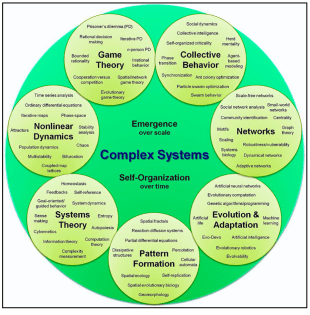
DBs are best understood in a larger framework, as part of Cybernetics & Complex Systems Theory. It shows the inter-dependence of message components, providing an order to what looks like chaos (if you’re a Newtonian). The mind itself, & therefore human communication, functions inter-actively, like all ecosystems  CIRCLEs ⬇️

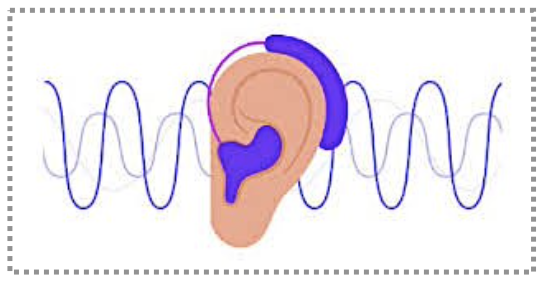
NORMALLY, context & body reactions (meta-language) allow participants to decipher the kind of interaction they’re part of – not just the ‘words’.
EXP: As two puppies are playing, they growl & nip at each other gently. But their tails are wagging & their ears are NOT back.
Lower level message: “I am threatening you – I will bite”
Higher level : “This is play- fighting – I won’t hurt you.”

IMP: ‘Levels’ is a common metaphor for arranging experience. Lower levels are defined by more specific examples of higher levels.   (Explanation)

IN CONTRAST – DBs are based on Level-confusion, the contradictory statements being expressed on different Logical Levels of Abstraction (higher/lower) in ‘orders of message’ sent – causing the bind. Are you confused enough? (MORE…..) 
EXPs
:
✦ Paradoxes are a special kind of contradiction, where the incompatible statements exist on different “logic levels” – one of them being part of the context of the other – which is a logical no-no.

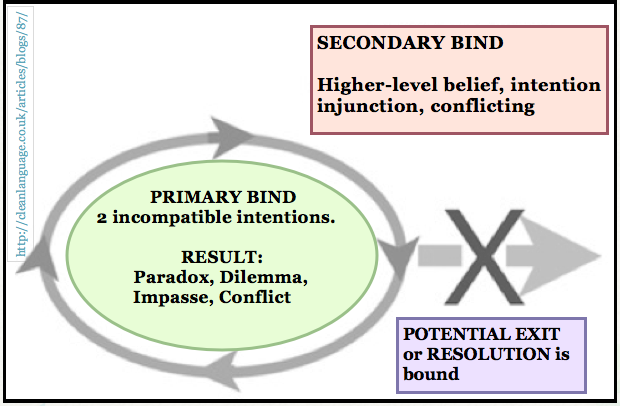
✦ A lose-lose evolutionary DB is the rhino horn – meant for protection & to enhance ‘desirability’ for procreation. But the very same feature has caused their near extinction, the horn being harvested for the human desire for sexual potency. Ironic, since it only works for the rhino! CHART ◀️DBs No exit
Another lose-lose DB, in “Alice in Wonderland”, exemplifies the needs of the individual and its physical characteristics being mutually incompatible, one on a more abstract level than the other:  A: If the bread-&-butter fly, which lives on weak tea with cream, does not get its food, it dies.  And / But –
B: If it does gets its food, it dies, because its head is made of a sugar lump, which will dissolve in the tea

MORE Confusion: If a R objects to or ‘outs’ the distortions inherent in a D. Message, the Sender can reinforce the DB by disqualifying the person, making the R’s objections seem unimportant & therefore to be ignored (from 32 DBs….. )
BY:
• negating the whole discussion, or evading it in some other way
• twisting the meaning or context of the objections
• changing ‘reality’,  by doubting the validity of the objections
AND reminding the R who has the power: S claims to have a higher status, so what it says is of higher value. (More DB from NLP Institute)
• Q & A Confusion: Head-scratching is inevitable when a Q. is asked on one logical level but answered on another. This is the basis of much humor.

• Abbott and Costello’s routine “Who’s on First” works on two levels of ‘orders of message’ at the same time, incorporating Lower-order (literal) & Higher-order meaning (implied).
This is NOT a Q, only a statement of fact, but is heard as a Q, so the response is another Q (“I don’t know, who IS on first?”).
If said in a direct way, the higher-order Q. would be: “Who is the guy on first base?” & the lower order A. would be: “Mr. Who is on first base.”

• ACoAs – Discrepancies in Levels of Communication is one reason we go BLANK when someone responds to us from a different Logic Level than the one we’re coming from, or says something completely out of context. (TA’s Crossed Transactions, scroll down)

We were taught to not pick up on twisted communications, which has nothing to do with our intelligence. We know these people are ‘off’’, but not having learned to ‘hear’ distortions, we’re stumped!
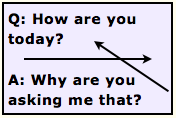
levels of logicSadly – we may realize it later & think what we could/would have said, but then it’s too late to defend ourself, or point out the inconsistency or ask for clarification. It can be very frustrating & enraging – but never let it take you all the way to S-H!

In this example ↖️, some responses :  “You just asked another question” , “That’s not an answer” , “What’s wrong with my Q?”,  “I’m interested / curious / worried…..”

In other word, we don’t have to be stumped or blank out. By not giving up or disappearing (on ourself), we may get useful / important info about the other person – OR we can decide to withdraw as an act of self-care, if the person is hostile or consistently unable to communicate. We don’t have to chase the unavailable, but also don’t have to take it personally!

NEXT: DBs – (Part 4a)

Double BINDS – Logical Types (Part 3a)

PREVIOUS: DBs, Part 2


💟 PROCESS in Childhood (Part 1)

🧩 REVIEW
♨️ SENDERS (S)
S create DB, some unconsciously or ‘accidentally’- copying their own early training, others quite aware & unscrupulous about using it on their targets. The key to controlling a person or group (cleverly) is not by overt domination, not by forcing someone’s mind to do what it doesn’t want to do, the same as with hypnosis. (see DMs #2)

Rather, it’s by taking advantage of the paths the mind normally wants to go down – like teaching an animal to do tricks using what comes naturally to them. Once a person or group’s thinking is understood, DBs can be applied to making them compliant.slpit

✦ DBs are designed to chronically bewilder, a devious way to control without having to be overtly forceful, in order to keep a Receiver (R) attached & do whatever the S wants.

This usually start with seduction – the emotional carrot on a mental stick. The S offers some bait to set the trap in the form of a (short-term) benefit to the victim.
Rs who are too trusting, ignorant or need to ‘believe‘ find out too late that the carrot is poisoned – the benefit comes with a blindfold & a gag! By then it’s much harder to get out of the snare – BUT not impossible.

• D.binding manipulation works because – while people feel an internal pressure to act on their survival instincts – yet they will follow powerful ‘others’ even when it’s at odds with those instincts.
External pressure can come from a peer group, an anonymous mob, national leaders & laws, orders from superiors, expectations of family & friends, or blindly obeying someone’s personal version of God & Scripture.

We ‘allow’ ourself to be swayed because of the Inner Child’s conflict between autonomy & attachment (DBs – Part 2). Any need or belief whipulled apartch compels people to feel locked into a particular course of action — leaves them open to being misled. IF there seems to be no choice, the pre-planned “fate” devised by someone else is accepted unchallenged.

• There are as many variations of the bind structure as there are unhealthy egos.
One way to categorize the Game sequence is:
> conflict, dilemma, impasse, paradox (More….)
Another is:
> withdrawal, aggression, superiority/ inferiority, authenticity/ bullshit

🧩 LOGIC  TYPES**
💢 RECEIVERS (Rs) 
of DMs are inevitably torn between the demands of conflicting ‘logic types’ in communication. They find themself in a painful & enraged state IF they try to understand & please a Sender, because no matter which way they turn, the R is not just continually mistaken, but also always bad

• All messages are made up of words ++ a context which modifies them (DBs, #1), so identifying the level of each statement becomes especially important when one can not tell if it refers to the whole set or some part of it.
EXP: When speaking of ‘man’ – is it about one male human (lower level = narrow focus), or humanity as a whole (higher = wide focus)? (LEVELS…..)

**Logic Types: a category of Bertrand Russell’s hierarchy, where any Class of objects (Animals) is identified as a higher logic type than the elements of that class or set (cat, horse, koala…. (DMs, #1)
Higher = INCLUSIVE – ocean // Lower = a group in the overall idea – shoals // Lowest =  individual parts of the whole – fish

EXP: ‘Context’ (the forest) is of a higher logic type than ‘Words’ (the trees). Likewise, the word ‘cat’ cannot scratch you but the animal can, so the word ‘cat’ & the actual cat are of two different logic types.

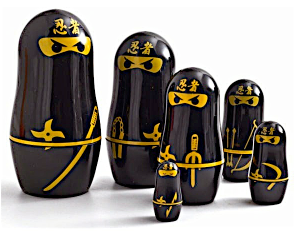
✦ According to Bateson, every organism is in its own specific “context”, not just as background, but shaping & shaped by it (family, education, religion….). ninja nesting dolls
That context is embedded in a larger one (ethnicity, nationality, social class….), which in turn is related to its own context as well as still wider ones (country) – like stealthy Ninja Russian Nesting Dolls – into infinity. (‘Frames”, DBs #7).

Therefore D.Binds can be understood – but not embraced – if one steps back to look at the bigger picture.
EXP: We’re not just the genetic product of our 2 parents, but of their parents, & they of their parents…… as well as by the effects of their environment on each family member who preceded us.

NEXT: DBs #3b

Double BINDS – Origins (Part 2)

Screen Shot 2015-09-21 at 4.31.29 PMI NEED TO LEAVE
but I have to stay……”

PREVIOUS: DBs, Part 1

SITE: “Double Bind Theory: Still crazy-making after all these years”


🌀 Types of BINDS (Part 1)

🚻 In PSYCHOANALYTIC Terms 
The ego’s unconscious intentional structure has the “logical form” of a double bind.
Everyone’s original DB is the un-resolvable early childhood conflict between —> staying connected to or leaving the protection of the mother. It starts out psychologically, but later also becomes physical.

It’s a pull between attachment & safety vs separation & independence. Whichever the young child wishes for at any given moment, it will experience fear & a sense of loss.
It’s the need TO:
a. STAYING under the mother-hen’s wings, for safety & warmth.
But if the child stays too long, it can’t develop the crucial S & I  of maturity. Symbiotic clinging will result in anxiety, because suppressing a legitimate need for autonomy creates a constant fear of completely losing one’s identity & freedom. The outcome would feel like ‘death’
AND ALSO 
b.  the need to develop one’s own identity requires ‘LEAVING’ – but not too early in life! Total separation also causes traumatic anxiety – the terror of facing a vast alien world alone, unprepared & helpless. The outcome would be ‘death’ to a small child.

In healthy families, this dilemma gets (more-or-less) resolved for the child by being given a balance of loving availability & personal freedom. ⬇️ CHART for details = Great info, like how injury blocks consciousness….
«

«
RESULTS
of the attachment-separation dilemma start in infancy. Once set in motion, they continue underground into adulthood, until hopefully brought to consciousness & resolved.
If not, as adults we’re vulnerable – via the WIC – to be manipulated by unscrupulous or unaware people who tap into the original DB.

💟 PROCESS in Childhood
1. Not able to decide on either unbearable alternative (be free vs to stay), the infant’s MIND develops the Super-ego (SE), a judgmental voice of the Ego-Self that’s been captured by the BIND.
>> It then creates a second layer of psychic binds (bondage) – the demand to always ‘be good’.  If the child gives in to the ‘voice’, it’ll feel weak & enslaved, but if it rebels, it’s stung by guilt

2. To counter the power of the inner Judge (SE’s too-ethical perfectionist), the subliminal censor generates another voice – the id, =‘evil SE’ Rager – demanding that the Ego-Self throw off all social conventions & appropriate behavior.

In adults the Rager might say: “Tell the boss to stuff it, have another drink, don’t pay your bills, cheat on your spouse….”. It viscious cycleenjoys the delicious feeling of power that comes from sticking it to the overbearing Judge…..  so the Rager scores.

3. BUT defiance scares the child’s id, worried about losing its connection to the only internal caretaker (SE) it knows, which would cause a psychic collapse (death).
ADULT – this attitude leads to self-punishment, dictated by the Judge, such as isolation (from shame), sabotaging daily functioning & plans, physical suffering or injury, in trouble with authority…. so the Judge scores

4. The vicious cycle continues. To keep from crumbling, the Rager takes over again, & in adults it’s reveled in antisocial / immature behavior, like missing work or avoiding other unwanted obligations (even sexual) – but also causes depression, migraines, being fired….
Score-points go to the Judge, who gets double points, as it enjoys punishing Rager with the pain it causes as punishment

🦠 But the Rager rescues / ‘soothes’ the Self with remedies, such as drugs that otherwise would not be allowed by the Judge…..mental games
— so the Ego-Self finally gets to score a point too – by numbing out.  Everyone ‘wins’, right??
BUT  the Bible reminds us : “What does it benefit a man if he gains the whole world but looses his own soul?” Mark 8:36

COMMENT: This unconscious game is how most people function, wondering why they haven’t fulfilled their dreams or found happiness.  Unresolved, it can turn us into damaged Senders or Receivers, limiting the True Self which is mostly free of internal or external coercion
• We may say “I never play games, I like to be direct.” Unfortunately most of us DO (4 outlined on acoarecovery.com), but they’re so incorporated into our daily relationships & spread over a lifetime, we don’t recognize them.

NEXT: D.Binds (Part 3a)

Double BINDS / Basics (Part 1)

DB sanke I DON’T KNOW WHAT TO DO – I’m all knotted up!

PREVIOUS:Double Messages (Part 8)


QUOTE: “No problem can be solved from the same level of consciousness that created it.” ∼ Einstein

NOTE: This set of posts is a continuation of the Double Messages series. Please read or review those first.

🌀DOUBLE BINDS (DBs)
a. In the D.Messages posts, we looked at one side of this harmful transaction – mainly that of the Sender. All the basic components are the same for DBs, except for the crucial difference – now the focus is on the Receiver (DMs, #2).

Eric Berne’s student Claude Steiner, in “Scripts People Live” showed how Senders & Receivers play an interactive game, each gaining points (Negative Benefits) – so the S is always in charge, while the R is always the victim & stays dependent (no S & I).   ➡️ IMAGE article re. DBs

b. The other side of the DM transaction is the Double Bind. One way the R gets hooked is when —
📣 they’re told specific words, while
👞 the accompanying actions or non-verbal reactions
🔕 directly contradict the  words that were said .
EXP: A mother screams at her child “I love you, and you’d better believe it or I’ll leave!”

• D. Binds are created by D. Messages as logic fails, Boolean questions** (in 3 parts) being asked in binary terms (in 2 parts). That doesn’t work.  A person is presented with a 3-way, no-win situation: You’re damned if you do / Damned if you don’t, and / Damned if you notice that you’re damned either way

**Boolean Logic: the main operations are the conjunction ‘and’, shown as ∧, the disjunction ‘or’, shown as ∨, & the negation ‘not’, denoted by ¬ (More…), which correspond to the 3 major components of the DM. (DMs #3)

• Accepting or trying to deal with DMs leads to a great deal of angst, causing the R to think:
Re. Actions: “I must do them both, but I can’t, but I must, but I…. If I don’t then I’m really bad!” OR, in other cases
Re. Emotions: “I have to make sense of the 2 demands / expectations, but they don’t make sense, but I have to, but I can’t … I must be crazy!”
♦︎ SOLUTION : Since DMs are inherently irrational & impossible, they must NOT be honored, which then eliminates the D.Bind

🌀 TYPEs 0f D.BINDs
CONFLICT : A struggle between equal but opposing forces (intentions). 
”Part of me wants to and part of me doesn’t.”
DILEMMA: A situation requiring a choice between 2 equally (un) desirable alternatives.  “I’m in trouble either way.”
IMPASSE: A situation where the intention to progress is stopped by a difficulty which can’t be overcome.  “I keep banging my head against a brick wall.”
PARADOX: A self-contradictory statement(s). 
”My head aches from trying to stop you from giving me a headache.”  (More….)
Also see chart in DBs – Part 2

EMOTIONAL Bind patterns focus on giving you the illusory choice of how to feel. It’s less obviously harmful but still manipulative, & confusing:
a. Which chair would feel better, the soft one or the hard one?
b. Would you feel better if I ignored you or talked to you?
c. Which restaurant would you enjoy eating at, Olive Garden or Red Lobster?…..
>> The manipulation is the limiting of your physical & emotional choices.

Qs presented in binary form (either-or) eliminate the larger truth – that in reality you have several other possible options, like – MAYBE YOU :
a = would rather stand than sit, OR perhaps leave
b = are not interested in me either way, OR maybe prefer to talk later
c = don’t like Italian food OR chain restaurants, OR not hungry

NOTE: You’re not in a bind if you’re ‘allowed’ to speak up, object or offer a 3rd choice.
However, if you don’t go along with the other person’s suggestions, and they get angry, act hurt, plead, whine, make you feel guilty, threaten to leave…. you’re being offered a DB.
💪🏽 Stick to your guns, don’t fall for it AND don’t feel bad!

NEXT: Double Binds (Part 2)

Double Messages – RESULTS (Part 8)

 PREVIOUS: DMs – (Part 7b)

⬆️ “Learned Helplessness“ = Designed & Created by DMT,
Theme #39 : THERAPY

SITE: The Power of Vulnerability

BOOK : “Healing the Shame that Binds You”, John Bradshaw

OUTCOME of Double Messages (DM) – which cause Double Binds (DB)
HINT that we’re in a DB:
🌀You compulsively over-react to a DM communication, & are surprised by your behavior – like being in a trance – “I just wasn’t myself.”
✂️ AND the sender (S) blames you for the conflict that often results,
❓ BUT you can’t see how or why you caused it. You become frustrated, distrusting the sender, (“What DO you really mean / want?”), but distrust yourself more (“What did I do wrong?”)

We don’t realize our reactions are normal & appropriately it the situation. While we are in fact a temporary prisoner – not the creator or cause –  it is the very thing the S wants us (R) to believe.

BASIC RESULTS of DMs – we believe THAT:
1. I’m crazy – what’s really going on here?crazy/stuck
> Can’t decide what’s real – leading to ‘pathologies’
2. I’m at fault – I’m always causing problems in this relationship
> Can’t step out of the attachment to the significant other (S)
3. I’m stupid – can’t figure this out, no matter how hard I try.
> Can’t understand the META-communication (subtext & cues to get the real meaning)
4. I’m stuck – whichever way I turn, I can’t move
> Can’t withdraw from the situation or see a way out

IN IT : DMs generate the excruciating feeling of SHAME 
Brené Brown  in her (TED Talks reminds us that shame comes from the belief that our essence is bad – which means our needs – & therefore unworthy of acceptance & belonging.  The problem is that we still believe this as adults (Part 7b).

ESCAPE
 To outgrow the DM trap, we need develop Emotional Resilience.
• No matter how it got started, anyone caught in a DB suffers damage to their ego – i.e self esteem.
While various kinds of therapy are vital to healing, being able to bounce back from trauma & the resulting grief can also be encouraged by supportive friends, family & a spiritual community.images

Shame separates us from those rich sources of help. It makes us distrust & judge ourself, disconnecting us from our intuitive wisdom. DMs make us doubt our sanity & basic value, so we hide parts or all of ourself by withdrawing emotionally &/or physically from the very relationships that would nourish us.

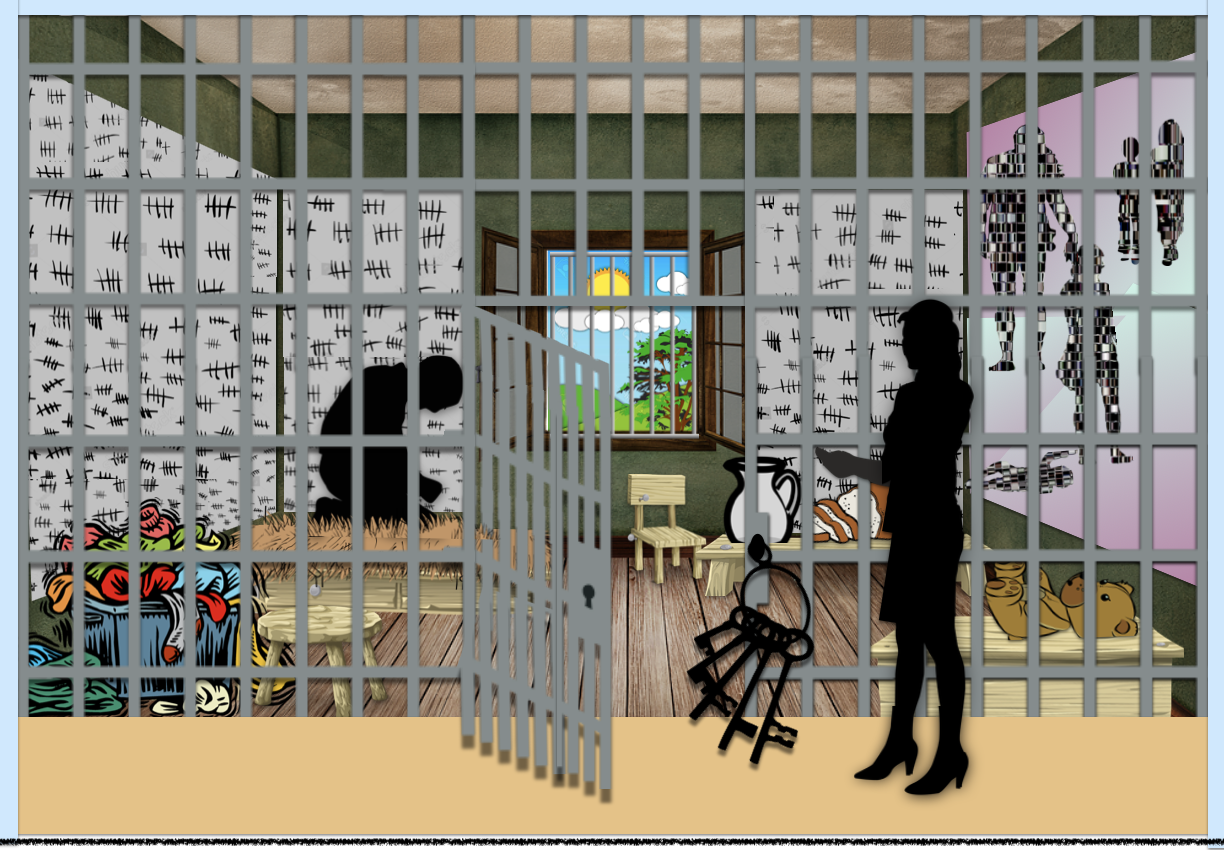
• “Learned Helplessness” : In a classic study (U. of Penn, 1960s) animals were repeatedly hurt by an electric shock when trying to get out of a locked cage. After many attempts, the animals stopped making the effort.
Eventually the experimenters opened the cage door, left it open & turned off the shock grid, giving the animals a change to get out.
BUT, even seeing the door open did not induce them to make a dash for freedom – they’d ‘learned their lesson’ too well – unwilling to take the risk of being hurt again.

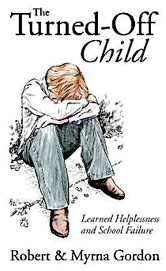
Turned-off child• Not Feeling: Children are naturally in touch with their emotions & intuition, so are more likely to resist & react to DMs – at first.
Eventually they have no choice but to submit. The emotional pull of the unspoken message (META-language) is stronger than what’s being said. They can ‘feel’ something is wrong, but don’t know why they keep getting into so much trouble with the controller.

> To survive emotional & mental torture, children have to ignore their own awareness. By compartmentalizing, they only focus on the S, hiding the awful reality from their conscious mind & try to avoid punishment – which sadly is impossible.
This is then carried into adulthood as a deeply ingrained pattern of denial.

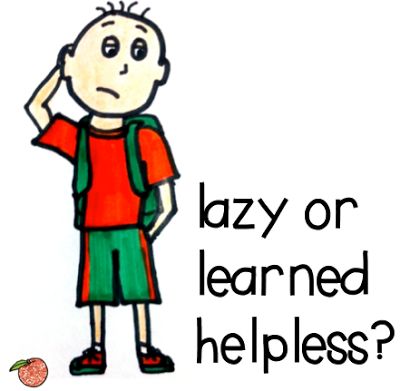
lazy or learned?• Having Feelings: Yet in spite of this defense, Rs do have strong emotions –  both loving & hating their captor / beloved. For adults, the confusion created by DMs leaves victims assuming they have no options, causing great anguish.
♣︎ Turned outward : it’s hidden anger/ rage at the S, but left smoldering under the surface, becoming resentment & bitterness. It can also be directed at others we pick who are similar
♠︎ Turned inward: it’s S-H & despair – at oneself. Being in a no-win environment saps the will, & leaves us disconnected from Self & others.

NEXT: Being CONFIDENT (Part 1)

Double MESSAGES – ACoAs (Part 7b)

I CAN’T WIN for LOSING!
If I let go, I’ll be all alone! Wa-a-a-a

PREVIOUS: ACoAs & DM (#7a)


1. DM from Family

2. OUR inner D. Bind as a result
Once we have a working knowledge of this ‘game’ we can take a serious look at the D. Messages we give ourself & how the repercussions permeate our whole life.

★ We rarely realize what we’re ‘saying’ to ourself, or that it comes from the WIC (R = receiver) via the PP (S = sender).
EXP:
Belief A – It’s good to flirt (sexy, desirable, successful…) – AND
Belief B – It’s bad to flirt (slutty, superficial, manipulative…)
RESULT
— If I DO flirt I’m inundated with Self-hate (ACoAs’ main form of self-punishment, courtesy of the PP).  Flirting expresses my natural sexuality, but I can’t enjoy being seen as sexual because it shows that I’m ‘dirty’.

flirt or not— If I DON’T flirt, I may: > ‘put off’ potentially positive relationships
> miss out on -safe- attention, compliments, sex… (my right to have)
> be considered frigid, unfriendly, a snob…. (even tho’ I’m just scared!)
> miss opportunities to get legitimate favors, help & considerations by being charming (with boundaries)…

★ Another way we trap ourself & frustrate others is by being stuck in the ‘Complain —> Help offered —> Reject —> Complain’ syndrome.
• we go on & on about a problem to anyone who’ll listen, implying that we need help. (Of course we would never ask for it outright!) BUT
• when people offer possible solutions, we reject them all & continue complaining!

WHY: The suggestions offered may not fit our specific need, which is legitimate, but most often – we’re addicted to being unhappy (Victim), don’t feel worthy of being helped, or think there is no solution – for us.
Eric Berne calls it the “Why don’t you – Yes, But….”  TA Game
See post: “People should treat me better, but I won’t let them”

★ Most common Double Message we give OURSELF
The 3-part hamster-wheel-thinking, even ACoAs in Recovery :
A: I’m stuacoa DB wheelck & in a lot of pain. I’m trying really hard to heal from my childhood, which I -sort of- know wasn’t so great. I read books, go to Meetings & therapy, Couple’s Counseling, seek alternative & spiritual healing …..
AND / BUT,
B. No matter how hard I try I’ll just never get any better. I’m always going to mess up, & get abandoned. I’ll never get the relationship I want, I don’t know how to love, I wouldn’t know a healthy person if they bit me!…..
It’s my fault because I’m just too slow, too dense, too stubborn, too damaged.
C. I can’t notice or object to or escape my self-imposed trap (WIC obeying the PP) !

Can you hear the D.Message, creating the D.Bind? 
• Position A. implies that you’ve been wounded AND can heal from it. You believe it’s actually possible to Recover because you did not start out defective – you were damaged by your early environment, so you’re willing to do the work at healing – as unfair as that is!
At the same time:
• Position B. blatantly asserts that your ‘f—ed-up-ness’ was not caused by anyone other than yourself. Didn’t your family love you, mean well & do the best they could? It was you who were born defective & therefore it’s hopeless to improve or outgrow your flaws & weaknesses. It’s just the way it is – everything is your own fault & it’s never going to change. You cause your own misery, but it’s what you deserve, so “why bother”.

You can’t have it both ways! Either you’re wounded & can repairingheal, or you’re defective & therefore intrinsically, irrevocably worthless.
a. If you were truly defective you’d be un-repairable. So why would you even try to work on yourself? Why go into Recovery? It would be dumb = futile, a waste of time & money
b. However –  If you are in fact wounded – by your upbringing – which you did NOT cause! – then you can slowly outgrow / repair the damage.

BUT to do that you must give up the belief that there’s something fundamentally wrong with your personality. It cannot be both A & B! With this conflict UNresolved, is it any wonder why we’re stuck?

BTW – some ACoAs try to cover up this dilemma by always being angry, distant & blaming everyone else for their problems, but the original DM  (Form #3) is always running in the background, like a computer virus.

NEXT: DMs – Results (Part 9)

Double MESSAGES – ACoAs (Part 7a)

acoa DBsI CAN’T BELIEVE
I’ve been so duped!

PREVIOUS: Double Messages, Part 6 


FACING OURSELVES
1. Many of us grew up drowning in Double Messages (DMs). Being raised in this kind of atmosphere it’s how we ‘connect’ with others, using this way of communicating in all relationships, especially the intimate ones. So if we’re serious about Personal Growth & taking responsibility for our patterns, it’s important to see how this all plays out

Childhood EXP: In many alcoholic / narc families, where the addict (& most everyone else) is/are in total denial – if one of the kids has the nerve to complain about or object to the harmful effects of the drinking, the alcoholic (& others) will label them as THE problem, rather than the addiction, because that kid is disrupting the family’s fragile mobile (Post: B. Distortions, #1).
Then the whistle-blower child is forced into either being a co-dependent enabler, OR withdrawing & eventually leaving the family altogether. Either way – everyone loses.

Adult EXP: 2 clients who both attended 12-Step meetings were going to the same psychologist – separately. At some point they started dating.
> Sarah didn’t tell the therapist right away, but instead asked his opinion about seeing someone in the Program. The reply was that it waDM angry clients not a great idea, especially in the first year of attendance. Sarah finally came out with the whole story but concluded: “I get it, you just don’t want me to date Chuck!”

> After a few weeks Sarah complained in session about all the problems with Chuck. She said in angry accusation: “So why didn’t you warn be against seeing him? Aren’t you supposed to be helping me?”

>> AND there was the DM: The therapist was bad for “preventing” and bad for “not preventing”.
However, he didn’t get caught, but pointed out the Double Bind she had created so she wouldn’t have to own her decision or deal with the stress of two WICs trying to have an adult relationship!
PS irony : the 2 clients did marry AND eventually divorced.

REVIEW / REMINDER : Parental DM – forced on the Hero, the Introvert or the Sensitive child : 
A. Incompetence – Be dysfunctional, like us (misery loves company)
• parents (& later our PP) want us to be their carbon copy : fearful, self-hating, stuck, not risking, depressed, powerless, OR controlling, angry, limited, paranoid ….
• and they spend a lot of time putting us down, pounding into us all the things we can NOT do, & how lazy, weak, wrong, selfish & over-sensitive we are
confusuion cornerBUT ALSO:
B
. Competence : Be functional, like we wish we were (so you can take care of us)
•  WIC ( & later as Adult) must make them feel safe, to not feel abandoned, fix them, be their parent
• and, have to be : > perfect, strong, gutsy, able to take risks – for them
> have backbone, fight for them, save them from themselves
> be smart, capable, clever, & use all our knowledge (for THEM only)
AND
C. Be in Denial (the way they are)
They won’t tolerate questioning or objections about how they’re treating us, insisting that we’re ungrateful, making things up, being defiant, ‘difficult’, spoiled….
“I never said that!  ,  How dare you speak to me that way?!  , Stop complaining, after all I’ve sacrificed for you!…. ”   DENY, deny, deny what we’re doing to you.

★ This D Message forms the basis of our own D Binds- next post

OUR PAIN: They were our first role models. What kind of example did they set? Kids absorb & imitate their parents, regardless. We imprint on them like ducklings! Yet what they left for us is fear & confusion.

• If they were capable of **truly loving us, they would have wanted us to be happy, free & successful – for ourself.  So obviously they didn’t / couldn’t love us – not really!
No matter how much we don’t want to hear that, the WIC knows!

Just because they say/said “I love you” doesn’t mean they do – except in some narcissistic way. Remember, if you had been truly loved, you could have ‘normal’ human insecurities, but NO self-hate!

NOTE ** Healthy parental love is expressed in many ways, but most of all by being Nurturing. Children can only develop self-esteem if they feel truly loved. And that can only happen if parents have the capacity to be loving, kind, supportive, rational, available, sober….  not just give it lip service.

NEXT: ACoAs & Self DBs, Part 8b

Double MESSAGES – Forms (Part 6)

DBs & WomenTHERE ARE SO MANY
different way to get trapped!

PREVIOUS: DMs Part 6 –  Styles

SITEs:  Double Bind: Escaping Contradictory Demands of Manhood Rodney L. Cooper, Ph.D.,

☼ Double-Bind Dilemma for Women in Leadership

PURPOSE of D.Messages is to D.BIND another
1. From Manipulation to ‘evil‘
bounda. to keep you symbiotically tied to the Sender, unable to escape – preventing your autonomy & personal growth (S & I), because of their unconscious Fear of Abandonment (FoA)
b. for power & from greed – to sell products, ideology or a way of life
c. for total control, a compulsion to always be ‘one-up’, forcing others into a weaker position
d. to mess with someone’s head out of resentment, jealousy, revenge….

sweet/sour2. Not malicious, but just as controlling:
a. to not hurt someone’s feelings, by not saying what you really feel or think (‘I act like I want to be with you, but I really don’t, but I can’t say it’)
b. from cowardice – fear of setting boundaries or having confrontations
c. social or religious training – must always be polite or ‘spiritual’, taking the “high road”
FORMS
DMs are disorienting by design so you can’t prove what the S is really doing. That way they never have to admit culpability – nor change!
So, we must understand that the problem is not you, only the Sender’s twisted ‘frame’ – how info is presented. (see Part 3)
If you got caught up in this game, whichever side you try to ‘obey’ – you’ll always pay a painful price for ‘winning’ the WRONG one.

FORM 1, a ➖ with a  ➖ : Presented by the S as 2 negative injunctions (warnings or commands) that always cancel each other out.
neg/neg DMsBOTH must be obeyed, AND whichever one is ignored is punished :
A: Do NOT do ___ or you’ll really ”get it” (not allowed),  AND
B: You HAVE TO do ___, or I’ll punish you (you must)

A: I’ll hurt you badly if you stay = so leave & save yourself – AND
B: Everyone always hurts me, I’m used to it = so stay & save me

FORM 2, a ➕ with a  ➖ : More often, Message A can sound like a positive about something, while Message B is a negative about the same thing.
A: I love it when you play the piano (so I can brag/show you off) – AND
B: I hate it when you play the piano (you get too much attention)

A: I want to be with you because of you’re so wonderful (perfect) – AND
B: I’m angry at you for not being everything I want/need (not perfect)

Screen Shot 2015-09-23 at 11.43.30 PMFORM 3, a ➖ with a  ➕ : In reverse – Message A is hostile & B is ‘friendly’.
ACoAs: A familiar set-up for us by an abusive, drunk &/or mentally ill parent, who needed to:
A. keep you insecure, scared, feeling stupid & confused, even crazy, by constantly belittling & disapproving: “You’ll never amount to anything, you never do anything right, no one will ever love you, you’re lazy, ugly, stupid…”
These were said to INSURE you would never feel good enough about yourself to leave the symbiotic connection, to always be available to take care of them, one way or another

While at the SAME TIME they:
B. manipulate you (demand, cajole, whine, complement, attack) into being highly capable for them: figuring out how to do all kinds of complicated, intelligent, creative things to solve their problems, (and not just when they’re old!)
– their nurse, therapist, lawyer, accountant, companion, manager, cook, housekeeper…..
– as long as you never used any of it for your own benefit. And so you didn’t, & still don’t!all tied up

☻ Talk about crazy-making! In other words – the parent says:
A = “You’re stupid & incompetent – for yourself,  and
B =
“You’re clever & capable – for me”

ACoAs are addicted to this cruel DM which put us in a D. Bind, & now we perpetuate it in self-destructive ways, finding many other relationships to play it out. The problem isn’t just that we run into Ss, like our family – it’s that we stay.

NEXT: DMs – Part 7, Re. ACoAs

Double MESSAGES – Styles (Part 5)

DMS all tied up

THERE ARE SO MANY WAYS

I can mess with your mind!            

PREVIOUS: DMs, Part 4b

See ACRONYM page for  abbrev.


NOTE: Do not confuse DMs with changing your mind, or ‘going back on your word’ : “I said I would, but now I can’t. Sorry.”. It can anger or disappoint someone, but it is not presenting them with 2 contradictory statements or command, which the person must try to make sense of & ‘honor’ EXP:  “I love you, I hate you /  Be good,  be bad / Help me, don’t help me”…. at the same time.

VERBAL AMBIGUITY is also not a form of DMs, which are single statements having 2 or more possible meanings – perplexing, sometimes leading to mistakes & embarrassment, but not usually harmful. EXPs:
> “I saw John with binoculars.”  Who had the glasses – me or John?
> Consider “The HORTA” episode from the original Star Trek, when Cpt. Kirk finally encounters the rock-creature mother reacting to crewmen smashing her eggs, & she etches on the wall in acid: “NO KILL I”.
> Or the alien cookbook “To Serve Man” in the 1962 Twilight Zone episode

STYLES of Double Messages (DMs)
DM re. alls1. Two opposite VERBAL declarations, sometimes together, often at different times which makes it much hard to catch.  EXP:
A – Sam says to Jane:  “Let’s get together. Call me anytime” (I need to connect – I’m lonely).
SO Jane calls, but no answer. She tries a day later & he answers, but is curt.

She tries again in a week & he gets angry:
B – “Why are you calling so much?” (I feel suffocated by you neediness / pushiness).
MESSAGE: You’re a commodity AND a nuisance! (Come here/go away)

EXP : The computer HAL in “2001: A Space Odyssey” was programmed with a D. Message, forcing him into a D. Bind :
A – “Always process information accurately” (never lie) – AND
B – “Keep the true purpose of the mission a secret from your fellow crew members” (in this case – you must lie)
OUTCOME = a ‘mental break’, leading to the only solution HAL could come up with – murder the crew.

2. A hostile communication (verbal abuse) WITH an endearment
sweet covers sourEXP: “Don’t be so stupid, darling / My dear, you’re a pathetic moron /
I hate you, don’t leave me! / Baby, you know I can’t live without you! Why do you always let me down?”

3. One verbal WITH one physical directive (tone of voice, facial expression, body position or style of interaction…). What is said doesn’t match how it’s said
EXP: • Your brother says you’re really smart, but with a smirk
• Someone says “Your hair looks great” with a frown
• A co-worker looks angry & stiff, but says: “I’m fine, nothing’s wrong”
• A wife spends less & less time at home, but says: “I’m not avoiding you”
• A husband says: “Of course I love you”, in a flat tone & looks away

4. Both non-verbal : Bateson’s famous EXP – a hug given stiffly = OSTENSIBLY an act of affection AND/BUT with emotional distance. Note the legs on the stiff-hugger – not quite ‘in’ AND  hand on shoulder, almost pushing away.
It leaves the recipient wondering – Which is it, are you happy to see me or not?

5. Verbal ‘encouragement’ inside a negating event
EXPs: “Of course I want you to get better”, as the husband hands his newly recovering alcoholic wife a beer
• Boss to new bank MBA employee: “Here’s a important project to cut your teeth on. Lets see how good you are”.
BUT unknown to the young man – the ‘project’ is an unsolvable accounting mess specifically designed to fail.
PS: Only an ACoA would drive themself crazy actually trying to work it out – afraid to look dumb & get fired!

★ Unlike young Lt. James T. Kirk, who solved the ‘unsolvable’ Kobayashi Maru dilemma – by changing the rules – one legitimately way to deal with DBs!

CHART : Typical DB relationship between a co-dependent & a narcissist.
PINK wants a ‘one-way symbiosis’ without being vulnerable.
GREEN needs to have boundaries, but is willing to forgo them in order to keep the relationship, no matter how harmful.  MORE…)
NOTE that here the healthy win-win options are not used – ‘whited out’ .
Screen Shot 2014-02-09 at 8.00.17 PMNEXT: DMs (Part 6)

Double MESSAGES – Mind Games (Part 4b)

PREVIOUS: DMs, Part 4a


HARMFUL mind GAMES (cont)

🦨 “If You’re Not Good, Santa Won’t Bring You Any Gifts
” 
It’s both a bribe & a threat – a terrible way to get a child to behave. It makes being loved (the gifts) conditional on the child’s actions, rather than being loved unconditionally. An easy game to play for the month of December

🦨 “Go Ask Your Mom / If Your Dad Says it’s Okay” 
It’s when a child asks one parent if they can do something, or if they can have something, & that parent refers them to the other one, shifting the burden of responsibility so they don’t have to be the “bad guy” or say the wrong thing. They leave it up to the other adult to either please the child, or disappoint it. It’s a mean game to both child & other adult

shaming🦨 “What Would Your Father / Mother Say?” 
This game is both —
— a way to shame the child : ”What would he/she think of you if they know what you just did/said?” (“he/she won’t love you any more”), AND
— again, pitting one parent against the other, A using B as a threat & judge, so A can shirk parental responsibility

🦨 “Just Wait Until Your Father Gets Home”
This game is gender-specific, making the male parent the ‘more dangerous’ one – not universal, just more common. It unfairly, unnecessarily makes the child afraid of that parent, who is being used as a threat.
If mom (A) is home when a problem comes up she should deal with it immediately herself – if possible. Making the child wait for the other parent to dole out discipline or punishment is both unfair to dad (B), and a torture for the child

🦨 “Why Can’t You be More Like Your Sister”  (cousin, movie star….)?
This one is down right evil – negatively comparing one child to ANYone else. Rather than involving the other parent, it adds fuel to the horrors of sibling or peer rivalry.  It can involve 2 girls, 2 boys in the same family, one child & a cousin or other relative, or the child vs. an idealized religious or media figure (“What would Jesus do?”, or why can’t you be more like Cindy Crawford? )

more games• Pitting one child against anyone else clearly says to the ‘bad’ child that they’re unacceptable & therefore unlovable. It can be made into
— a competition (he’s getting good grades / she doesn’t give me any trouble…) OR
— a comparison (She’s so quiet, elegant, obedient, respectful)
Either way the “imperfect” child loses – developing S-H, as well as resenting / hating the other child or person BUT still “trying to be perfect”

🦨 “If You Don’t Look After the Pet, We’ll Get Rid of It
” 
This is another destructive game. Not only does it hurt the child, but ultimately the pet. Children should NEVER be told they’re 100% responsible for pet care. They cannot be asked to accept a lifetime commitment, & many pets will not be taken in by others when they’re no longer little & cute, so they’re often euthanized. If parents can’t handle the responsibility, they shouldn’t get one

• This game is yet another way that destroys a child’s sense of trust, safety & innocence. It also damages their understanding of responsibility, even their ability to maintain a relationship later in life. After all – their own parent showed them that all life, all commitments, are disposable!

SHORT FORM of DMs – with Medical examples:
'bad doc'1. Explicit (direct) : If you take some Action, you’ll be criticized  (punished)
>> You go to the doctor with serious symptoms, & told you should have come in sooner
2. Implicit (hinted): If you take that SAME Action, you’ll also be punished
>> You go to the doctor with mild or vague symptoms, & are labeled a hypochondriac or drug-seeking
3. Meta – If you bring up the contradiction, you’ll be punished
>> If you point out the dilemma, you’re labeled as uncooperative
4. You can’t leave, or you’ll be punished
>> You still need medical care or you’ll get a lot worse  (MORE…..)

NEXT:  Styles of DMs, Part 5