I DON’T WANT TO BE ALONE – but I’m afraid to let anyone in
PREVIOUS: Under-Trusting (#2)
POST : ”Lack of Trust”
QUOTES: “Our distrust is very expensive.” ~Ralph Waldo Emerson
“He who does not trust enough, will not be trusted.” ~Lao Tzu
INFO
🪴 Perception of competence = A person’s self-evaluation of their abilities, skills & readiness to succeed in specific areas
POS : The assumption that when we need to cooperate with other people, we’re capable of providing each other with what’s needed
NEG : In abusive situations, an obvious violation of competence is the neglectful parent – those doubting their skills experience higher stress & may withdraw from interacting with their children.
Perception of intention – the ability to infer another person’s motives, goals or underlying plans – just from observing their behavior.
POS : In a trusting relationship – it’s believing that everyone’s working towards a shared desire, & no one’s going to be exploited
NEG : However, we can’t / should not trust someone we think or know is trying to use us for their own benefit
🔶 WHY ACoAs DON’T Trust (Part 2)
🔶 RESULTS of UNDER-Trusting (UT)
🥀 EMOTIONAL
• we miss out on the joys & challenges of intimacy by never letting our guard down, AND we don’t find out what’s really going on with others
• it makes us bitter & cynical about people, missing out on great friendships & love – which would be healing
• we miss out on fun & companionship, which would alleviate some of our loneliness, AND provide relaxation
🥀 PERSONAL
• Keeps us isolated : if we became suspicious / paranoid in childhood, then the isolation makes us more so – because we don’t know what’s really going on around us
• Makes it hard to fulfill our potential, because we don’t trust genuine praise, NOR helpful info from friends, bosses, teachers….
🥀 SOCIAL
• Don’t let others know who we really are – not just our needs but our abilities, SO don’t get the mirroring & validation that’s crucial for success
• Lose respect & ‘street cred’ at work for not being more social or a team player
• Miss out on available info & opportunities that are better suited to us
• People won’t easily come to us for our knowledge, expertise, help… SO we don’t get the admiration & honors we’ve earned & desperately want
• Possibly lose loved ones, friends, even jobs – by being suspicious, stingy, unfriendly, uncommunicative
🥀 BEHAVIORAL
• Deprivation – we end up having to do everything ourself & what we can’t do alone gets left undone – even if it’s important
• Keeps us from taking legitimate risks (requires trust in the possibility of good outcomes), because we don’t have help when truly needed (sick, moving, fired, divorce, kids…)
 • On a broader scale, under-trusting separates us from the world at large. It can make us suspicious of anyone ‘not like us’, potentially leading to anti-social behavior
• IT makes it hard to have a spiritual connection, which prevents us from the sense of belonging to the human race, leaving us ‘out in the cold’ just like we were in our family.
* * * * *
🟩 The BRAIN & Trusting
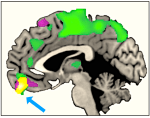 1. A 2015 study with 82 participants showed differences in brain structure based to how trusting someone is of others.
Most important finding : the ventral medial prefrontal cortex was larger in those who tended to be more trusting, the area that evaluates social rewards.
ALSO : the volume of the amygdala was greater in 2 groups – those who were most trusting & those who were least trusting of others. This brain structure helps encode & remember things that are emotionally important to us.

2. Many of our decisions hinge on how much we trust others, built on past dealings with a person OR their reputation.
Another study used MRI to brain-scan participants while playing a Trust Game with various partners who – by social reputation – were pre-labeled as fair, unfair & indifferent, in order to make trust-based decisions together.
Any activated part of the brain uses more oxygen, so the more oxygenated blood that flows into an area, the stronger the signal.
RESULT : the area called the caudate (deals with decisions & responds to reputation) “lit up” most strongly in the ‘trusters’ when dealing with unfair or indifferent partners, but not with the fair ones.
NEXT: Patterns of Mistrust – #1