Ennea – 9 LEVELS for Type #1

k13563295I WANT EVERYONE
to be perfect so I’ll be right!

PREVIOUS: Levels of Development – Intro (Part 4)

SITEs: Personality & the Brain” / #1 Overview


LEVELS by TYPE
NOTE: Each type is divided into 9 levels of Psychological Health, 1= highest & 9=lowest, grouped into Healthy, Average & Unhealthy. These 9 posts are a summary of these sub-groups by Type, in broad strokes, based on Oscar Ichazo’s work.

TYPE 1 – The REFORMERS / Perfectionists
♦︎ Healthy  – characterized by Acceptance & Wisdom, leading others through integrity & reason.
♦︎ Unhealthy  – use Condemnation & Punishing behavior. Hindered by perfectionism & resentment.

HEALTHY 1s  “I am hard-working and ethical”
♦︎ The Upstanding Citizen: accepting, conscientious, ethical, hard-working, objective, responsible & wise. Rational yet idealistic.

Right Action** overcomes the 1’s vice of anger & resentment, bringing them closer to their ideal of perfection. They have high standards, integrity, live by their values, are commitment to quality & don’t cut corners. They do more than is expected of them & finish most things they start.
** Right Action is the ethical conduct that aligns with universal moral truths, compassion & mindfulness
«


«
AVERAGE 1s:
“I maintain my spaces in an orderly way.”
♦︎ The Perfectionist: clean, conscientious, neat, organized, punctual, responsible & tries to live up to good moral standards

● Reformer / crusader ‘high-minded’ idealist.  They’re hard on themself, which ‘leaks out’ as resentment & being critical of people-places-things. Constant frustration at ‘things being wrong’ makes it seem like they’re making headway in advancing what is “right”, but actually their indirect anger pushes their internal world further from it. The tempting path of perfectionism can lead to unintentional & counter-productive outcomes.
«


«
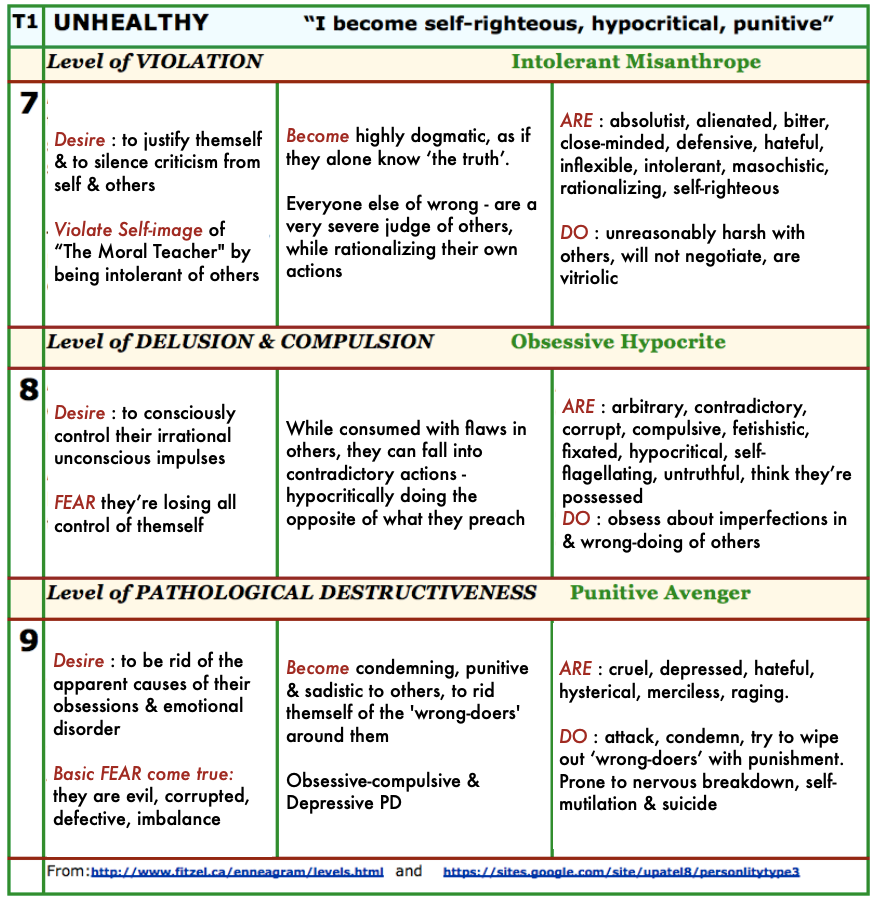
UNHEALTHY 1s
: “I am obsessive-compulsive”
♦︎ The Anal-Retentive: closed-minded, controlling, inflexible, overly traditional, self-righteous
● They’re ever more dogmatic, impersonal, intolerant, judgmental, moralizing, & can only see one ‘right way’ – theirs.
«
«
Type 1 INTEGRATION
Type 1 LEVELS
♦︎ Healthy loop:
The Basic Desire of Needing to be Right leads 1s to seeking truth & do the right thing. When they do, the need is satisfied & balance is reached.

♦︎ Average state: 1s don’t work to seek truth as much, so the need to be right increases. If 1s work hard toward their heart’s desire, balance can be created.
♦︎ Unhealthy loop is run by the Basic Fear of “being condemned”. As a defense 1s judge & correct others right off, but since this is not right it adds to their basic fear & prevents balance.

LENS you see the world thru: “I see what’s wrong & how it can be improved. I carry around an internal yardstick I use to measure myself & others.”
GROWTH: Stop correcting others & start examining yourself for ‘truth’.

~~~~~~~~~~~~~~~~~~~~~~~~~~
LEVEL 5 in BIZ (Mid-Average)
AS LEADERS
The best ONE leaders are
conscientious & rock solid, with the end goal always in mind
Enn- 4-6 LEVELSYOU:
• are guided by quality control, since for them quality & control go hand in hand
• have a clear picture of the ‘correct’ results & the best way to get there
• tend to direct & define procedures, keeping others on the designated track
• like to plan in detail & to follow it rigidly

• lead by executing this plan & assigning responsibility for each part
• find it hard to delegate, worrying about getting the job done right
• tend to correct others & often criticize instead of praise
• have usually risen thru the ranks, so can see who the hard workers & team players are – or aren’t

SUPERVISING Type 1 WORKERS
Your type 1 employees need a plan to work toward, so you can either form a strategy with them or let them make one for themselves – within the context of your project. As a leader you need to play by the rules with 1s & clearly explain what you want.  When either praising a 1’s performance or discussing work deficiencies, be specific & detailed
THEY:
— are very practical, so can shape abstract ideas into step-by-step procedures
— are devoted to being on a schedule, so you need to be on time too. And if you make them late they won’t easily forget or forgive
— need specific guidelines, so loopholes can be very confusing
— prefer DO-ing rather than feeling, & focus on work rather than relationships
— need a great deal of structure in assignments & reports

As a worker – if your boss is a 1, find out how they like things done & do it that way. It will make your life a lot easier.     From: Global Leadership Foundation

NEXT: Levels of Type 2s

Ennea – LEVELS of Development Outlined (Part 4)

levels 4EVERY BIT OF KNOWLEDGE
helps me on my journey

PREVIOUS: Levels outlined – #3c

SITE: SAMPLE of “Enneagram Monthly” magazine


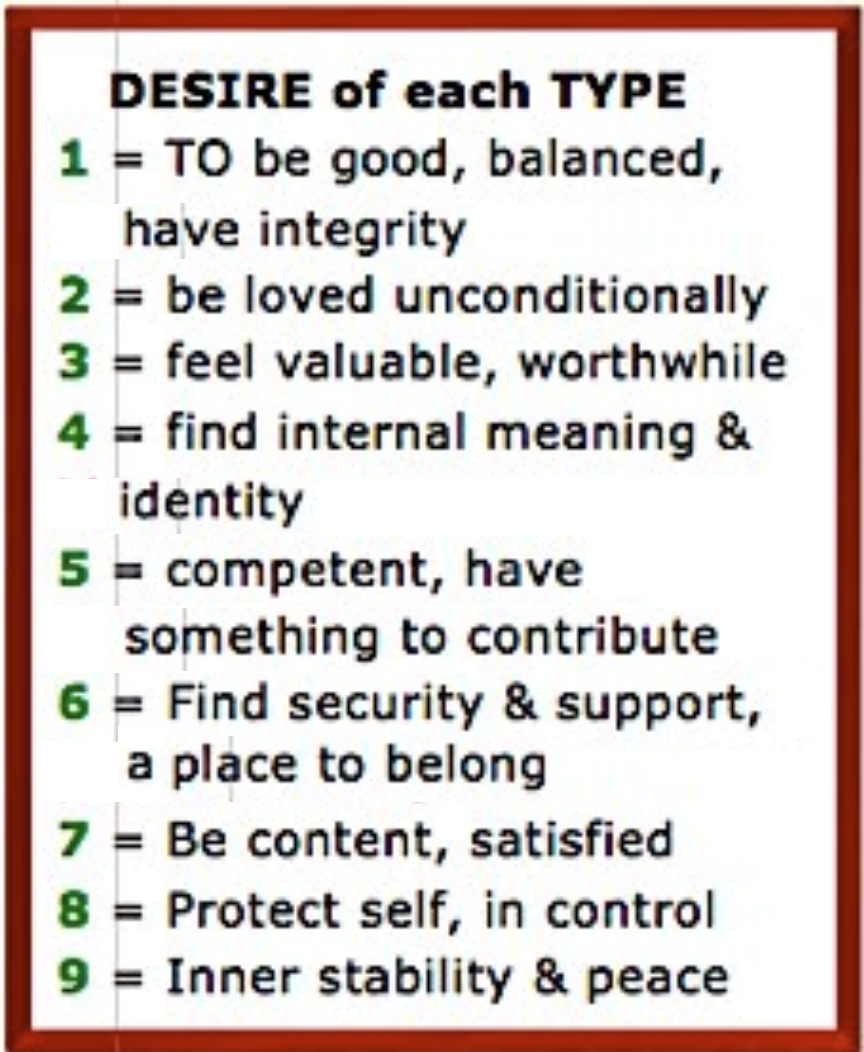
OVERVIEW : The movement thru the levels is a barometer of how much we’re attached to vs free from our Type’s fixed self-image. (Defects #1). People generally operate within a certain range of levels throughout life.
EXP: Earlier in life a person may have operated between levels 5 – 7, while later in life some maturity may raise them to levels 2 – 5.

The 9 Psychological Levels help us see/find:
1.  Our FALSE self – The physical, emotional & mental habits that prevent our ability to experience the Authentic Self :false self
— the emotional (Passion) & mental habits (Fixation) that shut down our heart, body & mind
— The Basic & Secondary Fear that unconsciously drives our specific Personality Habits (weakness)
— The shadow side of each type – our defensive responses . While we imagine being open & present to reality, we’re actually caught in the unconscious pattern of our ‘persona’.

2. Our AUTHENTIC Self – Path of growth & transformation for each typetrue self
— The tools we can use to awaken joy, spaciousness, clarity, intuitive knowing & deep connection with self/others, which comes from being less defended, more Present
— The practices available to each type to digest & outgrow the defensive habits developed in childhood as a response to suffering.

MOVING UP? – In a talk by Edward Morler “Integrating the Enneagram of Personality with the Levels of Emotional Maturity”, he stated that modern Enneagram theory regarding Levels of Emotional Health does not offer much in terms of how to move from one level to the next. (How each level deals with a problem in Part 2) (Morler articles)
HELPING: In terms of how a leader / therapist / teacher / minister…. can use this list to help improve someone’s life – once you’ve identified the level someone is presently at, you can try moving them up the scale ONE stage at a time, & only as far up as you are. EXP:
— When someone is in apathy (9), remind them of a reason to grieve (if seeing his mom in bed in a pathetic depression – remind her of a house they once had and lost)
— When someone is grieving (8), bring up something anxiety-provoking (7) ….. until they’re in a much better place.

SOLVING – Steps to making changes when facing a problem:
1) Recognize the problem
2) Own the problem (“What am I contributing to this ?”)
3) Forgive oneself, & acknowledge one’s positive contributions
4) Do something different.
~~~~~~~~~~~~~~~~~~~~~~~~~~~~~~~~~~~~~~~~~~~~~~~~~~

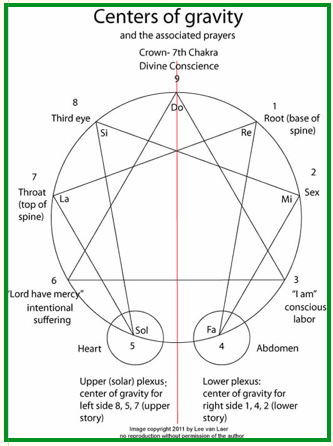
CENTER of GRAVITY
SEE: ‘Ennea Strengths #2’ // ‘Centers of Consciousness – Basic Triadsennea 2 halves
Just as we each has our own version of all 3 Centers (emotions, intellect, instinct), our personality has a center of gravity in one of them – our Type – which puts a specific ‘spin’ on the meaning of those 3 categories for each of us.
It’s also useful to look at the chart divided vertically, because the Energy Centers (power sources /chakras) of the 2 sides do fundamentally different kinds of ‘growth work’. (MORE…..)

ctrs of gravityRIGHT side = the “lower” story – which relates to the physical, natural, mechanical forces. The dominant center of gravity is found at #4, the lower portion of the central nervous system plexus, located in the abdomen, below the navel

LEFT = the “upper” story – relating to the conscious, spiritual forces. Its center of gravity is found at #5, commonly referred to as the solar plexus, corresponds to the center of the spine, & heart energy position

To have integrity what’s needed is a permanent & well-formed center of gravity,** with a whole integrated I-system (healthy ego) held inside one’s Being & assimilated into the Real-I.

**Centre of Gravity : In behavioral & developmental contexts, it refers to the core psychological characteristics, values, or dominant focus of a person’s thoughts, feelings, & decisions.
EXP : a person deeply invested in their career or physical well-being has a “center of gravity” rooted in achievement or fitness.

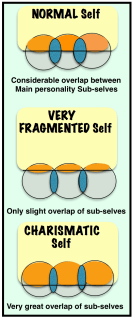
CHART:  the fragmented Self  is the result of a person’s multiplicity ofI’s  not being recognized, & so the parts (ego states) are not able t0 relate to each other.  Instead, they fight & bicker among themselves, only functioning on the periphery, while the False Self pretends to be Unified-I.

As we start to understand what the multiple-Is are, how they work & relate, we can gradually move to internal unity. Right-side work on oneself begins with the creation of a permanent center of gravity.…

NEXT: the 9 levels of each type – TYPE 1

Ennea – LEVELS of Development Outlined (Part 3c)

levels 3c IT’S PAINFUL TO SEE
who I grew up with!

PREVIOUS: Levels of Development – part 3b

SITE: “Essential Wholeness: Integral Psychotherapy, Spiritual Awakening, and the Enneagram”- Eric Lyleson


UNHEALTHY (7-9) – ALL Types
LEVEL 7 – Violation
♦︎ External Behaviors – We are dissipated, eccentric, empty, isolated, rejecting, unstable. We burn bridges & retreat
♦︎ Internal Attitudes – We are guilt-ridden, impulsive, nihilistic – with dark fantasies & negative expectations. We devalue, feel besieged but defenseless

♦︎ Desire is To – cut off all connections with the world and people (“to hell with everything”)
♦︎ Basic Fear of this Level – That the world is closing in on us

At Level 7, believing that life has violated us, seeing ourself  as victims, which allows us to justify any offensive or abusive action. We become so desperate to get our needs met that it turned inwardleads to terrifying behavior – we’re willing to harm ourself & others, causing serious conflict & damage.

● We tend to over-indulge in anything we think will eliminate our pain (food/drug/alcohol abuse, sex, exercise, self-cutting…), but since they’re just an escape from dealing with reality, they causes more suffering.
● We get highly dogmatic, intolerant, inflexible, self-righteous & very
judgmental. Tend to deal in absolutes, as if only we know “The Truth” & everyone else is wrong, while rationalizing our own destructive actions.
* * * *
LEVEL 8: Delusion & Compulsion
♦︎ External Behaviors – We are erratic, sinister,  repelling others & have chronic insomnia. Can become delirious, may hallucinate, project
♦︎ Internal Attitudes – We are horrified, nauseous, manic-depressive, overheated, with weird perceptions. We distort reality, resist all help, become schizoid (withdrawn / separate)

♦︎ Desire is To – endure / survive our terrors (staring into the abyss)schizoid
♦︎ Basic Fear of this Level – That we can no longer defend ourself from both inside & outside influences

At Level 8 – Have become obsessive about imperfection & the wrong-doing of others, although we may fall into those very actions, hypocritically doing the opposite of what we preach.

* * * * *
LEVEL 9: Pathological Destructiveness
♦︎ External Behaviors – We try to annihilate others & self-annihilating, suicidal, are ‘autistic’, deranged, paralyzed, with psychotic breaks
♦︎ Internal Attitudes – We implode, are internally chaotic, desperate for oblivion, split off. We feel panic-stricken & damned

♦︎ Desire is To – leave “reality”, to eliminate all sensory input, to break away from any kind of awarenessdestructive
♦︎ Basic Fear of this Level – Our basic fear comes true: we are helpless, incapable & useless

At Level 9 we condemn everyone, becoming punishing & cruel – to rid ourself of “wrong-doers.” Severe depression, a nervous breakdown & suicide attempts are likely. Generally corresponds to the Obsessive-Compulsive and Depressive personality disorders.

* * * * * *
EXP: TYPE 5 person’s disintegration (re. school-shooting)
“On December 14, 2012, Adam Lanza killed his mother, drove her car to Sandy Hook Elementary school where he gunned down 20 children and 7 adults before taking his own life.

It seems that Adam was a typical Enneagram #5 – highly intelligent, socially withdrawn with an inability to emotionally express himself.

• Pent up anger waits for a trigger.  Any Type follows the same downward pattern as they deteriorate. Fives decide they need less & less of everything, including food, clothing, hygiene. They tend to become reductionists and worse, nihilists….”(MORE…..by Marcel Elfers)

«
NEXT
: Levels of Development – part 4

Ennea – LEVELS of Development Outlined (Part 3b)

levels 3bI HATE BEING “AVERAGE”
but I’m working my way up!

PREVIOUS: Levels of Development #3a

BOOK: “Personality Types “~ Riso & Hudson (excerpt pages)


MEANING of the 3 Mental Health GROUPINGS (cont.)

AVERAGE (4-6) – ALL Types
LEVEL 4 – Imbalance
♦︎ External Behaviors – We are non-conforming, dilettante or expert, we acquire technique, collect, delay closure, practice, prepare, study, withdraw
♦︎ Internal Attitudes – We are acquisitive, abstracting, encyclopedic, knowledgeable, uncensored, uncertain. We analyze, build models, conceptualize & ‘fine tune’

♦︎ Desire is To – feel safer & more confident by retreating into our mind & imagination (like a Tinker Toy)
♦︎ Basic Fear of this Level – That others will demand too much of us, & then our inner world will be threatened.

At Level 4, we become more attached to / identified with a self-image we’ve created, & tend to reject any of our qualities & actions not consistent with that ‘picture’. Protecting our self-image comes at the price of limiting our options.
● We now believe that by striving for the qualities listed at Level 2, we’ll be able to meet our needs.
● Dissatisfied with reality, we become high-minded idealists, thinking it’s up to us to improve everything, so can become crusaders, critics, advocates. We get into “causes” & try to explain to others how things “ought” to be.
* * * *
LEVEL 5 – Inter-personal Control
♦︎ External Behaviors – We are flighty, high-strung, impractical, mis-interpreting, offbeat, preoccupied, secretive, speculative. We create fantasy worlds, compartmentalizing ourself into parts
♦︎ Internal Attitudes – We are agitated, absent-minded, detached, distant, indiscriminate, intense – complexifying, minimizing & ignoring our needsrigid anxious

♦︎ Desire is To – shut out intrusions (be more ‘in their head’)
♦︎ Basic Fear of this Level – That others are attacking our niche or our competency

At Level 5 we’re afraid of making a mistake, so everything must be consistent with our ideals. We become orderly & well-organized, but emotionally constricted, impersonal & puritanical, rigidly keeping feelings & impulses in check. Often workaholics, can get anal-compulsive, fastidious, punctual & pedantic.

●  In personal relationships we are manipulative & controlling, insisting that people accept our self-image. Unfortunately they don’t always respond the way we want, leading to tension & conflict.
● At this Level, we start to see the Shadow Issue of each type – the hidden elements of our personality that represents the major defect each type needs to correct in order to grow.
* * * * *
LEVEL 6 – Over-compensation
♦︎ External Behaviors – We are contentious, far-fetched, insensitive, prickly, scornful, submissive. We argue antagonize, provoke, rationalize
♦︎ Internal Attitudes – We are cynical, extreme, greedy, impatient, intellectually arrogant, pessimistic, stingy. We are distrusting & jump to conclusionsuptight anxious

♦︎ Desire is To – scare off anyone who threatens our niche or inner world
♦︎ Basic Fear (red flag) – That we’re never going to find our place with people or in the world

Throughout the Levels, the strategies we use are a way to ‘manage’ underlying anger, shame, or fear.
At Level 6 we over-compensate for those emotions. We’re so desperate to have others accept our self-image that we end up being offensive –  abrasive, indignantly angry, moralizing, scolding.
● We’re highly critical both of self & others: judgmental, picky, perfectionistic. Impatient, never satisfied with anything unless it’s done according to our prescription.
● Are very opinionated about everything : correcting people and badgering them to “do the right thing” – as we see it.

From:  “The Everything Enneagram Book by Susan Reynolds
“While it’s true that part of your type is genetically predetermined, without question our early childhood experiences vastly affect our development.
The quality & style of parenting, in conjunction with environmental givens — health, income, education, location, and wealth or dearth of physical, emotional, or spiritual resources — have everything to do with our ability to function at the higher, the middle, or the lower spectrum of our EnneaType.

We began life whole, but whatever happened in our early life led to a set of adaptive behaviors that suppressed our essence & created a self-constructed ego. ennea symbol
These traits are sustained by habit & the failure to examine our beliefs. If our childhood was particularly dysfunctional, our coping mechanisms will likely be more rigid and more neurotic than those people who had “normal” or idyllic upbringings. Fear grows in proportion to the dysfunction — the greater our early childhood family’s dysfunction the greater our underlying fear, anger, or need for relationship.”

NEXT: Levels of Development – part 3c

Ennea – LEVELS of Development Outlined (Part 3a)

galaxy  I WANT TO IMPROVE MY LEVEL
so I can live better

PREVIOUS: Healthy Levels (Part 2)

SITE: “Identity & Type


ANALOGY: Psychological layers (like the Ennea-levels) are like layers of apparel – is how we ‘clothe’ ourself, but are not our Essence.
Outer – what we present to the world – like a man’s jacket. He can easily put it on or take it off, but it’s what he usually wears when he goes out. 3 levels
Middle  – how we are with our family & friends – like his pants and shirt. He can take them off, but is not likely to do so & then walk down the street in his underwear.
Inner  – what we only show to our most intimates, or keep totally private – like his underwear. He can easily take it off, but like most people, isn’t willing to walk naked through town. At home he’ll first take off his jacket, later his pants & shirt, & maybe only be naked when taking a shower. His clothes are what he uses, they’re not who he is.

MEANING of the 3 Mental Health GROUPINGS (see Part 2)
Everyone can express the achievements or tackle the lessons of the various Levels, no matter which Type, but how we handle the tasks & demands of any given Level will depend on our Number.

Most often, people live within a certain continuum of consciousness they believe to be their ‘self’, anywhere from the clarity of ‘Presence’ (Level 1) to self-harming behaviors (9). At any given moment, we are more OR less Present, in contact with ‘Being’ (Human Being rather than a Human Do-ing). Presence distinguishes the Essential from the ego-self, the real from the illusory.

Starting in 1973, Don Riso observed that a person might be healthy (high-functioning), average (‘normal’), or unhealthy (destructive to self & others), depending on what was motivating them at any given time.
He also observed that while people’s basic Type stays the same throughout life, the level they’re functioning from can fluctuate a great deal day-to-day, as well as over the years.

HEALTHY (1-3) – ALL Types
LEVEL 1 – Liberation level 1 optimal
♦︎ External Behaviors – I’ve become compassionate, energetic, enraptured, knowing, pioneering, profound, revolutionary, visionary
♦︎ Internal Attitudes – I’m awed, clear-minded, comprehending, immediately discerning, non-attached, participating, trusting

♦︎ Self-Actualization – I let go of the identification with a particular self-image, & are separate from the environment (an outside observer)
♦︎ Basic Fear of this LEVEL – Being helpless, incapable, overwhelmed, useless

At our best (no matter which Type) we have become extraordinarily wise and discerning. We no longer see ourself as limited & incomplete, having integrated qualities that were rejected at Level Two, & so truly come into balance. When living from Level 1 we realize that we DO possess what we were always looking for. By accepting what is, we become transcendentally realistic, knowing the best action to take in each moment. We are connected to ‘the Truth’ – humane, hopeful & an inspiration to others
* * * * *
LEVEL 2 – Psychological Capacity
♦︎ External Behaviors – I’ve become aware, curious, clever, perceptive, playful, unusual
♦︎ Internal Attitudes – I’m attentive, fascinated, have sensory acuity, objective, observant, unsentimentalcompetence
♦︎ Desire
is To – be capable & competent (have something to contribute)
♦︎ Basic Fear of this Level – Of not being smart enough, since intuition & perceptions aren’t strong enough to give us confidence.

At Level 2 we achieve the full potential that our ‘personality’ allows us, for the most part being very open-minded & tolerant. Although we have preferences, we can act largely without bias.
We recognize our gifts, talents & qualities – trusting them : we are conscientious, have strong personal convictions, an intense sense of right & wrong, with personal, spiritual & moral values. Our desire is to be mature, moderate in all things, rational, reasonable & self-disciplined.
* * * * *
LEVEL 3 – Social Value
♦︎ External Behaviors – I’m communicative, creative, innovative, inventive, learning, original, skillful, tinkering
♦︎ Internal Attitudes – I’m concentrating, exploratory, focused, independent, open-minded, patient, uncompromising, whimsicalsocial interest
♦︎ Desire
is To – master something in order to gain confidence & create a niche for ourself
♦︎ Basic Fear IS – not having anything of valuable to contribute (unprepared)

At Level 3 we form a stronger, clearer identification with our self-image, wanting to share our talents & abilities, believing that they will have a positive impact on those around us.
Extremely principled, we always want to be fair, objective & ethical : truth & justice are primary values. It’s no longer enough to just hold a certain picture of ourself to stave off underlying anxieties. We also want to show others who we are – with personal integrity & a sense of responsibility – which reinforces our self-image. Having a higher purpose often leads to being teachers & ‘witnesses to the truth’.

NEXT: Levels of Development – “AVERAGE”

Ennea – LEVELS of Development Outlined (Part 2)

levelsTHE MORE INFORMATION I HAVE
the better I can understand others

PREVIOUS: Levels of Development outline (#1)

SITE: Rob Fitzel, Canadian engineer


OUTLINE
● Our Enneagram personality Type is guided by a basic desire, the driving motivation behind most of our behavior, staying largely the same (though sometimes distorted) throughout the levels.
The qualities of each LEVEL apply to every TYPE – within it’s unique style, no matter how different the types are from each other.
SEE: “Freudian Enneagram”, connecting his id/ ego / superego to the EnneaTypes. (scroll down)

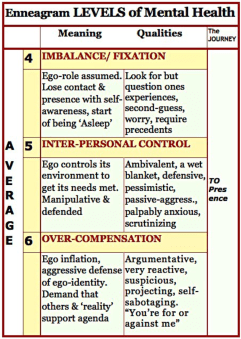
NOTE: The right hand column of the 3-part chart below identifies the different categories of THE JOURNEY, in relation to how much Presence or Essence we’re in contact with at the various levels. Presence is: “Living in direct connection with what is fundamental & most genuine in us, free of the social & childhood conditioning which originally caused us to abandon or hide our Truest nature.”

USING the Enneagram LEVELSEnn- 1-3 LEVELS
PERSONALLY Understanding the characteristics of each Level shows us how we can move up thru them to become more balanced, open, present, relaxed & to take healthy responsibility – by being self-aware & self-honest. Most importantly we can learn about behaving in line with our deepest inner truth.

● If we apply our type’s higher qualities to dealing with stressful people & situations – using respect, compassion, gentle honesty, kindness,…. problems tend to be resolved more easily & effectively, which helps us to grow & improve, by accessing more of our natural potential.

● If we only focus on the negative, staying in the middle levels (4-6) we’re more likely to be dishonest with ourself, beat ourself up, blame others, complain, be easily agitated, play victim, & generally act against our inner wisdom.

● If we deal with life’s problems mainly using the lower qualities of our type (7-9) – blaming others, being avoidant, irresponsible, harshly critical of ourself & others – then things are likely to stay bad or get worse.

At WORK : It’s very useful to figure out what level bosses or employees are functioning on, since it can make all the difference in our performance & morale.
Negatively – their character will indicate the amount & intensity of the competition, distrust, excessive conflict, individual rewards, job insecurity, lack of clear working agreements and stress/tension….

Positively – those factors help us have work appreciation, clarity of roles & goals, collective accountability, direct communication, the tools to do the job right, degree of trust, & an overall sense of being able to make a difference.

EXP of levels expressed
RESPONDING to a problem: from most mature to least (1—–>9): Level 1: Be a Leader –> a Doer –> a Coper –> an Opposer ——> a Manipulator (most dangerous, a con artist pretending to be a doer) –> Level 9: be a Victim

DEALING with a problem: from most mature to least (1—>9):
Ennea-Type 1: See the issue as an opportunity –>
Merely cope with it –> Be antagonistic towards it –> Be angry at it –> Be Passive-aggressive –> Fear it (of the potential loss) –> Be anxious about it –> Grieve –> Level 9: Sink into apathy, or Die  (Edward E. Morler, M.B.A., Ph.D)

NEXT: Levels outlined (Part 3a)

Ennea – LEVELS of Development Outlined (Part 1)

psych levels I’M AFRAID TO FIND OUT
what level I’m at!

PREVIOUS: What ACoAs know & Don’t know

SITE: Enneagram & Addiction


Psychological LEVELS
 Each of the nine Enneagram Types contains its own 9 levels/stages of possible psychological development, (don’t confuse Types & Levels), starting at the bottom: from the most destructive (level 9) to the healthiest (level 1) – see chart above. This categorization was developed by Don Riso in 1977, added to by Russ Hudson & used by Ken Wilber in the study of personal & cultural evolution.

● The Levels are a way of picturing the “skeletal” structure of each Type,
& account for differences between people of the same Number, as well as the shifts we see in ourself & others over time. Moving upward on the scale means becoming less bound by the limiting defense mechanisms of our type, to become truer to our Real Self, to be more present in the moment. Moving downward sinks us deeper into damage, increasing our distance from objective reality.

• Unless we know each Type well there can be confusion in identifying someone. People of the same Number may seem quite different from each other when coming from differing levels of mental / emotional health. And different Types can seem deceptively similar, depending on which stage they’re in. To identify anyone correctly, focus on the Passion, and listenlevels of developmet to the way each type used language.

● These stages are NOT fixed. The Level we act from can change even in the course of a day, based on feeling peaceful or stressed – usually to the one above or below our ‘normal’ level. Because levels are (potentially) fluid, it’s perfectly normal to do this depending on the situation.
— Anyone working on self-improvement will be able to move up one or two on a more permanent basis, with great effort, but most commonly we migrate from lower to higher & back down again throughout life, while the majority stay in the mid range of 4 to 6

— Very few people achieve level 1, altho some do touch it from time to time, & while they’re likely to slide back down, they usually stay in the 2 to 4 range.
— And no one drops from the uppermost levels to the bottom 3, especially not all at once, unless there is severe physical trauma to the brain, or long-term exposure to severe abuse.
EXP: This is what can happen to a happy well-adjusted child who is forced to endure repeated beatings, verbal assaults &/or sexual abuse, over a long time

OVERVIEW by RANGE: At each level, we use different strategies to reinforce our sense of self / ego-identity. NOTE: ‘ego’ = the created self-image. These divisions apply to everyone, no matter which Type one is.
LEVELs 1-2-3 : Healthyhigh achivement
Anyone who in the process of Self-actualizing (not 100% or all the time) : high functioning & operating successfully, who can use admireable / balanced / consistent, reliable ways of thinking & acting. There’s a sense of flow, being fully engaged with the task at hand, moving with little or no friction against the internal & external world.

a. INSIDE: Not strongly identified with their self-image. Are free to express & reinforce their identity, by acting consistent with the ‘persona’, as well as letting go of it when appropriate
b. OUTSIDE: In High Performance mode, they see other people as valuable in their own right, with unique needs & tastes, separate from themself, & can balance their needs with those of others.
● High-functioning people have a personality – it doesn’t have them

LEVELs 4, 5 & 6 : Average
averageEgo-driven people are neurotic but still functional, & can contribute to society, but are limited in some specific way. They have a mix of productive & energy-sapping patterns.
● In this ‘normal’ range, people are generally self-focused, mainly on image – wanting to be seen in a certain way. They use social roles, manipulation & controlling others to reinforce their sense of self. They interact others based on their own needs, with less concern for what others may need. This can generate resistance & resentment toward them, but they won’t understand why.
● Average-range people believe they are their personality (“It’s just the way I am”)

LEVELs 7, 8 & 9 : Unhealthy
Unhealthy / Pathological people are already – or in the process of being – so out of control that they develop personality disorders such as being obsessive-compulsive, & may eventually lapse into psychosis. There is an increasing sense of ‘spinning their wheels’, heightened internal & external conflict, resistance, trouble with the public….poor reportcard

● In this Acute/Chronic Stress range these people’s focus is so narrowed down to themself that they can break with reality. Their self-image is completely different from how others see them, since they experience others mainly as objects rather than human beings, putting a great strain on all relationships.
● For lower-functioning people, the personality has them & they just act out of it automatically.

NEXT: Levels outlined (Part 2)

What ACoAs Know & Don’t Know

SO MUCH TO KNOW –
I’ll never get it!

PREVIOUS: Ennea-Triads – 9s, 1s (3b)

SITE: Self-esteem – the problem behind the problem


ACoAs are some of the smartest, most intuitive people around.  We had to be – to survive our childhood!  But we:
a. don’t acknowledge it (taught to not trust our judgment)
b. are ashamed of it (taught to not think so highly of ourselves)
c. are missing basic, ‘normal’ info about ourselves & the world

1. LACK of INFO
a. About Alcoholism in the family, denial – that they were drunk, that their drinking effected us, &
that our damage (& theirs) was not our fault or responsibility
Deny THAT WE :alcoholism
• were abused & neglected (on one or more of the 4 levels: physical, mental, emotional, spiritual)
• were molested, sexually or physically abused
• we carry deep pain, from all that trauma
• we don’t have to suffer any more
• we have a right to be here
• we can trust our intuition ….

b. About Healthy Living
• what Process actually is & how to use it
• what clear, sane Thinking ‘sounds’ like
• that in many situations we have Options & what they may be
• what we want to be / do, when we ‘grow up’. Some of us do know, but are not allowed to go for it & too scared to fail no crisis
• how to live without constant crisis, abuse, anxiety
• that we don’t have to manipulate to get our needs met
• that we can take care of ourself, if we grow a Healthy Adult
• how to be kind to our Inner Child – by growing a Loving Parent!
• what mental health is  (see posts on ‘Recovery’)
c. General
• how the rest of world actually functions
• what reality is – mental, emotional, physical
• what to SAY when someone says hurtful or outrageous things
• what healthy people are like  (ACoAs think they don’t get angry, overwhelmed, make mistakes, lose relationships…)
• why other people do what they do (get away with things, are entitled, can function well…)

2.  What is NORMAL – which has 2 meanings:
i. the opposite of crazy.  Our S-H says we’re crazy & everyone else is normal.  Yes, we do have distorted thinking, which can be corrected – but that doesn’t make us nuts.
⚀ It’s normal to: have emotions, to succeed via process, to mourn losses, to not get along with every one – all the time –  to always have some damage….

ii. what is average – for humans, & in your society
It’s about the behaviors & attitudes common to the majority. But in this meaning, normal is not always healthy! It’s what the norm was where you grew up, in your religion, in your neighborhood & school…
SO – normal could have been – drinking to excess, physical danger, verbal abuse, insensitivity, lack of education… OR being up tight, having to succeed, always looking good, doing the ‘right thing’…
⚀ This normal can be to: laugh when someone gets hurt or makes a fool of themself, to not help strangers in trouble, to stare at an accident on the street…

no happy reunion3. What’s NOT possible, or is unlikely
• for our parent to love us unconditionally
• to be free of all pain & suffering
• to have relationships that never end
• to be liked & wanted by everyone, all the time
• benefit from becoming a star, be famous, be adored, worshiped

4. What CAN be worked towards & accomplished
Screen Shot 2015-07-11 at 11.53.34 AM• diminished S-H & gain self-esteem
• be heard/ listened to/ get healthy attention
• have healthy friends & mates
• improved health & appearance
• an enjoyable career, creative outlets
• to belong & be accepted
• respected, treated well
• feel comfortable, safe, secure
• have fun, relax, enjoy life   – etc.

5. What ACoAs DO Know, BUT….
• what really happened to us as kids (abuse, neglect, coercion, torture) – BUT don’t want to admit or deal with
• some of the things we want in life – BUT are not allowed to have
• what we’ve learned & accomplished since we left home – BUT can’t admit or own it & use it for ourself
• ALL the things we figured out on our own, as kids & as adult – BUT don’t value or validate them because of:
— S-H – we dcaused anything bad that happened to us (then and now)chinese S-E
— shame – not allowed to have our need met, or our value our accomplishments
— lack of healthy mirroring – our real self wasn’t validated by our family, so we negate our natural abilities

💝 SELF-ESTEEM comes from validation & unconditional regard / love.
Validation means admitting what we know & learning what we don’t. Regard is being kind, patient & respectful toward ourself. It’s never too late to have a happy life!

NEXT: Ennea Development Levels – OUTLINED (#1)

Ennea: TRIAD EMOTIONS – + 8s (Part 3a)

ANGER triadI FEEL SO MUCH ‘SAFER’
when I stay angry

PREVIOUS:

 Triad Emotions – 6s, 7s (2b)

BOOK: “Emotions and the Enneagram, Working Through Your Shadow Life Script” ~ Margaret Frings Keyes

567s Triad :  THE HEAD (2a, b)

891s – THE BODY / Instinctual Triad : Aggression and Repression
PHYSIOLOGY: this triad is associated with the brain stem (earliest developed part, also called “reptilian”), which controls motor movement, & connected with creative, sexual & bio-electric energy in the spinal column
FOCUS: this ‘Center of Intelligence” uses visceral responses to understand the world, typically responding first from the gut, a place of intuitive ‘feeling’-knowing**

ROOT Emotions
: ANGER, Aggression, Resentment
RESPONSE : they tend to act without having to stop to think, are oriented to action, using body-based intuition to deal with relationship issues
891 triad Es
POWER: is in the ability to instinctively take action
TIME: mainly in the present, since actions can only be in the now
UNDERSTAND Life best when translated into physical activity or movement

**NOTE: In this context, it’s important to not confuse Feeling / Sensing (891s) with Sentiment (234s).
Feeling – is ‘background awareness’, spontaneously coming from deep within & so is more primitive, using bodily sensations, intuition, instinct… vs
Sentiment – the copy-cat show of the ‘Feeling’ triad, which is more surface, ‘skin deep’, based on energy picked up from the environment

◆ The 891 triad has to do with muscle movement, & therefore ‘knowing through doing’. Intuition helps them make correct, concrete decisions quickly & easily. They love to face reality head on AND rebel against injustice
But when resisting reality, & assuming there’s nothing else wrong with them, the resistance is held in various physical tensions (neck, lower back…..)
And, when stressed, processing verbal or written information can be slow, with trouble expressing themself verbally:
— angry 8s will think in caricatures or temporarily blank out
— repressed 9s tend to get mentally fuzzy, or go into long ramblings
— compulsive 1s tends to think only in Black & White

“MANAGING” ANGER
◀︎▶︎ EIGHTS – Challengers
♝ Root: use anger to hide a tender vulnerability & childlike innocence, from growing up abused, controlled & exploited, & with one weak parent bullied by other
Re. not being held/ supported: try to “hold” everything & everyone by forcefully taking charge (See Enn. Emotions, Part 1)

type 8 Es♝ Expressing anger & aggression: externalize, acting automatically. They’re consciously aware of anger about an unmet need, or use it to present themself as the ‘strongest’ one around.
They tend to bulldoze through life – letting their hostility out, then leaving others to “deal with it”. It’s their main way of getting what they want, & for coping with stresses or challenges.

♝ Acting out anger: the emotion is obvious to everyone because they feel free to express it. When their anger starts to build, it shows physically – raised voice, clenched fists, moving more forcefully…. When overcome with strong ‘animal instinct’, they react blindingly fast

♝ In relationships: 8s are comfortable with anger & are known to ‘stir the pot’ to get a reaction from others as a way of engaging, but will gladly overpower anyone who will let them. They tend to be confident, confrontational, decisive, willful.

♝ When boundary invaded, they react directly & forcefully to push away.
♝ Reacting to underlying fear : afraid of being vulnerable to others, they’re driven to be self-reliant & strong, so they can often be thoughtless, even heartless

With an UNHEALTHY childhood – 8s can become bullies, delinquents or gang leaders… & eventually their adult counterparts.

With a HEALTHY childhood – 8s become hard-working volunteers, protectors of the underdog, inspiring class presidents…. & eventually competent, moral, strong leaders in corporate, government or religious arenas.
• The inherent Positive emotion of 8s is an enthusiasm for life, moving into action & experience with their big energy.
• Their Virtue or higher emotional state is innocence, approaching life without cynicism or blame – the 8’s version of open heartedness – willing to be receptive to whatever comes, & therefore be vulnerable, without being weak.

QUESTIONS to ask yourself for 891s

NEXT:  Ennea GUT Emotions (3b)

Ennea: TRIAD EMOTIONS + 5s (Part 2a)

FEAR triadI NEVER ADMIT TO ANYONE
that I’m deeply afraid inside

PREVIOUS: Triad Emotions (1b)


567s – THE HEAD / Thinking Triad: Fearful & Unsafe

PHYSIOLOGY: associated with the neo-cortex, most highly developed area in the human brain
FOCUS: primarily use logical, left-brain intellect, tending to ignore heart & gut input
ROOT Emotions: FEAR, Anxiety, Dread

RESPONSE: from their head first, then act or not act
POWER: comes from the ability to think
TIME: mainly to the future – what they look forward to, good or bad
UNDERSTAND Life  best when it’s translated into logic, sometimes in the form of rules & instructions

This group thinks AND creates much fear – via negative anticipation :567 triad -- fear
• 5s act too little, since so much time & effort is used to complete their thoughts before expressing them
•  6s deny the value of their thoughts & actions, flipping between extremes of too much – or – too little certainty, most out of touch with direct knowing
•  7s act too much & think too little or incompletely. Don’t stay with an idea long enough to see it through, so the Head Center’s optimal function – to completely understand – is aborted

5s & 7s (& some 6s) aren’t very focused on the outside world or on what others think – often seen as distrustful, superficial or uninterested.  However, these surface reactions are defense mechanisms against their fear of being destroyed in some way by a frightening world.

567s look for reassurance in B & W facts. Even though this can often be a positive, it becomes a negative when dealing with problems – they ignore intuition, emotions or actions, causing misunderstanding & conflict

◆ Their FEAR (not always experienced directly) creates a deep insecurity. Depending on the Type it’s expressed as  = ‘fear of failure’, = not doing the right thing, = missing good opportunities, & especially = not understanding what’s going on .
Since living in one’s head includes imagining, it can also include obsessive worry about what might happen.
When severely stressed, especially over a long time, fear can become panic, causing them come to a dead stop until they can get enough new info to proceed. (This is not the anxiety of the 234s, who react with impulsive activity).

“MANAGING” FEAR
► FIVES – Investigators
5s expect to run out of resources – so will hoard energy, info, money, time…. They assume they can deal with fear by constantly strategizing – as if honing skills enough will prepare them for anything scary ‘outside’

Relying on their first-rate thinking process to decipher what they consider an illogical world, ego-driven 5s can appear very cool, calm & collected – OR be secretive loners who focus their mind on the ‘nature of the universe’.
They hope that understanding reality in their own way will eventually allow themself to rejoin the world, but they never believe they know enough to participate with total confidence. Instead, they get caught up with increasingly complex inner worlds. type 5 es

Root: 5s early traumas & abandonments leads to considering the world as a scary place. Overwhelmed by emotions & life’s demands, they’re afraid of not knowing how to cope or not having enough facts to explain things

Express fear by
: live in their head, rather than connecting with others. They may take time to consider their emotions, but later & in private – so there’s a time lag between an event & their response

Deal with fear by: retreating to the safety of their private space, accumulating as much knowledge as they possibly can, & mulling everything over to make (mental) order of it all. They’re often disconnected from daily life & their emotions, assuming that figuring everything out will free them of dread, without actually facing it.

Respond to their fear: by collecting &/or hoarding money, possessions & energy tightly. Resentful of having their ‘space’ intruded on, they retreat from anything that make them anxious, into a private universe & only rely on themself
Alleviate fear: by using their intellect to feel omniscience, looking for answers to life’s riddles in isolation

QUESTIONS to ask yourself (for Types 567)

NEXT: Triad Emotions (#2b) Types 6 & 7