BOUNDARIES & ACoAs (Part 2)

love hurts
I DO THE BEST I CAN –
why does love always hurt me?

PREVIOUS: ACoAs & Bs (#1)


2. ACoAs & Boundaries (Bs)  
(cont)

c. Some Results of not having healthy Bs
i.  FAILURE: No matter how badly we were treated or how angry we were about it, like all children – we were/are deeply attached to our parents & didn’t / don’t want to injure them.
They indicated that their unhappiness was our fault (Parents Blaming Us‘) – so we turned ourselves inside out in a desperate attempt to protect them – but it never worked.

Realistically, we could never satisfy them, because what they objected to was:
— normal behavior for a child, with our many developmental needs & limitations
— a reaction to us from their unhealed damage (buttons) which never had anything to do with us

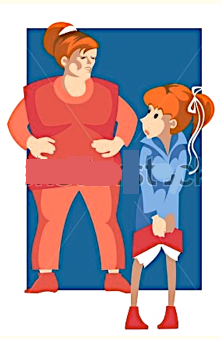
EXP: One young mother would snap at her 8-year-old whenever Katie came home from school excited by a newly learned piece of info: “Mom, mom, did you know that ________?”
The wounded ACoA parent would say with great annoyance: “Of course I know that!” instead of being proud of her daughter. What the mother ‘heard’ was that her own intelligence was being questioned, which came from being constantly put down by her mother!

ii. RISK: We developed a fear of taking any kind of risk, because it wasn’t safe to be ourselves at home where it should have been. How could we expect it to be safe anywhere else in the world, with strangers?

This unconsciously created a fear of ‘leaving home‘ (S & I), so even if we physically move far away, we’re internally loyal to the very system that crippled us, by staying attached to their toxic rules!
We isolate or stay & stay in harmful situations & with unavailable or abusive people, don’t follow our dreams, or if we try – we stop short of reaching our goals….

iii. INTENSITY: Given the message that we were “too much” for them, our child’s grandiosity made us conclude that we were ‘negatively powerful. The conclusion was that IF we were so detrimental to our family, we would naturally hurt everyone else in the world too – especially with our rage – making us afraid to let anyone get too close to us as adults.

✶ALSO, it left many of us with the deep-seated belief that it would be better if we were dead – it would spare our family the suffering we seemed to be causing then but couldn’t change!

People-pleasing / Rescuing
Trying to be here for others but having weak or missing Bs :
To US — we get used by others
— overwhelmed by their damageB-less ACoA
— get burned out & exhausted
— eventually get enraged & attack
— bitter & disappointed with ‘love’

To OTHERS
— they get bored with us, or never let go
— criticize us for not being perfect
— take as much as they can
— unaware of our needs & hurt
— blame us for their weaknesses

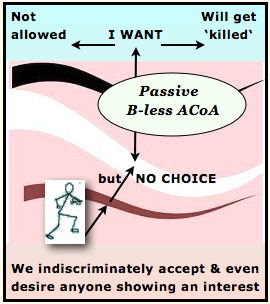
d. No Boundaries – No Choices
Un-recovered ACoAs, even those of us who see ourselves as strong, smart, adventurous…. act like victims because we don’t internal permission to choose who we connect with & who we leave behind, from a deep sense of powerlessness!

Without Bs we fall into the co-dependent trap, because:
• we’re so afraid of having to face our abandonment pain, AND our S-H says no one can possibly love us . What a double bind!

So when someone ‘wants’ us – our WIC is so relieved – that we accept them, even though they may be totally inappropriate, self-centered & just using us as their narcissistic supply.
Often some deep part of us knows they’re unsuitable, it won’t work out & we may not even really like them! BUT —

• we convince ourselves to stay, because they have some qualities we find appealing, maybe similar to ourself – even though it’s not nearly enough to offset the enormity of their dysfunction (addictions, depression, self-hate, immaturity, narcissism, controlling, cruelty…)

• we’re afraid to reject anyone, worry about hurting their feelings, identify with their pain… instead of honoring ourselves (we identify too much with their WIC, while ignoring our own!)
• we focus on fulfilling their needs, wants and demands, so they won’t get upset & shut us out – while most of ours go unmet.

NEXT: ACoAs & Bs (#3)

BOUNDARIES & ACoAs (Part 1)

Screen Shot 2015-06-25 at 12.05.31 AM 

I HATE YOU – DON’T LEAVE ME!
I need you but you’re too close – I can’t breathe

PREVIOUS:
Bs – Healthy Source ( #2)

REMINDER: See ACRONYM page for abbrev.

1. Normal Development – Stable Core (previous 2 posts)

2. ACoAs
Unfortunately, growing up – ACoAs did not originally have that all-important stable core to rely on, so weren’t able to form our own, because of:
• being overstimulated by chaos, emotional volatility & conflict
• being over-controlled, expected to be perfect, judged harshly
• not having role models for self-esteem & appropriate Bs
• not being loved & supported unconditionally

a. Wounded Adults
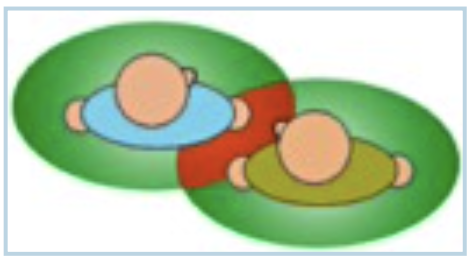
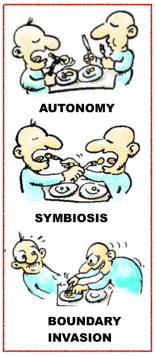
• Many un-recovered PARENTS are symbiotically enmeshed with their children, to cover their own FoA – ie. both the adults & the kids have similar immature mental drama & temperamental intensity, so they overlap each other, which is emotionally abandoning & terrifying for the children

• These parents function from their WIC’s ego state, so have:
— weak or no Adult & missing Loving Parent aspects
— weak or rigid boundaries, overlapping child’s feelings, as if the child were only an extension of themselves
— a narrow range of emotions available, w/ few nuances
AND
— their focus was on their addictions, bad relationships, financial worries, depression, mental illness, relatives, sickness ….
— often changed the rules arbitrarily or made them unreachable, so no matter how hard we tried to obey, it was inevitably going to be wrong – & then we got attacked & punished! We could ‘never win’.
As kids, this kept us off-balance so we wouldn’t become independent (& eventually be ‘separate’), which requires being sure of oneself.

Al-Anon visual: the alcoholic has their arms around the bottle & the co-dependent has their arms around the alcoholic!
In these households, children are just pawns to be used & burdens to be neglected, ( Games Alcoholics Play’)

b. Limiting our Emotionsnegate Es
• In an alcoholic, narcissistic family, one or both parents limit or repress the type of emotional responses allowed the children, who are expected to act like adults, both mentally & emotionally, long before maturation.
ACoAs were blamed for not behaving ‘right’,  even thought we were not experienced yet in social etiquette or subtleties, didn’t have enough motor co-ordination, weren’t old enough to actually act like adults!….

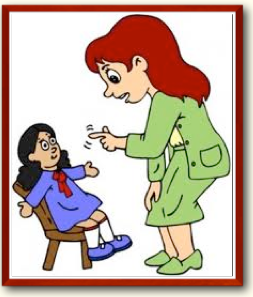
EXP: Beth was a pretty little girl who grew up in church. On one occasion her mother was at the dais addressing a Ladies Group. Beth was left all alone in the front pew & expected to sit for 2 hours like a perfectly groomed doll. But she was a normal 4-year-old – bored, lonely & fidgeting. Her mother was annoyed at her child’s ‘misbehavior’, confident it would make her look bad.

She gave Beth ‘the look‘, who immediately froze – terrified – knowing the dire consequences of displeasing her mother, but quick obedience saved her this time.
For years afterward her mother proudly liked to tell how the group afterward complemented heron having such a well-behaved child. Sadly – neither the mother or anyone else ever had a clue of the intense terror that was generated that day!

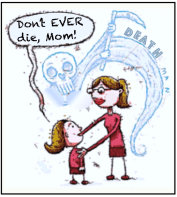
• We learned very early that our emotions & behavior had global impact – they effected the ‘gods’ badly. Our parents let us know blackmailin various ways that we harmed them just by being ourselves (kids). EXP: A mother repeated remarked : “You’ll be the death of me yet!”

• Many ACoAs experienced being emotionally blackmailed controlled using fear, obligation or guiltOur parents’ narcissism & lack of boundaries made it easy for them to:
— treat us the same way they had been – the ‘kick the dog syndrome’, ie. passing on their rage at their parents’ neglect & abuse
— project their self-hate onto us – they couldn’t face that they were considered ‘bad’ children’ so they made us bad instead – to preserve their fragile self-image

EXPs: “If you loved me…. I made that just for you…. If you don’t do your chores, dad will get really mad at me….
BOOKs: “Emotional Blackmail”  & “Toxic Parents“~ Susan Forward

NEXT: ACoAs & Bs (Part 2)

BOUNDARIES – Healthy Source (Part 2)

mom-child bond 

I GET ALL MY NEEDS MET
& I don‘t have to do anything!

PREVIOUS: Bs – Healthy Source (Part 1)

REMINDER: See ACRONYM page for abbrev.


1. NORMAL DEVELOPMENT (cont.)
While going through the Developmental Process, children look to their parents to be the source of all PMES provisions:
• Parents are experienced as ‘gods’ = all-powerful, all-knowing, all-providing, & baby has direct access, without having to earn it

• Small children have strong & erratic emotions. When the mother is not emotionally fragile – their adoration, clinging, neediness, tantrums, withdrawals, rages…. will not injure or topple ‘god’ – ie. Love is NOT conditional on the child’s behavior or reactions towards the parent. When her love is unfailing, the universe is safe!

John Bradshaw often stated: Before the age of 7 children ‘deify their parents, & after 7 they parentalize their Deity’. This means that how we experience a Higher Power is a reflection of how well or how badly our parents treated us! But this is not who God is, since He has no weakness. A truism from ACA meetings is that “God is NOT an alcoholic parent”!

• Without their own boundaries, infants need the mother’s affection & attention to not be ambivalent, because babies have to deal with:
External stressors:
Too much input coming at them from many sources, which thebaby stressy can’t process by themselves. Mother needs to arrange their world to minimize over-stimulation, while also providing the right amount (touch, music, talking…). Her ability to limit internal & external excitement for baby is a substitute for its lack of defenses, until it can mature to form it’s own
Internal stressors:
Physical needs: hunger, wetness, gas / need for safety & comfort…. for caregiver to protect from discomfort & pain = holding, burping, changing, feeding, attention, affection….

Emotional reactions: extreme, all B & W, without grays – rage, terror, intense frustration, as well as over-excitement, joy, pleasure…. Need for mother to tame & channel emotional buildups before they explode, by breaking into the child’s ‘trance’ of intensity, whether too high or too low.
Also to limit & protect child from their own behaviors (pounding their head or first, throwing a tantrum, manically running around, screaming with excitement….)safe connection

Mother needs to have good Bs, so she can:
• be emotionally available & responsive to baby, AND provide a one-way affection bond, allowing the child the freedom to develop in a protected environment, without having to take care of the adult
• give baby reliable non-verbal communications & appropriate interactions, to establish the child’s ability to trust others
• clearly give the message that having needs & getting them met is normal, acceptable & will not harm her in any way
REMEMBER – It’s not possible to have sound boundaries without the right to having needs

In a HEALTHY family, children learn that:
• parents’ emotions are consistent & separate from those of the child
• parents do not compete with their children for anything: not for attention, affection, information, skills, friends, support, validation….
• kids are allowed a wide range of emotions without punishment
• extremes of emotions do not usually indicate ‘reality’ (danger)
• managing all emotions is taught, directly & by example
• a distinction is clearly made between real trauma & small problems

CHART: Healthy Attachment & Separation
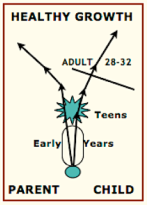
Birth: mother & child are ONE – normal symbiosisS & I
Early years: parents are a stable, consistent source of comfort and knowledge. Children’s emotional life is intense & extreme, fluctuating a great deal.
As they grow, they need the opportunity to move away from under the parental wing for self-expression & then back again, knowing they’ll be welcomed without judgment AND without hurting their parent’s feelings or ego for being a separate entity!
The child can make mistakes, be emotionally dramatic, learn about their capacities & limits, knowing there’s a safe base to return to.

Adolescence: a time for more distinct separation & individuation. Some rebellion is necessary, & separation is achieved by forming outside attachments, including limited sexual interplay
Adulthood: a clear sense of self.  Parents are never peers, only other adults whom we value & love but do not n-e-e-d!

Next: ACoAs & Boundaries (#1)

BOUNDARIES – Healthy Source (Part 1)


I HAVE A RIGHT TO BE HERE –
I feel safe & loved

PREVIOUS: Bs Defined (#2)

See ACRONYM page for abbrev.

The TIES THAT BIND
• Having boundaries (Bs) is the opposite of being enmeshed (symbiotic)**. Humans are not born with Bs, & have to develop them with the guidance of healthy nurturing, so the main caregiver (usually the mother) needs to be a secure base from which the infant can safely explore its environment.

A well-grounded mother experiences the child as separate from herself, although from her body, so even if she’s anxious or sick, is able to be nurturing because she finds the helplessness & needs of the baby irresistibly appealing. She is not overwhelmed or put off by them, like in alcoholic / dysfunctional homes

• With the proper care, gradually the all-consuming ME of the child will separate from the NON-ME (all others), & personal boundaries are formed.  Being given a solid foundation is crucial before the age of 9 or 10, as by then our defense mechanisms are SET, & a bad beginning will generate a harmful crop of ‘negative protections” that are hard to change

**Symbiosis: At birth: “….is experienced by both the mother & child as a temporary merging or sharing of their needs”, an important early phase of omnipotent fusion (very deep) between the two, In a safe environment, this merging is gradually given up by the child over a long process of S & I. 

This infant’s experience is: I cried, I got fed, aren’t I great! This sense of invincibility is alternately —
— ascribed by the baby to the grandiose Self –> “I’m all-powerful”
— & about the idealized mother/caretaker –> “She’s all-powerful”
As the child separates & internalizes the parent, IF it’s a loving, healthy experience, he or she can safely become their own person, with a sturdy sense of self-hood, along with a Positive Introject

•  When this satisfying connection is not available or not adequate for the child, it spills over into adulthood, so that in unhealthy relationships: “…. symbiosis is still going on, occurring when two or more individuals behave as though between them they only have one complete personality….”, rather than being 2 separate people.

Neither have a full complement of ego states, so that one person acts from their Adult & Parent while the other only from their Child part – forming one false ‘whole’ ‘between them.
This is why it’s so hard for co-dependents to leave what others may see as destructive attachments – they would be cutting off a ‘part of themselves‘ since they haven’t yet grown their own complete identity.

1. Normal Development
• Children are highly intuitive, intelligent & curious. But at first they experience little difference between Self & others, between inner & outer, fantasy & reality.  The work of Mahler, Kernberg, Hartmann, Spitz et.al. identified 3-4 important developmental stages – not in a straight line but more like a fluctuating helix:

i. Autistic or Undifferentiated = in the first month of life, during which the infant is in its own inner world, with a minimum awareness of ‘others’, focused on reducing physical (hunger, wet diaper…. & emotional tension (fear, uncertainty, loss….)

ii. Symbiotic = for the next 4 months, the infant becomes more aware of the mother / caretaker as the source of fullness & warmth, but not as a separate person

early developmentiii. Separation-Individuation (S & I)  = made up of a series of sub-phases, thru the 3rd or 4th years of life, when the child begins to investigate the world beyond its own body through sight, locomotion, language…. & later, conflicts with mother about needing her vs. needing some independence, which requires much help in balancing

iv. Object Constancy, developed during the S & I period (if allowed!) around age 2 1/2 to 3, when the child is capable of experience both the good /providing & bad /withholding sides of the mother as one whole, as basically dependable & trustworthy, not perfect but not dangerous — assuming she’s mentally & emotionally sound! (MORE….)

NEXT: Bs – Healthy Source (Part 2)

BOUNDARIES Defined (Part 2)

gates 3IT’S UP TO ME
what I allow in, & what I don’t agree to!

PREVIOUS:
Boundaries Defined (#1)

REVIEW: My Rights – Qs. & Having Rights


Joy2MeU
: “One task in recovery is to learn to re-align our defense system with healing & Love, instead of self-destruction.”

VISUAL IMAGES of Boundaries (Bs)
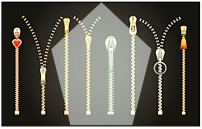
a. As a ZIPPER
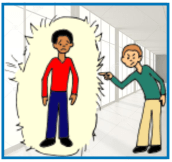
Bs can be seen as an impermeable but clear energy container completely surrounding us, with an invisible zipper down the front, from head to toe. We can see out & others can see us, but we are inside a protective shield. The zipper allows for easy access, but what’s of major importance is whether the zipper tab in on the inside or the outside!

➖ EXTERNAL: If the tab is on the outside, anyone we invade us by pulling it up or down, as they please, so we’re always at the mercy of others
➕ INTERNAL: If it’s on the inside, then WE decide when to open ourselves up – or not. ALSO, how far down we pull the tab speaks to how much of ourselves we choose to expose, depending on the situation & our current state of mind (even with the same person or environment).

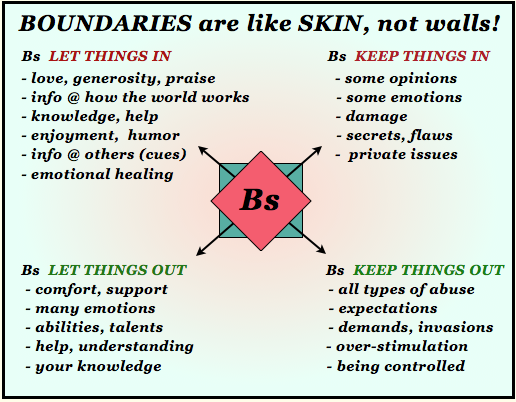
b. As our SKIN (like on our body) IT:
• breathes, so it lets toxins out and take in nutrients
• can be injured, but also repaired
• covers us completely, thus containing all our physical components
• is elastic, so can expand & contract….

Bs as skinPURPOSE of Boundaries
They are ‘Ego Barriers which are needed to guard our Inner Space, so we can:

1. Deal with the OUTSIDE WORLD positively
by Screening : protect from danger or unpleasantness, TO
— cut down intake of too much noise, info, activities, people
— eliminate toxic people, substances, locations – whenever possible
— protect from subtle manipulation, too many demands, confusing communications – anything that can inundate us

by Interpreting: understand the specific meaning of something
— TO be able to read people & situations accurately
— not assume everyone or everything is dangerous to us
— correctly assess what someone is saying or wanting from us
— think of 2-3 different causes for events – not just bad ones

2. Manage our INTERACTIONS with the world
by Modulating oneself: temper, soften, tone down, vary, TO
— not over-react to ‘normal’ situations
— choose when & where to be boisterous vs silent, angry or rageful, when to fight vs back down….
— know when to say something & when not to, and how

by Regulating oneself: adjust according to a standard in order to insure success, TO
— behave appropriately, depending on the venue & event – based on  self-respect
— pick the right time to ask questions, conduct business, communicate our upset or bad news…. with someone
— accomplish a goal : follow the rules of the relevant group we want to interact with – if not in conflict with our personal values

QUADRANTS of Interaction — dealing with struggles, using Bs
Q 1 – Open with Self : identify Bs you can practice on yourself, setting limits on self-defeating acts
Q 2 – Open with others : be available to help or participate with, as it fits who you are
Q 3 – Closed with Others : about the Takers in life, so be sure to set PMES limits with them, to protect your energy output
Q 4 – Closed with Self : TOO self-disciplined – need to release rigid Bs. Take breaks & put the joy back into your life.

NEXT: Boundaries & ACoAs (Part 1)

BOUNDARIES Defined (Part 1)

boundary gate 1
IT’S UP TO ME
what I allow & what I don’t agree to!

PREVIOUS: INFO & the Brain #4

SITE: “Vision & Self-Knowledge” – CHARTS


BOUNDARIES (Bs)
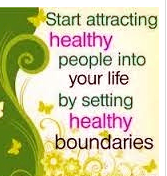
are an essential component of physical, mental, emotional & spiritual health (PMES).  They are the beneficial “rules of relationships”, representing the opposite of being manipulative.
The difference between asserting boundaries & manipulation? When we set a boundary, we let go of the result!

• Children are not born with a built-in concept of Bs, being more likely to resist any sort of limits – so it’s natural for them to test how much they can get away with.
However, because the world is a big, overwhelming, unpredictable, & therefore a scary place – they have a great need together given appropriate Bs, & will actually feel safer when those are provided. No matter how much children may struggle against Bs at first, when parents gently insist & persist, most of them learn & adapt to legitimate rules quite easily.

nourishing parentNourishing parents are both good role models & good teachers of Bs. They set limits that are — age appropriate, reasonable & consistent, in ways the child can understand. When taught to respond to healthy Bs & then incorporate them, children become well-mannered & confident adults.

Boundaries are about:
• protecting our body, our identity, our rights, our values
• expressing specific needs, wants & preferences
• making it clear what is acceptable, or not, from others
• choosing who & what we want to allow into our lives

Joy2MeU: “Learning how to set boundaries is a necessary step in learning to be a friend to ourselves.  It’s our responsibility to take care of ourselves – to protect ourselves when necessary.
– It’s impossible to learn to be Loving to ourselves (owning our rights & responsibilities) without having a Self
– It is impossible to have a healthy relationship with someone else with no boundaries, who can’t communicate directly, honestly”

a. Too MUCH – Limits that are too narrow & rigid for a child, creating a great deal of confusion them so they don’t want to venture out into the world, for fear of being constantly overwhelmed or making a fool of themselves.
Children raised with stifling Bs become afraid TO:
• think for themselves or take independent actions without being told what to do, think or feel
• take any kind of risk, even normal ones
• express their creativity, imagination, sense of possibilities
• reach their highest potential, prevent them from expressing their True Self, keep their ‘light under a bushel’

AND of course, some kids will eventually rebel by not wanting any limits! They go haywire & end up harming themselves & others

b. Too LITTLE – Too loose or non-existent Bs allow for too many options, don’t give guidelines about where to draw the line in dealing with self or others. It tells children they’re not actually cared for, not important enough to guide.
They’re ALSO afraid, but it’s hidden under blatantly angry attitude & behavior. They become adults who:
• are convinced they’re entitled to anything & everything
• are rude, disruptive & disrespectful, any time or any place limits are set for them
• don’t have empathy for other people’s needs & feelings
• don’t know how to get along with others, often getting into trouble, & are disliked by most people
• don’t consider or care about the consequences of their action
• ignore or fight against all forms of authority

💦 Both styles damage children’s self-esteem because unconditional love is missing.
Both styles indicate parental dysfunction & concern for their own needs at their children’s expense.
(POST: Good vs bad parenting . Compare w/ Healthy Parenting

🎯 PREREQUISITE for having Bs
We cannot develop Bs if we don’t know what our NEEDS are – where the line in the sand is. This means believe we have rights, since activating Bs requires expressing them.
We have to:
• know all 3 types of needs, specific to our True Self (not the ones the disease tells us to want !)
• have internal permission to acknowledge & honor those needs, in opposition to the PP voice
• actively provide those needs, both for ourselves & with the help of others, when appropriate (Fundamentals)

NEXT: Boundaries Defined (Part 2)

NEURO-PLASTICITY : Retraining the BRAIN

PREVIOUS : Attachment =Parent child

SITEs : ☸︎STRUCTURAL PLASTICITY of the ADULT BRAIN
☸︎ 6 neuroplasticity exercises for Anxiety relief

☸︎
Brain-repatterning (Free exercises – recommended)
☸︎ Raising the bar on brain training (subscribe)

NOTE for ACoAs  
Please read the 4 posts on “How the Brain Learns” (Jan 2011), which will help to understand why it’s so hard for anyone to let go of toxic beliefs!

In spite of that info  – the fact is that the human brain also has Neuroplaticity, which provides a tool to modify our earliest training – with perseverance & repetition.

The brain grows very fast in a child’s earliest years. At birth, every neuron in the cerebral cortex has an estimated 2,500 synapses (connections). By age 3, it has grown to a whopping 15,000 synapses per neuron.
But the average adult only has about half that number – because as we accumulate new experiences, some connections are strengthened while others are eliminated. This process is known as synaptic pruning., allowing the brain can adapt to changing environments.
DEF:
☀︎ NeuroGenesis : continuous regeneration of neurons in certain brain areas
☀︎ New Synapses – New skills & experiences create new neural connections
☀︎ Strengthened Synapses – With repetition & practice neurons  develop stronger connections
☀︎Weakened Synapses – connections that aren’t needed or not used regularly become weak or die off.

2 main types :
a. Functional plasticity is the brain’s ability to move functions from a damaged area to other parts that are undamaged. It allows for recovery from strokes & traumatic brain injuries, & strengthens areas where function is lost or has declined.

b. Structural plasticity is the brain’s ability to actually change its physical structure as a result of learning, experience & memory formation,. Improvements in brain imaging technology show that neuroplasticity is ongoing throughout life,  involving neurons, as well as glial & vascular cells.
It’s the result of :
adding information, experiences, skills…
 — enhancing existing cognitive capabilities
— creating improvements that boost brain fitness

LIGHT side : neuroplasticity makes the brain resilient, so we can find new ways of being, & better ways of responding to conflict.
Also, it allows us to recover from birth abnormalities (VERY improved by Feldenkreis treatments for children) , & in many cases can be a healing tool for overcoming depression, addictions, OCD, ADD….

DARK side (see 2011 posts 🔼) : the brain is actually neutral, so it doesn’t know the difference between good & bad, right & wrong information. It absorbs whatever is repeated, both helpful & unhelpful thoughts, action & habits. So it can also be a tool for reinforcing negative beliefs & patterns.

Intrinsic motivation is our spontaneous tendency to be curious, look for challenges, develop & use our skills & knowledge.  We engage in an activity because we find it interesting & inherently satisfying, even without a tangible or obvious pay-off.
In contrast, when Extrinsically motivated, we participate in an activity to gain some practical result such as a getting a reward, avoiding punishment, or achieving a valued outcome.

IMPROVE Neuroplasticity by:
1. Being Mindful – regularly practice immersing your mind in the present moment, without ruminating over the past or worrying about the future. Stay aware of the sights, sounds & sensations around you & the emotions inside yourself

2. Enriching Your Environment – continually find & make use of opportunities to focus attention on novelty & challenges, because it stimulates positive shifts in the brain.
EXP : Reading different genres, learning a new language or how to play an instrument, traveling & exploring new places, creating any form of art, Recovery work from childhood trauma, addictions….

3. Exercising Regularly – exercise might help prevent neuron loss in key areas of the hippocampus, the part involved in memory & other functions. It may also help to form new neurons in the same region. 

Physical movement can also boost brain plasticity through its effect on functional connectivity, brain-derived neurotrophic factor (BDNF, a protein that impacts nerve growth), & the basal ganglia, responsible for motor control & learning.

4.  Playing – 10 Best Brain Games to Keep Your Mind Sharp

5. Getting Plenty of Rest – Sleep has been shown to have important effects on both physical & mental health, partly due to genetics & partly due to the grey matter in the brain.
It plays an important role in dendritic growth, which are located at the end of neurons, & help transmit information from one neuron to the next. Strengthening these connections can encourage greater brain plasticity. (VeryWell Mind)

NEXT :

How the BRAIN LEARNS (Part 4)

trees 4THIS ‘PAYING ATTENTION’ THING
is a lot of work!

PREVIOUS: How the brain learns  (#3)


OUR BRAIN – Gathering Info (cont.)
6. BROAD TOPICS
7. INCOMPLETE

8. OLD is still VALID
a. EXPECTATIONS: The brain will continue to ‘understand’ & interpret the present – based on the way things were when it got the last piece of information about something familiar, no matter how long ago that was.
Therefore, it won’t know if that info is still viable, or obsolete.

✓ Think about going to a school reunion. We may unconsciously assume classmates will look the same as they did when we last saw them (10, 20 + years ago), OR to act the same, especially towards us, & may be shocked at the changes in them. Of course this isn’t logical, but….

Obsolescence has 3 main sources – THINGS :obsolete
• that often change, like prices & styles
• that change more slowly, but steadily – like aging
• learned a long time ago, as in childhood.
The further back the input, the more likely it’s not valid in the present, ✶altho’ this doesn’t apply to everything, like moral values or spiritual truths

b. ACTIONS: The mechanical brain can’t alert us to which memories (experiences) are still valid – to be used as a basis for present behavior – & which ones are out-dated. So, our current reactions to circumstances are often founded on useless, maybe even dangerous, info.

Types of Memory
a. Sensory – When our senses are triggered by a stimulus, our brain briefly stores the information for few seconds before it’s gone. It then has the option to process it through the memory banks or forget it.
When registering sensory input, it gathers info passively through visual & auditory cues – “iconic” & “echoic”.

b. Short-term – the brain temporarily stores information when it is triggered by stimuli. It can only hold a maximum of 7 items at a time, & also has a time limit for each, which is usually between 10 seconds to a minute.
“Working memory” – info stored for the purpose of using it, such as remembering a set of numbers while working on a math problem.

c. Long-term – After passing through short-term brain areas, relevant info is moved to long-term storage. Now we’re less likely to forget important details, but they can fade over time if we don’t refresh them.
When these memories form, they stay as long as they’re in use.  The hippocampus retrieves info from working memory & starts changing the brain’s physical neural wiring – between neurons & synapses.

SOURCES of distorted info
▪︎ Parents, community, school, religious leaders, who may be well-meaning & want to be helpful, but more often are damaging
▪︎ Experienced manipulators : advertisers, politicians, investment promoters, sales people….
▪︎ Popular Culture: books, TV, internet, news media ….

➼ IRONY:  Since the only criterion the brain has for identifying good or bad info is IF it’s consistent with what’s already stored, based on first impressions, then:
• for accurate input, the brain can protect us from accepting anything new that’s useless or harmful, BUT
• any bad info we started out with will stop us from believing new, correct info.
✶ That’s why we’re told that FIRST IMPRESSIONS are so important.

IN RECOVERY
a. Sometimes we hear or read something ‘healthy’ & our head says it’s true, makes sense, the speaker / writer knows what they’re talking about…  BUT we don’t feel it.  This usually means we have a layer of defense against taking it in all the way –  because the mechanical brain says it doesn’t fit,
AND the unconscious knows it’s going to be painful, & will go against the family’s messages.

b. Other times we hear or read something & it ‘rings a bell’, not just in our head but alsring a bello in our gut.  We know it’s RIGHT.  It may be quite contradictory to our earliest training, but it’s right for us – down to our toes!

This is likely because the healthy info we’re receiving now is something we (secretly) knew in our hearts a long time ago, & had to suppress but is finally being validated.
Sometimes the healthy info is so clear & relevant to our True Self that all we can do is cry in relief at finally getting what we need!

NEXT: BOUNDARIES DEFINED –  #1

How the BRAIN LEARNS (Part 3)

styled tulipsCOM’ON BRAIN –
don’t fail me now!

PREVIOUS: How the BRAIN LEARNS (#2)

See ACRONYM pg. for abbrev.

OUR BRAIN – Gathering Information (cont)
3. ADDITIONS
4. COMPARISONS

5. ALL ALIKE: The brain assumes all similar items are the same (all whites look alike to me / all rock music sounds like noise / all men are dogs!….)
• This originally had survival value so humans could respond instantly to a need or crisis, without ‘evaluating’ differences.

We still need automatic grouping – to save time, for ease of communication, to understand different things with a common meaning – like ‘scribbles’ or word-accents that represent the same word / idea….all alike

•  However, it can also lead to serious errors:
a. We can assume that all members of a particular group are alike
✓ Your mother was a nasty crazy lady, so you grow up to believing that, in spite of charming ‘disguises’, all women are nasty & crazy

b. It can be hard to notice subtle differences or gradual changes in others
✓ if you’re in Recovery – most people who’ve known you a long time will keep treating you based on how you used to be, just as some parents keep treating a grown son like a little boy

c. It can influence the way we behave / react to things around us
✓ Treating all snakes, body aches or drugs — as if they were the same — can be painful or fatal
✶ SO, one measure of intelligence is how well we can distinguish subtle variations among very similar people, things or situations.

6. BROAD TOPICS
• Focusing only on a narrow slice of life will only eliminate certain new items that are contradictory
EXP:  Women raised by a controlling parent are more likely to believe ‘The Rules’ book. So in contradiction – being told by a teacher/ preacher/  therapist… that it’s not emotionally healthy to manipulate men – will automatically be dismissed.
Exception: a woman might accept suggestions opposed to the book’s premise, if it comes from a trusted ally.

• BUT the broader the topic, the more all types of contradictory info are rejected as false.  Just the act of accumulating similar experiences will seem to confirm our original belief, right or wrong. That’s why people who are ‘trained’ in childhood to be winners tend to continue winning – or vice versa. So:
EXP: If we’re taught that our country, religion, ethnic community…. is the best, the only one to trust, is infallible… then any proof to the contrary will be ignored or make us angry!

✓ So too, if we have a bone-deep conviction that we’re worthless & unlovable, any compliment or acknowledgment is automatically rejected as b.s., even if said sincerely, & is actually true & valid about us!

7. INCOMPLETE: The brain can’t identify if it has complete info about a topic, so even when we suspect it, it can’t tell us what is missing
✓ This happed with a salesman & in college: I knew I was missing a crucial, pivotal piece of info to understand what I wanted to buy or was supposed to be learning, but I didn’t know what that was!

All I could do was ask haltingly, clumsily (sounding like an idiot!) & they’d tell me a bunch of stuff I did know. Sometimes, if I kept bugging them, eventually they’d go away in disgust OR  ‘accidentally’ spit out the missing piece.

Yeah! I was happy, but by then they were very annoyed! lazy brain
😡 When I expressed relief, they’d say “Well, I thought you already knew that!” because it was so obvious to them, they assumed I already knew it! Wrong.

Perpetuating Incomplete info:
Mental laziness: not making a consistent effort to get info on topics that have an impact on our lives & well-being
OR fear of asking, of having to take care of oneself, of no one wanting to help, of getting it wrong, of not being able to do what’s required….

• Either way, we automatically compensate by assuming we know things we don’t (Ass-u-me). Since we don’t realize we’re making assumptions, someone has to point them out.
Obviously, a lack of sufficient or accurate info will be a real road block to achieving our goals.

NEXT: How the BRAIN LEARNS (Part 4)

How the BRAIN LEARNS (Part 2)

cds & the brainMY EXPECTATIONS ARE TOO HIGH
for my own good!

PREVIOUS: How the brain learns (Part 1)

BOOK : Think Better, Feel Better ∼ Carl Pacifico


OUR BRAIN – Gathering Information (cont.)
1. FIRST INFO

2. CONTRADICTIONS

3. ADDITIONS
– all new items which do fit with the majority of already accumulated info will automatically be considered as correct, whether they are or not. Finding similar elements about a topic adds to our knowledge base – which doesn’t mean it’s accurate – just reinforced!

• When we have too little info about something, any previous knowledge (no matter how flawed) will carry a lot of weight in our evaluation about a person or situation, & therefore will heavily influence our action or reaction

EXP: If our parent was an addict, & then our first lover was an alcoholic . drug user…., & we keep dating & marrying addicts, then active addicts become our ‘drug-of-choice’!

👁‍🗨 DUALITY – AND what if we encounter a situation or person that’s both a benefit AND a threat (like a parent, a spouse, a job or career, your own child)?
Because the brain is pre-programmed to label all previously gathered info as basically valid, it rejects anything that doesn’t fit — precisely to reduce the pressure of this kind of dilemma, called ‘cognitive dissonance’.frenemies

• This makes it very hard for us as adults to leave bad situations where we get or got some good stuff – emotional crumbs – along with mostly bad stuff, the same way we did as kids, like  :
needing to leave : a sibling we were once close to who is now screwing us out of our inheritance

a parent needing to oust : an adult-child still living at home, not working, drugs internet   – who was an adorable & adored favorite when little….
The ‘good stuff’ may have only been a long time ago, or it could have all been an illusion, but we’re still hanging on to memories, hopes & wishes!

4. COMPARISONS – The brain can’t measure anything directly, but rather using some pre-set standard, will compare various things, actions, people, events…  If the standard is flawed, our evaluation will be off!
EXP: Being on a ship without navigation tools & no land in sight – you can’t ‘magically’ tell where you are by just looking out of the porthole!

a. VALIDITY – For the comparison to be credible:valid
• the thing or person must be completely & correctly identified (like 2 specific books)
• the 2 things must be equal (can’t compare adult with child, a paperback to a hardcover)

• there has to be an actual way to make the measurement  (color, college degrees, education, height, weight….)
• the observer is objective (no personal stake in the conclusion)
• there should not any others factors involved – but if necessary, they also have to be of equal value (2 books in different languages, but on the same topic)

b. INTANGIBLES – What about measuring things like intelligence, honesty, love…? These are impossible to define because they’re subjective, & their meaning is embedded in one’s culture. Yet it’s constantly being attempted.

Most results of trying to pin down abstract concepts are incorrect & therefore meaningless, BUT the attempt can sometimes effect a person’s occupation/ income, social acceptance & identity.intangibles

EXPs: IQ tests only measure the ability to answers certain Qs, not the person’s actual intelligence – but can be used as a hiring tool.
EXP:
👮🏽 What cops & lawyers mean by ‘honesty‘ will be very different from what a minister believes it to be, and
👶🏼 what a kid means by “I love you” isn’t the same as when said by a lover.

c. EXPECTATIONS – a common standard for measuring performance – either our own or that imposed by some authority.
▪︎ Put on us: the results are quite arbitrary, depending on who is ‘doing’ the expecting
✓ What my high school music teaches thinks about my singing may be very, very different from how a Juilliard professor will assess it

▪︎ We put on others: Errors can easily occur when measuring others based on our expectations of them
✓ “I can’t believe she didn’t call me this week, knowing I’d been in the hospital! I would have called her right away, if she’d just had surgery!”

NEXT: How the BRAIN LEARNS (#3)