People Should Treat Me Better – But I Won’t Let Them


ACoAs ARE IN A DOUBLE BIND  –
either way we lose ourself,
to stay loyal to the family

PREVIOUS: Healthy Give & Take (#2)

Posts : Double Messages / D.Binds


ACoAs have a terrible dilemma :
1. On the one hand we desperately want to be loved, acknowledged, seen, heard. We complain bitterly for years that we have to chase people down, do all the work in relationships, friends don’t come thru for us, we’re too isolated, hate being lonely, we can’t trust anyone….
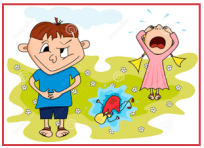
You know what kids used to say: ”No one loves me, everyone hates me, I’m going to eat worms & die!” (Toxic Rules)

HOWEVER – because we’re not allowed to be loved, comfortable & comforted, happy, thriving… we chase those few who don’t want us at all, &/or are unavailable in some way, even if there was an initial attraction.  They let us know in a 1,000 ways they’re not really able to connect (their S-H & FoA), but we don’t want to deal with that info, even when we hear it!

✶ The real reason for chasing the ‘impossible dream’ is that these unavailables are parent substitutes.  Our family gave impossible dreamus messages that we were too much trouble (for them), not worth bothering with, in their way, messy, greedy, unruly pain in the a–es.
We couldn’t live with that. We had to figure out a way to win them over, to love us, if only we knew how to fix ourselves & them.  BUT we never succeeded

✶ So now, with the current unavailables, we’re determined: this time we’ll get them, this time we’ll win – if only we’re perfect & persistent enough. OY!  (“Perfectionism”)

2. On the other hand, we’re terrified of getting too much attention, are 
uncomfortable with compliments, don’t want to ‘put anyone out’, can’t accept being given to. We think (conscious or unconscious):
a. I don’t deserve good things. After all, my family didn’t like me & they knew me best. So, when anyone else gets to know me they’ll also be disgusted, & leave me. OR
b. If someone likes me, then they’re stupid, weak, needy (no one I’d want to be with) because they’re too dumb to know I’m not worth liking. OR

c. If they’repush away being nice – they’re conning me, being polite, people-pleasing, Then just when I start enjoying things they’ll leave or want something from me I don’t have.  Sooner or later the real them will show up & I’ll be disappointed – again. ALSO =

d.
I don’t want to owe anyone – no one gives anything for free, everyone has an agenda….
e. If I admit I want to be liked & given to, then I’m the weak one, & that 
disgusts me. I’d rather be alone than be that vulnerable
f. People are just trying to control me by being nice, so they can get what they want, & make me do things their way…

ACoAs waffle back & forth between opposites – BUT only Negatives :
✶ either too alone or chase people interested in us or abuse us
✶ isolate for years or stay way too long with the wrong people
✶ hate ourselves for being too much or not enough
✶ act out Victim or Perpetrator Role (aggressor, abuser) ….
….. SO we keep hurting ourself & then find some addiction (not always a chemical) to dull the pain

STAYING in OLD PATTERN  – even WHEN we know better
✶ are loyal to family & it’s system (still think we need them)
✶ don’t want to disobey the Toxic Rules : they’re our connection to home AND we don’t want to be punished, AND if we obey them, the family will love / accept us

broken love✶ MOST OF ALL : we don’t want to ‘get depressed’ ie. feel all that pain (sad, lonely, terror, hopeless, rage, powerless… ) about our parents not loving us the way we needed.
We knew the truth back then, but it was too much to bear & we didn’t have many options, so we stuffed it all down.

If we do give up our fantasies & false hope about the unavailables, & walk away – we may get flooded by that accumulated old pain! But once we know where it’s coming from, we can learn to manage it until it passes. “If it’s hysterical, it’s historical”

It takes quite a bit of Recovery (growing the UNIT) to tolerate feeling that are awful! & still be ok. With enough time & the right kind of support, we can go through it – knowing that it was not our fault that our family (& others) couldn’t take care of & love us.
Now it’s ok to let love in where it’s genuine, today & every day from now on.

NEXT: Resist talking the IC? – #1

UNIT: Healthy Adult/Parent (Part 4)

 PREVIOUS:  the UNIT #3

ACRONYMS:
PP = Pig Parent
IC = Inner Child
LP = Loving Parent
HA = Healthy Adult


1. Being ‘kid whipped’
!
2. The Introject (cont)

3.  BUILDING the UNIT (cont)
The stronger you UNIT the more you’ll experience improvement & get lots relaxing satisfaction!  Helpful prerequisites  :
• Less Self-Hate & less attachment to the Bad Voice (PP)
• Willing to take time & effort to learn this new language
• Done enough inventories to know your WIC’s issues
• Know quite a bit about all your good qualities
• Less anxiety – to be able to sit quietly & communicate
• Maybe have done ‘morning pages’, prayer, meditation….
• Lot & lots of patience – the kid may not respond right away

3 DIALOGUES with the Inner Child & 1 with the PP

After one date with a sexy, attractive but self-hating guy
HA: “So, that was interesting. Do you want to see him again?
IC: Only shrug, but no words
UNIT: Asks the kid again for the next few days
IC: No words – but a slight pulling back
LP: “OK, honey, I get it – you’re conflicted but the answer is basically no.”
IC: “Yeah”
HA: “I agree – we can see his WIC clearly, BUT it is completely surrounded by barbed wire, so if I let you reach in to connect, your arm will get all cut up!”
LP: “We feel bad for his kid, but I can’t let you get hurt.”
IC: “OK. Thanks”

After the death of a beloved pet
IC: Sobbing, sobbing, sobbing
LP: “I know, sweetie, let it all out”
IC:” I want a new one – let’s go to the ASPCA”

UNIT: “OK, lets see if they have another orange one.  I trust you to pick the right one”
IC: At the shelter – “I don’t see any here. We have to look at the computer pictures.” Eventually she finds the right one – online!

Having a bad experience with someone
LP: knowing that the kid is very angry but afraid to let it out – asks the kid to show her an image of how she’s feeling
IC: creates a picture of being chained down on a wooden bed in a dark room, powerless & trapped
UNIT: “I’m here to help. It’s ok to be mad”  Visualizes using huge pliers to cut away all the chains. Then picks the kid up & leaves the dungeon.   IC: Still upset but relieved
⚜️
ADULT standing up to the PP
✅  UNIT to self :
I think I’ll go to that business intro I’ve been invited to – it’s the politically smart to do
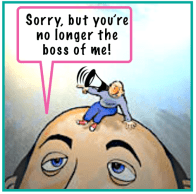
PP: Don’t be ridiculous – you won’t know anyone! They won’t be interested in you – you’d just be wasting your time!

HA:
Wow, you sure know how to lay it on thick! Those are YOUR worries & assumptions. Don’t lay them on me!
PP: How dare you talk back to me! I know what I’m talking about! I’m just trying to save you time & effort

HA
: Well, It’s obvious you don’t know how valuable networking is – you never had to promote yourself. So you’re not being helpful!
What I could use from you is telling me you believe in me, no matter what I try. I’d love to hear that you only want the best for me, that you know I’m competent & I’ll figure it out.

PP
: You’re living in a fantasy. Life is hard & you have to be prepared for the worst. That’s what I’m trying to do for you but you don’t appreciate it!
HP: Well, thanks for your input, but I’ve heard it all before & it hasn’t worked. So I’m going to try something new. You don’t have to watch!
PP: HUMPH!
UNIT: Shakes it’s head, smiles & ‘walks’ away. 😀

NEXT: “People should treat me better- but I won’t let them”

UNIT: Healthy Adult/Parent (Part 3)

PREVIOUS: Healthy Adult & Loving Parent #1


3.  BUILDING the UNIT (cont)

♥  INNER DIALOGUES
❀  Everyone’s INNER CHILD combines emotions, experiences, memories & thoughts from childhood. It’s made up of:
• every age & developmental stage we’re lived thru
• our interactions with family, school, friends, religion…
• our version (conscious interpretation/ ‘understanding’) of all the people who were important to us, good or bad
• what we picked up from them subliminally.  Kids are very intuitiveego states

Depending on the content of a voice, we’re hearing from:
❧ a good parent or a bad inner parent
❧ a healthy child or a wounded inner child
❧ a sane adult or a fake inner adult

The 1st in each duality are soothing, informative, helpful, humorous, even spiritual

The 2nd causes us great pain, a feeling of hopelessness or futility….. & some of those voices are louder, carry more weight, are meaner….than others

❤️ We need to be talking WITH the kid every day, as often as possible, about everything – no matter how trivial.
It can be about what you feel like eating or wearing, what someone is doing, the colors around you – anything from : ‘It’s time for bed, now…” , “No, we can’t go there today – not enough time” – to – “I can tell something’s bothering you. How are you feeling?”…

It never has to be a big deal. You can do it on a bus, in the bathroom, walking down the street… Yes, the written version takes a chunk of time, but not the everyday chit-chat

DON’T WAIT until you’re in a crisis, to start. If you haven’t already established a good link with the kid, & then something upsets you – you will not have the UNIT available to handle it.

?? How often do you talk to anyone you live with or see every day? Only when there’s some difficulty?
The more you interact with your kid —-> the stronger the bond —> the more you prove your reliability —> the more the UNIT can take care of things & make your life WORK!!

⬇️ UNIT conversations with the Inner Child ⬇️

♥  Week before an operation:
IC: ‘I want a new red blanket to take with me to the hospital’
LP: ‘OK, honey, let’s go shopping.’
In the store:
IC: ‘I want that one! ‘ (the most expensive)
HA: ‘We only have $– to spend on this.  We need some money for groceries too’
LP: ‘I’ll get you one of these – the smaller one. We already have 2 red blankets at home – & yes I know they’re old!”

Sensing the WIC’s anxiety:
LP: “I know you’re worried & scared about the procedure. I’ll be with you the whole time & Jerry’s picking us up afterwards.”
HA: “You know I trust this doctor.  We’ll be ok.”
IC: (Pouts but understands)

Waiting to get on a plane
IC: (A little antsy but not talking)
LP: (Noticing, waiting – knows kid is not afraid of flying, so it can’t be that)
IC: (Not saying anything but seems concerned)
LP: (Finally gets an ‘image’ of the issue) — “OK, OK, I’ll take you!”
(Kid doesn’t have to ‘go’ but is worried about needing the bathroom on the plane before seat belt light is off!
They go to the restroom & the kid is happy.😘

After a social gathering with casual friends
IC: (In a lot of pain) “They don’t like me, I talked too much, no one came over to me afterwards, I can’t go back there, I know they’re saying bad things about me …
HA: OK, I hear you.  But what we know about these particular people is that they have shown ways that they like you. You’ve talked a lot before & they’re still nice to us”
IC: “Yeah, but…”

HA:
“Yes, we aren’t their age or have the same core beliefs & not in their inner circle, but that’s not a negative reflection on you – or them. It’s just a reality. Different is different, not bad.”
LP: “Honey, the bottom line is that you are who you are & not everyone fits with us. That doesn’t make you undesirable.  We have to find places that suit all parts of us – the mental Adult, the feeling kid (You, little one) & the spiritual Parent.
IC: Reluctantly “OK”. It took a few days, but the pain went away.
*The next time at that same gathering  – everyone was as friendly as usual.   (“See, honey?” >”I know”)

NEXT: Healthy Adult/ Loving Parent – #3

UNIT: Healthy Adult/Parent (Part 2)

IT’S SORT OF LIKE MY:
Adult is  = the good Dad
Parent    = a good Mom
&  Child  = little ME

PREVIOUS: The UNIT – Part 2

POSTs: Why resist talking to the Child?
Bookending with the IC

🦻🏼 WHY you may not ‘hear’ the IC 🦻🏼(cont)
1. Being ‘kid whipped’!

2. The Introject:  Some people mainly hear the Bad Parent voice – in the form of ‘shoulds’ & judgments, about themselves & others (you know who you are). They’re the ACoAs who know it all, are controlling, bossy, demanding, pushy….  channeling the Introject! (“Ego States – Parent #4“)

• So – when you’re with such a person, you’ll be talking to their PigP.
EXP: When Mike asked: “Hi, how are you doing?” He got back: “None of your business!” And when Sara thought about writing a book, she heard inside “Who do you think you are?”

• It can be very enlightening to dialogue with the PigP, to find out more about it’s point of view, what it’s telling the kid all the time, what it wants, what its concerns are…. so we can counter with truth & logic! 🥺

3. BUILDING the UNIT
a. Read & re-read the extensive list of characteristics of each Ego State
• Print 2-3 copies, & keep 1 each where you’ll see it every day – bathroom mirror, bag, tablet, cell….
• Little by little – write something about each characteristic  = what you think it means, how you do or don’t use it, how you see others doing it…
• Pick 1 characteristic of the L.P. & focus on it for a week.  Use the same Qs as in your writing, as you go thru each day of the year
• Take notes about your observations & talk it over with trusted people. Ask for suggestions & feedback on how to improve

The UNIT (HA + LP) needs to interact with both the NC & the WC :
• Get IC dialogue-writing workbooks, & practice until it becomes natural. Listen to “Self-Parenting” videos
• Watch how kind, loving real-life or TV parents talk to their children  (especially when the kids mess up!)
• Visualize holding your WIC & NC – what do they need & want to hear? what would you have liked your parents to say to you?
✶  Make sure to leave time for the kid to answer, comment, feel, react… It’s not a dialogue if you do all the talking!

👥 The UNIT has to consistently be in play. As grownups, we have to prove to the WIC we’re worthy of being in charge, since the ones who raised us were not.
As kids we had to either hide or be super-kid, but all of us were on our own. So now – developing a functional UNIT is the only way the kid will trust us enough to turn over its power, the only way to show the WIC is Safe & Valuable!

This is done by the UNIT’s healthy internal communication + appropriate external actions – which takes time & dedication to develop.  Our ONLY job is to take care of our Kid. If we do – everything else falls into place.

b. Actions to develop the ….. ADULT ES :
INTERNAL
• catch S-H thoughts & stop them as soon as possible
• do drawings of how you feel emotionally
• learn about your damage (WIC #1 post)
• learn healthy ways of thinking
• read everything about your issues & about growth
write some of your thoughts down every day
• try things you always wanted to do (school, travel, move…)
EXTERNAL
• listen carefully to kind people & copy them
• talk to smart, sane people regularly
• stick with the winners (others on the same path)

….& the PARENT ES:
• daily dialoguing with the WIC & the NC
• do more good things for yourself
• do less bad things to yourself
• hold your Kid, pat your chest, sing, say soothing things
• let yourself cry & do rage work as often as needed, but only in safe ways
AND —
• practice standing up for yourself, say what you want & don’t want
• stay away from people who consistently cause you pain
• nurture a spiritual life that suits you
✶  If you do your best to follow some or all these suggestions you will see improvement & get lots of satisfaction!

NEXT: The UNIT- #4

UNIT: Healthy Adult/Parent (Part 1)


BALANCE OF POWER –
I can change ‘who’ runs my life!

PREVIOUS: Ego States-Parent #4


ACRONYMS:

ES = ego states // HA = healthy adult //
LP = loving parent //  NC = natural child  //
WIC = Wounded inner child //  PP = pig parent  //  PMES = physical, mental, emotional, spiritual // UNIT = HA + LP
✦    ✦     ✦
Genuine Recovery is marked by internalizing the ‘sane’ information we’re learning, so it becomes an automatic part of us – the new normal.
As we incorporate new understanding, we’ll be able to consistently respond to the world from a different place, which gives us a sense of safety, mastery & empowerment (as in the “AA Promises“)

This can never be done perfectly or without regressions & digressions – so don’t expect that. The goal is to keep moving forward on the path of healing. To do this we need to build a healthy ‘UNIT’ (H.A. + L.P.) to be the inner EXECUTIVE.

• All unhealed ACoAs are run by the interaction of  their Bad Parent & Wounded Child ego states (E.S.)
• But so are many people who are in Recovery, before they do family-of-origin work (FoO)

• High-functioning ACoAs have a fairly well-developed Adult E.S. (but with some CDs), but are missing the Loving Parent, which can be seen in how we talk to ourself & deal with personal relationships

3 MAJOR TASKS of the ‘UNIT’
a.To separate the PigP & WIC
, to stop the child from having to obey the cruel & unhelpful domination of the BAD PARENT .
Internally, we may only hear one or the other, but without Recovery the PigP has all the power, & left on its own, the vulnerable WIC has no choice but to submit

b. To nurture, guide & take care of both the Healthy & the Damaged parts of our Child
• For the WIC – to help it heal from all it’s PMES wounds with unconditional love & nurturing, & let it know it never has to be alone again
• For the N.C. – to help it find it’s voice & develop it’s true potential, which creates our self-esteem

c. To interact efficiently with the rest of the world in order to get ALL our needs met – by learning what our options are, developing the skills & attitudes for self-care & social ease – given our individual circumstances & abilities, so we can have more comfortable & fulfilled lives

🦻🏼 WHY you may not ‘hear’ the IC 🦻🏼
1. Being ‘kid whipped’!
a. you’re ALL kid.  Without the ‘UNIT’ present there is no dialogue. That can be changed. The child E.S. is a separate entity, & should not be in charge.  A therapist once said: “You have a child, you are not a child!”
• Picture the WIC outside of yourself – in your lap, on the bed or floor, hiding behind a chair or curtain…. but always there, waiting

b. the IC is too young to talk.  Depending on what IC age is being triggered by a current situation, you may feel your pre-verbal infant self – with lots of emotions but no words

c. the WIC doesn’t trust you.
If you’ve been unavailable altogether, or inconsistent, only talking AT the kid,  sounding like the bad parent…. the kid isn’t going to respond!
EXP: “Hi buddy, what’s up ?”  >> “What do you care?”

d. the IC is old enough to talk but doesn’t know how to express what’s going on with it yet – doesn’t have the right words for things it’s feeling, isn’t developed enough to think abstractly, isn’t allowed to say what it feels or needs…. EXP: “ Hi honey, what’s bothering you?” >> “I don’t know”. —- young kids always say, whatever the situation

e. The older WIC – maybe 16-18 – is angry if you’ve been ignoring him/her, responded when asked why they’d done something ‘off’, especially if you’ve already been talking to the younger ones. You may get an image of it with its back turned to you, crossed arms, pouting….

The teen needs just as much attention, but of a different kind = more practical, included in decisions, being asked its opinion. This ES often hold knowledge & wisdom we’re not even aware of – until we connect.
BUT also – there are still many things our teen Self doesn’t understand, so it needs validation of its painful experiences, AND talked to with respect.

NEXT: Healthy Adult / Loving Parent – #2

Ego States – PARENT (Part 5) Modes

adult choices 

MY “ADULT” CAN CHOOSE HOW I RESPOND –
from a positive or negative Parent voice

PREVIOUS: Parent E.S. – Part 4

See ACRONYM page for abbrev.


EGO STATE (ES) MODES
NOTE : The Adult ES is our Executive branch, & most beneficial as a person’s guiding force. It can either be the healthy or unhealthy part of someone, with good or bad motives, with good or bad consequences.

EXP: The Adult is in charge whether one is planning a new town on a drawing board, or planning to rob a bank. Both require logic, reason, critical thinking faculties, planning skills….. Review ‘OK Corral’ (Adult E.S., Part 3)

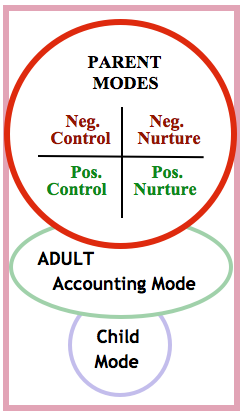
This chart ⬇️ shows the Parent aspects. (See CHILD ES version)

1. UNHEALTHY PES says: “You’re Not OK” to self & others
a. Negative CRITICAL / Controlling P. is punitive & insensitive. Gives abusive, degrading criticism, to overemphasize being in control – using fear, suspicion & distrust: “How stupid can you be”….
For ACoAs :
• Outward – often expressed towards others as prejudice & disapproval
• Inward – continues to influence the Inner Child in the form of S-H
Parent Mode
EXP: It’s the person who sees an injured dog in the street, & says: ‘All dogs should be kept on leads, not allowed to roam free’ – & so does nothing to help

b. Negative ‘NURTURING P. is over-protective or engulfing, giving physical attention in order to control or manipulate others. May smother with concern, denying people the opportunity to develop their own skills.
Help is given from a self-serving attitude which discounts the other person’s actual needs, as well as their autonomy & competence

The Negative Parent (PigP) is ‘on’ when we’re:
Physical – frowning, crossed arms, finger-pointing, angry or impatient body-language & expressions, superiority gestures…..
Verbal – using a condescending tone, judgmental & critical words, patronizing or posturing language :
“This is how you should — //  under no circumstances — //  you should always — //  never do — //  for once in your life — // you shouldn’t — //  how dare you —  // don’t do as I do, do as I say…”

Keep in mind that cultural differences in body-language or tonal emphases that may seem ‘Parental’ in one culture may not be the speaker’s intention in another.

2. HEALTHY PES says: “You’re OKto self & others
Since the following aspects are either missing or weak in most ACoAs – especialgood parent voicely toward ourself – developing & encouraging the Good / Loving Parent voice is a critical (no pun intended) & fundamental requirement for our growth

Positive NURTURING P.
🌺 For US: It’s used to self-sooth, help the WIC with any form of emotional distress, letting the Child (C.) know it’s never alone.
It is also the part that encourages, cheers & champions the Healthy / Natural C. to “be all you were meant to & can BE”! It draws from our own native capacity for kindness, as well as any experiences of being cared for, by anyone, but especially in childhood. (This is – or can form –  our Positive Introject)

✿ For OTHERS: It’s the source of kindness, respect & help we give others, coming from a genuine regard for them as fellow-travelers on this earth. It allows us to give-&-take appropriate physical affection, such as a gentle hug or touch when desired
EXP: It’s the person who lovingly picks up that dog, who got injured by a car while crossing the road, & takes it to the vet

Positive CRITICAL / Controlling P. (needed!) 
🌺 For US: It’s used to set boundaries for oneself, providing self-control – limiting the Child’s excessive wants, demands, distorted thinking, inappropriate behavior such as unhealthy or unsafe acting out ….  It’s the way a good parent holds a child back from running across the street, limits unhealthy foods, sets curfews…. the Pos. Controlling P. helps us stay out of or leave dangerous or unsuitable people / situations…..

✿ For OTHERS:  Instructions & commands are aimed at genuinely encouraging someone’s well-being. Constructive criticism is used to protect & steer away from harm or potential danger : “You might want to consider — //  I encourage you to stay away from the — //  be careful when you — // I recommend that you…..

NEXT
:  Parent ES #6

Ego States – CHILD (Part 5)

broken home

 PREVIOUS: Child E.S. (Part 2)

CES = child ego state
AES = adult   ”     ”
PES  = parent  ”    ”

NC = Natural C.  // AC = Adapted C.

2. ADAPTED CHILD (cont)
2a. BROADLY (Part 4)

2b. SYMPTOMS of the -AC
Ways it expresses uncomfortable or painful emotions
Physical – have temper tantrums, roll eyes, shrug shoulders, use a whining voice
AND / OR inappropriately giggle, kid around, laugh, raise hand to speak, squirm, talk behind hand, wink….

Verbal – baby talk, be literal, talk too much. Phrases : “Oh no not again, Things never go right for me, ….worst day of my life, I dunno”….
AND/ OR  brag, exaggerate, pontificate. Use many superlatives (best, most, biggest), ‘big’ words to impress…. Phrases start with :  “I wish, I want, I’m gonna, I don’t care”.
CHART:
In adulthood :  
Three negative adaptations to early trauma, -AC styles, found in C2
These nuances are ways the WIC can act up at WORK or in other groups, expressing “I’m NOT OK” or “I’m not OK & neither are you!” (OK Coral)

• Compliant Child ES
Fearful attitude :“I’ll do anything to please you as long as you don’t get mad at me or fire me”.
This person doesn’t make a good team member (don’t pull their weight), & will be highly stressed if they have to manage others. Often feel depressed, overwhelmed & unrealistically anxious
• Oppositional Child ES
Angry attitude : “No one can control me”  
Reacts against others, whether someone actually agree or disagree with them – as a false boundaries & a temporary sense of power. Negative repercussions are obvious
• Reckless Child ES
Arrogant attitude : “I only do things MY way”. (-FC)
This type has no boundaries & does whatever it wants, no matter the consequences to self or others. The person never / rarely takes responsibility for their actions. If they’re an employee it takes a great deal of management effort to keep them focused & out of trouble. As a boss – they run roughshod over everyone.

NOTE: We can switch into whichever state gets triggered by a current situation, often related to different ages in our past “Compliant’ is usually the youngest Inner Child of the past – age 3-5 . “Reckless / Rebellious” tends to be our teenager….
(⬆️ see the 3 Damaging Parent ES in “Parent – #4”)

FIXATION (see Basics Part 3)
DEF : an attachments to people or things persisting from childhood into adult life. An inability to adopt any different or new perspective about a problem

As long as the original trauma in our past is still lurking in the background as unfinished business, those experiences become psychological fixations – ‘stuck-ness’. So behaviors, beliefs or feelings connected to unhealed buttons can still be triggered by events in the present.
One stressor may throw us back to thoughts, emotions & actions when we were 10, while another event make us feel like a helpless infant

When the -AC E.S. takes over our usual way of functioning, we’re hijacked by something inside, out of our control because it happens so fastold damage – & we’re back in our childhood (regression). This shows us exactly where particular old wounds need to be repaired. (“Cycles of Power” has examples)

Fixations hold up a mirror to the PigP (Introject), not from our True Self which includes the Natural Child (+FC), capable of being comfortable with self & others.
Instead, mal-adaptive Introjects keep our Child part in pain, psychologically trapped in the past. Fortunately we can reprogram the brain.

⚙️ We can be emotionally stuck in the past because of verbally, physically & sexually abusive adults, physical & emotional neglect, unmet developmental needs, & generally unskillful or inadequate parenting. Children get confused when their needs are punished, misunderstood, ignored or trivialized – consciously or not. When it happens often enough, those lacks poison our whole world. (MORE…. examples)

💜 But even with caring parents, some ACoAs can get fixated at a  developmental stage because:
• the child or siblings’ needs were particularly complex or obscure
• unavailable or incompetent social / medical ‘support’ systems
• the family was under extreme stress from various hardships (severe financial or health problems, natural disasters, war / PTDS)…..
….. which under better circumstances 🌤 those parents would have wanted to & been capable of providing 🌺.

NEXT: Ego States – CHILD (Part 4)

Ego States – CHILD (Part 3)


PREVIOUS: NATURAL Child ES

SITE: Comfort bags : emotional first aid kit (includes SONGS for the IC)

CES = child ego state  //  AES = adult ES  // PES  = parent ES
NC = Natural C.  // AC = Adapted C.(WIC)

1. NATURAL Child (Part 2)

2. ADAPTED Child (+AC) – It is a normal & necessary aspect of all human beings, the part that learns about & adapts to what is expected of us in our particular society, so we know who we are & how to survive.
It incorporates the lessons of our family, school, society & religion – molded in childhood, every day from every aspect of our early environment.child aspects

Our Adapted Child part learns how to behave under the influence of its family, in ways the parents would like it to be – obedient & precocious, or reserved & scholarly, or aggressive & vindictive….

❇️ For kids from functional homes, it’s formed around healthy rules & values, which then translates into well-adjusted, self-caring grownups who contribute their special abilities to society.

POSITIVE QUALITIES
🔅 Adapts, adjusts, fits in, reconciles itself to its environment
🔅 Absorbs values, mores, rules & restrictions of its society
🔅 Conforms to gender-specific messages & other norms
🔅 Contains the development of social skills & appropriate behavior

IMPORTANT : The Natural & Adapted Self are not automatically in agreement. Even in healthy environments (home, school, culture, religion) the 2 part of us can have different needs, desires & dreams.
EXP: What if the NS is born to be a talented artist / actor…., but the AC is required to be an academic, or macho sports hero, or business leader…..? ☆ How developed the Natural Self becomes over time will determine which one eventually wins out.
🔻          🔺           🔻
For ACoAs, the ADAPTED C.(-AC) ▲  is our wounded part (WIC), in reaction to wounding caregivers. It has to adapt in harmful ways BY rescuing, over-conformed & easily manipulated, being helpless or self-destructive…. It’s made up of our:
Ts – accumulated memories of many traumatic events
Es – all the pain (loneliness, despair, shame, hurt, humiliation….)
As – the child’s coping behaviors (caretaking adults & siblings, fighting, hiding, lying, studying…. )

For everyone, the normal Child includes sometimes being unpleasant – having resistance, hostility or reactivity – when feeling uncomfortable or threatened (a new siblings, a poor school grade, a divorce, a serious illness….), but most of the time they don’t have to worry.

BUT for ACoAs – our sense of dread & anxiety in childhood came from being constantly stressed (neglect, abuse, confusion, losses), so the -AC:
• became our False Self, developed as the only way to cope in childhood
• overshadows the True Self, so we may not even know who we truly are
prevents us from having access to a Healthy Adult
• denies the intuition & emotional intelligence of our Natural Child

All kids come up with strategies to get through difficult situations, but when a child endlessly needs to protect itself, those strategies become a habit, then armor or a wall, the default position used in all situations, no matter what the circumstance.

Characteristics of the -AC ego state
PSYCHOLOGY
• Assumes it is the ‘Real Self’, being the only one a person knows, but is not
• Believes it’s protecting itself, but prevents our normal / universal needs from being met correctly
• Compulsively obeys the Toxic family RULES
• Emotions include anxiety, envy, guilt, rage
• Houses the Toxic ROLES Hero, Scapegoat, Lost Child, Mascot
BEHAVIOR
• Acts from Victim, Rescuer or Bully position
• Can over-compensate, becoming aggressive or rebellious
• Is over-controlled or can be controlling (copying thbad WICe Introject)
• Lacks genuine confidence. Not able or willing to accept balanced, appropriate responsibility
• Weak boundaries, so gives in to unreasonable demands from others – OR
• Walled up, so is always deprived &/or withholding

As the WIC, the -AC reacts to the world around it by either changing itself to fit in (‘good girls/boy’), or rebelling against all forces it encounters (as enemies)

If a ‘normal’ grown-up temporarily regresses to this ego state, they’ll experience inner needs & the outer world as they did in one of their earlier developmental stages. In that state, although seemingly in the present, they’re actually reacting to a current situation thru childhood mental & emotional lenses. But it doesn’t last.

NEXT: Child E.S.

Ego States – CHILD (Part 1)

Inner children
I CAN FEEL ALL MY EMOTIONS
when I connect with my Child part

PREVIOUS: ADULT E.S. (Part 3)

CES = child ego state
AES = adult   ”     ”
PES  = parent  ”    ”
NC = natural child / AC = Adapted C.

GENERAL
Everyone has a CHILD Ego State (CES) – the earliest stage of our development, forming our personality in the first 5-7 yrs of life. Similar in many ways to the Freudian concept of id, it operates on the pleasure principle, automatically & persistently aimed at gratifying & fulfilling needs – but available on a conscious level.

We continue in child mode well into our late teens & early 20s, through 7 developmental stages.(“Cycles of Power” by Pamela Levin). For the rest of life the CES is both an influence (what we think & feel inside) & a state (looking & acting like the little person we once were).

CHILD e.s.🌺 It’s called “archaeo-psyche” because it’s a collection of taped & stored info – behaviors, thoughts & feelings held over from childhood.
In T. A. terms, it’s made up of the Natural /Free Child (NC) – our fundamental identity – overlaid by the Adapted Child (AC), healthy or unhealthy, developed in response to our environment which are ‘understood’ as filtered through our natural tendencies (Part 2,3)

Its goal is to feel pleasure & avoid pain – no matter how or at what cost. It’s focused on Self needs only, even when relating to others or trying to being helpful : “I want, Don’t leave me, I refuse, You can’t make me, I don’t wanna, I want you to….”

This does not mean it’s a bad aspect, to be gotten rid of. We need it, since it holds the seeds of our native qualities, as well as the wounds that influence later behavior. It’s just that as adults it’s not healthy to be ruled by the Child. (See ‘Contamination’)

✦ This E.S. is mainly the domain of the ‘felt’ – the Right brain. Before we were able to talk (Left), our whole world was about feelings & sensations!
So most, but not all, of our emotions (Es) – including all the old stored up ones – reside in the C. part of us
brain sidesFor ACoAs, it is our NC that has mainly been suppressed, ignored, almost crushed. Early on it had to go into hiding to preserve itself from overwhelming harm.
However, it shows up anyway, perhaps sideways – when we use our natural talents – in business, in the arts, in science…. BUT without Recovery we don’t believe they have value, assuming we’re frauds. ◎ Healing works to help us own & happily appreciate them.

▶ In CHILDHOOD
Before we have the grown-up components of the Adult & Parent, we develop rudimentary aspects of them – the Child’s versions of them (+FC), along with the basic tendencies we’re born with – the C’s C. Eventually these 3 parts become the essence of the Inner Child E.S. no matter how old we are. (see Second Order E.S. Map).

C. e.s.C’s Parent – sometimes called mother’s ‘Little Helper‘.  Kids, even very small ones, will help a drunk parent up the stairs, rock their dolly to sleep, care for a pet… OR be bossy, lecture other kids, copy their parents’ way of treating their younger siblings…
Electrode (zaps you with a toxic command, causing a knee-jerk reaction), Witch Mother or Fairy Godmother

C’s Adult – trying to do ‘grownup’ things, even before they’re ready, going to the store or school – alone, ‘being in charge’, showing off their cleverness & knowledge… trying to figure out how things work…. BUT without enough info or mature ego states to process everything correctly
The Little Professor

C’s Child – our most basic self, the core of our identity, the most vulnerable part, aspect of ourself which, as adults, has often been suppressed to the point of being invisible.  This part is composed of our physical self, instincts, biological urges, genetic recordings, and how we learn, our level of sensitivity, social preferences, the full range of emotions – from great joy to great pain, down to how we like our eggs cooked! 
Magical Child or Little Fascist

NEXT: CHILD E.S. (Part 2)

Ego States – ADULT (Part 2)

inner girlI NEED TO WATCH OUT FOR
ways the Child or Parent take over

PREVIOUS: ADULT Ego State (#1)

ACRONYMS :
H.A. – Healthy Adult
G.P. = Good Parent
H.C – Healthy Child

PURPOSE of ADULT  (cont)
b. Regulating  //  c. Accounting
d. INTEGRATING
🔻Unintegrated Adult – the rational, competent part of us which many ACoAs use to get along at work & in a variety of relationships, but which doesn’t connect with the Inner Child, is easily swayed or blocked by old damage & can’t ally with a Loving Parent, because there is no LP

🔺Integrated Adult – is expressed in many of the same ways, but mainly as the primary ‘executive’, interacting with both P & C ego states, to form a whole personality. It prevents the WIC or the PigP from running our life

Adult FUNCTIONS
✦ The Adult E.S. can be compared to a computer or regulator, in charge of un-emotional activities such as decision-making & problem-solving
✦ it lives in the present, is able to be spontaneous & adaptable
✦ is intelligent, logical, organized, evaluates facts based onScreen Shot 2015-09-02 at 5.34.10 PM available data

✦ has a keen sense of awareness, understanding, insight – knows what’s possible & what’s not in the real world

is fully awake to the environment, constantly updating itself through every-day experiences, to keep on top of things
✦ estimates probabilities, observing & processing information dispassionately

can ask for help & apply practical problem-solving strategies when things get tough
✦ determines appropriate actions with enough rational input, & draws from recorded ‘tapes’ of a Positive Introjected Parent

looks for information rather than staying scared or making assumptions. Makes an effort to search for knowledge, both from necessity as well as for pleasure (curiosity)
while not focused on emotions, is balanced, not over-or under-reacting
funadult ESctions from understanding that most things are done with a medium level of importance or intensity (not dramatic)

allows the Healthy Child & Good Parent to have intimacy because it provides good boundaries, as a result of knowing what its rights & personal needs, so is not afraid to connect with others
knows who is safe & who’s not, because it can see people as they truly are, rather than idealizing or undervaluing

takes the best from the past & uses it appropriately in the present by integrating its strengths with the G.P. & H.C.
✦ Is not overly influenced by harmful childhood experiences, does’t project personal or family damage onto others

NOTE: When ACoAs function too much from the Adult E.S., we live ‘in our head’, not in touch with feelings & can’t relate to others emotionally

Eric Berne (T.A.) wrote that coming from an Integrated Adult E.S. does not only mean being rational / reasonable, but also provides access to feelings, values & attitudes. It allows the 3 parts to work together as a whole, in current reality – internally as well as externally. The Adult ego state is “principally concerned with transforming stimuli into pieces of information, then processing & filing them on the basis of previous experience” (Berne, 1961).

🔸 The healthy Adult-in-the-adult (rather than the Child’s version of an adult) is fully in contact with Healthy P & C, allows us to see all current options & possible resources – given who we are, in relation to what we need & what’s going on now.

❥ When in the A. ego state – we’re aware of what’s real and what isn’t, & act accordingly.
So when we experience emotions in response to something in the moment – like feeling sad when a friend moves away – our behavior is consistent with how we actually think & feel, (T.E.A.) rather than reacting from our unhealthy past (raging, attacking, withdrawing….).

structure❥ With the A. in charge – we communicate that “WE are OK”, able to choose which mode to switch into depending on what’s called for, without giving up the A. ‘in charge’ position. (see Overview of E.S.)

EXP: As long as the Adult is ‘on’, Child can have fun at the beach or at a nightclub without getting into trouble or hurting others…. & Parent can help someone or run a work project – without overstepping boundaries or taking on too much responsibility….

NEXT: ADULT E.S. (Part 3)