Enneagram – Type STRENGTHS (Part 3)

enn water over rocks AS WATER FLOWS OVER ROCKS
so do my Gifts from out of me

PREVIOUS: STRENGTHS (#2)

SITE: Popular Enneagram books

REMINDER:  In this context – EGO = FALSE SELF,  NOT the same as a HEALTHY EGO, and read “EGO”)

OVERVIEWFall from Higher Essence Qualities to Ego Distortions
Oscar Ichazo made a connection between the 10 spheres of Kabbala’s Tree of Life, & the Enneagram symbol. The Tree’s first sphere, Keter, is reserved for the Messiah, leaving 9 others for humans, suggesting 9 kinds of souls as emanations or facets of the Divine Unity.  (MORE...)
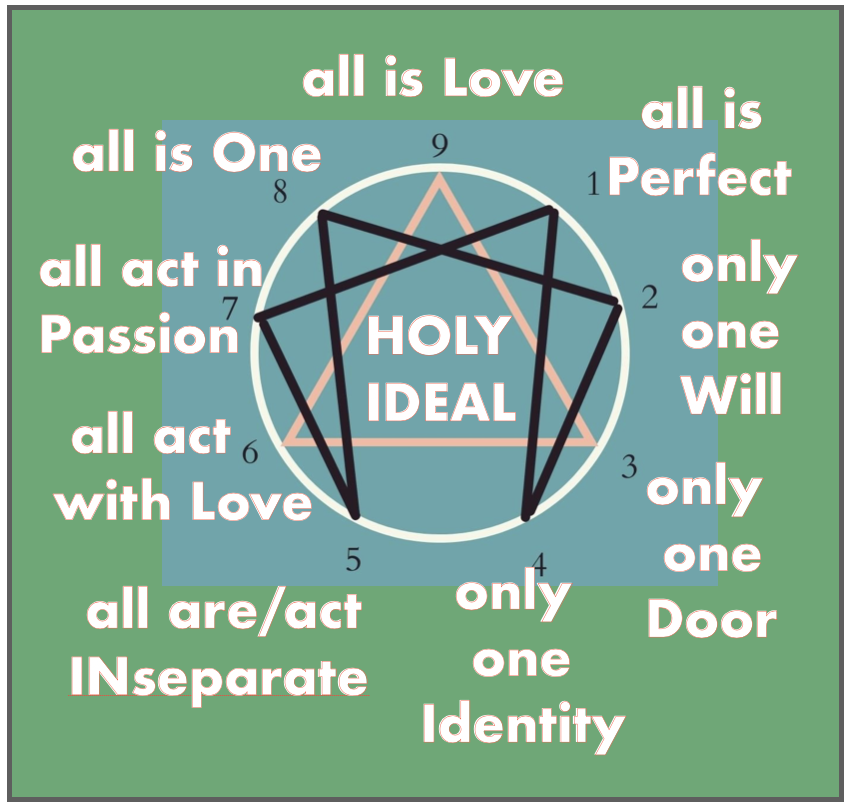
● While everyone has the capacity to embody all of the Holy Ideas and Virtues, one pair of them is central to the soul’s identity, so their loss is felt acutely, & the person’s ego (conscious False Self) become totally preoccupied with recreating it, although in futile, self-defeating ways

● Based part on this, Ichazo created a hierarchy of expressions:
9 HOLY IDEAS (Part 1) the objective, experiential understanding of higher Truth. Their loss or absence generates specific delusions /fixations, the underlying Toxic Rules of our ego-driven lives. Each delusion forms the center of a psychological complex, which the core of that particular fixation.

VIRTUES
Based on the Holy Ideas, the Virtues are the natural expression of the awakened heart – the unified, expansive qualities humans experience when we are abiding in Essence, our True Self. AND they can not be ‘practiced’ or claimed as personal achievements. While our ego-self is most preoccupied with recreating it, doing so would only be a narcissistic self-aggrandizement for the ego – the very opposite of a Virtuous state.
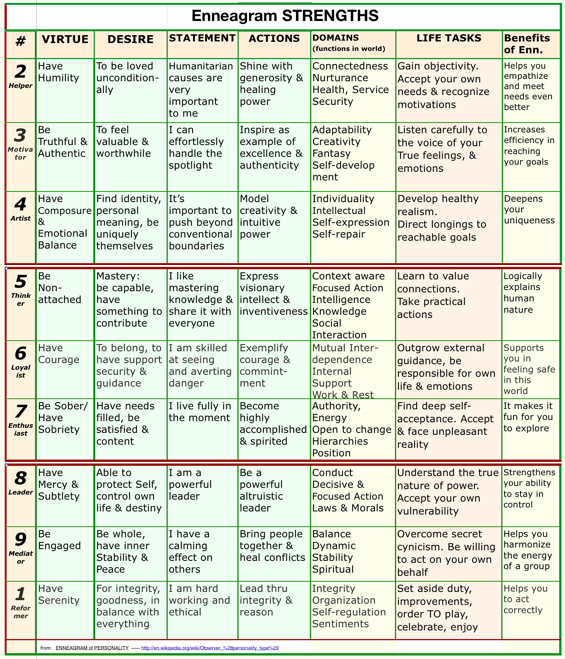
They are each type’s antidote to its Passion – pointing to our STRENGTHS – so as we “Let-go-&-let-God”, accepting what is already waiting in us to emerge, our specific Virtue begins to express itself in our daily life. They are not simply ‘their own reward’ but expressions of Grace & a method of transformation*.

*Transformation can be understood as a conversion of energy: shifting from the narrowness & futility of our Vice to our Virtue. It is not easy to do, since out Type is hardwired & a life-time of doing things a certain way are hard to soften & dissolve. Shifting this energy takes time, along with great desire & determination, persistent effort & a willingness to look deep inside ourselves. Repetition of new habits & patterns create new neural pathways that, over time, allow us to catch our automatic responses before they get going. This makes it possible to choose a new way of responding to PPT (people-places-things).

EGO-FIXATIONS
As a person loses Awareness & Presence of the Holy Idea, we fall away from Essence into the trance of the outer personality – an ego delusion about self or reality. But once the True Nature is restored  we can see through the particular delusions of our type. Again, our underlying Truth is antidote to the ego-fixation when we want to restore the balance & freedom of our personal Holy Idea

PASSIONS

They represent the underlying characteristic emotional response (Basic Fear column) to reality which was created by the loss of contact with our Essential nature – the Virtue. The underlying hurt, shame & grief this loss entails are enormous, so our ego (defended Self) is compelled to come up with its particular way of emotionally coping with the loss, altho misguided & ineffective.
— It can also be thought of as our untamed animal nature before it’s transformed by contact from higher influences—an awareness and Grace. Together with the ego-fixation, these represent the ways that spiritual qualities become contracted into ego states

INSTINCTS
Our Instinctual Self is a primal aspect of personality, & our dominant one insures our fundamental survival in the physical world, but in so doing can block the way to growth. The Enneagram’s 3 instincts are an anchoring counter balance to the higher spiritual Essential Self, rooting us in the dualistic (good-bad) defended self, which ‘forces’ us to distort & habitually overuse our survival strategies.
● They are considered the way we forget our connection to the Divine. Losing our Essence-center distorts our Thinking, Feeling & Doing (TEA). Spiritual / emotional growth comes from being able to balance, release & transform our instinctual nature into its higher opposite.

NOTE that the strengths and weaknesses of each type are two sides of the one coin. There is NO point in wanting to change to another type, since that would just mean swapping one set of problems for another.

NEXT: Type VIRTUES (Part 4a)

Enneagram – Type STRENGTHS (Part 2)

ennea strenghI CAN REST EASY
in the castle of my identity

PREVIOUS: Type STRENGTHS (Part 1)

SITE: Buy Profiles of 9 types (BIZ)

BOOK: The VISUAL Enneagram (pictures)

REMINDER: In this context – EGO = FALSE SELF
NOT the same as a HEALTHY EGO,
and read “EGO”)

To appreciate the POSITIVES of our Type, it helps to put the work of the Enneagram in context.
Chasing ‘healthiness’ is not the main goal of the Enneagram – but rather to become aware of our unique Role in the larger scheme of life, & experience how it plays out in every-day experience. Our fixation behavior – the acting out of the Defect – is Ego trying to hang on to its particular corner of Reality.
EXP: #5: “I must fill the unfillable hole of not-knowing”.enn HIGHER OCTAVE

● Yet our unconscious pull toward Essence, with its way of higher thinking & feeling, suggests that each Number represents an archetypal energy pattern, a Higher Octave, self-aware of the deeper characteristics of Reality. This awareness can increase self-knowledge & a deeper connection to Spirit. (Enn in Motion)

● When our focus is on being less & less attached to our usual (defensive) way of functioning, it naturally results in healing the split between parts of ourselves, between ourselves & others, & between us & our Higher Power. Transpersonal* experiences allow us to see ourselves as we are meant to be – in our current state, but moving toward being whole.
*Transpersonal means growing beyond narrow or personal needs, from “experiences in which the sense of self-identity extends beyond (trans) the individual, to encompass wider aspects of humankind, life, psyche or cosmos”. (Shakti – 10/16/05)

● The combination of the 9 Types make up a total Microcosm of the human viewpoint. The movement toward Presence (the ‘work’ is to become awake to a Higher Truth) starts at the Mechanical / Automatic way of functioning on the right side – thru #1-the way of the body, #2-the way of love & #4-the way of power, which need to be learned before moving up the left side. Growth proceeds around the Inner Points via the ‘spiritual’ octave Do-Re-Mi-Fa-Sol-La-Ti-Do, toward full Essence /Consciousness (#9), as taught by Gurdjieff.

being/grace/mercy● The universal principles – Being, Grace, Mercy – also used in Enneagram study,  are divine forces which drive the engine of the universe & function according to spiritual laws in every octave, regardless of ones ‘developmental level’. Cosmic consciousness diversifies naturally into personality types (1-9) according to these principles, as:     Materiality, Desire, Conscious Labor, Power, Being, Intentional Suffering, Purification, Knowing, Essence.  (MORE…)

● As energy circulates around any octave, it is expressed by specific characteristics, depending on its proximity to the Divine. Each octave is a circulatory system with a set enn affirm deny reconciieof specific demands placed on it. These give some basic insight into the nature of Holy Affirming, Holy Denying & Holy Reconciling forces.
PINK = closest to the divine, (“do”, the absolute) are material expressions on the  right & wisdom, on the left.
GREEN = represents the heart, the mediating zone between the most holy at the top – and –
BLUE = manifestations of intelligence and awareness, being furthest from the divine, at bottom. (MORE….)

«
NEXT: Type Strengths (Part 3)

Enneagram – Type STRENGTHS (Part 1)

ennea jewels IT’S GOOD TO ACKNOWLEDGE
my special strengths & talents!

PREVIOUS: Type Weaknesses (Part 3c)

SITE:  Enneagram Types & Tips for Happiness (iTunes) Jackie Wells Smith


CORE qualities = our GIFT
● The flip side of each Type’s ‘defect’ is the characteristic which allows us to self-actualize – our Virtue / Strength. These exist in immature form when we’re born, & are supposed to mature over the course of a lifetime (like an acorn), but can only do so IF planted in good soil – ie. a safe, loving family.
> If Nurtured, the Strength will allow us to grow into something grand

> If Hindered – it will be used incorrectly, to everyone’s detriment.
We know that a damaging childhood environment stunts the healthy development of our specific core quality – so it doesn’t turn into a mighty oak – which is what happens to most ACoAs – before Recovery. SO an essential part of our process is to find healthy people-places-things (PPT) that help us undo the damage & allow our precious acorn to RE-grow correctly. “It’s never too late to have a happy childhood” – NOW.

● The reverse of the “defects” are the 7 Heavenly Virtues:heavenly virtues.png
Charity, Faith, Fortitude, Hope, Justice, Prudence, Temperance + 2

The coordinating Enn. Strengths are:  (#1 – #9) : Serenity, Humility, Truthfulness, Equanimity, Detachment, Courage, Sobriety, Innocence, Action
— These positive qualities can also be used as PROCESS, starting at #9, which represents “The Whole” – for planning a trip, making a meal, running a company, pursuing our Recovery…

● To find our Type, we start with the exaggerated expression of the self – the defect – & trace it back to its original state. Our harmful ‘Habits of Mind’ (CDs) come from over-using /mis-using the Strengths, which are our most natural positive tendency – what we’re best at & our fundamental way of approaching the world. Therefore, the positive quality hidden in the flaw is our GIFT, with both the characteristics of Divinity & of human personality, which we bring into the world to share with others.
EXP: 2s love to help people, but damage turns it into co-dependence.
Healthy 1s like things to be done right, but damage turns it into judgmental perfectionism. Healthy 5s love to be quiet & study, but damage turns it into isolation or being pedantic (a know-it-all) …..

VALUES
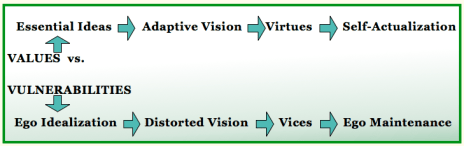
● In “Types of Men” (1928), Eduard Spranger wrote that people are best understood through the study of their values. In the 1960’s Gordon Allport, father of Personality Psychology, agreed that perValues vs Vulnerabilitysonal values are the basis of our philosophy of life.

OUR:
Vulnerabilities come from what caused our essence to be distorted
Values come from what each Type finds most important & deeply wants

● Another way of saying all this is: At the heart of each person’s adaptation to the world are inborn aptitudes & abilities, present as potentialities in our core self. These energizing talents form our values, which we hold dear, influencing our motivations & perspectives on life. They orient & focus our vision – identifying what’s important to us, what to organize our life around, what to live for. While we can appreciate & express something of all the 9 qualities, temperamentally we favor a specific one which guides our attitudes, behaviors, emotions, energies & perceptions – expressions of our Essence.

a. From a spiritual point of view, we are told that human being were made in the image of God (Genesis 1:27), ie. God’s character & attributes reflected in us, such as compassion, rationality, love, hatred, anger, mercy…..
b. From a psychological view, human nature shows up in differing points of view & their accompanying ways of experiencing, evaluating, perceiving, understanding & responding to the world.

The “Primal Catastrophe”
Unfortunately most people lose touch with our specific Essence early in life. The Defect of our type is formed in response to the primal catastrophe of our childhood – the loss of connection to the Divine. In Christian terms, we’re born separated from God by our sin-nature, forgetting our birthright as children of God. In reaction, humans develop 9 different (ineffective) strategies to try reconnecting with Spirit & our deepest self.
holy ideas
● The Virtues/ Strengths identify the way to reconnect to Essence, out-growths of the spiritual insights called Holy Ideas (Holy = objective spiritual reality, expressed in the higher, essential qualities of the human mind). Since our Type’s Ego Desire is a mix of divine yearning & ego questing – in spite of the distortions – ‘personality’ has a sacred impulse at its core.

Ego vs. Essence ?
Essence = Our True Self, originating at birth. It’s different for each Type, & depends on the basic flavor of True Nature which each Number is most sensitive to, based on one’s Holy Idea. When we’re in touch with it, we feel an all-encompassing sense of aliveness, connection & well-being.

Ego: Not the Healthy Self from Psychology, but rather our False Self, the
‘personality’ with all its illusions, defenses & hidden features, which is only a reflection or imitation of our individual True Reality.
— It’s not accurate to think in B & W terms: ‘negative’ ego/ personality being an extreme opposite of ‘positive’ Essence, because humans are on an ego/Essence continuum all the time. Being aware of, understanding & working with both aspects are needed for our growth.
A.F. Almaas reminds us in his book Diamond Heart Book Four: Indestructible Innocence: “The personality is not something that needs to die or be thrown away…. but rather to be developed over time, to be refined & integrated with the sense of Being-ness” (p. 69).

NEXT: Enneagram – Type STRENGTHS (Part 2)

DEFENSE MECHANISMS (Part 2)

no see, no hear, no talk
I HAVE SO MANY OPTIONS 
for escape!

PREVIOUS: Defense Mechanisms (#1)

SITE: “Types & Uses of Defense Mechanisms


ALL DEFENSES are used to avoid some form of anxiety
Acting out – coping with stress by taking actions, instead of actually feeling one’s emotions about the situation
Affiliation – compulsively turning to others for support, instead of being in charge of their life

Aim Inhibition – settling for a modified version of their original goal (as in “Those who can’t – teach”)
Altruism – gaining satisfaction by self-sacrificing service to others, or participating in beneficial social causes

Asceticism – the moral renunciation of certain pEnneagramleasures, to avoid the internal conflict associated with impulse-gratification
Avoidance – refusing to deal with or face an unpleasant person, object or situation

Compensation trying to make up for what one sees as personal deficiencies
Conversion – a repressed mental conflict turned into a physical symptom

Denial – unconscious need to refuse acknowledging important parts of oneself, of ones own experiences or of external reality, even though these things may actually be known or perceived
Displacement – shifting emotions or mental conflicts about one person or situation onto another. It’s ‘dumping onto’ one person what one feels towards someone else (kicking the dog instead of the boss)

Fantasy – a retreat into a dream world, mental drifting back to ‘better times’ or to an ideal place…. when concrete, adult action is needed OR when the current situation is experienced as completely hopeless
Idealization – making up a fantasy image of PPT (people, places, things), rather than seeming them realistically,
to deny aggressive or competitive feelings towards someone they love or are afraid of  (Enneagram defenses ↗️ )

Identification: model oneself on another’s persona, in place of developing a ‘Self’ of their own
Intellectualization – warding off unacceptable emotions & desires by only thinking about PPT rather than experiencing them directly

Introjection
– imprint onto oneself another’s whole personality, (psychologically absorbing another person into the developing Self) to avoid directly expressing powerful emotions such as love, rage, hate, envy….
Isolation (not isolating) – cutting off from memory painful emotions caused by a distressing situation or trauma, so no longer trigger anxiety

Projection
– attributing to others ones own unacceptable but unconscious thoughts & emotions. Disowning unwanted parts of oneself by only seeing them in others, & then hating that person or quality
Rationalization – use convincing ‘logical’ reasons to justify an idea, emotion or action, to avoid recognizing the real but unacceptable underlying motive for ones bad behavior (like getting defensive)

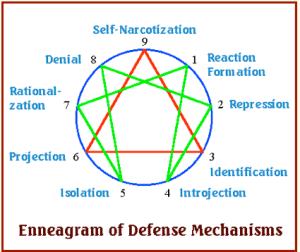
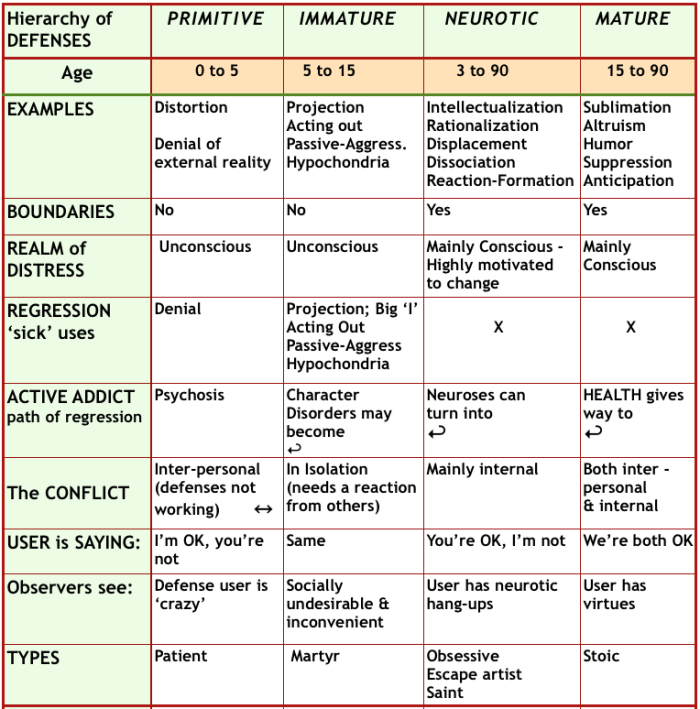
Reaction formation – compulsively saying & doing the extreme opposite of what one really wants, but is afraid of (violently preaching against lust, while not admitting to being filled with sexual longing)  (CHART INFO ⬇️ )
Regression – unconsciously retreating to the actions, feelings & beliefs of an earlier developmental phase when feeling threatened (tantrums)
Repression – keeping unwanted thoughts & emotions out of awareness, which can include forgetting actual painful or traumatic events, or those associated with painful emotions

Reversal – turning a feeling, attitude or behavior into its opposite
EXP: when masochism is replaced by sadism, love into hate….
Simple denial: unpleasant things are treated as if they don’t exist

Splitting – characteristic of borderlines, it’s the inability to hold in ones conscious mind both positive & negative qualities of the Self or others in a realistic whole (like loving & hating the same person or thing)
Somatization – when intolerable impulses or conflicts are converted into physical symptoms (suppresses rage into an auto-immune disease)

Sublimation – redirect id impulses (a socially objectionable desire or goal) into socially acceptable activities, while still retaining the original goal of the impulse. It’s considered the most “mature” defense. (Play football instead of fighting, make art instead of adultery)
Suppression – painful emotions & events are consciously ‘stuffed’ down.
Undoing – involves symbolically nullifying or voiding an unacceptable or guilt-provoking act, thought, or feeling

NEXT: Enneagram Strengths #1

DEFENSE MECHANISMS (Part 1)

defense typesI USE WHATEVER I CAN
to escape my fears

PREVIOUS: Enneagram Humor #4

REVIEW posts: Abandonment Pain

SITE: Defense Mechanisms Quiz

BOOK:In sheep’s Clothing (re. manipulative people) go to slide 50 ++

DEF: Unconscious & conscious processes to defend against or escape from conflicts, frustration & depression, so that the person can make useful adjustments to be able to live in their society.

REMINDER – as such, defenses are NOT bad. They’re needed to cope with life’s difficulties, as when we use humor to lighten our mood or altruism to lighten someone else’s load.
At best – most are delaying tactics, giving us breathing room to take a break & re-group.
The problem comes when any one of them become ‘land-locked’, so deeply ingrained that it can’t be given up easily, so rigid that it’s used like a hammer on every problem, regardless of size or importance.
tree of defenses
• In that case they become Negative Benefits” – used to avoid childhood or other trauma which the person does not want to deal face. To better understand what these are, we need to know about Defense Mechanisms, which were first identified by Freud, & then added to over the years by others.
He noted that people have wishes, desired & impulses that are either unacceptable to their society, religion or family – or their own sense of self  (CHART)

• The fact that the impulses don’t go away, but are usually hidden in our unconscious, leaves a residue (like at the bottom of a bottle) of anxiety*.
Keeping the impulses pushed out of awareness takes a lot of energy – which is exhausting, but considered by the ‘user’ to be safer than admitting them
(EXP: wanting to kill one’s parents or oneself). We do this by using Defenses. Which ones we pick will depend on our upbringing & our native personality.

*ANXIETY types, according to Freud
1. Neurotic – the unconscious worry that we’ll lose control of the id‘s urges, resulting in punishment for inappropriate behavior
2. Moral – the fear of violating our own principles
3. Reality – the fear of real-world events, usually easy to identify.
EXP: Fear of being bitten when near a menacing, snarling, barking dog is appropriate – so it’s best to avoid genuinely dangerous situations (PPT) if at all possible.

Defense Mechanisms distort reality
In proper proportion & with limited use they can also be adaptive, allowing us to function normally in very difficult situations, where there are no better options

The big problem comes from over-use, as a way of life, especially when they’re no longer needed. What was once a way to cope then becomes the problem. A goal in Recovery is to make the extreme / harmful use of defenses conscious so the we can develop healthier ways of handling anxiety & stress – without eliminating defenses altogether.

Sdefenses hierarchy


NEXT: 27 Defenses

ACoAs & PROJECTING (not Projection) (#1)

projecting 

THE SKY IS FALLING! THE SKY IS FALLING!
or it will any minute now!

PREVIOUS: Book Suggestions

SITEs: “Mistakes of projecting your future” (AlcoholicsFriend.com)
• “Negative Risk (threat) & Positive Risk (opportunity)”
“You should Visualize Positive & Negative Outcomes More”

DEF: PROJECTING (a CD=cognitive distortion) – Imagining one or more bad / painful / disastrous things will always & inevitably happen in the future, in general or re. a specific person or situation (victim mentality / ‘learned helplessness’ / scapegoat)

NOTE: This is not the same as correctly knowing who someone or some situation actually is, & what to expect of them.
EXP: “My whole life my mom has said mean or insensitive to me or about me. She’s never changed, so I know any time I talk to her in the future it will be the same.”

❎ SIDEBAR
Projecting is NOT the same as Projection – a defense mechanism (via Freud), in which a person:
a. Re. US – When we unconsciously reject one or more unacceptable qualities we have – or believe we have – AND attribute / assign those same qualities to another person, animal or situation.
Often the ‘others’ do not have those characteristics. So it’s
inevitable that in some cases projection will result in false accusations.
Everyone Else’s Fault?…..” //  Don’t Project Your … Inadequacy Onto Others

EXP: “I can’t trust anyone because everyone lies” (deny being a liar oneself)
“I know she hates me” (deny our own self-hate OR that we hate that person)
VARIATIONS:
• Complementary = assume others think or feel the same way we do about things
• Complimentary = assume others can do the same thing  – as well as OR in the same way – as we can
📌These are both expressions of narcissistic thinking (you & I are “one” – the WIC’s desperate desire for a symbiotic connection) (MORE…..)

b. Re. FAMILY – To attribute actual negative characteristics of our dysfunctional family members on to others, who may be like them, only a little, or not at all.
EXP: My father was a mean abusive drunk, therefore all men are bad / dangerous // “All authorities are evil, out to get me”

✳️ Back to PROJECTING
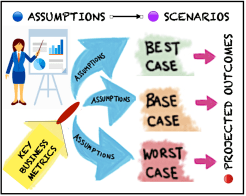
In BIZ: Positive OR Negative scenarios

In business it’s called forecasting, looking at all possible outcomes based on previous performance.
Projections are not budgets, rather “big picture, what if” exercises, done at a higher level of abstraction, ie context (See “D.Binds #3a“), with a ‘what is hoped for’ & “what could be” perspective.
NOTICE – a savvy business plan always includes 3 major possibilities. CHART

For ACoAs – However, most of us almost never project that things will work out, that we’ll be happy, that we’ll get what we asked for, that our relationships will be beneficial, that we’ll get the job we want…. No-o-o-o!
We assume the worst – only projecting negative outcomes – pain, disappointment, suffering, disaster.

▶️ The exceptions are the severe narcissists (& active addicts) who only project ‘positive’ possibilities, which often are simply pie-in-the-sky schemes which never come true, because either they don’t have the skill & inner motivation to make it happen, it’s a stupid idea, or not actually do-able.

WHY assume negatively? BECAUSE :
a. our childhood was filled with endless suffering & deprivation, so that’s our template for rdisaster forecasteality, becoming our world view  (POSTS: “Information & the Brain – How we learn“)

SCIENCE –Brain’s Negative Bias  : “The brain reacts more strongly to stimuli it deems negative, with a greater surge in electrical activity….. historically. our very survival depended on dodging danger. The brain developed systems that make it unavoidable for us not to notice danger & thus, hopefully, respond to it…..

b. we have unconsciously, but consistently been reproducing that original chaos & abandonment in our adult life. (Repetition Compulsion).
Unfortunately, it’s the WIC’s way of staying loyal to the family system, even though it was harmful to our parents & continues to harm us

PSYCH – Bad is stronger than good ….Many kinds of trauma produce severe & lasting effects on behavior, but there is no corresponding concept of a positive event that can have similarly strong, lasting effects……”

NEXT: Projecting #2

BOOK Suggestions

images-1


PREVIOUS : Enneagram Defects, #3c


The TOOLS – to help & inspire you to live life in forward motion”
~ Phil Stutz & Barry Michaels   / thetoolbook.com

COMPLEX PTSD”  –  Recovering from Childhood Trauma
~ Pete Walker

TRAPPED in the MIRROR” – Adult Children of Narcissists In their Struggle for Self
~ Elan Golomb, PhD

PSYCHO-CYBERNETICS” ~ Maxwell Maltz, M.D.
Cybernetics is a network of constant feedback loops in the brain, correcting its course & receives further feedback on the success of the transmission. This allows us to travel to places we don’t have the instructions for beforehand, & build on the history of our actions.

NO-DRAMA DISCIPLINE: The Whole-Brain Way to Calm the Chaos and Nurture Your Child’s Developing Mind” ~ Daniel J. Siegel & Tina Payne Bryson
COMMENT: They talk about what works & what doesn’t – in disciplining your “outer” kids – but can apply to dealing with the Inner Child as well.

“30 COVERT EMOTIONAL MANIPULATION TACTICS” ~ Adelyn Birch
How manipulators take control of personal relationships – re mates, but is also clearly about our family’s ‘games’.

“ADULT-CHILDREN of EMOTIONALLY IMMATURE PARENTS” ~ Lindsay C. Gibson PsyD. How to Heal from Distant, Rejecting, or Self-Involved Parents who create a sense of neglect, & discover ways to heal from the pain and confusion caused by your childhood.

Pls let me know if these are helpful.

Thanks, DMT

Enneagram – Type ‘DEFECTS‘ (Part 3c)

Vices 3cI WANT EVERYTHING TO BE EASY
so I don’t have to work on myself

PREVIOUS: Type Vices (4,5,6)


TYPE 7 – The ENTHUSIAST
(also 6w7 & 8w7, somewhat)
FEAR : of being deprived & trapped in pain, so avoid dedicating themselves to a person or situation, over-stimulate themselves & always live in the future
INTERNAL Story: “I must always be excited”

WEAKNESS : Reject any hint of seeing or admitting to the serious & painful sides of life – optimism is the ONLY option. Insist on putting off committing to anything, never ‘sitting still’
DEFENSIVE PATTERN: ‘Rationalize’ away uncomfortable experiences by re-framing them as ‘not a problem’, or denying responsibility for their part in it. They avoid suffering, hanging on to the self-image of being OK

HIDE from others: “I’m not as happy as I appear to be.”
Gluttony / greed causes 7s to use their charm, humor & liveliness to ensure they’ll always have more than enough of the good things in life. They struggle to hold the facade of happiness & fun, while also feeling anxiety, doubt, disappointment & sadness – like everyone elseenthusiast

PROJECTION: Experience others as boring, dull, joyless, modest, negative, overly serious, pessimistic, restricted & unimaginative.
7s think it’s up to them to make everything great, insure others are happy & imagine an optimistic future, see the good in things, & give others something to laugh about

MANIPULATE by: distracting & entertaining others & being upbeat – so they can get their way, insisting that others meet their demands for pleasant stimulation & satisfaction (narcissism)
Create CONFLICT by: being demanding, distracted, escapist, excessive,
impatient, irresponsible, over-extended, restless, scattered, thrill-seeking

✥ ✥ ✥

TYPE 8 – The CHALLENGER (also 7w8 & 9w8, somewhat)
FEAR: of being harmed & controlled, & so are aggressively dominant, forcing their agenda & desires on others
INTERNAL Story: “I must always be powerful”

WEAKNESS : Are resentful & angry if they feel at all defenseless, or believe someone is out to get them / take advantage. Insist on always being in charge
DEFENSIVE PATTERN: ‘Denial’ – re-direct energy by strength of will to controlling their environment, to maintain a self-image of being strong

HIDE from others: “I’m not as powerful or in control as I appear to be.”
Lust & craving makes 8s seek power, or at least the appearance of it. Believe they need to run everything, that without authority & respect – from everyone – they won’t be able to protect themselves by impacting their environmentdominant/bossy

PROJECTION: Others are seen as ambivalent, bleeding hearts, naive, needy, overly dependent, phony, sentimental, unfair, weak.
So it’s up to 8s to right all injustice, give others a dose of reality, protect & toughen others up

MANIPULATE by: throwing their weight around, bluff, make big gestures, dominate, demanding that others do as they say
Create CONFLICT by: being bad-tempered, blunt, confrontational, cynical, defiant, forceful, pushy, rageful, vengeful, willful

✥ ✥ ✥

TYPE 9 – The PEACEMAKER (also 8w9 & 1w9, somewhat)
FEAR: of loss of love & being abandoned, so they avoid being assertive, expressing their ideas or taking self-directed action
INTERNAL Story: “I must always be peaceful,”

WEAKNESS : Ignore things that need their attention – completely, or procrastinate until the last-minute. Insist on not noticing problematic issues and on staying neutral in unpleasant interactions with others
DEFENSIVE PATTERN: ‘Narcotization’ – to avoid conflict & keep a self-image of being comfortable or harmonious.
They get lulled into an emotional coma, deadened to uncomfortable reality by adjusting / molding themselves to fit other people’s desires or demands​

HIDE from others: “I’m not as agreeable as I appear to be.”
Indifference keeps 9s from voicing any disagreement. They take the easy way out, avoiding discussion rather than face dissension. They hide their own desires, afraid of being disliked if they make too many (any) demands, or if their needs are different than those around thempeacemaker

PROJECTION: Others are seen as aggressive, conflicted, demanding, excluding, frantic, inconsistent and pushy.
9s think it’s up to them to pacify the world, bring everyone together, calm them down & make others lower their expectations.
Also, they avoid their own plans & desires, & then project that others
ignore them, don’t take them seriously & consider their plans & dreams unimportant

MANIPULATE by: ‘opting out’, resisting others, being indecisive or inattentive, & passive-aggressive
Create CONFLICT by: being complacent, emotionally unavailable, ineffectual, resigned, stubborn, unaware of their own anger, unrealistic.

NEXT: Enneagram STRENGTHS (Part 1)

Enneagram – Type ‘DEFECTS‘ (Part 3b)

enn defects 3b


I WISH I DIDN’T HAVE TO
deal with these defects

PREVIOUS: Enneagram Defects, Part 3a

SITE: Everything Enneagram book


TYPE 4 – The INDIVIDUALIST (also 3w4 & 5w4, somewhat)
FEAR: of being insignificant, unseen, without identity – so they become moody, hypersensitive & pretentious
INTERNAL Story: “I must always be unique”

WEAKNESS : Being ordinary is experienced as boring, but also makes them ‘feel’ like a nobody, so they’re jealous of other people-places-things. Insist on having all of their emotional needs met at once
DEFENSIVE PATTERN: ‘Introjection’ – to avoid ordinariness & keep self image of being authentic. Internally they magnify a positive ideal, & obsess on self-blame for any painful outcome ​

HIDE from others: “I’m not as sensitive as I appear to be.”
Envy/ jealousy that others seem to have more & are treated better than themselves – so 4s to develop an aura of emotional hyper-sensitivity. They want special treatment, thinking it’ll compensate for all the unfair treatment they’re experienced

PROJECTION: Being ‘Common’ is projected onto others, who individualistare seen as detached, insensitive, overly cheery, plain, predictable, rude, shallow AND not terribly interesting or refined.
4s think they unique & interesting, but always misunderstood. So they think it’s up to them to restore class, refinement & sensibility to the culture

MANIPULATE by: being erratic, temperamental, hard to get’, making others “walk on eggshells”
Create CONFLICT by: being dramatic, emotionally demanding, moody, pretentious, self-absorbed, self-indulgent, temperamental, withholding

✥ ✥ ✥

TYPE 5 – The INVESTIGATOR (also 4w5 & 6w5, somewhat)
FEAR: of being helpless, useless & incapable, of be emotionally overwhelmed, so avoid as much contact as possible with the world
INTERNAL Story: “I must always be detached”

WEAKNESS: Their urge to know everything on a topic or situation helps avoid a sense of emptiness. Insist on personal space & non-interference
DEFENSIVE PATTERN: ‘Isolation’ – withdraw to avoid feeling small & helpless, & keep self-image of being all-knowing. Provides the space to develop a sense of structure & try to understand their ‘problem’

HIDE from others:“I’m not as smart as I appear to be.”
Holding back / isolating prevents 5s from having to share their emotional life with others – mainly relating by their intellect. Their source of strength is in accumulated knowledge, using it to keep others away

PROJECTION: Project their 1d1319272f56a3120542ebd0cfc1112flack of all knowledge onto others, so feel like they’re surrounded by a “confederacy of dunces” (Sherlock Holmes). Others are considered emotional, foolish, overly effusive and chatty, myopic, oblivious, shallow-minded, stupid.
5s can either avoid others entirely, OR research & discover TRUTHS, & then enlightening everyone else

MANIPULATE by: staying preoccupied with thoughts & projects, distancing emotionally from others  (Forum….. )
Create CONFLICT by: being detached, extreme, high-strung, impractical, isolated, preoccupied, provocative, unconventional, uncompromising

✥ ✥ ✥

TYPE 6 – The LOYALIST (also 5w6 & 7w6, somewhat)
FEAR: of never having support, & not being able to survive on their own, becoming defiant, defensive & suspicious
INTERNAL Story: “I must always be secure”

WEAKNESS : Anxiety, doubt & worry lead to a lack of trust in themselves, so are indecisive & procrastinating. They fluctuating between a need for be close & a need to be alone, between self-distrust & over-reacting
DEFENSIVE PATTERN: ‘Projecting’ – their feelings on to loved ones & authority figures​ – to avoid feelings of rejection & to keep a self-image of being loyal

HIDE from others: “I’m not as committed as I appear to be.”
Fear of being punished & disapproved of, from an internal or external authority figure, drives 6s to be overly-responsible & loyal. This makes them seem committed to any given cause, which is mainly to their own need for securityloyalist

PROJECTION: project rebelliousness & power onto others, who are seen as flighty, isolated, overly trusting, negligent, reckless, threatening, & trying to get away with something

📌 For fearful 6s the world is experienced as disappointing & unsafe, so it is up themselves to create certainty, order, safety & security everywhere
📍 Counter-phobic 6s (not conscious of their great fear) project ambivalence onto others, especially authority, seeing them as inconsistent & untrustworthy – so they must scold or train others to be consistent & fair

MANIPULATE by: being evasive, complaining, testing others’ commitment to them
Create CONFLICT by: blaming, being defensive, doubtful, evasive, negative, pessimistic, reactive, suspicious, worried.

NEXT: Defects – Part 3c

Enneagram – Type ‘DEFECTS’ (Part 3a)

defect part 3
I HATE TAKING MY INVENTORY
it makes me feel hopeless

PREVIOUS: Enneagram ‘Defects’ (Part 2)

QUOTE: “ People are wonderful; people are difficult. The Enneagram helps us make sense of both” ~ Peter O’Hanrahan


EACH TYPE develops their 
own way of coping with life’s stressors, but not always helpful.  'defects' Part 3This chart shows how how each type’s WIC reacts to the lack of positive nurturing.
w = each Type has 2 wings – additional modifying characteristics – one number on either side, with one as a preference


TYPE 1 – The REFORMER  (also 9w1 & 2w1, somewhat)
FEAR: of being corrupt & “not good,” so they refuse to recognize their mistakes, & take even mild suggestions as criticism
INTERNAL Story: “I must always be perfect”

WEAKNESS : Get frustrated & angry when things or others don’t meet their high standards. Insist on being correct at the expense of connecting with others. Al-Anon asks: “Do you want to be right, or be happy?”

DEFENSIVE PATTERN: ‘Reaction Formation’ – an opposite or unrelated reaction to an authentic feeling – to avoid direct anger, & maintain the self-image of always being right

HIDE from others that  “I’m not as perfect as I appear to be.”
Anger & frustration in part comes from 1s being resentful for having flaws. They’re convinced that if they’re seen as less than perfect they’ll lose their position of the moral authority & arbiter of logicperfectionism

PROJECTION: Since 1s avoid their own anger & flaws, they project those onto others – who they see as critical & angry towards themselves.  In general, the world is considered careless, flawed, frivolous, imperfect, messy & wrong. They must clean it up, straighten everyone out to get them back on the road to perfection (to feel ‘safe’)

MANIPULATE by: constantly correct others, playing on others’ sense of guilt & inadequacy, insist others share their standards
Create CONFLICT by: being opinionated, critical /self-critical, impatient, irritable, judgmental, rigid, perfectionistic, sarcastic


TYPE 2  – The HELPER  (also 1w2 & 3w2, somewhat)
FEAR: of being unloved & unappreciated, so they play favorites, judging some people more worthy of their attention than others
INTERNAL Story: “I must always be connected”

WEAKNESS : Poor boundaries, helping others instead of self-care. Insist on exclusivity & ever more nearness

DEFENSIVE PATTERN: ‘Repression’ of personal needs & feelings to avoid looking needy (which they are), to maintain a self-image of being all-loving, & gain approval 

HIDE from others: “I’m not as caring as I appear to be.”
Pride prevents 2s from showing their needs, so they try to get them met indirectly, secretly. Believe that by being constantly helpful, others will automatically reciprocate – as if their good deeds are vouchers to be cashed in later. But others don’t know that’s the deal & so keep disappointing the 2helper

PROJECTION: Since 2s avoid their own needs, they project that out onto others, who are seen as cold, critical, heartless, indifferent, mean, prickly, selfish, withholding AND needing help.
So 2s think it’s their job to identify & empathize with the needs of others, then fit them, to make themselves indispensable

MANIPULATE by: mind-read what they think others need or want, & then provide it, un-asked
Create CONFLICT by: being clingy, flattering, ingratiating, insincere, people-pleasing, possessive, seductive, self-important, self-deceptive, worried


TYPE 3  – The ACHIEVER  (also 2w3 & 4w3, somewhat)
FEAR: of being worthless & unappreciated, so they create a too-good-to-be-true image & push to achieve, at any cost
INTERNAL Story: “I must always be outstanding”

WEAKNESS : Believe they must present an image of success, rather than express who they really are. Insist on career & social status over people

DEFENSIVE PATTERN: ‘Identification’ – to avoid failure & keep a self-image of flourishing, ignoring their True Self 

HIDE from others: “I’m not as together as I appear to be.”
Self-deception causes 3s wear a ‘I have it all together’ mask, as anything less would not meet their need to shine. They can’t face the possibility that others might seachievere them as a failure or incompetent

PROJECTION: 3s avoid failure & inefficiency, which are projected onto others, who are seen as being aimless, the source of all failures-inefficiency-ineptness, in danger of entropy, limited, losers, wall flowers, AND in need of assistance & guidance from the 3

MANIPULATE by: charming others, taking on / adapting to whatever image will work to keep up appearances
Create CONFLICT by: being “appropriate” instead of sincere, boastful, competitive, grandiose, overly-driven, self-promoting, taking advantage

NEXT: Type Defects (Part 3b)