Enneagram – Type STRENGTHS + Type 1 (Part 4a)

k5941299THERE ARE MANY MORE
pieces to this puzzle

PREVIOUS: Type Strengths (Part 3)

SITE: Ennea Happiness & Strengths (fun)


STRUCTURE of PERSONALITY
Claudio Naranjo has united several theories, contrasting Essence to Personality (the conditional Self/lesser mind <——> to the Real Being/Higher Mind). This chart shows his variation of Ichazo & Gurdjieff’s view of the human psyche, made up of five centers, with the addition of two higher centers of the ‘awakened’ individual.

● It’s based on the current view of optimal mental health that the outer expressions of Personality do not represent the True Self within, but are motivated by a sense of deficiency – the passions/drives repressing, contaminating & replacing core instincts. The Bound (lower) parts include the Enneagram’s Triad of Instincts:
— Self-Preservation, for personal survival
— Sexual, for intimate one-to-one connection
— Social, for connection to the larger world. More in future posts. (MORE…..Chart—>.)

ESSENCE:  Higher Mind drives an automatic orientation toward our particular kinds of awareness – not mediated by every-day thinking.
The Virtues are automatic bodily responses – not directed by personal likes or dislikes.

Although higher mental awareness is different from its counterparts in the Personality, it’s easy to mistakenly assume we are in our Essence when we – think humble thoughts (4s), force ourselves to be brave (6s), feel we’ve been of ‘great service’ (2s)….. These reactions are only indirectly related to being open, undefended & attuned to the environment & other people. Fortunately, each type has the unconscious drive to identify ‘the trance of type, AND the conscious ability to outgrow it.

LIBERATION & Presence* (being fully awake)
2 = Humility. By Disinterestedness we can express Altruism
3 = Integrity. By Self-acceptance we gain Genuineness
4 = Equanimity. By Self-renewal we achieve Creativity

5 = Generosity. By Understanding we experience Discovery
6 = Courage. By Self-Affirmation we gain Courage
7 = Sobriety. By Assimilation we experience Gratitude

8 = Subtlety. By Self-restraint we can express Magnanimity
9 = Engagement. By Self-possession we find Fulfillment
1 = Serenity. By Discernment we gain Tolerance

*Presence – the opposite of being trapped in our Enneagram style – habitually acting out of the past as a reflex – when controlled by a younger part of ourself. If we’re not truly awake to current experiences, our judgments are flawed & our actions inappropriate. Being Present is a spiritual process, & while it’s not easy, it is a crucial requirement for a full life.

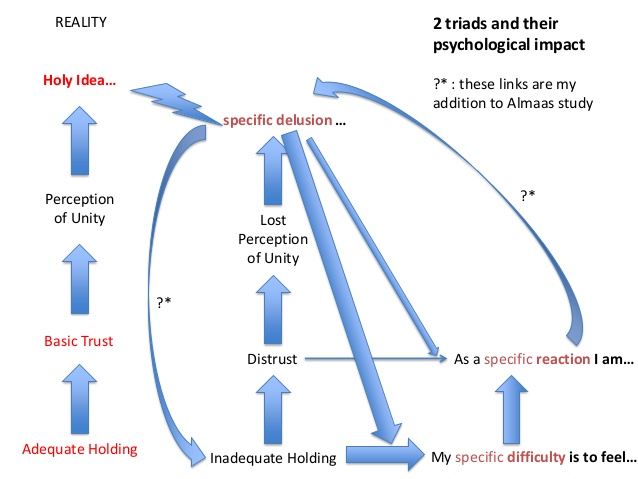
Overviews – Holy Ideas are the essential qualities of Universal Reality.
The left-hand chart shows how it coordinates with the Enneagram’s Heart, Head, Body triads.  enn - holy-ideas 2 TRIADS
Use the right-hand chart as the model for the #1-9  diagrams that follow. (All created by P.Ferrieux)

HOLY IDEAS & VIRTUE (STRENGTHS)
Type #1 VIRTUE: Serenity is the recognition that Reality is inherently perfect. As part of that reality, we are already ‘perfect’ so we can be open & accept the conditions that we are working with, trusting that whatever wisdom we may need will be available in the moment

PERFECTIONISTS are fair, honest, honorable, improvement-oriented, noble, responsible, want equality with a shared purpose and values, can be morally heroic
— They really want to be good people & make the world a better place, for everyone to realize their full potential & help them actualize it
— They value/are attracted to Goodness & right-ness

Holy PERFECTION points to the more universal sense of perfection , which we can only uncover in small doses. Understand that your purpose is not to achieve some transcendental level but rather to accept & deal with the imperfect world as it is . Everything is already as it should be, so when you’re in “here and now” the moment is always perfect. You trust the process & bring your support to every situation with compassion.

HIGHER MIND: True Perfection isenn - holy-ideas 1
a balance of positive & negative elements blending together at every moment. Any perfect relationship, event or product has to go through stages, including occasional bad risks or bad timing. So – 1s can benefit by accepting that what can seem like terrible mistakes are connected to an ultimately correct outcome. Their only responsibility is doing the best job they can at any given time

NEXT: Type VIRTUES – Types #2, 3, 4 , 5 (Part 4b)

Enneagram – Type STRENGTHS (Part 2)

ennea strenghI CAN REST EASY
in the castle of my identity

PREVIOUS: Type STRENGTHS (Part 2)

REMINDER: In this context – EGO = FALSE SELF
NOT the same as a HEALTHY EGO,
and read “The EGO”)

To appreciate the POSITIVES of our Type, it helps to put the work of the Enneagram in context. Chasing ‘healthiness’ is not the main goal of the Enneagram – but rather to become aware of our unique Role in the larger scheme of life, & experience how it plays out in every-day experience. Our fixation behavior – the acting out of the Defect – is Ego trying to hang on to its particular version of Reality.
EXP: #5: “I must fill the unfillable hole of not-knowing”.

“Primal Catastrophe” The Defect of our type is formed in response to the primal catastrophe of our childhood – losing touch with our specific Essence & the Divine. In Christian terms, we’re born separated from God by our sin-nature, forgetting our birthright as children of God. In reaction, humans develop 9 different (ineffective) strategies to try reconnecting with Spirit & our deepest self.

● This unconscious pull toward Essence, with its ‘best’ way of thinking & feeling, suggests that each Number represents an archetypal energy pattern, a Higher Octave, intuiting its deeper Reality. This awareness can provide self-knowledge & a way to connect to Spirit. (Enn in Motion).  

Ego vs. Essence 
Essence = our True Self, originating at birth. It’s different for each Type, & depends on the basic flavor which each Number is most sensitive to, based on one’s Holy Idea. When we’re in touch with it, we feel a sense of aliveness, connection & well-being.

Ego: not the Healthy Self from Psychology, but rather the ego of the False Self, the ‘personality mask’ with all its illusions, defenses & hidden features, only a dim reflection or imitation of our individual Truth.
BTW – it’s not accurate to think in B & W terms – that ‘negative’ ego/ personality is an extreme opposite of ‘positive’ Essence, because humans are on an ego<—>Essence continuum all the time. Understanding & working with both ends are needed for growth.

A.F. Almaas reminds us in ‘Diamond Heart Book Four :  Indestructible Innocence’ that “The personality is not something that needs to die or be thrown away…. but rather developed over time, to be refined & integrated with the sense of Being-ness” (p. 69).

VIRTUES
Based on the spiritual insights of the Holy Ideas, the Virtues (in Part 1) are the natural expression of the awakened heart – the unified, expansive qualities of humans experience when abiding in our True Self. They identify the way to reconnect to Essence. (Holy = objective spiritual reality, expressed in the higher essential qualities of the human mind & soul)

The Virtues are each type’s antidote to its Passion, pointing to its Strength, AND cannot be ‘practiced’ or claimed as personal achievements.  Our ego-self is very preoccupied with recreating it  but it’s only a narcissistic self-aggrandizement – the very opposite of a Virtuous state.
Rather, they are ‘their own reward’ as expressions of Grace & a method of transformation*.  So if we “Let-go-&-let-God”, accepting what is already waiting in us to emerge, our specific Virtue begins to express itself in our daily life.

*Transformation can be understood as a conversion of energy : shifting from the narrowness & futility of our Vice into our Virtue. It’s not easy to do, since our Type is hardwired, & a life-time of doing things a certain way are hard to soften & dissolve.
Shifting this vice-energy takes time.  It requires great desire & determination, persistent effort & a willingness to look deep inside oneself. Repetition of new habits & patterns create new neural pathways that, over time, allow us to catch our automatic responses before they get going. This makes it possible to choose a new way of responding to PPT (people-places-things).

● When our focus is on becoming less & less attached to our defensive way of functioning, it slowly heals the split between parts of ourself, between ourself & others, & between us & our Higher Power. Transpersonal* experiences allow us to see ourself as we are meant to be – in our current state, but moving toward being whole.
*T
ranspersonal = having “experiences where the sense of Self-identity stretches beyond (trans) the individual, to embrace wider states of humanity, life, psyche & cosmos”. (Shakti – 10/16/05)

NEXT: Type Strengths (Part 3)

ENNEAGRAM Basics (Part 1)

ENNEAGRAM

FINDING OUT MY TYPE
makes me squirm

PREVIOUS: ‘Keep the focus on yourself (#3)”

SITEs:
♦︎ Multidimensional Enneagram Immersion  

♦︎ “The Enneagram, Jung & MBTI

BOOK: “3 Keys to Self-Understanding” – Pat Wyman, combines the MBTI, Enneagram & Inner Child Work

INTRO
Essentially, the Enneagram shows us how we CAN BE, at our best, as well as how we ARE – including our weaknesses. It is a merciful delusion-buster that opens us to the truth of our experience by the use of radical awareness as well as compassion.

• It’s a Map of Wholeness. Its primary purpose is to study the universal Human Soul expressed in each of us, to connect us with what is deeper than our outer persona – which is legitimate but limited – and toward what does not come from our ego-fixations (weakness to be overcome).

QUOTE: “Always remember that it is your birthright & natural state to be wise and noble, loving and generous, to esteem yourself and others, ➡️
The Wisdom of the Enneagram, Riso & Hudson (p 41)

• It’s a “nature/nurture” system, with both social & genetic components for each Type. The numbers are psychological templates tied to brain development, as well as the influences of our environment, & so can be considered ‘programs’ or life-scripts. They also point to Carl Jung’s 9 psychological processes of consciousness & 9 distinct versions of his Shadow archetypes, all of which makes the Enneagram a powerful system for self-understanding.

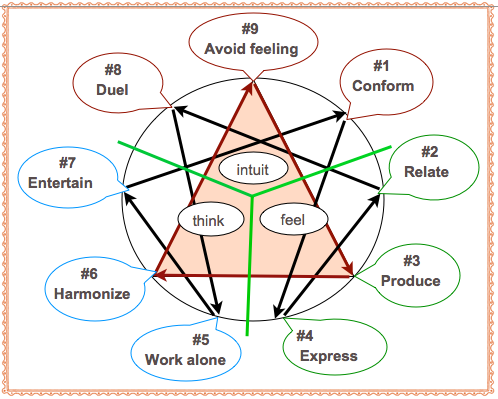
enn SYMBOL• The 9-point diagram gives us nine different sets of values & filters through which we can view the world, a way of describing inner experience as well as conscious self-image. But it goes deeper, indicating unconscious motivations as the source of thoughts, emotions & actions. It can help people recognize & expand the boxes they’re already in, & ultimately be a way to dissolve those boxes.

• The Enneagram SYMBOL is an ancient form to describe the path of self-development. It can be traced at least as far back as the Greek mathematician Pythagoras (c. 500 BC), improved on by Christian & later Sufi mystics (c. 500-1000 AD).
It was re-introduced in the 20th cent, starting with the Armenian mystic George Gurdjieff (a controlling Type 8), the founder of an influential Inner Work school, who drew from Sufi tradition & focused on sacred dance, using musical notes for each type.

• Then Oscar Ichazo, the South American student of ancient wisdom, formed the Arica School, updating the Enneagram by creating a system of Types using Gurdjieff’schief feature as a starting point. More recent writers, including Claudio Naranjo, Don R. Riso, Russ Hudson & Helen Palmer, have developed the Enneagram further, adding a psychological emphasis to its spiritual base.

The symbol is made up of :
♦︎ A circle, representing the whole experience of life & the container within which we live our lives. It’s used AS:
– a Process, when moving around the circumference
– an Experience, if taken as a whole
– a Point in time. It speaks to the cyclical nature of change – death follows life, life follows death – with its progression through time  (CHART  ↖️ )

♦︎ A triangle, dividing the ‘ONE’ into 3 parts, which introduces things outside influencing the Process (movement), with internal intentions & connections to each other.
The points touching the circle (9, 3, 6) are where external energies provide the fuel needed to drive any procedure, including needed Change. It represents the universal Law of Three (man-woman-child, Body-Mind-Spirit, the physical-emotional-intellectual body)

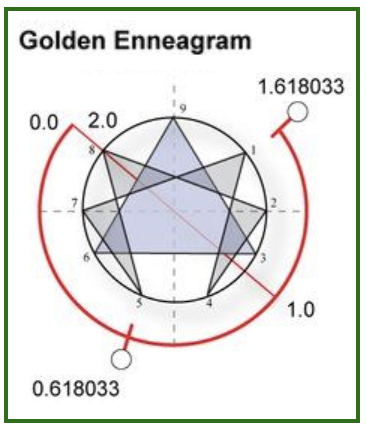
♦︎ The Six straight Lines show the relationships between the steps in the Process, which overlap & are coordinated. They are the ‘one’ divided by 7, which equals the repeating fraction  .142857142…,**,  not including the triangle points. ➡️ (Chart) scroll down (ALSO…..in Wikipedia).
** The Enneagram has been associated with the invention of the decimal system.

Placing these decimals around the rim forms the 6-line web showing the essential internal movement of the universe, & gives us the direction of our personal growth-work as we move around the outer circumference.
The “missing” 7th line is the point in the center of the circle.

EXP: Step 1 is influenced by steps 4 & 7 via their connecting lines (arrows)

NEXT: Enneagram Basics (Part 2)