
 PREVIOUS: STRENGTHS (#2)
SITE: Popular Enneagram books
♟️ FALL from Higher Essence Qualities to Ego Distortions 
Oscar Ichazo made a connection between the Tree of Life & the Enneagram symbol. This chart shows his hierarchy of expressions. While everyone has the potential to embody all of the Holy Ideas and Virtues, one version of each (pr. type) is central to each soul’s identity. So when one or both are missing, the loss is acutely felt, & the person’s ego (conscious False Self) becomes totally preoccupied with recreating them – although in futile, self-defeating ways.
Any loss or absence of connection to spiritual Truth generates a specific delusion /fixation, showing up as the underlying Toxic Rules of our Wounded Self. Each delusion forms the center of a psychological complex, which is the core of that particular fixation
Loss of awareness of the Holy Idea becomes a person’s Ego-fixation, &
Loss of contact with the Virtue forms the person’s characteristic Passion.
↗️ Ego-fixations & Passions (review posts) represent how spiritual qualities shrink into Ego States. The Enneagram’s 9 types indicate the main ways we lose our specific center, which creates distortions in thinking, feeling, & doing. The Passions can also be considered our untamed animal nature before being transformed by contact from higher-awareness & Grace.
↗️ Instinctual Self – a primal aspect of personality. The Enneagram’s 3 instincts : Self-preservation, Social / Adaptation, Sexual / Attraction. Also a “Blind-spot instinct. (MORE…. )
Our dominant one insures our fundamental survival in the physical world, but in so doing can block the way to growth. They become an anchoring counter-balance to the higher spiritual Essential Self, rooting us in the dualistic (good-bad) defended Self, causing a habitual overuse of our survival strategies.
Spiritual & emotional growth comes from being able to balance, release & transform our instinctual nature into its higher opposite.
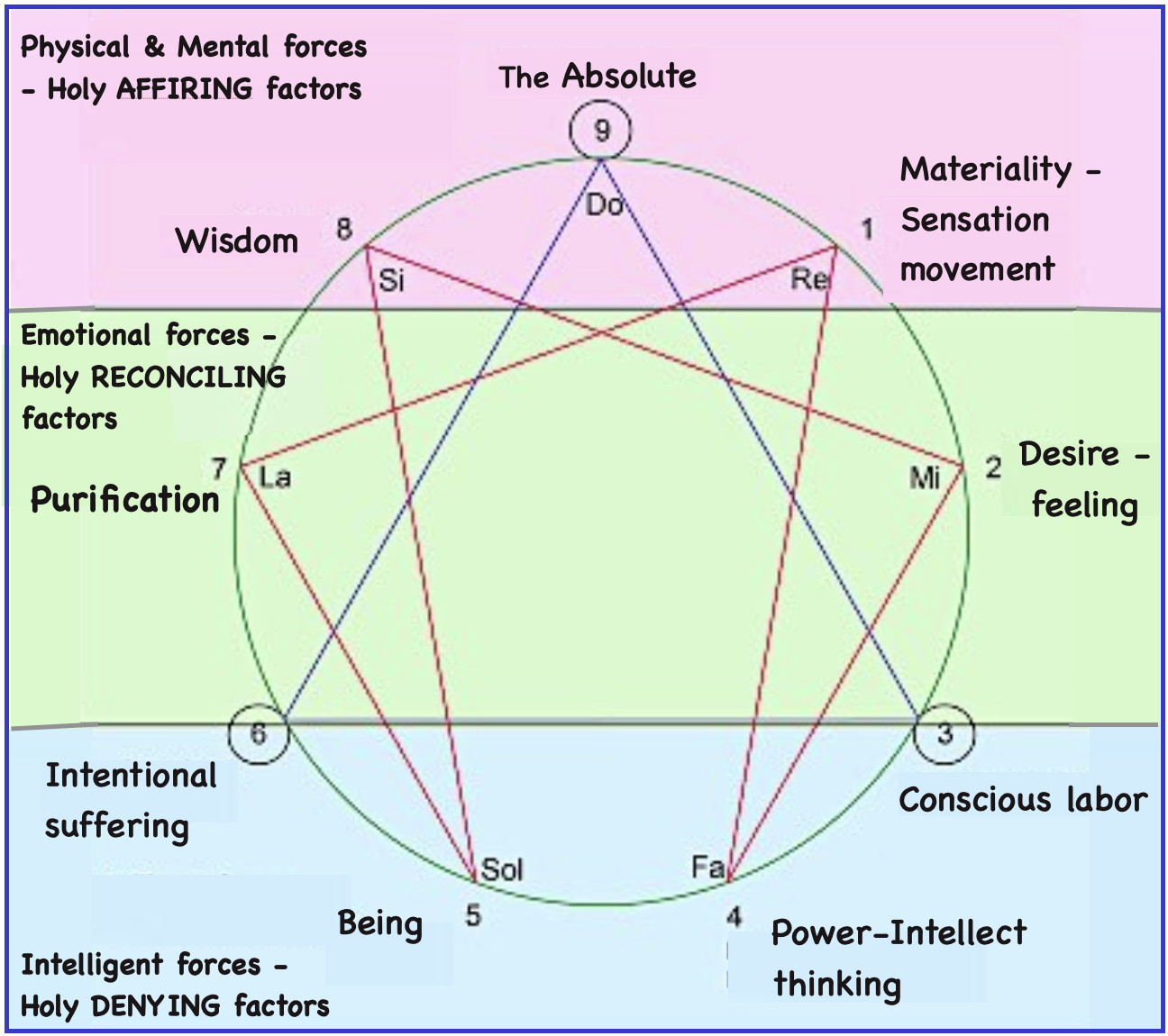 ♟️ LAW of THREE – states that any creative act or Process requires three dynamic forces to manifest. And the Law of Octaves / Sevens – how vibrations & all creative processes proceed in periodic stages / waves, like the musical scale.
Personal growth proceeds around the Inner Points of the circle via the ‘spiritual’ octave Do-Re-Mi-Fa-Sol-La-Ti-Do, toward full Essence /Consciousness (#9). Each octave is a circulatory system with a set of specific demands placed on it.
As energy circulates, it’s expressed by specific characteristics, depending on its proximity to the Divine, 🔑 starting at the Mechanical / Automatic way of functioning on the right side – THRU 🔐 #1-the way of the body, #2-the way of love & #4-the way of power, which need to be learned before moving up the left side.
PINK = closest to the divine, (“do”, the absolute) are material expressions on the right, & wisdom on the left.
GREEN = represents the heart, the mediating zone between the most holy at the top – and –
BLUE = at bottom are manifestations of intelligence & awareness, being furthest from the divine.
Enneagram use : for self-observation & inner work to deal with daily obstacles, with conscious effort instead of pre-set reactions. ALSO – to help break out of “stuckness”.
🔆Affirming (#3) = prodding or unfolding force for growth – the active, dynamic energy that initiates action & moves things forward
🔆Denying (#6)= resisting or contracting force providing structure, limits, & grounded reality, as the necessary friction against which Affirming pushes
🔆Reconciling (#9) = resulting harmony or neutral force that reconciles the two extremes. It holds the big picture, serving as the neutral stability that allows creation, movement & completion.
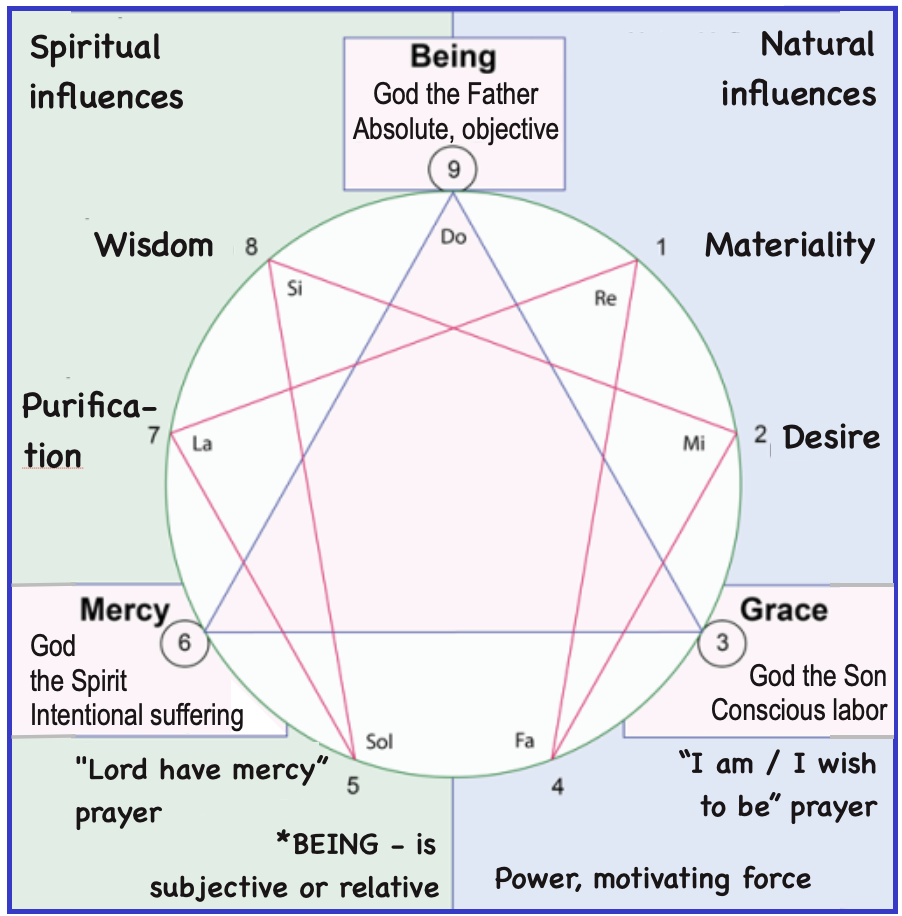 ♟️ The Universal Principles of Being, Grace, Mercy – in Enneagram studies – are seen as the bridge between flawed ego structures & True Nature. They are divine forces driving the engine of the universe & function according to spiritual laws in every octave, regardless of a person’s ‘developmental level’.
❣️ Grace = unmerited favor, which is not earned
❤️🩹 Mercy = withheld punishment which is deserved
💝 Being = Cosmic consciousness expands naturally into personality types (1-9) according to these principles, as: Materiality, Desire, Conscious Labor, Power, Being, Intentional Suffering, Purification, Knowing, Essence.
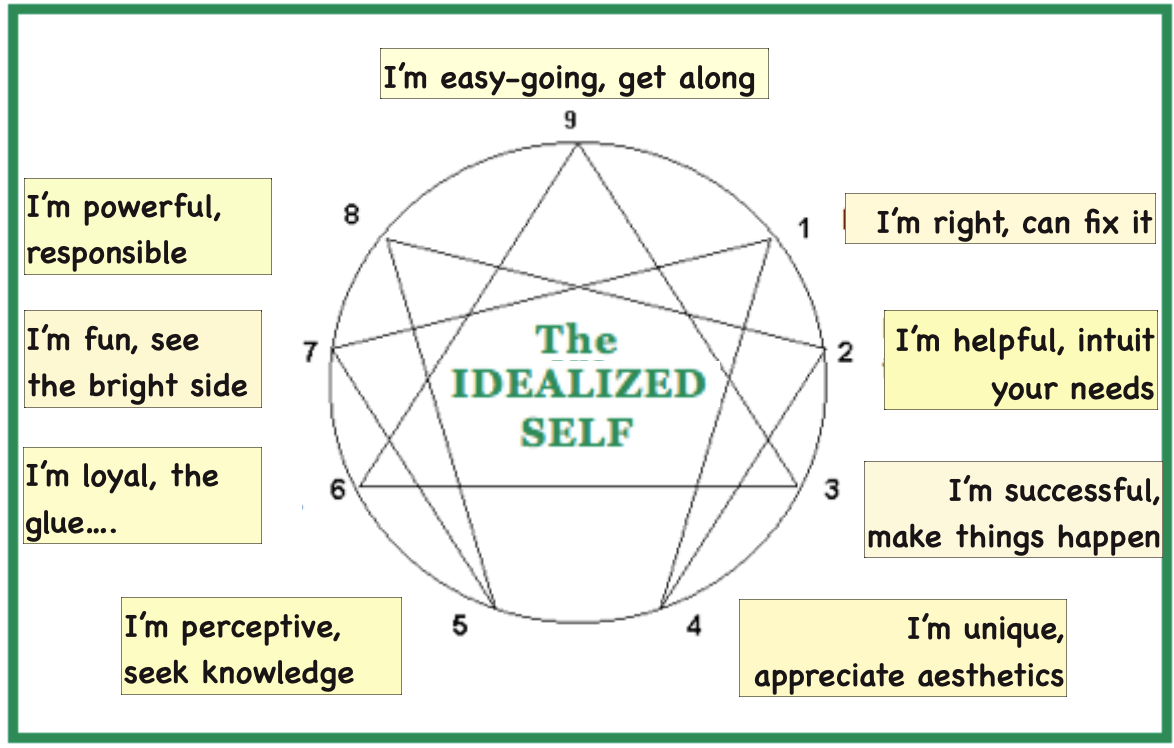
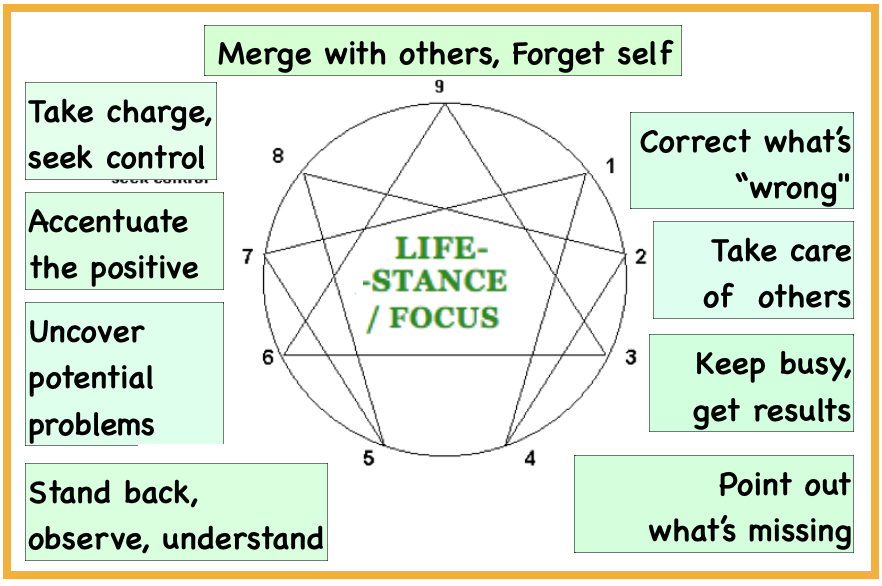
NOTE that the strengths & weaknesses of each type are two sides of the one coin. There is NO point in wanting to change to another type, since that would just mean swapping one set of problems for another.
NEXT: Type VIRTUES (Part 4a)


 HEAL & GROW for ACoAs