MBTI : DOM / INF in Combination

PREVIOUS: Aux-Tert functions 


CONTRAST RESEARCH ➡️ 
:
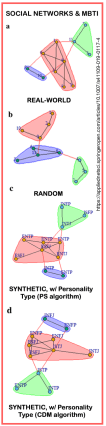
Synthetic social networks were identified by assigning human Personality Types to the nodes, then adding links between nodes based on the compatibility of those Types

Probability Search (PS) & Compatibility-Degree Matching  (CDM) were used (More….)

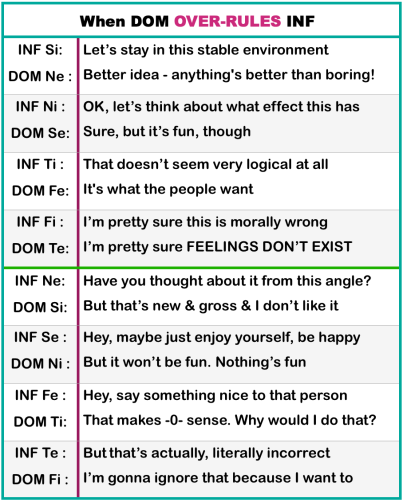
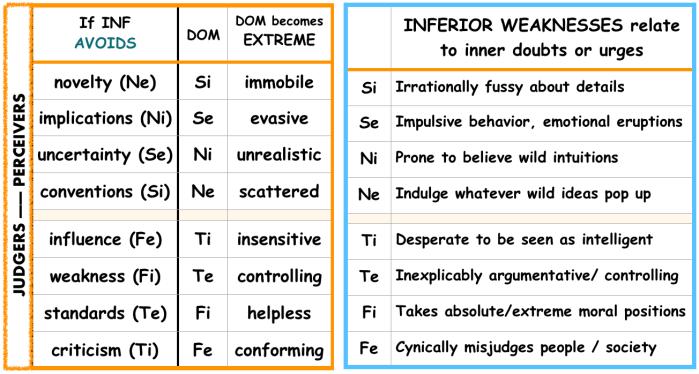
INFERIOR reaction BLOCKED by its DOM Counterpart ⬇️ :

☀︎ REVIEW
2 kinds of Perceiving:
a. Sensing
  – the ability to perceive details, & go for the fullest possible experience through the 5 senses
b. iNtuition – seeing the big picture, chasing the furthest reaches of the possible & the imaginative

2 kinds of Judging
:
a. Thinking – being objective & deductive, looking for rational order thru the impersonal logic of cause & effect
b. Feeling 
stepping in to the situation, being empathetic, & looking for rational order in accord with key values

 🗺 🗺 🗺

DOM-INFERIOR interactions: POSITIVE & NEGATIVE
When a function is misused or misapplied, the person will have problems & setbacks.
🔸 SP = Sensate Perceiving 🔸 NP = Intuitive P
🔸 SJ = S Judging  🔸NJ -Intuitive J

1. SENSING

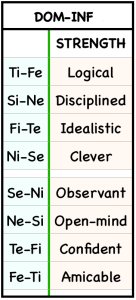
• Se-Ni (SP): When well-aligned, you pursue goals assertively, & are great at working around minor setbacks or environmental obstacles

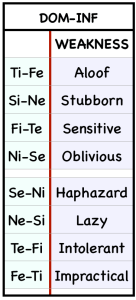
WEAKNESS: You enjoy things so much you forget to stop & plan stuff out

FAIL: When misaligned, you tend to overlook or misunderstand the deeper meaning & implications of events / behavior, prone to aimlessness or impulsivity, with harmful long-term consequences

•  Ne-Si (NP): When well-aligned, you’re able to carry out your good ideas, making progress in the world, very resourceful in turning around problems or setbacks

WEAKNESS: So many ideas, but can’t just pick one, shut up & stick with it

FAIL: When misaligned, you tend to be too idealistic / impractical, very careless about details, sometimes too scatter-brained to succeed, or keep repeating same mistakes
😁

•  Si-Ne (SJ): When well-aligned, you reliably carry out tasks & duties in a detailed, thorough way, knowing the best methods for handling & implementing logistics

WEAKNESS: 
So comfortable with routine but new ideas freak you out

FAIL: When misaligned, you tend to be too stubborn, narrow-minded, & risk-averse, unable to discover new / better ways accomplishing goals, because you can only see / accept one pre-existing or ‘correct’ way

•  Ni-Se (NJ): When well-aligned, you have ambitious & lofty visions for self &/or the world, very focused in pursuing an ideal

WEAKNESS: Your head’s in the clouds so much, you forget to stop to enjoy things

FAIL: When misaligned, your vision is too limited, or you have unrealistic expectations, too blind to see what you’re chasing is not workable, or that it won’t have a positive outcome (maybe blind to important external changes)

🦋 🦋 🦋

2. THINKING

•  Te-Fi (TJ): When well-aligned, you’re determined & competent at setting goals & reaching them, very good at leading, & efficient at eliminating obstacles or solving problems

WEAKNESS: T
he facts are the facts are the facts  – & you don’t care if someone’s feelings get hurt

FAIL: When misaligned, you tend to be too hasty / aggressive in how you try achieving goals, believing the end justifies the means, even trampling over others

•  Fe-Ti (FJ): When well-aligned, you can accurately assess the needs of everyone involved, & very compassionate in how you resolve interpersonal problems or social issues

WEAKNESS: You want to make everyone happy even if it means ignoring giant internal problems

FAIL: When misaligned, you tend to be socially insecure/inept, easily misunderstanding others (even tho’ you believe you’re great at reading people). You try to influence social situations but choose ineffective strategies that are likely to blow up in your face later
😄

•  Ti-Fe (TP): When well-aligned, you’re knowledgeable & self-sufficient when trouble-shooting problems, very skilled at resolving whatever issues come your way

WEAKNESS: You want to get to the bottom of what makes the world ‘tick’ & don’t care if it makes society freak out

FAIL: When misaligned, you tend to have poor judgment, worsening rather than solving problems, by being unable / unwilling to see (human) complexities, or by dismissing other people’s valid viewpoints

•  Fi-Te (FP): When well-aligned, you confidently influence the world to become more moral & just, very passionate about creating opportunities for everyone to flourish

WEAKNESS: 
You spend so much time in your own world, to the point that facts aren’t important to you

FAIL: When misaligned, your evaluations tend to be too self-centered / subjective, & you keep wasting time on futile action that get negative results – not knowing the best way to produce lasting change in the world.

«
NEXT: Alcoholism – Intro, #1a

MBTI : AUX-TERT Functions

PREVIOUS : Dom-Aux #2


The TERTIARY function is needed for stress relief, if used in healthy way, to :
— give other overworked functions a break
— as a general support for the AUX & for relaxation

Because the MBTI letter of this function is not part of our type, it represents characteristics that tends to be less interesting to us, so fewer of its skills get developed. It generally starts exerting its influence about midlife, & can then
— be used to guide us toward areas of life that have been neglected or avoided, but which require skills the person doesn’t feel comfortable using.

EXP:  a Thinking type with N-Tert could start taking a literature course & a Thinking type S-Tert might take up carpentry or weaving classes…..

AUX can be hampered by an immature TERTIARY:

1 – Si or Ni dominant
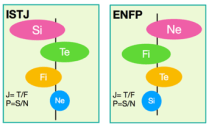
• Te-Fi (IxTJ) : If Fi-TERT interferes with Te-AUX, the person can concoct faulty moral reasons for why they should stick to their beliefs at all costs. The result is manipulative or unproductive behavior, causing self-inflicted disappointment & withdrawal.
They may seem individualistic or principled (mistaken for Fi-Dom), but it’s more like narrow-mindedness, greatly oversimplifying moral issues into crude B & W judgments (the higher Te), to become self-serving & insensitive (unlike Fi-Dom).
🏮
• Fe-Ti (IxFJ) : If Ti-TERT interferes with Fe-AUX, the person can come up with faulty logic to neglect / ignore social roles or responsibilities. Their insecure or guarded behavior leads to self-inflicted unhappiness &/or loneliness.
They may seem knowledgeable or analytical, (mistaken for Ti-Dom), but it’s defensive, used to rationalize away mistakes & criticism, or mis-attribute blame (the higher Fe). This creates incoherent / contradictory thinking & cautious behavior (unlike Ti-Dom).

📈 📉
2 – Se or Ne dominant
• Ti-Fe (ExTP) : If Fe-TERT interferes with Ti-AUX , the person can rationalize away their mistakes or bad behavior by twisting their perception of social interactions. They react by being thoughtless or devious, ending in self-inflicted isolation.
While they may seem sociable or charming, they have a calculating underside, treating others as tools / objects for self-centered gain (the higher Ti). This creates relationship failures & social discord (unlike Fe-Dom).
🏮
• Fi-Te (ExFP) : If Te-TERT interferes with Fi-AUX, the person can focus on immediate but superficial gratification, leading to immoral or destructive behavior, causing self-inflicted suffering.
They can be determined or commanding, but with a desperate bent. They’re more likely aggressive & controlling, to make up for an underlying sense of inadequacy, or to temporarily soothe emotional pain (the higher Fi). This results in unnecessary setbacks or unintended consequences (unlike Te-Dom).

📈 📉
3 – Ti or Fi dominant
• Se-Ni (ISxP) : If Ni-TERT interferes with Se-AUX, the person can make excuses for why they can’t or won’t broaden their outlook. This causes short-sighted or over-simplistic judgments that lead to self-inflicted fatalism or self-defeating thinking.
They may seem serious or brooding, (mistaken for Ni-Dom), but it’s just superficial, while carelessly dismissing deeper meaning or potential for growth (the higher Se). So they have a dejected or cynical attitude about what’s possible in life (unlike Ni-Dom)
🏮
• Ne-Si (INxP) : If Si-TERT interferes with Ne-AUX, the person can get stuck in their old comfort zones or rely only on past knowledge/experience. The result is doubting or stubborn judgments that lead to self-inflicted pessimism or stagnation.
They may seem reserved or proper, (mistaken for Si-Dom), but there’s an obsessive undercurrent. They compulsively fuss over trivial details, misinterpret physical discomfort & irrationally magnify painful past experiences, (unlike Si-Dom) which get projected as negative future possibilities (the higher Ne).

📈 📉
4 – Te or Fe dominant
• Si-Ne (ESxJ) : If Ne-TERT interferes with Si-AUX the person can continually make excuses for very sloppy decision making, which ends either in disruptive or micro-managing behavior, causing self-inflicted discord & chaos.
They may seem humorous, positive or clever, (mistaken for Ne-Dom( but there’s a grandstanding element used to cover anxiety, or deflect criticism & mistakes (the higher Si). It ends up in bad ideas that fall flat or make situations worse (unlike Ne-Dom).
🏮
• Ni-Se (ENxJ) : If Se-TERT interferes with Ni-AUX, the person can selectively focus only on what they want to see, to justify unsound beliefs, leading to pointless or hasty actions that cause self-inflicted failure or defeat.
It makes them seem fun & enthusiastic (mistaken for Se-Dom), but there’s an undercurrent of over-reaction, which makes them irritable & retaliatory when reality crushes their expectations (the higher Ni).
They distort / overlook important realistic details, or react poorly to unexpected changes (unlike Se-Dom).(FROM: Type-spotting guide)

NEXT: DOM-INF

MBTI : DOM – AUX Functions (#2)


PREVIOUS: Dom/Aux #1


The AUXILIARY
can be considered a bridge function that connects DOM with the lower half of the Stack (Tert & Inf ), which represents a more sustainable path to the expansion & integration of one’s type.
In most cases, trying to integrate Dom & Inferior without the help of AUX creates an either-or / tug-of-war energy, rather than a symbiotic one. This is because the psychological gulf may be too great without the 2nd & 3rd functions providing additional personality characteristics.

Also, AUX gives needed Extroversion energy for the Introvert, & provides an Introverted opportunity to process experiences for the Extrovert. Without that balance, a person’s life can become ‘unmanageable’.

👤 People who don’t use each function properly can become incompetent flakes who don’t do anything right (in the extreme, of course 🙁).
EXP: An Introvert who only relies on their DOM will start having unreal ideas of the world, while such an Extravert will be reckless & do thoughtless things….
AND
🧠 If an Introvert doesn’t use their Extrovert AUX, they’ll just live in their head, imagining all the things they want to do, talking about them – endlessly, even make plans, but never actually DO-ing them
OR
If an Extrovert ignores their I Aux, they’ll rush thru life taking actions without stopping to consider why, & making messes even if their motives are good, ignoring consequences to others, or the effect on their own physical & mental health ….

DOM-AUXILIARY pairs at their MOST UNhealthy:
Te-Si and Si-Te (ESTJ or ISTJ) will completely lose sight of why they do & want the things they do & want, robotically going through the motions of life, checking off boxes, until they wake up one day to realize they’ve been miserable for the last 40 years

Se-Fi and Fi-Se (ESFP or ISFP) will be self-absorbed, caring only about their own experiences. They have a lot in common with ENTJ & INTJ, but those 2 types are more likely to bulldoze others into submission – making everyone hate them, while ESFP & ISFP will neglect people – making everyone just feel indifferent
❄️
Se-Ti and Ti-Se (ESTP or ISTP) will become so disconnected from society that their skills & knowledge will become useless to themself, but blame everyone else for their problems

Fe-Si and Si-Fe (ESFJ or ISFJ) will be fake & smiley. They’ll do everything possible to keep up the APPEARANCE of having a solid personal life, then let off steam by talking trash behind people’s back. With an unhealthy ESFJ or ISFJ, one can never be sure íf they’re really your friend – or not
❄️
Ne-Ti and Ti-Ne (ENTP or INTP) will ‘devil’s-advocate’ everything into oblivion, never committing to any opinions of their own

Ne-Fi and Fi-Ne (ENFP or INFP) will get trapped between their need to consider everything vs making the absolute bestest decision, so become paralyzed
❄️
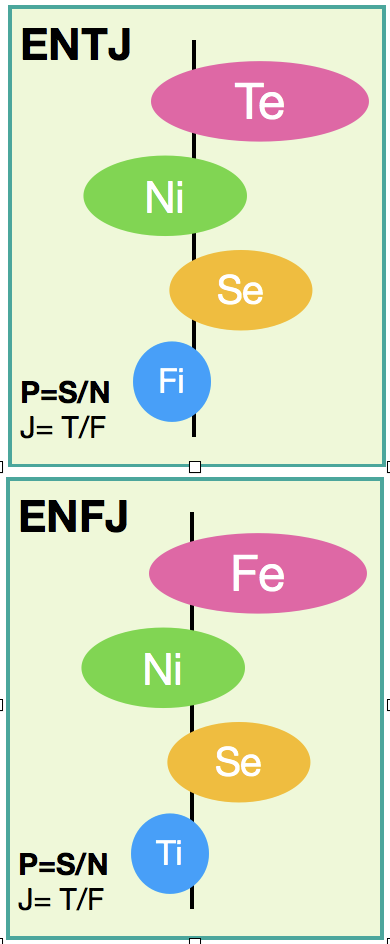
Te-Ni and Ni-Te (ENTJ or INTJ) will become very, very selfish, not considering others when pursuing their goals

Fe-Ni and Ni-Fe (ENFJ or INFJ) will see the world through B & W colored glasses, while thinking they know what’s best for everyone. In their own mind, they’re morally superior judges standing above an evil, lazy world. In reality – they are just TREMENDOUS jerks.

NEXT: DOM-AUX #2

MBTI : DOM-AUX Functions (#1)


PREVIOUS: Unhealthy functions (T-F)


DOMINANT needs AUXILIARY to stay balanced – for both decision making & taking action.

Since the STACK is made up of our Type’s 2 center levels, it shows how we –should – gather new information (Perceiving – S or N), then process it & come to some conclusions (Judging – T or F), so we can make decisions that best suit our needs.
EXP:  someone with an E Dom will have an I as AUX to help, & vice versa.

To be psychologically healthy – mentally & emotionally – we all need to be able to -both- move into action by paying attention to our outer world, AND step back, to pause & reflect on our experiences.

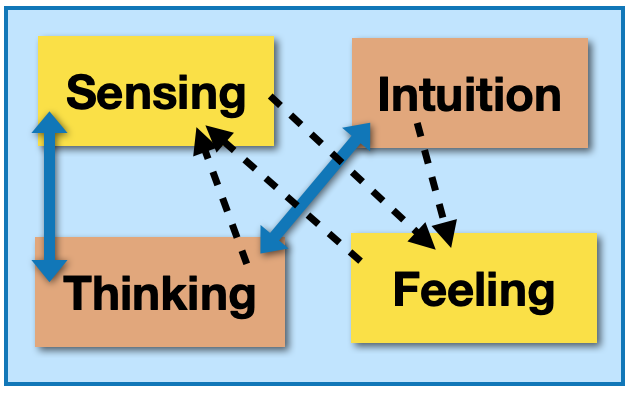
AUX’s  ‘nature’ is always different from, but not antagonistic to, our DOM : either of the irrational functions (S/N) can be auxiliary to one of the rationals (T/F), & vice versa.

So, Thinking & iNtuition can easily pair up, as can Thinking & Sensation, since neither N & S are by their nature opposed to the T function. Also,
— S can be bolstered by T or F auxiliary
— F is supported by S or N
— & N goes well with F or T.

EXPs: logical T succeeds with concrete S, speculative T forges ahead with imaginative N, artistic N can choose & present its ideas with the help of F-values, philosophical N systematizes its vision into comprehensive thought by a powerful T intellect …..
(from “General Description of the Types” ebook)

NOTE: People who have not yet explored & developed their AUX may find it harder to identify their type. So, while an IN-J may be confident about being an N type, without knowing their AUX they won’t be able to tell if they’re an INTJ or an INFJ.

Also, someone ignoring their AUX will act very differently from those who incorporate it in daily living, although this may not always be deliberate, perhaps influenced by unconscious, environmental or other influences. (MORE…. )

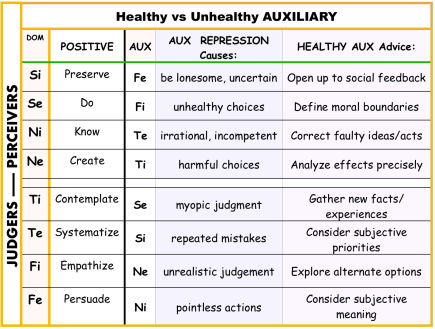
♥️ The following info indicates the effect a HEALTHY Auxiliary can have:
🔹With Si or Ni dominant:
Te-Fi (IxTJ):  a Te = AUX can make an Introvert more competent & goal-oriented, to help quickly correct faulty thinking & irresponsible behavior when needed, for better results

Fe-Ti (IxFJ): an  Fe = AUX can make an Introvert more sociable & compassionate, to help them better integrate into social situations, & accept feedback when change is useful or needed

🔹With Ti or Fi dominant:
Se-Ni (ISxP): an Se = AUX can make an Introvert keen to explore new first-hand or hands-on experiences, to broaden their outlook on life & make better judgments 

Ne-Si (INxP): an Ne = AUX can make an Introvert keen to imagine new possibilities & make improvements to their life.
🗝 🗝 🗝
🔹 With Se or Ne dominant:
Ti-Fe (ExTP): a Ti = AUX can make an Extravert more analytical, to correctly calculate which decisions are most likely to produce beneficial results for everyone  

Fi-Te (ExFP): an Fi = AUX can make an Extravert more ethical & honorable in their decision-making, to avoid unhealthy behaviors that will sabotage themself 

🔹With Te or Fe dominant:
Si-Ne (ESxJ): an Si = AUX can make an Extravert more careful & thorough in their approach to people/problems, to help manage situations more effectively

Ni-Se (ENxJ): an Ni = AUX can make an Extravert more nuanced & thoughtful in their approach to people/problems, to help carry out their vision successfully
(FROM: Type-spotting guide)
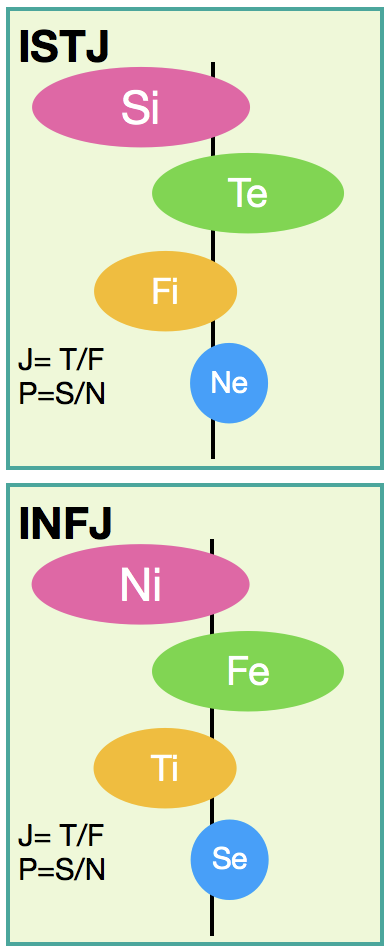
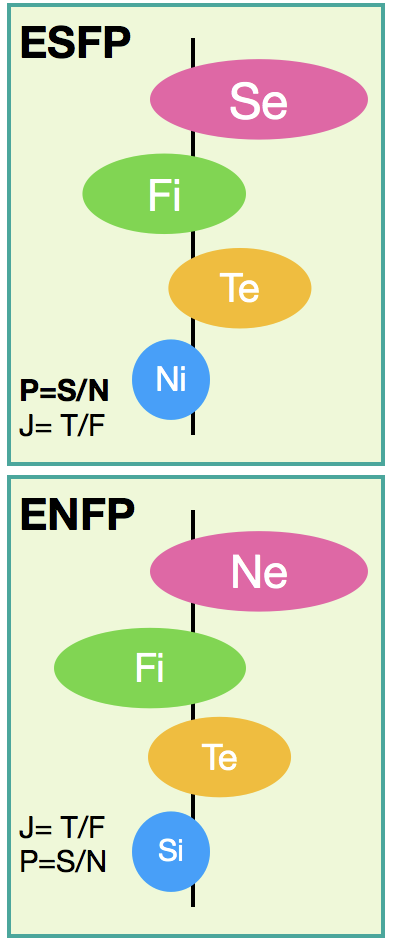
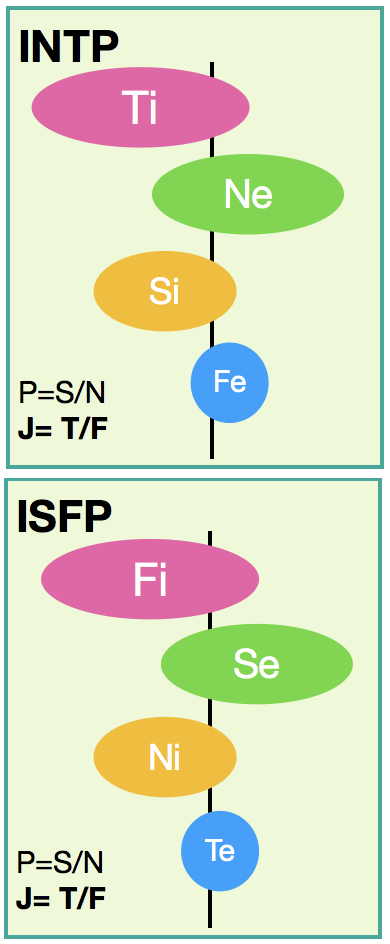
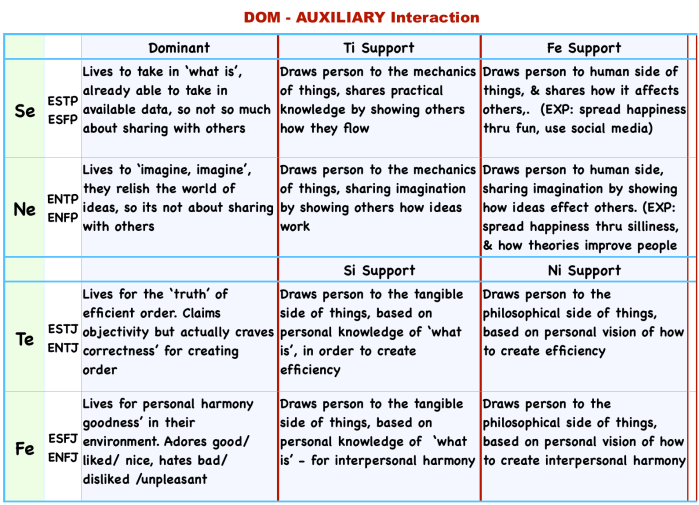
⬇️ 2 CHARTS by Eric Bolden : 


«
NEXT:  DOM – AUX #2

MBTI – UNHEALTHY Functions (T / F)

PREVIOUS: Unhealthy  N

🛠 THINKING
HEALTHY Ti: “Wait, have we checked everything? I wanna make sure it works

Ti types (ISTP / INTP) look for factual analysis – SO they can react very intensely confused or complicated situations
▪︎ They value being skilled & clear-headed, SO they’ll react against anyone they see as ignorant or irrational

Unhealthy Ti – they think they’ve got it all figured out, yet results prove otherwise. They mentally detach from not only the external world, but anything that adds emotional or personal value, because these things can’t be rationalized.  They’re often cynical & smart-assed – & not in a fun way – criticizing & avoiding everything human – like emotions, unity, spirituality….
When Ti goes into “as long as I get when I want” mode, it’s aggressively manipulative, disregarding others’ feelings

ATTITUDE: “I am the ultimate source of truth, and if I did not figure it out, it is wrong. I don’t care if it doesn’t work for others. They’re just emotional fools”

EXP: extremely skeptical, overanalyzes, obsessively searches for truth, harshly critical, outright rejects group institutions or norms

As unhealthy DOM
Ti: Think they’re the smartest, but can’t actually follow thru. They’d rather pick apart other people’s points endlessly, because they like to. They’re cynical & lack empathy – as an automatic defense to avoid their own emotional shortcomings

🐶
HEALTHY Te: “OK, so these are the steps to make this happen. If anyone objects or has a new idea, let me know, because that matters

Te types (ENTJ / ESTJ) look for rational expediency –  SO they can react intensely against ambiguous or disorderly situations
▪︎ They value efficiency & competency, SO they’ll react against anyone they see as lazy or incompetent

Unhealthy Te – those who want everyone to stick to the rules, but are often the first to break or twist them when it works in their favor. They’re overeager to hand out advice, but much of it is obvious because they think everyone else is too stupid to solve their own problems effectively.  So any “sound advice” will be sprinkled with insults about their abilities, even their entire character. Most frustrating is that when people finally have had enough of them, they just don’t understand why. In their opinion, they’re actually the only rational & responsible ones

ATTITUDE: “Efficiency & control matter more than people.I don’t care if you like it or not. That’s how it’s gonna be”

EXP: aggressive, B & W thinking, inconsiderate of/rejects others’ feelings, need for control, need for dominance, ruthless

As unhealthy DOM
Te: Boss people around, shouts judgments & criticism. Harsh & often belittling everyone. Prone to deny mistakes & shifts blame onto others

🛠 FEELING
HEALTHY Fi: “This is deep & personal to me. I want to live by it & lead by example

Fi types (ISFP / INFPlook for honor & integrity –  SO they can react intensely against unethical or infringing situations.
▪︎ They value being just & virtuous, SO they’ll react against anyone they see as callous or corrupt

Unhealthy Fi – they’re extremely self-absorbed. masters at justifying everything they say & do. If all else fails, they’ll play the victim, loudly complaining that no one understands them. They can get high-minded & judgmental, becoming callous & cold towards others, since ‘villains’ aren’t worthy of empathy.  Their lives are often a disorganized mess, & please don’t offer them sound or logical advice, because that’ll really get them mad. They’ll gladly self-destruct even more – if it’ll get rid of you

ATTITUDE: “My inner feelings justify any selfish choice, and I am always the victim of everyone else’s malice.  I don’t care if this hurts others. I’m gonna do it because it feels right”

EXP: excessively stubborn, hypersensitive, rejects objective decision-making, selfish, self-righteous, ‘special snowflake’ syndrome

As unhealthy DOM
Fi: Do & say whatever they please with total disregard for appropriateness – because that’s just “who they are”. Act irrationally, which they’ve mentally twisted into being the “right” thing to do. Refuse to take personal responsibility when things go south, since they’re convinced they were just being authentic & sticking to their guns

🐶
HEALTHY Fe: “I wanna make sure everyone’s OK with this. I win if we all win

Fe types (ESFJ / ENFJ) looks for social harmony –  SO they can react intensely against inequitable or contentious situations
▪︎ They value being considerate & respectful, SO they’ll react against anyone they see as selfish or impertinent

Unhealthy Fe – they know what everyone else is up to, believing they have an ‘uncanny knack’ for knowing what’s best for others. Their need to belong & be needed can drive them to meddle in affairs that are none of their business.  They’re just trying to lift themselves up by knocking others down. This may be gossiping, or judging other’s behavior as if they wrote the “Etiquette” book. If you try to disagree or ignore their advice, they’ll play the martyr, as if you intentionally aim to hurt them for some reason. Worst of all, they never seem to realize they can’t take care of themself without a lot of help from others, which should be their top priority.

ATTITUDE: “I will manipulate or degrade myself to force social approval and control how others perceive my status. (If he’s not OK with this it’s HIS problem) ”

EXP: desperate for approval, emotionally volatile, manipulative, obsessed with social standing, rejects logical reasoning,  spineless, self-neglecting

As unhealthy DOM
Fe: Expect everyone to cater to them. Only want to hear what they want to hear. Sacrifice too much for others, then demand constant attention & validation. Publicly ostracize anyone they don’t feel an affinity with.

NEXT: DOM-AUX functions

MBTI – UNHEALTHY Functions (N)


PREVIOUS: Unhealthy S 

SITE: “Unhealthy Coping Mechanisms of Every MBTI Personality Type”  (How each type tries to defend their ego)

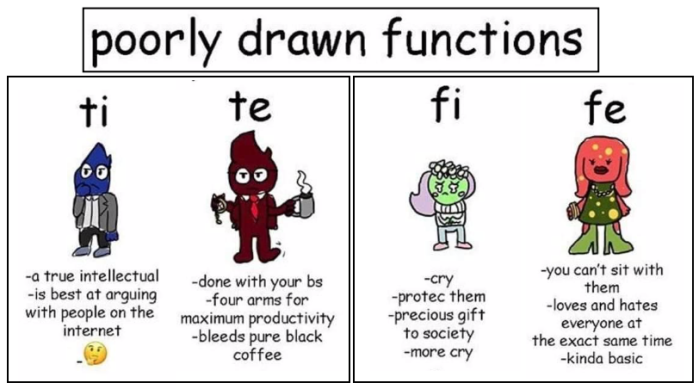
CARTOON ⬅️


FUNCTIONS
▶︎  Our top 2 functions can manage a lot of stress before they start getting overwhelmed, especially the HERO (Dom). The MENTOR (Aux) function can handle more than the Sidekick (Ter), but at the cost of getting worse at dealing with anxiety. The SIDEKICK can manage anxiety (internal), but struggles most with stress (external). Finally, the RIVAL (Inf) struggles to handle both anxiety & stress. (Code Flow)

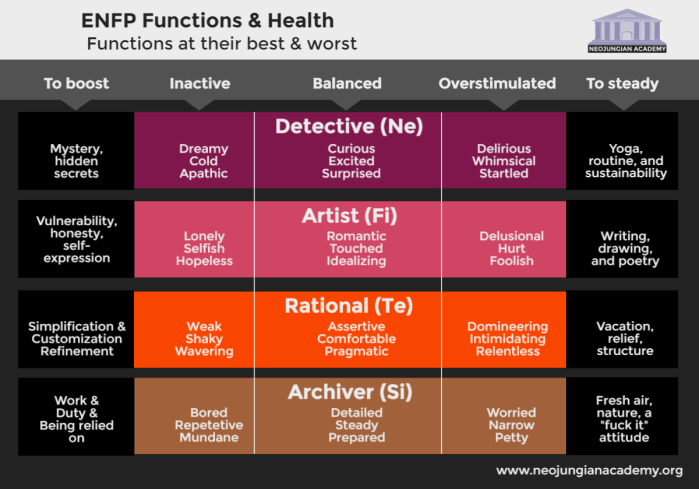
▸ When a function is over-stimulated, steadying it with it’s opposite function may help (Intro / Extro)
▸ If a function is under-stimulated, boosting it with its inspirational function (opposite) may help. Inspirational triggers help boost your function to its max.
EXP: Ne provides patterns, possibilities & ideas – that can be essential to the philosopher’s Nconceptualization.

 🛠 INTUITION
HEALTHY Ni:
“I figured out the pattern & it could lead to something great!”

Ni types (INTJ / INFJ) look for meaningful purpose – SO they can react intensely against unpredictable or pointless situations
▪︎ They value a life-calling & long-term implications, SO they’ll react against anyone they see as fickle or short-sighted

Unhealthy Ni – those who’ll have a 2 hour ‘discussion’ with you, mostly monologue, & don’t seem to make a point. They’re excited about anything & everything, but never get specific or say how their experiences turned out.
They not only contradict themselves in a span of a few days, but sometimes even in the same statement. While they often think of themselves as knowledgeable on just about every subject, most of the time its only surface info, based on something they heard in passing

ATTITUDE: “My vague, unproven hunches are absolute prophecies, and all outside facts or opposing views are completely worthless.”

EXP: all-or-nothing goal setting, dismisses others’ opinions, no spontaneity, obsessive visualization, refuses to back up conclusions with evidence, “all-knowing” attitude, single-minded

As unhealthy DOM  
Ni: Have a bad case of superiority complex, thinking they understand things better than everyone else – when they actually don’t. Stubborn in their ideals & refuse to budge when new information is presented. At the same time, they’re afraid to act if they don’t think they know how to proceed, panic & think they’ll die if they don’t understand everything.

🦋    🦋    🦋
HEALTHY Ne: “There are many side to this situation & many solutions”

Ne types (ENTP/ ENFP) look for mental stimulation – SO they can react intensely against repetitive or monotonous situations
▪︎ They value creativity & inspiration, SO they’ll react against anyone they see as narrow-minded or pessimistic

Unhealthy Ne – they always think they understand stuff better than you, AND that their word is gospel. They effortlessly exude arrogance & superiority without even realizing it. Despite sounding ‘deep’, you still wouldn’t trade places with them, since they never seem to have had one minute of fun their whole life, & their only ounce of contentment is when someone says they were right about something

ATTITUDE:  “Commitment is a trap; I will jump from idea to chaos while running away from the real world”

EXP: avoid mundane tasks, completely reject traditional methods, detached from reality, extremely indecisive, commitment-phobic, flaky

As unhealthy DOM
Ne: Easily bored, constantly looking for something new.  Can’t stick with anything for more than a day or follow a schedule. Keep making the same mistakes over & over (maybe they need to be sure it is a mistake??) Often contradict themselves by the end of any pronouncement. Think everything established is old & worn out

🦋 🦋

EXAMPLE : ENFP plus & minus (from Flow Code)


NEXT: Unhealthy T / F

MBTI – UNHEALTHY Functions (S)

PREVIOUS: Blog Celebration

SITE: Many LINKS   re. the Inferior Function

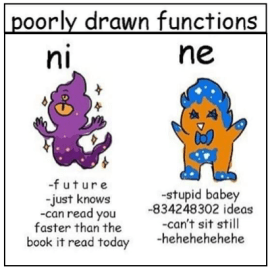
CARTOON  ⬅️


▶︎ In MBTI terms, being unhealthy means using a function in ways that harm self &/or other people – because it’s not working well with the rest of our stack, especially its opposite (Ne/Si, Te/Fi…). Tracking our behavior over time will alert us which function(s) are/is causing problems in life. Learning the healthy version of each one & how it applies to our specific Type can be a blueprint for growth.

When stressed:
Extroverts = become fearful & insecure about taking action
Introverts = frequently burn out, because of feeling ‘forced’ to act
Judgers = become passive / apathetic, as nothing ever goes smoothly
Perceivers = get rigid / compulsive, since they keep falling behind
AND :
Sensers = will lack confidence in their abilities, despite being talented
iNtuitives = be pessimistic, never imagining a better life
Thinkers = be short-tempered, from constantly being thwarted
Feelers = sabotage relationships by controlling or immoral behavior

🛠 SENSING
HEATHY Si: “I hear your idea. Tell me more & I’ll consider it, even if it’s not for me”

Si types (ISTJ / ISFJlook for material security – SO they can react intensely against disruptive, new, unknown, or risky situations
▪︎ They value authority & precedence, SO they’ll react against anyone they see as unreliable or improper

Unhealthy Si  – never change their mind about anything, always shoot down any kind of alternative or proposal, & love to criticize anything they’ve never even tried. They take everything literally & panic when there’s no plan.
Some will go as far as experiencing progress as The Enemy, so it would take a bulldozer to move them from their comfort zone.
You just want to punch them in the face when they call all excited about a new discovery that you’ve spent 5 years telling them about!

ATTITUDE: “Any change or new method is my enemy. Nope, that’s stupid. I don’t need to consider it – it’s just wrong”

EXP: always play it safe, completely ignore contradictory information, fixated on the past, obsessed with detail, stagnant, reject novelty

As unhealthy DOM
Si : Super narrow-minded, doesn’t want to step out of their “sanctuary” to consider new ways of seeing or doing things. Harshly judge & dismiss as crazy anything not ‘normal’ to them

🦋    🦋    🦋
HEATHY Se: “I want to fully experience this – it makes me feel alive”

Se types (ESTP / ESFP) look for pleasurable engagement – SO they can react intensely against unsatisfying or tedious situations.
▪︎ They value being bold & adventurous, SO they’ll react against anyone they see as cowardly or passive (a parent?)

Unhealthy Se – they have a very short attention span, everything has to be FUN, & without an awareness of consequences to their actions. Always seem to be in trouble – legal, financial, professional….. so if you care about them you can easily get pulled into cleaning up one mess after another.
You’ll scratch your head when they ask to borrow money for the rent, & then buy something expensive, like a designer dress or a vacation trip……
They’re great for a night out on the town, but otherwise, it’s best to avoid them like the plague (from Steve)

ATTITUDE: “I must chase instant physical thrills regardless of the consequences. I wanna do this NOW. It won’t hit me in the butt later…. right?”

EXP:  act without considering later outcomes, completely reject the practical. Are flighty, overindulgent, reckless, physically aggressive, refuse to plan ahead, (from High on MBTI)

As unhealthy DOM
Se: Unnecessarily risk-taking & reckless. Can’t for the life of them think 2 steps ahead, preferring to live all “Carpe Diem”, but at a hefty price. Will try to squirm their way out of every bad situation, rather than sitting back & thinking something through before they act.
🦋 🦋

EXAMPLE : INFJ plus & minus (from Flow Code)

«
NEXT
: Unhealthy T/F

Blog UPDATE & CELEBRATION

NOTE to all my readers, recent & long term:
Thank you for your interest & loyalty all these years!

Re. “PROGRESS not Perfection”- & listening to friends reminding me of spelling errors, I decided it was time to do major housekeeping.

1. on the back office list I went through every post’s SLUG to make any needed corrections

2. going thru posts, starting at the beginning – to check spelling

3. cutting down any post that’s too long, keeping to about 650 words per.
Info on most topics is so dense & intense that making them into bite-size chunks is best.
It includes moving paragraphs around, reword some parts & add new info where appropriate

4. EACH new one also has to be added to the YEAR page, in the correct month it goes in  (EXP: “ROLES” – in July 2011), making sure the links work – moving entries in the second column to fit

5. Need to correct the TOPICS page (# of posts listed)

6. I also have to find new art work, which adds a lot more internet research time. Not complaining – just saying.

🧡 As of this writing, over the last 2 weeks – I’ve gotten through 2010 & half of 2011.

** That’s why you may be getting flooded with a lot of one-page posts, often as “Part 2”, (even though they’re dated to the appropriate month & year), which is interrupting the flow of a current topic about the MBTI.
Annoying, but it may serve as a reminder to review topics of interest, BUT please always start with Part 1.

PS: Other than spelling, this won’t have to be done for the last few years, as I’d started keeping to the lower word count.

AND now – DRUM ROLL:

NEXT: – More MBTI

MBTI & Nardi : Brain ACTIVITY (#5)

PREVIOUS: MBTI & Scans #4


See Brain Area CHARTS in previous posts


APPLICATION
“All of us have the needs & values of 4 (S/N, T/F) MBTI Temperaments but one is “home base”- which comes naturally, the one we go to when under stress.
We can’t seem to live without it – the one we’re most drawn to & find satisfying (Dominant).
Equally, we dislike one of them, the one we avoid or are suspicious of.” (Inferior)   

MBTI Functions associated with Neocortex Regions:

Si – brain activity reflects background, training & expertise. ‘In the zone’ when reviewing past events, good at recalling info without context or kinship data
– high level of activity in T5 (respect for protocol & social order) when responding to social feedback
– activity in T6 (planning) when considering the future

▪︎ ISTJs & ISFJs are both visual (O1 &/or O2).
ISxJs favor Fp2 over Fp1, while ESxJs do the reverse.

Se – shows “Tennis hop” pattern. Quickly integrates body & sensory info
– has over-all low level cognitive activity (blue areas), allowing quick action response in the moment
– can easily go into ‘the zone’ in a crisis
– often bored : more activity when looking out window than when doing desk work

📈
Ni – (INFJ / INTJ) often shows ‘In Flow’ pattern when attacking new task
– works best when focused on a single Q without distraction (blue)
– strong activity in O1 & O2, the visual areas. like picturing the future
▪︎ Other types only show this pattern when engaged in their specific area of expertise, except Ni-users, who also show it when tackling a new problem

Ne – (ENTP / ENFP) often shows “Christmas Tree” activity
– least likely Types to have ‘In Flow’, unless due to expertise
– uses areas that support imagination (F7), often experience creative HIs
– has
 fast, creative responses, sometimes too much (‘Imaginative Mimic’) 
– hard to get in ‘the zone’, & then only after practicing / internalizing an activity over weeks, months or years

📈
Ti
– sometimes shows ‘Tennis hop’ (ISTP). Least interested in listening
– INTPs tend to quickly stop listening, to assess relevance of what’s being said

neocortex shuts out raw emotions, for objectivity
– 
tend to dissociate when arguing or meeting someone new
– high use of complex logical reasoning areas (F3, F4, P3, P4), which are deep inside neocortex, so can ‘detach’ by being away from visual, auditory & kinesthetic distractions
– engage the 4 areas, as well as Fp1 & 2, when examining a topic from multiple angles, to integrate info into coherent whole 

⚙︎ F3 – derives solutions linearly (ESTPs highest, then INTPs)
⚙︎ F4 – categorizes & defines concepts (INTPs highest, then ESTPs)
⚙︎ P3 – integrates visual-kinesthetic data (ISTPs highest, then ENTPs)
⚙︎ P4 – holistically weighs many pros & cons of uncertain or risky factors (ENTPs highest, then ISTPs)

Te – (ESTJ / ENTP) shows efficient use of mental energy
– relies on 4 key Left side areas (O1, C3, T3, Fp1 = hearing, seeing, recalling, deciding). Tends to not use other areas much, even with tasks that would normally invoke them in others
▪︎ IXTJs are more visual, attentive to tone of voice, & focus on applying details over quick decision-making
• ESTJs more open to brainstorming, & listen intently to authority figures

📈
Fi – (ISFP / INFP) excellent at active listening. EEG is solid bright blue, all parts being in sync
high activity in T3 & T4 (language). Carefully compose speech (content & delivery)
high activity in F8, stimulated by ranking importance
least activity in anterior regions that encourage logic / – relies on left-brained (Fp1) decision-making

▪︎ INFPs will listen deeply for 10 min. & so can get to core of someone’s psychology. Less likely to defend their own views or take action, though when they stop listening, Fp1 gets very bright, from making a strong (or final) decision
• INSPs listen briefly for connection, then move to action (show ‘Christmas Tree’), but more attentive when others withhold info 

Fe – (ESFJ / ENFJ) increased brain activity focused on social responsibility
– active in T3 (diction & grammar) – stimulated by communicating explanations & decisions
– uses F5 a lot, which helps adjust to social feedback
uses Fp1 to suppress emotional impulses from deep in the brain, in favor of mature cognitive responses
– uses Fp2 less, so may suddenly switch from highly composed to very angry
– least activity in visual areas (O1 & 2)

▪︎ ESFJs more left-brained, high activity in C3 & F7
▪︎ ENFJs more right-brained, high in F4 & T4

NEXT:  Unhealthy MBTI  functions

MBTI & Nardi : Brain ACTIVITY (#4)

PREVIOUS:
Nardi – brain activity #3


MBTI & Brain Scans
Brain activity does not equal behavior or preferences
EXP:  Most who enjoy brainstorming do not show the holistic ‘Christmas Tree’ pattern typical of Ne types, who excel at trans-contextual thinking

• Although areas of the brains can be identified & connected to the main function of each Type, we can not assign a Cognitive Process to those areas
EXP: F7 handles several functions, including mimicking others’ behaviors, asking “what if?” & drawing conclusions based on context

Participants performing tasks ⬇️
Med 
Blue = most used regions, Light blue – commonly used, Grey – used on some occasions, Black – almost unused.
Notice that INFP & ESTP are the exact reverse of each other = perfectly complementary.


⬇️ USAGE
•  The entire Prefrontal region is used a great deal by all Types, but those with a dominant “Rational” function (T or F), either E or I, show higher activity in Fp1, while ‘Irrationals’ (S or N) rely more on Fp2 (from Scionics)

• In general (with exceptions, of course) Es are more apt to use front of the brain, while Is tend more to use back areas

• Sensates tend to use Left side more (analytic), & Intuitives use the right (holistic)
• Thinkers show more activity in the reasoning areas (F3, F4, P3, P4 ), & Feelers have more access to C4, while Ts use C3 more.

• Every type uses some region in common with their ‘opposite’ type. An ISFP (Fi-Se) relies on some of the same regions as INTJs (Ni-Te) or ENTJs (Te-Ni)…

♠️ ♦️ ♣️♥️  EMOTIONS
✦ Various neocortex areas produce or enhance particular emotions which encourage or discourage us to act in certain ways, presumably for survival

▪︎
Everyone prefers some brain areas over others. When one region has maxed out its activity, another will take over

🌸 Result – each person has a somewhat different set of emotional dynamics


EMBARRASSMENT
“The brain acts as a feedback device. It gets external input which it considers along with other data (memories, values, theories), & then prompts us to act (or not). So, everyday distinctions like ’emotional vs rational self’ don’t really exist in the brain, which is more like a forest ecology than a matrix.

Many regions are involved in emotions as well as thinking, such as region T5 on the lower left, which helps us pay attention to social feedback. It light up when we notice how others are responding to us, such as being criticized, noticing a smile of approval…. or feeling embarrassment, which may spur us to change our behavior. (More….)
2 EXPs:
ENFJs are quite easy to embarrass. Only the T5 is affected, but reacts to even minimally uncomfortable situations. The level of embarrassment is confined to that one area, & but increases proportional to the intensity of the circumstance.

▪︎ Normally, INTP’s T5 is rather hard to activate. But when embarrassment finally registers, reaction spills over to several neighboring regions, including ones responsible for dexterity, which can explain why some get klutzy.
⚫️ Always represents non-activity
🔴 shows the sudden emotional flooding in 5 other areas around T5 as well:
T3 = sexuality, C3 = factual recall / move step-wise, P3 = integrate vision /sensation & identify objects, O1 = build/rotate objects, & part of the mid-line.

NOTE: T4 also allows us to have a sense of humor!

“A bus station in where buses stop, & a train station is where trains stop. On my desk I have a work station.” 🤪
“To steal ideas from one person is plagiarism. To steal from many is research.”

⬇️ From: AncientSpirits (Dr. Nardi) 12 /2017
EQ”: EMPATHY, MBTI Types & Brain Scans
The MBTI framework doesn’t cover emotions. So here’s an example from “Our Brains in Color” to consider. Multiple neocortex regions are involved in our functioning, & It’s rare for a person to have skills in all of them, but each Type has their strengths.

EXP
:
▪︎ ESFPs tend to have more wiring & activity around voice tone / detecting intent…..
▪︎ …… while for ESTPs it’s around seeing & interpreting body language

▪︎ ISFJs tend to be a master of using FC6, ➡️ which helps sort out emotions in a social context

▪︎ ENFPs tend to be great at mirroring others’ emotions (F7) but not actually feeling it themself (PC4), which is more ENFJ and ESFJ…..

NEXT: Nardi – brain activity #5