AFTER-EFFECTS of N-Abuse : Health (Part a)

PREVIOUS : After-effects -Symptoms

SITE: ” In Sickness & in Health?  Not if Your Partner is a Narcissist !”

REVIEW:
Driving a victim to madness, suicide or death from a disease delivers a grand rush to the narcissist’s ego. Death or insanity provides a lifetime supply of ready-made psychological hooks to use on the next partner. Ns milk their ‘misfortune’ for all they’re worth.
And while the victim’s destruction may take various forms, the end result for the abuser is always the same – as ever, they emerge unscathed, quickly working to reinvent themself.

▼ Prolonged emotional, physical, even perceived stress – all have exactly the same physical impact on the body.  Consequences of chronic stress include vulnerability to disease, slow rate of injury healing, loss of libido, sleeplessness, digestive problems, depression….

Quora Q: Can having a narcissistic partner make you physically sick?
Ans FROM :
Mel E. Quinn, Lifelong Veteran of Toxic Relationships  (Jan 26)
💔 “YES it can! Your immune system can’t function too well when you’re under constant & increasing stress over time. Maybe you’re prevented from seeing a doctor, poisoned, being physically beaten… …. Your body starts to fall apart from all the trauma.

You’re neglecting all your own needs, pushing your body past its limits to keep up with the N’s expectations.
It starts with little things you brush off as weird but unimportant.

Digestive issues, frequent colds, pre-existing conditions & old injuries that were previously under control – are suddenly flaring up a lot. Your face looks tired, your skin & hair lose some luster, you’re not sleeping well & not eating normally.

Over time, you start seeing worse problems – elevated blood pressure, drastic weight & appetite changes…. You have no energy, something’s always hurting, there are symptoms of glandular malfunction &/or organ issues – that the doctor doesn’t know why.

Memory & focus get so bad you feel like you’re “stuck on stupid” most of the time. Anything that was wrong to begin with is way worse now, & you’re not getting better, even with treatment.
The longer you stay, the worse it gets. The N may not actually kill you, but the stress they cause certainly might.
Something to consider when you’re debating about leaving.”

Recommended audio book: “Prepare to be Tortured  – The price you will pay for dating a narcissist”∼ AB Jamieson

Quora Q:  Why do you get physically sick after being with a narcissistic person?

Ans. FROM:  Veronica Welles  (October 29, 2017)X
💔 “MRI studies have shown that when we feel emotional pain, the same regions of the brain get activated as when we feel physical pain……We get sick because we hurt so much invisibly after dealing with a narc, but nobody else can see it. Before the MRI studies there was no way to even prove it, so nobody would believe us. But now we know it is just as bad as a physical injury.

The N is invisibly boiling our insides through antagonism. Our bodies were never built to indefinitely withstand a constant barrage of hostility, so it will eventually break down, starting with the immune system, followed by the rest….. Permanently high inflammation markers is a symptom shared with cancer, a signal the body gives when constantly dealing with recurring injury.

EXP: Research has shown that children from abusive homes have prematurely shortened telomeres. Even their DNA was damaged.

Do not trivialize narcissistic abuse – it’s deadly.
Work to be authentic, slowly training yourself to reject Ns maneuvers -wherever, whenever – even in the midst of an audience, even if means violating social norms.”

NEXT: After-effects – Health (Part b)

AFTER-EFFECTS of Narc ABUSE – SYMPTOMS

PREVIOUS: After-effects : PTSD

SITE : “After Narcissistic Abuse – There is Light, Life & Love” (FaceBook page)


REMINDER: Symptoms apply to either gender, those who have finally been able to get away from a NPD parent, mate, boss, cult leader….

These painful symptoms are definitely a major legacy from our alcoholic, narcissistic family. We then find & stay in various N relationships which mimic what we grew up with, they re-traumatize us. This list has echoes of the ACoA Laundry List.
💠
🍂 Avoidance – of places, sounds, tastes, & songs that remind you of your abuser, &/or abuse events. Intense feelings of anxiety surface even with the idea of having to remember

🍂 Awareness of Symptoms – It’s very scary when you start to realize you’re different from the person you were before the N twisted your world.  PTSD has replaced the presence of the abuser, a constant emotionally draining reminder of the person you’ve escaped

🍂 Confusion = Ns purposely cause extreme confusion & anxiety, knowing that a divided mind is their prisoner, who won’t be able to identify that their confusion is deliberate. Years of gaslighting has blurred – even erased – reality & the border between yourself & others

🍂 Dissociation = Years of ugly power & control tactics constantly used against cause you to ‘dissociate’. It’s an unconscious detachment from one’s emotions, with very little awareness of the body & external surroundings, as an automatic coping mechanism (See symptoms in 2 charts)

🍂 Doubting Yourself = You can often seem uncertain, mistrusting your opinions & feelings, constantly looking for clarification that you haven’t made a mistake or misheard something

🍂 Disturbing Thoughts & Guilt – You may obsessively picture terrible things happening to the N, such as accident, illness, even death. However, such thoughts can leave you with deep guilt & self-hate, adding to your damage

🍂 Feeling ‘Crazy’ =  Ns constantly project their psychological disorder onto those around them. The degree to which you’ve been exposed to this poison is the degree to which you’ll think you’re crazy. But it’s not you!

🍂Fight or Flight Response – Your system was on constant high alert for very real danger in your environment. You’ve become so used to Adrenalin agitation that it’s easy to be startled, reacting sensitively to sudden movements & sounds

🍂 Lack of Joy & Hope – Having been treated with so much cruelty (no matter how subtle) you had to shut down emotionally. Now you’re afraid you’ll never be able to love or trust anyone again. BUT you can recover the ability that’s just hidden.

🍂 Memory Loss – Almost all survivors report trouble with their memory – regardless of age.  It’s from automatically needing to avoid feeling the pain of it all, as well as from the damage to the hippocampus (in Part 3)

🍂 Need for Solitude  – You’re exhausted after the chaos & yo-yo of narc abuse, so wanting to withdraw & isolate is understandable and necessary. You just want to be in your own head for a while to find out your own opinions & answers, reconnecting to True Self

🍂 Physical Numbness – (toes, fingertips, lips) is common, as is lack of emotional numbness experienced in the body

🍂 Self-harm – Without the distraction of daily N trauma, you may find yourself staggered by accumulated emotions of shame, self-hate, rage & terror. OR end up in another, sometimes worse, situation.
Your reaction may be to cut yourself, bang your head against a wall, hit yourself in the face…. in an attempt to relieve the emotional tsunami, or as a self-punishment

🍂 Sleeplessness – Many survivors are afraid to go to sleep because of nightmares & night terrors, experienced for a long time after ‘freedom’ from the N. It’s exhausting, overwhelming & can feel very lonely. Napping then becomes a new favorite passion, along with taking Melatonin.

At the other extreme – for some – the emotional overwhelm is dealt with by over-sleeping, 12-15 hrs at a time.

🍂 Suicidal Thoughts – While you may never act on it, many survivors use ‘creative’ scenarios of how they could kill themself, as a mental stress reliever. It’s a back-door option : “If it gets too much for me, I’ll just check out”.
HOWEVER – there are many better ways to cope ! (go to “Topics” list)

💠 ALL these symptoms can slowly be reversed or minimized with perseverance & the right kind of info & support!
😥 You were a Victim.
🥹 NOW you’re a SURVIVOR.
😀With healing you can be a WINNER.

NEXT : After-effects, #3

AFTER-EFFECTS of Narc Abuse – PTSD

«
PREVIOUS : Signs of Abuse #3

SITE : “What are the effects of emotional abuse?”


AFTER-SHOCKS
Persistent exposure to emotional / psychological / physical trauma causes PTSD & C-PTSD. Long-term narcissistic abuse has many traumatic consequences, including one that may be the underpinning of all the other obvious symptoms, but is rarely considered.

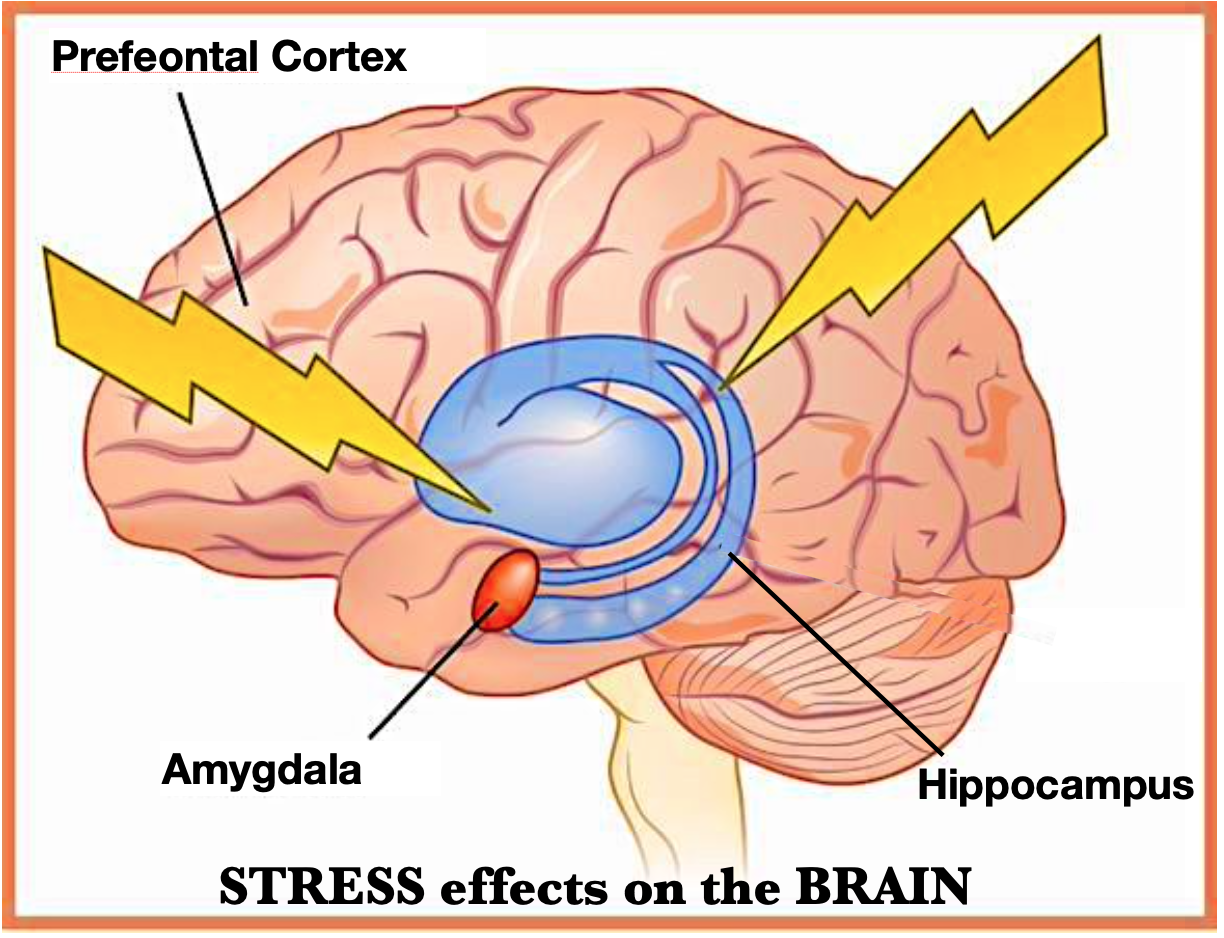
It’s the devastating impact abuse has on the brain – especially to 3 key areas : ▼ shrinking of the hippocampus, & ▲ swelling of the amygdala, & ◘ limiting the use of the prefrontal cortex.

1. The hippocampus holds short-term memories that get converted into long-term storage. New neurons formed there extend themselves to make connections to many others areas. Everything we do, read & learn & understand – rests on it functioning properly.

► Hippocampal cells are especially vulnerable to ongoing emotional distress, damaged by the body’s releases of the stress hormone Cortisol. With constant exposure to abuse, this brain structure gradually diminishes in size.
As a result, N victims end up finding it hard to absorb new info, & easily forget things they used to know (not related to age).

2. The amygdala – the general emotion-centre of the brain, gets activated every time we’re frightened or agitated.  It stores all the memories of abuse, which are triggered every time experiences are remembered, or when someone else talks about them.  It forces your attention to painful emotions like envy, guilt, fear, shame…..

While it reduces the hippocampus, Cortisol stimulates the amygdala, so that traumatic stress increases its size, which manifests as mood disorders, decreased mental sharpness, & restricting our ability to take in new information.

3. The prefrontal cortex (PFC) is located right behind the eyes. This region controls attention, decision-making, memory, & planning. It too is shown to shrink with trauma. The neural highway for unhappiness runs from the amygdala to the right side of the PFC.

As this circuitry activates, thoughts fixate on the distress. Extremes of anxiety, anger & sadness push brain activity beyond its effectiveness. Some results : N victims find it hard to make decisions, have a shorter attention span, generate fewer new thoughts, are continually depressed &/or agitated & tend to neglect self-care.

PTSD (called RE-LIVING) – It’s the cerebral anxiety attack that makes your whole body react with old terrors – causing heart palpitations, intrusive thoughts & spinning emotions – as if the traumatic event is happening right now! Along with painful emotions, physical reactions include looking over your shoulder, shrinking back, wincing, walking on eggshells while waiting to be attacked….

What to EXPECT
1. You’ll need to cry – a lot.
The more the tears flow the lighter the load pressing on your forehead, chest & shoulders
2. You’re going to be slightly paranoid –
feeling the need to watch your  back everywhere you go, no matter what state you’re in
3. The depression is real. It feels like your heart is being ripped into pieces, while the rest of your body doesn’t want to move – ever again!
4. You’ll  blame yourself – taking on all the verbal, emotional attacks that came FROM the N, but are not you.
💖 Remember that ‘C.R.A.P’ = “I can’t speak up or I’ll be Criticized, Rejected, Abandoned, & Punished .” is no longer applicable.
(
Review post: “What N’s need you to be“)

«
Insecure Attachment

The longer someone is exposed to trauma, the more distorted & fearful their world view becomes. Because N abuse is so de-stabilizing, it impacts the way we attach to & connect with others. This will have a serious effect on how we experience ourself, approach our life & react to others.

Insecure attachment happens when we repeatedly learn that it’s not safe to love or confide in someone we depend on (parent, mate, boss….). So we end up with intense anxiety about interacting with anyone, or avoid attachment altogether, which severely restricts our world, & makes most relationships difficult.

Narcissistic abuse is slow, subtle & insidious, undermining our sense of self & stability, making it extremely hard to establish healthy connections. Breaking free of PTSD symptoms is a long, tough process, but accepting the impact it has on us is a starting point.   (See both versions of the Laundry List)

«
NEXT
: After-effects, #2

 60 Common Qs FROM N-Abuse Survivors

PREVIOUS : Narcissism can KILL

SITE: “10 Unhelpful Responses Christians Give Victims …. “

❗️“4 Reasons Churches Attract Narcissists

Most people who experience N-Abuse are hampered by  :
⁍ bad ‘helpful’ info from others
⁍ brain-washing by the N, AND
⁍ lack of info about NPD (Narcissistic Personality Disorder)
⁍ pre-existing low self-esteem (childhood wounds)

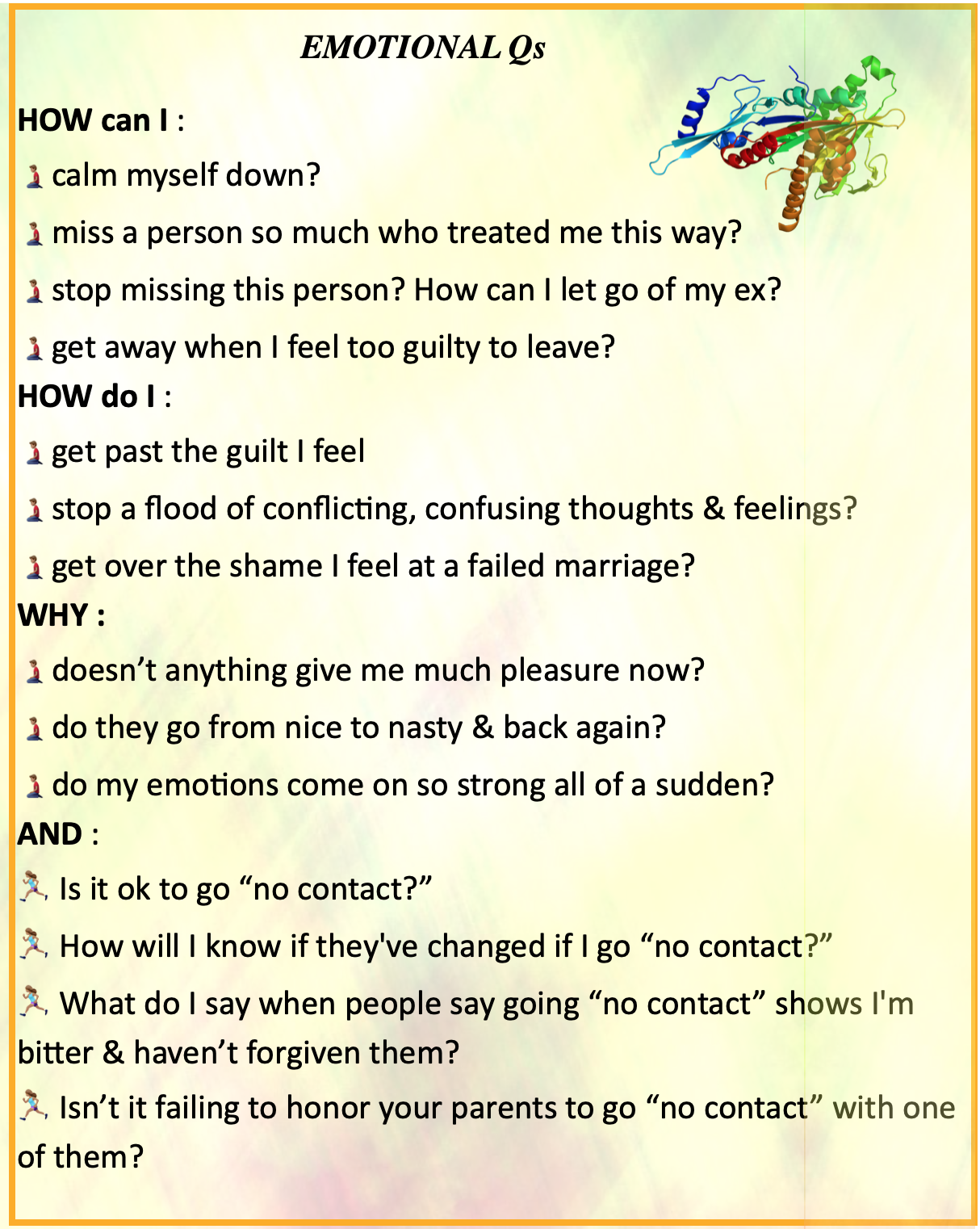
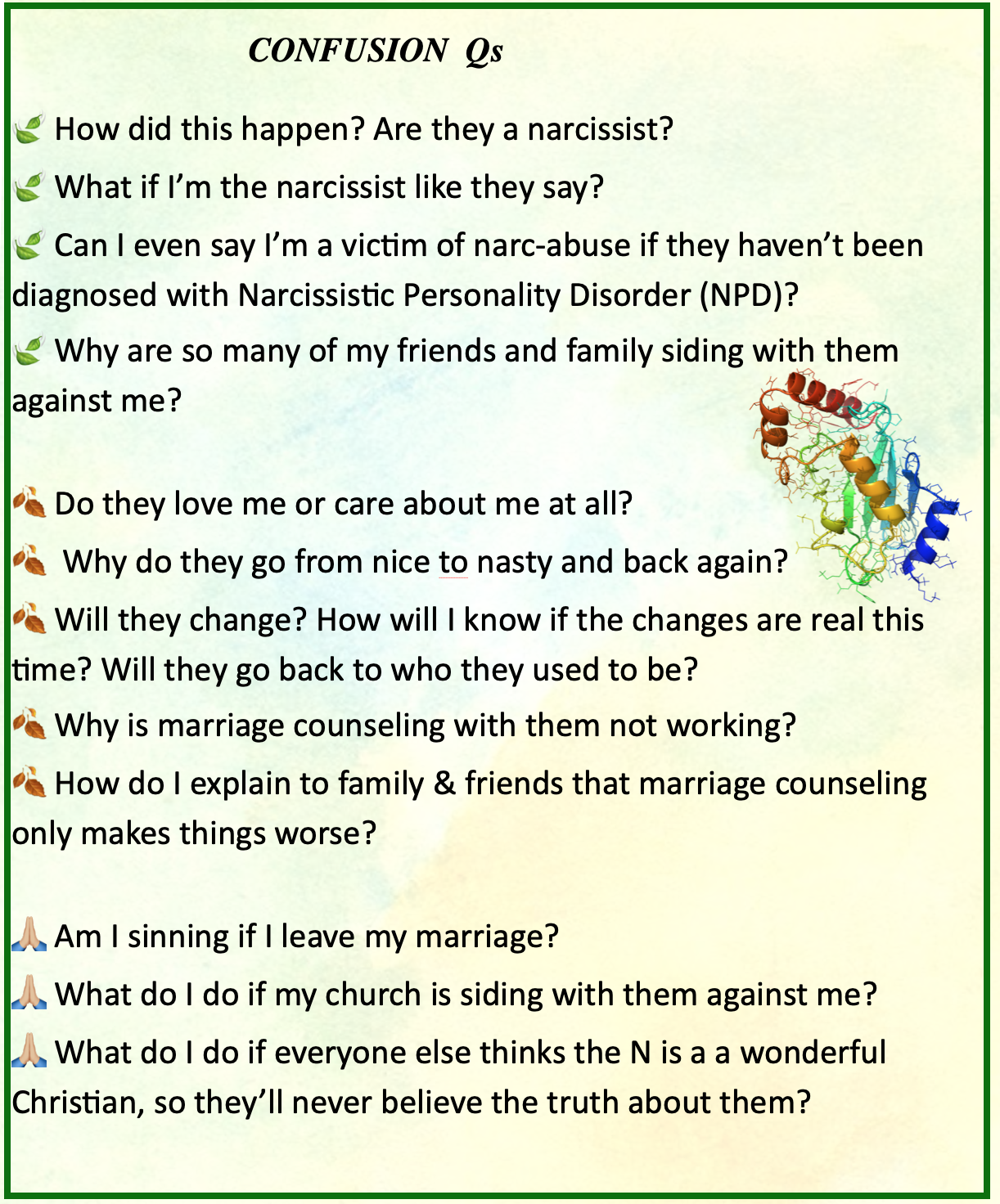
This deadly combination understandably leaves many survivors full of pain, confusion & questions. Below is a standard sample list of such Qs, divided into topics for ease of reading. You’re not the only one wondering.

↘️ QUESTION LIST from Bonnie Ronstrom, life coach, victim’s advocate, and pastoral counselor at Willow Life retreat in Virginia.

Trying to break free from a narcissistic relationship?
People who stay with N are sometimes described as addicts. In fact it is a physical addiction from brain chemistry that’s created by the anticipation of being ‘loved’, combined with being traumatic bonded to the N.

When a relationship is unfulfilling, you can be left with a constant state of emptiness, which is temporarily relieved by each positive encounter with the N, flooding your system with oxytocin, dopamine & endorphins, called ‘love’ chemicals.

However, other chemicals released when trying to detach from a toxic bond do not feel good, such as cortisol, the stress hormone. So the intense discomfort may suck you back in. To overcome this, it works best to stay away from the N entirely (no-contact). But this can be tough to do.

Even if you’re somewhat relieved at first, you’ll feel antsy, depressed, tired…. for a while, experiencing withdrawal & grief.
Turning to Recovery Programs (Al-Anon, CODA, ACA), a skilled therapist, safe friends & other support systems, as well as practicing self-care, will help you work through a difficult breakup. And over time you will heal. (More Qs & As)

NEXT : After-Effects of Abuse (Part 1)

NARCISSISTIC ABUSE CAN KILL

PREVIOUS : Signs of Ongoing Abuse – to WOMEN

SITE: “My Grandma the Poisoner.


Can NARCISSISTIC ABUSE KILL You? 
YES, definitely, both directly & indirectly. A psychopathic & sadistic Narcissist may also be homicidal, adding to their play bill of abuse.
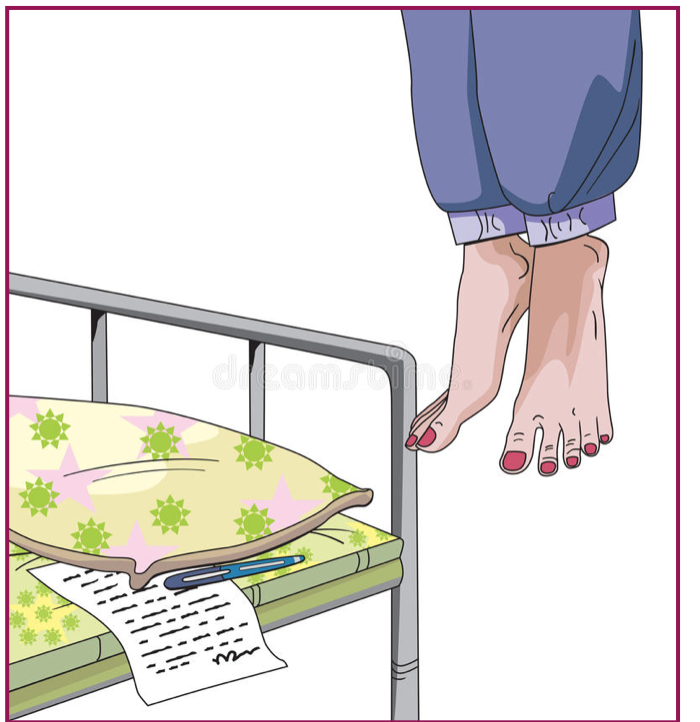
a. Accident? Doctors familiar with this disorder say this type of child abuse has the highest mortality rate, but consider most deaths as accidental, since the usual goal of the parent is to get strokes for being caring, not killing.
EXP: One published case of a mother who put too much salt in her sons feeding tube, killing him. She said her intention was just to make him sick.

However, believing such deaths are ‘accidental’ overlooks the reality of the tremendous benefit of N-supply in the form of gifts & emotional support… this mother receives from her community, when her child dies.

b. Murder. Narcissists love a funeral. Labeling such harmful behavior ‘accidental’ ignores the N’s ability to carry out premeditated killing. EXP: Some use bed-ridden elders as proxies, starving them to death.

c. Suicide. Ns have also been known to murder indirectly, by setting someone up to kill themself. This brings N-supply in the form of absolute power & control over another person, manipulating their victim to give up the most precious thing they have – their life.

d. Revenge. This set-up can also be the N’s indirect retaliation for some injury to their ego. The victim’s suicide (teen, wife….) creates guilt & blame in the N’s primary target, such as a grieving parent or mate. Then the Narc will use that person’s self-hate to control them.

☠️ When given a chance to escape any type of Narc, don’t walk – RUN.

FROM: L.C.Torres, former Court-Appointed Special Advocate at Child Abuse Prevention Council, San Joaquin County (2014-2015).  Updated April 29, 2020 · by Gia Jones, Lived with & loved a malignant narcissist.
🙀       🙀       🙀
Some Ns exhibit Munchausen syndrome by proxy (MSP) .
This is a psychological disorder where a pathological narc gets their supply of attention & ‘special status’ by using children, vulnerable adults, even pets – as proxies. They set themself up as someone’s caretaker, then persistently harm the dependent person, to either keep making them sick, or actually kill them.

MSP is a relatively rare psychological disorder. It usually affects a primary caretaker – the mother. But they can also be health-care professionals (nurse, attendant, & rarely a doctor) who cause severe illness in patients not terminal, & then swoop in to rescue, as the hero / angel.


A MBP mother will fabricate symptoms, making her child sick to get ‘supply’. She enjoys repeatedly being in medical environments where she gets sympathy & praise for being devoted to her sick child (proxy = in place of being sick themself).

Often these women are well-read experts on their child’s fake ailments, & allows them to know exactly what to use to do damage. So they also get a fix from conning smart doctors. For others, the distress they create can be a cash cow for the parent, but turn deadly for the child. EXP: The go-fund-drive online where parents ask for donations for their “sick” child.

The MSP mother appears to be very loving, sensitive & extremely distraught over their child’s illness, but denies knowing what caused it.
She’s admired for being an exceptionally attentive parent, while exaggerating or making up symptoms, altering tests, falsifying medical records….
OR doing direct damage by such actions as poisoning, suffocating, starving & causing infections.

In her ‘care’, the child keeps on worsening by being subjected to physical abuse &/or medical neglect, usually reported by the parent but not witnessed by hospital staff.
Abuse HINT : The child’s condition improves in the hospital, but symptoms return when returned home.   (More…). Also (Wikipedia ….includes statistics)

😹 A related illness is Munchausen Syndrome, where a person continually acts as if they themself have a physical or mental illness, which they do not – to make people feel sorry for them.
EXP : The case of the young woman falsely claiming she had cancer, even to the point of shaving off all her hair, then begging for & receiving donations to pay for chemo treatments.

NEXT: 60 Common Qs from Survivors

SIGNS of ONGOING Narc ABUSE – to WOMEN

PREVIOUS : Ongoing N Abuse – to MEN

SITE : “Can a Narcissist Love?“


LOVE vs. NARCISSISTIC Love – The “EMPATHY” Connection (Joyce M Short)

Empathic people are capable of unconditional love & forgiveness. Their dear one can have a bad day, be seriously ill, put on some pounds or lose their hair. Unconditional love is part of your core, & compels you toward the beloved (parent, mate, child….), regardless of how that person looks or behaves. Your sense of attachment to them is deeply rooted.

People with empathy have emotional reactions to the pain of others & a conscience that keeps them from committing harm.
If they encounter another person who has a specific vulnerability, been harmed by a prior relationship, lost a loved one, or overcame other hardships – their sensitive heart goes out to them.
💕 BUT if the empath is psychologically healthy, they do not lose themself in the effort to connect & help. ➡️

NPDs are NOT able to love THIS way 
Unfortunately empathetic people are also drawn to others who seem ‘sensitive’ – such as Ns using ‘neediness’ to hook Supply.
Narcissist “love” is emotionally & spiritually shallow because it’s selfishly motivated. It can confuse the unwary, since they pour on affection at the beginning of a new relationship.

To the recipient, it seems that their caring is boundless & deep. But this form of attachment is similar to how the N loves their money, house, car…. In fact, their money & car could be more valuable to them than you will ever be, which are visible signs of power & control.

Ns do stay in long-term relationships (with victims) BUT can’t bond with ‘full-bodied’ love.
Do not mistake N “sensitivity” – which is only about their own personal needs – with being “empathetic” toward others. In fact, being “over-sensitive” could indicate Borderline Personality Disorder.
=  =  =  =

😹 SIGNs of VERBAL abuse are often FELT, but not seen by others
Abusers are very conscious of what they’re doing to you. If it weren’t deliberate, they’d feel bad & correct inappropriate & cruel words & actions. Especially after you point them out.
Healthy people don’t want to hurt others. Hurting others is how abusers survive.

❤︎ WOMAN in long-term relationship with verbally abusive man
YOU:
‣ feel uneasy or anxious much of the time, jumping at every tiny sound, or your heart pounds for no obvious reason

‣ think you must be crazy & need professional help to overcome your ‘issues’.
Your internal voices are often overpowering – critical, very mean, repeating abusive things he has said so many times
‣ don’t trust your ability to make sound decisions for yourself or the family. So you go along with your abuser’s poor decisions without much resistance
YOU:
‣ don’t get excited about much of anything. And if you did look forward to an upcoming positive event, the pleasure wouldn’t last long, from wondering how you’re going to tell your abuser about it – to get the best possible reaction from him

‣ are paraded around like an ‘Oscar’ trophy when attending group functions for the N’s work or activities. You’re afraid to say much while there, for fear of payback abuse later, for having said or done the ‘wrong’ thing

‣ keep telling yourself it’ll be better when he retires, the children are grown, he gets that promotion, he finishes that project, after lunch….. constantly waiting for the ‘good times’
‣ believe that one day your abuser will realize how good a mate you’ve been & be sorry, doing a complete 180 to finally admire & respect you.

🌧 These last 2 are especially hard to shake because of the pleasant breaks between attacks, when he stops being abusive just long enough to lull you into thinking “It’s different this time” (intermittent reinforcement).

«
NEXT
: After-effects of N Abuse #1

SIGNS of ONGOING Narc ABUSE – to MEN

PREVIOUS : N abuse – M & F

BOOK : “The Body Keeps the Score” ∼ Dr. Van der Kolk (with reviews)


ABUSED MEN
Men are mistreated at home far more often than we might expect – in both straight & gay relationships. In some cases the abuse can instead come from an elderly parent, or a disturbed teen.
It happens to men from all cultures & all walks of life, regardless of age or occupation. Figures suggest that as many as 1 in 3 victims of domestic violence are male.

Abusers can have a ‘dual diagnosis’, being severely narcissistic and active alcoholics &/or drug addicts, severely mentally &/or physically ill, have PTSD….. (Abusive elderly parents…. )

Men are reluctant to report abuse for some of the same reasons that women don’t.
And the types of abuse they experience are similar to the list below, including:
✦ The N controls how you spend money, or deliberately defaults on joint financial obligations
(See : “N’s financial abuses”)
✦ Takes away car keys or locks you out for hours
✦ Prevents you from getting medical help or hides your medications ….
✦ Makes false allegations about you to employers, family, friends, the police…. anything to isolate you.   (More…. with help-suggestions)

↘️ GENERAL CHARACTERISTICS NEXT : Ongoing N abuse to WOMEN

SIGNS of ONGOING Narc ABUSE – M & F

PREVIOUS : N  abuse- OVERVIEW

SITE: “Mental & Emotional Abuse if Real” 


SYMPTOMS of N. ABUSE
These apply to You (the victim) in relation to your N partner (either gender)


YOU:

✦ are not allowed to grow
People need to develop, in order to become their best self. An insecure partner will tend to discourage this – lest you gain wisdom, & then see their weaknesses & want to leave. If you give in to their fears, you sacrifice a valuable part of your identity

✦ become tense around your significant other (S.O.)
It’s normal to feel anxious while you’re fighting, but it should not be all the time. Your relationship is supposed to feel like a soft place to land – anytime – especially after a long, hard day

✦ believe you can’t do anything right
This means your partner is taking your good qualities for granted – & happy to make use of them – while totally focusing on your limitations & flaws. Nobody’s perfect, but a partner who chips away at your self-esteem is being cruel
YOU:
✦ develop dissociation as a survival mechanism
This is being emotionally & physically numb in the face of horrific circumstances, like an alcoholic blackout but without drinking. It’s an actual detachment from your surroundings, with gaps in memory, perceptions, consciousness & sense of self.
In this state, mind-numbing activities, obsessions, addictions & repressed awareness become escapes from current reality

✦ don’t ‘feel like yourself’
This is a major sign that you’re compromising your identity & integrity for the sake of the relationship. To accommodate an abusive partner, you keep negatively adjusting your behavior & self-perception – to prove you  ‘really do care’. These self-denying changes cause you to lose a sense of self, leaving you confused & empty

✦ fantasize about (or try) suicide, or engage in self-harm instead
Along with depression & anxiety comes creeping hopelessness, having developed “learned helplessness”. Victims of domestic violence are 2x as likely to try suicide, even multiple times. It’s the way your partner can commit the ‘perfect’ murder – without being held accountable
YOU:
✦ find yourself avoiding your S.O. – or notice them avoiding you
Taking some time to be alone is healthy. However, if you usually dread spending time with this person, it means they’re not safe to be with

✦ habitually lie to each other
Often lying to your partner means – either you’re doing something you know isn’t ‘kosher’, OR more often it’s because you know they won’t accept something legitimate & positive you’re doing for yourself &/or the kids

✦ have the same arguments over & over
This usually represents deeper problems than the annoyance or criticism at the moment. It can also mean one or both of you don’t communicate appropriately, OR one doesn’t want to deal with the issue, causing distress to the other
YOU:
✦ (one or both) suffer from serious jealousy
This is a huge red flag. Accusations of infidelity or lack of attention is not a sign of love, or even of passion – only throwing childish tantrums. Jealousy indicates personal immaturity, insecurity, & lack of trust in the partner (especially when it’s UNjustified)

✦ put aside your basic needs & desires
You believe your partner’s happiness is more important than your own, so you sacrifice emotional, even physical safety to please the abuser. Trying desperately to please someone so they won’t leave you, is exhausting & pathetic

✦ romanticize the past
This is a subtle sign of dysfunction, but a very important one. Healthy people enjoy looking back on good times. But, if you live in the past because your future imaginings look like more of the same misery, you’re in the wrong place
YOU:
✦ walk on eggshells
Forced to avoid whatever will set the abuser off again – to stave off their rage. But it never actually works, since they want to use you as an emotional punching bag – no matter what you try. So you’re constantly anxious about accidentally ‘provoking’ your abuser, trying to prevent confrontations & physical harm

✦ withdraw from everyone & isolate
Just the 2 of you in your cocoon of distrust of the outside. You feel ashamed about the abuse, & assume no one will understand or believe you anyway. Unfortunately, victims can be re-traumatized by law enforcement, family, friends & the N’s harem members who won’t validate your experiences

NEXT : Signs of Ongoing Abuse – to Men

SIGNS of Narcissistic ABUSE – OVERVIEW

PREVIOUS :
What not to do with Ns, #4

SITEs : “What happens when you Start Ignoring a Narcissist ?”

♟ “What happens when a narcissist see that he/she can’t destroy you?“


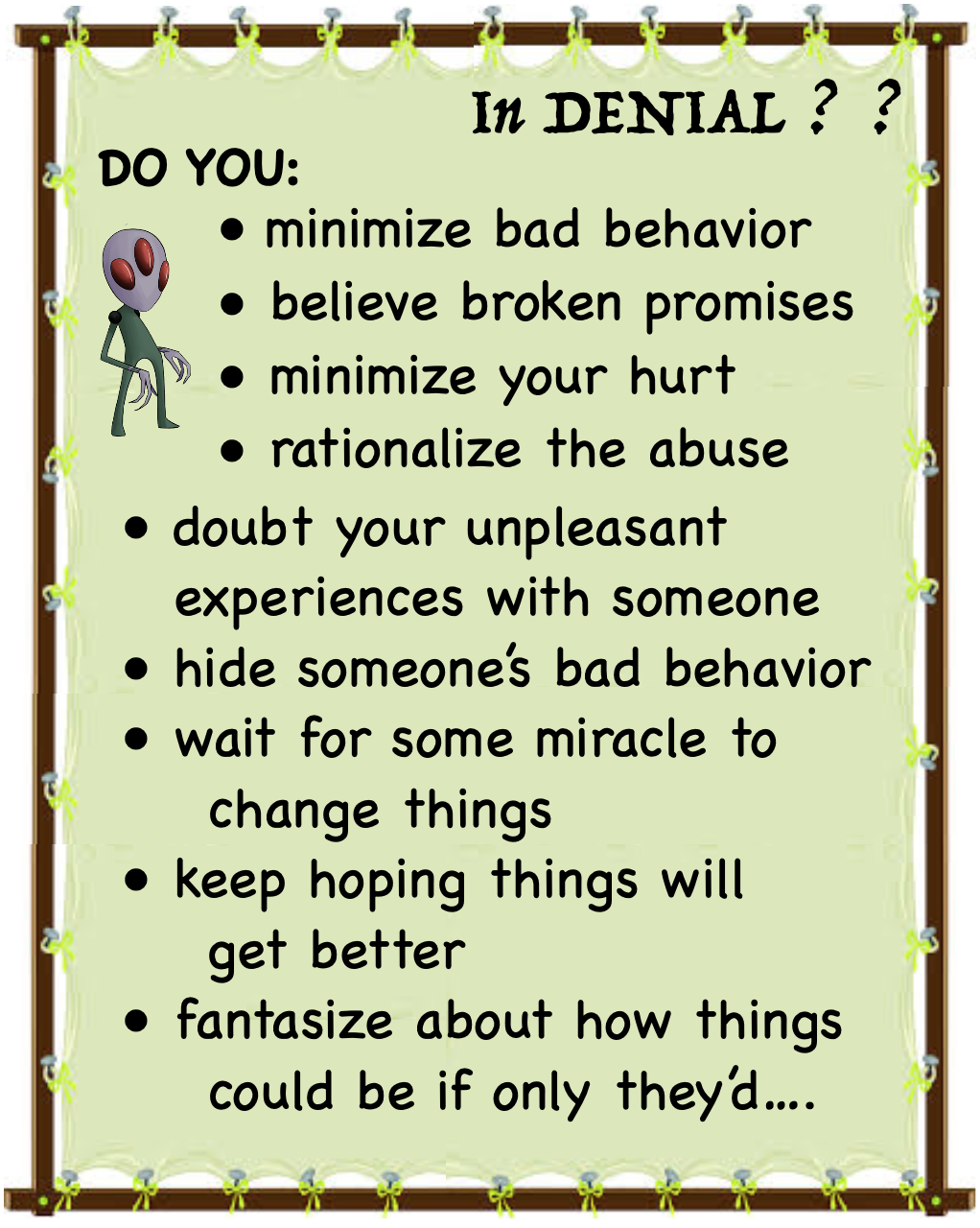
Denial is our frenemy. It is naturally the child’s first & only defense. Being helpless & dependent makes it safer & less scary to deny extreme, continual deficiencies in & abuses from parents & other caregivers, than to ‘see’ what the child is actually experiencing.
And as adults, following the same patterns, it may feel safer to blame ourself for problems than to question the integrity of people we depend on for our survival. 

As long as we’re in denial, we repeat unhealthy patterns, failing to protect ourselves & those we love from further abuse. Breaking denial about a parent, spouse, or other important relationship is the first & often most difficult step in the Recovery process. But crucial.
«

 «
NEXT
: Signs of ongoing N-abuse , #1

What NOT to do with NARCISSISTS (Part 4)

PREVIOUS : What NOT to do (Part 3)


WHAT NOT to do with NPDs (cont) 

23. DO NOT attend couples counseling with a NPD
BECAUSE it’s a scam to keep you hooked. Don’t be fooled by their agreement to go, since it’s bound to fail. They’ll triangulate with the therapist, be sooo charming or portray themsef as the victim, & use everything you say in therapy to further gaslight & retaliate between sessions.
Unwary therapists will address the Victim’s reactions instead of the abuse itself, & risk re-traumatizing the survivor. Since NPDs refuse to take any personal responsibility for their beliefs & actions, they don’t outgrow their patterns.

Many NPDs won’t even try counseling, totally blaming their partner. But if they do, it won’t last & then they can say manipulatively :
“See, therapy didn’t work – YOU’re not any better. So there’s no point in continuing”, OR
“It’s too expensive. Besides, the doc doesn’t know what he/she is talking about.” or when they quit, will say :
“I tried, so you can’t blame me” (after only a few sessions)

And
DO NOT talk about ways you’re planning on taking care of yourself – especially if it includes leaving. It’ll just give them the time & ammunition to sabotage & then derail you, often getting ‘help’ from the therapist to do it.
🙀 🙀 🙀
NOTE from Dr. Ramani Durvasula
In reality, the previous 4 points can’t always -OR ever- be avoided . So this info is to help you know what to expect, & prepare yourself & your Inner Child, using Recovery tools (12-Step meeting, literature, prayer, phone & text calls…. )

24. DO NOT attend family activities (yours or theirs)
BECAUSE it’s another opportunity to make you look like the crazy one or the b–ch. The N can too easily rile you up behind closed doors to make you seem unhinged or emotional to their family & friends, while playing the calm, collected partner.

‼️ To show others you’re not ‘the problem’ they’ve heard about, make sure you stay calm, smile a lot, tell about your accomplishments & only talk about facts – never emotions. And don’t complain about the N.
Vent your frustration & rage privately, in Program, therapy, your journal, in prayer….  Use these coping suggestions for the next 3 as well.

25. DO NOT attend get-togethers with the N
BECAUSE – among other things – it’s an opportunity for the N to triangulate by flirting with others in front of you, to get you to vie for the N’s attention.
The only ‘value’ in going – is to cut thru your denial by actually seeing how they interact with others. Attending social gatherings with the N. can cause you much pain & a sense of alienation – as he/she charms the crowd while devaluing you

26. DO NOT have celebrations with them
BECAUSE if you do – the N will most likely sabotage events such as your birthday, special celebrations or holidays. They’re infamous for ruining situations where you’re supposed to be the center of attention & make you happy. If you have to ‘share’ these moments, make sure your support people are present as well

‘Special’ events also includes important deadlines, a work interview….. Do not let the N know when these are happening, since it means potentially losing power over you. They’ll deliberately rattle you so much – often using unrelated issues – that you may ruin it yourself!

27. DO NOT travel with them
BECAUSE if you do – you’l be shocked at how horrendous it can turn out. This is very familiar to anyone growing in an alcoholic family!

As adults, ‘dream vacations’ may initially be part of love bombing, but end up opportunities for the N to isolate & degrade the partner. Beside drinking alcoholically & triangulation with anyone around, they’ll want to eliminate any witnesses – to how they ‘groom’ you to always expect verbal & psychological abuse.
AND – NPDs are notorious for abandoning their victims in foreign countries, making dream destinations a trip to hell, include the most special one – their honeymoon.

NEXT : Narc abuse – Overview