AUTONOMY & ATTACHMENT (Part 1)

gain autonomy
SERVANT or MASTER of YOUR CASTLE
Who’s the boss of you?

PREVIOUS: Being Visible (#3)


ACoA SYMBIOSIS   (see Post)
It’s an unhealthy attachment to others as a way to:
• compensate for emotional abandonment in childhood
• cope with deep anxiety of being a separate entity
• escape having to face the struggle of growing up emotionally
• mask self-hate & fear of abandonment

In the process of healing the past, we move thru layers of growth with the ultimate goal of being free.
Symbiosis ——> Autonomy ——-> Attachment ——> Inter-dependence

AUTONOMY
1. GENERAL – As part of the human life cycle, the normal, healthy psychological goal of adulthood is to become our True Self, be inter-dependent with others & contribute positively to society.
• A reasonably healthy family encourages children to be an accepted part of the family group, as well as developing as a separate individual, & then be able to function successfully in the larger world

• However, as ACoAs we were:
☼ not allowed to fully develop our own identity
☼ forced to stay in emotional & sometimes physical bondage to the family
☼ so ignored, neglected &/or tortured we couldn’t form a stable bond with anyone.  See  Attachment Disorder site

2. REQUIREMENTS woman w/ lotus
a. S & I  (Separation & Individuation) is required to connect successfully with others, the opposite of co-dependence & symbiosis, BY knowing:
• ourselves & being comfortable in our own skin
• what our needs & tastes are, & provide for them
• we’re OK, which is self-esteem & not arrogance or superiority
• we can be safe & at ease when dealing with others by having strong boundaries

b. Motivation
A hallmark of Personal Independence is being our own motivator** — not from egotism, but from being responsible for ourselves.  Spiritual & psychological teachers tell us that we need to look inside for the answers to our problems – that it’s an ‘inside job’, not what we have, but what we are. (‘Process, Part 2, b, iii’ )

in charge**Self-Motivation means we want to do things – for ourselves. It’s the reason behind our actions, our guiding principles.
NO – It does NOT mean ignoring or disrespecting our family, the needs of others or our spiritual connections
YES – It DOES mean is that, as adults, we’re not waiting for someone else to give us permission or a reason to act

➼ Pre-FoO Recovery, ACoAs can take many actions FOR others or because OF others, but rarely just because WE want to. (‘Responsibility’ )
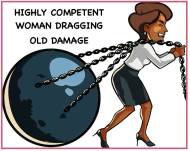
Without someone pushing or pulling us, we’re like dormant trees in the forest or hibernating bears, waiting for the sun to shine on us, warm us up, give us a reason to move. This is the essence of co-dependence

Past motivators – Normal: Our parents & family, school, teachers, friends, peer groups, religion, our countryour damage
• Present day motivators

negative: PRIMARILY our damage – hidden from us in the subconscious (the Shadow side) – old unresolved pain, toxic beliefs, our allegiance to our wounded family system, our resentments, fears… all expressed thru the WIC’s behavior

SECONDARILY: by other people’s opinions, the needs & wishes of friends, relatives, mates, children, bosses, our community, a punitive religion, & a distorted view of God

☆ positive
: a loving H.P. & Ourself. All other reasons to act need to come second, evaluating them based on mental health, common sense, Recovery (not from the WIC or PP bad parent) – ie. emotional maturity

c. TOOLS to get to KNOW OURSELVES:
• a variety of psychological inventories & personality tests

tools• dreams, visualizations, prayer, spiritual literature
• feedback from reliable sources / meetings, therapy, body work
• listening to ourselves, mindfulness, staying in the now
• listing things we’re good at, ask others about our good / excellent qualities
• observing our behavior patterns, slowly over time
• noticing our emotional responses to every situation
• talking with the IC thru the day, listening to our intuition/gut
• written inventories, journaling, morning pages, I.C. writing

NEXT: Autonomy & Attachment, #2

ACoAs & BEING VISIBLE (Part 4)

I CAN BE SEEN
without being in danger

PREVIOUS: Visibility (#3)

ARTICLES: “Psychological Visibility
and “Psychological Visibility as a Source of Value in Friendship”, by Shailushi Baxi

DEFINITIONS
To understand being truly visible we have to be clear about the differences between our misunderstanding of reality & what IS real.
Much confusion about it comes from distorted definitions & beliefs re. Arrogance vs. Having Rights, & Confrontation vs. Self-Assertiveness, Humility vs. Humiliation.

ACoAs often have the mistaken notion that being visible is arrogant, showing off, expressing hubris. NOT SO.
We’re so trained to not speak up, that we think any form of assertiveness is a confrontation. Not true.
Instead, when we speak from our Adult Ego State, use ‘I’ statements & don’t attack – we are in the right
🦚
1a. Arrogance
• Having (& showing) an exaggerated opinion of one’s own importance, value & ability, from an assumption of ones superiority over others
• Not being able to take correction, criticism or guidance. These are the WIC’s or PP’s narcissism & grandiosity

It stems from insecurity & a need to be validated – often trying to take credit for more than the person really did, in order to boost themselves. It tends to be expressed by not listening, dismissing others’ opinions, with ‘loud‘ energy, craving attention online, being pushy with coworkers, or just never letting someone else speak
vs.
1b.Having Rights” – review it, along with My Rights
When we know our needs & rights, we value ourselves. So acknowledging our beliefs, assets & accomplishments is HEALTHY!
Re. NEEDS :
1. Basic PMES requirements – same for all humans across the planet, listed on the Maslow Pyramid
2. Personality needs, based on our specific configuration – learning style, MBTI & Enneagram Type…..
3. Wound needs, from the repeated ways we were abused & neglected.
In the present it’s about finding the best ways to compensate for past trauma that may always be with us to some degree, but becomes much milder with Recovery
🦚
2a. Confrontation (aggressive): ALWAYS comes from anger.
It means approaching someone (in person or not) in a threatening way, assertiveness....being argumentative, wanting to unsettle them – especially with abuse, accusations, arrogance & defiance.
A hostile clash of opinions, ideas & power
vs.
2b. Assertiveness: being confident & direct in claiming one’s rights or putting forward one’s views, clearly & without anger, in an honest & respectful way, especially about difficult issues

It’s based on present-day reality. At work, such a person is confident about their identity & competence, so their energy level is quiet‘, whether they’re getting attention & recognition or not. They can also safely acknowledge the contribution of others & are able to share credit. Site: “How to manage conflict & confrontation
🦚
3a. Humiliation:  (not including degrading sexual interactions)
MUST involve 2 or more people – one who bullies, intimidates or socially embarrasses, although not always directly, AND the other as victim, usually not a willing recipient. It means TO:
• be reduced to a lower position in one’s own eyes &/or others, losing prestige or self-respect
• cause someone a painful loss of pride, self-respect, or dignity
• degrade, dishonor, disgraced, mortify, shame
vs.
3b. Humility / Humble : the quality of being courteously respectful, & modest, with a realistic opinion or estimate of one’s own importance, abilities, rank….
• Free from : boastfulness, egotism, great pretensions or vanity
• For some : retiring, unassuming, unobtrusive. May need to  be alone, to de-emphasizing & heal the wounded ego. (More…)

NOTE: Damaging parents, bad bosses & some religions use humiliation to control & make others submissive to their power.
HEALTHY people & institutions teach how to function well (actions), and encourage, or at least allow, others to develop their own natural way of thinking & feeling

IRONY: The more self-esteem we gain the more humble we become, comfortably! It’s what John Bradshaw called “healthy shame” – knowing what our actual human limitations are, without S-H, shame, guilt or toxic beliefs

🚴🏻‍♂️ Then we’re not afraid of making mistakes, of not know everything, of being imperfect. At the same time, we’re comfortable owning our God-given attributes – talents, knowledge & accomplishments.  Visibility is not dangerous to our welfare or identity!
REPEAT every day : “I know what I know, & I can’t know / don’t have to know – everything!”

NEXT : Being visible #5

ACoAs & BEING VISIBLE (Part 2)

invisibilityI DESPERATELY WANT TO BE ACKNOWLEDGED
but I don’t want to expose the real me!

PREVIOUS: ACoAs Being VISIBLE (#1)

POSTS: “Healthy Adult…andSeparation & Individuation

1. WOUNDED CHILD (Part 1)

2. AS ADULTS
STAYING Invisible
– In the present we have many options never available to us as kids – such as searching out people who are relatively ‘sane’ & already capable of seeing & hearing us.
However, as long as the WIC is still running our emotional & mental life, it is the Ego State in charge of the picking process. So we’ll continue to choose friends, mates, even jobs, whose abuse & incompatibility with us make us feel unsafe

This reinforces the WIC’s conviction that we should stay invisible, not just because of the unhealthy people we surround ourselves with, but because of the WIC unconscious connection to the Negative Introject (IT), which is our real source of threatplexiglass

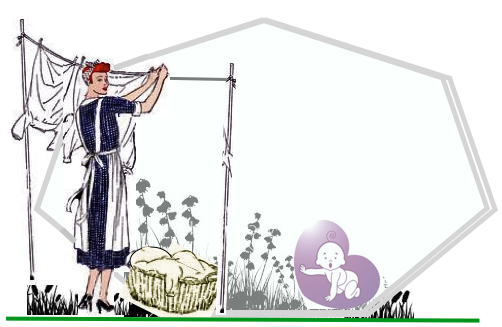
EXP: In doing early childhood visualizations, Tamara had an scene of herself as a 15 months old, sitting alone on bare earth in a big yard, only wearing diapers & a tiny top.

Near by her mother was hanging the wash on a clothes line, talking & laughing with another women, paying no attention to her little daughter.
It was as if there was an infinitely large sheet of plexiglass between Tamara & her mother – they could see, but not hear each other.
The infant sat there alone, unnoticed, neglected, unable to get thru to her mother – bewildered & scared! She had not created the wall, so she couldn’t tear it down & it was too vast to be gotten around. She WAS utterly alone!

🥀 This image represented her daily emotional experience growing up with a narcissistic mother, who was controlling & over-protective, while at the same time accused the child of being ‘difficult’, distant & disrespectful.  Tamara’s mother had made her feel invisible & then blamed her for the result!

Now, the only possible result of our True Self becoming visible is a feeling of danger. Our WIC is convinced that if we can be seen, well everyone else in the world will treat us as badly as our family did. toxic beliefs
So we continue to hide behind our glass wall**. We think that even if we tried to have a presence, we’d likely fail (not prepared, don’t know enough…)

The WIC says : “If I show who I really am & go for what I want”, then : • I’ll be made fun of, judged, criticized
• no one will want me or what I have to offer
• no one will pay me for what I do
• people will be jealous of me, & then attack / try to stop me”…..
AND even if I by some miracle manage, it will be taken away

**Glass wall: While we’re trying to hide behind a creative facade, we do NOT really go completely unnoticed. Depending on how we function in the world, other people see various aspects of us – both our good qualities & our damage.

• What all ACoAs** present to the world is our ‘defensive persona’, an outer shell housed in the PP or WIC ego states, & in some cases a clever but unhealthy Adult. The sad thing is that we believe this outer shell is the real us. Actually, it’s a mis-directed version of our natural personality, distorted by childhood abuse & neglect

While many of us are terrified of even that much exposure, those of us who tend towards the blatant are nevertheless suppressing or perverting the healthy Natural Child, trying to show the world (our parents) we deserve to be valued (“look at me – and – I hate you all”), as compensation

**This is not to diminish the accomplishments of many determined & talented ACoAs who have worked hard to achieve one or more goals. And not all successful people function exclusively from damage – it depends on how authentic they are in their personal life.
In PMES terms, most function out of their (P) Physical & (M) Mental aspects, but rarely (E) Emotionally or (S) Spiritually mature.

NEXT: ACoAs being Visible (Part 3)

ACoAs & BEING VISIBLE (Part 1)

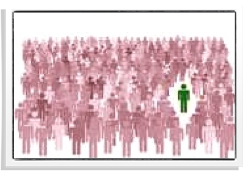
stand outWITH ALL THESE PEOPLE AROUND
– why do I feel so alone?

PREVIOUS: Emotional Maturity

POSTS: Ego states”  and Toxic Roles


1. WOUNDED CHILD (the WIC)
Invisibility is a basic protective mechanism for any abused child.
Physical: kids in dangerous homes will often try to make themselves invisible by hiding in their room, under tables or beds, in closets… or spend a lot of time out of the house, at the library, in sports, at a neighbor or friend…..
Psychological: damaged parents give their children a strong message – spoken or not: “DO NOT BE YOURSELF” – only be what we are, what we want you to be, what we can tolerate & control, what we believe is ‘right’

ACoAs, having experienced both kinds of harm, learned early on to mask our True Self, so much so that we end up not knowing that we even have one! Our family threw our essence on the trash heap, so we learned to do the same. We needed to protects ourselves from family, school, church & neighborhood because
THEY:trashed child
• used our weaknesses/ feelings/ desires / sensitivity – against us
• made fun of & teased us, played mean or cruel ‘jokes’ on us
• punished us unfairly or unnecessarily
• ignored or belittled our skills & gifts (often from jealousy)
• didn’t back us up, take our side – anywhere (at home, at school…)
• physically hurt us (abused for not being perfect – or just for being there)
• expected too much of us (be a little adult, take care of them…)
• never gave us the right info to function successfully in the world….

Bad mirroring: The more severe the parents’ self-absorption is, the less they provide their children with positive mirroring, which all kids must have in order to forge a sense of Self & how we relate to other people. Without this pure feed-back from the start (“I get who you are, exactly the way you are”) it’s very hard to develop a true image of ourself. Our family’s narcissism created a kind of childhood black magic: “If they don’t see me then I must not exist!”

invisibleNo matter at what age, when we’re in the presence of a severe narcissist we are actually alone, since N. only recognize themselves as having reality or viability. We are in fact INVISIBLE to them as separate entities
For a healthy adult, being with someone & still feeling ‘alone’ is at best boring, at worst aggravating.

For a child, when it’s our parents – it’s life-&-death terrifying. We come into the world helpless & are totally reliant on caretakers to provide all the basic needs, as well as safety, information & emotional connections
• The only way a pre-verbal infant has of communicating is thru their emotions.  If the adults cannot tune into the child on that wavelength, the baby experiences such aloneness & frustration that it creates intense anxiety

• The baby then tries to ‘manage’ that anxiety in any modernchineseorphanage
way it can, with extremely limited options – sucking it’s thumb, crying a lot, clinging to mother / doll /  blanket, not responding to stimuli, being afraid of strangers …..

Studies in orphanages have shown how great the toll is on children who only get the minimum of care & are neglected mentally, emotionally & physically.  Also not being held, touched & comforted creates permanent personality damage. A common reaction is continual heads banging & compulsive rocking, & never developing the ability to bond with others.

For an infant, being left physically alone for too long is a death sentence. Being with a lot of others (family) without emotional connection is soul murder.

For ACoAs, growing up with adults who were supposed to be nurturing YET were NOT, was overwhelming to the point of powerless rage!  It felt like we might not survive. They made us feel so worthless & unlovable that we assumed they wanted us to be dead. Some parents even said so!  One narcissistic mother would say: “You’ll be the death of me yet!” – so even that was about her! but the child understood the translation: ‘You’re a murderer, you don’t deserve to live!’

NEXT: ACoAs & being Visible (Part 2)

Relationship FORM B. (Part 3)

WHEN I’M HURT I DON’T WANT TO ‘keep the focus on myself!’

PREVIOUS: FROM B. (#1)


REVIEW: KtFoY (keep the focus on yourself), in Part 1


Relationship FORM B

~~~~~~~~~~~~~~~~~~~~~~~~~~~~~~~~~~~~~~~~~~~~~~~~~~~~~~~~~~~~~~
WHEN YOU ___________________________________________
I FEEL  _______________________________________________
& BELIEVE THAT I AM ____________________________________
These are my thoughts & feelings, which are not your fault, and which
you’re not responsible for.
HOWEVER, I’D APPRECIATE IT IF YOU WOULD ______________________________________________________
WOULD YOU BE WILLING TO TRY THAT? ___________
~~~~~~~~~~~~~~~~~~~~~~~~~~~~~~~~~~~~~~~~~~~~~~~~~~~~~~~~~~~~~~

EXP 2.
WHEN YOU (As) – spend too much time talking to other people (especially to ___) when we’re out together
I FEEL (Es)  – invisible, disrespected, humiliated, angry, hurt, lonely
& BELIEVE THAT I AM (Ts) – not attractive, not desirable, boring, a burden to you
These are my …
HOWEVER, I’d APPRECIATE it if YOU WOULD (As) – pay more attention to me, include me in your conversations, show people I’m important to you, maybe even brag a little about me to others… 🙂
WOULD YOU BE WILLING….?

RESULTS
Re. US
• ACoAs unconsciously expect others to know our needs without having to say anything. This is ‘mind-reading’ & not kosher to expect. It comes from the WIC, whose needs were not met sufficiently at a very young age, when we genuinely needed mom, or someone, to consistently know what to do for us, especially before we could talk.

🗝 NOW we refuse to ask for what we want & need – not just because we’re not ‘allowed’ but because that wounded part of us insists (unconsciously) that if we have to ask – whatever we get doesn’t count!
What the WIC doesn’t realize if that ADULTS are supposed to ask.

• Although our intense anger & hurt is from inside, we can have a ‘legitimate beef’ if the other person consistently disappoints or abuses. It will take some work for ACoAs to know the difference – by identify our specific needs and human rights, speak up for the WIC from the UNIT

Re. THEM
• If you’re dealing with an older child or teen – the way to handle them will be quite different. You’ll need to be more assertive but not punitive, & may need to insist they ‘behave’ by your rules.

a. But if you’re dealing with a self-centered, immature, narcissistic adult, they’re not likely to do as you ask – even if they promise to.
With anyone who is that heavily ‘armored’, you probably won’t get anywhere.
They may not even be willing to look at the ‘dumb’ form you worked so hard to fill out!

In that case the purpose of the Forms A. & B. is for YOU to be clear about the issue, & stay awake to who / what you are dealing with.
You may have to decide to distance yourself, if not physically, then emotionally.
Save every form, & fill a new one out each time a new ‘issue’ comes up, for you or from them. Only show them to someone trustworthy, like a sponsor or therapist. The forms are NOT to be used to beat someone up, or to hold resentments

b. re. their annoying or harmful actions, such as —
• at home : ruining furniture, breaking objects, throwing important things out…..
• in public : revealing too much, over-explaining, not answering direct questions…..
• inter-personally : promising but rarely coming thru, not listening, not holding up their end of responsibilities…..

✒︎ ….  one possibility is that the person has ADD, OCD, dyslexia, serious depression… & isn’t getting the right treatment for it.  So they may not be able to stick to an agreement, even if they want to.

EITHER WAY: If the person balks – at listening to your request, at considering it or at actually doing something differently – it’s important to ask “why not”:
✓ is it the way you’re stating the request or need?
✓ what would it mean to them to comply? the personal cost?
✓ what worries them about your request?
✓ can they give you an alternative action they are willing to do – but only if it’s legitimate and acceptable to YOU – for you to consider?

• Of course, if they listen with an open heart, you have a chance at getting some of your needs met
• Even if the person’s response is favorable, don‘t expect miraculous shifts.  We all take time to change. Be willing to remind then, nicely!

Start the sentence with “Please, would you … / Do you remember you said you would be willing to…’ , rather than angrily:
“You never… / Why haven’t you… / You promised to…”!

• ALSO, you may need to be more assertive, more pro-active, more visible – to not be a victim of other people’s personalities & / or their damage.  🪒 ASK, ASK – nicely!

NEXT: ACoAs – Being Visible – #1

Relationship FORM B. (Part 1)

  Screen Shot 2016-06-18 at 6.03.46 AM
WE  SEE THINGS VERY DIFFERENTLY.
Can we understand each other better?

PREVIOUS: Relationship Form A. (#2)

See ACRONYM page for abbrev.

‘KtFoY’ = “Keep the focus on yourself!” 


“WHEN YOU….”
Form in Part 2 & 3
• We hear from many sources that to be mentally & emotionally mature, we need to take responsibility** for our own TEAs (thoughts, emotions, actions). Yet ACoAs were taught by our family & religion NOT to think about our own needs, tastes, ideas, values… only other people’s – which means we’re not allowed to KtFoY. It’s considered:
☀︎ selfish, because it takes attention away from them
☀︎ arrogant, because we feel so worthless that we have no rights
☀︎ disobedient, because we’re not allowed to think for ourselves – only what they said was acceptable – no matter how contradictory or crazy

Can you hear the PP’s poisonous voice whispering: “Who do you think you are?”
And no matter how intelligent or accomplished, without correct info, many ACoAs don’t actually know what KtFoY means or how to do it.

REMINDER: ** Taking Responsibility is different from Self-Hate, which tells us everything bad / painful that happens to us and others – is our fault.
☼Responsibility is not about fault, but rather ownership. It acknowledges what we have or have not thought, felt or done (T.E.A.) – period.
☼ S-H adds to that :”Yes I’ve done/ not done —- and therefore I’m bad!”
This is not KtFoY.

•  Taking responsibility without S-H allows us to determine who did what – if anything – & if there is anything we can learn or correct for next time – without shame or recrimination.

NEGATIVE USE:Screen Shot 2016-06-18 at 6.16.44 AM
• Some ACoAs will use KtFoY to justify being selfish, thoughtless & inconsiderate – coming from their narcissism. Like : promising to do something important for another person, & then flaking. When confronted, they may say “Oh, I just needed to take care of myself” – without considering the consequences to anyone else.

• Other ACoAs think they’re being righteous when they use their version of KtFoY – but only to point a finger. Like: “I feel that you…. should be more… are being stupid for staying with… don’t know what you’re talking about… ought to do…”

POSITIVE USE:
•  Identify the thoughts & emotions YOU are having about a situation, leaving out as much reference to others as possible. That may take some soul-searching, but a good way to find out what’s going on inside is to ask what the the Inner Child or the PP is going on a about.
Either one is having some old emotional reaction – the direct result of our thoughts – wrapped in a cognitive distortion & Toxic Rule “If it’s hysterical it’s historical”.

•  Then, if appropriate, write or state what you’re thinking & feeling. Of course you’re reaction is in response to something or someone else, but it’s YOUR response, regardless of that they do or say. focus on self
Such as:

☼ re. Es: ‘When you talk like that it hurts my heart!’ or  ‘It’s very painful for me to watch you harm yourself’  or ‘I get so angry when you disappoint me, over & over!’
☼ re. Ts:  “I simply don’t agree with your assessment of the situation” or “I don’t understand why you keep …” or “I know I didn’t do that, even if you don’t believe me”….

✒︎ Notice that these are all “I”  statements. It’s the best way to communicate, because it eliminates blaming or trying to control.
It also stops most people in their track – it doesn’t give them much they can use to escalate. They can of course divert your attention by changing he subject, or just make fun of what you said.
Hopefully it greatly cuts down on defensive, angry & resentful responses

REMINDER: Don’t wait endlessly before saying something appropriate about an annoyance or a serious problem. Otherwise you’ll just be in a rage & any communication will be short-circuited.

SO, back to these forms – regarding something another person has done over & over that bothers you a lot. Notice:
☆ Form A. was about a future event that worries / angers you
★ Form B. is about recent but ongoing past actions, you wish would stop. Examples in Part 2 & 3.

NEXT: FORM B. (Part 2)

Relationship FORM A. (Part 2)

couple troubleSOMETIMES IT SEEMS THAT
relationships are more trouble than their worth!

PREVIOUS: Form A. (re. forms: Who, What, When –#1


FORM A: “IF I WERE TO LET YOU

1. WHO / 2. WHAT / 3. THEN

4. WHY: It’s important to know what your motives are in sharing these forms with another. The 3 main possibilities are:
a. as another manipulation, so you can change the other person, to get them to do what you wan. Ask, don’t demand or assume.
b. to open lines of communication, & be able to talk about the topic /situation – if you’re both willing, & possibly lead to a better outcome (Actions) or at least a resolution of conflict (Emotions & Thoughts) – Ts, Es or As.
c. to get as clear as you can about your own thoughts & feelings, regardless of the other person’s ability to hear you

~~~~~~~~~~~~~~~~~~~~~~~~~~~~~~~~~~~~~~~~~~~~~~~~~~~~~~~~~~~~~~~
IF I WERE TO LET YOU  (As)  ______________________________
I WOULD FEEL (Es) ____________________________________
& I’M AFRAID of THAT, BECAUSE I BELIEVE (Ts) _______________
__________________________________________________
SO I PREVENT YOU FROM________________________________
BY (As & words (Ts) _______________________________________
even tho’ I’ll still end up angry & resentful (Es),  that’s
LESS SCARY than having to experience :_____________________
a. FEEL (Es) _________________________________________
b. & DEAL WITH (As & Ts) _______________________________
~~~~~~~~~~~~~~~~~~~~~~~~~~~~~~~~~~~~~~~~~~~~~~~~~~~~~~~~~~~~~~~

EXP 2:
IF I WERE TO LET YOU – go back to school
I WOULD FEEL – envious & scared
I’M AFRAID OF THAT, BECAUSE I BELIEVE – that it will take up all your time, so you won’t have any time for me, & I’ll be the dumb one, won’t be able to keep up, you’ll lose interest in me…..
SO I PREVENT YOU FROM – registering for classes
BY – trying to convince you it’s too expensive, too hard, you don’t really want to go, you don’t need it because you’re smart enough….
…. even though I’ll end up feeling guilty, that’s
LESS SCARY than having to FEEL – alone, frustrated, helpless, vulnerable, hopeless
or DEALING WITH – paying for things by myself &/or for you, not having any company  evenings & weekends, not being able to do some of the things I want to do because I have to help you…

NOTE that most of what you write on these forms isScreen Shot 2016-06-18 at 5.44.30 AM your WIC’s reaction to a situation (or copying your PP) – no matter what the current reality is.
✐ If it’s the PP, ask it to step back, get out-of-the-way, leave you alone. Say “You’re not helping!”
✐ If it’s the WIC (more likely), give the kid a hug, repeat: “You’ll be OK, I’m here, you’re never alone. I can handle it. We have other options….” Then use any positive tool to support your Adult self.

WAYS to COPE no matter the outcome
Who the other person is will have some bearing on how you deal with this. Could be a sibling or your own child, even an order parent, but most likely a mate.
Your evaluation of the situation may be quite accurate – you will not have much time with this person if they’re in school – depending on their class load. So, instead of just panicking, ask yourself:

Re. YOU
• what buttons from my background is this pushing in me?
• what tasks (if you live together) can I stop doing, so I don’t feel so used?
Even if that makes you uncomfortable, in the long run it’s better than being resentfulScreen Shot 2016-06-18 at 5.46.33 AM.png & a victim
• If this happens, will there be things I can do to help ease the situation for both of you? Ask the other person for suggestions

• Where can I connect with a support system, so I’m not so alone?
• is there something I can be studying on my own, that doesn’t cost a lot? even if I don’t get credentials right away

TOGETHER
• Will having him/her go to school be beneficial to us both, in the long-run? Better job or career, more money… will I feel proud of them?
• am I willing to wait (1, 2, 4 years)?
• if no, am I really prepared to leave? If not, then own that decision & don’t sulk or punish the other person because you choose to stay
• if yes, what can I do with my empty time? Things I always wanted to do, but haven’t yet?
You can be growing on your own or with friends so you’re not left behind….

➼ These (Part 1 & 2) suggestions are just 2 possible ways to use this form & some healthy ways of dealing with a situation. Start by looking at your own buttons (sore spots) & negative thinking. Always remember “keep the focus on yourself.”

NEXT: Form B. “WHEN YOU…”

Relationship FORM A. (Part 1)

discussing 

RELATIONSHIPS ARE SUCH A PAIN!
I’m always dealing with some c—-p!

PREVIOUS:
Healthy Adult / Loving Parent – #3

See ACRONYM page for abbrev.


FORM A: “IF I WERE TO LET YOU

ABOUT:
ACoAs did not have good role models for communicate clearly, directly & honestly.
• We became afraid & ashamed to say what we really mean, how we feel emotionally & what we want or need. So it takes courage TO:
— practice listening to what we’re thinking (usually negative), & writing down our inner mental reactions to every aspect of our life
— have the courage to recognize, admit & verbalize our emotions – not just a few, like anxiety or annoyance, but the whole range
— hear the difference between thoughts (always sentences) & emotions (always one word for each)

~~~~~~~~~~~~~~~~~~~~~~~~~~~~~~~~~~~~~~~~~~~~~~~~~~~~~~~~~~~~
IF I WERE TO LET YOU  (As)  ___________________________
I WOULD FEEL (Es) _________________________________
& I’M AFRAID of THAT, BECAUSE I BELIEVE (Ts) ____________
_______________________________________________
SO I PREVENT YOU FROM (A)_____________________________
BY (As & words (Ts) ____________________________________
even thought I’ll still end up angry & resentful (Es),  that’s
LESS SCARY than having to experience or:
a. FEEL (Es) _______________________________________
b. & DEAL WITH my (As & Ts) _____________________________
~~~~~~~~~~~~~~~~~~~~~~~~~~~~~~~~~~~~~~~~~~~~~~~~~~~~~~~~~~~

1. WHO
• You’ll need to know about T.E.A. ( thoughts, emotions, actions), to fill it in accurately. This is NOT about blame!Screen Shot 2016-06-18 at 4.10.17 AM
• For it to be most helpful, both people need be able & willing to be emotionally & mentally honest – which is not always possible

• IF YOU are dealing with someone who is shut down, hostile, defensive &/or uninterested – you may still choose to show them the filled-out form, but be clear that you will NOT get what you want

2. WHAT: This is a standard form for 2 people in any kind of personal relationship – friends, lovers, mates, siblings… A starting point, only!
It’s specifically about a possible/ probable future action of the person you’re dealing with – and your reaction to that possibility
• It does not offer a correction or shift in perspective, or a Recovery way of responding. That has to be added by you
• Part 1 & 2 give examples of how to use it.  Keep several blank copies handy, for when one of you is bugged about something

EXP 1:
IF I WERE TO LET YOU – go to the party without me
I WOULD FEEL – lost & alone
I’M AFRAID OF THAT, BECAUSE I BELIEVE – you’ll find someone else who’ll be more interesting & attractive to you
SO I PREVENT YOU FROM – going
BY – making you feel guilty / starting a fight / whining / getting sick ….
EVEN THO’ I END UP FEELING guilty & selfish, that would be LESS SCARY than having to FEEL – unwanted
& DEAL WITH –  the possibility of loosing you, which feels unbearable

3. THEN: Once you’ve filled it out, you will want the other person to read & respond. However, that may not always happen. If you’re with someone who is unwilling to cooperate, that’s a clear signal for you to evaluate the relationship.

However, if the other person has read it, wait patiently for the response. It may not be a new problem between you.
Re. this EXP, DO THEY? :
✐ try to placate you by people-pleasing
✐ respond thoughtfully, kindly, without being defensive
✐ insult, belittle, yell, justify, or divert attention from the issue
✐ decide to stay home so you won’t be mad at them? …..

WAYS to COPE, no matter the outcome
Re. YOU:
• Take a moment for yourself –  Give the WIC a hug & say: “You’ll be OK, I’m here, you’re never alone.”
• Consider if your assumptions are valid or not.  Are you ‘awful-izing’, or basing it on experience & intuition?  If it’s only your WIC reacting again, take time to deal with it lovingly
• If you need help, call someone else (appropriate) to share your distress with, rather than creating drama. Go to a Al-Anon ACA or SLA Meeting. Read some comforting or spiritual material to help with the FoA. Go to a movie or to a friend’s place.

Re THEM:
• If you can, admit your FoA to the other person (fear of abandonment) & simply state that you will feel sad & alone if they go without you. They may not be able or willing to take you along, no matter how you feel. That’s their right.

• If you are invited – but NOT out of co-dependence or guilt, then go & enjoy. If not, make an alternate plan, for something you’ll like, on your own or with friends. Always have plan B

• IF you know you’re not just being jealous, & your concern is based on ;
✐ past experience or things the other person has said (threaten to leave, insensitive to your feelings…)
✐ you’ve had a nagging feeling or the ‘icK’ factor about them for a while, but you’ve been in denial….

…. then your FoA (that they’ll find someone else) may be realistic. Consider this minor event as a signal that something deeper is wrong – they may not BE safe or suitable for you, at all! You could start looking around – yourself.
Remember: “I know what I know”!

NEXT: Form A. (Part 2) Another example

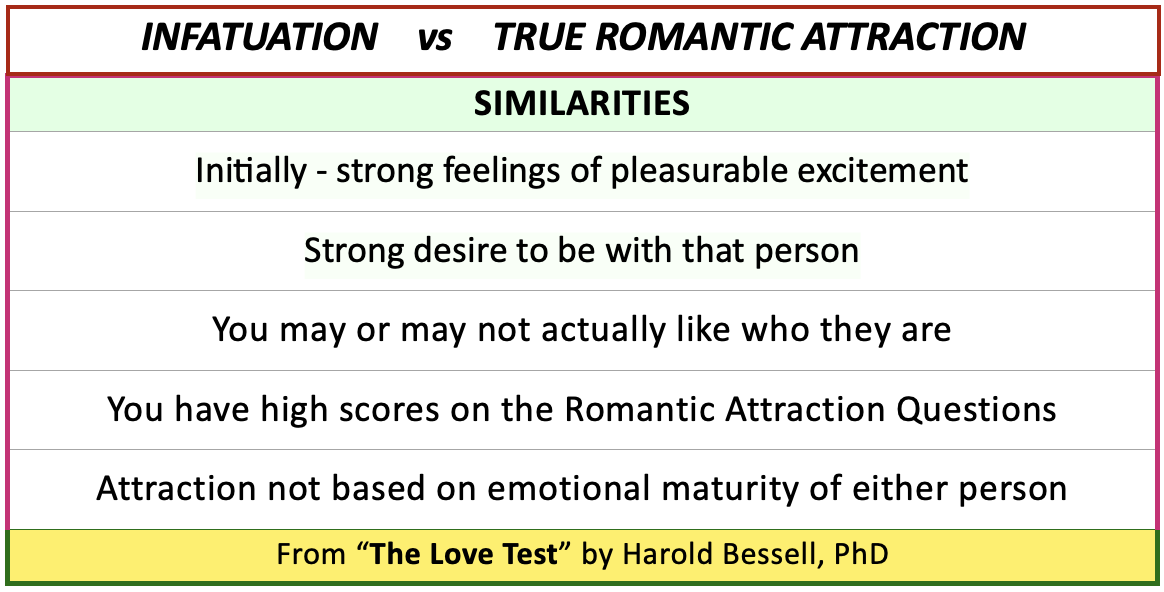
Infatuation, Sexual or Romantic Chemistry

HE LOVES ME, HE LOVES ME NOT
But how do I feel?

Review: Relationship Continuum & following posts


NOTE to Readers: If you’re interested in these topics & the other charts from the book “The Love Test”,  you can also do additional book & internet searches to read variations about these issues.  The lists below are only one version – to get you thinking & to give you a place to start from.


You may notice some similar characteristics from the previous 2 posts.

NEXT : Relationship Form A, (Part 1)


ROMANTIC ATTRACTION – Qs (Part 2)

dancing 

I WANT TO BUILD MY LIFE AROUND YOU –
I hope you feel the same way!

Part 1: R.A.Qs, 1-30

POST: FRIENDS Inventory

INVENTORY (cont)
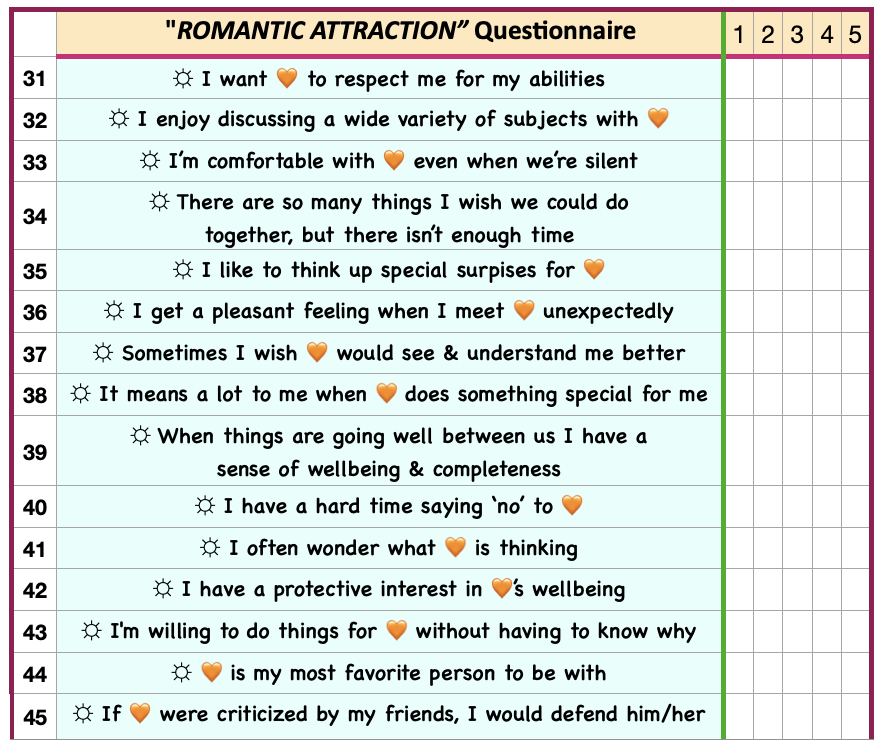
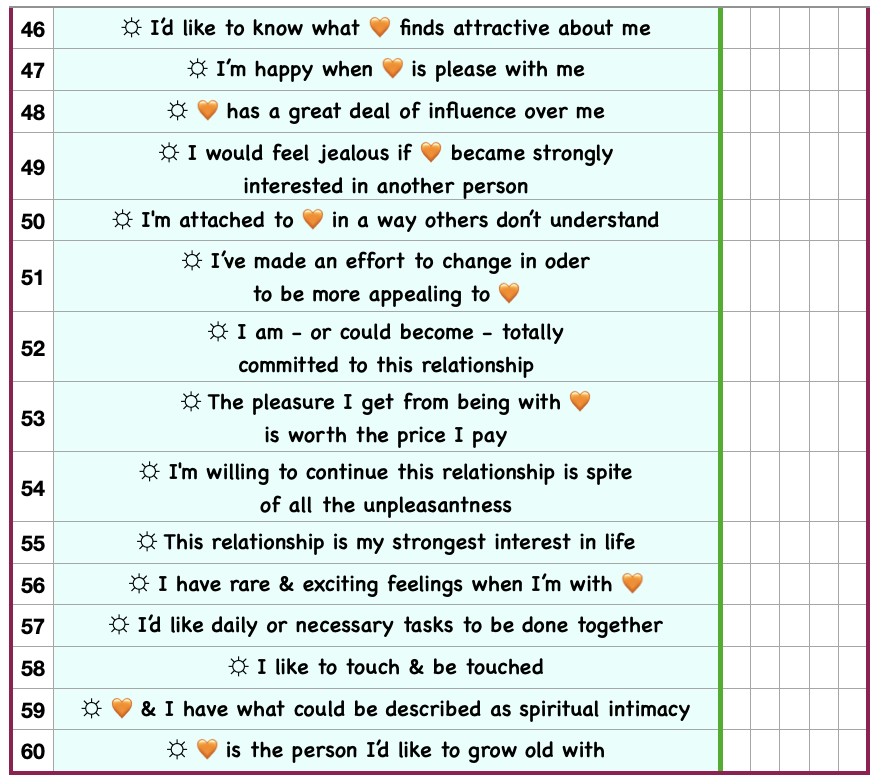
➼  Print out Part 1 & 2.  Put a check mark in the column which best fits your responses about a specific person: _____________ (🧡)

Use #1 as the weakest to #5 as the strongest feeling you have about each statement. Do NOT consider #5 as ‘perfect’, only as intensity
• If you don’t know or are confused, mark #3.  You can always go back later & fill the ‘blanks’ or reevaluate your answers

• Take your time considering the Qs – think about your own experience with each person AND what you know about them
• If possible, have your partner take the same test
• Total up each column & then add them all together.

👁 See below – to interpret your scores

EVALUATION
Add up each column (1-5) – for both Parts 1 & 2. Combine all columns , to get one number for your Romantic Attraction (R.A.)
• 180 -200 = Little or no romantic interest, so it’s not likely to work out, no matter how much one of you may wants it
• 200 – 220 = Weak R.A., indicating borderline interest
• 220 – 260 = Strong R.A., enough for a relationship to be satisfying if both of you fall in this range
260 – 300 = Very high R.A., indicating a strong compatibility, if both have similar scores

• If one of you scores below 200 & the other is over 220 – especially after several tries – expect the relationship to just run its course.  Enjoy what you can & then move on
• If both of you score below 200, you’re not suited for romance, unsatisfied
BUT it makes it easier to have a satisfying & long-lasting friendship, if you want to & there are enough compatible interests

REVIEW – ACoAs (& unrecovered addicts in general) usually have relationships:
• based on interlocking damage with another person
• driven by our WIC & PP, rather than the True Self
• just to keep from feeling alone & abandoned, no matter how unsatisfying or harmful
• trying to get the good parenting we never got in childhood – from someone else, instead of from Ourself & H.P.
• that act out our deepest fears & greatest wounds
rejectionWe’re afraid:
• to stand up for ourselves – say what we want or don’t want
• that we won’t ever be able to choose better friends & lovers
• our family will disapprove of / not accept our choices
• to risk ‘everything’ on our Inner Truth

A secondary GOAL of this kind of QUIZ is to get us thinking about the positive qualities we can own in ourself, as well as those we need to be looking for in partners & friends. Then we can grow into being comfortable & happy in any relationship
• Romantic excitement can not be manufactured or forced if it doesn’t already exist, but all good relationships require a level of emotional maturity, which can be improved on with continuing effort & the right tools.

NEXT: Infatuation…