UNIT: Healthy Adult/Parent (Part 4)

 PREVIOUS:  the UNIT #3

ACRONYMS:
PP = Pig Parent
IC = Inner Child
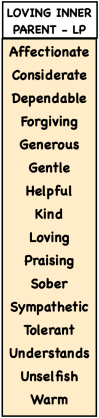
LP = Loving Parent
HA = Healthy Adult


1. Being ‘kid whipped’
!
2. The Introject (cont)

3.  BUILDING the UNIT (cont)
The stronger you UNIT the more you’ll experience improvement & get lots relaxing satisfaction!  Helpful prerequisites  :

• Less Self-Hate & less attachment to the Bad Voice (PP)
• Willing to take time & effort to learn this new language
• Done enough inventories to know your WIC’s issues
• Know quite a bit about all your good qualities
• Less anxiety – to be able to sit quietly & communicate
• Maybe have done ‘morning pages’, prayer, meditation….
• Lot & lots of patience – the kid may not respond right away

3 DIALOGUES with the Inner Child & 1 with the PP

After one date with a sexy, attractive but self-hating guy
HA: “So, that was interesting. Do you want to see him again?
IC: Only shrug, but no words
UNIT: Asks the kid again for the next few days
IC: No words – but a slight pulling back
LP: “OK, honey, I get it – you’re conflicted but the answer is basically no.”
IC: “Yeah”
HA: “I agree – we can see his WIC clearly, BUT it is completely surrounded by barbed wire, so if I let you reach in to connect, your arm will get all cut up!”
LP: “We feel bad for his kid, but I can’t let you get hurt.”
IC: “OK. Thanks”

After the death of a beloved pet
IC: Sobbing, sobbing, sobbing
LP: “I know, sweetie, let it all out”
IC:” I want a new one – let’s go to the ASPCA”

UNIT: “OK, lets see if they have another orange one.  I trust you to pick the right one”
IC: At the shelter – “I don’t see any here. We have to look at the computer pictures.” Eventually she finds the right one – online!

Having a bad experience with someone
LP: knowing that the kid is very angry but afraid to let it out – asks the kid to show her an image of how she’s feeling
IC: creates a picture of being chained down on a wooden bed in a dark room, powerless & trapped
UNIT: “I’m here to help. It’s ok to be mad”  Visualizes using huge pliers to cut away all the chains. Then picks the kid up & leaves the dungeon.   IC: Still upset but relieved
⚜️
ADULT standing up to the PP
✅  UNIT to self :
I think I’ll go to that business intro I’ve been invited to – it’s the politically smart to do
PP: Don’t be ridiculous – you won’t know anyone! They won’t be interested in you – you’d just be wasting your time!

HA:
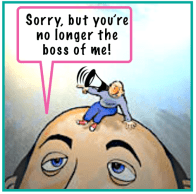
Wow, you sure know how to lay it on thick! Those are YOUR worries & assumptions. Don’t lay them on me!
PP: How dare you talk back to me! I know what I’m talking about! I’m just trying to save you time & effort
HA
: Well, It’s obvious you don’t know how valuable networking is – you never had to promote yourself. So you’re not being helpful!
What I could use from you is telling me you believe in me, no matter what I try. I’d love to hear that you only want the best for me, that you know I’m competent & I’ll figure it out.

PP
: You’re living in a fantasy. Life is hard & you have to be prepared for the worst. That’s what I’m trying to do for you but you don’t appreciate it!
HP: Well, thanks for your input, but I’ve heard it all before & it hasn’t worked. So I’m going to try something new. You don’t have to watch!
PP: HUMPH!
UNIT: Shakes it’s head, smiles & ‘walks’ away. 😀

NEXT: “People should treat me better- but I won’t let them”
UNIT: Healthy Adult/Parent (Part 3)

PREVIOUS: Healthy Adult & Loving Parent #1


3.  BUILDING the UNIT (cont)

♥  INNER DIALOGUES
❀  Everyone’s INNER CHILD combines emotions, experiences, memories & thoughts from childhood. It’s made up of:
• every age & developmental stage we’re lived thru
• our interactions with family, school, friends, religion…
• our version (conscious interpretation/ ‘understanding’) of all the people who were important to us, good or bad
• what we picked up from them subliminally.  Kids are very intuitiveego states

Depending on the content of a voice, we’re hearing from:
❧ a good parent or a bad inner parent
❧ a healthy child or a wounded inner child
❧ a sane adult or a fake inner adult

The 1st in each duality are soothing, informative, helpful, humorous, even spiritual

The 2nd causes us great pain, a feeling of hopelessness or futility….. & some of those voices are louder, carry more weight, are meaner….than others

❤️ We need to be talking WITH the kid every day, as often as possible, about everything – no matter how trivial.
It can be about what you feel like eating or wearing, what someone is doing, the colors around you – anything from : ‘It’s time for bed, now…” , “No, we can’t go there today – not enough time” – to – “I can tell something’s bothering you. How are you feeling?”…

It never has to be a big deal. You can do it on a bus, in the bathroom, walking down the street… Yes, the written version takes a chunk of time, but not the everyday chit-chat

DON’T WAIT until you’re in a crisis, to start. If you haven’t already established a good link with the kid, & then something upsets you – you will not have the UNIT available to handle it.

?? How often do you talk to anyone you live with or see every day? Only when there’s some difficulty?
The more you interact with your kid —-> the stronger the bond —> the more you prove your reliability —> the more the UNIT can take care of things & make your life WORK!!

⬇️ UNIT conversations with the Inner Child ⬇️

♥  Week before an operation:
IC: ‘I want a new red blanket to take with me to the hospital’
LP: ‘OK, honey, let’s go shopping.’
In the store:
IC: ‘I want that one! ‘ (the most expensive)
HA: ‘We only have $– to spend on this.  We need some money for groceries too’
LP: ‘I’ll get you one of these – the smaller one. We already have 2 red blankets at home – & yes I know they’re old!”

Sensing the WIC’s anxiety:
LP: “I know you’re worried & scared about the procedure. I’ll be with you the whole time & Jerry’s picking us up afterwards.”
HA: “You know I trust this doctor.  We’ll be ok.”
IC: (Pouts but understands)

Waiting to get on a plane
IC: (A little antsy but not talking)
LP: (Noticing, waiting – knows kid is not afraid of flying, so it can’t be that)
IC: (Not saying anything but seems concerned)
LP: (Finally gets an ‘image’ of the issue) — “OK, OK, I’ll take you!”
(Kid doesn’t have to ‘go’ but is worried about needing the bathroom on the plane before seat belt light is off!
They go to the restroom & the kid is happy.😘

After a social gathering with casual friends
IC: (In a lot of pain) “They don’t like me, I talked too much, no one came over to me afterwards, I can’t go back there, I know they’re saying bad things about me …
HA: OK, I hear you.  But what we know about these particular people is that they have shown ways that they like you. You’ve talked a lot before & they’re still nice to us”
IC: “Yeah, but…”

HA:
“Yes, we aren’t their age or have the same core beliefs & not in their inner circle, but that’s not a negative reflection on you – or them. It’s just a reality. Different is different, not bad.”
LP: “Honey, the bottom line is that you are who you are & not everyone fits with us. That doesn’t make you undesirable.  We have to find places that suit all parts of us – the mental Adult, the feeling kid (You, little one) & the spiritual Parent.
IC: Reluctantly “OK”. It took a few days, but the pain went away.
*The next time at that same gathering  – everyone was as friendly as usual.   (“See, honey?” >”I know”)

NEXT: Healthy Adult/ Loving Parent – #3

UNIT: Healthy Adult/Parent (Part 2)

IT’S SORT OF LIKE MY:
Adult is  = the good Dad
Parent    = a good Mom
&  Child  = little ME

PREVIOUS: The UNIT – Part 2

POSTs: Why resist talking to the Child?
Bookending with the IC

🦻🏼 WHY you may not ‘hear’ the IC 🦻🏼(cont)
1. Being ‘kid whipped’!

2. The Introject:  Some people mainly hear the Bad Parent voice – in the form of ‘shoulds’ & judgments, about themselves & others (you know who you are). They’re the ACoAs who know it all, are controlling, bossy, demanding, pushy….  channeling the Introject! (“Ego States – Parent #4“)

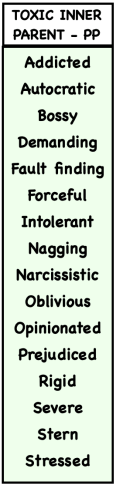
• So – when you’re with such a person, you’ll be talking to their PigP.
EXP: When Mike asked: “Hi, how are you doing?” He got back: “None of your business!” And when Sara thought about writing a book, she heard inside “Who do you think you are?”

• It can be very enlightening to dialogue with the PigP, to find out more about it’s point of view, what it’s telling the kid all the time, what it wants, what its concerns are…. so we can counter with truth & logic! 🥺

3. BUILDING the UNIT
a. Read & re-read the extensive list of characteristics of each Ego State
• Print 2-3 copies, & keep 1 each where you’ll see it every day – bathroom mirror, bag, tablet, cell….
• Little by little – write something about each characteristic  = what you think it means, how you do or don’t use it, how you see others doing it…
• Pick 1 characteristic of the L.P. & focus on it for a week.  Use the same Qs as in your writing, as you go thru each day of the year
• Take notes about your observations & talk it over with trusted people. Ask for suggestions & feedback on how to improve

The UNIT (HA + LP) needs to interact with both the NC & the WC :
• Get IC dialogue-writing workbooks, & practice until it becomes natural. Listen to “Self-Parenting” videos
• Watch how kind, loving real-life or TV parents talk to their children  (especially when the kids mess up!)
• Visualize holding your WIC & NC – what do they need & want to hear? what would you have liked your parents to say to you?
✶  Make sure to leave time for the kid to answer, comment, feel, react… It’s not a dialogue if you do all the talking!

👥 The UNIT has to consistently be in play. As grownups, we have to prove to the WIC we’re worthy of being in charge, since the ones who raised us were not.
As kids we had to either hide or be super-kid, but all of us were on our own. So now – developing a functional UNIT is the only way the kid will trust us enough to turn over its power, the only way to show the WIC is Safe & Valuable!

This is done by the UNIT’s healthy internal communication + appropriate external actions – which takes time & dedication to develop.  Our ONLY job is to take care of our Kid. If we do – everything else falls into place.

b. Actions to develop the ….. ADULT ES :
INTERNAL
• catch S-H thoughts & stop them as soon as possible
• do drawings of how you feel emotionally
• learn about your damage (WIC #1 post)
• learn healthy ways of thinking
• read everything about your issues & about growth
write some of your thoughts down every day
• try things you always wanted to do (school, travel, move…)
EXTERNAL
• listen carefully to kind people & copy them
• talk to smart, sane people regularly
• stick with the winners (others on the same path)

….& the PARENT ES:
• daily dialoguing with the WIC & the NC
• do more good things for yourself
• do less bad things to yourself
• hold your Kid, pat your chest, sing, say soothing things
• let yourself cry & do rage work as often as needed, but only in safe ways
AND —
• practice standing up for yourself, say what you want & don’t want
• stay away from people who consistently cause you pain
• nurture a spiritual life that suits you
✶  If you do your best to follow some or all these suggestions you will see improvement & get lots of satisfaction!

NEXT: The UNIT- #4

UNIT: Healthy Adult/Parent (Part 1)


BALANCE OF POWER –
I can change ‘who’ runs my life!

PREVIOUS: Ego States-Parent #4


ACRONYMS:

ES = ego states // HA = healthy adult //
LP = loving parent //  NC = natural child  //
WIC = Wounded inner child //  PP = pig parent  //  PMES = physical, mental, emotional, spiritual // UNIT = HA + LP
✦    ✦     ✦
Genuine Recovery is marked by internalizing the ‘sane’ information we’re learning, so it becomes an automatic part of us – the new normal.
As we incorporate new understanding, we’ll be able to consistently respond to the world from a different place, which gives us a sense of safety, mastery & empowerment (as in the “AA Promises“)

This can never be done perfectly or without regressions & digressions – so don’t expect that. The goal is to keep moving forward on the path of healing. To do this we need to build a healthy ‘UNIT’ (H.A. + L.P.) to be the inner EXECUTIVE.

• All unhealed ACoAs are run by the interaction of  their Bad Parent & Wounded Child ego states (E.S.)
• But so are many people who are in Recovery, before they do family-of-origin work (FoO)

• High-functioning ACoAs have a fairly well-developed Adult E.S. (but with some CDs), but are missing the Loving Parent, which can be seen in how we talk to ourself & deal with personal relationships

3 MAJOR TASKS of the ‘UNIT’
a.To separate the PigP & WIC
, to stop the child from having to obey the cruel & unhelpful domination of the BAD PARENT .
Internally, we may only hear one or the other, but without Recovery the PigP has all the power, & left on its own, the vulnerable WIC has no choice but to submit

b. To nurture, guide & take care of both the Healthy & the Damaged parts of our Child
• For the WIC – to help it heal from all it’s PMES wounds with unconditional love & nurturing, & let it know it never has to be alone again
• For the N.C. – to help it find it’s voice & develop it’s true potential, which creates our self-esteem

c. To interact efficiently with the rest of the world in order to get ALL our needs met – by learning what our options are, developing the skills & attitudes for self-care & social ease – given our individual circumstances & abilities, so we can have more comfortable & fulfilled lives

🦻🏼 WHY you may not ‘hear’ the IC 🦻🏼
1. Being ‘kid whipped’!
a. you’re ALL kid.  Without the ‘UNIT’ present there is no dialogue. That can be changed. The child E.S. is a separate entity, & should not be in charge.  A therapist once said: “You have a child, you are not a child!”
• Picture the WIC outside of yourself – in your lap, on the bed or floor, hiding behind a chair or curtain…. but always there, waiting

b. the IC is too young to talk.  Depending on what IC age is being triggered by a current situation, you may feel your pre-verbal infant self – with lots of emotions but no words

c. the WIC doesn’t trust you.
If you’ve been unavailable altogether, or inconsistent, only talking AT the kid,  sounding like the bad parent…. the kid isn’t going to respond!
EXP: “Hi buddy, what’s up ?”  >> “What do you care?”

d. the IC is old enough to talk but doesn’t know how to express what’s going on with it yet – doesn’t have the right words for things it’s feeling, isn’t developed enough to think abstractly, isn’t allowed to say what it feels or needs…. EXP: “ Hi honey, what’s bothering you?” >> “I don’t know”. —- young kids always say, whatever the situation

e. The older WIC – maybe 16-18 – is angry if you’ve been ignoring him/her, responded when asked why they’d done something ‘off’, especially if you’ve already been talking to the younger ones. You may get an image of it with its back turned to you, crossed arms, pouting….

The teen needs just as much attention, but of a different kind = more practical, included in decisions, being asked its opinion. This ES often hold knowledge & wisdom we’re not even aware of – until we connect.
BUT also – there are still many things our teen Self doesn’t understand, so it needs validation of its painful experiences, AND talked to with respect.

NEXT: Healthy Adult / Loving Parent – #2

Ego States – PARENT (Part 6) at Work


PREVIOUS
: Parent ES #4


AT WORK

Continuing from ‘ADULT E.S. Part 3’, this chart shows how people function in organizations.


1. DAMAGING PAREN
T styles of communication are ineffective. The intended message sent to an employee is not understood, so whatever needs to be accomplished is less likely to be done, or done incorrectly

The ‘sender’ boss or group leader is not OK & so treats ‘listeners’ the same as themselves = as “Not OK”, or encourages them to make someone else “Not OK” (as scapegoat).
Because communication is broken, it can escalate to anger by more & more misunderstanding, or will stop altogether. In extreme cases the rift will be permanent. (Adult E.S., Part 2’)

a. Criticizing P.: In this mode we try to hang on to a sense of power & superiority by controlling through fear & intimidation. We talk down to others, not allowing them to share in decisions, sometimes even the actual work, or expecting too much of them, & always dissatisfied with their performance

We assume other people can’t do things as well as we can, except maybe a few chosen ones (who are like us) – but we never take responsibility for our own mistakes or ignorance. Then we can end up taking on too much of the workload, & get burned out

b. Inconsistent / Unavailable : In this mode we’re not dependable, give incomplete or confusing instruction, & mixed messages, like offering praise one day & judging or ignoring staff / co-workers another day
Actions are seemingly random, depending on our inner turmoil, even leaning on subordinates to do the work for us or ‘hold our hand’ emotionally

At other times we may be silent, distant & cold. This style is often a copy of one of our parents, so we’ll might be indecisive, because of distorted thinking (CDs), & lack of knowledge or experience (Ts & As) and/or being moody, depressed, afraid of taking risks because of low self-esteem & fear of loss (Es & As)

c. Interfering / Oinconsistentver-indulgent P.: All 3 styles treat others as bad, needy & incompetent children we have to control – but here it’s done more subtly.

Just as the Interfering Adult thinks no one can do anything right in the practical / functional realm,
= the boundary-invading Parent believes no one can take care of themselves emotionally.
At work these modes put a great deal of pressure on anyone in charge, (boss / manager), often creating exhaustion, anxiety & depression.

Unhealthy Parent style
People-pleasing – It’s the ROLE of the ‘parent who lets the children run the household’. At work or in other groups we try to make everyone our friend, don’t discriminate between safe & unsafe people, trying to over-compensate for the bad parents we had originally, & who are now in our head

Rescuing – we see everyone as a ‘child who must be attended to in some way’. This controlling style looks like a benevolent care-taker, but actually imposes our own point of view on others. It’s an over-blown sense of responsibility, trying to meet everyone needs – like the ones we never got but are not allowed to give ourself.
👨‍👨‍👧
2. INTEGRATING ADULT is the effective way to clear talk tell others “WE are OK” It’s the E.S. most likely to get the desired / intended responses or results from others that we want :
= info is received, necessary actions follow, & good relationships are developed or maintained.

It allows conversations to continue (now or later) if necessary & desired. Each person or group is able to hold onto their “I’m OK” position, whether they agree with each other – or not, or whether like each other – or not

WISE PARENT is the Supporting / Nurturing. In this E.S. we are caring & affirming.
= We can be helpful, guiding, mentoring…. without controlling or micro-managing
= We can be understanding & compassionate, without people-pleasing.
Pos. Physical: arm around shoulder as sign of support, pat on the back
Pos Verbal: encouraging statements “I’ll take care of you, you did really well, I’m proud of you….”

NEXT: The UNIT, #1

Ego States – PARENT (Part 5) Modes

adult choices 

MY “ADULT” CAN CHOOSE HOW I RESPOND –
from a positive or negative Parent voice

PREVIOUS: Parent E.S. – Part 4

See ACRONYM page for abbrev.


EGO STATE (ES) MODES
NOTE : The Adult ES is our Executive branch, & most beneficial as a person’s guiding force. It can either be the healthy or unhealthy part of someone, with good or bad motives, with good or bad consequences.

EXP: The Adult is in charge whether one is planning a new town on a drawing board, or planning to rob a bank. Both require logic, reason, critical thinking faculties, planning skills….. Review ‘OK Corral’ (Adult E.S., Part 3)

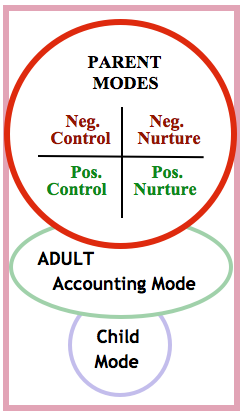
This chart ⬇️ shows the Parent aspects. (See CHILD ES version)

1. UNHEALTHY PES says: “You’re Not OK” to self & others
a. Negative CRITICAL / Controlling P. is punitive & insensitive. Gives abusive, degrading criticism, to overemphasize being in control – using fear, suspicion & distrust: “How stupid can you be”….
For ACoAs :
• Outward – often expressed towards others as prejudice & disapproval
• Inward – continues to influence the Inner Child in the form of S-H
Parent Mode
EXP: It’s the person who sees an injured dog in the street, & says: ‘All dogs should be kept on leads, not allowed to roam free’ – & so does nothing to help

b. Negative ‘NURTURING P. is over-protective or engulfing, giving physical attention in order to control or manipulate others. May smother with concern, denying people the opportunity to develop their own skills.
Help is given from a self-serving attitude which discounts the other person’s actual needs, as well as their autonomy & competence

The Negative Parent (PigP) is ‘on’ when we’re:
Physical – frowning, crossed arms, finger-pointing, angry or impatient body-language & expressions, superiority gestures…..
Verbal – using a condescending tone, judgmental & critical words, patronizing or posturing language :
“This is how you should — //  under no circumstances — //  you should always — //  never do — //  for once in your life — // you shouldn’t — //  how dare you —  // don’t do as I do, do as I say…”

Keep in mind that cultural differences in body-language or tonal emphases that may seem ‘Parental’ in one culture may not be the speaker’s intention in another.

2. HEALTHY PES says: “You’re OKto self & others
Since the following aspects are either missing or weak in most ACoAs – especialgood parent voicely toward ourself – developing & encouraging the Good / Loving Parent voice is a critical (no pun intended) & fundamental requirement for our growth

Positive NURTURING P.
🌺 For US: It’s used to self-sooth, help the WIC with any form of emotional distress, letting the Child (C.) know it’s never alone.
It is also the part that encourages, cheers & champions the Healthy / Natural C. to “be all you were meant to & can BE”! It draws from our own native capacity for kindness, as well as any experiences of being cared for, by anyone, but especially in childhood. (This is – or can form –  our Positive Introject)

✿ For OTHERS: It’s the source of kindness, respect & help we give others, coming from a genuine regard for them as fellow-travelers on this earth. It allows us to give-&-take appropriate physical affection, such as a gentle hug or touch when desired
EXP: It’s the person who lovingly picks up that dog, who got injured by a car while crossing the road, & takes it to the vet

Positive CRITICAL / Controlling P. (needed!) 
🌺 For US: It’s used to set boundaries for oneself, providing self-control – limiting the Child’s excessive wants, demands, distorted thinking, inappropriate behavior such as unhealthy or unsafe acting out ….  It’s the way a good parent holds a child back from running across the street, limits unhealthy foods, sets curfews…. the Pos. Controlling P. helps us stay out of or leave dangerous or unsuitable people / situations…..

✿ For OTHERS:  Instructions & commands are aimed at genuinely encouraging someone’s well-being. Constructive criticism is used to protect & steer away from harm or potential danger : “You might want to consider — //  I encourage you to stay away from the — //  be careful when you — // I recommend that you…..

NEXT
:  Parent ES #6

Ego States – PARENT (Part 4) as Adults

controllerI CAN FILL THE HOLE IN MY HEART
by developing a Loving, Healthy Parent

PREVIOUS: Parent Ego State (PES), Part 2


PES = Parental ego state

AS ADULTS : PES CATEGORIES
1. Normative Parent (NoP) with either realistic or damaging guidelines, rules, punishments & rewards
a.  Positive NoP / “Counselor Parent” is strong, powerful, protective, principled. Provides appropriate boundaries & is comfortable setting limits without being disapproving or harsh – with self and others

b. Negative NoP / “Persecutor Parent”
✦ Treats the Inner Child harshly & tries to make it do as it wants – either to obey it’s own set of rules regardless of the benefit to the Child, or just treating the Child as its ‘whipping-boy’

child-writing✦ Towards others – react with judgmental comments that are arrogant, authoritative, condescending, critical, demanding, disapproving, judgmental, opinionated, moralistic…. with a lot of Do’s. Don’ts & little flexibility.
— At work, managers in the NoP mode are task oriented & can be dictatorial & exclusionary.

2. Nurturing / Sympathetic Parent (NuP) – who appropriately loves, cares for, provides for others.  Both men & women can be in the role of Good Parent, but it’s most often in the form of a mother-figure
✦ One of the NuP’s goals is to take care of the Inner Child – to sooth it’s troubles & keep it content, providing it with safety & unconditional love

✦ In terms of others – we will respond with reassuring communications, & behave in ways that are consoling, considerate, respectful, nurturing, permitting, protecting….
— At work, managers coming from the NuP are supportive & relationship- oriented, consulting subordinates & encouraging their participation.

HOW the Parent ego state (PES) is USED
1. INFLUENCING – operating internally
IF our early caretakers were loving & reasonably healthy, then our Inner Parent is positive, so we’ll treat ourself with self-care & self-soothing

IF they were wounded &/or toxic, the we’ll hear the Introject (PES) as a weak-scared or mean-angry voice, EITHER
👮🏽 in the form of self-criticism, causing feelings of SHAME, self-hate, self-doubt, a constant sense of being watched & controlled, not knowing what we want, think or feel, generating chronic anxiety and depression….self-talk
OR
👨🏽‍🏭 as outside criticism, always hearing warnings, judgements, demands, needs, rules, warnings …. from others, creating fear & a degree of paranoia.
Whether these come from real people or from ‘mis-hearing’ what’s been said to us, we usually don’t realize we’re projecting our own PigP outward.

This means that:
❀ when we stay with people who really are unavailable, selfish, mean, crazy…. we’re participating in a relationship that’s an external version of our PigP, a copy of our original abandoners / abusers
✿ OR when we have strong painful / angry feelings toward people who are just being ‘normal’ humans but happen to push our unhealed buttons – we’re making them into the PigP we carry in our head

2. ACTIVE – operating externally
This version of the PES is being the Bad Parent toward others, hiding the WIC behind a defensive wall. In this mode we function in the outside world exactly the way our family treated us, reproducing the emotions, attitudes & behavior of our original significant-others.

As above, this will depend on how we were treated as kids. Since most people are wounded, the ‘acted out’ (projected) bad voice will be coming from the Negative PES. The psychological purpose of treating others badly is to diminish the pressure & anxiety created by our Toxic Introject & the WIC. Letting it out on others feels like a relief from the ‘influencing’ voice that’s badgering us all the time.

EXP: When a mother screams at & criticizes her children (as -CP) the same way her father screamed at & criticized her when she was young – she gets momentary relief from her PigP pain without rules & regsrealizing she’s reacting from her Bad Parent ego state.

PARENT E.S.
When a person functions too much out of our PES, they’ll either be judgmental & finger-pointing, OR patronizing & overly solicitous

Someone with a strong (P) persona tends to focus on:
• the ‘right way’ of doing things based on the rules they believe in
• how they can have an effect on others (controlling or helpful…)
• not showing too much emotion, more self-contained
• put strong importance on how things are done (specific steps)

NEXT : Parent ES, Part 5

Ego States – PARENT (Part 3) ACoAs

The CRITICAL INNER PARENT
can take up a lot of space!

PREVIOUS:
 Parent ego state (Part 2)

SITE :  The Child & the Seriously Disturbed Parent (Patterns of Adaptation to Parental Psychosis)

POSTS:Rescuing
Healthy Helping
5 Harmful mothers

WHEN our most important caretakers are mis-attuned, invalidating, emotionally neglectful &/ or physically abusive – they create great anxiety in the child. The resulting desperation triggers an unconscious defense :
❥ the child identifies with ‘the other’ (the -CP),  taking on the character of the abuser & suppressing its own needs & identity, in an attempt to stay attached, bonded and loyal.

In healthy families the P template will have fewer discrepancies with reality, but —>
—->for ACoAs, this part of us houses the Negative Introject, also called Pig Parent, gathered from a collection of people who deeply influenced us as kids, & who we now carry around in our head.
It’s the voice the WIC is always listening to, who is terrified of displeasing, is trying to obey -perfectly- & constantly failing!

NOTE – kids pick up just as much subliminal information about the people around us just as much as what’s on the surface. AND what we absorbed was their WIC & PigP, which got mingled with our immature thinking.

🔻Along with our inborn personality, this combination (obvious & hidden) becomes the blueprint for the way to think of ourselves & how to function in the world.
So now PigP messages can be very hard to get rid of, since they’re linked to a great deal of original psychological & emotional trauma still held in the WICs  ego state.

But since each of us also brings our own style to how we express P2, with Recovery, it’s possible to behave much better than our dysfunctional training!

For ACoAs, the Loving Parent (LP) – for ourself – is usually missing, but can be developed in Recovery as part of the “UNIT”.  It requires a measure of Separation & Individuation to be a self-caring, nurturing component in us, capable of empathy for self & others, & can therefore be of help without being co-dependent.
Whenever we notice the OLD voice getting loud or taking over we can ‘de-contaminate the bad Parent’ by calling on the Good P. to help get the Adult back in charge.

Interestingly, many ACoAs do have a version of a Loving Parent, BUT only used for others – in the form of care-taking, rescuing, people-pleasing, AND sometimes being of genuine help (teacher, nurse, leader, parent….) , yet don’t apply that benevolence & skills to our own needs

In RECOVERY the goal is to learn how to always talk to ourself in the best possible way. Harmful internalized messages have to be identified & replaced, & most ACoAs need help hearing what they sound like.
EXP: Sarah was telling a friendly neighbor some frustrations she was going through lately. The older woman was sympathetic, & thought she was helping when she said “You shouldn’t feel that way”. Sarah smiled & replied “I don’t ‘should’ on myself.”

REVIEW  :  Distorted or Missing Parent states
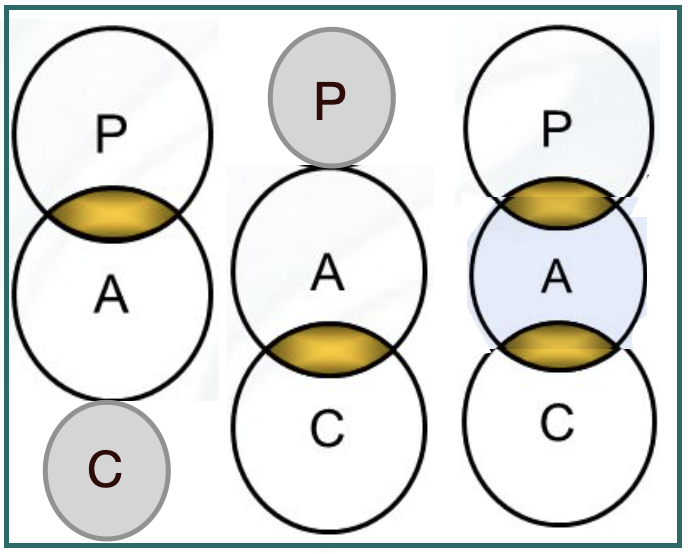
🔻Contamination ➡️
🗯When Parent contaminates Adult & C. is unavailable, the person is stiff, humorless, always ‘correct’
🗯 When Parent is unavailable & C bleeds into A, the person has no regard for others, & is only interested in self-gratification
🗯 When Adult is unavailable to mediate & guide P & C,  the PigParent & WIC are in constant conflict, potentially leading to mental illness

🔻Excluded Aspects
Shows up in stereotyped, predictable attitudes, clung to as long as possible in the face of any threatening situation ⬅️

a. Missing Inner PARENT:  boundaries & limits are not respected, person has a weak conscience, missing rules about how the world works
b. Missing Inner CHILD: the person has shut down memories of childhood, & emotions are suppressed, maybe psycho-somatic disorders – most likely victims of early severe trauma
c. Missing Inner ADULTreality is ignored or denied, producing strange or bizarre ideas, in constant conflict, potentially leading to mental illness

(MORE Cartoons)


POSTS:
4 Parenting Styles //  Replacing Negative Introject  //   Healthy Rules / Rights  //   Self-esteem  //   Talking to the IC   //  What is Self-Control

NEXT : Parent ES #4

Ego States – PARENT (Part 2) Healthy

good paretnPREVIOUS: Ego States – CHILD -#5

SITEs: “Identity & Introjection
▪️Psychotherapy with the PARENT Ego State

POSTS:  The Introject (PP)


Reminder
: Ego states are normal internal parts of ourselves, aspects of our True Self that are supposed to work together for our benefit.

PES = Parental ego state

INNER PARENT
 PES (cont)
Review of PES PURPOSE
❥ To have a strong, safe, loving way to nurture oneself & provide a clear sense of direction in life, based on positive experiences in childhood
❥ To take care of & nurture the next generation, passing on knowledge & skill to help children develop a positive sense of self so they can contribute to society
❥ To express caring behavior toward one’s immediate society & also the world, wherever help is needed – teach, guide, support – to the degree that the person is realistically capable of

🏡 We’re in Parent mode when we evaluate things, make generalized statements about the world, look after ourselves or others. This is OK as long as it’s coming from a Good Parent voice, & the Adult stays in charge

1. Old / Historic ES (Part 1)

2. NEW Parent** voice
family4The experiences, emotions & instruction we got from family were taken in wholesale, without consciously considering whether we really agree with any of it or if it suited us. The PES is now our ingrained voice of authority, combining our native personality with our conditioning. It’s made up of a huge number of hidden + obvious mental recordings.

People from a reasonably safe family will have automatically formed a positive Inner Parent, with accurate rules & regulations, realistic knowledge about the world, knowing how to be appropriately kind, useful, socially appropriate….

But even for such people, as adults some of their parental messages will be out of date & need to changed or modified because:
• they’re no longer children, so some of those rules no longer apply
• in many cases society is different (role of women, technology, working
styles…), making some of the early info limiting or useless

loving parent**Our INNER Loving PARENT voice follows the ‘general guidelines’ for healthy self-care. It is a biological imperative that children require mental, emotional & physical attachment to maintain psychological health.
Some of the things we would have gotten in a functional family (there are no perfect ones) include the need-to-connect common to all children —>
BY:
• having thoughts, emotions, fantasies & our needs validated, so we can do that for ourself later
• providing realistic mirroring, which allows us to know who we are
• giving us opportunities to have an effect / make an impact/ influence others around us
• being listened to, our needs understood & accepted, & at least some of the time wishes / desires provided
BY:
• feeling secure with a safe adult who can be relied on to provide protection, like freedom from humiliation & physical violence
• receiving support & guidance, with physical closeness & positive shared experiences, such as learning & playing together
• opportunities to express our gratitude to & love for good parents & caretakers, received well by them as a sign of bonding & loyal

EXPRESSIONS of GOOD Parenting – PROVIDE :
Physical
security = for
 child’s body & life. Shelter, clothes, nourishment, protection from dangers….
🌺 development = for physical growth. Includes good health habitstraining the body w/ sports, games ….

Intellectual
✿ security =
 conditions for child’s mental growth. If their dignity is safe, with nobody encroaching on the child physically or verbally, then they  freedom have to learn. Includes bonding times, an atmosphere of peace & justice in family, a “no-fear, no-threat, no-verbal abuse” environment

🌺 
development = Intellectual games, with 
opportunity to learn Reading, Writing, Calculating, & the laws of nature.
Includes Social skills & Etiquette, Moral & Spiritual understanding, Ethics, Values & Norms… contributing to the child’s beliefs

Emotional
✿ security
help protect & shield child’s fragile psyche in a safe environment, with Emotional support & encouragement. Includes giving a sense of being loved, needed, welcomed, by emotional attachment, caressing, hugging, touch….

🌺 developmentgive an opportunity to love other people & animals, to help siblings, grandparents…. Includes actively caring for / showing empathy & compassion to younger, older, weaker, sicker people.

TREAT YOURSELF in THESE positive WAYS! (+NP to WIC & +NC)

NEXT : Parent ES, Part 2

Ego States – PARENT (Part 1) Source

PREVIOUS : CHILD ES #7

SITE: REBT & CENT therapies, and
3 distinctions between them


PES = Parental ego state

Reminder: Ego states are normal internal parts of ourselves, aspects of our True Self that are supposed to work together for our benefit.

Main PURPOSE of P: The survival of the Species
a. For US: In general, the PES ego states allows us to function automatically, so we can respond to many aspects of our life without having to think about ‘How or What’ (how to behave in different situation, how to ride a bike or dress ourselves, what we believe, what comes next, what’s right.good mom…). This saves time & effort, freeing up the Adult part of us to make decisions ‘in the now’.

ALSO – the inner P (P2) directs how we treat ourselves, both in inner dialogues & actions. When we ‘hear’ its voice, it’s either loving or abusive (+NP or -CP). Because its purpose is to tell us how we’re supposed to ‘nurture’ ourselves, we need to evaluate it carefully, to check it for toxic content, & then work to correct what’s harmful & reinforce what’s healthy.

⬇️ P1 in this chart indicates the stage when the ‘early parent’ (C’s P) is formed – from birth to about age five (review CHILD – Part 6“)

b. For OTHERS: It functions as PARENT to the next generation (our own children, & anyone else in genuine need), using a combination of our family experiences + our native personality + what we’ve taught ourselves.
The ideal parent is “all-about-the-child”, nurturing & protective

CHILD ES = “Archaeo-psyche” // ADULT ES = “Neo-psyche”

Inner PARENT Ego State (P.E.S.) ‘Extero-psyche’
1. HISTORIC (rooted in the past)
This ES is our Introject  – either positive or toxic, an internal picture of how we saw & experienced our real parents & other important care-givers when growing up.
Children are highly intuitive, with little antenna up all the time to learn about themself & how they’re expected to behave.
Since all children think they’re the center of the universe, they assume everything the adults do & say is about themself, which leads to a limited understanding of & sometimes distorted perspectives on the grow-ups

⬇️ P1 in this chart indicates the stage when the ‘early parent’ (C’s P) is formed – from birth to about age 5 (review CHILD – Part 6“)
P2 :
Then the grown-up Parent ego state starts developing from age 5 to around 20, with continued input from caretaker & authority figures. After that, any time P1 in C2 (Parent in our Child) gets triggered, we tend to reacts just like our original role models.

EMOTIONS: Most of our emotions are housed in the Inner Child E. S. since we start out as children, & the first way we communicate, before we can talk, and The Adult E.S. is non-emotional
🔸But the Parent E.S. definitely has feelings – anger, compassion, concern, enjoyment, frustration, healthy pride, humor, joy, love, patience, pleasure…

DEFENSE MECHANISMS of Ego States (E.S.)
Defenses are maneuvers used by the subconscious mind to protect & serve our various E.S., which can become the way we interact with others & treat ourselves. Not to be used to mediate between conflicts in the subconscious part of ourselves (neural networks), & so reducing anxiety

While they are survival tools, they’re usually not good substitutes for healthy coping behaviors. When over-used & hardened into compulsive life-patterns, defenses become harmful, because they interfere with or prevent us from developing our True Self.

Healthy ADULT – We all need defenses to some degree, & when in this E.S. we use them sparingly & as benefits, in the service of the True Self, such as :
Altruism, Compensation (making up for a perceived weakness), Fantasy (imaging what’s possible or as pleasant diversion), Humor, Sublimation (channeling sexual energy into socially approved activities)….

Damaging PARENT
a. ‘Influencing’ – operates Internally, uses : Denial, Repression, Splitting, Suppression, S-H (negative self-talk)…. (see list of Defenses)

b. Activeexternalizing the PES, can use : Displacement, Projection, Reaction Formation, Rationalization…
ALSO :
If Parent excludes (ignores) A & C, one DEFENSE will be religiosity
 If Adult excludes P & C, it will be intellectualization
 If the Child excludes P & A, then it’s flattering pseudo-compliance

NEXT : Parent ES -#2