ACCEPTANCE & ACoAs (Part 1)

'acceptance' stampACCEPTANCE – BAH!
I don’t like it, so I’ll ignore it

PREVIOUS: Healthy Give & Take

QUOTE: “Most men would rather deny a hard truth than face it.”
G.R.R. Martin, Game of Thrones

😁 Calvin: “Now what state do you live in?”
Hobbes: Denial.” ― Bill Watterson 

1. The ‘PROBLEM’
ACCEPTANCE is the middle ‘A’
 of Al-Anon’s 3 As (2. Awareness — 3. Action).  Correctly understanding & using this concept will make our life much clearer & saner.
For ACoAs this pesky A2 is the most misunderstood & the one many ACoAs HATE!  We don’t even want to acknowledge it’s something we need to deal with, because of thinking that “I can’t accept anything I don’t like or is too painful”, which is a CD – cognitive distortion

DEF : A2 does NOT mean –
• liking or not liking something! – a MAJOR misconception
• staying a victim, accepting our lot in life, being resigned
• giving up, not trying, not looking for a way up & out
• putting up with ‘crap’ from people, including our Introject’s bad voice
• sitting around waiting for things to happen or for someone to rescue us

Parts 2 & 3 will explain what it IS. Sadly, as in other areas of life, ACoAs will turn almost anything against themself, even good things. But first let’s see how we do use the 3 As, in the service of our dis-ease, a shorthand for all of our toxic thinking.
Negative MEANING of the 3 As
To put Acceptance in context, the unside downalcoholic / narcissistic family message given children is —
You are Bad, We are Good, the World is Bad”.
And the WIC understands this triple threat to mean:
Neg. A-1 = “I’m so bad, no one will ever love me”, &
Neg. A-2 = “I try to ignore it, but believe it absolutely”
Neg. A-3 = so – “I must be perfect, (or dead!), to make up for it” 

These 3 became the foundation of our world view – being stuck with this awful protocol without any possibility of escape. Negatives EXPANDED :
A1 = Awareness re. US – the deep-seated belief of the WIC that we’re unworthy, not entitled, beyond redemption! (S-H)

A2 = Acceptance re. THEM – that our family was right about everything, which we absorbed from their overt / covert brain-washing. Guess whose opinions we still hold on to!? We believed them because :
• all humans are intensely loyal to their upbringing – it’s our most basic connection to others
• it’s the way our brain got programmed – every experience created the neural pathways which formed our understanding of life (“How we Learn“)
• AND ‘they’ constantly made it clear that we were un-acceptable. Some parents even used God, spirituality & religion to convince us of their beliefs!

As a result we were trained to accepted all sorts of terrible things as normal & inevitable for the rest of our life, in obedience to our family & community’s lessons

dangerous worldA3 = Action re. the WORLD – everything & everyone who’s not part of our distorted & insulated family mobile is considered dangerous, unhelpful, unwelcoming, indifferent…. since our family (& community) forced on us their narrow, alcoholic, bigoted view of the world. Our actions reflects this.

Unhealed ACoAs deal with the ‘A3‘ BY:
Defiance of all authority & systems, which have become substitutes for our parents.
We can hate outside forces instead of admitting our rage at the family.
AND since the world is SO-O-O dangerous – we’re NOT going to give in or let them get us! OR —
Compliance – we have to give in, keep our head down, hide in the shadows, so no one will get us!

NEXT: Acceptance & ACoAs (#2)

CDs & Al-Anon’s 3 As


PREVIOUS: Healthy give & take #3

SITE: “Codependence & the 3 A’s: Awareness, Acceptance & Action”


See ACRONYM pg. for abrrev.

CD = Cognitive Distortions

AWARENESS (A-1)
It’s imperative we don’t expect Recovery changes in our thinking to be in a straight line or done perfectly (S-H), nor to be immediate (impatience of the WIC).
However, positive shifts can occur with repetition & enthusiasm. We do have direct control over what we think, even when it goes contrary to our emotional state. We can choose to think a different way until it becomes habit & then it’ll ‘feel’ valid.  Understanding this process will help to be in charge of ourselves

It pays to be purposeful. At first what’s required is to gradually become aware of all the thoughts & beliefs that create anxiety, depression, S-H, rage, over-reactions, pessimism, fear of abandonment…..
EXP: “I can’t try that new job ,  I’m sure something’s wrong with me…”, or “Nobody loves me, everybody hates me, I’m going to eat worms & die!”

safe feelingsACCEPTANCE (A-2): Always remember that thoughts & emotions are 2 separate forms of energy, not to be rolled together, even though they’re related as cause-&-effect. SO:
• we can feel (E) hopeless but know (T) that many things in the present are not
• we can feel self-hate but know that we are not bad, worthless….
• we can feel suicidal but know we have a right to live!….. because now WE ARE SAFE!

CD programming makes it hard to ignore the unhealthy things we’ve learned. So when we first correct distorted self-reinforced thought patterns, it FEELS like the new info is a lie OR dangerous (in relation to the family system)

🐰Because it’s so uncomfortable, & we feel embarrassed by how sappy the statements are that no way is the WIC going to believe them…. we just won’t want to accept the changes. However, we have to ‘act as if’. To not totally revert, we need a lot of support, the presence of the UNIT (Adult & Good Parent ego states), & ‘faith in the process’. Progress, not perfection!

Change the tape anyway!  Each time we do, the huge loudspeaker at our back blaring verbal ugliness will shrink a little & the tiny one in front squeaking out Recovery will get a little taller & clearer.
✓ Some ways of dilating the aperture into the conscious mind are – hypnosis, biofeedback, guided imagery, EFT , NLP…..(self-administered, or professionally) and prayer, which more easily allows the introduction of contrary concepts into the unconscious (“how the brain learns“)

ACTIONS (A-3): Since thoughts are stored in one of 2 ways, so too can corrective habits be developed:
i.  BY simple repetition:  Replace a CD with a new thought 4-5x a day, which only takes 30 seconds at a time. So it’s not the amount of time but the consistent effort that pays off

ii. By associating a thought, decision, conclusion, action or experience with a strong emotion. Sometimes it’ll only take 1 or 2 trials for it to click, making the shift less of a hassle
Pair a thought, like : “I am comfortable in groups of any size” with a pleasurable emotion, like – enthusiasm, excitement, positive anticipation, curiosity…. which can turbocharge the replacement process

talents• Moving outside the mind’s comfort zone is challenging, but instead of suffering so much because of CDs, we can gradually:
😁 own the talents & skills we already possess & may already been using
😽 improve any weakness in knowledge, social skills, style of learning or work habits…. to make us feel better about ourselves & more confident in the world

• We can determine to make the effort of challenging the Bad Parent voice (PigP), even though it doesn’t “feel” right at first, & our conscious mind ridicules us for suggesting it.
ACoAs will often say: “I feel so awkward talking the Inner Child”, so we stop! instead of persisting until the dissonance melts away, which it will.
(Extended article by Dr. W. D. Fabian)

NEXT: Acceptance & ACoAs #1

ACoAs – Healthy GIVE & TAKE (Part 3)


PREVIOUS
:Give & Take #2

SITE: “Relational Sphere Hypothesis” (includes 4 universal kinds of social interactions: Communality, Dominance, Reciprocity & Exchange)


HEALTHY RECIPROCITY
(cont.)

Beneficial exchanges of any kind DEPEND ON:
a. Knowing our needs.
b. Trusting ourselves.

c. Who we’re dealing with. If we can’t trust our own judgement we can’t be awake enough to identify who’s safe to take from & who’s not!
TOXIC Rules: “ No one is safe or trustworthy” , “Never, ever, hold anyone else accountable for their bad behavior”
ASK :
🔎 When was the last time this person stepped up for me when they knewI was in need? (don’t expect mind-reading)
🔎 Do I feel drained or filled after spending time with this person?
🔎 Are they someone I can count on – the way they can count on me?
🔎 Do they appreciate what I bring to the relationship – the way I appreciate them?chaos

d. The circumstances. When there’s too much uncertainly (as in alcoholic family chaos), exchanges are not possible, as one or both parties will tend to hold on to all their ‘valuables’ – time, info, money, affection, confidences….
TOXIC Rules: “Life is suffering” , “Don’t expect anything good – ever”

ACoAs – with the focus so completely on the family addicts & narcissists, we were left out of the loop of information (Ts), nurturing (Es) & protection (As) that any healthy parent would have provided.
Our training to not-be-given-to goes so deep that even the thought of someone legitimately treating us well can cause anxiety. It can actually feels dangerous, terrifying & physically painful!

EXP: A successful business man found out (from some careful questioning) that over the past 10 years he had employed 3 different assistants who were ACoAs. One of them, Jane, was not only efficient at work but had consistently gone above & beyond her duties to ‘take care’ of her boss.

• This CEO wanted to show Jane his appreciation in addition to the usually expected business ‘gifts’, & asked her what he could do for her.  She was adamant that he should do nothing more. He was puzzled & insisted she receive some additional compensation, such as an all expense paid vacation or free school tuition. She began to shake & cry, insisting she could not possible take anything more. Her reaction was so intense that he finally backed off, shaking his head in

Reminder: Don’t confuse positive givers and narc takers! If you consistently have unhappy experiences with someone (narcissist, controller, bully), stop giving to them.
Giving them anything or expecting reciprocation – will always disappoint. Eventually you will be drained, get angry, then hopeless – & back in your childhood!
Unjustified giving is the WIC’s denial of past & present abandonments: trying frantically to create reciprocity with someone who’s not capable – wanting / demanding to get a return on our investment, in an impossible situation.

BASICS : To get more comfortable with the idea of receiving, it’s helpful to know some universal facts about how human society functions. In social psychology, the “norm of reciprocity” is the expectation (assumption) that people will respond to someone else’s behavior in like manner – they will reward a positive action with another positive action, & conversely will react to hostile behavior by responding either with indifference or hostility.
The focus is centered on trading favors rather than making a negotiation or a contract with others.

• Reciprocity is basically an exchange of energy,  beneficial to all concerned when the exchange is positive. It’s something everyone needs, like trees exchanging their oxygen for our carbon dioxide. So being a receiver is just as vital to smooth social functioning as being a supplier

And it’s not just about the things that are exchanged, which may or may not have value in themselves, but needed as a linking mechanism used as social capital (spend/expend) to bond with others – hopefully to create trust, affection & solidarity. It’s a powerful mechanism for creating & maintaining social ties of all types – anywhere from 2 friends to 2 nations.

NOTE: Accepting honest kindness, respect & generosity from others is a way to say you value them. They’re also some of the same ways we can give back.

NEXT: Healthy give & take #4

ACoAs – Healthy GIVE & TAKE (Part 2)

reciprocity
THE MORE I KNOW ABOUT MYSELF
the more I can enjoy what I’m offered

PREVIOUS: Give & Take (#1)


WHAT TO TAKE from others – or NOT

👎🏽 Saying ‘NO’ requires that we know enough about ourselves & our rights – to make the best choices.
In some cases it also depends on who’s offering & why. If the giver is a relative, a boss or important client, taking the gift may be the kindest, or wisest thing to do, regardless of our taste. We can always regift

But if it’s close family or friends who are supposed to know who we are – & they insist on giving us things that are clearly not appropriate or suited to us – it’s legitimate to say “No thank you!”

EXP: Paula & Sharon were BFFs who lived in adjacent buildings & spent a lot of time in each other’s place. Paula was ‘earthy’ & preferred antiques, while Sharon liked everything bright, shiny & new. For their B/days (one day apart) they exchanged lovely gift BUT Paula always gave Sharon things that were her taste & totally NOT Sharon’s.

After a few years of this Sharon finally spoke up, asking to be considered accurately. The following gift again did not fit Sharon clothes or decor, so with regret, she gave the gift back!
PS. Years later Sharon developed another close friendship, also an ACoA, who admitted not knowing how to give appropriate gifts. They solved it by exchanging a short list of what each would like, to choose from. It worked great.accept good

Say YES to:
• complements about anything – looks, skills, style, accomplishments, knowledge, talents,  creativity
• freely given generosity – of money, help, provisions, short-term free services, lending something you need
•  kindness, respect, positive attention, appreciation….. any time
• offers of aid when you most need it
• new ideas, suggestions, other people’s experiences we can learn from
• something frivolous & fun – just because!

CONSIDER: Rejecting someone’s good-faith offers of time, kind words or small objects – is a way to dismiss the person as unimportant, & can un-necessarily hurt their feelings. It implies that what they’re not good enough for you

EXP
: In early Recovery Sean was reminded to appreciate whenever he was complemented, rather than negate it by explaining at length why he didn’t deserve the acknowledgement. His sponsor said: “It’s insulting to the person who is giving you a gift, by throwing it back in their face. Just say ‘thank you’ & then zip the lip.”
He remembered thinking: “OK, I’ll just say thank you, but privately I don’t have to agree!”  Oh well, Progress – not Perfection! Eventually he was able to appreciate genuine praise.

HEALTHY RECIPROCITY
IMP: Being reciprocal means that we are supposed to receive something in return for our efforts – it can be a Thank You, a smile, a vacation or even a house! It means we ‘allow’ others to give to us in return for something positive we have done (once or regularly) – OR just because they like us! Can you imagine?

Being able to receive is a normal part of life. This is hard for many ACoAs to believe & grasp – if we’ve been blindly obeying Toxic Rules such as “Only other people’s needs count”. Do-ing for others is all we know & taking anything makes us feel guilty! Because we don’t feel worthy of anything good, we’re not comfortable receiving – even when it’s done freely & with pleasure.

Beneficial EXCHANGES of any kind DEPEND ON:
know thyselfa. Knowing our needs. Directly or indirectly, we were taught to ignore & deny them. So now – how can we know what to take & what to reject, if we can’t tell what’s good for us or what we need?
TOXIC rules: “No one wants to help me, nor ever will” , “I should never be comforted when in pain”….(Post : Our Rights)

b. Trusting ourselves. We learned that we could never believe our own thoughts, experiences, emotions, good judgement or intuition!
They told us everything we felt was wrong, stupid or the opposite! So now – how can we identify what feels right for us or not?
TOXIC Rules: “It’s weak & dangerous to have needs, ask for help, have our emotions”

NEXT: Give & Take (#3)

ACoAs – Healthy GIVE & TAKE (Part 1)

taking in love
I CAN TAKE IN GOOD THINGS –
& I decide what they are or are not

PREVIOUS: Give & Take (#2)

SITEs: The UNDER-Receiving OVER-Giver
• 5 reasons why it’s HARD to RECEIVE


WHAT TO TAKE from others – or NOT

ACoAs have a tendency to do everything in extremes, black & white, no room for fitting an action or emotion to the current situation. This applies to the issue of ‘receiving’.
🔻 Because we think that taking anything is a form of manipulation, we don’t want to seem greedy or taking advantage of others.
🔺 But, as with all mental health, we need a balance. Not everyone is like our family, many of whom were selfish & stingy or insensitive & oblivious.

👍🏽 👎🏽 People GIVE – based on their state of mental health:
healthy ones only offer what they legitimately have, can & want to do
co-dependents usually give others what they want for themselves but aren’t allowed to have. They want to fix you (whether you nsharingeed it or not) so you’ll be well enough to take care of them in return, hoping you’ll intuitively know to do that

narcissists only extend themselves to give whatever they like to do or give, which has nothing to do with you
– If their offer doesn’t suit you, say “no thanks & don’t give it a second thought
– If it does suit, don’t agonize & wonder why they’re doing it & what you have to do in return – just take it & smile.
AND – they do love to be appreciated & fawned over!

1. START from the assumption that IF someone volunteers something, they have the ability & the willingness to give you what’s offered. Take it at face value. In general, people like to share what they know, what they have & what they create. They feel good about it & we have the right to take it

NOTE: It’s usually best to accept what’s offered as a way of respecting the positive motivation of the giver. This is not co-dependence, as long as you also feel free to refuse, when appropriate

2. EXCEPTIONS to taking something offered. You can say “no thanks” :
👎🏽 taking what’s suggested would in any way harm you or someone else
👎🏽 because you don’t like / can’t stand it
👎🏽 if it truly does not fit your genuine needs & tastes – especially if you ask for something specific but offered something completely different
👎🏽 when a gift or action is inappropriate for the current situation (‘too soon’, not ‘that kind of friend’, not age-appropriate….)
👎🏽 if you already know that the ‘offerer’ is manipulative, sneaky or will use it against you – based on experience reject the bad

Say ‘NO’ to anything which retards Recovery, & is:
• against your principles & spiritual beliefs
• generally harmful / abusive
• mentally repetitive &/or boring
• not your right to have
• not what you need at the moment
• not suited to your personality or your taste
• something you’ve outgrown
• something you don’t want, ever
• useless & a waste of your time

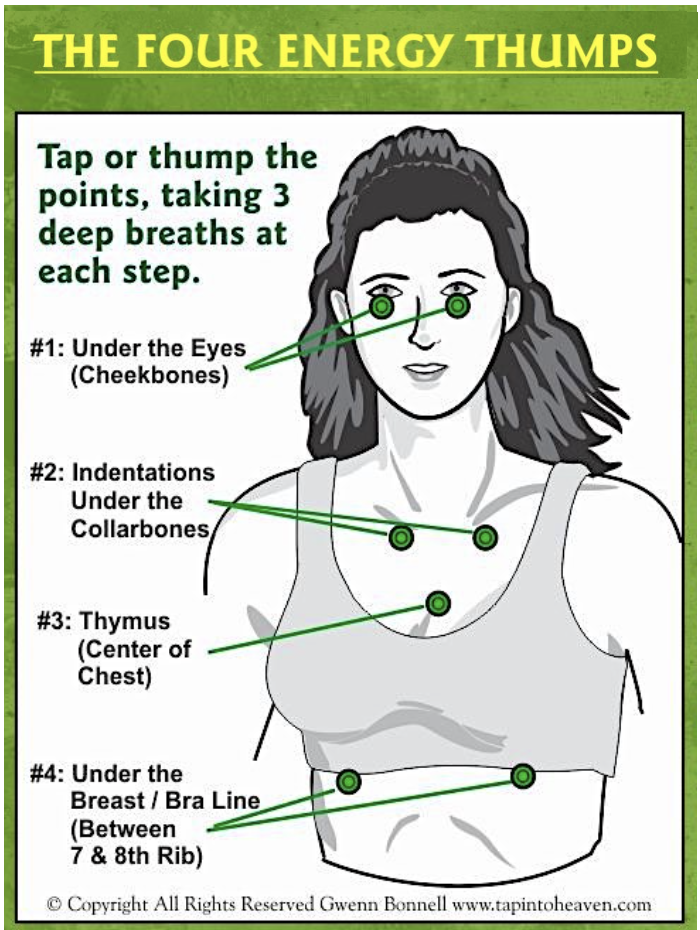
Use EFT to make a shift –
for each step, tap or thump the points while breathing IN thru the nose & OUT thru the mouth – 3X

😩 BEGIN with the negative BELIEFS you want to change / undo.
EXP: “I can’t receive. It’s not ok to get things. I’m only supposed to give”
Specific aspects of the main self-defeating statement are combined with tapping parts of the face & body : eyebrow, side of & under eye, under nose, on chin, collarbone, under arm & top of head

💚 REVERSE: New statements are combined with tapping the same face & body parts, in the same sequence, refining the desired outcome with each successive area. (MORE….)
EXP: While tapping Collarbone, say: “I’d like to receive respect, honest responses & encouragement from those I love, & from those who work with me”….. AND

❤️ END with – Top of the Head: I am so happy to receive; I receive divine gifts of time, energy, playfulness, joy, laughter, delight, but especially love. Love is the best gift to receive. I receive love now.” (Also Fear of being loved)

NEXT: Healthy Give & Take (Part 2)

ACoAs – NOT allowed to RECEIVE (Part 4)


PREVIOUS : Can’t receive #3


2. ACoA assumptions ABOUT OTHERS (cont.)

WE BELIEVE :
a. On the one hand =
• that everyone‘s hiding the ‘truth’ that there’s “not enough to go around”, so they have nothing to spare – for us. This is the alcoholic ‘Law of Scarcity’ : the glass is always half-full or less —
— which means we can’t expect anything, so why bother trying, since everyone we deal with is as needy as we (secretly) are. They’re always going to want too much from us – more than we can possibly give. If we let our guard down, even a little, by engaging in any kind of exchange, they’ll suck us dry!not enough love

• that no one is naturally generous & so never gives freely. Everyone has an ulterior motive – to take & use us, only for their benefit. When people volunteer anything that seems good, we have to be on guard & figure out why they’re offering, or what they really want

no one is safe or trustworthy. Better to not take anything so we don’t have to give anything back. To give even a little is to lose everything (ourselves)
we can’t accept any favors, because we won’t be able to repay it enough, & then we’ll be mad & punish us for not providing exactly what they need or want (mind-reading them). Better to keep everyone at arm’s length

REALITY: Most people do not want the equivalent of ‘our first-born child’.
They do want at least a modicum of acknowledgment, respect & pleasantness. Most will definitely appreciate a hello, a thank you, a smile, maybe some light conversation.
ACoAs would do well to develop small talk – yes even Introverts! – a legitimate social lubricant, since it’s not appropriate to lay a heavy trip on everyone we meet! Save that for your journal, therapy, BFFs & Program. But it’s also not ‘normal’ to have nothing to say.

b. On the other hand = 
• we feel so worthless or evil that we should be dead, yet try to survive. TO be ‘allowed’ to exist we have to do & be whatever others want. That’s the only way to get anything – but indirectly.  So WE:manipulate
i. Manipulate 
• control, bully, out-smart, out-think everyone
• use sexual attraction, great salesmanship & charm
• OR be weak & needy so others feel sorry for us

Because we’re not allowed to ask for anything outright (god forbid!), most ACoAs trudge thru life in long-suffering limbo, desperately hoping someone will figure out what we want or need & give us a crumb or two.  CODA points out that we stay in bad relationships because of the scraps of attention unhealthy people throw us – just enough to keep us hooked. So if we finally do leave – we have ‘crumb withdrawal’!

ii. Self-Sabotage – our WIC plays a sneaky self-destructive life-game with the PP : “I hangoverknow I’m not supposed to have anything, but I still have needs (my bad), so I’ll make a sideways effort get a little something, but it’ll all be harmful so it won’t really count. With one hand I’ll be defying you, while obeying you with the other.”

• To play this game, we unconsciously make sure that most of what we pursue & stick with follow the Toxic Rules, by
— not actually fulfilling our fundamental, long neglected needs & rights, AND
— by choosing substances, types of people, careers or locations…. that ultimately damage us. Some of our choices may seem exciting for a while, because they’re ‘illicit’, but their destructive qualities insure that we’re punished for even trying to take care of ourselves, however poorly.

SOLUTIONSget a hug
Knowledge Once we understand what’s at work we can manage the discomfort of HEALTH, until the anxiety fades
Acceptance – Don’t fight the backlash or go into S-H. Keep to the path
Nurturing – Be kind to yourself, hold & talk to the WIC. Assertion – Stand up to the PigP voice & ride out the discomfort. It will pass & you’ll be left with the benefits of whatever good things have come into your life! GET A HUG!

NEXT: Healthy give & take #1

ACoAs – NOT allowed to RECEIVE (Part 3)

giving infoNOTHING IS FOR FREE!
I know I’m going have to pay a high price!

PREVIOUS: Not allowed to Receive – #2


ACoA REASONS 
1. ABOUT US
(cont)
c. Backlash – Most ACoAs believe that if we ever got the good things we long for – we would be SOOO happy (right away) & all our problems would vanish.  It’s true that over time being with healthier people, pursuing our dreams, being loved… is healing, but not always right away!

Of course there may be some negative or mistrustful reactions from other people (bosses, friends, family, spouse, even adult-children).  But since we assume everyone will reject us for changing, we’re surprised when some respond positively

IRONY: We need to keep in mind that when we first start receiving emotional & practical benefits of Recovery, we may actually feel worse – for a while! This seems counter-intuitive, until we understand what’s at work, & can prepare ourselves to manage the discomfort, until it fades.backlash

• Moving toward positive things in our life – going on vacation, going into Recovery / therapy, finding a loving friend or mate, getting compliments & validation …. can produce internal backlash – from ourself.

Our discomfort is confusing & unexpected, especially when nothing seems to be wrong on the outside (it’s actually tooo good). It makes us think we’ve done something wrong because:
• the PigP’s voice will get louder “Who do you think you are…”
• we feel depressed, fearful, unsettled….  which is so ‘normal’, we don’t make the connection
• we may feel angry at the person who has been helpful, complimentary….

Actually, the ANXIETY comes from: • breaking the Toxic Rules
• feeling disloyal to our parents, even though they were neglectful & cruel, because the WIC thinks they were right! so we feel unworthy of receiving
• the contrast HURTS – compared to all we’ve suffered as kids & since then – at the hands of family, teachers, mates, sometimes even healers
• rage at being duped by our ‘disease’, when we “Could’a had a V8” (Love) all this time!

REMINDER : There are still people who insist (from ignorance, denial or control) that: “The past is over & done with & has nothing to do with now – let it go & get on with your life”!

Unfortunately those of us who experienced abuse & trauma as kids have a toxic programming deep in our bones. So, being conditioned to believe we’re unworthy of receiving, we can’t properly nourish ourselves or let others help us. To ‘let go’, we need the right info! To heal takes courage & time
🧤
2. Assumptions ABOUT OTHERS
• ACoAs project onto others all the overt & covert experiences we had with our dysfunctional parents (see list in Part 1). Since they were absent, careless, crazy, controlling, depressed, incompetent, demanding, violent, incompetent….
we unconsciously assume everyone else in the whole world is like that too, even though, as adult, we have definitely seen, heard of or met capable, functional people.
Emotionally, we simply ignore this knowledge & automatically react to everyone as if they’re a carbon copy our family

a. Actually, many people we run across will not be like our family, yet we treat them unfairly. Such people will be confused by the way we act & react to them. They inwardly just shake their heads & stay away!

b. More commonly, because ACoAs are talented at sniffing out people who indeed are similar to our background – we feel pulled to them, drawn in by their familiar dysfunctionality.

They have little or nothing to offer – but all the while we’re wanting, expecting, even demanding to have a different kind of interaction with them – better, more satisfying!

• We try to create a different outcome because we think it was somehow our fault that family relationships didn’t work out – & therefore we can change it, fix it, even if it has to be with substitutes! This is clearly impossible, but we keep trying – until we ‘get it’ that we didn’t cause the original problems and that we’re powerless to change other people.

NEXT: Not Allowed to Receive #4

ACoAs – NOT allowed to RECEIVE (Part 2)

sealed doorsTO HAVE OR NOT TO HAVE –
I need, yet have to deny it!

PREVIOUS: Can’t Receive (#1)


ACoA ASSUMPTIONS about Receiving
1. ABOUT OURSELF (cont)
a. Neglect –  another form of Abandonment
• After visiting the Empire State building a loving mother asked her little girl: “So, did you like it?”- twice.  An ACoA listening recalls that in a similar situation, her own parents were totally focused on their own interest: “Wow, that’s some view!” but never actually included the kids.

• This is one of many indirect ways we were ‘told’ we didn’t count. We were also told outright to not ask for what we needed, much less wanted. When we did, we were ignored, punished or told that nothing was wrong with us
Anything from needing the bathroom to having a broken arm – the message was clear : we were too much of a bother, only to be tolerated but not taken care of

EXP: Dickens’ Oliver Twist was one of many starving orphans forced to labor in a 1830‘s London workhouse. One day he held out his bowl & begged: “Please Spay attentonir, I want some more” (watery porridge), which started a riot – but got him no seconds.

• Whether we ACoAs were deprived of food or not, & some of us were, we certainly were starved in a wide variety of PMES ways. Abused kids find their own particular way to cope with years of deprivation – denial & repression being an inevitable result.
This leaves us acting out the neglect either by being overtly needy & grasping, or ‘above it all’ – suppressing how much we still long for the impossible, for the care they couldn’t give

Wanting more is not just about having things. It’s the normal human needs like attention, comfort, kindness, love, nurturing, the right information, respect, safety, …. that we never got.
Many of us concluded our main character defect is our need for love (a misuse of 12-Step Program’s 4th Step). After all these years, how foolish to still want something we believe we don’t deserve! Right?

b. Asking
🤢 ACoAs are terrified to ‘blatantly’ ask, sure that we’ll always hear “NO”.
The underlying assumption is that we’ll never get any needs met, & the rejection would be too painful, so let’s not even go there
😢 AND, we’re convinced that if we have to ask for something – whateask, askver is given was not done freely, so receiving it doesn’t count, has no meaning or value!
Others are supposed to magically know & provide (read our mind)

• This assumption & demand both come from the WIC, as far back as pre-verbal infant experiences, an echo of a time when we couldn’t talk yet, so needed mother to automatically know & provide for us – but in our case didn’t!

REALITY: Adults are supposed to ask for things.
We don’t always get everything we want, or at the time we want, which does not mean we’re destined to always be deprived. Delay is OK.
God definitely answers prayer – with a Yes, No, or Wait. We have a right to ask & receive!

NOTE :  An ACoA DOUBLE BIND  (from double messages)
a. We don’t want to take care of others, hate having to give & give, especially to angry & selfish people. We’re trapped in a debilitating conflict: If we disobey the Rules, we feel terrible guilt, but if we give in, we hate ourselves & the people we ‘help’. Tortured either way.

b. BUT – we’ve been brainwashed to believe we have no other choice but to provide whatever others need. So we obey – assuming it’s the only way they’ll tolerate us. ACoAs handle the expectations, demands or whines of others
BY:
• Most often: a knee-jerk reaction to comply. Before we can take a breath we’re fixing, doing, comforting – giving, giving, giving!
• Some of us:  the only option is to be almost totally withholding – to not get sucked in
✶ Either way, it leaves NO room for us to RECEIVE

NEXT: Not Allowed to Receive – Re. OTHERS (Part 3)

ACoAs – NOT allowed to RECEIVE (Part 1)

attitudes 

NO, THAT’S OK –
I don’t need anything!

PREVIOUS: Bad Decision Styles – #3

REVIEW: Abandonment Pain Now


DEPRIVATION & TRAUMA

THIS CHART  ↘️ is in reverse order of Maslow’s hierarchy of Needs. Instead of going from most basic to highest, this tragic deterioration is an all-too-common repeated life cycle of trauma victims – without Recovery – causing great distress & tragedy

• While many wounded people manage to carve out a life without emotional healing, they can only manage by using rigid defense mechanisms to hold their world together (addictions, bullying, controlling, cutting off all emotions, rescuing, illness, isolation, narcissism, rescuing….).
If they ever do begin a Recovery process, all the pain hidden under these defenses surfaces, causing an avalanche of anxiety, confusion & rage.

• In A.A. based on over 50 years experience, the general wisdom is that it takes a newly sober alcoholic the first 5 yrs in the Program just to get their ‘brains out of hock’. Then they can start developing a sober life!

ACoA ASSUMPTIONS about Receiving
1. ABOUT OURSELF
✦ Co-Dependence – because of the ACoA rule ‘Other people needs are always more important than mine’, we have to keep on giving to everyone else, without ever considering our own requirements & desires
✦ Control – We had to figure out how to manage on our own – way too young – and take care of others in the family (Inner Child as little adults) – “To give is better than to receive”. AND we survived! This was the only ‘power’ we had at the time, so to give up a little of it to ‘receive’ feels vulnerable & weak

Envy / Jealousy – We’re afraid to take in good thing from others & let ourselves be successful, because either we’ll be forced to share it or it’ll be taken away. We were raised with an envious parent, always in competition or ‘stealing’ our accomplishments : “What’s your is mine & what’s mine is nobody’s business”
Screen Shot 2015-09-07 at 6.36.54 PM✦ Failure – ACoAs are “human doing, rather than human beings”.  The focus was always on what we did wrong – on actions, not personal value. And since we never seemed to do anything well, right or good enough – we haven’t ‘earned’ being treated well, receiving respect & consideration, much less love

✦ Loyalty
– staying connected to the family system as adults – to not feel rejected, abandoned, alone (even though that’s exactly what they did to us!) – we unconsciously decided that it’s NOT ok to have more or better connections, in any life-category, than we’ve had with our family. That way we can all continue to suffer together :“Misery loves company”
✦ Payback – If we DO take anything, we automatically feel obligated to that person or group. While reciprocity is a normal human expectation, ACoAs believe what we have to give back is our time, money, total attention…. our very life blood! No wonder we’re reluctant!

✦ Punishment
– to try for more of anything could get us deliberately ignored, a slap, a disgusted look, being humiliated in public or an abusive tirade. Some of us had to ask over & over for anything, even basics, before they reluctantly gave in
✦ Scarcity – based on real experiences, we concluded that the universe has very limited resources, so to get anything for ourselves automatically diminishes someone else – usually a parent or sibling
✦ Selfishness – to ask for more is not just futile, it’s presumptuous & arrogant. Many of us were taught that wanting for yourself is a sin.

✦ Self-Hate
– it’s not hard to see then why we gathered that we aren’t worthy of beinsufferingg given to! Not only because we’re bad, unlovable, selfish, greedy – “Children should be seen & not heard” – but that we haven’t ‘earned’ it, in some mysterious way!
✦ Suffering is the rule of the (alcoholic) universe: ”Life is hard!” and “You’re always supposed to struggle, but never ‘get there’”. So – don’t bother trying!

Re. Others in Part 3-4

NEXT: Can’t Receive #2

People Should Treat Me Better – But I Won’t Let Them


ACoAs ARE IN A DOUBLE BIND  –
either way we lose ourself,
to stay loyal to the family

PREVIOUS: Healthy Give & Take (#2)

Posts : Double Messages / D.Binds


ACoAs have a terrible dilemma :
1. On the one hand we desperately want to be loved, acknowledged, seen, heard. We complain bitterly for years that we have to chase people down, do all the work in relationships, friends don’t come thru for us, we’re too isolated, hate being lonely, we can’t trust anyone….
You know what kids used to say: ”No one loves me, everyone hates me, I’m going to eat worms & die!” (Toxic Rules)

HOWEVER – because we’re not allowed to be loved, comfortable & comforted, happy, thriving… we chase those few who don’t want us at all, &/or are unavailable in some way, even if there was an initial attraction.  They let us know in a 1,000 ways they’re not really able to connect (their S-H & FoA), but we don’t want to deal with that info, even when we hear it!

✶ The real reason for chasing the ‘impossible dream’ is that these unavailables are parent substitutes.  Our family gave impossible dreamus messages that we were too much trouble (for them), not worth bothering with, in their way, messy, greedy, unruly pain in the a–es.
We couldn’t live with that. We had to figure out a way to win them over, to love us, if only we knew how to fix ourselves & them.  BUT we never succeeded

✶ So now, with the current unavailables, we’re determined: this time we’ll get them, this time we’ll win – if only we’re perfect & persistent enough. OY!  (“Perfectionism”)

2. On the other hand, we’re terrified of getting too much attention, are 
uncomfortable with compliments, don’t want to ‘put anyone out’, can’t accept being given to. We think (conscious or unconscious):
a. I don’t deserve good things. After all, my family didn’t like me & they knew me best. So, when anyone else gets to know me they’ll also be disgusted, & leave me. OR
b. If someone likes me, then they’re stupid, weak, needy (no one I’d want to be with) because they’re too dumb to know I’m not worth liking. OR

c. If they’repush away being nice – they’re conning me, being polite, people-pleasing, Then just when I start enjoying things they’ll leave or want something from me I don’t have.  Sooner or later the real them will show up & I’ll be disappointed – again. ALSO =

d.
I don’t want to owe anyone – no one gives anything for free, everyone has an agenda….
e. If I admit I want to be liked & given to, then I’m the weak one, & that 
disgusts me. I’d rather be alone than be that vulnerable
f. People are just trying to control me by being nice, so they can get what they want, & make me do things their way…

ACoAs waffle back & forth between opposites – BUT only Negatives :
✶ either too alone or chase people interested in us or abuse us
✶ isolate for years or stay way too long with the wrong people
✶ hate ourselves for being too much or not enough
✶ act out Victim or Perpetrator Role (aggressor, abuser) ….
….. SO we keep hurting ourself & then find some addiction (not always a chemical) to dull the pain

STAYING in OLD PATTERN  – even WHEN we know better
✶ are loyal to family & it’s system (still think we need them)
✶ don’t want to disobey the Toxic Rules : they’re our connection to home AND we don’t want to be punished, AND if we obey them, the family will love / accept us

broken love✶ MOST OF ALL : we don’t want to ‘get depressed’ ie. feel all that pain (sad, lonely, terror, hopeless, rage, powerless… ) about our parents not loving us the way we needed.
We knew the truth back then, but it was too much to bear & we didn’t have many options, so we stuffed it all down.

If we do give up our fantasies & false hope about the unavailables, & walk away – we may get flooded by that accumulated old pain! But once we know where it’s coming from, we can learn to manage it until it passes. “If it’s hysterical, it’s historical”

It takes quite a bit of Recovery (growing the UNIT) to tolerate feeling that are awful! & still be ok. With enough time & the right kind of support, we can go through it – knowing that it was not our fault that our family (& others) couldn’t take care of & love us.
Now it’s ok to let love in where it’s genuine, today & every day from now on.

NEXT: Resist talking the IC? – #1