The BODY & Emotions (Part 2)

body Es 2OK, TELL ME ALL ABOUT IT.
Yeah, but you left out how you feel!

PREVIOUS: Emotions & the Body (#1)

SITEEmotions Are Physical 
INCLUDES “Signs You May Be Afraid of Your Emotions”

IMPRESSIONS
1. Showing strong Es in public too blatently is usually looked down on or made fun of – in the theater it’s called ‘chewing the scenery’ (think Captain Kirk) but is acceptable if we’re at a ballgame or rock concert. We remember how Jackie Kennedy was endlessly praised for her stoicism at JFK’s funeral.

2. On the other hand, when someone shows NO sign of emotion, it will be read by others as an indication that —
a. the topic is not important, as when :
= someone carries on about something too intellectually, or is just talking BS
OR
= talk in a monotone (flat affect), a neutral voice or with a smile about very painful events – the way many ACoAs do about their traumatic childhood, or newscasters reporting a tragedy.
The listener may just gloss over it or not actually ‘hear’ the info!

b. OR that they’re a ‘cold’ fish, heartless, even psychopathic, like if there’s no emotional reaction to the news of their child being horribly killed, or told they’ve lost everything in a disaster

c. BUT if someone doesn’t show any Es about an event or person –
it can imply that they disapprove of it / them, like when there’s complete silence from an audience toward a performance or a public figure, or we ignore a friend or spouse…..

REALITY
Regardless of the actual reason for a person not adding emotional subtext to their communication (from boredom, exhaustion, sickness, shock, shyness, shut down, terror….), the average observer is looking for some cue to the meaning (value & relevance) of what they’re hearing from or seeing in another person – which would help them know how they themself should feel & respond (If you don’t care then I won’t care either)
HOWEVER
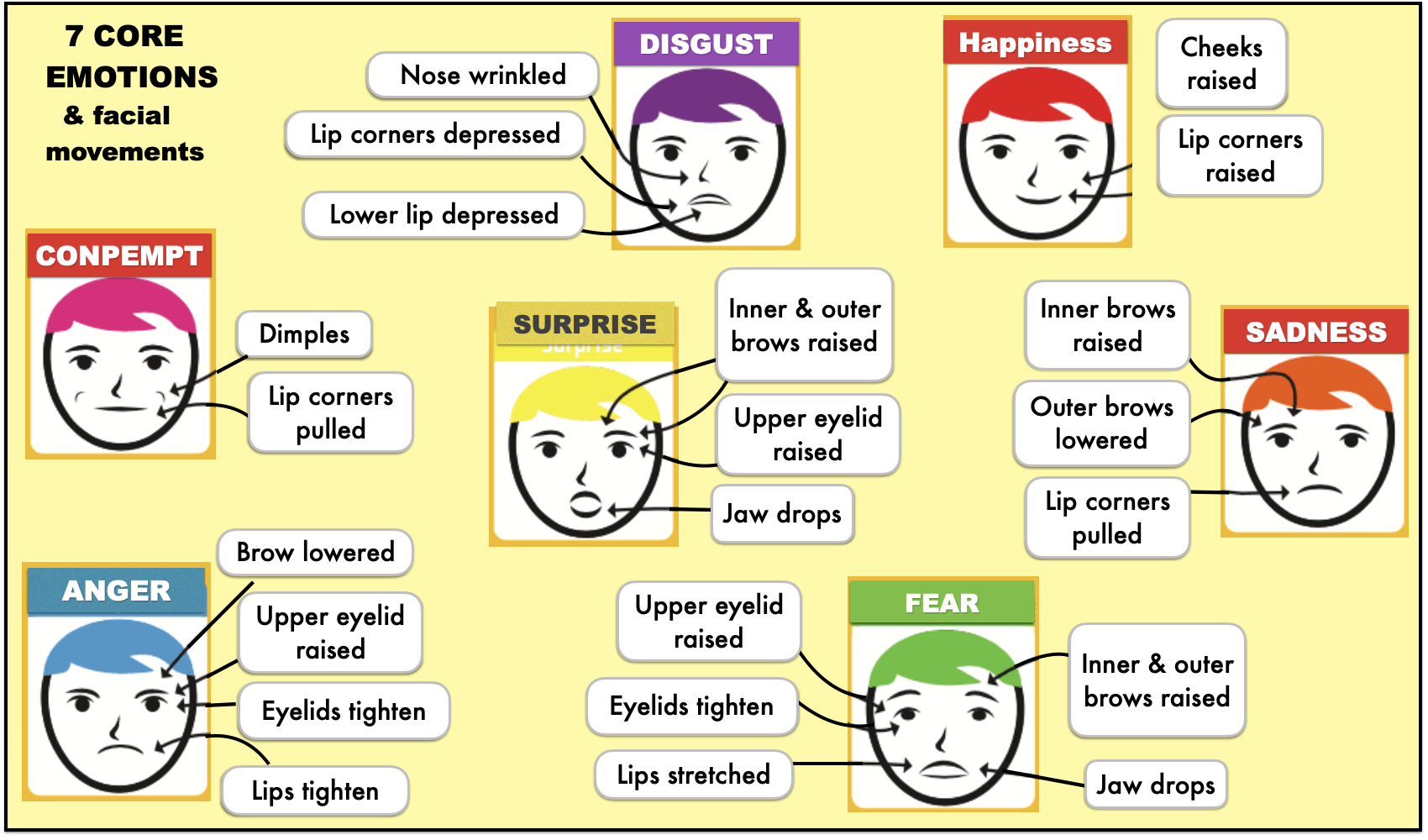
Everyone does unconsciously telegraph their true feelings – even the reticent & the repressed – by micro-expressions of the face & throat muscles (as well as other physical signs like a clenched fist, leaning forward or back, slouching….).
Normally, both sender & receiver of these tiny movements are unaware of them, but astute observers can pick them up anyway & respond internally, if not outwardly. As in the “Lie to Me” TV series, anyone trained to carefully read them can identify what someone else is feeling / experiencing

ACoAs
1.
Toward ourself –  we were thoroughly trained to ignore our own   experiences (intuition, emotions & thinking), that we’ve suppressed (but NOT lost) the ability to know what we feel, becoming numb to this level of internal information, from both feelings & body sensations

2a. re.Others
• Because involuntary muscle contractions are such subtle cues to someone’s emotional state, and –
• we’ve just as thoroughly been taught to deny / ignore what we hear & see from others, unfortunately :
— we don’t even notice these interaction, BUT
— if we do pick up the cues from others (what they’re actually telling us about themselves), we don’t trust what we’ve seen, & then talk ourself out of the implications.
This is one reason we’re greatly handicapped in understanding & dealing with others.  Fortunately, we can change this!

2b. At the same time, as kids in a chaotic, abusive environment – we became overly focused on how the adults were feeling, in an understandable desire to protect ourself. Their every nuance became signals – are they going to beat me, fall asleep drunk, stay in bed depressed or “sick”, be in a rage & get ready for a fight…..
Our goal was to placate the monsters & stop the abuse. This never worked! to change them, so one conclusion was that we’re a failure at understating moods & ‘fixing  pain’.

SO NOW – it’s hard for us to evaluate :
• what someone is actually telling us. We easily misread their meaning or motives
• what we feel emotionally about their communication. We react from internal wounds instead of responding to present info
• how to respond appropriately, so our actions are too harsh or too weak

Because of our ‘limited vision’, when someone is verbally insensitive or mean, we don’t feel the emotional punch in the stomach until sometime later if at all, & then are more likely to feel scared, or maybe get angry but blame ourself!

NEXT: The Body & Emotions (Part 3)

What about EMOTIONS? (Part 4)
therapy couch 3 I CAN HAVE ALL MY FEELINGS, & still be in control of myself!

PREVIOUS: What about Es? (Part 2)


MASTERY vs CONTROL
EXTERNAL focus: Control : “TO direct & command & having authority over others, OR to hold back, curb, restrain”.
The need for negative control (being controlling) in our personal life comes from an intense desire to avoid feeling fear – fear we’ve been storing away a little at a time, year after year, until it’s a mountain too overwhelming to face

Without realizing it, we believe that if we can ‘direct or restrain’ other people & situations around us we can prevent feelings of terror & rage from surfacing.  Controlling our Es keeps us from knowing ourself fully, while trying desperately to manage other people’s perceptions of us.

INTERNAL focus: Mastery, on the other hand, is about becoming an expert in some area.
Regarding emotions (Es), it’s recognizing & accepting our True Self &  others’ – since we’re all emotional beings.  We can be in charge of our feelings & behavior, as well understand & be respectful of others

• In ACoAs language,  mastery of our Es means having our Healthy Adult & Loving Parent in charge (the UNIT), instead of the WIC or PP, while giving lots of room for the Healthy Child to thrive & express itself.
When we let ourself to have a wide range of Es & learn how to handle them correctly, their intensity fades because they don’t get back-logged & then have to explode.

painfull EsUNHEALTHY or UNUSUAL:  Painful Es that we feel continually over long periods of time (rage, fear, sorrow, hopelessness …..) may be:
• from a traumatic past, & are tightly linked to beliefs, fantasies, wishes, resentments…. that we haven’t processed yet, & so are harmful to us
• caused by sudden shock or unexpected loss we can’t seem to get over (such as with PTSD)
• the result of aging, a brain injury, chemical imbalance (like with clinical depression) or side0effects of legal & illegal drugs or medications

Many (but not all) of these causes of Es can be worked thru psychologically so they can be released, & in some cases be greatly helped by corrective medication.

NOT ALL EMOTIONS are big, scary or overwhelming.
The ones we have in the moment are usually subtle, short-lived & sometimes conflicting.  ACoAs have been so brain-washed to not recognize Es in general, that we barely acknowledge the big ones, so the subtler ones can get missed altogether (non-dramatic ones like – being pleased, relieved, quite comfortable, a little frustrated, mildly annoyed, glad…..)

Some ways to relieve the pressure of backed-up E:
• sometimes just writing them out is enough, or drawing them using pens or crayons
• call someone who won’t try to fix or control you, share your Es in Al-anon & therapy
• if angry, do a minute or more of under-your-breath yelling while pounding on the couch or bed, sit in the car, or go outside to vent
• if sad, listen to music, watch a movie, read a book…. to trigger your tears.  Some of us can only cry when we are with others – if they’re safe, some of us only when we’re alone
➼ In many cases you’ll feel lighter & be able to sleep better!

EXP: You got an email from an ex you haven’t heard from in a long time. You’re over him/her, & the content was ok – nothing special.
So — you don’t feel anything. Right?
Well — look inside, & you’ll find there are some left over from old wounds – still vivid & intense.  Don’t judge, just accept & use all your tools to process them.a little sad

• OR maybe there’s only a little sadness, or guilt, or loss or forgotten anger or disappointment – that got activated. But you’re not aware of it – because, you don’t really care anymore, you’ve moved on…. And yes, you really are not invested in this person now, BUT feelings are feelings & aren’t logical.  Just say “I might be feeling something – just quietly.” It’s normal. Acknowledge whatever Es you identify (quiet or loud), give your kid a warm hug & go on with your life – no drama!

NEXT: Es & the body (Part 1)

What about EMOTIONS? (Part 2)

therapy couch 2I FEEL THAT SHE DOESN’T LIKE ME!
OOPS – that’s not a feeling. It’s a thought!

PREVIOUS : What about Es? (#1)

POSTS : USE THINK …..


HEALTHY
 emotions (Es) usually are brief / short-term, & will dissipate rather quickly. They’re an immediate response to a thought or some situation at the moment. They give us important information about what’s going on, & get us ready or motivated to act, when appropriate or necessary.
Es come from :
external events, like being cut off in traffic or your boss being annoying, so you may feel angry, irritated, frustrated…. OR
internal ‘events’, such as memories of —
— a bad job, a lost loved one, so you may feel sad, lonely, angry, scared OR
— a fun party, great success, a great trip, so you may feel happy, relieved, proud, nostalgic…..

LONG-TERM** emotions are those unhappy, intense ones that – when triggered – seem to go on forever! causing great stress on the body so we never relax. The intensity lets us know they’re not about something current, but rather taping into the unprocessed deep well of accumulated childhood pain.
In the present, when an old button is pushed, we chew & chew on a feeling (anger, abandonment, disappointment….), obsessing on painful experiences, & then add more pain by judging ourself for what we’re feeling.

** Unexplored childhood Es prevent us from being in touch with or honoring honest gut responses in the present, which then distract us from taking needed actions, or drive us to take the wrong kind.

Old painful Es don’t dissipate easily or quickly because they’re still attached to self-abusing beliefs that our WIC is loyal to – the Toxic Family Rules & Roles.
The only ‘benefit’ they provide now is to let us know how we felt in childhood. Accumulated Es hang on until we can verbalize & finally experience them safely.

EXP: You got really angry at a rotten driver on the highway, yelling & giving them the bird… but then gave yourself a hard time for being angry – because you learned as a kid that anger is BAD. You keep judging yourself, maybe also feeling guilt, shame, anxiety & S-H.
WHY? Not making a distinction between the emotion of anger vs. behaviors that expresses it.

Truth: All emotions are legitimate, but not all actions are appropriate!
Even if you can’t prevent the bad-voice tape from clicking on, do NOT let it run – stop it right away AND strongly disagree with what it’s saying. If you do that each time, its power will eventually diminish!

TIME FACTOR
REMINDER – In a psychological healthy state, emotions usually come & go rather quickly. We can have several, even conflicting Es, at the same time – about a specific person or situation.
They’re brief because they’re situation-specific, & we’re not holding on to a negative mental interpretation of what’s being felt (not judging or being afraid of Es)   (More…..)

Interesting : A pioneering study about how long various emotions can be felt, identified – being ashamed or disgusted lasts about (30 min), bored (about 2 hrs), guilt (3.5 hrs), but sadness outlasts them all (up to 120 hours!) The next longest was anger, about 60 hrs.!

⚙️ SOME Es: There are some healthy long-term ‘states’ like love, loyalty, faith…. that can last years or a life-time, even with ups & downs, depending on the individual &/or the relationship

RECOGNIZING Es
Regularly ask What am I feeling emotionally right now?  Name any that you can. If you’re not sure, keep the blog’s list of Es on your phone. Write about recent events & talk about them to a friend or in a meeting. Not being alone with them helps.

feelingsQ: Have you noticed that at the end of a day – or week – you feel heavy, tired, depressed – BUT you think ‘Nothing really big / bad happened’ ?
A: List every event, no matter how trivial or ‘innocuous’. Some may actually have been quite stressful
• Next to each one – list Es you had been ‘in touch’ (sad, mad, lonely… or happy, relieved, peaceful….) ,   OR – If you don’t know or are unsure,  imagine which Es you may have felt about them EXP : Your boss ignored you, again – & it didn’t bother you.  Are you sure?

• There are many different Es associated with people & situations that come in & out of your life. If you don’t regularly discharge all that emotional energy, usually from uncomfortable Es, they accumulate in the body & you end up feeling weighed down!
💗 We can also overlook pleasant Es if we’re not used to or allowed to feel them, losing out on healing energy.

NEXT: What about Es? #3

What about EMOTIONS? (Part 1)

PREVIOUS: “What others think of me is none of my business’ (#2)

REVIEW: 
Feelings Aren’t Facts

DEFINITIONS (Answers.com):
• The English word emotion (Es) is from the French émouvoir, from the Latin emovere, where e- means ‘out’, & movere means ‘move’, as TO emit & emote
• at its most basic: Es are pure mental & spiritual energy from the core of our being that makes us all one, where we meet & overlap as human beings
• they are short-lived psycho-physical phenomena that represent efficient adaptations to environmental demands (Levenson, ‘94)

• an E. is a particular mental state formed spontaneously rather than by conscious effort, often accompanied by physical changes
therapy couch 1• they are the part of our consciousness that involves sensibility: “The very essence of literature is the war between emotion & intellect” Isaac B. Singer

• Es are the result of combining external experience, brain chemicals, the way we think & the actions we choose —
— based on our native Self, our personal history, with the cultural rules & values we grew up with
• Es can be used to motivate us to take actions needed to connect, to protect ourselves, & to grow
• our Es liven those actions, which would otherwise be rigid or boring

• Emotions coordinate our many adaptive needs so we can function more efficiently, without those needs being in conflict or demanding attention all at the same time (food, shelter, reproduction, safety, sleep, communication….)

survivalEs make up an overriding brain-program that temporarily activates, deactivates, or modifies particular needs. This depends on the current situation – where 1 need is turned on, while another has to be put on hold  – so we can keep functioning properly (sleep vs go to work, stay connected vs withdraw from danger, achieve vs relax, socialize vs. regroup alone…..)

• From Affective NeuroScience (en.wikipedia)
Affect is an encompassing term, used mainly in psychology to describe emotion, feelings & moods, even though it’s more commonly used to mean Emotion

Feelings are our subjective impressions of emotions, private to the person experiencing them – based on perspective, beliefs & desires. A general state of consciousness independent of physical sensations and thoughts….

Moods are diffuse effects, generally lasting much longer than individual Es, but less intense. They represent an overall tone that effects one’s outlook on everything, for as long as the E lasts

• In “What are Emotions? And how can they be measured?” (2005) K. R. Scherer suggested 5 crucial elements:
📌 Action tendencies : motivational energy to prepare & direct motor responses – Es are the push to act in some way
📌 Bodily symptoms : physical aspect of an emotional experience, generated in the gut, but also experienced in other body parts
EXP: FEAR can be felt as tightening of the chest, stomach, throat, weakness in the knees…. & in panic attacks – as temporary blindness, inability to think, ‘clutched heart’, trouble breathing….

📌  Cognitive appraisal : Es provide an evaluation of events & objects. It’s the Mental component that which generate Es – what we think / believe about something, either healthy or unhealthy, accurate or not
📌 Expression : facial & vocal output almost always accompanying an emotional state as a reaction to it, or indicate the intention of taking some action (unless using Botox! )
📌  Feelings : the person’s subjective experience of their emotional state, once it has occurred

BTW – Don‘t confuse feelings or emotions with:
obsessionCompulsions, which are actions we’re not in conscious control of – OR –
Obsessions (Os), which are over-focused, circular mental rumination, our hamster-in-the-wheel :
a. most Os are unconsciously —
— fueled by anxiety, trauma, S-H, FoA….
— supported by unhealthy thinking (CDs), wanting revenge, being one-up, proving oneself ….

b. less often (legitimate) Os may be:
POSITIVE uses • a way to rehearse phrases or counter-arguments from our Healthy Adult ego state
• ‘passions’, motivated by a deep need to connect with a H.P, to be of service to others or follow a creative goal.

BEST use • mentally reviewing a positive event recently experienced, to anchor it in memory. This is important for countering our “built-in-forgetter”, which automatically negates the good things in our life
Purpose : to solidify smarter ways of verbally responding, which can counter — ACoAs’ tendency to blank out when confronted or criticized (fear,) or — when told something outrageous, insensitive or mean (rage)

💎 Therefore, ‘obsessional repetition’ is a smart tool, creating new brain pathways, so the Frontal Lobes can stay ‘on line’ when we need them the most

NEXT: What about Es? (Part 2)

What Others Think of Me is None of My Business (#1)

LONELY CREATURES
We’re all social animals, but also need privacy

PREVIOUS: Safe & Unsafe People

REMINDER: See ACRONYM page for abbrev.

NOTE: Many people in the mental health field, spiritual practices & new-age wisdom say we shouldn’t worry about what others think of us. Yes, OK, but it’s not that simple! What they don’t tell you is that there’s 2 different aspects, the negative & the positive.

1. DAMAGE (ACoA version) – for anyone with limited self-esteem / S-H, there’s always the assumption that other people don’t like us – it’s our default position & hard to let go of.  And that has 2 parts too! Doesn’t everything?  AH, Dualism!  I can’t help it – I’m a 22/4 with an 8 Destiny. I see both sides – ‘now’. 🙂 Anyway…

a. Awkward (lame, a “drip”? —>)akward
• If we’re obnoxious, angry, childish, clingy, lazy, needy, selfish, un-groomed, or say lots of dumb things – OR just full of negativity & self-doubt, then most people will not like us!

• If we care, these problems can be worked on – if we have the courage, right kind of help & willingness to deal with the pain, sadness & fear that’s at the root all our ‘shortcomings’

• If we don’t care, or the resistance is too great to get past, the external signs & internal causes never get corrected. A great loss for us as individual & to society, but each has their own path.

b. Isolators: Some ACoAs (not about Extroverts / Introverts)
isolate• hide out because of some physical or mental disorder
• but mostly it’s from — Fear, Lack of good Boundaries & Self-hate : wounded souls who need lots of love but aren’t allowed to let it in, even when it’s available. They blame themself for everything that goes wrong. They ‘don’t belong’

• At the other extreme are those wounded ACoAs who are always angry,  complaining, dissatisfied & think they’re superior. They push others away & lose out. They have S-H too, but their whole focus is outside of themself, blaming everyone else for their troubles

c. Acceptable:  Most of us are not social misfits –
• we have an education, jobs, mates, maybe children & some outside interest. YET we think everyone is going to judge us harshly, find out we’re frauds, see  all our flaws… later if not sooner, especially if they get to know usbeing udged
• that’s straightforward Projection onto others of – how our parents treated us & now, our self-judgement

also, it’s Mind-reading (a CD). We’re sure we know what others are thinking – especially about us, & it’s always negative. That’s ACoA grandiosity.  Stay out of other people’s heads!
• Sadly, even when others like us, love, admire & laud us – we have a hard time believing it, don’t trust it, get embarrassed, tell them why it’s not true. Yuck!

2. Mental HEALTH  — All humans NEED connections, but in differing amounts.
a. Normal:
Extroverts. (They are 75-80% of the population, at least in the West)
They thrive on the energy absorbed by being around a lot of activity – choices, options, people, events….. even if not interacting with them directly.  (PS – not referring to the energy vampires).
Think: a walk in the park on a great spring day alone, when intro/extroeveryone’s out,  or an evening with a bunch of friends, just ‘messing around’. Doesn’t have to be heavy or deep, although that’s good too. Just being ‘part of’ feels great

Introverts need activity too with others, just in much smaller doses. They’re mostly comfortable one-on-one & in small groups, for short periods. They derive their energy internally, & are overwhelmed by too much external input.

NEXT: What others think…. #2

Forming Boundaries – with OTHERS (Part 2)

setting ;imitsIT’S UP to ME to SET MY LIMITS
it’s up to others to honor or ignore them

PREVIOUS: Bs with OTHERS (#1)

POST:   ‘ACoAs & Self-Esteem’

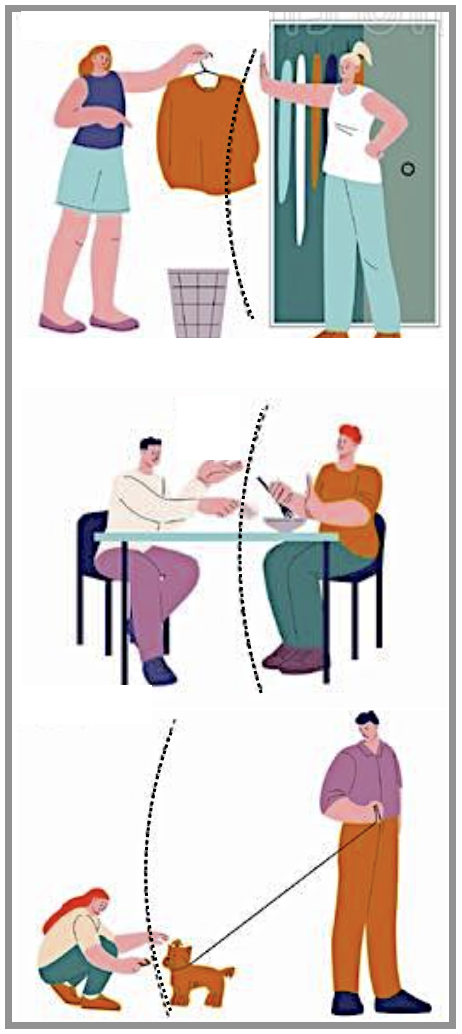
DEF : A boundary is a PMES space you put around yourself, & so do others for themselves

FORMING Boundaries (Bs) with OTHERS 
1. For OURSELF 

2. In Relation to OTHERS
a. Don’t punish others if they’ve forgotten your B. requirements. Consequences should be an inevitable outcome of the choices we each make. Outcomes (our reactions to them) may or may not feel like punishment to the B violator – depending on how intensely they’re still run by their WIC or PP.

• If you feel a strong urge to punish someone for ignoring your requests, it would be best to work on yourself before talking to them again. While they did indeed ‘stepped on your toes’, you may have let the violation go on too long, or else you’re making it too personal. NOT everything is about us!

★ Persistent B violators act like that with everyone, or anyone who will let them!  Do rage work in private, share about it in Al-Anon & therapy, pray for patience, & talk or write to your Inner Child.
Then remind the other person again, OR tell them they’ve crossed the line for the last time!

ii. Make a plan of action for when someone severely violates your Bs (& somebody will!) :
a. Tell them what you don’t like about their behavior – be specific. If you’ve already talked to them about it, refer back to those conversations
b. Ask they to stop immediately – when this is a possibility. If they don’t, then strongly insist
c. Ask for help from your support system when stressed, especially if you feel in danger
d. If there are no other options, walk away with as much dignity as possible, without sarcasm or nasty get-even comments.

💗 Thank anyone who honors your boundaries

REMINDERS
• You can not set Bs AND take care of someone else’s needs! They’re mutually exclusive

• When you feel angry, complaining, rageful, threatened, suffocated, victimized, whiny…..  it’s the pain of not having your Bs respected. These emotions are like flashing red lights telling you something’s wrong – something you don’t like, can’t stand or hate. It means you have to say or change something

• Talk to a Violator from your ADULT ego state,
— since you will inevitably get frustrated & annoyed with someone you love & don’t want to leave, who’s being a pain in the neck
— you may need to express your anger, to get past your resistance to speaking up. Anger makes us feel less vulnerable when we’re afraid —
— AND there are people who will only pay attention when you get ‘heavy’, but getting Adult-angry is not the same as being nasty (from the WIC or PP)

Avoid justifying yourself, apologizing for or rationalizing your needs – because it’ll sound like you don’t believe what you’re saying – so Violators won’t take you seriously either.
Say very little, OR offer a brief explanation – if appropriate & you feel ok doing it. It’s hard to be genuinely intimate with someone if you don’t tell them what’s bothering or hurting you

• At first you may feel afraid, ashamed or guilty when setting a Bs, so it’s it easier to let it slide.
— Do it anyway, the next time you’re with them – because it’s our job to let others know, & some don’t realize they’re trespassing
— Also, people don’t respect someone they can use, manipulate or control, even though they’ll try to get away with itangry at Bs

• Be prepared for anger, attacks, denial, opposition, resistance. Violators don’t like being reined in.
Don’t let their reactions make you doubt your rights! They’re just having a 2-yr olds’ tantrum when they don’t get their way. You have to be ready to enforce your needs, otherwise people will simply ignore you.

• The main prerequisite for good boundary setting is believing you have a right to them! When you’re sure, it will be clear to others even when you don’t say anything, AND fewer B-invaders will show up in your life

• ALSO: make a list of 5-10 ways you violate other people’s Bs. (ACoAs violating Bs) Work on correcting them.  You’ll  feel better about yourself!

NEXT: “What other think of me….”

ACoAs & RIGID Boundaries (Part 2)

wallsI HAVE TO PROTECT MYSELF at all costs

PREVIOUS:  Rigid Bs (# 1)

SITEFamilies & Groups with Rigid Boundaries

BOOK:  Boundaries & Relationships,
— Charles Whitfield


OUR DAMAGE
:  As a result of boundary invasion throughout childhood, ACoAs didn’t develop our own. So our options are:
Thick walls, when both inner & outer Self are barricaded
No Bs, where we let everyone tramp in & out of our head & heart
Partial Bs, protecting only some parts, such as the inner but not the outer Self – usually based on previous bad experiences in similar situations

⚙︎ INFLEXIBLE 
Rigid Bs effect us & everyone we interact with, BY:
• ‘Abandoning’ ourselves – we ignore or eliminate so many available options that we can’t properly do self-care. Spiritually, we don’t take personal responsibility for our values….
Abandoning’ others – we withdraw, sulk, shut down & hide behind our wall, making it almost impossible for anyone to love, help or appreciate us

⚙︎ PHYSICAL
Stability helps us feel safe, which is very important to us, so all activities have to be predictable – no room for spontaneity or fun, last-minute opportunities, trying new things….  WE:
stay away• are stoic, have stiff body posture, maybe “stone faced”, trouble giving or receiving physical affection (afraid to let go), don’t like to be touched or hugged….
• are sexually cold or just disinterested, have perfunctory or pity-sex, OR are promiscuous without deep enjoyment, don’t use protection
• under-react to personal or external events, whether pleasant or unpleasant, or not at all

⚙︎ EMOTIONAL – WE:
• are aloof & disinterested, insensitive to anyone else’s feelings
• don’t seem to identify with other people’s problems, do not want to hear their troubles, especially when very upset or crying
• don’t trust anyone, generally suspicious of other’s motives, can be somewhat paranoid
• fear with abandonment and engulfment. No one can get close (staying too busy, pick fights, make plans & then cancel or just not show up…), to avoid being disappointed, hurt, or taken advantage of
isolated• have few or no close relationships. If we do have a partner, it may be in separate places or with little shared social life
• seem emotionally numb, don’t show or talk about feelings & emotions, rarely share personal info
• struggle with loneliness, self-disgust, anger & self-control, but cover it well

⚙︎ MENTAL – WE
:
• are more likely to lie, even about unimportant thing OR omit important facts
• don’t know how to make small talk. Are afraid to say the wrong thing
• don’t like giving anything to anyone. Refuse most social invitations
• have trouble identifying needs, wants & dreams
• ignore all feedback. If it’s criticism, it validates our belief that everyone’s against us. If it’s positive we assume it’s not real
• ‘listen’ to others without responding, in our own little world
• stick to pre-conceived ideas (from childhood), with no room for anything nereject helpw

⚙︎ SOCIAL – WE:
• feel like no one really knows or understands “the real me”
• generally – unconcerned with the world outside of own borders.
• have trouble receiving from others. If someone offers – we get mad or defensive
• won’t ask for help when needed, don’t know who to ask, believe no one will help anyway, so why try?
• make an effort to go for some goal – BUT all alone, & if we can’t achieve it right away, or fail, we stop trying & do without

Love requires Trust, & trust requires (appropriate) vulnerability.
ACoAs with rigid Bs sabotage any shot at healthy love by shutting out anything unfamiliar…. We keep everyone at arm’s length, pick the wrong people to trust, mistakenly associate all humans with the painful events of the past, assuming everyone is as dangerous as our family was / still is

Unrecovered, all wounded ACoA fear being vulnerable, because it means :
• our WIC will be exposed without protection because we don’t have a Loving, capable Inner Parent
• w’re not allowed access to our human rights & Bs, so are easy prey

BOTTOM LINE: Rigid boundaries are walls built around us as a substitute for real ones. (see Healthy Bs.) They’re meant to keep us from getting hurt again, & trying get our needs met, by insisting everything be OUR way
UNFORTUNATELY they don’t work to our benefit. We just end up starving !

NEXT:  Healthy Boundaries – INFO (#1)

ACoAs & RIGID Boundaries (Part 1)

heart in jail
DON’T GET TOO CLOSE –
it’s the only way I can feel safe!

PREVIOUS: WEAK Bs. – #2


Healthy BOUNDARIES are about  having personal power.
When used appropriately they are our “line in the sand,” defining who we are & protecting ourself from unwanted influences.

• In any family – parents are supposed to provide emotional nurturing, & teach children how to function successfully in society.  This includes age-appropriate boundaries, allowing children enough leeway & options to find out who they are as separate individuals, not just extensions of the caretakers – while also providing appropriate protection from harm, which they gradually internalize & use as adults.rigid Bs

Unhealthy – However, in families where boundaries are too rigid, all power & control is with the parents. There’s no room for kids to breathe, make mistakes, take their own time to learn or be playful & relaxed.
One-sided power strangles communication, limiting or eliminating any real sharing between the generations (“no back talk” / “children should be seen & not heard”…)

• Some parents are monolithic – standing together as a unit, against the children, rather than for them
• OR one parent, often the father, is the tyrant dictating all rules, to be followed without question
— If the other parent simply capitulates or escapes, children at the mercy of the bully or mentally ill mate
— OR the weaker parent will join forces with the children, either to secretly help the kids, or in self-protection, & will manipulate/ coerce/ guilt the kids into obeying the abuser

• As CoA children become adolescents, they either withdraw or rebel.
EXP: Ben was a happy talkative little kid, friendly to everyone, even strangers. His narcissistic parents were performers, constantly forcing him to be on stage – which didn’t suit his personality.
Over the next 10 yrs. he lived thru several uprooting family moves, physical & emotional abuse at home & bullying at school. Gradually he withdraw, & by 13-14 he’d stopped talking or socializing. His parents wondered “what’s wrong with him”!

ACoAs develop overly-rigid Bs from families:
• that were too restrictive, dictatorial, cruel. Even though it made us very angry, we end up copying their pattern, afraid to break out of the suffocating shell they created
OR
• who were neglectful but emotionally over-dramatic & boundary invasive. Being constantly overwhelmed, confused  & terrified, we over-compensated by tightening our own Bs (becoming rigid), as a way to have a tiny measure of internal control, to quiet intense anxiety

EITHER way – Physical, psychological, emotional &/or sexual assaults forced some ACoAs to choose this per-version of Bs as protective armor (Toxic Rules & Roles  – (“how things have always been done // the right way to do things”….).
So, afraid of being personally violated -again-, we become inflexible & hyper-vigilant, even paranoid.
All our relationships suffer because we’re incapable of true emotional intimacy, convinced that if we let our guard down, we’ll fall under the total control of The Other. Instead of protection, it only leaves us deeply empty & lonely.(‘’Come here-Go way )

• Traumatized children naturally become very mistrustful (just like animals abused by humans). Since the Brain is innately organized in schematics…. we associate people & experiences in generalities.
Therefore ACoAs set up defensive walls against those who originally hurt us, & then extend them out to everything else, losing the ability to make the equation : people = pleasure.
EXP: A woman violated / beaten / neglected … in childhood by an adult male will definitely not trust any man. And a man ‘broken’ by beatings & betrayal from his mother won’t be able to trust his judgment or intuition about other women…..

ACoA irony: When isolation becomes unbearable, in desperation we reach out to whoever is immediately around, whether inappropriate or not.wrong guy
If that person or group shows any interest or kindness – we fall profoundly under their influence before even realizing it! For an instant we drop our guard & drift into the fantasy of finally being loved & taken care of. They become our sole obsession – for a time – convinced we can’t live without them

**Eventually, we’ll feel strangled & crushed, because rigid Bs are not Bs at all! They only mask a desperate longing for a connection that’s actually symbiosis.
▪︎ Hopefully we come to experience the toxic person / group as a virus invading our inner sanctuary, which must be expelled.
▪︎ We can crash-separate by devaluing & discrediting them, finding fault, starting fights or withholding & losing interest!
🔺 Alternatively – we can walk away with a smile, healthy self-esteeme, head held high.

NEXT: RIGID Boundaries (#2)

ACoAS & WEAK Boundaries (Part 2)

rigid BsI DON’T LET MYSELF TALK
so I don’t upset other people

PREVIOUS: WEAK Bs (Part 1)


REMINDER
:
The requirement for having appropriate Boundaries
IS
knowing what your NEEDS are & actively providing them, as best as possible.


CHARACTERISTICS of weak Bs
They represent not having the right to our needs, often expressed as a general passivity in life – letting people & circumstances push us around.
BTW, you may notice that some of these expressions of weak Bs are the same or similar to those of rigid Bs. This is only natural since the underlying causes all come from our unhealthy upbringing.

⚙︎ SEXUAL
We have weak Bs if we:
• attach our self-esteem to being sexually attractive
• can’t distinguish between love and sex
• have sex when OR with whom we don’t want to
• feel a need to always be in a sexual relationship
• “fall in love” at first sight  – just because someone seems interested or reaches out to us
• let others touch us, even when it’s uncomfortable or inappropriate

⚙︎ PRACTICAL
We have weak Bs if we :
• accept unwanted gifts to not hurt feelings or make others angry
• allow others to take as much as they want from us (time, $$, energy….)
• are indecisive & therefore unpredictable, undependable
• don’t protect our physical space, letting people  — stand or sit too close
— take and/or use something of ours without asking
• don’t acknowledge our need for privacy, but don’t object to being asked personal questions, don’t stop others from snooping around our things…… without doing something about it
WE:
• DO too much, either by being controlling (B invade), OR overly responsible (doing everything ourself)
have to do something a certain way or modify our behavior so that someone else can continue their unproductive or unsafe behavior – enabling any kind of bad or self-destructive behavior in others
• let others determine our wants, needs & tastes, sacrificing them to someone else’s desires or demands – no matter how subtly done
no choiceWE:
overcompensate for existing ! especially when we think we’ve messed up in word or action
• measure another person’s caring by material gifts – how much, what kind they give us
• sacrifice our own goals, projects & self-care to help others – from FoA
• set no specific limits on our willingness to help others
⚙︎ MENTAL
We have weak Bs if we:
• allow the expectations of others to define our potential
• always verbally agree with others, even when we actually don’t
• are afraid to ask for help, so have to constantly manipulate others to get what we want (indirect)
• compromise values & beliefs to please others or to avoid conflict
• get too close too fast, share too much personal info (TMI – especially about our faults) before establishing mutual trust
WE:
• ignore our inner voice & rely on others’ opinions, values & emotions
• know we’re covering something up or keeping a secret, such as battered wife & children hiding injuries, kids covering up parental addictions, emotional torture, mental illness….
• let other’s influence / effect our behavior, continue to be unclear about our own preferences
• personalize everything, over-reacting to feelings or behavior of others (assume other’s reactions are all about us).

⚙︎ EMOTIONAL
We have weak Bs if we:
• are constantly preoccupied with & overwhelmed by others’ emotions, needs & problems (take them on as if our own), feeling responsible for their happiness & fulfillment

• are dependent for our identity & emotional well-being on what others think of us, so become chameleons OR isolates
• are not comfortable being alone, at least some times
WE:blend or leave
• can’t say no, even when wanting to, for fear of rejection (abandonment)
• feel everything ‘too much’, not able to contain or soothe our own emotions
• feel & act like victims, have no balance of power or responsibility in relationships
WE:
• have a high tolerance for abuse, for being treated with disrespect
• ignore our own discomfort, anger, anxiety or fear so someone else can be happy & comfortable
• need constant reassurance from others that we’re acceptable
• people-please – saying yes when we want to say no, & then act out later, either on ourselves (S-H) or at others (passive-aggression)
• symbiotically attach ourselves to someone, something – anything!

NEXT: RIGID Boundaries – #1