
 I’LL LET YOU KNOW
how close you can come!
PREVIOUS: RIGID Bs (#2)
REVIEW: ‘Boundaries Defined’
WHAT are Healthy Bs?
According to L. A Hayduk (1978), it’s “the area each person actively maintains around themself, into which others cannot intrude without arousing discomfort”. And Richard Stengel (1995) found that ‘Personal Space’ surrounds one’s ego-center, intuitively understood by all human beings
• Setting boundaries is about moderation & grey areas, which requires a person to be “fully differentiated” via S & I. A good boundary-setter is willing to step into their uncomfortable ‘grey zone’ with a clear Yes or No line. They know who they are & who they’re not, taking responsibility for what’s theirs, & expecting / allowing others to take responsibility for what’s theirs
• Then 2 such people, already independent in their True Self, can be inter-dependent, close enough to stay connected with a positive impact on each others’ life, without unwanted intrusion. Healthy Bs are flexible enough so people can grow & change. Each can soften where their Bs are to encourage intimacy, or extend their Bs to create safety
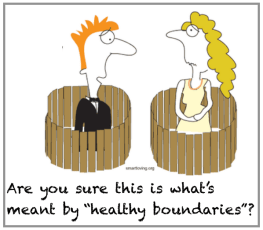 • We all react to changes in environment, managing them to suit our unique ‘Comfort Zone’ – with specific rules for what works for us, so there are no absolutes. A severe decrease in available personal space makes us itchy. If that situation persists, this lack of control can cause psychological distress
🔒 PRIVACY
Social scientist Irwin Altman studied privacy in relation to all forms of Social Boundaries – what makes them optimal, balanced between ‘not too hot & not too cold’!
According to Altman (1975) Bs Are :
1. fluid – we decide how open or closed we are, in reaction to what’s going on inside or outside of ourself
2. not perfect – the amount of space we want or need to feel comfortable & fulfill a particular role, is often different from what’s available
3. flexible – our invisible Bs can be adjusted to different situations. With too much privacy (more is not always better), a person will start crowding others, given an opportunity.
With too little privacy, they compensate by withholding & isolating
4. 2-way – involves input from others, such as noise, and output to others, such as talking
5. 2-leveled – individuals vs groups (public places, cyberspace…)
🔐 PROXEMICS
In the early 1960s American anthropologist Edward Hall was a pioneers in the study of humans’ spatial needs, who coining the word ‘proxemics‘.
A subcategory of non-verbal communication, it’s about the impact it has on social interactions: how we respond to & use our personal space – the distance between ourself & others.
His research led to a new understanding of the human need for territory (animals do too), divided into:
▪︎ Personal – the immediate area surrounding a person. EXP: our body’s space-need & posture are unconscious reactions to subtle changes in sound & pitch of another person’s voice
▪︎ Territorial – the area people lay claim to & defend against others IS used to “propagate the species by regulating density”
This aspect includes the study of how space is organized in houses & buildings, the layout of towns & cities, & in collective forms such as Clans & Countries.
Some responses to B Invasion:
▪︎ choose less personal topics, talk about leaving, avoid eye contact
▪︎ increase inter-personal distance, turn away, leave
▪︎ AND, as with non-humans when pushed too far – reacting with aggression
Degree of Intimacy: Hall identified types of responses by the “angle formed by the axis of the conversants’ shoulders” – a combination of postures (sitting, standing, prone…) which are affected by nonverbal factors each person picks up from the other: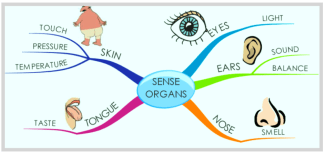
⚓︎ Kinesthetic – how close people are touching
⚓︎ Olfactory – amount of odor picked up
⚓︎ Thermal – degree of body heat
⚓︎ Touching – the ways they’re touching, or not
⚓︎ Visual – amount of eye contact
⚓︎ Voice – silent, very soft, soft, normal, normal+, loud, & very loud.
Cultural Factors : Hall noted that Realizing & Recognizing cultural differences helps eliminate discomfort people may feel when their inter-personal distance is too great (“stand-offish”), or too small (intrusive).
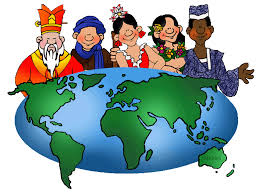 The Lewis Model of Cultural Types suggests 3 styles :
a. “Multi-active” cultures, that are warm & impulsive (Brazil, Mexico, Italy)
b. “Linear-active” cultures, cool & decisive (Germany, Norway, USA)
c. “Re-active” cultures, accommodating & non-confrontational (Vietnam, China, Japan)
NEXT: Healthy Bs – info (Part 2)


I found this easy for me to relate with – however, I am saying I will be able to do it in a thinking way, mainly I will be more forgiving to myself and others and accepting of circumstances that we do not have to do it perfectly, as there is no perfect, and each circumstance may be done with difference in how we perceive the circumstance and and the unknown response with in me.
Many thanks, Peter.
LikeLike