SAYINGS that MISREPRESENT (Part 3)

I’M NOT SURE –
what to ask for!

PREVIOUS: SAYINGS…  (#3)


REVIEW Intro in Part 1 

7. “Be careful what you ask for – you may get it”
❤️ YES – said as a warning
if you’re superstitious, self-destructive, have a habit of choosing badly….

GROWTH : There’s a different YES – not as a negative – but can be stressful at first. This is when we determine to make a positive change in our life, & perhaps ask HP for help – to be released from a bad relationship & find a good one, be provided with a new job/career, to live in a bigger, safer, more suitable location …..

And then it comes our way, not magically but because we did the foot-work and were in the right place at the right time.
BUT – if we’re not fully prepared to receive these blessings, we can feel uncomfortable, scared, unworthy….
That’s OK. If we ride it out & get validation from the right people, eventually we’ll be able to relax into it.

💜 NO – As ACoAs, we don’t want to be so ‘careful’ that we don’t ask, since many of us have a poverty/deprivation approach to life. It’s imperative we give ourselves permission to ask for what we NEED, first & foremost. This requires knowing who we are + knowing what our human rights are + being able to deal with the risk of not getting.

Also it requires that we never go to people who have already proven – a hundred times over – that they’re not capable or willing.
THEN we can begin, slowly, to ask for bigger & better things, healthy things, fun things….. and when we get them – take them in, be happy, be grateful. Enjoy!

8. “A good beginning makes a good ending”

💜 NO –
in most instances for ACoAs before Recovery. If we start by marrying an alcoholic &/or other addict, it’s for-sure going to cause years, even decades of great pain. It’s not uncommon for these to end with a bang.
OR – if we enthusiastically start an unsuitable job, try to do too many things at once, idealize a new partner, be great caretaker….. it’s likely to end in disappointment, frustration, exhaustion & rage

OR – if we start a good thing, such as exercising, a diet, an advanced degree, a recovery book, a 12-Step program or therapy…. all with the best of intentions, but it goes against our Toxic Rules, it’ll peeter out with a whimper. (“Anxiety & T.E.A.” ).

❤️ YES – if we pick the right kind of job/careers, or healthy & suited-to-us friends, mates, therapist, doctors….. then it’s likely that a good beginning would predict at least a neutral if not a good ending – when appropriate or necessary.

9. “Forgive yourself
❤️YES for harmful things you did as a result of your damage
💜 NO for being damaged in the first place!
POST: “Outgrowing Co-Dependent Niceness #6a

10. “Everything that has happened to me is OK because it’s made me the person I am today”.
There are a couple of ways this is wrong. Yes the things that happened in childhood naturally molded us, & for some people that was beneficial.

BUT for ACoAs, saying that what happened to us was OK – is cruel. Was it OK that you were beaten all the time? That you had to take care of everyone but not yourself? That you were mind-f–ed, punished for having emotions? That you were molested, raped, neglected, starved???? 💜NO!
If some or all of these were part of your early years, then all they accomplished was to form a False Self, which we mistakenly believe is who we are. (Our Wounded Inner Child

All the horrifying things that happened to us made us who are today – all right!  – into frightened, self-hating, over-working, ego-less wrecks.
But anyone in FoO Recovery knows that our healing work is to strip away the layers of defenses (self-destructive messages) to get to the person we actually are inside & would have been a long time ago – without the abuse!! (POST: “They did the best they could”)

NEXT: Sayings #4

SAYINGS that MISREPRESENT (Part 2)


WE KEEP PASSING ON – half correct ‘helpfulness’

PREVIOUS: SAYINGS… (#1)

REVIEW Intro in Part 1
3. “I don’t have to be perfect.
What’s wrong with this statement?
💜 NO – Unfortunately, people in Recovery who say this actually consider it a sign of growth, but is in fact one of those sneaky ways our ‘damage’ keeps us hooked. Why? Because:
It implies we COULD be perfect, we just don’t have to be. NOT true!

No one can be perfect except God. So, what is true & accurate is that “Humans are not perfect, & I am human, so I can’t be perfect!” That’s normal. To think otherwise is arrogant. We can only do the very best of our ability given where we are in our life-progress right now.
It means that “To err is human”,  so we must accept the reality of having limitations. This does not minimize our accomplishments or gifts! We can say: ‘There’s nothing wrong with being imperfect, because it’s a universal Truth”

4. “Feelings aren’t facts” is 💜 not about our emotions, as most people assume. The confusion comes from the reality that we use the word ‘feeling’ in 3 completely different ways: As physical sensations, as emotions AND as thoughts.  See POST

5. “The way you do one thing is the way you do everything.”
💜 NO – It’s the word “EVERYTHING” that’s the problem. Taken literally, this is a blatant inaccuracy. Always keeping PMES in mind, how we do the various parts of our life depends on many factors.
It will depend on your fundamental personality, such as indicated by their MBTI or EnneaType – whether you’re more left or right-brained, (scientific vs artistic) Introvert vs Extrovert, AND above all what areas of childhood experiences were allowed & praised or ignored & punished.

So, I can be meticulous about how I dress & do my makeup, but sloppy about keeping my house orderly.  I can be a brilliant scholar & writer, but neglect my family. I can be very talented & dedicated to my native art form but irresponsible if I have to do office work…. .READ article – a Lesson
▶︎ None of us do everything the same way!

(❤️YES) However, if we take this phrase more psychologically, we can use this woman’s experience to indicate where we’re stuck. Each of us can have the same kind of ‘aha’ connections – between everyday ways of doing (or not doing) things & how they’re a reflection of our fears & resistance to change. Such discoveries help us remove blocks which will improve our life.

6. “If you hate a flaw in someone else it means you have that flaw yourself, otherwise you wouldn’t be upset by it”
💜 NO – the things that bother us the most in the present, that push our buttons or ‘trigger us’ are actually the abusive / neglectful things that were done to us by our family (& other perpetrators) over & over throughout our childhood.
They are wounds we need to clean out, but they are not our character defects.
EXP: I’m almost never late anywhere, but I will definitely be angry at anyone who’s consistently late to dates / appointments, because of all the times as a kid I was left waiting to be picked up by my drunk parent….

❤️ YES – Al-Anon says that when we point a finger at someone else, 3 fingers point back at us. So the statement is true to the degree that our denied ‘character defects’ get projected out onto others, & we don’t like what we see of ourselves in them. These flaws are the emotions, beliefs & behaviors (TEAs) we internalized from our family & society, rolled into our Negative Introject’s voice (PP).

BUT that is not who we are. It’s the False Self we developed in reaction to our unhealthy upbringing.
Even so, our True Self sneaks thru in spite of early brainwashing – sometimes indirectly, sometimes obviously.
EXP: a secret interest, types of addictions we chose, our career path, the way we dress, places we love to go….. So the goal is to find out who we really are & live it!

NEXT: Sayings #3

SAYINGS that MISREPRESENT (Part 1)

I WANT TO BE CLEAR
about what I’m saying

PREVIOUS: Growth for the Scapegoat #3

SITE:Use of Language (Many links re. the meaning of words & phrases)

INTRO
CONFUSING
: We all use short-cuts in daily conversation, which is understandable, but sometimes this can do us a disservice.
There are truisms we take for granted, phrases & sayings we repeat without considering what they really mean. We assume they are correct, & that they apply across the board  (the latter is B & W thinking – a CD).

It is said that the unconscious has no sense of humor & is completely literal. It’s the reason affirmations need to be said in the positive: “I have a right to be happy…. rather than “I don’t want to suffer any more”, and stated as if our goal had already happened; “I am making / have made $100,000 in sales this year”, rather than “I wish I could make….”.

Language is so important, not just to connect well with other people, but mainly to connect with ourselves in the healthiest possible way. The Inner Child is always listening to everything we say to others, & at the same time is listening to the Bad Parent voice shouting or whispering in the background.
It’s up to the UNIT (healthy adult & loving parent) to make sure our language is kind as well as accurate.

In terms of having good mental boundaries, “Accuracy is more important than agreement”. Just because everyone else believes or does something – doesn’t mean we have to. Don’t let others confuse you. Don’t follow the crowd!

☁︎ NOTE: How we use Language is as important in the quest for ‘sanity’ as other factors. The words & phrases we choose either help or hinder our progress.

1. “I deserve to / You deserve it…..”
The problem is the word ‘deserve’. Sounds OK? Well, in terms of actual meaning, ‘deserve’ refers to something given as a reward for acceptable, special or difficult behavior (as in: “Here is your A+ / medal / Oscar / gold watch…..you deserve it”). It’s something earned, which is OK, since it’s good to be recognized & honored for accomplishments.

So it’s a ❤️ YES if you’re rewarded for earning a living, getting a good grade, winning at a sport or climbing a mountain….

BUT it’s a definite 💜 NO when speaking of our rights as a person. We’re not supposed to deserve them. They’re ours no matter what. Using ‘deserve’ in the context of personal growth is misguided, because it implies that our worth is based on how much & how well we DO things.

This reinforces our difficult childhood, when we were only acceptable (if at all) based on the condition of how well we conformed to dysfunctional rules, instead of being loved unconditionally for just being here.

So, connecting “I deserve …..” with self-worth is a subtle distortion, disguised as Recovery, which ignores our BE-ing. The implied message is: “Produce or lose!” It sneakily tells us that we have to keep on earning validation & permission to have things which are in fact universal Human needs (love, freedom, respect, identity, guidance, dependability….), & therefore should not have to be struggled for.
This deep-rooted negative assumption is why we keep trying to be perfect & please everyone.

2. “Well, at least you’re alive, You’ll be just fine, You’re strong”
❤️YES – of course. We want to affirm life & let people know we care about their existence.
❤︎ However, without making this a NO, there is a way in which these phrases are a kind of insensitive throw-away. With many people it’s just a polite standard.

But if you just had a devastating loss & may even be injured – like a serious accident with a death, a full-scale house fire, a near drowning, a severe physical assault, a major illness…. You’re in pain, in mourning, in shock! so those comments are not comforting or uplifting.
Without looking for pity or to be rescued, some indication of empathy or sympathy would be welcome, rather than a glib pat on the head.

NEXT: Phrases #2

ACoAs being Scapegoated – GOWTH (Part 3)


 CAN PROTECT MYSELF
in healthy adult ways

PREVIOUS: Scapegoated (#7b)

SITEs: Empath as Scapegoat in Group Dynamics
• Being a Corporate Scapegoat (cover-ups)

BOOK: Puttin’ Cologne on the Rickshaw, ~William Bouffard, re. Scapegoat Mechanism at work

TO WORK ON (cont.)
BUSINESS – & Relationships in general
Re. Others
A key to not being scapegoated at work is to “stick with the winners”! which means changing our behavior. Healthier people have fewer or milder buttons, & so are more patient with us when we (accidentally) step on their toes.
Pay attention to each person you’re around. What’s their usual m.o. – pleasant or unpleasant, sane or crazy, realistic or in denial, sober or addicted, connected or narcissistic …..?

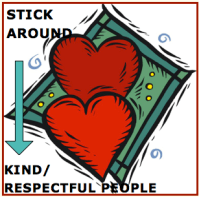
Positive people to stick with: Those who are generally cheerful, discreet, encouraging, friendly, forgiving, loyal, & with good boundaries

Negative people to avoid –
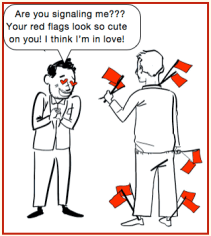
waving big red flags that scream “issues” we don’tred flags want to be a victim of nor take on:
– Overly controlling, always judgmental, critical, know-it-all, bossy
– Talking ‘at’ you, generally intimidating
– Making fun of you or others, gossips, clicky….
– Always complaining about others or the job, without doing anything to improve themselves or the situation
– Only talking about themselves, endlessly

Such types make us anxious or angry. The longer we’re around them the more it harms us. We’re so used to it from childhood we put up with it. But now we don’t have to!

Re. Our Behavior – at work & anywhere
• Don’t complain about stuff so much: politics, social deterioration, your crazy family, the weather… whatever! Emotionally upsetting things belong in therapy, church, Program…..
AND do not use friendships or romantic partners for therapy. Work on your issues with a trained therapist who knows ACoA issues, & in Al-Anon, ACA, CODA

• DO NOT make fun of or belittle yourself – ever! It’s OK to laugh at our imperfection – not taking ourselves so seriously – as long as it’s NOT from S-H! Denigrating ourselves or letting others do it signals low self-esteem, giving unhealthy people ‘permission’ to disrespect us

Screen Shot 2015-11-27 at 3.49.55 PM• Stop being a “truth-teller” (tattling) unless you need help from an authority figure to stop being abused
• Don’t use feeling terms at work (that’s upsetting, I’m frustrated, angry….). INSTEAD – talk about what you would like to see or do, & make practical suggestions

• Don’t over-disclose to co-workers, bosses & casual friends (serious problems, intense emotions, financial & legal details….). Some people will use them to judge, mistreat, avoid…you. If asked personal Qs, be general or vague, using a rational tone (Adult ego state), & end on a positive note

• Don’t attach to a new acquaintance too quickly or easily. Listen for cues about who they are, so you know if they’re safe or not. That takes time
• Don’t assume everyone’s trustworthy. It’s naive to think everyone usually takes the high road. It’s our narcissism to think others will or should act & feel the way we do

• Don’t trust most people with your secrets, which can lead to betrayal. Be friendly, have fun, but don’t expect others to honor confidences. Secrets are always juicy & some people can’t resist sharing them, while others will use them against you, from jealousy or meanness

• Don’t stay a Scapegoat – work on shedding the “Victim Mentality.” Find & hang on to what’s positive in your life, so you can enjoy them.

RESPONDING to a Scapegoater
Manager: Jill, I need those sales figures to complete my analysis
Scapegoater Boss: Why didn’t you tell me this sooner?
M: Check out the email I sent you last Friday
Sc: I never got it. Blame our server, not me
M: Our system shows that you received & saved the email

Sc
: Oh, those figures. I told Bryan to do them. You mean he hasn’t gotten them to you yet? What’s wrong with that guy?
M: Bryan been working on the account for the past month
Sc: Well … (To herself: “Who can I blame now?”)

NOTE: The Scapegoater will stop blaming – temporarily – if given very specific examples of how their mistakes or miscalculations are the real problem. Being direct & clear makes it harder for them to shift blame.

NEXT: Sayings that Misrepresent #1

ACoAs being Scapegoated – GOWTH (Part 2)


PREVIOUS : Scapegoat #7a

See ACRONYM page for abbrev.


TO WORK ON (cont)
a.
BOUNDARIES  / b. PRESENTATION / c. RELATIONSHIPS

d. COMMUNICATION: ASK, ASK, ASK – never assume you know what others are thinking! Be clear about what you want & then speak up using declarative statements – not circling around a topic or issue. To be effective it has to some from the Adult ego state – not the scared or angry kid

• Ask for things you want or need – no matter how small (even if you can get it yourself) especially when you’re overwhelmed. It’s practice for getting help.
• Ask people to explain themselves, don’t assume you already know: “What do you mean, why did you say that…?”

• Ask for information: “How do you do that, where can I find one, how do I get there…?”
• Ask for respect: “Please don’t talk to me that way, thadirect communicationt’s unacceptable, I don’t like it when you_______ ”
• Ask for clarity: “You misunderstood me, can you rephrase, why did you….?”

e. RESCUING: Growing up a frustrated ‘truth-teller’, it’s time to curb your impulse to focus on other people’s ‘bad’ behavior – especially when it has nothing to do with your life.
Being a scapegoat (SC) is a horribly painful situation to fall into for an Empath. To avoid that, empathic SCs must learn to distinguish between your emotions & that of others‘ you may be absorbing. Stay inside your boundaries!

Two ways :
1. Only speak your own truth, when someone’s upset:
Some people will come to the SC to vent or rant about another person or situation, subconsciously trying to lure the SC into picking up sword-&-shield on their behalf.

If you get riled up when listening to them, check with yourself: “Whose emotions am I experiencing?” Your sensitivity will absorb what others feel, & then want to fix it.
You can choose to listen or not – but do not take on their fear, anger or disapproval. Don’t try to rescue or protect other adults. It tends to backfire!

2. Choose the truths you tell, when something bothers you:
Some things are none of our business. Being naturally intuitive & observant, we’re forever on guard for potential danger – to ourselves.
So when we see someone misbehaving (coming to work drunk, stealing, making a mistake….) we get revved up, our anxiety hitting the RED ZONE.
The WIC is desperate to tell the boss, the teacher, a leader….. DON’T.
When it does not affect your well-being in any practical way – stay out of it!

NEW RULE: If the other person’s actions do not impinge on your rights or freedom, it’s best to not say anything. It’s not your job to be a snitch – anymore. Besides, others probably know about it already.
Instead, keep the focus on yourself. Learning to love our Inner Child helps us legitimately believe & accept our value – being gifted, loving, intelligent, sensitive, & for many – highly accomplished.

STOP being a SC at WORK (& everywhere else)
As we recover, we can stay awake for things we still say & do, often subconsciously, that attract negative attitudes from other damaged people, leaving us wide open to their disdain & disrespect.
Almost everyone else also has unresolved issues – not just us. If we push their buttons, or run into an actual personality disorder (which isn’t always obvious at first), we can easily be victimized.

The ‘Golden Child’ at work (see Part 2)stolen wriitng
If you grew up as the SC, you’re likely to be particularly enraged & hurt by the office favorite, who can do no wrong – just like that sibling!

You may have experienced:
• working your butt off only to have some brown-nose narcissist steal all the credit (or your actual work)
• doing the best job possible & watched others be rewarded

• blamed for something that went wrong when you either didn’t do it or were told to do it by the person blaming you.

SCs have a hard time recovering from the early loss, betrayal & disrespect that can get re-triggered at workthe rage making it hard to focus on the bigger picture. (MORE, re.work favorites…..)
ALSO: many book re. Managing Difficult People

NEXT: Scapegoated Growth #3

ACoAs being Scapegoated – GOWTH (Part 1)

empowerment

I CAN & AM OUTGROWING
this toxic victim role!

PREVIOUS: Scapegoating #6


FOR ALL ACoAs
Emotional damage: Scapegoats (SCs) are forced undeservedly to carry the family’s burden of disowned defects. They drown in the pain of those closest to them, & later in the collective pain of the society – with no one to comfort or understand them

In the process SCs are robbed of experiencing their own pain, denied the opportunity to learn how to contain, endure & grieve the suffering they’ve had to ignore & bury. (What is Scapegoat child abuse?)

No matter what our toxic family role was as kids, many of us tried to bring attention to the family’s dirty laundry,
so it would get corrected, but in most cases that never happened. (This is true even if parents or siblings eventually get into 12-step Programs, but still have not done their own FoO work).
We assumed that if we could make the adults own their emotional baggage, our torment would stop & life would be great.
And so we pushed & pushed – but it only got us more abuse.

• ACoAs desperately want justice / fairness! Failing at this childhood goal, some continue trying to ‘fight injustice’ as adults, especially those of us who were scapegoated. We may become ‘expose´journalist, prosecuting attorneys, ‘church ladies’, public service advocates or whistle blowers….

However, most of us live more conventional lives, with little social or political clout. Even so, we compulsively insist that dishonest & hypocritical friends, relative, mates, bosses (& elderly parents)…. admit their flaws. It didn’t work at home, & rarely works in the adult world either. It still brings negative feedback & so another layer of abuse

TO HEAL
Ask: “Am I willing to do whatever it takes to give up my Scapegoat role?” That’s not always an easy Yes, but do-able. Remember, if you continue to be :
😠 belligerent,  demanding, controlling
-OR-
😔compliant, over-agreeable, too silent, submissive or unclear
THEN
👎🏽 it’s easier for others to end up avoiding, making fun of, manipulate or attacking you
That’s even true coming from people who are not usually scapegoaters!  It’s a normal human reacpull out toxic roletion toward someone acting out their WIC’s damage.
BUT – as you heal the inside, you’ll get better reactions from others! Who knew??

• Once you acknowledge this toxic role that was forced on you, & truly believe it was not your fault (Al-Anon‘s 3 As), you can observe how you perpetuate the syndrome, & slowly change the pattern

❇We can bear to re-feel our old pain IF & when we’re comforted, understood & treated with respect by one or more safe & caring people. Then apply that treatment to ourselves.

TO WORK ON 
a. BOUNDARIES: • Don’t expect others to respect your boundaries. You have to set the standard that’s right for you. “This ____ works for me, this ____ doesn’t, I want to do this, I don’t want to do that…..”

• Practice saying NO – at first in your head – a lot! Then try it out on small things you don’t like or don’t want to do – with people or situations that don’t feel TOO ‘dangerous’ if it doesn’t work out the way you hoped.

• Don’t over-give. Offer a little, & then see what & how much the other person can reciprocate. If the can only give 10%, you give only 10-15%, etc. It’s up to you to not get taken advantage of

b. PRESENTATION: ✦ Walk into every room with head held straight, look at people directly, don’t slouch, walk ‘confidently’ – as if you believe you have a right to be here – even if you don’t feekind peoplel like it.
✦ Dress appropriately for the situation you’re in
✦ Look around & notice what’s going on, notice who’s NOT safe (using your inner radar) ….

c. RELATIONSHIPS: Whenever possible, stay away from the people who originally set you up, or who still treat you as the black sheep in any situation.
Look for people who are already kind, or at least respectful.
If you aren’t getting any of your needs met or are treated shabbily, you can walk away.
We MUST keep the focus on ourselves – owning & correcting our own character defects, AND appreciate & cherish our talents & skills.

NEXT: Scapegoated GROWTH #2

ACoAs being SCAPEGOATED (Part 6)

I NEED TO GET IT – 
that their attacks are not about me!

PREVIOUS: Scapegoated (#5)

SITE: Why does a narcissist need to have a scapegoat?

4. CONSEQUENCES for the SCAPEGOAT
5. Scapegoat-ING ADULT

REVIEW: SCAPEGOATING is a way of acting without integrity – the perpetrator (P) slandering another person in order to take the focus off of themselves.
Most family members, if not all, seem to accept it as the normal way to treat the victim – verbally, emotionally &/or physically abusing one child – & look the other way when the Sc is bullied or otherwise mistreated & made the ‘black sheep’.
It’s usually a long-standing pattern in the whole family, perpetuated because it’s experienced as advantageous – to keep the status quo.

💜 HOW were YOU Scapegoated (Sc)?
This list applies to what happened in childhood, but may still be going on, no matter how old you are. You were the Sc IF YOU were/are —
• picked on by either parent to be the ‘bad one’, who looked for things to make you wrong – most of the time unjustified
• put in the role of family outcast, treated with disdain or disgust by family – & then by yourself
• blamed for others’ actions, & held responsible for family problems, conflicts or challenges, that had nothing to do with you
WERE you
• attacked / punished for telling outsiders the truth about abusive, inappropriate & hurtful family dynamics (‘whistle-blower’)
• never believed when telling the truth about things that actually happened to you or around you, even if you had proof
• blamed for &/or punished for what a sibling did, or for the very same things the other kids were allowed to get away with
• accused unjustly, your actions & motives exaggerated or lied about
WERE you
• told or shown that your accomplishments were bad, ugly, unimportant, useless, worthless
• ignored or rejected by anyone who was/is easily influenced by your torturers (in & out of the family), & perhaps still are
• physically abused (slapped, beaten, kicked, thrown against walls….) whether you did something ‘wrong’, but even when not
• repeatedly accused of behavior only the scapegoater is / was doing (More....)
constantly given contradictory messages or expectations
EXP:
– Parent regularly yelled at you, then accused you of being abusive
– You were being genuinely thoughtful & caring, but told “all you care about is yourself”
– You were the mentally healthiest family member, but accused of being sick, bad, selfish….. Add your own crazy-making experiences

Bill Taylor, of Stressed Health Professionals & Families says: “ One of the most destructive patterns is the scapegoating of a physically or sexually abused child, especially when the mis-treatment is unknown to anyone except the victim & abuser

REACTIONs: Such a victim will often misbehave or be completely withdrawn, take out their anger on others, develop depression or other signs of emotional distress – as a way of handling the anxiety about the abuse.

They are then punished for acting out, by attacks & beatings, which create even more trauma, increasing the child’s misbehavior.
“Most people can’t imagine the daily hell such children or teens suffer from the combination of physical abuse & emotional scapegoating.” (MORE….)

NOTE: The above list applies to many ACoAs, especially in families where all the kids were abused & neglected in various ways.
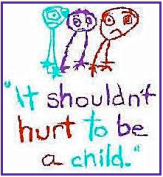
However, the focus here is on the one – out of a number of children – who is tortured, while the others are treated a great deal better – at leastshouldn"t hurt to be ak id on the surface. (MORE…..)
EXP:
💥 In 1995, 6-year-old Elisa Izquierdo was starved and beaten by her mother while her 5 siblings were left unscathed
💥 7 year old Nixmary Brown was the only one chosen for parental abuse & neglect while her 5 siblings were relatively well-treated
💥 In 1996, Nadine Lockwood was starved to death while her 8 siblings were treated fairly well

💧 Not every Sc is tortured to these extremes, but everyone in a scapegoating family is harmed, even those not directly picked on. Just living every day in a sadistic environment eats away at one’s soul – especially vulnerable, developing personalities. SO – if you were not ‘it’ in your childhood, it doesn’t mean you got away emotionally, psychologically & spiritually undamaged.

NEXT: ACoAs being Scapegoated (Part 7a)

ACoAs being SCAPEGOATED (Part 5)

pointing finger

 IT HELPS TO KNOW – I’m not the ‘crazy’ on

PREVIOUS: Scapegoating #4

SITEScapegoating in Families-What We Need to Know

QUOTE: “Most of the time, victims sense that their attacker is a threat, but ignore this inner knowing.” from The Gift of Fear ~ Gavin De Becker, Criminologist

3. Scapegoat-ed CHILD
4. CONSEQUENCES for the SCAPEGOAT

5. Scapegoat-ING ADULT  (towards a parent, boss, mate, adult-child….) Just las in Double Binds, scapegoating can be called “enemy behavior against an innocent & helpless victim”, because the real source of the abuser’s frustration is
• at themselves, but denying S-H
• at someone else who’s not available to be attacked
• someone in their life who’s unsafe to confront

Their frustration is projected on to others (Thoughts) & then acted out (Behavior), usually a person or group without supporters or otherwise can’t protect themselves.  Even if others observe the abuse, they rarely want to get involved, so the victim stays unprotected & alone.

HABITUAL scapegoaters are irritatingly smug, managing to convince themselves that the way they’re treating the Sc is somehow justified. But behind the facade, they’re actually miserable, extremely dissatisfied with themselves & life in general. It’s expressed as hostility – at the least punitive, at the worst sadistic.

Just like double-binders, they raise themselves up by lowering another person, getting narcissistic satisfaction from being controlling, & some from torturing the Sc. Scapegoating is their self-righteous discharge of aggression, which momentarily frees them from a little of their own S-H & inner powerlessness

Narcissists (Ns being overt, & Co-deps because they’re covert Ns) generally blame their bad behavior – addictions, emotional immaturity, volatility, cruelty – on other people or things (partnersangry-father-scolding-son, children, the weather, the ‘system’….)
They’re master fantasists – no one is better than an N for looking directly at another person & only seeing who they want/need that person to be

EXP: When a N parent considers their child, they see many things: a source of narcissistic supply, an ally or obstacle to their lust for personal power, a string of intolerable annoyances, the inconvenience of the child’s emotions & needs, unwanted personal limitations, someone to rescue & take care of them or to take their frustrations out on…. BUT never the actual child.

Scapegoaters’ main characteristics are cowardice, dishonesty, egotism, immaturity, pride, self-righteousness & weak character, with Borderline, Narcissistic or Histrionic Personality Disorders.
They live through a manufactured looking-good public image they desperately need. ANY truth-telling child or other adult who challenges it risks destroying everything, so they have to be stopped at all costs!

• Scapegoaters are not in touch with most of their emotions, rarely knowing how full of hate they really are. They just feel dissatisfied & frustrated, while ‘blissfully’ unaware of the original source of their hurt & resulting ragecenteroftheuniverse

• Since self-deception is a major trait, the Perpetrator’s (P) drive to displace & transfer responsibility away from themselves may not be totally conscious, which makes it easy to cut off any guilt or shame, & deny what they’re doing.
But even if they do become aware of the actual cause of their unhappiness, they can’t or won’t direct their anger where it truly belongs – usually their original family

• To deal with their deep anxiety, scapegoaters will rationalize that this specific victim \ group is somehow responsible for their frustration.
A perfect candidate can be anyone who reminds them of the person who originally injured them (parents or parent-figures). They look for someone who’s not socially confident, is emotionally over-reactive, anxious & self-hating – which makes them an easy target

• Often the main scapegoater (parent, spouse, teacher….) has a good social standing in their community, & some power. Naturally they don’t want to lose either one – at any price. If the Perpetrator consciously knows the victim is innocent, they may increase the attacks, to keep their house-of-cards standing, & keep the upper hand
Assistant scapegoaters will also add to the fire, to stay in the P’s good graces, & to never admit they’ve been gullible – being manipulated into blaming the innocent

• In milder cases, occasional scapegoaters can be anyone temporarily angry & dissatisfied, who uses this tactic as a relief valve. If they’re not too damaged they will experience some shame & guilt afterwards, & pull back.

NEXT: ACoAs being Scapegoated (Part 6)

ACoAS being SCAPEGOATED (Part 4)


IT’S IMPERATIVE I GET  – that I am NOT bad, stupid or weak!

PREVIOUS: ACoAs being Scapegoated (#3)

2. Scapegoating FAMILY
3. Scapegoat-ed CHILD

4. CONSEQUENCES for the SCAPEGOAT
🌊 To survive, Scapegoats (Sc) had to build a wall around the toxic family’s shadow energies they were forced to swallow, hiding the origin of the abuse. Even so, now the least little emotional ‘bump’ is felt as an extreme pain when an event touches any old wound they haven’t yet learned to process & contain.

Common symptoms are academic failure, delinquency, drug / alcohol abuse, depressions, rages, PTSD, stress-related ADD, obsessive-compulsive disorder, sexual acting out/pregnancy….. especially in teens, & can continue for many years into adulthood.

abuse S-H

Sc carry psychological & emotional scars. They may not start out with a mental illness (although some ACoA Sc are predisposed because of parental alcoholism & depression), but are highly likely to develop one or more – after years of being subjected to abuse.

a. The WIC in every Sc automatically assumes they can’t cope with their intense emotions (fear, anger, sadness…)
— & so are often crippled by them in the form of anxiety, -while-
— those who can’t consciously admit they were the family victim mistakenly believe they should not be in so much distress, because to them being ‘normal’ means not being ‘upset or unhappy’.

b. To compensate for being rejected by ‘loved ones’, some Sc cover it up by feeling omnipotent, seeing themselves as the ‘chosen one’ (which they are – but in a very sick way) for having the ‘special strength’ to carry the guilt & misery of others – their way of keeping the family together!

These adult Sc live in the grandiose belief that “I can do everything for everyone who needs me”, while resenting others for not providing them with their own un-spoken needs! They feel cut off from the rest of human experience for having suffered ‘more’ than anyone else, but also superior & above it all!

As the designated Scapegoat, YOU:
• blame yourself for the original abuse, & look for rational reasons for the way you were treated, BUT
• have developed a lack of trust & deep resentment against the world, while maintaining self-hate & hopelessness

• feel worthless, ugly, stupid, incompetent AND crazy!
• live out the negative messages heaped on you as a kid, which prevented self-esteem – by not developing your potential, getting into harmful & unfulfilling relationships, letting abusers walk all over you…..

• may struggle academically & avoid opportunities which include competition – not from lack of intelligence, but from Toxic Rules (CDs)
• OR try to prove your worth by becoming an over-achiever, often to the detriment of you true needs & dreams
YOU:
• feel overburdened, at the edge, marginalized, but still responsible for the tribe’s shadow side (clean up others’ messes, soothe anger in a group, ‘keep an eye’ on everything, listening to others dump, put out ‘fires’….)

• feel misunderstood & burned out, BUT duty-bound, noble, virtuous, self-sacrificing, AND
• are inevitably fueled by the accusing internalized voice (PP) & Self-Hate disapproving of yourself & others, & then scapegoating a child of your own
• feel a lot of shame for being ‘the bad guy’, but also rage at being blamed for the family’s dysfunction
• are desperate to find acceptance but can’t hear complements or absorb caring when it’s available, finding life almost impossible to manage, SO —

• tend to look for acceptance outside of yourself, making you vulnerable to manipulating individuals & groups who thrive on taking advantage.
EXP: Religious cults, criminal organizations, & violent or sexual predators lure their victims by initially offering validation to Sc, who want to belong, but have not learned to recognize users & abusers (underlying similarities to their family)

GROWTH: It can take Sc half a lifetime (30s & up) to get the right information that put the pieces of the puzzle together. Once they realize that all the blame & slander they’ve endured came from the very people who were supposed to love them the most on this earth, they often decide to cut interactions.
★ This may be to avoid dealing with the truth, OR because they’ve developed enough emotional strength & support to stop putting themselves in harm’s way.

NEXT: ACoAs – being Scapegoated (Part 6a)

ACoAs being SCAPEGOATED (Part 3)

 PREVIOUS : Being Scapegoated #2

SITE: “Thru the Looking Glass
(anti-bullying blog)

1. ORIGIN
2. Scapegoat-ing FAMILY

3. Scapegoat-ed CHILD
Scapegoatees (Sc) are the non-entities of the family, held to an impossible standard not required of other members, accused unjustly, treated cruelly, & then ostracized.
The Sc is usually the most sensitive & intuitive child. Having no one to teach it the correct way to use empathy (with boundaries & discretion) this kind of child can easily be used by wounded parents, deliberately or not, to carry the ‘sins’ they refuse to deal with themselves (‘never wrong’, hypocrites, selfish, self-hating….)

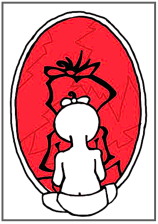
◆ All children need to be mirrored – to know who they are – by looking into the faces, hearts & minds of loving adults. And all children need a degree of connection to family members – some more, some less – to feel safe.

😢 Sadly, too many children only get back warped reflections from parental & teacher mirrors, who provide their own distorted versions of reality.
What sensitive Scapegoats ‘see’ tells them they’re the ‘guilty party’, the one responsible for everyone else’s pain.

With no choice but to believe it, they’re pounded down by this message, forcing them to the bottom of the totem pole, where they stay in school or at work. No matter how well or poorly they do in life – on the outside, they build their life on an unstable foundation of anxiety, guilt & insecurity.

WHY is the Sc child CHOSEN?
🔎 A family’s scapegoating leader will choose a particular child, with ‘assistants’ who follow their lead (sibs, relatives….), because the child MAY –
• be too radically different in personality from the parents -OR-
• have similar characteristics to a parent, who hates those in themselves

• remind a parent of a hated relative, such as their own parent, sibling….
• be seen as a hindrance to a parent’s new marriage or relationship, OR be a child from a previous one
• be hated for being an unwanted ‘accident’, the a product of rape or incest, their birth ‘caused’ the mother’s death or the father leaving….
• be viewed as yet another mouth to feed, a burden to be gotten rid of…….

MAIN Sc “REQUIREMENTS”
1. SCs must actually be the strongest – because they have to psychologically / spiritually & sometimes physically carry the defects of the entire family. Their strength is needed to survive, alone, in the family ‘desert’ without the comfort or support of their tribe. (Part 1)

2. SCs must be the most loving – by their nature willing to sacrifice themselves for the benefit of the tribe. Again, this may be partly unconscious, but as a child the Sc has no choice. On some level they know they’re ‘willing’, so the family can appear to be OK

ALSO – SCs may be
• vulnerable in some physical or psychological way (ADD, obsessive…)
• hyperactive, non-compliant, overtly acting out
• young, or viewed as too weak to defend itself
• not the gender the parents wanted
OR
• too independent, smart & clever, with it’s own mind
• opposite in personality to the designated ‘golden child’ who can do no wrong = like Ivanka.
The favorite can be the eldest, sometimes the youngest, or even a child who died before the Sc was born & is now idealized (More….)

⚡️ In some very dysfunctional families, a parent will goad the other children into also picking on the disfavored one. Or siblings may copy the habit of taunting & blaming the Sc on their own, by watching adults get away with the cruelty. They will do this, at least in part, out of fear that if they side with the victim they’ll be tortured as well

Also, only children raised by severely damaged parents are likely to be alternately treated as Scapegoat & Golden Child, creating great confusion for the child (MORE…..)

⚡️ Once the scapegoating pattern is woven into the fabric of the family system, it’s inevitable that the Sc will gradually empathize with–> then carry–> then identify with all of the unresolved adult character defects that suffocated love in that home.

NEXT: ACoAs being Scapegoated (Part 4)