RESENTMENT- Signs ( Part 2b)

PREVIOUS : Resentment – SIGNS (Part 2a)

QUOTE :
“Resentment and Anger  = To protect, they destroy”


SIGNS (cont)
√ Diminished Empathy — Resentment can sneak into our life in subtle ways. Often, it starts as a small irritation—something we brush off or tell ourselves isn’t worth addressing. Over time, these unspoken feelings can grow, manifesting in habits we might not immediately recognize as resentment.

When painful feelings build, it can cloud our ability to empathize with others. You might feel less likely to understand someone’s perspective, or you brush off their struggles as “not my problem.” This emotional distancing often signals unresolved anger with underlying hurt.

√ Hanging on to Anger
BEING Resentful can make it hard to let go of your anger. You notice that you’re hyper-focused on this emotion, especially whenever having to deal with the person or situation that caused the anger in the first place.  You might even experience a strong desire for revenge.
Consistently feeing this way for too long will take a big toll on your physical & mental health. It can  lead to a real concern for your safety &/or to others.

√ Keeping Score – Keeping a mental tally of everything you’ve done for someone —> compared to what they’ve done for you. While it’s natural to notice some imbalances in relationships, it’s a sign that you might feel undervalued or unacknowledged, & those feelings are bubbling to the surface.
This includes Over-Criticism being hyper-focus on someone’s flaws or mistakes, judgements based on your frustration & unresolved painful emotions. This pattern can push people away, even if your underlying wish is to mend the relationship.  (see also  “Signs in intimate relationships”).
Is there more sarcasm, criticism, more edginess or a negative tone of voice?  Other pointers to resentment : passive-aggressive comments, subtle digs, scoffing & belittling what the other person says . There could also be moodiness or short closed-end statements that cut off actual conversation.

Regret or Remorse
When strong, complex feelings like resentment hang on, we tend to associate it with other emotions like anxiety, guilt, regret, shame…. along with remorseful thoughts, leading to self-blame & wishing we’d acted differently. OR we justify our resentment when others blame us for the difficult situation, whether they are the cause, or if we contributed to the problem by our reactions to the other person/group’s Bad Parent/ Wounded Child’s behaviors.

Dr. Albers : “When we nurture Resentment, it can become a breeding ground for self-doubt, leading to the treacherous trap of gaslighting ourself, This means we distort our own perceptions, question our worth, & let others manipulate our reality”.

√ Relationships Changes
Resentment can cause real shifts & imbalances in a relationship. If you’re holding a grudge, you can lash out at a person in very obvious ways, or react instead passive-aggressively. We mainly hurt ourself by withdrawing from already-formed connections, pushing away casual or new people, & focusing on the negative in ourself & others, isolating & souring relationships.

Whether you recognize it early or catch it down the road, once it’s become all-consuming, resentment is consumed by repetitive  damaging signs & patterns of behavior (compulsive habits). If left unchecked or if you feed into it for too long, it becomes harder to forgive or let go & move on from the fight or betrayal.

Resentment can also lead to ending a relationship, since it can become grating on anyone involved with the ‘resenter’. If you are someone who is always angry, bitter, and feeling wronged—& always talking that way around others—over time people are not going to want to be around you.

√ No Closure
BEING Resentful makes it hard to stop thinking about the event that led to overwhelming emotions, especially if you have / had no closure. These thoughts may come and go, or linger for days, months or even years, depending on what happened & how things were handled.

At its most intense, there may be times you’re caught in an obsessive loop — overthinking the situation about the person, place or events that led to resentment. Continually re-playing the entire situation – you wonder “what if only”- how it could-a-would-a-should-a turned out differently.

(How to get closure without contact).

NEXT : RESENTMENT- Signs ( Part 2c)

RESENTMENT- Signs ( Part 2a)

PREVIOUS : Resentment – What & Why (Part 1)

POSTs :
☁︎”ACoAs & BLAME”
💔 “Parents Blaming us”
🤯  ACAs wanting Revenge


SIGNS
Stages  — While there are no official stages of resentment in psychology, painful feelings naturally can progress from mild to severe. What starts as a real or perceived injustice builds up inside until it turns into anger, hatred, & even a need for revenge.

In the beginning, resentment is mainly about hurt.  You start to build a defense against the pain. Hurt turns into anger, because being angry makes you feel more empowered & in control. Unless you address them, unhappy feelings build & become harder to change or let go of.

√ Passive-Aggression (P,A.) – This is one of the most telling signs of resentment. It can show up as responding with short, clipped answers – when someone asks a question,  or leaving sarcastic notes instead of having a conversation about your upset.  Passive-aggressive behavior comes from an ongoing experience of being unheard, marginalized or ignored, and being afraid to express those frustrations directly. Over time, subtle gabs or double-edged compliments can erode relationships, leaving everyone confused & frustrated.
NOTE : Remember that the underlying emotion is anger which you’re afraid to express or even of admitting to yourself.

√  A variation of P.A. is Chronic Forgetfulness or Procrastination “accidentally” not doing what someone asked of you (which you originally agreed to ), or consistently delaying tasks related to a specific person or situation.
For many ACAs, this is an ongoing way of life, because it’s a copy of a  family pattern, reinforced by Self-Hate & Fear of Abandonment.  However – this style of communication may not show up in all areas of your life, but rather be confined to a definite “People/Place/Things”  situation that causes you anxiety (with a parent, lover,  adult-child, boss….).
In either case it’s not accidental.  Rather than a memory issue it’s a way of expressing resentment without confronting the source directly. While it may feel safer than an outright conflict, it can crease your lack of connection, with isolation & loneliness.

√ Co-dependence Symptoms – when you consistently :
♦︎ allow an imbalance in the give-and-take
♦︎ have your needs go unmet—but unspoken

♦︎
hold yourself to an unsustainable standard
♦︎ say yes when you want to say no
Whether out of guilt, fear, or habit, overriding your boundaries or letting them  get trampled –  leads to frustration & inner conflict. Over time, this erodes your sense of self-identity & safety in the world.

√ Fear & Avoidance
BEING Resentful makes us armor up. Why would you ever surround yourself again with the same kind of people or situations that hurt you originally?
Reaction : But if you have to deal with people or places that remind you of past mistreatment, old feelings of anger & bitterness can get triggered & seem overwhelming.  If your self-esteem tends to be low, you may feel inadequate, even invisible – even if that’s not how you’re actually being treated this time.

EXP : If you’ve been ghosted by a previous partner, you might resent them & anyone else who reminds you of them or how they acted. Your anxiety can get triggered —> about being betrayed &/or their lack of commitment.

Reaction : Withdrawal or Stonewalling . You may find yourself retreating emotionally & physically— avoiding certain people, skipping conversations, shutting down when conflicts show up…. some of the signs that resentment has taken root. Withdrawal can feel like self-protection, but nsteadi leaves issues unresolved, creating an emotional backlog that’s hard to clear.

One way people cope with the fear-of-being-hurt-again is to turn inward, making yourself smaller, avoiding dates & other social gatherings you’d normally be interested in.  On the surface, this resentment-reaction may seem like having power & control over loss & painful experiences. But internally, it can cause real, long-lasting damage to your mental health.

Dr. Albers : “This pattern extends beyond relationships, affecting other parts of our life, like self-worth, personal goals, & career. Resentment sabotages our appropriate expectations of everyone & therefore a willingness to engage with them. Then we go into situations feeling angry & hopeless that things will be better – before they even begin.”

NEXT : Resentment – Signs (Part 2b)

RESENTMENT – What & Why ( Part 1)

PREVIOUS : 27  defects


Standard DEFs : Re-living a persistent sense of ill-will & suppressed anger (obsessions) – a blend of anger, bitterness, disgust, disappointment & disapproval – toward the person or events that led to your attitude.  The focus is on injustice, injury, insult, offense…. done to yourself (or to a loved one ?) – when you think “that’s not fair!”

✅  IMPORTANT Distinction  ✅
Actually — resentment is NOT the emotion of anger itself.
It IS made up of the thoughts (mental obsessions) about the real or imagined events that cause the anger. (“He / she keeps making fun of my ideas….. ignoring me….. breaking promises…..”)

★ Resentment is the inevitable end result of Co-dependent People-pleasing. (Posts: C…. & the False Self.. & Anger…… & Roles….. )
It’s caused by the unresolved conflict between: “I have to  do or be who YOU want, vs. what I need & want – but am never allowed to ask for & get.
Toxic Rule : “Other people’s needs/ wants are always more important than mine.” (Many Posts : Secretly angry nice people)

💔  Negative Benefits
a. Staying in Resentment is a way of distancing yourself from the physical energy of anger, which most ACAs are afraid of letting themself feel. So, instead – we keep ruminating over the way someone or something has “done a number on me”, never actually getting to the combination of emotions that are legitimately underneath (anger, hurt, fear, frustration….).

b. You can secretly feel superior & justify your ‘position’ about what’s “right!!” (I’m talking the high road’) regardless of what’s currently real or possible. Maybe you’re waiting for the other person to realize what they did “wrong” to fix it, and apologize.

OR – hanging on is still wanting the perpetrator to be punished. Letting Go would feel like you’ve “lost”, letting the person off the hook, an admission that your emotional investment in this long-held feeling was a waste of your time & energy.

c. You don’t have to disobey the Toxic Rule of “never being angry at the abusers”. That prevents you from having guilt whenever we go against the family system (actual people who will disapprove, &/ or from your deeply ingrained Introject, the bad parent voice.
SO you can quietly justify holding a grudge, warming your heart!

d. You don’t have to actually feel the rage in your body, accumulated over months or years. The inner terror is that either you’d lose all control & injure or kill the ‘perp’ (which you secretly want) ,
AND / OR you’ll become aware of feeling so-o-o vulnerable (small, weak…. ) so you’ll completely withdraw & wish you were dead.

e. You can hang on to your self-hate which blames you for anything that goes wrong or that causes you to hurt (sad, scared, hopeless…).
That way you can keep the illusion that since you caused the problem (rarely the truth) then you can & should be able to fix it – to stop the pain.  (Serenity Prayer backwards) .

f. It reinforces the Fear of Abandonment – letting you think that you’re keeping safe (from authority figures, from everyone else’s anger) – by not being genuinely visible.
The Wounded Child’s belief is that “If I keep the obsession going (resentment inside your head) no-one will know how selfish / bad / stupid I really am”. Toxic rules say we must never speak our truth nor stand up for ourself.

g. You don’t have to grow up  (I don’ wanna!!) to become a separate being (Individuation).  You’d rather stay psychologically weak & emotionally dependent, never having to say what upsets you, what you need, think or feel, waiting for someone – anyone – to come along & take care of you.

SOURCES
🫩 Accused wrongly, not being heard,  treated unfairly/ unjustly, taken advantage of, your opinions or ideas regularly put down

🧎🏽‍♂️‍➡️Past hurts: Lingering painful feelings from real experiences, in childhood, in bad marriage, by the legal system….  Systemic or historic injustices, such as racism or discrimination

💪🏽 Power imbalances: Someone who actually has more power & control in a situation or over yourself – which you can’t escape.
OR persistently having to deal with people who undermine your authority. Also – someone stealing your work or ideas.

😳 Unrealistic expectations of others that are not met (usually unspoken /assumed)
ALSO realistic ones, based on an ongoing relationship, &/or on promises made but unfulfilled.

NEXT : Resentments – Signs, #2

ACoAs – 27 Character Defects

PREVIOUS : COMMENTS re Abuse Aftereffects (#2)

SITE : Laundry Lists

❇️ AA 4th Step Guide 


Character defects, als0 called negative traits or weaknesses, are  long-standing patterns of thinking & behavior  get in the way of personal growth & healthy relationships.  ** They are not aspects of a person’s native personality, although influenced by inborn characteristics, twisted by long-term emotional & physical abuse  & neglect.

VERY IMP : NO emotion is a defect ! only distorted thinking & self-defeating actions (Post : T.E.A. & anxiety)

Defects are destructive coping mechanisms developed as a way to manage stressors is our early life, because of limited, damaged  or abusive role models we grew up with, & then were carried over into adulthood.  They are harmful because :
🤢 They’ve become compulsive, so they run your life & so have lost power to be in charge of your choices
😢 Although they’ve helped you cope in the past, it’s been at the expense of yourself & others.

YOUR INVENTORY
Pick out one defect you immediately identify with. Answer some questions that help identify how it plays into your past & current behavior.    THEN do it again with another …..
☀︎ How do my actions express it in my every-day life ?
☀︎What are the consequences of this acting out this defect?
☀︎Does it affect my use of drugs or alcohol?
☀︎ How does it slow down my health & Recovery?
«


«
NEXT : ACoA – Growth & Healing

COMMENTS re. Abuse Aftereffects (#2, Reprint)

PREVIOUS : Abuse aftereffects – Part 1

SITE : Original Laundry List
and Reverse Landry List


More RESPONSES from “The MIGHTY” mental health community (cont)
about RESULTS on adults who experienced childhood emotional abuse

14. “I avoid asking help from anyone because I don’t trust anyone. I believe if someone offers me a hand, there will always be something they [want to] ask in return. I have friends but I don’t have a best friend. I keep my distance from people. Automatically, my wall blocks anyone.”

15. “[I have] attachment issues, trust issues [and am] paranoid that everyone will leave me. A lot of this is part of my BPD. My sudden divorce also contributed to these behaviors.”

16. “I’m overly shy around people and struggle [with] having a voice. [I believe] no one wants to hear anything I have to say.”

17. “[I] won’t let anyone see the ‘bad’ side of myself.”

18. “I constantly think I’m not good enough and I’m not smart enough. [I] was told [this] all my childhood… I’ve gone back to university to prove to myself that I am smart enough, but it’s always there in the back of my mind, like a poison, reminding me I’m not good enough, not smart enough.”

19. “My whole childhood was emotional abuse. It is extremely hard for me to accept I have people in my life who actually care about me. That’s the worst one. I am nothing to myself so why would I matter to others?”

20. “I have a hard time making eye contact with people. I look away a lot when I’m speaking. I get startled very easily and it takes me awhile to get my heart rate back to normal.”

21. “I have major issues with anxiety and depression because of my childhood. The biggest factor is I cannot communicate well and I don’t know how to express my feelings with others because I am so used to just holding them inside because I wasn’t allowed to share how I felt. When tense situations arise, I get nauseous and uncomfortable, [and] my anxiety levels sky rocket. Definitely have a lot of emotional scars from my past, it’s been the hardest thing to conquer.”

22. “I never, ever fight back. I may cut toxic people out of my life with the help of amazing friends and professionals, but whenever a conflict is actively going on that involves someone attacking my character… I completely shut down. I let whatever they want to say wash over me until they tire themselves out. That’s what I had to do when I was younger. It was so much worse to fight back. I learned to let them yell themselves out.”

23. Blaming myself for everything. I have to fight the urge to beat myself up constantly. I’ve also struggled with feeling like I’m not good enough, which makes things like school, dating and applying to jobs really hard.”

24. “I don’t really know who I am or what I truly think. Virtually everything I say seems to me to be a lie I’ve just fabricated for that particular situation. I have real problems trying to identify what I’m feeling.”

25. “Several things, but the main one was lashing out on social media for years. Controversial and angry statuses, just due to the anger inside of me. I have texts I sent my friend where I described just how much I felt this unsettling anger in my chest. Emotional abuse from peers at school to family [can] really [mess] you up. I then finally found a therapist who could help me and I’ve come a long way
«

«
NEXT :

COMMENTS re. Abuse Aftereffects (#1, Reprint)

PREVIOUS : 


25 things YOU DO as an ADULT when you’ve experienced childhood emotional ABUSE :

INTRO: “No one escapes childhood unscathed.” is especially meaningful for a person who has experienced emotional abuse as a child.
The effects are both debilitating & far-reaching, often extending into adolescence & adulthood, affecting their self-worth & relationships.
🧎🏽‍♂️‍➡️Emotional abuse may even contribute to an ongoing struggle with mental illness.

RESPONSES from the — “The MIGHTY” Mental Health community

1. “[I] can’t stand conflict, loud sudden noises, shouting and screaming or aggression in any form. [It] triggers my fight or flight, instantly.”

2. “I can’t accept compliments. When someone [compliments] me, my response would just just be ‘umm yeah’ or I’ll just smile awkwardly. I just figured out why… During my childhood, people just [noticed] my mistakes and not my achievements. So now it is hard for me to accept compliments.”

3. “I’m an overachiever. At everything and anything. I still feel the need to prove I’m good enough. I obsess about doing a job/task to perfection. And then I obsess about how I could do it better. [I worry] about others’ opinions way too much.”

4. “I always feel like I am doing everything wrong… It’s very hard to convince me I am good at something.”

5. “I become apologetic over everything. If someone doesn’t text back, I’ll believe they’re upset with me, and I’ll apologize. If I ask for something and annoy them, I’ll apologize. Everything becomes a situation where I feel like I’m to blame.”

6. “I’m basically a hermit. My home is my fortress. I have BPD, PTSD and anxiety. It’s so hard to work or apply myself in school or just life when every time I want to apply myself, I can’t help but run to the nearest exit to catch my breath. I constantly fear everyone around me.”

7. “I have problems trusting people. I keep people at [an] arm’s length. I never really let them into my life. I don’t allow them to know of my health problems and my mental illnesses. If I do let them in, it is rare and they [will] have known me for years. It takes a long time [for me] to build trust.”

8. Indecisiveness. [It feels like] every choice I make is wrong even if I choose the option I’m told to take…I’m afraid to [be a] parent because I don’t want to ‘mess up’ my kid.” 

9. “I avoid saying anything that others might not agree with, which means I’m never being myself. I wear a mask of complete neutrality in any situation, because I’m so scared of anyone feeling negative towards me.”

10. “I’m very defensive which can come across cold or nasty. I also portray quite a lot of negativity which seems to be my barrier so I don’t get hurt.”

11. “I have trouble accepting any kind of love because growing up, it was always given with strings attached or used a tool for manipulation. I don’t trust that others have the capacity to love me unconditionally, so I hide away parts of myself, never allowing myself to experience the vulnerability that comes with being loved, chosen and accepted by others.”

12. “I feel the need to please everybody I deem ‘of authority’ and thus have a hard time getting my needs met. I strive too hard for [a] perfection that doesn’t exist, and then eventually, melt down when too many things are not up to the standards held in my past.”

13. “I find myself always explaining my every move. I explain why I bought something, why I did what I did, etc. I feel like people think I’m lying to them, so I owe them a detailed explanation. Also feeling as though if I say ‘no’ to someone, they’ll hate me. So even if I’m inconveniencing myself, I’ll say ‘yes.’”

NEXT : MORE responses – #2

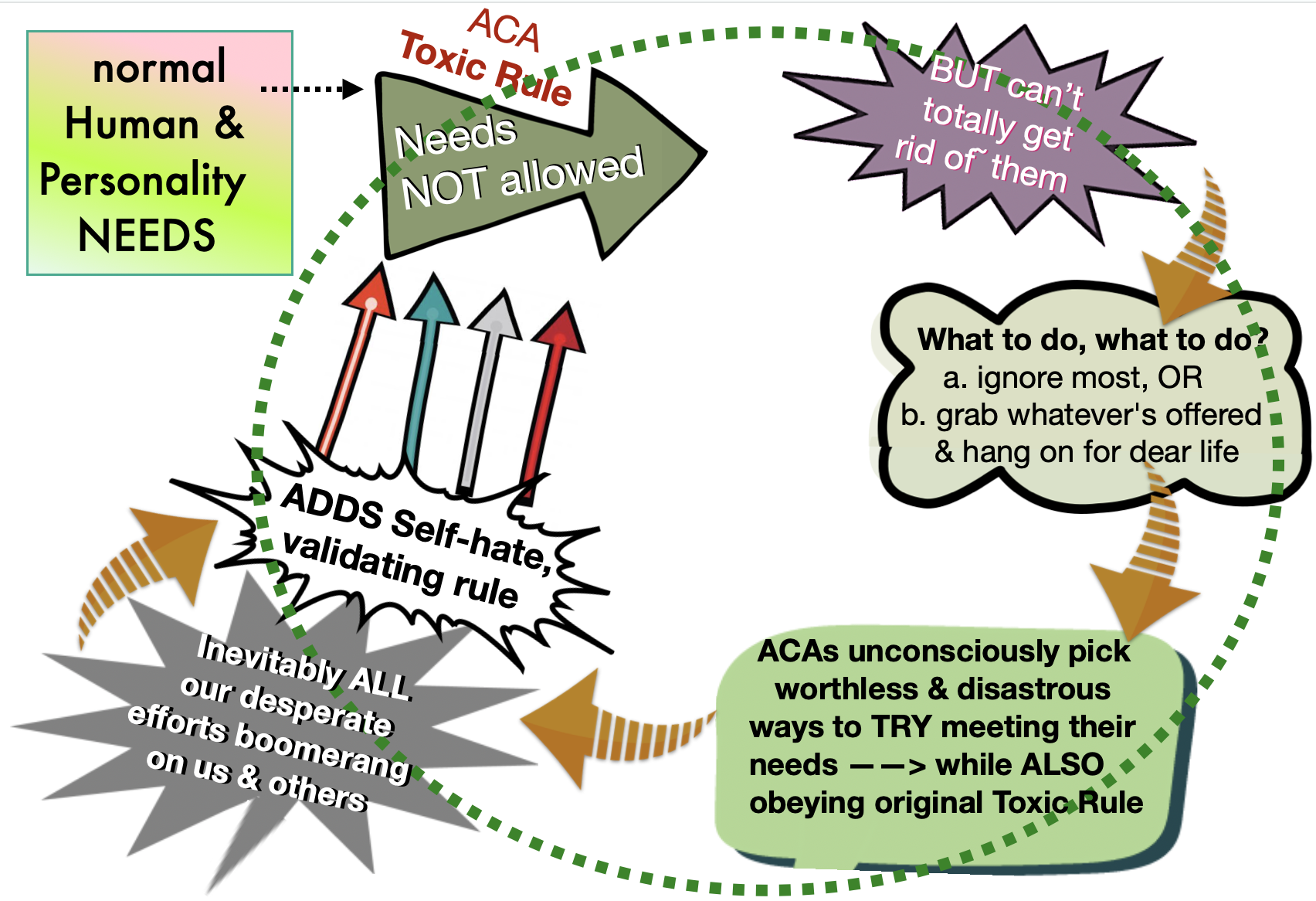
ACoA – Vicious Cycle re. Needs

PREVIOUS : Money Madness – Spirituality & $$

SITE : “What is a Vicious Cycle….. ?

POSTs : “Needs –  Human, Personality & Damaged”
Outgrowing Co-dependent ‘niceness‘    ///  Healthy Boundaries
Deserving vs RIGHTS     ///  Rights Questionnaire (1-48)


NOTE : Everything in this post is a review of all the basics topics written about on this blog, as well as other things you’ve read or heard. But these familiar issues have been pulled together here to focus on a tragic mind-f—k that ACAs are drowning in, always before recovery, often even during.

Def : NEED  – A psychological feature that arouses any organism (humans….) to move toward a goal, giving purpose & direction to their behavior.
❣️ NEEDS are normal, made up of all the elements required for developing a safe, stable & healthy life. Having an accurate & sufficient amount of them fulfilled is imperative,  ☁︎ since a deficiency will have severe consequences : dysfunctional life or premature death.

Q : What is the most basic truth about NEEDS? It’s so obvious that most people have never thought about it, just taking it for granted.
A : You can’t get rid of them!

Q: SO  –  what’s your point?
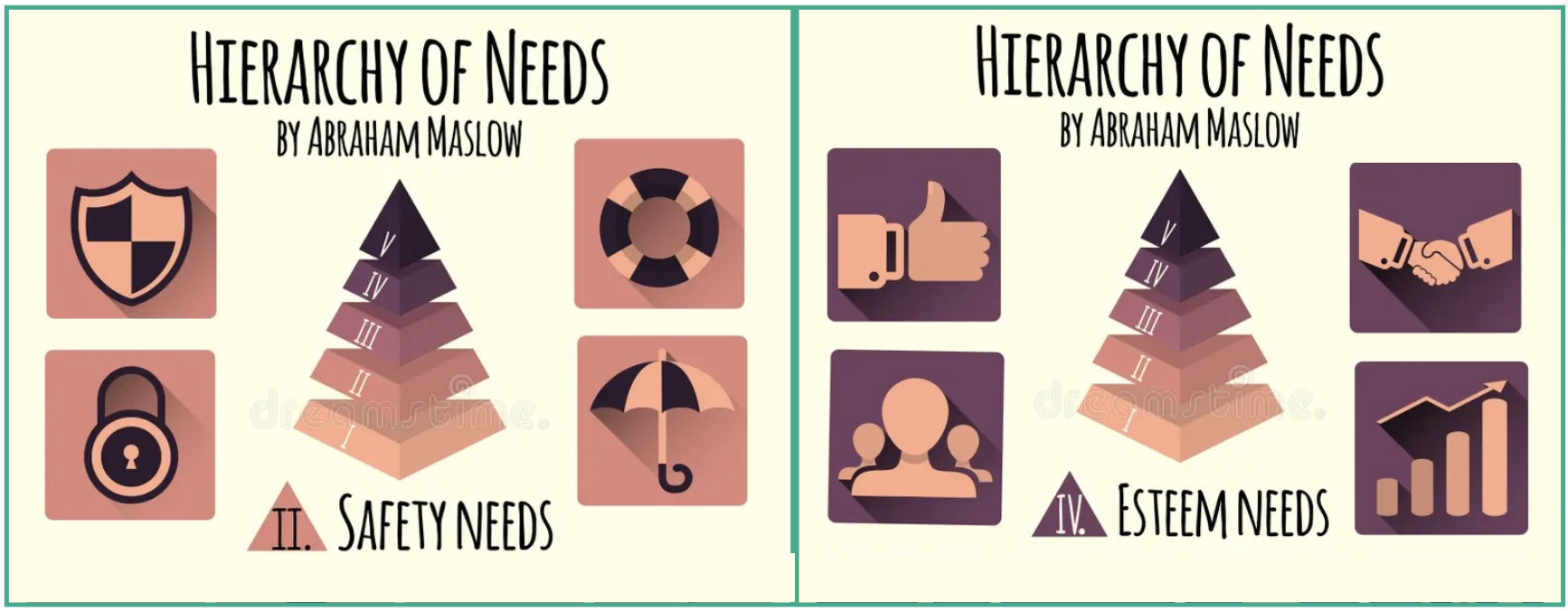
A : Well, as Maslow identified, our needs come in many layers : food, love, a job, friends, education, sex, respect, accomplishments ….

BUT ACAs got the message beaten into our brain – as it was developing all those chemical pathway connections from birth – that we are not supposed to even have needs! much less have them provided.  (Posts: “How the brain learns“)

REASONS: √ our parents weren’t nurtured, so they didn’t know how to pass it on to their children
√ therefore – our needs were too much for them to deal with, & they took their frustration out on us kids for needing them
√ and – their narcissism & various addictions (food, sex, drink, fear & rage….) consumed their life, so there was nothing left for us. Their only focus was on their “issues”.

RESULT: As adults, we don’t even seem to know what our core human requirements are.  What we mistakenly assume to be needs are more likely to actually be physical & psychological addictions, unattainable fantasies, impossible goals based on toxic rules, a need to be perfect, getting love from narcissists….

Co-dependence :  besides, what we think are our needs — are only what other people demand, need, want –  which we’re convinced we MUST support, help with or provide, even if we don’t want to, & no matter the cost to ourself !
❤️‍🔥 ACoAs’ ingrained belief that pursuing one’s own needs first (or at all) = is selfish, therefore bad, and will harm others! It’s true that narcs won’t like it if we do, but is actually the best form 0f Self-Care, the road to healing the Inner Child’s wounds.  (Post: review of Healthy Rules for ACAs)

🖤 Here is the vicious cycle of self-defeating efforts, vigorously pursued by all ACAs, but especially by the unhealed smart, actions-oriented ones.  It’s a Double Bind =
a. Make every effort to meet my needs, wishes, dreams met,
——— AND at the same time  ——-
b. Make sure I do not, so I can stay loyal to the family, culture & religion.
We’re compulsively  – but unconsciously – obeying toxic rules :
√ You have to always struggle but never get there
√ Don’t talk, don’t feel, don’t think
√ Other people’s need are more important than mine
√ If you don’t like it you have to stay      (MORE …..)
«


«
RECOVERY:   Read, save & apply the 3 posts of  HEALTHY RULES  to break this vicious cycle. Also, see Overview .

Remember : Actively applying the RIGHTS to your life – slowly,  ODAT – is the way to get NEEDS MET.

NEXT : Comments – Aftereffect of abuse, #1