

PREVIOUS: Maslow – Part 1
MISUNDERSTOOD – At the time, some psychologists considered this hierarchy to challenge other models as either superior – to be feared, resented, or boot-licked, & admired, OR inferior – to be scorned, humiliated & dominated (Maslow, 1943a, p. 402).
But it was not his intention for it to supersede or be superior – it was mainly to be used as a logical framework to understand human motivation.
T.E.A.: The Pyramid of Needs does not refer to intelligence levels or talent. Instead, it’s about the never-ending process in life of making our potential a reality – living to the fullest, without the limitations & toxic thinking we grew up with. It’s about learning to trust our own judgment (T) & our inner feelings (E), & to act accordingly (A).
Maslow identified the first 4 levels – physical, security, social & esteem – as deficiency needs (DN), which have to do with deprivation – basic things that must be attended to or provided. Satisfying them avoids unpleasant feelings &/or consequences.
The higher one deal with growth needs – later called BEING-needs (BN), which is not about a lack of something, but a desire to improve oneself. He made happiness & self-fulfillment (Level 5 – & much later ‘Trancendence’) a central part of his life’s work – convinced that following our personal instincts leads to more accurate decisions about what’s truly right for us as individuals.
As one grow / mature further up thru the stages, each need becomes less about survival, & more about emotional issues. We have the opportunity to trust ourself….. to trust that we’re safe now, so we can step outside our self-limiting ‘protective’ shell.
Idealistically, at first he believed that we all want to move up thru the Levels toward self-actualization – the highest achievement – an expression of the True Self. Eventually he understood that not everyone is interested in or is willing to try. Also, knowing that progress is often disrupted by unforeseen circumstances out of our control, he realized very few are able to become fully self-actualized.
He also recognize that not everyone follows the same pattern in working their way up to the top. EXP: Someone may need self-esteem more than security….
While the pyramid levels may seem logical & straightforward, in practice moving up the ladder is a complex, life-long process. It’s rarely smooth, often thwarted by :
• getting stuck at the lower levels if the needs can’t be met for some reason, or because the person won’t risk moving up
• life’s unpredictable ups-&-downs can keep someone constantly fluctuating between level
• society only rewards motivation based on social needs such as money and power-positions.
In relatively ‘normal’ families (healthier than ours), the first 4 levels help children develop the capacity to make good life choices. This went seriously off track for us, so we need to go back to the beginning – applying what we’ve learned as adults to correct distorted beliefs, replacing them with compassion & the right info – to take better care of ourself & more easily connect with others.
INFORMATION wanted at each level
 • at #1 (physical) we want coping info, to meet basic needs. Anything that doesn’t directly relate to quickly providing survival & sustenance is simply ignored
• at #2 (safety) we need helping info, looking for ways that others can make us feel safe & secure
• at #3 (love & belonging) we want enlightening info, perhaps found in books, classes, therapy…. on relationship development
• at #4 (esteem) we look for empowering info – how our Self can be developed
• at #5 (Self-A), we want edifying info (cognitive, aesthetic & transcendent/spiritual) so we can connect to something beyond ourself, and to learn how we can help others. (Norwood – 1999)
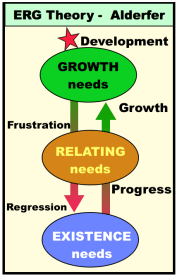
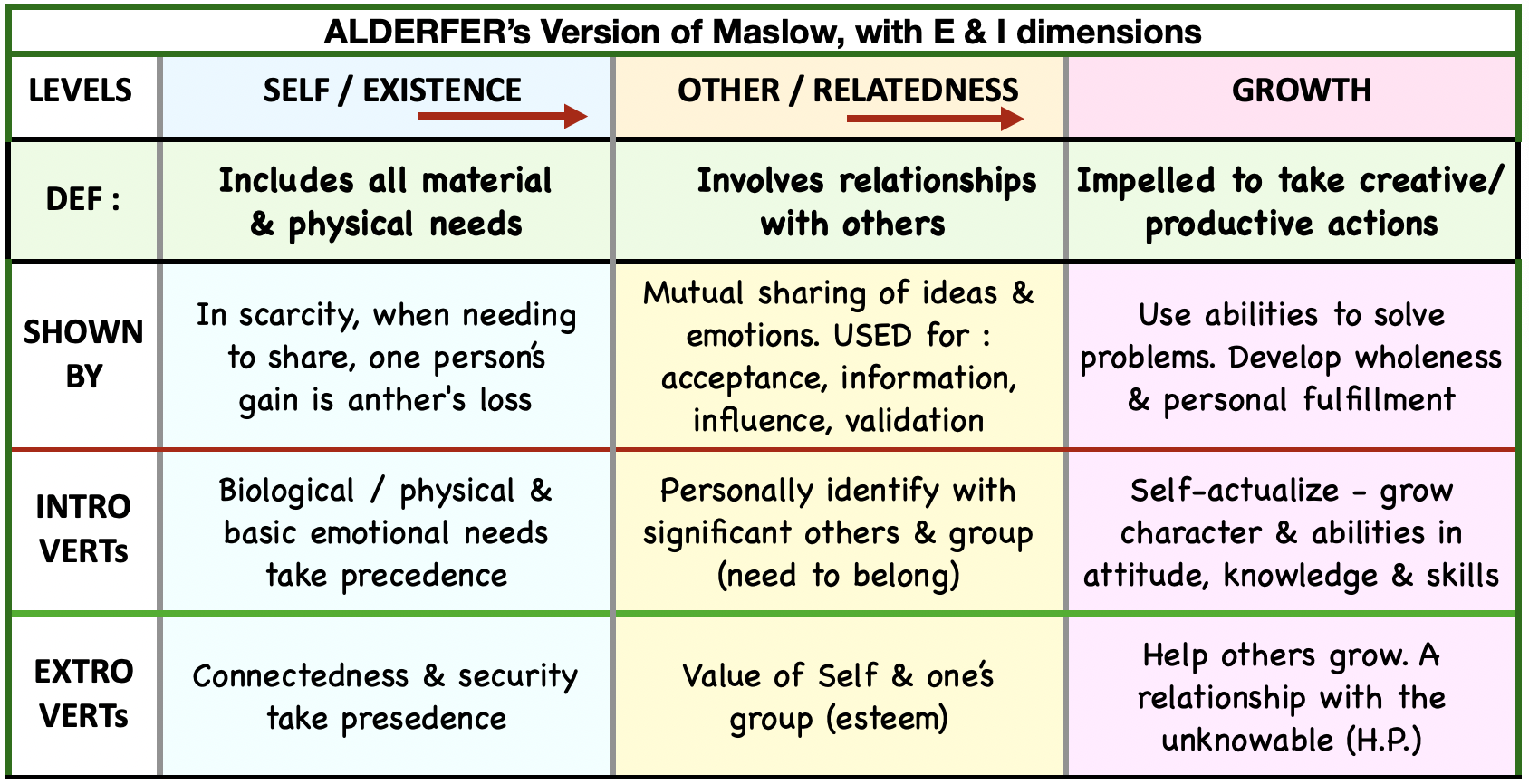
Since Maslow’s Pyramid (1940-50s), there have been many other ways to classify personality traits / dimensions : Enneagram, MBTI, the Big Five, D.I.S.C., Holland Code, Burton….., and C.P. Alderfer, who compressed Maslow into 3 categories (Existence, Relatedness, Growth).
Note differences between I vs E needs. (CHART- combo) ↓↑
«
«
NEXT: Level 1

