DEFENSE MECHANISMS (Part 2)

no see, no hear, no talk
I HAVE SO MANY OPTIONS 
for escape!

PREVIOUS: Defense Mechanisms (#1)

SITE: “Types & Uses of Defense Mechanisms


ALL DEFENSES are used to avoid some form of anxiety
Acting out – coping with stress by taking actions, instead of actually feeling one’s emotions about the situation
Affiliation – compulsively turning to others for support, instead of being in charge of their life

Aim Inhibition – settling for a modified version of their original goal (as in “Those who can’t – teach”)
Altruism – gaining satisfaction by self-sacrificing service to others, or participating in beneficial social causes

Asceticism – the moral renunciation of certain pEnneagramleasures, to avoid the internal conflict associated with impulse-gratification
Avoidance – refusing to deal with or face an unpleasant person, object or situation

Compensation trying to make up for what one sees as personal deficiencies
Conversion – a repressed mental conflict turned into a physical symptom

Denial – unconscious need to refuse acknowledging important parts of oneself, of ones own experiences or of external reality, even though these things may actually be known or perceived
Displacement – shifting emotions or mental conflicts about one person or situation onto another. It’s ‘dumping onto’ one person what one feels towards someone else (kicking the dog instead of the boss)

Fantasy – a retreat into a dream world, mental drifting back to ‘better times’ or to an ideal place…. when concrete, adult action is needed OR when the current situation is experienced as completely hopeless
Idealization – making up a fantasy image of PPT (people, places, things), rather than seeming them realistically,
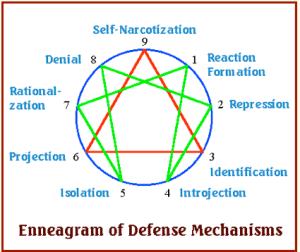
to deny aggressive or competitive feelings towards someone they love or are afraid of  (Enneagram defenses ↗️ )

Identification: model oneself on another’s persona, in place of developing a ‘Self’ of their own
Intellectualization – warding off unacceptable emotions & desires by only thinking about PPT rather than experiencing them directly

Introjection
– imprint onto oneself another’s whole personality, (psychologically absorbing another person into the developing Self) to avoid directly expressing powerful emotions such as love, rage, hate, envy….
Isolation (not isolating) – cutting off from memory painful emotions caused by a distressing situation or trauma, so no longer trigger anxiety

Projection
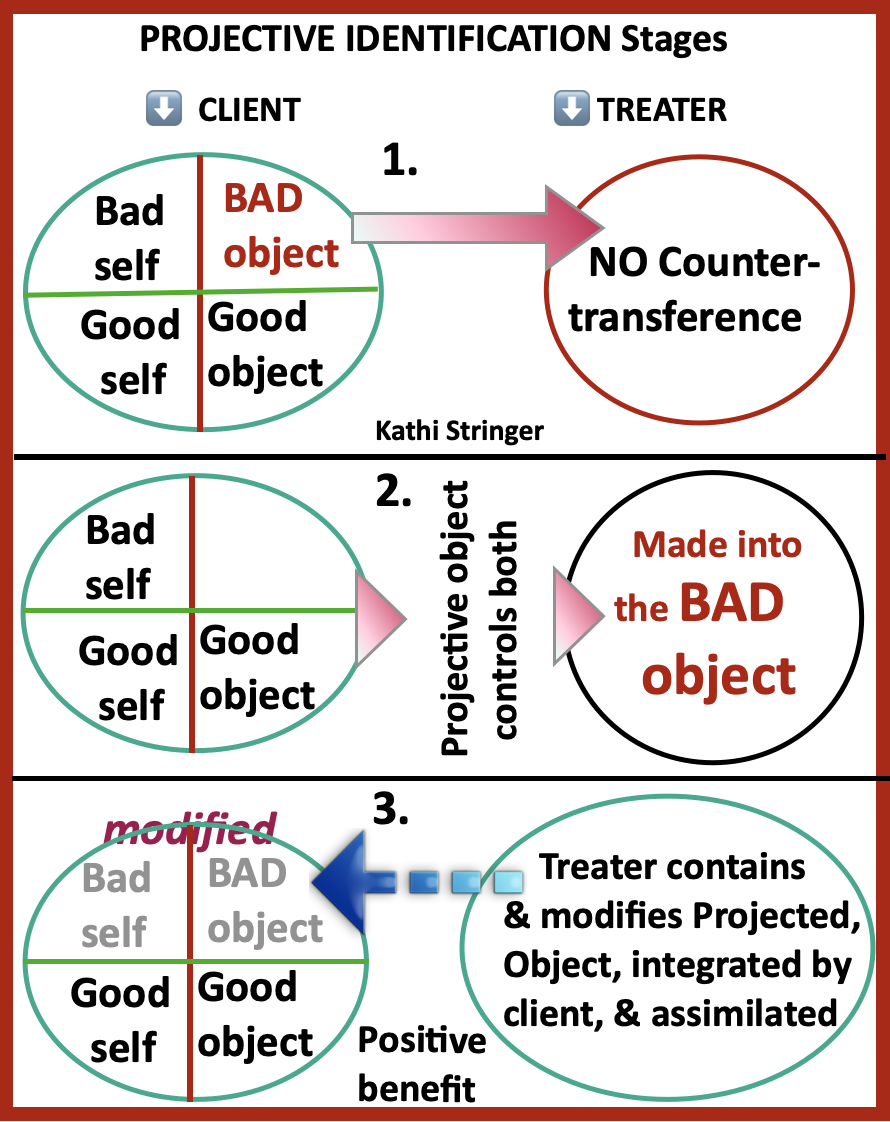
– attributing to others ones own unacceptable but unconscious thoughts & emotions. Disowning unwanted parts of oneself by only seeing them in others, & then hating that person or quality
Rationalization – use convincing ‘logical’ reasons to justify an idea, emotion or action, to avoid recognizing the real but unacceptable underlying motive for ones bad behavior (like getting defensive)

Reaction formation – compulsively saying & doing the extreme opposite of what one really wants, but is afraid of (violently preaching against lust, while not admitting to being filled with sexual longing)  (CHART INFO ⬇️ )
Regression – unconsciously retreating to the actions, feelings & beliefs of an earlier developmental phase when feeling threatened (tantrums)
Repression – keeping unwanted thoughts & emotions out of awareness, which can include forgetting actual painful or traumatic events, or those associated with painful emotions
Reversal – turning a feeling, attitude or behavior into its opposite
EXP: when masochism is replaced by sadism, love into hate….
Simple denial: unpleasant things are treated as if they don’t exist

Splitting – characteristic of borderlines, it’s the inability to hold in ones conscious mind both positive & negative qualities of the Self or others in a realistic whole (like loving & hating the same person or thing)
Somatization – when intolerable impulses or conflicts are converted into physical symptoms (suppresses rage into an auto-immune disease)

Sublimation – redirect id impulses (a socially objectionable desire or goal) into socially acceptable activities, while still retaining the original goal of the impulse. It’s considered the most “mature” defense. (Play football instead of fighting, make art instead of adultery)
Suppression – painful emotions & events are consciously ‘stuffed’ down.
Undoing – involves symbolically nullifying or voiding an unacceptable or guilt-provoking act, thought, or feeling

NEXT: Enneagram Strengths #1

DEFENSE MECHANISMS (Part 1)

defense typesI USE WHATEVER I CAN
to escape my fears

PREVIOUS: Enneagram Humor #4

REVIEW posts: Abandonment Pain

SITE: Defense Mechanisms Quiz

BOOK:In sheep’s Clothing (re. manipulative people) go to slide 50 ++

DEF: Unconscious & conscious processes to defend against or escape from conflicts, frustration & depression, so that the person can make useful adjustments to be able to live in their society.

REMINDER – as such, defenses are NOT bad. They’re needed to cope with life’s difficulties, as when we use humor to lighten our mood or altruism to lighten someone else’s load.
At best – most are delaying tactics, giving us breathing room to take a break & re-group.
The problem comes when any one of them become ‘land-locked’, so deeply ingrained that it can’t be given up easily, so rigid that it’s used like a hammer on every problem, regardless of size or importance.
tree of defenses
• In that case they become Negative Benefits” – used to avoid childhood or other trauma which the person does not want to deal face. To better understand what these are, we need to know about Defense Mechanisms, which were first identified by Freud, & then added to over the years by others.
He noted that people have wishes, desired & impulses that are either unacceptable to their society, religion or family – or their own sense of self  (CHART)

• The fact that the impulses don’t go away, but are usually hidden in our unconscious, leaves a residue (like at the bottom of a bottle) of anxiety*.
Keeping the impulses pushed out of awareness takes a lot of energy – which is exhausting, but considered by the ‘user’ to be safer than admitting them
(EXP: wanting to kill one’s parents or oneself). We do this by using Defenses. Which ones we pick will depend on our upbringing & our native personality.

*ANXIETY types, according to Freud
1. Neurotic – the unconscious worry that we’ll lose control of the id‘s urges, resulting in punishment for inappropriate behavior
2. Moral – the fear of violating our own principles
3. Reality – the fear of real-world events, usually easy to identify.
EXP: Fear of being bitten when near a menacing, snarling, barking dog is appropriate – so it’s best to avoid genuinely dangerous situations (PPT) if at all possible.

Defense Mechanisms distort reality
In proper proportion & with limited use they can also be adaptive, allowing us to function normally in very difficult situations, where there are no better options

The big problem comes from over-use, as a way of life, especially when they’re no longer needed. What was once a way to cope then becomes the problem. A goal in Recovery is to make the extreme / harmful use of defenses conscious so the we can develop healthier ways of handling anxiety & stress – without eliminating defenses altogether.

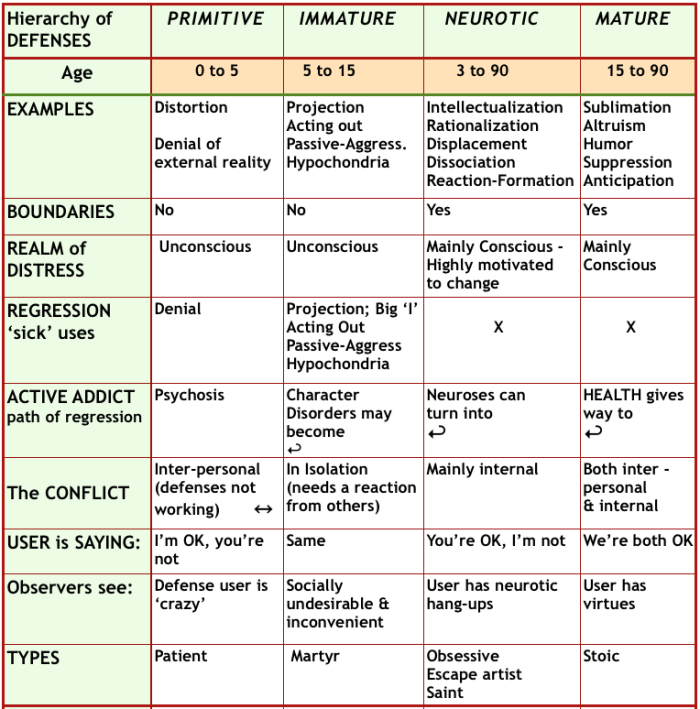
Sdefenses hierarchy


NEXT: 27 Defenses

ACoAs & PROJECTING (not Projection) (#2)

PREVIOUS : PROJECTING (not Projection) (#1)

SITEs:  Hope Vs. ‘Realism’ – Challenging the Negative Assumptions of our Fears

•“Things My Dog Taught Me: Don’t Project Negatives”

ACoA NEGATIVITY
Underlying BELIEFS / 
assumptions
• We have no choice but be trapped in bad situations (Toxic Rule: “If you don’t like it you have to stay”)
• So we have to figure out all the bad things that will for-sure happen – to us, or to a loved one, a family member, a beloved pet, the new job, house, neighborhood, the world
• And, the more we prepare for the inevitable, the more we can protect ourselves

Secondary assumptionbased on S-H, also a defense mechanism:
Since everything bad that has happened & is happening to us (or our loved ones) is our fault, we have to figure out how to correct the problem in order to stop the pain
• If we fail, it just proves how worthless & stupid we are, & therefore unworthy of anything good

We’re Double Binded when: (post = ACoA Double Messages)
A. we think that if we’re prepared for the worst, it won’t be sI=C reatingo painful, we’ll know how to fix things, be able to manage, won’t be so effected….
At the same time:
B. we are not allowed to make things better, so
• can’t even imagine viable options, much less implement them, and
• can’t ask for appropriate & useful help, much less leave an unsuitable person or bad environment

REMEMBER
• it’s the WIC who is projecting negatively, based on actual childhood (& many adult) experiences. It still believes the PP voice (negative introject), with its cruel Rules:
“Life is only hardship, You can never be happy, You have to keep struggling, You can never ‘get there’, You have no choices, Don’t ever risk...”

• the difference between Feeling (emotion) & THINKING. Projections are ALL thoughts, which cause fear & hopelessness, which won’t diminish until the beliefs are replaced. (posts: Anxiety & T.E.A.s)

• negative projections are always CDs (cognitive distortions) learned a long time ago, which DO cause painful emotions, like anxiety & despair AND rage.
(posts: “Feelings aren’t facts”)

🔅NOTE: Projecting is NOT the same as Planning Ahead.
Planning ahead starts with the assumption that things are possible, that we can do it, & that we have options. It can be: evaluating a current or potential relationship, a new job or living space, picking a pet, a diet, a doctor, a vacation…..

• It DOES includes having or getting enough information so we can do a ‘cost-benefit’ analysis (pros & cons), & inventory our assets or liabilities – to fill in what’s missing (if possible).
• It does NOT include unrealistic expectations, denial about whats not feasible, nor narcissistic entitlement (to what’s not rightfully ours.)

RECOVERY 
Whether you’re having trouble with a person or situation OR going to try something new / different, OR making a change:
1KNOW YOUR RIGHTS! – in general, as well as specific to the issue
(posts: My Rights // Healthy Rules // Recovery Thoughts // What Recovery IS)

2. Develop the ‘UNIT’ to take charge of the WIC, correcting CDs as they surface. Set a healthy boundary with the Bad Voice: “Stop scaring my kid!”
(posts: What just happened? // Noticing painful events)

3. Comfort & dialogue with the Inner Child all the time, not just when you’re upset!
(posts: “Our Wounded Inner Child”, Bookending with the IC”)

4. Use Positive affirmations, using your own – they work best. They need to be directly opposite the specific beliefs your WIC is holding, or a replacement
EXP: “No one can ever love me” becomes “______ & ______ & ______ & _______ love us, I love you & HP has always loved you”

5. Get help (if you need some) TO:
• identify what you really want & need in a situation
• figure out the most useful opposite beliefs
• learn what legitimate options there may be
• list realistic pros & cons
(posts: use charts in Why are you stuck?, and What to Do when confused)

6. Don’t neglect your spiritual needs. Read the Psalms, watch TED Talks, listen to soothing music, pray for guidance – for ‘right thinking’ & to heal the underlying terror all ACoAs carry from childhood.

NEXT: Defense Mechanisms #1

ACoAs & PROJECTING (not Projection) (#1)

projecting 

THE SKY IS FALLING! THE SKY IS FALLING!
or it will any minute now!

PREVIOUS: Book Suggestions

SITEs: “Mistakes of projecting your future” (AlcoholicsFriend.com)
• “Negative Risk (threat) & Positive Risk (opportunity)”
“You should Visualize Positive & Negative Outcomes More”

DEF: PROJECTING (a CD=cognitive distortion) – Imagining one or more bad / painful / disastrous things will always & inevitably happen in the future, in general or re. a specific person or situation (victim mentality / ‘learned helplessness’ / scapegoat)

NOTE: This is not the same as correctly knowing who someone or some situation actually is, & what to expect of them.
EXP: “My whole life my mom has said mean or insensitive to me or about me. She’s never changed, so I know any time I talk to her in the future it will be the same.”

❎ SIDEBAR
Projecting is NOT the same as Projection – a defense mechanism (via Freud), in which a person:
a. Re. US – When we unconsciously reject one or more unacceptable qualities we have – or believe we have – AND attribute / assign those same qualities to another person, animal or situation.
Often the ‘others’ do not have those characteristics. So it’s
inevitable that in some cases projection will result in false accusations.
Everyone Else’s Fault?…..” //  Don’t Project Your … Inadequacy Onto Others

EXP: “I can’t trust anyone because everyone lies” (deny being a liar oneself)
“I know she hates me” (deny our own self-hate OR that we hate that person)
VARIATIONS:
• Complementary = assume others think or feel the same way we do about things
• Complimentary = assume others can do the same thing  – as well as OR in the same way – as we can
📌These are both expressions of narcissistic thinking (you & I are “one” – the WIC’s desperate desire for a symbiotic connection) (MORE…..)

b. Re. FAMILY – To attribute actual negative characteristics of our dysfunctional family members on to others, who may be like them, only a little, or not at all.
EXP: My father was a mean abusive drunk, therefore all men are bad / dangerous // “All authorities are evil, out to get me”

✳️ Back to PROJECTING
In BIZ: Positive OR Negative scenarios

In business it’s called forecasting, looking at all possible outcomes based on previous performance.
Projections are not budgets, rather “big picture, what if” exercises, done at a higher level of abstraction, ie context (See “D.Binds #3a“), with a ‘what is hoped for’ & “what could be” perspective.
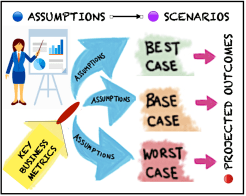
NOTICE – a savvy business plan always includes 3 major possibilities. CHART

For ACoAs – However, most of us almost never project that things will work out, that we’ll be happy, that we’ll get what we asked for, that our relationships will be beneficial, that we’ll get the job we want…. No-o-o-o!
We assume the worst – only projecting negative outcomes – pain, disappointment, suffering, disaster.

▶️ The exceptions are the severe narcissists (& active addicts) who only project ‘positive’ possibilities, which often are simply pie-in-the-sky schemes which never come true, because either they don’t have the skill & inner motivation to make it happen, it’s a stupid idea, or not actually do-able.

WHY assume negatively? BECAUSE :
a. our childhood was filled with endless suffering & deprivation, so that’s our template for rdisaster forecasteality, becoming our world view  (POSTS: “Information & the Brain – How we learn“)

SCIENCE –Brain’s Negative Bias  : “The brain reacts more strongly to stimuli it deems negative, with a greater surge in electrical activity….. historically. our very survival depended on dodging danger. The brain developed systems that make it unavoidable for us not to notice danger & thus, hopefully, respond to it…..

b. we have unconsciously, but consistently been reproducing that original chaos & abandonment in our adult life. (Repetition Compulsion).
Unfortunately, it’s the WIC’s way of staying loyal to the family system, even though it was harmful to our parents & continues to harm us

PSYCH – Bad is stronger than good ….Many kinds of trauma produce severe & lasting effects on behavior, but there is no corresponding concept of a positive event that can have similarly strong, lasting effects……”

NEXT: Projecting #2

BOOK Suggestions

images-1


PREVIOUS : Enneagram Defects, #3c


The TOOLS – to help & inspire you to live life in forward motion”
~ Phil Stutz & Barry Michaels   / thetoolbook.com

COMPLEX PTSD”  –  Recovering from Childhood Trauma
~ Pete Walker

TRAPPED in the MIRROR” – Adult Children of Narcissists In their Struggle for Self
~ Elan Golomb, PhD

PSYCHO-CYBERNETICS” ~ Maxwell Maltz, M.D.
Cybernetics is a network of constant feedback loops in the brain, correcting its course & receives further feedback on the success of the transmission. This allows us to travel to places we don’t have the instructions for beforehand, & build on the history of our actions.

NO-DRAMA DISCIPLINE: The Whole-Brain Way to Calm the Chaos and Nurture Your Child’s Developing Mind” ~ Daniel J. Siegel & Tina Payne Bryson
COMMENT: They talk about what works & what doesn’t – in disciplining your “outer” kids – but can apply to dealing with the Inner Child as well.

“30 COVERT EMOTIONAL MANIPULATION TACTICS” ~ Adelyn Birch
How manipulators take control of personal relationships – re mates, but is also clearly about our family’s ‘games’.

“ADULT-CHILDREN of EMOTIONALLY IMMATURE PARENTS” ~ Lindsay C. Gibson PsyD. How to Heal from Distant, Rejecting, or Self-Involved Parents who create a sense of neglect, & discover ways to heal from the pain and confusion caused by your childhood.

Pls let me know if these are helpful.

Thanks, DMT