ACoAs & BLAME (Part 1)

the BLAME GAMETAKING RESPONSIBILITY
is a healthier way to live

PREVIOUS: Revenge #2

SITE: “Blame – What’s the Use?” Psych & religious

PostSatir’s BLAMER Role


BLAME as a ‘social disease’
– by Carl Alasko
“Deeply embedded throughout our society is the destructive psychology of blame. We tend to view it as a necessary behavior, a way to seek justice, a synonym for accountability or responsibility. It is none of these.
In fact, blame is a four-headed beast that attacks our very spirit.

We can launch these behaviors separately or fuse them into an assault that can annihilate the intended target. Painful emotions can & do kill. Consider those who commit suicide when battered by just one of these toxic tactics – that of humiliation. Indeed, blame is so unrelentingly harmful exactly because its primary function is to injure.

• There’s also an unacknowledged psychological paradox embedded in blame that preserves its vampire-like longevity : Screen Shot 2016-06-01 at 4.04.05 PM.pngHuman beings are hard-wired to dump their uncomfortable emotions on to others. So blame helps reduce our anxieties by externalizing our fears & stresses.

Naturally this does not excuse or condone it, since humans are also capable of learning how to accept & deal with our inner ‘demons’.

We see how political candidates temporarily surge in popularity when attacking an opponent, which reinforces the ‘value’ of the tactic. Then the opponents responds in kind, & the cycle continues. This dynamic is also at the root of bullying, whether in school or on the street. The bully’s internal anxieties are relieved by debasing another person or group. Thus blame feeds the roots of every form of bigotry, sexism and racism.”

🌀 🌀 🌀

ABUSE / cruelty : ‘Blaming the victim’ is holding someone responsible for pain they have or are suffering, especially when they did not cause it & had no way of preventing it
EXP: Born with some defect, illness, deficiency…..

Adult Blamers, in the present : the mental decision (conscious or not) to accuse someone of causing our suffering (even if accurate), WITHOUT acknowledging any possible part we may have in the source of our pain (sticking around for it, misunderstandings….)

Damaged parents often blame their children & the whole world for their own short coimages-2mings & life stressors (“Your made me hit you! If it weren’t for you I could have…..”). Then it’s only natural that as children we take on the blame. So we learned to:
• hold ourselves accountable for what was not our responsibility, AND
not hold others accountable for their bad behavior, and/OR
• blame others for our troubles, the way our parents did

SELF-HATE is the result – incorrectly blaming ourselves when anyone hurts us, even though we have nothing to do with causing it.
ACoAs IRONY:
While easily pointing out other people’s shortcomings (as it affect us, of course), <—-> being hurt by them triggers our S-H, to deny feeling vulnerable.
Actually, we have it backwards – we blame ourselves for the source of our pain to avoid holding our parents accountable for those original wounds.

Reality : We did not deserve being blamed as kids, & we don’t deserve our S-H now, which is simply agreeing with the Perpetrators. In many alcoholic & other unhealthy families, no one recognized or took responsibility for their abusive or neglectful ways, & certainly never for their twisted thoughts & disowned emotions.

• It’s imperative for ACoAs to identify when or if someone is actually doing something harmful, neglectful, abandoning – to us or to others. If we are not sure, we can start by making a list of all the ways & times various people have hurt us or our loved ones, & look for common threads. (22 POSTs : “What just happened?” re. Noticing Painful Events)

This inventory is a sincere effort to clarity what we’ve experienced, especially when at the hands of someone who is taking out their damage on us.
The legitimate motivation for this kind of writing has to be the desire to identify & distinguish between:
• when we’re angry because of unrealistic expectations & assumptions, vs.
• breaking denial about harmful relationships we hang on to, so we can outgrow the addiction to abuse

NEXT: Blame #2
ACoAs – ARROGANCE (Part 1)

I CAN ONLY STAND MYSELF  – if I pretend to be superior!

PREVIOUS: Humiliation (#3)

SITE: The Difference Between Confidence & Arrogance is Empathy
Teaching Humility in an Age of Arrogance

QUOTEs:“Much to learn, you still have” ~ YODA to Count Dooku, StarWars II
• “Do you wish people to think well of you? Don’t speak well of yourself” ~ Pascal

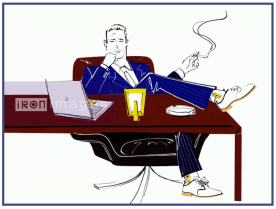
DEF: ARROGANCE (ARR) = inflating, exalting, over-valuing oneself. It’s “Bigging yourself up”, whether publicly or just inside your own mind, & often involves criticizing & knocking others down at the same time. (Ennea-Type #3)
“The act or habit of making unjustified declarations in an overbearing manner…. exorbitant claims of rank, dignity, estimation, or power”

♦️It is a major characteristic of all styles of narcissism – overt or covert, falling on a continuum from mild to severe. The extreme  expression of arrogance is Narcissistic Personality Disorder.  2 main types:
• Vulnerable – those who use arrogance to compensate for their insecurity
• Grandiose – who truly believe themselves to be perfect, without weakness or limitations.

It’s one of 7 features of “dark” personality traits, based on 7 basic fears, which are the False Self’s primary means of self-preservation.
• Arrogance = FEAR of vulnerability
• Greed = f. of lack / not having enough
• Impatience = f. of missed or lost opportunity
• Martyrdom = f. of worthlessness
• 
Self-Destruction
 = f.  of loss of control
• Self-Deprecation = f. of inadequacy
 Stubbornness = f. of change or of new situations (MORE…)

CHARACTERISTICS of ARR people (A G. Cerdan)
☂︎ Constantly talking about themselves & their achievements
☂︎ Charming – at first. Behind it is contempt, lack of empathy, resentment & selfishness
☂︎ Intolerant of anyone who doesn’t like or approve of them
☂︎ Never asking for forgiveness
☂︎ Over-compensate for insecurity – being loud, stubborn, showing off in dress & makeup….
☂︎ Tremendous need to be praised
☂︎ Trouble forming & keeping relationships
☂︎ Won’t admit mistakes, can’t handle criticism

ARR. is the result of Negative childhood experiences, causing:
a. deep (hidden) terror & insecurity (fear of abandonment)
b. the WIC’s dysfunctional strategy to ‘protect’ the Self
c. misconceptions about the nature of Self, life & others
d. a False Persona to hide a, b & c in adulthood

• We all have the potential to be arrogant in some area  of our life. But – for people terrified to admit or show common human limitations, it can become a dominant pattern.  This character defect represents the need to be seen as flawless, because exposing any weakness makes them feel unbearably vulnerable (like negative EnneaType 1, but not exclusively). See (Ennea-Flaws in All)

Hidden belief: “Who I really am will never be good enough for anyone to accept. So no one must ever see the real me.”
ACoAs are very familiar with this obsession with perfection, because our family punished or made fun of normal childhood needs & behavior, which they treated as unforgivable flaws!

Opposite poles 
– – Vanity (unhealthy False Self): 
an irrational / obsessive belief in our superior attractiveness or abilities as reflected in the eyes of others – which is falling for our own lies (egotism / narcissism).
It comes from the Latin vanities: empty, foolish, futile, untruthful

+ + Pride (healthy Confidence): recognizing, appreciating AND enjoying all our good qualities, rather than exaggerating or need yo make them up to mask or deny normal human limits & imperfection.
It’s a positive expression of the True Self, being realistic about our innate value & accomplishments  (“Worst & Best Personality Traits” – lists)

WHY do ARR people Succeed?
⚡️They use anger to intimidate
⚡️Being ‘difficult’ makes others give in to them more easily
⚡️Being dominant / domineering allows them to steal the show
⚡️Believing they’re superior helps them go for what they want
⚡️In disagreements, they attack the person rather than the issue

Arrogant leaders can do well in business, but rarely create lasting relationships – because they doesn’t inspire loyalty & trust. They’re often surrounded by users who are all too happy to take advantage of the egotist’s ruthless & obsessive need to ‘make good’, but will jump ship at the first sign of trouble

ARR is built on a variety of sandy / swampy foundations, such as:
– family lineage, ‘connections’, money, possessions
– achievements based on natural talents + hard work
– illusions / self-deception about non-existent personal qualities
– being stuck in past glory & accomplishments
HOWEVER none of these provide genuine self-esteem, which only has one source: Unconditional love!

NEXT: Arrogance #2

ACoAs & HUMILIATION (Part 2)

inner-critic I’VE LEARNED ALL TOO WELL
to humiliate myself & let others


PREVIOUS: Humiliation – Part 1


1. EXTERNAL Sources (cont)
a. Physical
b. Emotional (Part 1)

c. MENTAL
Being:
• always held at arm’s length (non-responsive mate, child, ‘friend’)
• deliberately overlooked or ignored
• falsely accused, or subject to slander, gossip, insinuations
• given the silent treatment, treated as invisible
• made to wait for someone unnecessarily, habituallymental abuse
• threatened with any form of abuse

Having
• acknowledgement or recognition withheld
• to agree with someone’s opinion or beliefs which contradict your own
• the attention you get only be a way to manipulation you
• to apologize unfairly, when not guilty of anything
• your experience or information dismissed, discounted, silenced

d. SOCIAL 
Being:
• forced to defer to others who are less honorable, intelligent or less qualified
• poor, unemployed, foreclosed, homeless
• reduced in authority, power, rank, responsibility, role, title
• publicly disrespected, downgraded, defeated, slighted
• shamed by bad investments, debt, bankruptcyignored
• subjected to punishment, social powerlessness, imprisonment
• shamed for appearance, character,  gender, heritage, race
• made the victim of a practical joke, prank, or confidence scheme

NOTE: Not all recipients of these experiences are innocent. While many people are true victims – some ‘earn’ one or more of these mistreatments by acting out, being abusive, disrespectful, criminal activities…. or by unconsciously setting themselves up, to have someone teach them a lesson, punish or pay them back.

This does not mean that humiliation is a legitimate way to treat anyone – but is often the way people retaliate on their abusers (perpetrator), or copy their original tormentor by inflict on others the injuries previously done to them.

2. INTERNAL Source: Self-humiliation
Being put down always comes from outside, something done TO someone, & is NOT acceptable to most victims.

However, if you were continually humiliated as a child – at school, in the playground, but especially at home – you came to believe you deserved it, so is the way you should always be treated (via the PP = introject).
Even though it makes you feel angry, sad, lonely, hopeless…. & maybe consciously you don’t think it’s right or fair – you’ve internalize the mistreatment (of course) & will act it out in many, or all, parts of your life

• For ACoAs, being humiliated is experienced as :
“You’re attacking my feeling shamevery essence, & it seems to make enough sense since I already doubt my own worth, so I feel shame”.

It represents a lack of self-respect – not about our abilities or actions – but about the core of our being, saying we have no intrinsic value.
Without ‘serious’ help to understand & deal with it, we assume it’s inevitable – perpetuating our self-degradation, & finding others who will also reinforce the original pattern

SHAME is internal. It’s an emotional response to an insult to our basic Self.
As adults, we can only feel humiliated if we agree with what’s said or done to us. When we’re insecure about our rights & our value, we’re more prone to feel shame when disrespected, because we give too much weight to what others think of us than to what we think of ourselves.
NOTE: Feeling ashamed is from us. But –
‘Being shamed’ is the same as ‘being humiliated’ – & comes from others

WAYS of functioning from shameS-H & FoA
🚩 an adult always acting or sounding like a child (childish / immature)
🚩 acting out in various ways, public drunkenness, lewdness, fighting
🚩 always grabbing the spotlight, being arrogant, showing off
🚩 being inappropriate in a particular setting (actions / language suited to some venues, but not the one you’re in)
chasing🚩 being sexually inappropriate, promiscuous
🚩 ‘chasing’ anyone who is just not interested or definitely unavailable, &/or something unrealistic, not appropriate…
🚩 dating people who neglect & abuse you
🚩 justifying or over-explaining yourself
🚩 making a fool of yourself – for attention, from rage or arrogance
🚩 not having or using common sense
talking too much🚩 not ‘letting go’, not accepting reality

🚩 punishing self or letting other punish you – for making mistakes
🚩 talking trash, over-using sexual innuendos
🚩 telling everyone your personal business / all of your flaws / dumping your problems in them
🚩 trying to do the impossible (reversed Serenity Prayer)
🚩 trying to convince a narcissist of your point of view, or that you’re right & they’re wrong

NEXT: Humiliation (Part 3)

Anger – Triggers (Part 2)

many triggers I CAN ONLY COPE WITH
but so much stress!

PREVIOUS: Anger Triggers (#1)

SITE:Aggressive Driving & Road Rage
Anger Worksheets – Checklists


1. Internal (in Part 1)

2. EXTERNAL Triggers
Triggers are all the PPT that make us uncomfortable – causing emotional distress of some sort.
Anger is only one response to negative external experiences. The most common is fear, in the form of dread or anxiety. It can also be sadness, frustration, feeling abandoned…..
The defenses that have helped us survive can also cause intense painful reactions – when it seems that someone’s not respecting or valuing what makes us special

We get triggered when the brain thinks we will be or have been deprived of a positive need that’s important to us. Then we quickly rationalize & justify our anger or fear-behaviors so we don’t look so bad. (see LIST of NEEDS). Of course, when we can access the Healthy Adult voice we can catch the over-reaction, giving us time to discover if the threat is real or not.

REMINDER – While there are ‘universal’ things that annoy most of us, it’s important to figure out what our particular buttons are, so we can deal with them differently or at least better – mainly for our own benefit
(see post re. Damaged Needs)
ALSO – there are situations which legitimately SHOULD make us angry – such as physical, mental & emotional boundary violations & abuses

BUT, much of the time our anger stems from our harmful past :
• things family, school, church…. did to us when we coulSTRESS listdn’t stand up for ourselves (“If it’s hysterical, it’s historical”)
• AND, our reactions are based on what we were / were not allowed, as well as watching how adults dealt with their anger, hurt, frustration….

STRESSORS predispose us to anger, & the amount of stress we’re under at a given moment determines if we ‘let fly’, & to what extent
The following Anger Triggers come from other people or circumstance. They may not all apply to you, so focus on the ones that do, & go back to Part 1 to see what might be under your anger/rage.

🚹 Abuses = all PMES forms (“Emotional Abuse”)
🚹 ‘Bad’ parents = drunk, controlling, insensitive, manipulative, mentally ill, narcissistic, negative, unavailable, unreliable…..

🚹 Betrayal  • a cheating spouse
• anyone going behind your back to cause you problems
• someone passing on private info to others / using it against you
• ‘friends’ spreading malicious gossip
• taking credit for your ideas or work
🚹 Boundary invasions • someone going thru your stuff
• being woken prematurely (in the middle of a REM cycle)
• continual / repeated loud noises, music, neighbors
• telemarketers / tv ads / popups

🚹 Breakage / breakdowns
• equipment failure (esp. when most needed)
• tech complications or malfunctions
• destruction of a favorite or prized object/possession
🚹 Concerns
 worrying about family members (health, finances….)
• wondering what might have happened to them
• not able to help someone in trouble (powerless)
• worry about possible injury to self or a loved one / health problems

🚹 Communication problems
• being put on hold – especially for a long time
• dealing with incompetent “customer service” calls
• not heard, words twisted, ideas misunderstood or used against you
• given the wrong instruction or info (esp. when important)
🚹 Delays / Interruptions
• obstacle to reaching goals (the closer to an important goal when interrupted – the greater our anger)
• prevented from completing any ongoing task, especially if meaningful
• interference with planned fun / entertaining activities
• long lines, slow service
• waiting for something you badly want right now

🚹 Disrespected / Embarrassed / Humiliated / Shamed
• being treated as unimportant, invisible, stupid….
• not obeyed when you’re in authority (parent, boss….)
• belittled, called on the carpet…. especially in front of others
• being with someone who acts badly, as a reflection on you

Anger- red range 🚹 History • annoying or painful behavior someone repeats & repeats – even when asked many times to stop. Over time will accumulate frustration & then become anger
🚹 Lack of consideration
• often texting when with you, anywhere
• loud cell conversations in enclosed spaces
• talking at movies, concerts….
🚹 Losses • of illusions or of hope
• of a relationship, job, home, health…..
• death of a loved one, friend, pet…

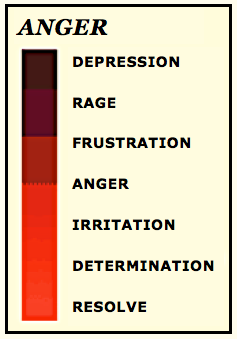
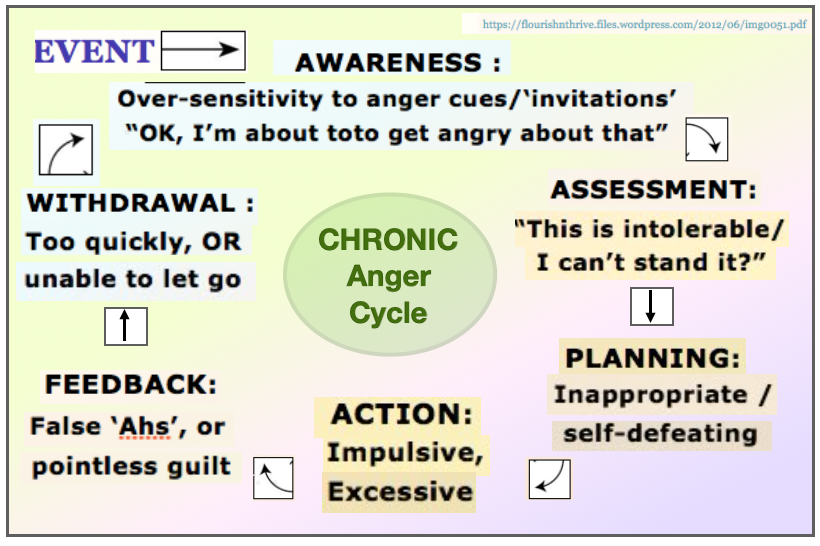
CHART ↗️  : Anger colors + 8 other Emos  

⬇️ ANOTHER look at the Anger Cycle comes from Ronald Potter-Efron’s best-seller “Angry All the Time” – Normal vs Chronic anger


ALSO: See an expanded behavior cycle – applied to anger & other dysfunctional patterns (from “Anger management for Kids”)
NOTE: This site includes other links, which may help ACoAs teach our Wounded Inner Child how to deal with our anger.

NEXT: Anger triggers (#3)

ACoAs & BEING VISIBLE (Part 4)

I CAN BE SEEN
without being in danger

PREVIOUS: Visibility (#3)

ARTICLES: “Psychological Visibility
and “Psychological Visibility as a Source of Value in Friendship”, by Shailushi Baxi

DEFINITIONS
To understand being truly visible we have to be clear about the differences between our misunderstanding of reality & what IS real.
Much confusion about it comes from distorted definitions & beliefs re. Arrogance vs. Having Rights, & Confrontation vs. Self-Assertiveness, Humility vs. Humiliation.

ACoAs often have the mistaken notion that being visible is arrogant, showing off, expressing hubris. NOT SO.
We’re so trained to not speak up, that we think any form of assertiveness is a confrontation. Not true.
Instead, when we speak from our Adult Ego State, use ‘I’ statements & don’t attack – we are in the right
🦚
1a. Arrogance
• Having (& showing) an exaggerated opinion of one’s own importance, value & ability, from an assumption of ones superiority over others
• Not being able to take correction, criticism or guidance. These are the WIC’s or PP’s narcissism & grandiosity

It stems from insecurity & a need to be validated – often trying to take credit for more than the person really did, in order to boost themselves. It tends to be expressed by not listening, dismissing others’ opinions, with ‘loud‘ energy, craving attention online, being pushy with coworkers, or just never letting someone else speak
vs.
1b.Having Rights” – review it, along with My Rights
When we know our needs & rights, we value ourselves. So acknowledging our beliefs, assets & accomplishments is HEALTHY!
Re. NEEDS :
1. Basic PMES requirements – same for all humans across the planet, listed on the Maslow Pyramid
2. Personality needs, based on our specific configuration – learning style, MBTI & Enneagram Type…..
3. Wound needs, from the repeated ways we were abused & neglected.
In the present it’s about finding the best ways to compensate for past trauma that may always be with us to some degree, but becomes much milder with Recovery
🦚
2a. Confrontation (aggressive): ALWAYS comes from anger.
It means approaching someone (in person or not) in a threatening way, assertiveness....being argumentative, wanting to unsettle them – especially with abuse, accusations, arrogance & defiance.
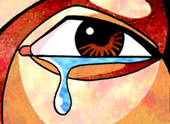
A hostile clash of opinions, ideas & power
vs.
2b. Assertiveness: being confident & direct in claiming one’s rights or putting forward one’s views, clearly & without anger, in an honest & respectful way, especially about difficult issues

It’s based on present-day reality. At work, such a person is confident about their identity & competence, so their energy level is quiet‘, whether they’re getting attention & recognition or not. They can also safely acknowledge the contribution of others & are able to share credit. Site: “How to manage conflict & confrontation
🦚
3a. Humiliation:  (not including degrading sexual interactions)
MUST involve 2 or more people – one who bullies, intimidates or socially embarrasses, although not always directly, AND the other as victim, usually not a willing recipient. It means TO:
• be reduced to a lower position in one’s own eyes &/or others, losing prestige or self-respect
• cause someone a painful loss of pride, self-respect, or dignity
• degrade, dishonor, disgraced, mortify, shame
vs.
3b. Humility / Humble : the quality of being courteously respectful, & modest, with a realistic opinion or estimate of one’s own importance, abilities, rank….
• Free from : boastfulness, egotism, great pretensions or vanity
• For some : retiring, unassuming, unobtrusive. May need to  be alone, to de-emphasizing & heal the wounded ego. (More…)

NOTE: Damaging parents, bad bosses & some religions use humiliation to control & make others submissive to their power.
HEALTHY people & institutions teach how to function well (actions), and encourage, or at least allow, others to develop their own natural way of thinking & feeling

IRONY: The more self-esteem we gain the more humble we become, comfortably! It’s what John Bradshaw called “healthy shame” – knowing what our actual human limitations are, without S-H, shame, guilt or toxic beliefs

🚴🏻‍♂️ Then we’re not afraid of making mistakes, of not know everything, of being imperfect. At the same time, we’re comfortable owning our God-given attributes – talents, knowledge & accomplishments.  Visibility is not dangerous to our welfare or identity!
REPEAT every day : “I know what I know, & I can’t know / don’t have to know – everything!”

NEXT : Being visible #5

Considering Abuse

I’M SO UNHAPPY BEING WITH THEM
but it must be my fault!

PREVIOUS: Principles of    Character

SITE: re. Categories of abuse

NOTE: This series will have many lists of abusive behaviors, in many categories, & from different perspectives, so there will be a lot of over-lap in headings & examples. This is deliberate. As kids we HAD to ignore, trivialize or forget what was done to us, & then act out those self-destructive patterns in our adult life.

We must identify exactly what happened before we can change it, & repetition is useful in breaking thru our denial. Also, reading or hearing something in different wording & context can more easily get past our defenses. The main (but not exclusive) focus of these posts is on Emotional Abuse.

DEF : Abuse – are all the painful things done to us & around us as kids, & comes in each of 4 PMES categories,
and Neglect – are all the good things we didn’t get, growing up

ABUSE : In general, it’s any communication or behavior designed to control & enslave someone. In alcoholic & narcissistic families it was to keep us ‘in our place’, to prevent us from leaving home, to punish us for not being who or what the Perpetrators expected, or wanted!
It is & was done by causing continual fear, humiliation, intimidation, guilt, coercion & manipulation.

Its any form of intrusion into another’s psyche, including :
• a desire to to denigrate, to ignore, to causes pain
• financial, intellectual or spiritual tactics, ranging from mild to lethal
• ignoring or making fun of another’s basic needs & interests
• verbal, physical, sexual &/or emotional attacks
• not respecting privacy, being brutally honest with a sadistic sense of humor, consistently tactless, expect too much

⚙︎ Most people automatically assume ‘abuse’ only refers to physical harm – yelling, hitting, beating, broken bones …. so will firmly state: “I was never abused growing up”. However, because human beings are made up of 4 interlocking categories (PMES = Physical, Mental, Emotional, Spiritual) we can be wounded OR encouraged in many ways at each level.

Being abused can happen just once with someone, or when subjected to a bully for a short time. But usually it’s a long-term pattern of behavior by a severely damaged, cruel, angry &/or mentally ill person who uses their position (as parent, boss, teacher, mate, older sibling or friend, community leader…. ) to:
▷ intimidate others who have less personal or social power, OR
▷ take advantage of those who by nature or training are more accommodating, compliant & sensitive

While most people on occasion act unkindly, even cruelly, when provoked or under great stress, what we’re looking at here is ongoing attitudes & actions that tear us down, body & soul. Even when they seem intermittent, over time they wear at us !
Therefore ACoAs can honestly say that we were severely & regularly abused by our damaged parents (& other authority figures) , especially re. emotions (Es). Genuine Es are NOT widely recognized, valued or encouraged in our society, much less in dysfunctional families. So we ended up ignoring or minimizing them in ourself, as well as in others, especially if we didn’t get physically or sexually attacked as kids.

Most of us never felt loved but blamed ourself for the lack. Regardless of what our parents said or how they felt about us in their own mind & heart – their distorted way of treating us was not an expression of healthy Love.
So to compensate – as adults – we look for it everywhere we go, & from everyone we deal with.
This can make us vulnerable to a subtle form of abuse – being ‘over-loved’, needed & depended on too much, OR being over-protected & infantilized, OR controlled & used.

These are actually ways to treat us as an extension of the person who claims to love us, as an object rather than a separate being, or a means of their personal gratification. It’s never about what the way the ‘beloved’ really needs or wants.
BTW,
LOVE is the emotion with the highest energy vibration. IT:
🔅feels good, because it’s the absence of fear
🔅is an action, not just a feeling, so requires attention
🔅is unconditional, understands & accepts differences
🔅has empathy, no room for jealousy, has wants but is not needy
🔅means putting other people’s needs equal to, or before our own
🔅varies in how it’s expressed & accepted, which can include letting go, so doesn’t demand continuing a relationship that no longer works.

NEXT: Victims or not?