ACoAs Being Controlled (Part 4)

door matI FOLLOW ALL THE RULES,
so why am I still being walked on?

PREVIOUS: Being Controlled (#3)

SITE : Dealing with Manipulative people – from “In Sheep’s Clothing”

🎯 WHO / WHAT we LET Control us
Controlling patterns are the same as Emotional Abuse.  All but one of the following groups can influence us positively OR negatively. It’s up to us to know what suits us best & stick to it!

INNER DAMAGE – everything this blog covers. Also read “Bitchlifestyle” blog : Who Controls You, Your Bitch or Your Brat? (PP or WIC). The more we try to please everyone, we become:
• MORE angry, disorganized, exhausted, frantic, overwhelmed, unhappy
• LESS focused, rested, peaceful, satisfied, pleasant to be with
AND the fewer people we actually do please!

Letting ourself be controlled is giving our power away. Yet we think it will actually:
• GAIN us acceptance, love, continual attention, protection
• PREVENT being ignored, made fun of, punished or left. Unfortunately, it’s an illusion!

 THIS LIST is about how negative relationships can controls us :
CHILDREN – expressing your love for / attachment to them can go too far, being afraid to set boundaries or they won’t love you, or not teach them discipline so they won’t be angry at you

ENEMIESA) people who dislike or hate us for their own reasons. We didn’t cause it, but we can end up wasting way too much time, energy & money trying to win them over or placating them, instead of leaving them alone, praying for them or being neutral
-OR-
B) those we hate – which eats us up year after year – wasting time trying to get even, obsessing about telling them off (but never doing it), or actually putting nasty plans into motion

JOBs/ Bosses – their expectations, demands … especially the ones we think have to be fulfilled but actually are unreasonable. After all, aren’t we used to doing the impossible ? – or at least trying like crazy

NEMESES – (people we’re jealous of or in competition with) – we can do many foolish or self-defeating things to stay ahead of them or keep them from winning over us, whether the ‘prize’ is important to us or not. We become obsessed, over-work, cheat, connive, worry… just to shore up our weak ego

PARENTS – wanting their love & approval at any expense, we often twist into distorted versions of our True Self – & still never please them or get what we need from them (see Part 3)

PARTNERS – our fantasy beliefs about what a good relationship or marriage is supposed to be (especially that women have to be the ‘giver’) makes us into servants or slaves

PEERS / FRIENDS – trying to keep up with or out-do them, keep their approval, get their admiration, be in the ‘IN’ group, use them to____ ….

HEROES – because we don’t know the real person, they’re usually one-dimensional, yet we put them on pedestals – so they’re not fully human. We think we could / should be like them, but it’s not automatically true that if they can do or be something, we can too.

• And even if we follow their lead in some way, we may not be able to do it right away, or it may be a lot harder that we thought, or we may not have the same talent or resources…. which can leave us discouraged & self-hating.
We have to be realistic, without giving up, working toward goals that fit who we are!

• We may find positive qualities to emulate, but only with careful assessment & background research. THEY must be people:
— who are actively living the qualities you admire and fit your values, not just talking a good game
— you are genuinely similar to (not just matching damages). REMEMBER – Just because someone else can do or be something does not mean you can or should want to!

NO GUARANTEE:  Being psychologically healthy does not prevent damaged people from trying to hurt us. Also – we know there have been some good people in the public eye that have been vilified, even killed!
Self-esteem + correct info are our best protection – recognizing the people who are very unwell & removing ourself from them.

NEXT: Being Controlled (Part 5)

ACoAs Being Controlled (Part 1)

beggingI’LL BE & DO WHAT EVER YOU WANT –
just don’t leave me!

PREVIOUS: “Controlling” & Abandonment (#2)

SITE: Recognizing…..Control” – extensive list of tactics used by Controllers

See ACRONYM page for abbrev.

BEING controlled by others
People who are easily controlled don’t know there’s a difference between –
a. Natural, appropriate authority. Being IN control is using our power in a positive way – for oneself, or as good leader. The person in control is the main decision-maker, in charge of communication & makes things happen. People choose to listen & follow appropriate authority because they want to learn, connect &/or be taken care of —
— vs.
b. Un-natural, abusive control (mental/emotional coercion). Controllers (Cs) misuse power – they force us to obey them, against our will. They have no regard for our rights, needs or individuality. They use their position to suppress our identity so only their’s is visible. Their main weapon is negative anger, aimed at making us afraid, so we’ll be more compliant

ACoAs ‘letting” ourself BE controlled
• Most ACoAs were negatively controlled as kids by very wounded parents & teachers, & without Recovery we continue playing out the victim role we were originally forced into.
As adults, allowing others to control us copies our earliest experiences. It keeps us symbiotically attached to the ‘source’ of our wounds & therefore emotionally immature, AND ‘protects’ us from having to face our own fear of intimacy (“ACoAs & Boundaries, Part 1 & 2”),
NOW
controlledFirst: We have to be around someone who is a controller – who belittles, embarrasses us in front of others, treats us like a child, tells us what to do or how to be….who is manipulative & intimidating, however subtly.

Second: We have to be available.  While dealing with such a person is unpleasant for anyone, for ACoAs it’s emotionally debilitating – but also emotionally addictive!  We fall into a black hole, regressed to an old familiar space of being a powerless child with no options. We’re trapped & become mute! We’ve been programmed to instantly surrender – as if we have no rights or identity of our own. And then we stay, & make excuses for the controller’s behavior!

T.E.A. (thoughts, emotions, actions)
Many teachers & groups insist that we choose to “feel” the way we do, which is an unfair judgment. Of course the word feel is being used to mean thoughts rather than emotions, which is confusing & harmful, as it leads to believing we should ‘control’ our Es! (see “Feelings Aren’t Facts”, & Using THINK, instead of Feel“)

This is not accurate or realistic. No one chooses their Es, only what we Think & how we Act! And even those are pre-programmed by family. Yes, sometimes changing Ts & As can shift our Es, but not always, especially not when the pain we’re feeling is old & therefore cumulative. That takes time to vent & process out of the body.

• Being controlled is the outward proof of Toxic Family Rules we internalized from childhood. And when we consider those beliefs (a sub-category of Thinking) we find them indeed very hard to change.
As adults — 
— allowing ourself to be controlled is not a conscious choice! It’s a knee jerk reaction to specific people or events that are carbon copies of our family experience.
— it’s a clear indication that capitulating to the will of another means our WIC is in charge

🩸To ‘accuse’ us of choosing to be manipulated (Action) or be miserable (Emotions)…. only adds to our S-H, & is in fact a subtle form of abuse & abandonment.

YES – we are responsible for changing our training – learning new ways of thinking & acting to take back the power we give away.
BUT we can only do this if WE:
— understand what’s actually going on inside
— have compassion for ourself (we didn’t cause the wounding)
— remember that changing deeply-etched brain patterns takes time
— learn what our needs are & use them to practice having boundaries
— ask for help whenever we need it, especially when regressed (child ego-state of being a victim, lost child, scapegoat…)
— develop & continually strengthen the Loving Parent voice

NEXT: ACoAs Being Controlled (Part 2)

PURPOSE of Emotions : Awareness (Part 1)

EMOTIONS GIVE IMPORTANT INFO
how I feel & respond to the world

PREVIOUS: Communication #2

Review post :Getting to our Es – Over

SEE Acronyms Page for abbrev.

1. SOCIAL NEEDS

2. INDIVIDUAL NEEDS

a. To Feel ALIVE
The over-all purpose of Emotions (Es) is to experience & get the most out of life.
They are spontaneous responses to everything inside & outside of ourself. They’re what make us feel alive – both the thrills & chills – telling us who we are BY how we feel about our experiences. The more an event or person means to us, the more intense our emotional response to them.

“NORMAL”:  A healthy, integrated life includes having access to a full range of Es. They are meant to surface temporarily & then pass thru us, so we can feel other ones as we go thru our daily routine. When an emotion is experienced to the fullest & allowed to run its course, it dissolves like smoke but remembered with a smile – even if it was unpleasant !

positive psychPositive Psychology tells us that psychological satisfaction & well-being come from participating in activities that boost pleasant Es, which then allow us to discover & use our character strengths & virtues.
It offers 4 broad pathways that can enhance these Es, in order to experience happiness more often – PATH OF : joy & pleasure, love & relationships, peace & tranquility, hope & resilience

DAMAGE: Without Es we would be like robots (Computer Role). Anyone who is physically healthy but emotionally cut off has trouble identifying with other people’s feelings, & so can do a lot of harm – usually unaware.
If someone’s damage is not too severe (like NPDs & psychopaths are) their emotional numbness can be modified, if they’re willing to do the ‘thawing out’ work.(Secretly angry ‘nice’ people)

A medical parallel can be made with autistic people, who have a disability in recognizing facial & body cues. (“The Body & Es, Part 2) This limits their capacity to identify Es in others & therefore hard to make ‘normal’ emotional attachments & social connections.
However, autistic people do have feelings, & if taught early in life to identify physical cues, they can lead more satisfying lives, & others will be more comfortable around them.

b. For SELF-AWARENESS
The “Self-Perception Theory” & “Cognitive Appraisal Theories of Emotion” suggest that we figure out how we feel about things, by staying awake & observing ourselves. This allows us to access Inner Guidance, using Es as indicators of what’s good & bad for us, & therefore what our needs are

But each person differs in the amount of the ‘things’ that suit us, so that some people require more sleep, stimulation, space, quiet…. than others. One person may need freedom & independence while another security & continual social connections. Some may have a need to ‘understand’ life & satisfy a great curiosity, while others are content to accept whatever they’ve been taught (EXP :  “The 5 Love Languages“)

Es also alert us when any natural, normal need is not being met. They are a signal for us to pay attention & deal with the lack – hopefully by doing something appropriate & empowering. So, when we feel:
lonely – we’re not connected (enough) with others
• afraid – we don’t feel safe, for self or loved ones
 rejected – we aren’t being accepted, respected, valued….

REALISTICALLY, we would’t fare well in life without any Es
– How long could we physically survive if we never felt fear?
– Why would we want to apologize for hurting someone if guilt was not available?
– How could we miss the company of others if we couldn’t feel loneliness?
– Why would we want to help someone in dire need, without empathy?3 Es

ACoAs grew up in environments where our Es were constantly minimized, invalidated & punished, making is very hard to get our legitimate human needs & distresses taken seriously.
It taught us to not trust our feelings, nor believe in the right to have needs, even though they never go away – until met. (EXP: You’ll feel hungry until you eat, be tired until you sleep, scared until comforted…)

🔸In reaction, some of us increased the intensity of our Es & how we express them (dramatically, which is not crazy), desperately trying to be heard.
🔹Others decreased the strength & expression of most or all Es (withdrawn & invisible), making it hard to be seen & appreciated, leaving us even more emotionally ‘starved’!

NEXT: Awareness #2

ACoAs & Boundary Distortion (Part 2)

no one caresI CAN DO WHATEVER I WANT
because nobody cares about me

PREVIOUS: ACoAs & B. Distortion (Part 1)

SITEs: ▪︎ GENOGRAMS – def
 ▪︎ Genogram explained


PARENTS with distorted Bs don’t know how to connect with their children in a fair & balanced way.  In Boundaries – Defined”, we saw they can be either intrusive or uninvolved . Then children are either:

a. Being watched: Some of us grew up with an intrusive parent who needed to control everything & everyone in their environment (not just their kids). They were always on our back about something, overly critical, perfectionistic & boundary-less , sticking their nose in our business when we needed respect & some privacy. This was not a sign of loving concern!

• As a result these ACoAs continue to feel a creepy sense of having a camera over one shoulder – always judging, criticizing… assuming everyone else is also watching, watching, watching – waiting for our next ‘stupidity’ or mistake

d's mouseEXP: Sophie is 5 & it’s the first day of kindergarten. Her mother is fussing, worried that her daughter won’t behave perfectly, which will make the family look bad, & she won’t be there in person to make sure….

She gives all sorts of instructions – how to sit, what to say, what NOT to say…. Sophie is already scared & now she’s overwhelmed, so all she can do is stare. As they leave the house she hears her mother say – almost to her self: “I wish I could be a little mouse on the wall !”

• Sophie’s on her own for the first time, in a big room with other kids, all sitting in their little chairs, listening to the teacher – except for Sophie who is anxiously looking around the bottom edges of the walls, actually expecting to see a little mouse watching her from its hole, maybe with her mother’s eyes!

b. Being ignored: Other parents left us adrift – too much alone, unsupervised, unguided. Yet even as small children we were expected to know how to behave, & participate correctly in all sorts of social events, without being taught directly or setting a proper example. And they were oblivious to the burden they put on us!

hiding in publicOne result is that externally – now we don’t have Bs with others, & internally – we haven’t learned to set Bs with ourself, so we do whatever the WIC feels like, no matter how unhealthy, using unsuccessful ways to get needs met (needs we’re not supposed to have!)

Another result is that many of us who were neglected, are uncomfortable in public, especially with groups. We feel ill-equipped to socialize, sure we don’t know what to say or how to act. We watch other people to see how they manage, & even though we’re great mimics, we still don’t trust ourself to be acceptable. Extroverts will at least try but feel inadequate, & introverts don’t even bother!

EXP: Sheila was a bright, sensitive girl, living in a family that moved many times because of her father’s career. A talkative extrovert, she’d grown up mainly in the company of adults, so even tho’ there always were people around, she was very much alone.  She was expected to be sociable, charming, well-behaved & polite to the grown-ups, but she was deeply lonely, angry & hurt.

To cope, she found escape & solace in all kinds of books (before internet & cell phones) – in the library after school, reading while walking down the street!!, under the covers at night….
Once, when her mother wanted her full attention she commented sarcastically: “I can see it all now – you’ll be reading a book as you walk down the aisle!”

PS: Obviously, the mother’s passive-aggressive anger was showing:
a. her unconscious abandonment buttons got triggered
b. her narcissism kicked in, since she wasn’t a reader & didn’t see what was “so interesting”
c. she was oblivious to her daughter’s need for comfort & for a buffer when around her controlling mother
d. her lack of intellectual interest was obvious, or she would have encouraged the girl’s passion for knowledge

EXT: Boundary Distortion (Part 3)

BOUNDARIES & ACoAs (Part 2)

love hurts
I DO THE BEST I CAN –
why does love always hurt me?

PREVIOUS: ACoAs & Bs (#1)


2. ACoAs & Boundaries (Bs)  
(cont)

c. Some Results of not having healthy Bs
i.  FAILURE: No matter how badly we were treated or how angry we were about it, like all children – we were/are deeply attached to our parents & didn’t / don’t want to injure them.
They indicated that their unhappiness was our fault (Parents Blaming Us‘) – so we turned ourselves inside out in a desperate attempt to protect them – but it never worked.

Realistically, we could never satisfy them, because what they objected to was:
— normal behavior for a child, with our many developmental needs & limitations
— a reaction to us from their unhealed damage (buttons) which never had anything to do with us

EXP: One young mother would snap at her 8-year-old whenever Katie came home from school excited by a newly learned piece of info: “Mom, mom, did you know that ________?”
The wounded ACoA parent would say with great annoyance: “Of course I know that!” instead of being proud of her daughter. What the mother ‘heard’ was that her own intelligence was being questioned, which came from being constantly put down by her mother!

ii. RISK: We developed a fear of taking any kind of risk, because it wasn’t safe to be ourselves at home where it should have been. How could we expect it to be safe anywhere else in the world, with strangers?

This unconsciously created a fear of ‘leaving home‘ (S & I), so even if we physically move far away, we’re internally loyal to the very system that crippled us, by staying attached to their toxic rules!
We isolate or stay & stay in harmful situations & with unavailable or abusive people, don’t follow our dreams, or if we try – we stop short of reaching our goals….

iii. INTENSITY: Given the message that we were “too much” for them, our child’s grandiosity made us conclude that we were ‘negatively powerful. The conclusion was that IF we were so detrimental to our family, we would naturally hurt everyone else in the world too – especially with our rage – making us afraid to let anyone get too close to us as adults.

✶ALSO, it left many of us with the deep-seated belief that it would be better if we were dead – it would spare our family the suffering we seemed to be causing then but couldn’t change!

People-pleasing / Rescuing
Trying to be here for others but having weak or missing Bs :
To US — we get used by others
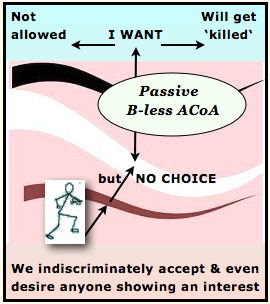
— overwhelmed by their damageB-less ACoA
— get burned out & exhausted
— eventually get enraged & attack
— bitter & disappointed with ‘love’

To OTHERS
— they get bored with us, or never let go
— criticize us for not being perfect
— take as much as they can
— unaware of our needs & hurt
— blame us for their weaknesses

d. No Boundaries – No Choices
Un-recovered ACoAs, even those of us who see ourselves as strong, smart, adventurous…. act like victims because we don’t internal permission to choose who we connect with & who we leave behind, from a deep sense of powerlessness!

Without Bs we fall into the co-dependent trap, because:
• we’re so afraid of having to face our abandonment pain, AND our S-H says no one can possibly love us . What a double bind!

So when someone ‘wants’ us – our WIC is so relieved – that we accept them, even though they may be totally inappropriate, self-centered & just using us as their narcissistic supply.
Often some deep part of us knows they’re unsuitable, it won’t work out & we may not even really like them! BUT —

• we convince ourselves to stay, because they have some qualities we find appealing, maybe similar to ourself – even though it’s not nearly enough to offset the enormity of their dysfunction (addictions, depression, self-hate, immaturity, narcissism, controlling, cruelty…)

• we’re afraid to reject anyone, worry about hurting their feelings, identify with their pain… instead of honoring ourselves (we identify too much with their WIC, while ignoring our own!)
• we focus on fulfilling their needs, wants and demands, so they won’t get upset & shut us out – while most of ours go unmet.

NEXT: ACoAs & Bs (#3)

Negative ReACTions to Painful Events (Intro)

confused man  

IT TOO HARD TO BE IN THE WORLD –
Should I hide or attack?

PREVIOUS: EMOTIONS re. Events #2

REVIEW previous posts


3. ACTIONS re. painful Events (blue oval)
It’s inevitable that we’ll take some type of ‘action’ in response to a stressful EVENT.  What kind will depend on our native personality & the specific CONCLUSIONS we draw about it.

• ACoAs are not readily aware of our thoughts (beliefs) or emotion. So, when triggered, we just re-act. It can happen so fast that it seems we have no control of our behavior, which may be verbal &/or physical, driven either by terror or rage.

• It’s normal for humans to be angry when hurt, frustrated or scared. Anger is simply the psychic energy needed to prepare for action, & is a fitting response to harmful situations.
Anger & Fear are on opposite sides of Plutchik’s  Emotion Wheel. To heal, fearful ACoAs need to connect with their anger, &  those steeped in rage need to get in touch with the fear & sadness underneath.  The key is Balance.
🥶
FEAR-driven Actions / non-actions
COVERT: ACoAs trained to not be angry are afraid to feel it now –  crippled by that suppression! Without healthy anger we’re depressed, feel stuck, AND can’t stop others from mistreating us

🌪 Fear EXP : Unhealed use of the 3 Circles 
EVENT (condition): Unrecovered ACoA Shakeera is dating a complicated young man – sometimes thoughtful, smart & sensitive, other times self-pitying & whiny. When he’s depressed & needy he threatens suicide, can’t look for work & lives off of Shakeera’s income.
Her Emotions: panic, compassion, pity, love, disgust, rage

 + CONCLUSIONS (thoughts) – When he’s in a good space, Shakeera thinks he’s the best, ever!  When he’s very down, her co-dependence kicks in :
“I have to fix this mess / I know how to help him – I’ll tell him all the ways he can get his life together / He just has to be ok, I can’t stand this / I feel humiliated being with such a looser”….

= ACTIONS: Shakeera alternately bullies him to ‘get it together’, gives him endless advice, tells him what he did wrong OR listens for hours to his self-hate & joins him in a depressed stupor
• He doesn’t change & she gets more frustrated. None of her actions help either of them!  Her FoA (FEAR of abandonment) keeps her trying to cure him – so she doesn’t have to leave!
😡
ANGER-driven Actions
Our behavior can tell us which ego state is in charge at the moment & how healed or unhealed a particular button is.  How we act out our rage may be —
— the same way our parents reacted to stress, or
— how we were allowed to behave as kids, or
— how we’d have liked to react, back then, but knew it was too Screen Shot 2016-06-19 at 7.40.57 AMdangerous to do so

OVERT: some ACoAs react with hostility too readily, when the WIC feels abandoned. We get nasty & more controlling, or unfairly cut someone off. This can hurts us just as much as the other person, since rage pushes others away & we’re already feeling unwanted & unloved!

▶ BUT, don’t let the self-help gurus tell you not to FEEL angry!  ACoAs have a lot of it pent-up from childhood abuse (plus bad adult experiences) which needs to be gotten out of our system – appropriately. What’s important to our Recovery is how we ACT.

💥 Anger EXP : Unhealed use of the 3 Circles 
EVENT: Sal hates being bothered by people in public places. One night he gets on an almost empty bus, on his way home from work. A smelly bag-lady gets on at the next stop, looks around & sits down right next to Sal!
His Emotions: revulsion, anger, frustration, superiority

+ CONCLUSIONS (thoughts) – “Why does this always have to happen to me?! There are 20 other seats she could have picked! Why ME?? Why do I attract the crazies? Me, only me!” (CDs: ‘Personalization, Egocentric & Can’t Stand It’)

= ACTIONS: Sal starts yelling at the woman & gets off the bus at the next stop. He keeps talking about the incident, repeating it over & over the next day to everyone he can corner
• He’s taken this personally, feeling like a victim, trying to get validation & sympathy. The woman could have either been lonely &/or wanted to bum some change.  It was never about him!

NEXT: Negative  reACTions (Fear)

ARE YOU AN ACoA?

WHY AM I THE WAY I AM?
From being raised by alcoholics,
ACoAs & other narcissist!


50 Qs: A Self-evaluating List for Adult-Children of alcoholics, abusers, abandoners….
Answer: Y = yes, N = no, S = some, D = don’t know

DO YOU…?….
___find that you seek out tension or crisis, & then complain about it
___become anxious around angry people or authority figures
___defend or excuse people when they abuse you, implying you deserve it
___get locked into a course of action without seeing alternatives or outcomes
___react to people & situations, instead of choosing your responses
___worry that your emotions may overpower or hurt you, or others
___tend to lie or exaggerate, when it would be just as easy to tell the truth
___find the needs & wants of others more important than your own
___prevent yourself from experiencing the joy of your successes
___frequently anticipate that situations or life won’t work out for you
___isolate yourself when problems arise, or when you ‘feel bad’hiding
___find yourself in one or more survival ‘roles’ (hero, lost child…)
___mistrust your feelings, thought, perceptions
___tend to see issues in life as B & W, right or wrong
___have a fear of abandonment, especially when criticized
___strongly criticize yourself when not being perfect
___defend or excuse people when they abuse you, implying you deserve it
___get locked into a course of action without seeing alternatives or outcomes
___react to people & situations, instead of choosing your responses
___have trouble relaxing, playing, having fun
___had trouble with close, intimate relationships
___feel responsible for the feelings & actions of others, & try to fix them
___stay in relationships even tho’ you’re being constantly hurt, neglected, lied to, manipulated, hit… not getting any of your needs met
DID YOU…?….
___fight with your family members over a parent’s drinking
___your parents make promises to you & then not keep them
___lose sleep at night due to a parent’s drinking
___take on some of the jobs or responsibilities belonging to your parents
___ever get sick, or worry a lot because of their drinking
___ever do anything to prevent your parent’s drinking
___always believe that no one knew your parents were drunks, when you were growing up
ARE YOU…?…
___able to recognize situation that you have no control over
___super responsible or super irresponsible
___unable to work thru crisis & conflict, or do you aggravate it
___seeing a pattern in your relationships similar to your family of origin
___unable to enjoy your successes & accomplishments
___afraid others may ‘find out’ you’re not good, or that you’re a fraud
___afraid of your emotions, & afraid to express them   get help
___unable to complement yourself
___ashamed of or feel guilty for being who you are
___afraid of going crazy, or becoming a bag lady or bum
___uncomfortable with your life when it’s going smoothly
___unable to ask for help, or do so apologetically
___constantly seeking approval from others
___uncomfortable with being liked, admired, approved of
___always mentally looking over your shoulder to see if you’ll be punished
___out of control with: food, chemicals, work, sex, spending, exercising…
HAVE YOU…?…
___been blaming everyone else for your life’s problems
___staunchly defended your parents’ ‘innocence’ in hurting you as a kid
___had trouble following thru on projects, or never finishing
___tried to hide the fact that your parents drank a lot, beat you or others in the family, incested you or your siblings
___concerned about your mate, children, friends’…use of chemicals
___developed fantasy beliefs about how loved ones may treat you some day
___considered what ‘normal’ is, & believe you’re not
___found yourself sabotaging your success & then feeling ‘more alive’
___been loyal to others (parents, siblings, lovers, children, friends, employers) – even tho’ your loyalty was undeserved, unjustified, un-returned
___been fired more than once & never really understood why
___* learned to have dialogues with your ‘inner child’, & consistently take care of yourself in loving ways ?
♥                            ♥                            ♥
IF you’re even taking this test, it’s likely you come from a damaged, angry, abusive, traumatic, neglected, unhappy backgroundanswers
TOTALS:   ____Yes   ____ No   ____ Some  ____ Don’t Know
IF you answered YES to:
✶ 10-20, you’re either not an ACoA, in denial or in long-term recovery
✶ 20-30, you’re a co-dependent, even if there was no alcoholism in the family
✶ 30 or more, you’re definitely an ACoA (adult-child of alcoholics and other narcissists), which includes mentally ill &/or narcissistic family members

• If you said NO to Qs in the ‘DID YOU…’ section, but still scored high, there may be alcoholism/ drug addiction in some other part of your family, even if you didn’t experience it directly
• You may also be an active addict, yourself – alcohol/ drugs, food, money, sex, relationships…

Look thru this blog (2010 – 2016) and go to Heal & Grow SITE MAP – for info covering issues in this questionnaire at: http://www.acoarecovery.com

• If you are not yet in Recovery from your childhood trauma & present day difficulties, you can seek out 12-step Programs. THEY’RE BASICALLY FREE, & are available on the internet & by phone, for anyone not able to get to these meeting in person.  See pg 55 or some of the 12-step groups.

• Also, there are many recovery books, site, blogs & of course therapy, with someone very familiar with ACoA / addiction issues.
✶  If you are in Recovery, keep up the good fight. It pays off! I know because I’ve been at it for 35 yrs, & it works.

NEXT: Variations of the L.L.