Passive Aggressives – Review for ACoAs (Part 3)

WHAT A CONCEPT : Honest doesn’t mean hostile.
Pleasant doesn’t mean passive!

PREVIOUS: P-A ACoAs (# 2)

SITEs:” Emotionally Volatile People
• “Difficult People & how to Handle Them

REVIEW (cont)
1.The GAME // 2. WHO plays the game

3. CAUSEs of the game
ACoAs ; from our family, school, religion…. we were NOT allowed :
• to be angry, to the point of not even knowing we are!
• to know what we wanted, how we felt, what we preferred (being too much of an individual got smashed – so it left us confused)
• to ask for anything (don’t bother them)
AND
• were taught to never put ourselves first
• always had to always be perfect (no mistakes) – so better not choose anything
• no matter what we did, we were punished, so we couldn’t win
• safer to not be too visible (in a dangerous family, & later in abusive relationships)
taking any risk was discouraged, made fun of, punished (so now we can’t risk ‘failing’ & being disappointed)

4. EFFECTs of the game, as the P-A
a. Negative BenefitsWE DON’T have to :
• figure out who we are, what we want & need
• disobey any of the toxic family rules
• admit we’re angry, even raging, underneath
• stand up to the ‘control freaks
• make a mistake & deal then with consequences
• AND we get to blame others when something goes wrong, & maintain the illusion of superiority

b. Negative Consequences of being P-A :
• always feel scared of disapproval & losing people (FoA)
• it increases our Self-Hate & Loneliness 
• lose out on many opportunities to grow, to be heard, to have fun
• make other people mad at us, a lot! for forcing them to carry all the responsibility & then getting blamed
• never get what we really want, unless by accident or by luck
• we are dis-empowered, lose self-esteem, stay a victim, are infantilized, stay mute, don’t risk anything

4. HEALTHY
a. General: We need TO
• identify all the ways we were hurt as kids, including the specific messages we still obey, like ‘don’t feel’ , ‘don’t talk’ (Toxic Rules)
• prevent the Wounded Inner Child from running our life BY growing a Healthy Adult & Loving Parent  (the UNIT) who can make executive decisions about how to own & fulfill our needs
book-end with the IC, to outgrow living in the past. If done consistently, it will teach the WIC the difference between what’s possible & real in the present, vs the way it was in our dysfunctional family

b. For Passive-Aggressives – we need TO:
• keep a safe distance from anyone who is easily provoked to anger
own our hidden resentments, anger, rage, bitterness
• learn safe ways of discharging rage, & healthy ways of expressing it to others, when needed
• practice saying what we need, want, like, prefer – to find out that nothing bad happens to us or others
• stop looking for other people to be in charge of our life, tell us what to do, make our decisions & choices

Practice making ‘I’ statements every day, silently to yourself, so it gets easier & easier to say out loud:  “I want… I need… I don’t like… I’d rather…  that’s not for me… ” UNTIL it’s your new norm!

c. For Volatiles – we need to:
• accept that the rage is legitimate, but our actions are not always healthy
• find out what’s under the rag e: the reality of child abuse & neglect we lived thru, and the pain it created
• become safe enough to feel what’s underneath – grief, sadness, loneliness, hurt, sorrow, vulnerability Screen Shot 2016-06-17 at 10.24.27 PM.png
• learn calming techniques (bio-feedback, prayer, poly vagal exercises, visualizations…)
• own our Inner Sadist: make friends with it, but never let it act out
• work on getting rage out in safe, appropriate places (therapy groups, 12-step programs, doing rage-work at home, drawing, writing….)

Practice comforting & mentally holding the WIC, so he/she doesn’t feel so alone with all its pain.  Give yourself permission to cry – it is not a weakness – no matter what our family taught us!  Crying clears out toxins & releases pent-up emotional stress. It’s very necessary!

Realistically, while P-As can definitely work on having permission to express anger & rage, it’s usually up to the V. to STOP the game, stop reacting to / expecting (anything) from the P-A. Maybe even having to leave!

NEXT: Qs – Are you P-A?

Hidden ISSUES for Angry ‘Nice’ People (Part 1)

P-A issuesAS LONG AS I’M ‘GOOD’
I’ll be OK (I 
hope!)

PREVIOUS: Intro b

SITE: Danger of Suppressing Anger

QUOTE: Unexpressed emotions will never die. They are buried alive and will come forth later in uglier ways”.  Sigmund Freud

ISSUES for “Secretly angry” people
GREAT DESIRE
• to be loved  //  to not be attacked // to not be alone or lonely

BASIC FEARSsad girl
• of self-reflection //  being abandoned //  being punished

UNDERLYING ISSUES
• feel inadequate, not entitled, self-hating, shame-bound
• not allowed to be assertive or angry, always assume rejection

WELL-BEHAVED, But ALSO:
• controlling, critical, unforgiving // indirectly cruel, attacking, vengeful
• depressed, fussy, hard to please, moody, shy, thin-skinned, withdrawn

PAY-OFFS for using defenses (ie. Negative Benefits)
1. False Weakness (see Original LL)
a. Avoid facing childhood pain
• Connecting with the pain of past & current emotional injuries makes us feel vulnerable, out of control, small & helpless. Anger is energizing – but not allowed – so we end up in constant anxiety, & don’t know why

bCreate physical pain (real or not), as substitute for #a.
• If we’re workaholic (do, do, do) and not allowed to rest / relax / have fun, we can get sick to slow us down
suffer• If we’re not allowed to be given empathy, sympathy, emotional support…. then physical ailments become a way of eliciting some of it ‘legitimately’, since they are tangible & considered acceptable, while emotional hurts can’t be seen & are often considered a weakness or ‘dramatic’
• If we’re not allowed to be/feel taken care of or to find the right kind of help, practically or psychologically, then being weak, sick, incapacitated…. can get us some attention

cContinue being mistreated & abused

• Some of us are so used to being in the victim role – which we really were as kids – that we don’t want to give it up as adults, because it would create separation anxiety from the family & our bad-parent Introject.
Being a victim is about the ‘poor MEs’, staying emotionally immature, waiting to be taken care of. While there is a lot of anger under this position, it’s not supposed to show!

dGet approval for a role
STOIC:
Not letting ourselves experience & deal with jealousy, anger, sadness, fear…. is often incorrectly considered ‘strong’, & gently admired in many parts of our society, including the religious community.  They tells us it’s not OK (weak or un-spiritual) to admit to or show unpleasant ‘negative’ emotions, especially anger. It’s called  ‘loosing it, being emotional’. 
We’re even told that all emotions ‘cloud our judgment’.
Unfortunately obeying these dictates is harmful physically & psychologically  (CHART)

DOORMAT: Being such a ‘nice’ person that you have no opinions or boundaries may make it easier on some people to be around us – especially narcissists – & superficially satisfies our WIC’s desperation to never be abandoned by others, but it insures that we abandon ourself  (MORE….”Recovering Doormat”)

2. False Strength (See Reverse  LL)
a. Superiority
• Admired – as martyr, ‘good guy’, saint, ‘spiritual’
• One-up – needing others to be needy, sick, dependent, not successful

b. Controlling
• Emotional blackmail, to keep others fearful, attached to us
• Demand our own way (always) – ‘nice’ is only superficial
• Hamper or destroy ‘loved ones’  – if they try to be free, happy, themselves

c. Punishing / manipulating
• When we, in the guise of ‘good’ GIVER (G), continually help / rescue / dominate – another person, then the Receiver/ victim/ inferior / weaker (R) must:
— have unquestioning, blind loyalty, never object or question
— always provide affection & total attention, care-take

• If the R. objects, withdraws or rebels, then:
— Giver (G) sees R. as selfish, ungrateful, abusive
— G. will punish R. overtly or covertly, attacking or withdrawing

NEXT: SYMPTOMS of Hidden Anger (#1)

ACoAs: DIS-comfort & Comfort (Part 1)

minor discomfortI’M DEFINITELY DETERMINED
to ignore my discomfort!

PREVIOUS: DIS-comfort & Comfort (Part 1)

SITE:  Fill-In Qs – Identify your stressors


OVERVIEW
Do What’s Comfortable” is one of the many helpful & profound phrases in Al-Anon. This is a useful suggestion, especially as ACoAs tend to live in perpetual dis-comfort (in the “wreckage of the future or in the misery of the past), subjecting ourselves to almost constant physical anxiety & the endless rumination of self-defeating ‘mantras’ (S-H), sometimes called ‘spinning’.

HOWEVER, we are so used to being uncomfortable that we barely notice, thinking it’s ‘normal’, AND believe we have no other option. So this phrase is incomplete, since ACoAs stick to what we know – no matter how bad – & avoid better/healthier/safer things – as we cling to our abusive family (refuse to S & I), & don’t have to risk being disappointed – yet again!

SOME stress in life is not only inevitable, but also needed in order to gently push us to take actions & grow. As the bell curve shows, there’s the calm state, which is good, & the ‘beneficial’ Eustress, to keep up us alert, motivated & on our toes.
But ACoAs typically live in the far right – in various intensities of distress.

Too much stress tends to paralyze. While there are plenty of external situations in life which can be aggravating, & many things we are truly powerless over, this topic focuses mainly on how we experience & categorize Comfort & Discomfort, negative & positive .

Originally, our harmful life patterns were learned grown up, which we had little or no control over. Now we keep using them :
— because they’re deeply ingrained , & obey family rules
— to avoid deeper painful realizations, anxiety & accumulated terror
— from the belief that we don’t know any better or can’t possibly change.
Still hanging on to them actually comes from the mistaken belief that the way we’ve always thought, felt & acted (T.E.A.) is our actual personality, & therefore no changes can be expected or even attempted. This belief persists even in ‘recovery’ !!

IN REALITY – all ongoing negative behaviors (character defects) are expressions of our False Self, developed in childhood in response to the abuse & neglect of our family & other harmful environments (baby sitters, neighborhood, school, ‘church’….). Therefore, the main goal of Recovery is to shed as much of this made-up persona as possible, in order to uncover, own & live in the REAL Self we were born into before the damage.

To understand why.  read or review posts “Negative benefits of.…”), info about how the brain learns, and “CDs — Info & the brain.
What we experienced from birth on is what makes the most sense to our ‘computer’,  which will fight tooth & nail to keep from having to change – as if we’re asking it to destroy itself!
Remember HAL 9000, in the “2001 – A Space Odyssey” movie?

Changing our programming will create great anxiety – at first. So for some time in our efforts to heal & grow it will genuinely feel more comfortable (a great relief) to go back to doing things the old way – no matter how ‘sick’. Unfortunately. But with persistent repetitions of new thinking & actions, that terror will lessen a great deal.

IRONY: Identifying these dysfunctions as ‘comfortable’, just because they feel ‘natural’, doesn’t mean they promote happiness & calm. While some ACoAs are in such deep denial that these patterns may seem like minor disturbances – from being numb to their long-term consequences – they in fact create endless stress, anxiety, shame, self-hate, frustration, physical & mental illness…. in all of us, whether acknowledged or not.social anxiety

Also, it may seem counter-intuitive that these damaging patterns would be considered comfortable, but it’s because the brain considers them valid, having learned them in childhood & then constantly reinforced in unhealthy environments.

NOTE: in Part 2 – Many of the items on the “Negative Comfort” list also fall into the more severe category of Negative Discomfort (like self-injury, bad relationships, lack of self-care….)

NEXT: Negative Discomfort – #2

ACoAs: RESPONSIBILITY (Part 2b)

I GIVE IT ALL AWAY & have nothing left for myself

PREVIOUS: Fear of Responsibility (FoR)  #2a


🧍🏽‍♀️🧍🏽 AS ADULTS (cont)
1. UNDER-RESPONSIBLE – as “Leavers” (cont)
a. re. OTHERS – Part 2a

b. Re. US
Being aleaver’ includes leaving ourself – not just putting ourself last, but barely enough to survive, or to make life worth living.

We do NOT:
• take care of ourself – appearance, health, living space…..
• acknowledge the damage done to us, & get the right help
• stand up for our rights, provide for our personality needs
• use our inborn talents, so don’t contribute our best to society
• prosper, perpetuate general ‘anorexia’ – such as under-earning, bad relationships, isolation, no fun ….

Most ACoAs do not show outward signs of our underlying wounds, but all of us suffer from it to some degree, even in Recovery.
• We didn’t learn self-care from our family, having been neglected & mistreated, thus given the message that we didn’t deserve any better, and
• This left us with a lack of information about self-care, so we don’t actually think in terms of what we need

At the extreme, the self-neglect of some ACoAs is more visible (deprivation / anorexia in many areas of life).
Gibbons (2006) defined it as: “The inability – intentional or not – to maintain a socially & culturally accepted standard of self-care, with the potential for serious consequences to the health & well-being of the self-deprivers, perhaps even to their community.” (Wikipedia) (MORE….)

Some overt symptoms of personal deprivation include hoarding items & pets, a compulsive need to isolate, living in a dirty  environment, poor personal hygiene, neglecting household maintenance, unwillingness to take needed meds, unkempt / sloppy appearance, eccentric behaviors……

🍎🔥
2. OVER-RESPONSIBLE = the “Stayers”
Being ‘over-responsible’ toward others includes our children & grandchildren (small or grown),
BY: • doing too much for them
• people-pleasing & not setting boundaries
• letting them get away with unhealthy behavior, spoiling them
• giving in to unhealthy requests or demands
• not holding them responsible for bad behavior
• not teaching them the best ways to live in the world

ACoAs as ‘STAYERS’
As long as the WIC is still running our life, we focus all our attention outside of ourself. We’re looking for someone to take care of us – to give us permission to even be alive, much less be our True Self

• We do too much for others, & most of the PPT we pick to ‘help’ are just are incapable of being there for us as our family was, with a few exceptions.
Also –
• Because our parents were so angry, depressed & unhappy, ACoAs are convinced (unconsciously) that everyone else is the same.  We project how our family treated us onto every situation we encounter in our daily lives, whether it’s similar or not.

That means we react & behave in the same way we did as kids = that we have to be responsible (R) for others’ feelings & needs, to ‘help’ / fix everyone we deal with, whether important to us or not (lover, parent, sibling, OR “butcher, baker, candle-stick maker”…..) & suppress our own emotions, hopes & dreams.

We BELIEVE that:
• without our intervention – others we meet will also fall apart or put out firesgo crazy, which would be our fault, so we rush in to put out other people’s fires
• if we don’t take care of them they won’t have any need for us, & ‘leave’ us
• by rescuing / saving…. others we will finally become worthy of getting our needs met (‘earning’ love)

⚡️ For prolonged rescuing, we stay with those:
• who are more wounded than we are (assuming we’re not), so we can feel useful, appreciated, even superior
• who don’t want to take care of themselves & could, but live in Victim mode – so would rather we do it for them, since we’re so good at it (& desperate to please)
• who are intensely narcissistic, using us to feed off of, which we agree to, at least for a time, because it makes us feel needed & important

AND, we automatically stay away from anyone who is reasonably healthy – competent, self-directed, doesn’t need or want rescuing…. because they don’t ne-e-ed us & we wouldn’t know how to interact with them as equals!

NEXT:
 Fear of Responsibility – #2c

DEFENSE MECHANISMS (Part 1)

defense typesI USE WHATEVER I CAN
to escape my fears

PREVIOUS: Enneagram Humor #4

REVIEW posts: Abandonment Pain

SITE: Defense Mechanisms Quiz

BOOK:In sheep’s Clothing (re. manipulative people) go to slide 50 ++

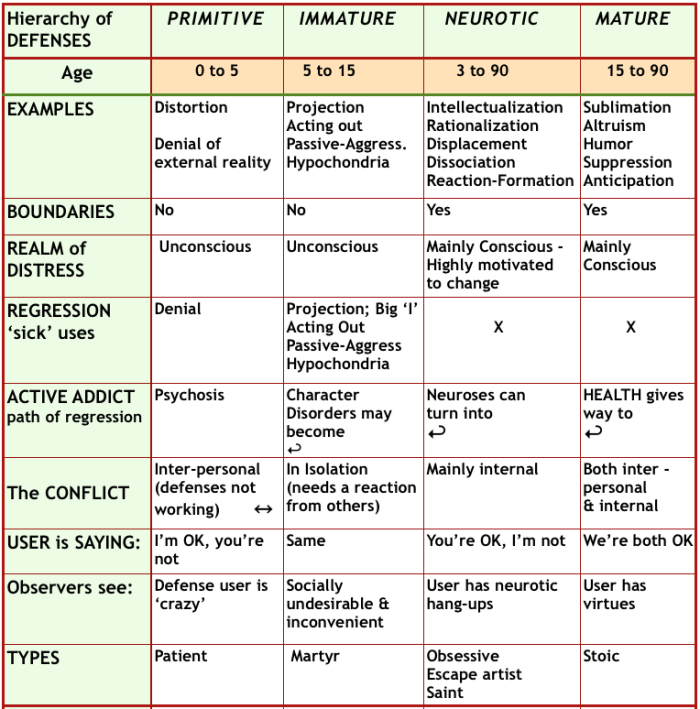
DEF: Unconscious & conscious processes to defend against or escape from conflicts, frustration & depression, so that the person can make useful adjustments to be able to live in their society.

REMINDER – as such, defenses are NOT bad. They’re needed to cope with life’s difficulties, as when we use humor to lighten our mood or altruism to lighten someone else’s load.
At best – most are delaying tactics, giving us breathing room to take a break & re-group.
The problem comes when any one of them become ‘land-locked’, so deeply ingrained that it can’t be given up easily, so rigid that it’s used like a hammer on every problem, regardless of size or importance.
tree of defenses
• In that case they become Negative Benefits” – used to avoid childhood or other trauma which the person does not want to deal face. To better understand what these are, we need to know about Defense Mechanisms, which were first identified by Freud, & then added to over the years by others.
He noted that people have wishes, desired & impulses that are either unacceptable to their society, religion or family – or their own sense of self  (CHART)

• The fact that the impulses don’t go away, but are usually hidden in our unconscious, leaves a residue (like at the bottom of a bottle) of anxiety*.
Keeping the impulses pushed out of awareness takes a lot of energy – which is exhausting, but considered by the ‘user’ to be safer than admitting them
(EXP: wanting to kill one’s parents or oneself). We do this by using Defenses. Which ones we pick will depend on our upbringing & our native personality.

*ANXIETY types, according to Freud
1. Neurotic – the unconscious worry that we’ll lose control of the id‘s urges, resulting in punishment for inappropriate behavior
2. Moral – the fear of violating our own principles
3. Reality – the fear of real-world events, usually easy to identify.
EXP: Fear of being bitten when near a menacing, snarling, barking dog is appropriate – so it’s best to avoid genuinely dangerous situations (PPT) if at all possible.

Defense Mechanisms distort reality
In proper proportion & with limited use they can also be adaptive, allowing us to function normally in very difficult situations, where there are no better options

The big problem comes from over-use, as a way of life, especially when they’re no longer needed. What was once a way to cope then becomes the problem. A goal in Recovery is to make the extreme / harmful use of defenses conscious so the we can develop healthier ways of handling anxiety & stress – without eliminating defenses altogether.

Sdefenses hierarchy


NEXT: 27 Defenses

Letting GO of ACTING Controlling (Part 2)

universeNEED TO HEAL THE FEAR –
to stop controlling

PREVIOUS: Letting Go, #1

POSTs : “Negative Benefits of…
☀︎” Discomfort & Comfort

Use Acronyms Page for abbrev.


Exercise:
 Write as much as you can about these 4 Qs.  Put it away for a week or a month & then go back & read it, adding more as ideas surface. Share about them where it’s safe

1. NEGATIVE BENEFITS (-+) of being Controlling
Q: What do you get from holding on to it?
• N.B. are patterns that keeps us attached to our damage, familiar but stunt our growth. It’s the narcissistic grandiosity of the WIC, as well as ‘entitlement’, which makes people temporarily feel powerfuldream control

• When in C. mode, we function from the underlying position that everything revolves around us – good or bad.
“My way or the highway // It’s late – I’ll let you go // I don’t understand why you don’t ____ (like what I like, think the way I do)….” .

This style lets us feel important & always : be right, get our way, never be vulnerable, be heard & paid attention to, have an effect on the world…. so many things we didn’t get as a kid. But they don’t actually heal us, because it keeps us totally dependent on others

2. NEGATIVE DETRIMENTS (–)
Q: How does it hurts you & others?in a vice
• This may be hard to answer at first, because Cs are not really interested in other people’s experiences, emotions or needs…
But we can remember how it felt when someone controlled us: resentful, stifled, belittled, disrespected….

• Being C. limits our options, keeping us out of the flow of life – preventing us from finding out the wonderful things that can happen if we stopped trying to force the world to conform to our narrow vision.

3. POSITIVE DISCOMFORT (+-)
Q: What are you afraid will happen?
Changing a deeply ingrained pattern like Controlling can bring up a lot of anxiety, especially if we’ve built our whole persona on ‘running things’, like Heroes. (although the other Roles alsocontrol in their own way).
It means giving up how we’ve been experiencing ourself, what we thought was our personality, but is actually the False Self

• We think we’ll be in some kind of danger, as if our actual life would be threatened! But it will only be the emotion of fear – feeling old abandonment pain & having to give up cherished illusions
OR
positive negatives• we’re afraid someone we love will be in danger. This may seem realistic if we’re dealing with an active addict bent on self-destruction.
We can present them with info & options for Recovery, but they have to want it. Sometimes formal interventions work, but not always. And sometimes, no matter what we do, active addicts die.

• When taking care of a very sick person we love, we may be the one responsible for many practical matters, but ultimately, we can’t control the outcome! Self-care becomes even more imperative!

• BUT – most of the time, the world goes on just fine without our two-cents! As we grow we can better tolerate the discomfort of not interfering with the natural order of things, which does gets easier.

4. POSITIVE BENEFITS (++)
Q: Why is it worth giving up?
• We get to find out who WE really are – talents, knowledge, gifts, experience… & finally take center stage in our own life, expressing a multifaceted Self, by being responsible for ourself – the opposite of being Controlled – instead of wasting energy on manipulating others

• Acceptance & gratitude! (not C.) lets us enjoy achievements & accolades, instead of cringing, or negating some success when it’s valued & acknowledged

• Recovery provides self-esteem, a genuine sense of freedom, the ability to connect with healthy people who respect us, & who we can trust to be OK without our constant vigilance!

REALITYimages copy 2
✶ Most people have more resiliency, depth, strength & flexibility than we give them credit for. That includes you. Believe you can handle all kinds of circumstances. Keep saying: “I know what I know – but I can’t know everything!”
SO – catch yourself in the act of being C. & stop as soon as you can. Remind yourself of the benefits of changing & give your inner kids a big hug!

NEXT: Letting Go, #3

ACoAs & Boundary INVASIONS (Part 2)

no limits

PREVIOUS: B. INVASIONS (#1)

ARTICLES: ‘Sexual Abuse / Trauma’
The Incestuous Family” – Roles re sexual abuse


BOUNDARY INVASIONS  
(cont)
2. MENTAL Coercion

3. Family SYMBIOSIS

a. Insecure parents :
push for an ‘us against the world’ attitude, hoping to increase family solidarity, powered by denial of dysfunction, & an unbearable threat to their sense of identity
can be over-protective.  On the surface it may look like love, but they’re only trying to keep us attached by dis-empowering us
📲 The underlying message is that we’re incompetent, weak & have to be afraid of everything

• may attribute the wrong motive to other kids or adults’ unpleasant/ abusive treatment of us, no matter what we actually did (cause trouble or not, be friendly or withdrawn….)
When we complained about the bullies, Mother may say: “Those kids are just jealous of you because you’re so much better than everyone else in the class”, which becomes the twisted thought “The boss doesn’t like me because I’m smarter than her”…. distortion

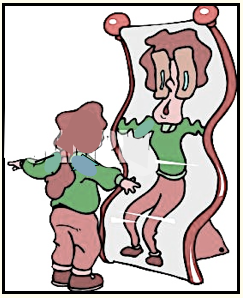
b. Distortions
 CDs cause many problems for children. IT :
• gave us a distorted view of how the world works, making it hard for us later on to take responsibility for our motives & action
• prevented us from – becoming fully socialize, taking normal risks & learning about the many options available in life
• severely increased our inappropriate school / social behavior, making it easy to be a target for bullying, insuring distance from peers, & forced to stay dependent on the family

Familiar phrases: Blood is thicker than water Never air our dirty laundry in public  ~  No one else will love you like we do
~ You’ll never make it on your own so we’ve got to stick together ~ We’re better than ‘those’ people
OR a childhood taunt:  “You have a face only a mother could love, & she died”!

c. Family Insularity is an attempt to feel safe BUT built on fear-based rules that inevitably lead to constriction, intolerance & an inability to collaborate / cooperate well with others.
Ironically it also creates isolation, scapegoating, unhealthy alliances & splits inside the family, which then get repeated in adulthood.
EXP: A  part of the dysfunctional family mobile, being trapped in a toxic ROLE, (Scapegoat. Lost Child….) had “negative benefits.” It seemed useful by ‘protecting’ a parent from their emotional problems, the consequences of their addictions, & whitewashing outright abuses.
As adults we look for the same kind of payoff when playing out our Role in the larger world (protecting a mate, boss….), which doesn’t work now either, only reinforcing our sense of being a failure.

4. Parental NARCISSISM (N)
a. Boundary invasions
• Ns require that everyone be their carbon copy, with no room for children to develop their individuality
• children need mirroring (reflecting back who the other person be like meis, without adding anything of oneself), but Ns can’t do that since they’re only projecting themself on to the child

Narcissists don’t recognize there are such things as Bs, that others are separate & not extensions of themselves. People either exist to meet their needs or may as well not exist at all. Anyone who provides narcissistic ‘supply’ will be treated as if they’re part of the controller, who demands the victim live up to their expectations (think: spider & fly).

• Some N. phrases:
“What’s yours is mine & what’s mine is nobody’s business”
“Do as I say – not as I do”, “Put a sweater on, I’m cold”
“No son of mine is ever going to…..”
“This is the thanks I get – after all I’ve done for you”
“Do that in the morning when you’re fresh” said by a mother always raring to go at 6 am, to her child who was born a dyed-in-the-wool night person!
Watch ‘Angry-martyr Narcissist” on YouTube

b. Role Ambiguity
Parental N. spawns much identity confusion. Since only their needs count, the children take on a parent role – “I am them”, & many a parent acts like a needy kid – “They are me”.

Family members aren’t sure who’s in or out of the clan, who’s performing what tasks or legitimate roles : Dad acts like a ‘girl’ , Sis is the ‘mom’, little Brother is the family shrink…..

Al-anon IMAGE: A co-dependent decides to kill himself by jumping off the roof of a tall building.  As he’s falling, someone else’s life flashes before his eyes!

NOTE: If you have firm boundaries in the face of a narcissist, the relationship won’t usually last! Good – better for you!

NEXT: B. Invasions (Part 3)

Cognitive Distortions – Intro (Part 3)

vcxcognitive distortions


NOW I’M COMPLETELY CONFUSED –
B & W thinking makes me feel safe!

PREVIOUS: CDs Intro (#2)

ARTICLE: “The NOCEBO Effect

4. Categories of INCORRECT THINKING 
There are more than 10 major kinds of Cognitive Distortions, over 40 kinds of Bias & almost 200 Fallacies. Part 4 gives a brief look at some. They’re all incorrect ‘logical’ arguments used to manipulate & control.

ACoAs are very susceptible to being conned by the WIC & PP’s use of CDs, but many people are also affected by anyone who uses twisted thinking to influence (advertisers, politicos, manipulative relationships…). This contributes to not feeling safe in the world, BUT we can protect ourselves by learning to recognize twisted thinking for what it is!

a. Cognitive DISTORTIONS (CDs): Exaggerated & irrational beliefs that contribute to & perpetuate certain psychological disorders. They can be divided into 3 groups of Negatives – re :
Views about the self (‘Mind-reading’), Views about the world, generally(‘Catastrophizing’) & Views about the future (‘Fortune Telling’).

b. Logical FALLACIES: Any part of an argument that’s flawed, making either a line of reasoning or the whole topic untrue. ALSO, when a seemingly plausible argument includes a mistaken idea (even if there are some valid parts) OR when we draw an incorrect conclusion from correct info.

ad-hoc fallacyEXP: A ‘post hoc’ fallacy insists on a direct cause and effect between 2 events, simply because one event preceded another:
i. I went to the jewelry store to look at rings
ii. While I was there, a masked man with a gun came in & robbed the store
iii. Since I was there before he came in, I must have something to do with the robbery!

Here the fallacy is the result of ignoring other relevant information around the 2 events, such as THAT:
— my being there was an unlucky coincidence
— the robber & I don’t know each other
— he’s robbed other stores I’ve never been in….

c. BIAS
• The human tendency to make systematic logic errors based on preconceived ideas, rather than evidence. They’re ‘one-sided’, favoring some outcomes over others, which interferes with the ability to be impartial & objective.  EXP of Gender Bias: ‘All boys are better at math than all girls’

• Biases can come from information-processing shortcuts, including errors in judgment, memory, or the cause of something – which drastically skew the reliability of personal accounts (experiences) or legal evidence (concrete proof). RESULT : Thinking Biases can harm our ability to make proper decisions, solve problems correctly, & limit the capacity to learn new information or ideas.

d. NOCEBO
We’ve know the term Placebo, used to identify both pleasant & harmful effects of the power of suggestion (voodoo dolls that cause pain or ‘fake’ medicines that reduce/eliminate pain).
In the 1990’s the term NOCEBO (Latin for “I will harm”) came into use in medicine. It’s anything that in itself is benign or neutral (the color of a pill or a type of plant), but which can cause symptoms of illness by the suggestion or belief that it IS harmful.  This belief can come from inside or outside of ourselves.

nocebo• ‘Nocebo’ was originally used to label the harmful, unpleasant, or undesirable reactions some test subjects actually exhibited when given an inert dummy drug.
The very real physical reactions were not created chemically, but entirely due to the subjects’ pessimistic outlook & expectations.

A psychiatrist at Boston’s Brigham & Women’s Hospital, found in a recent review of the nocebo literature that – patient expectations of possible harmful side-effects of a drug – played a significant role in the outcome of their care (Arthur Barsky, et al. 2002)
• In another study, more than 2/3 of 34 volunteering college students developed headaches when told that’s what could happen from a (non-existent) electrical current passing through their heads.

All Cognitive Distortions are mental nocebos!  Since CDs are incorrect assumptions or belief that negatively influence how we feel & act, those irrational conclusions causing untold emotional or physical injury to ourselves & others.
(From ‘Skeptic’s Diary’)

NEXT: CDs Overview

NEGATIVE BENEFITS of Old Patterns (Part 1)

neg.benefitsYOU CAN’T MAKE ME GIVE THIS UP !
I’d rather be miserable than face that pain!

PREVIOUS: “They did the best they could”

SITE: 10 Worst Habits for Mental  Health

See ACRONYM page for abbrev.

INTRO
Negative Benefits (NB) is a new concept for many people. A web search found nothing about this important idea.  When clients are asked what they get out of continuing a harmful behavior or thought pattern, they usually say “I don’t get anything out of it – it’s just what I know, a habit”.  They’re indignant that they’re even asked.  They only hear the word ‘benefit’ & can’t imagine that anything self-destructive can have a reward!

• Familiarity & habit are not the only reasons destructive patterns persist. The deeper truth is that we DO get something from hanging on to those old ways of acting & thinking – they’re a form of protection (defense mechanisms) against facing childhood issues that feel too terrifying to deal with.

So yes, they provide us with Negative Benefits. In reality the ‘protection’ they seem to offer comes at a high price – in grief, in more abandonment, shame, self-hate, loneliness, ill-health, bad relationships, depression, lost opportunities…. yet we protect them with our life, literally, until we do enodefensesugh FoO work to not need them – as much.
SO – to understand what Negative Benefits (NB) are, we have to start with:

DEFENSES
These are unconscious human psychological strategies our mind develops to protect us from having to deal with painful traumatic realities we can’t handle.
They’re also used to maintain our self-image – a mental picture of ourself we can live with, in the face of inner conflicts – between what we think we are & what we wish we were.

• Everyone needs defenses to manage. However, when we experience long-term stress as children our defenses become rigid armor & walls, which are hard to penetrate & hard to dissolve. They’re expressed in the form of Character Defects – self-defeating behavior patterns which can be seen as forms of Self-hate, SUCH AS:
😱 abusive behavior, being controlling, closed-minded, co-dependent, dishonest, isolating, negative thinking / pessimism, narcissism, perfectionism, prejudice, resentment, rationalizing, selfishness, self-justification…..(Immature)

These T.E.A. patterns sustain our denial by protecting against old pain:
— (E)motional: our abandonment terror, deadly loneliness, murderous rage, profound hopelessness, terrible longing for the impossible….
— (TMental: a deep-level KNOWING that they weren’t there for us, &/or tortured & neglected us, which was potentially lethal & which the WIC still believes can destroy it.
So, no matter how self-destructive or lala a defensive pattern is – we will do almost anything to hold on to it – even in Recovery – because:

a. the WIC is in charge of our inner life, until we develop the UNIT, the Healthy & Loving Inner Parent with must replace the PP’s bad voice ( Introject)

b. AND, the kid is beyond-convinced that our long-time defenses are not as life-threateningly dangerous (bad for us) as what’s underneath, hidden in our unconscious

• REVIEW: dysfunctional patterns ‘protect’ us from facing what we consider unbearable knowledge (T) & terrifying emotions (E) from the past, as well as having to deal realistically with functioning (A) in the present. They represent Freud’s ‘Repetition Compulsion’, which is so evident in the lives of most ACoAs. Yes, the pain accumulated from childhood is bad, but not dealing with it cripples or kills us in so many PtraumaMES ways

➼ In simplest terms, the main reasons we hang on to the old ways with both fists, as if it were a life-preserver is:
1. because our brain has been programmed from birth, & those grooves (neural pathways) are very deep. It takes LOTS of knowledge, repetition, perseverance & patience to make new, stable grooves
2. since our WIC believes it needs the psychological negative benefits to survive – it will take a lot of time & effort to develop the new UNIT that can take over the reins from the WIC & PP.

NEXT: Negative Benefits EXAMPLES (Part 2)