ACoAs : OVER-Controlling Ourselves (Part 2)

addiction  IF I DON’T KEEP A TIGHT LID ON
I’ll do all kinds of bad things!

PREVIOUS: Over-controlling ourselves (Part 2)


DEF: Over-controlling (O-C) ourselves is not so much about our actions – although it also affects them as a consequence – but mainly means :
✒︎ rejecting our emotions, needs & observations to such an extent that we go thru life in a state of constant ‘under-nourishment’ (deprivation) & bewilderment. Those discarded parts, which we’re terrified to face & own, then become our shadow side

• Instead, we are run by a False Self (FS), that protective identity formed so early we actually think it’s the real us. It’s made up of various aspects of the WIC (scared, angry, apathetic, suicidal…) & the PP disguised as a ‘guardian’ in the form of a know-it-all cattle-prod. The FS is comfort-seeking & therefore short-sighted, making unwise, unhealthy decisions – a kindergartener trying to do college level work

Peter K. Gerlach, MSW, writes that unhealthy will-power occurs when a person is controlled by a fierce Guardian hardened into sub-selves such as Addict, Fanatic,  Martyr, Perfectionist, Preacher, Survivor, Zealot….
Its determination to protect the WIC at all costs can cause rigid self-discipline which is toxic to the host person & also other people.
EXP: the talented Magician sub-self (as Delusional Mystic) can distort reality to justify or excuse self-destructive attitudes & behaviorsabused

☛ Of course some ACoAs will react to the controlling inner voice by
— doing very little with our life, from confusion & terror
— OR nothing positive – from misdirected rage.
Over all, these limiting sub-personae produce distorted beliefs (CDs) & intense Es such as shame, guilt, fears, trust imbalances = which make it hard to bond to others

EXP: A perceptive & bright daughter was a threat to her incestuous father because she would not have been easy to silence if he had molested her. So instead he turned her into the family scapegoat, verbally & physically beating her. This succeeded in convinced her that she was stupid & unable to trust her observations & intuition. Even though she resented him, she still gave him the benefit of the doubt & spent much of her life hopelessly trying to win his approval! SIGH, UGH!

AS ADULTS
ACoA Damage – Any form of prolonged & intense control is painful & debilitating, especially for children, who are powerless to escape it. Being over-coerced &/or under-attended (in Part 1) are both abusive parenting styles.

Deliberately or not, our family gave us the message:
“Search & Destroy any signs of personal identity. Be ‘good‘ (don’t think, don’t feel) or you’re not part of this family. If you try we’ll destroy you! ”
And we know that every kid reacts to the Family party line – whether by giving in or by rebelling.

• In reaction to the restrictions & neglect, this harmful message forced us to gradually over-control ourself, a basic component of S-H, & a familiar way ACoAs relate to self & others.
These early experiences became our Toxic rules which now act like a virus in our psychological operating system – invisible as it corrupts – and needs to be de-bugged!

Before FoO Recovery (family of origin)
✏︎ much of the time we act as badly as our family did, OR
✏︎ put ourselves in positions to get punished for trying to be ourself.
We’ve been so brainwashed that we’re desperately afraid to let go of familiar patterns, which the WIC believes would cause us to fall into a black hole we’d never get out of
EXP:
‣ Faced with a scary new experience, the WIC comes up with the usual reasons why it won’t work out
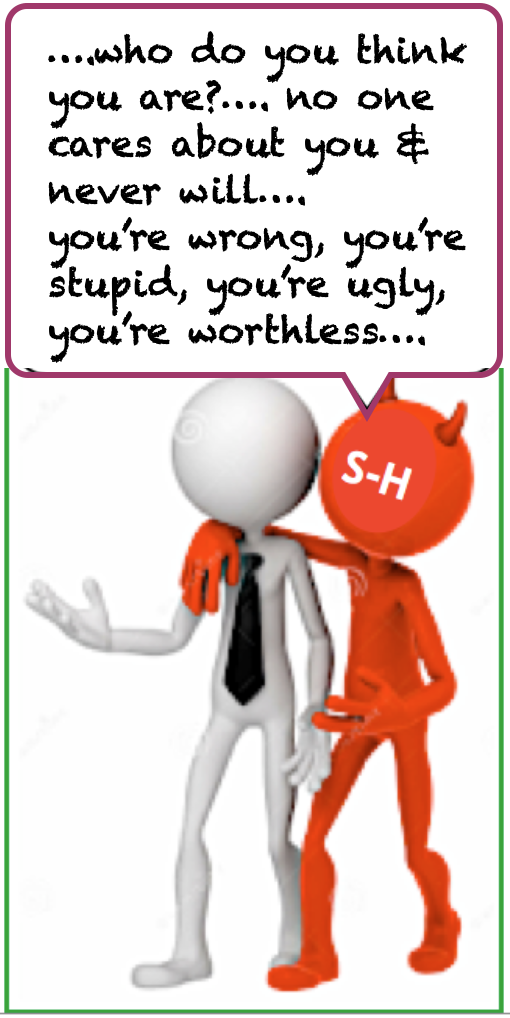
‣ If we even consider going after something we really want, the PP says: “Who do you think you are, anyway?”!

NOTE: Some ACoAs raised without more obvious physical abuse & chaos – but just as mentally, emotionally & Spiritually (PMES) unhealthy –
will act out all the hidden family damage by being the one sibling in trouble, socially or legally, using addictions, promiscuity & dangerous ‘excitement’.
▶︎ These ACoAs are the living “Portrait of Dorian Gray”, which shock & appall the perfect-looking family!
— EXCEPT that WE don’t have to die, we can Heal & Grow!

NEXT: O-C Ourselves – Part 3

ACoAs Being Controlled (Part 5)

drowningI CAN’T SEEM TO SURFACE
& it’s all your fault!

PREVIOUS: Getting controlled (Part 4)

SITE: 9 Ways We Set Ourselves Up To Be Controlled in Relationships

BOOK: Confessions of an Abandoned Child ~ Curtrina Pharr

See ACRONYM page for abbrev.


Negative STATES causing loss of Control
a. In Bondage / ways to lose independence
Accepting unwanted situations,  addicted & enslaved, be obsessed, be controlled, submitting to another, financially or psychologically tied down against our will
hopelessb. Focus on the Material / only aware of the physical
Caught up in appearances, getting & spending, over-indulging the senses, ignoring or forgetting the Spiritual

c. Ignorance / be unaware & stay
Taken in by appearances, choose to stay in the dark (denial), fear the unknown, live in deprivation, operate within a narrow range of options & emotions
d. Feel Hopeless / lack faith
Believe the worst, despair, doubt, see the world as ‘cold ’, predict a bleak future, think negatively  (More…..)

🎯 WHO / WHAT we LET Control us (cont. from Part 4)
You’re being controlled (or Over-C) WHEN you STAY:
Sphone fatigueon the phone, long texts…. or with someone you want to get away from
• in any location or event you’d rather not be at (or hate)
• in any relationship, job, home…. way too long
• with someone else – when you’d rather be alone, need to rest, or be doing something else, and/or ….
WHEN YOU:
• buy or eat things the other person wants you to, but you don’t like
• endlessly listen to someone’s dumping – who’s in too much pain, demanding, needy, abusive, just using you….
feel sorry for others instead of for yourself
• go out with someone because they want you to, or from loneliness
OR
• keep believing a proven liar, keep depending on someone who is consistently unreliable
bad date• keep seeing friends who are totally focused only on themself, never on you, including dates & mates
• let other invade your boundaries or say mean things — without objecting
• spend a lot of time worrying about someone else that you’re ‘powerless’ over
OR
• pay for things only to please another (not from love but from FoA)
• take care of very damaged people who need much more help than you can give them, because it makes you feel ‘important’, needed, less worthless….
• try to be something you’re not, or do things others want – out of guilt

You’re with a Controller (C.) anywhere :
BEHAVIORAL – if you
are given the ‘silent-treatment’ as punishment
• firmly state a boundary about something, & the C. ignores it completely
• feel like you’re losing it, because the C has systematically isolated you, to make you only be, do & think the way they want
• friends or family see a change in you when you’re with the C.
• have lost friends because the C. complained about or refused to let you see them AMD/OR have badmouth you to them

EMOTIONAL – if you
• feel depressed & physically drained much of the time
• feel suffocated by the C being needy, over-protective or intrusive
• feel ‘less than’, ignorant, belittled or hopeless when you’re with the C.
• end up feeling guilty all the time but don’t know why
IF you:
• eventually ‘shut down’ and ‘give in’ rather than trying to be heard, sticking to your point of view, being taken seriously
depressed• hide or run away from problems with the C. because you feel too weak to confront & stand up to them
✶ are being told by the C. that what you’re feeling – anger, fear, frustration – are from your ‘issues’, that you’re causing it, you’re over-reacting…. (while denying what they ARE doing! to hurt you)

MENTAL – if you
• always second-guess yourself, from actually being criticized, undermined or corrected by the C
• are accused of being boring now because : “You used to be so much fun, more interesting & outgoing…. you just copy me”
• tend to ‘go along with things’ to avoid conflicts with the C
• worry about the C’s reaction before you make a decision

✶ Are often told the C. is not ‘doing anything to you’, but rather that you’re choosing to do or be what the C. wants! (Cs take NO responsibility for their manipulations!)

SPIRITUAL – if you
• are constantly judged & accused of being bad, using a spiritual or religious dogma as ‘proof’
• feel you’ve lost your vision & are willing to compromise your values to try to please them
• punished for not being perfect, not following their rules

NEXT: Responding to Controllers, #1

‘Controlling’ & Abandonment (Part 2)

feelings
THOSE OLD FEELINGS –
give me acid-reflux!

Previous: Controlling & A. (Part 1)

Review Posts: My Rights – Qs
and
 ACoAs & Having Rights


LONG-TERM Abandonment (A.) experiences, especially in childhood, inevitably creates intense fear & shame in children. Total dependence on caretakers make them very vulnerable, so too much deprivation will feel life-threatening, & in some cases it is!  As terror grows, so does the compulsion grow to control oneself & the environment – to feel a little less unsafe by not being at the mercy of others.

EMOTIONAL A.  Children have to hide the parts of themselves not considered acceptable by the family (see the “Laundry List”) – to not get rejected. We were told what we felt was not true or legitimate, and DON’T make mistakes, have needs, be successful, show emotions …
We heard:  “You don’t have anything to cry about so stop being such a baby. Stop crying or I’ll really give you something to cry about. That really didn’t hurt. You have no right to be angry”…

• Ignored or punished childhood PMES needs cause developmental damage, the same as nutritional deficiencies, like sailors in the past who developed scurvy (internal bleeding, connective tissues weakness & sudden death) from lack of vitamin C in their diets during long trips.

For ACoAs, this will eventually show up as fear of taking appropriate risks, lack of trust, & fear of intimacy, not having a personal dream to follow, lack of healthy communication skills (how to talk to oneself kindly, how to make small talk, how to stand up for oneself), a weak sense of self…..

• Think of accumulated old A. pain (terror & rage) as acid, filling a deep well buried in our unconscious. We may not taste it all the time, but when it bubbles up it’s emotional heart-burn!  When someone or something bumps up against an unhealed wound in our psyche, the lid get blown off the reservoir, releasing a spurt of that old pain (like when – not getting a text back, a broken promise, being left out, accused wrongly or having to wait too long….)

OVER-CONTROLLED
Main hidden emotion is SELF-HATE
Not allowed to ‘be all you can be’ in our family, the very essence of our being was punished & rejected! Slowly we became controlling toward ourself, thinking this would please them

CONTROLLED
Main visible Emotion is FEAR
Not ‘being in our power’ makes us terribly vulnerable to everyone & everything round us, so it’s easy to let ourself be controlled, thinking we’ll be taken care of. All it gets us is more repression & damage

CONTROLLING
Main visible Emotion is ANGER
Not being internally ‘allowed’ to meet our needs pushes us to insist that others do it for us – any way they can. We desperately try to arrange our world to fit an ideal so we’ll feel safer.  We become the ‘control freak we hate so much in others!

BLAMING
In the present, ACoAs often accuse other adults of abandoning us when we feel hurt by some interaction or loss.  What we’re actually experiencing is the WIC’s unresolved old A. pain.
The intensity of our reaction is usually out of proportion to what’s actually happening – now.
Naturally there are real-life situations that make us sad, frustrated, angry… but unless an event is extreme (death of a loved one, a life-threatening attack or illness, a fire…), most situations don’t warrant our level of reaction. Remember “If it’s hysterical, it’s historical”

When others “A.” us: When someone we’re hungry to be with doesn’t respond right back – we feel S-H but also get very angry. We’re as devastated as if they had threatened to take away our livelihood or our home, which are NOT = to being ignored or put off. Yet we get just as scared & blame ourself, wanting to control them to stop the pain.

When we Abandon others: We also have great FoA when we aren’t perfect. Talking too much, asking questions, expressing strong emotions – or standing up for ourself! – are NOT = to punching them, yet ACoAs can feel the same anxiety & self-hate as if we had!  So we over-explain, withdraw or grovel – to stave off being abused &/or left like we originally were at home!

NEXT: ACoAs Being Controlled, #1

‘Controlling’ & Abandonment (Part 1)

baby controling I NEVER GOT WHAT I NEEDED –
so now I force it out of others!

PREVIOUS: Satir’sDISTRACTER Role


SEE
 Acronym PAGE for abbrev.


ABANDONMENT (A.) as SOURCE of Control Issues

• To understand being controlled or acting controlling, we have to know the underpinnings, which come from our original abandonment experiences.  In common usage, a person is said to be A. when someone physically leaves us – moving away, a break-up, divorce, long or repeated hospitalizations, death…..

However, based on ACoA experience we know this definition is too limited. When we observe little kids – ours or others’ – we notice how very needy they are.  This is perfectly normal, in spite of what we ACoAs were told growing up = that we were too much, too selfish, a bother, too sensitive, dramatic …. We got the clear message that at best we were being tolerated!

• A broader & more accurate definition of Abandonment (A.) is: “Not getting enough of our normal needs met in childhood”.  This includes all needs on each of the 4 levels of PMES – Physical, Mental, Emotional & Spiritual. We can also say that A. includes not being loved unconditionally, with the resulting loss of genuine connection to parents so crucial to a child’s sense of well-being & safety.sad/scared

• Picture all children as having 100 different needs in each of the PMES categories (total 400 – an arbitrary number, as example). Then consider the reality that in a severely dysfunctional family each kid only gets a small percentage of those needs met – just enough to survive. Of course some of us got more, while others didn’t even get that much & have died too young as a result!

Depending on birth order, gender & personality,  different siblings received differing amounts in each category. Certain children are favored because their ‘native’ style is similar to the parent, or rejected by the narcissists because the child was not like them!
But over all, most of us were only provided with 30 – 40% of our normal human needs – when we were the most fragile & in need of great care.

EXP: A pathological narcissist “mentally-oriented” father who incested each of his children in varying degrees, (4 boys & 1 girl) was slightly less abusive towards the one child who was also “mentally-oriented”.  This son is the only sibling who was able to forge a decent life for himself (as a doctor), but not without emotional scars. The others became addicts, severe under-achievers &/or criminals.

• With no validation & nowhere to process the emotional pain, it all goes underground & slowly eats away at us.   Toxic Beliefs then get ingrained.
As adults – these distorted rules combined with a great backlog of unmet needs –  has left us with an overwhelming desperation to be ‘fed’ by someone, anyone, along with the deep hopelessness of it ever happening. Pretending we don’t have needs, or suppressing our awareness of them does not make them go away. (Post: “Vicious cycle re needs“)

shadow sideSHADOW : To survive & not ‘go crazy”, many of those ignored childhood requirements get pushed into our ‘shadow’ – made up of every part of ourself that we were taught were so awful – so we have to deny their very existence.

In Jungian psychology the shadow aspect is a part of the unconscious mind consisting of repressed weaknesses, instincts & shortcomings…. “Everyone carries a shadow, & the less it is embodied in the individual’s conscious life, the blacker & denser it is.
It may be (in part) one’s link to more primitive animal instincts, which are superseded during early childhood by the conscious mind” (Jung-Myers Model + A Case Study & chart)

➼ Unfortunately for us, ACoAs not only relegate our ‘unpleasant’ aspects (such as the ‘7 Deadly Sins’) to Shadow, but also many of our good qualities – anything that was not allowed in our family!

We become so terrified of these aspects & activities, that we use a wide variety of defenses & addictions to keep them hidden.  But the more we suppress legitimate needs the more anxiety builds. Sooner or later they leak out or erupt in distorted ways, like being clingy, ‘invisible’, manipulative, irresponsible, vague, needy….. AND/ OR controlling, mean, demanding, domineering, promiscuous, pushy…
Sad IRONY: The more we suppress – the needier (& meaner) we get!

NEXT: Controlling & A. (Part 2)

NEGATIVE BENEFITS of Old Patterns (Part 3)

attitude 

YOU EXPECT ME TO DO WHAT?
I’d rather do it my way!

PREVIOUS:   Negative Benefits (Part 2)

SEE posts:Denial & Acting out
The UNIT: Healthy Adult, Loving Parent”

PMES = Physical, Mental, Emotional, Spiritual

DENIAL & RESISTANCE
Why do we keep blanking on what we’ve learned in Recovery?  Because even ACoAs who are sincere about self-growth – have a powerful built-in forgetter, pounded in place by our family. We can hear the same thing over & over, & still….

So, when clients are asked* some basics of ACoAs damage & recovery, such as:
a. “What is self-hate & why did we develop it?”
b.  “What do we need to have in place in order to have good boundaries?”
c. “How does this problem of anxiety relate to your childhood?”
d. “Why do you need to stay vague about your finances?” …..
…. they often give a blank stares & shrug, even after years of Program & therapy!

• ACoAs are not stupid people.  In spite of ADD, depression, hormone imbalances or other issues – we remember lots of other things – like how to do our jobs, how to surf the web, how to buy a house or car, how to expend lots of futile energy giving great advice to friends, lovers, family – that we don’t use for ourselves ….. but NOT what we’ve learned about our own damage OR about mental health!  adults-acting-childish
(adults acting like school kids  —>)

So if we want to keep growing, it’s very important to keep looking for the unhealthy payoffs (same as NB) behind our self-defeating patterns.

ANSWERs to the above Qs :

a. If we did understand what S-H is truly about, it would be harder & harder to maintain. THEN we’d have to deal with the intense pain & rage of the many ways we were neglected, abused & abandonment by our family.

NB:
Keep all that swept under the rug – locked away in a dark room of our unconscious.  The WIC thinks that if you ignore something scary, it doesn’t exist.  Too bad it doesn’t work that way!

b. To have good boundaries we need to:
1) know what our needs are
2) give ourselves permission the actually have those need
3) actively go about meeting those needs, a day at a time.
It would mean disobeying fundamental Toxic Rules, taking care of ourselves, not staying a victim (which we were originally) & stop waiting to be rescued

NB: Not have to be in charge of our own life – not ‘grow up’ emotionally, & face angry or fearful reactions from our family & ‘friends’ if we were to get better (we think it prevents getting abandoned – but that has already happened by those people!)S-H

c. Identifying how each problematic situation / relationship / emotion / pattern – in our life mirrors our childhood (S-H) would mean having to face what our parents were really like, what they did to us, what they didn’t provide…. which IS reflected in how we treat ourselves now.  We’d have to break many illusions & feel the deep hurt & longing of our eawrly years

NB: Not have to do an extensive written family inventory, to look at these realities on a deeper level – even when we think we’ve dealt with our issues or that we already know all about what happened.

d. To stop being vague about anything (our finances, time, our emotions, our knowledge…) means identifying the Toxic Messages we’re still obeying, feeling the old terror & having to take full responsibility for our actions in the present. S & I = becoming your own person, the one you were born to be, minus your damage!

NB: Not having to fully acknowledge knowing how bad it was growing up, not dealing with our accumulated old pain, not having to separate from the dysfunctional system we grew up in — which the WIC thinks means abandoning them, & us being alone forever!

NEXT: Neg benefits #4

“They Did the BEST They Could” (Part 1)

they did the best... 

YES, I WAS HURT BY MY FAMILY,
but they were hurting too, poor things!

PREVIOUS: Results of abuse – #2

REMINDER: See ACRONYM Page for abbrev.


1. GENERAL
This is a commonly used phrase – in & out of Program – mainly in the service of the speaker’s denial!
You may at first think this post is harsh or unfair, BUT please remember that everything our parents were  – WE internalized into our Negative Introject.
As long as we deny how harmful their actions were toward us – we will continue doing the same to ourselves, mistreat others AND let others mistreat us in many of the same ways! ( Self-hate’).

How is this phrase usually meant? That that no matter how cruelly, crazily…. our family may everything's OK ??have continually acted, to each other & us, even to this day – it was the ‘best’ they could manage.
It implies that they :
• used all possible resources to cope
• could NOT have done any better
• meant well, even if they didn’t show it
• really tried, in spite of falling short
• didn’t have any other options ….

In most of our families NONE of these are true – OR if true in part, it was a very small part – not enough to help us as kids!

2. DENIAL
a. THEM: This phrase is usually said by adults, about their parents – but only by people who had painful childhoods! You won’t hear a happy, well-adjusted person needing to even think this, much less say it!

The BEST they could? If our parents were verbally cold, controlling, cruel & insensitive, narcissistic, neglectful, not comforting, drunk, demanding, abusive, addicts, raging….  That was the BEST they could DO? Really?

NO. The most we could say is that they:
chose the ‘easiest way out’,  just didn’t care enough to bother, or were self-righteous about their parenting style (“Spare the rod, spoil the child”) – anything to not take to look at themselves & the effect they had on their children & others
did what any addict would (not just alcohol, but also food, shopping, raging, gambling, exercise, TV, sports, religion….) – everything possible to not deal with their responsibilities & emotions

did what was done to them. Yes, but most never bothered to change. One mother, when confronted, kept saying – “But there weren’t any books about this stuff when you were little”! Except the daughter knew mom never bothered with anything deep, ever. She only read ‘Readers Digest” & watched soap operas! AND, there were some books, & people she could have asked to help. But she ‘was never wrong’!

refused to get whatever help that was available to them at the time (AA & NO to helpAl-Anon have been around for over 50 yrs, psychologists even longer).  One mother admitted she wouldn’t be caught dead going to a therapist. Another was begged repeatedly by her daughter to go to Al-anon, but always blatantly refused

were neglectful – some of us had a parent with a genuine mental illness – but others in the family denied the problem & did little or nothing to seek out solutions that were possible at the time, if not for the sick adult, then at least for us kids
EXP: More than one CoA was left alone for years to deal with a drunk, suicidal or psychotic parent

b. US: On the surface, when ACoAs say this phrase we mean the ‘General’ qualities listed above (from denial).  Under that, we’re really saying that we :
• can’t afford, emotionally & mentally, to admit how badly we were treated
• still believe we caused or deserved the terrible things they did / didn’t do
• “understand” why they acted that way, intellectually – so we don’t have to FEEL the hurt, sadness, frustration, rage, disappointment….

—–> And here’s the kicker:  we’re saying that – since “they did the best they could” – we can’t possibly be angry at them! Saying that we forgive them is actually our way of exonerating them. – not holding them accountable.

OK, so what’s wrong with that? Yes, it is the ultimate goal of mental health to let go of our anger, detach with love – or indifference, to forgive, outgrow our need for them… BUT…… (cont. in #2)

NEXT: “They did the best they could” (Part 2)

“FEAR is the ABSENCE of LOVE”

Sscared fish 

LOVE vs FEAR
I don’t know what love is, so how can I tell?

PREVIOUS: How ACoAs Abandon Others #3b

REVIEW: ACRONYM page for abbrev.


WHAT DOES this quote MEAN?
• Like so many popular ‘spiritual’ saying there’s some truth in it, but not the whole story, so we can easily get confused & also misuse it. Love & Fear are both Emotions, see. T.E.A.
Generally, it means that if we did have enough love in our life, we won’t be afraid = loved by a Higher Power, by family, by pets, by friends…  Yes, these are to be desired & cultivated.
BUT the reality for ACoAs is that we are fear-based, no matter how much recovery we may have. There are 2 separate issues re. this quote:

1. Fear is created in CHILDHOOD by genuinely being in danger!
• As kids, ACoAs lived in an atmosphere of constant trauma, subjected to fear-inducing experiences (mental, physical & emotional) practically every day of our childhood.
AND there was very little comfort or validation of our reality. On the contrary, if we told anyone or complained, they said we were over-reacting, making it up, being disloyal, AND it was our fault “What did you do?” Even if anyone believed us, they didn’t / couldn’t help, so we had to suck it up.

EXP:  A lot of our childhood was like being:
— a 5 yrs old, dropped off in the middle of a huge traffic intersection at rush hour, left there in our underwear, told to not whine & ‘JUST COPE’ !!  How cruel !

All that pain & terror got pushed down, so where did it go?  Yes, in large part, psychologically, it went into the unconscious. But physically – the chemicals generated by terror & other painful emotions got stored in our body – in our organs, our muscles, choking our aura, meridians & chakras.

2. Fear is created NOW by outer events & inner thoughts
a. Present-day reality. There are many real-world stressful events we’re faced with in life requiring a clear mind, much human help & Spiritual support. .
It’s normal to be fearful when WE:
• are overwhelmed by too many things needing our attention
• find out we’re very sick, & sometimes – don’t know the cause…
• hear / read about traumatic world events ….
• have a lot of emotional turmoil (visiting family, getting married or divorced…)
• loose something very important to us (apartment burns down…. )
• see someone we love is in danger (a child, a pet …)

BUT for ACoAs, such events can easily trigger the pain of past trauma, pushing us over the limit of our scarce reserves. So our emotional reaction will be much bigger than that of less wounded people.

b. Toxic Thinking. Fear will always be generated by harmful thoughts – our inner world of beliefs babad voicesed on negative family rules (CDs) – the harsh, scary things we tell ourselves, creating more terror on top of what we’re already carrying from our past.

Terror & S-H are behind ALL rage and ALL obsessions. WE:
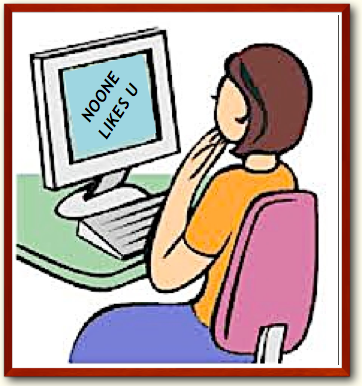
• are convinced someone’s angry at us or can’t stand us, when they didn’t say hello or give us a compliment …..
• are so used to things not working out, & having anxiety as our constant companion, that we create mental drama when it’s not called for…
• believe we’re “dying of cancer” when we’re not seriously sick (especially when not feeling well but don’t know what’s wrong)
• assume others will react to us the same way we think about ourselves – badly !
• project only painful outcomes on to situations & relationships
• worry about future catastrophes & abandonments, which may never happen & which we will have no control over

Daily childhood abuse & neglect (unprocessed) accumulate in deep reservoirs of hidden pain, which most people call anxiety, because on the surface it doesn’t seem to be connected to anything obvious. HA !
As long as this backlog remains frozen, the pain:
a. drives much of our behavior, our thinking & interactions
b. causes physical & psychological ailments ….

… but in Recovery, much release work can be done, which definitely helps!  We can get to a place where we live more in a state of calm rather than upset. There will always be some residual ‘old’ fear that shows up thru the years when we’re under stress – never being completely rid of all original abandonment terror. This should not be a surprise, since there was so much of it.  We need to be extra kind to ourselves.: “Feel the fear & keep going”, but softly, softly.Screen Shot 2016-06-17 at 10.34.08 PM

“Fear is the absence of Love” is about :
— not having loving safe parents, originally
— the scary thoughts which torture us
— not searching out people who can be good to us, &
— not believing there’s any safety in the world – for us !

HOWEVER when we practice nurturing our Inner Child, connecting with the peace of a loving H.P. & with healthier people, our overall fear level diminishes, especially the unnecessary suffering we’ve been add to the ‘pile’.
➼  We can’t always control or eliminate old fear, but we can be in better charge of that we THINK & what we DO about it.

NEXT: Not Enough Love? – #1

ACoAs – ABANDONING OTHERS (Part 1a)

 mean teacher

I DON’T KNOW WHY YOU THINK THAT
(since I never would!)

PREVIOUS: Abandonment Pain Now #3


See ACRONYM page for abbrev.

ABANDONMENT STYLES covered:
1. Symbiosing, 2. Controlling, 3. Ignoring, 4. Copying, 5. Repressing other’s Emotions, 6. Idealizing, 7. Undervaluing

ACoAs are usually focused on how much we got abandoned, without realizing we’re just as prone to do that to others.
Not surprising, since everyone copies what they learned in childhood. We treat ourselves & others the way we were treated & the way we saw adults treat each other.
➼ Each style derives from a combination of :
• The original role models (parent, siblings & other relatives, teachers…..
• Our own native personality, forming the type of defenses we choose.
BTW – even tho’ we can’t technically abandon another adult, the term is being used here to express ‘not being there’ for someone else

1. SYMBIOSING
CAUSE : Many ACoAs raised by controlling narcissists were trapped in the state of ‘one-ness’ with one or both parents. We may have felt safe & loved at first, but slowly were engulfed by the needs & demands of unhealthy adults.
As we grew & began developing our own personality, we were slapped down, cut off or rejected outright.
The only option we had was to stay enmeshed, without the chance of developing ourselves fully.

RESULT: As adults we look for anyone we can mesh with, to prevent a terrifying sense of aloneness & abandonment carried over from childhood. Trying to connect with others this way is actually a form of abandoning them, because we’re not connecting with them for who THEY are, only for what our needy WIC wants them to be – for us. (“Symbiosis“)

2. CONTROLLING
• Putting severe limits on what someone can & cannot do when they’re with us (what they wear, where they sit, how they talk, what emotions are OK…)
• Constantly telling someone how they should live their life or how they should be doing something (whether they asked or not)

NOTE: This is not the same as asserting appropriate boundaries regarding what works for you or what you don’t want to be around
CAUSE
• ALL controlling behavior represents our disowned fear accumulated from childhood on into the present
hiding the mess• Trying to micro-manage everything & everyone around us so we don’t have to feel vulnerable, as in our unsafe & chaotic family, & later in bad jobs or bad relationships

• A defense mechanism designed to make us feel powerful & the world be more predictable, by hiding our inner mess, trying to make everything exactly the way we want – SAFE.
As long as we refuse to or can’t deal with the underlying cause of this compulsion (& being controlling IS compulsive, fueled by intense anxiety) we won’t be able to stop

EFFECT
Regardless of the underlying reasons, this pattern is:
arrogant. We’re convinced we know better than everyone else, about everything,  AND have the right to make others do / be what we want
disrespectful to others!  We’re implying, consciously or not, that we don’t care about the effect our controlling has on the other person – we trample on their needs &/or wishes, because only our needs matter!
If we did care, we’d think twice about continuing.
insulting. We believe they are too incompetent, weak & stupid to make their own choices or figure things out for themselves

✶ Of course, trying to be in control of others instead of ourselves – never works. Not only does it not alleviate our underlying terror, but makes others withdraw or be resentful & angry at us – so us feel even more unsafe & alone

HEALTHY Separation & IndividuationScreen Shot 2016-06-11 at 6.34.14 PM 
• Acknowledge that each person has their own way of doing things & the right to make their own mistakes. We are NOT their Higher Power!

• ASK, ASK, ASK: what someone wants, what they need, how they feel, what works for them, what their taste is….
We do not have to supply any of it IF we can’t, don’t want to or it’s not appropriate. Just keep in mind that others are separate from us, & that’s not bad – their differences do not negate who we are!
• Be willing to deal with our own damage, our accumulated pain & toxic patterns

NEXT: ACoAs Abandoning others (#1b)

SELF-HATE & ACoAs (Part 3)

addictionsI CAN’T GIVE UP
the only ‘truth’ I know

PREVIOUS: ACoAs & S-H #2

QUOTEs:
🔻 “I won’t sleep if that’s what it takes to not wake up as myself”
Casey Renee Kiser, Hold Me Under: Poems to Drown to

😰”To keep my mind occupied when I can’t sleep – some people count sheep. I self-loathe.” ∼ Rainbow Rowell, Attachments

🥶 “Hostility, malice & sadism are the result of helplessness & self-loathing – all produced by adaptation to a hypercritical social reality, & are not attributable to innate aggression.” ∼ Arno Gruen, Swiss-German psychologist

FoO = Family of origin

1. DEFINITION
2. SOURCES of Self-Hate (S-H)

3. PURPOSE of S-H is TO:
• keep from risking any change via S & I (fear that letting go = being forever alone)
• keep us attached to the family (stave off deep loneliness)
• prevent us from dealing with ‘ugly emotions’ like our rage, envy, longing, hopelessness….
• protect our fantasy of having good, loving, safe parents
• protect us from feeling the reservoir of old abandonment pain
• protect us from Growing up, taking care of ourselves (we want to be taken care of! no matter the cost to ourself or others)

WHY is it SO HARD to GIVE UP S-H?
The above reasons are all part of the answer, but the MAIN one is that:
It gives us a FALSE SENSE of POWER! How?
Since every child is self-centered, which is human-normal, they think everything is about them – that whatever happens in or around them has to do with them.
The child’s logic says: “I’m in pain, & somehow I caused it. Therefore I CAN / must stop them from hurting me, if I can just figure out how!”

• Then we spend the rest of our childhood (& well into adulthood, until Recovery) trying different ways to FIX whatever the problem was & may still be – re :
US – by re-inventing ourselves (must be the origin of this USA craze), trying on different ‘personae‘ (be the perfect kid, the trouble maker, the helper, get good grades, be invisible, don’t have any needs, be funny…)
AND re :
THEM – by trying to make our parents see reason, get sober, get help, leave the marriage, get taken care of by us, cover up for them, fix their ‘craziness’, cater to their every whim….

Unfortunately NONE of our EFFORTS WORKED! In most cases ‘they’ didn’t change, didn’t listen, wouldn’t stop – drinking, raging, being unsuccessful, molesting, beating us, leaving, cheating, berating, controlling….!
But we kept trying, always asking: What’s wrong with ME?

Even if some of our parents did stop drinking,
— it was NOT because of our efforts. We assumed their ‘sobriety’ was, because we were extra good, prayed really hard or badgered them into it
— very few were willing to do the deeper work to become healthier human beings, so mostly they were just “Dry Drunks”. So their unhealed narcissism kept on hurting us.
RESULT -in us- was an intense feeling of failure!

• This is why so many ACoAs believe we’re FRAUDS – that people will eventually, inevitably FIND OUT.
Q: Find out what?
A: “Since I couldn’t make my parents/ family get well, be happy & be there for me – I’m not capable of and NEVER will be able ably to -succeed at anything else!” (WIC logic)

It’s an assumption ACoAs are not usually aware of, but glued to us by anxiety, and believed both by the less accomplished AND the most outwardly successful ACoAs, pre-FoO Recovery. Unfortunately, what we don’t realize is that the fundamental premise is false :
No child
— ever caused the adults’ messes
— was ever responsible for making them better! AND
— can fix anyone else

NEXT: ACoAs & S-H #4

SELF-HATE & ACoAs (Part 1)

self-hateI’M NO GOOD, & EVERYONE KNOWS IT – so I have to be perfect to make up for it

T.E.A. = Thoughts, Emotions, Actions

REMINDER: See ACRONYM page for abbrev.

FoA = fear of abandonment

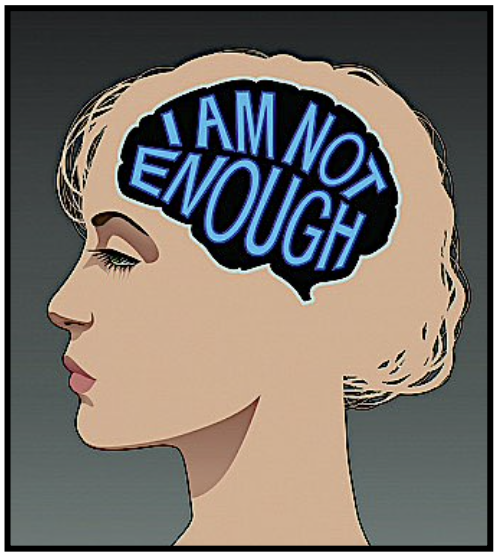
SELF-HATE (S-H) is the #1 deterrent to growth for all ACoAs.
It undermines our ability to function well, to have self-esteem & to be happy. Some people call it being ‘hard on yourself”, but it’s much more than that.  It’s so pervasive in the inner world of many ACoAs, that we don’t even know we have it & if confronted, vehemently deny it.
BUT the symptoms are all there, starting with a persistent nagging anxiety.

1. DEFINITION
✶ In Childhood : being thoroughly convinced that everything bad that happen to us as kids was our fault, that we caused our own pain!
✶ In Adulthood : continuing from the past, we believe in our very cells that anytime we feel hurt, suffer a loss, get ignored, can’t get something we want, have something taken away, have to wait for something … that it’s because we are bad, don’t deserve, did something wrong , failed to do something, don’t have a right to it – anyway

REALITY
ALL self-hate is a LIE
✶  it’s a defense mechanism to deny the original abandonment – by our family & culture. This a crucial point:
✦ S-H tries to cover-up all our abandonment pain
• It’s actually a form of narcissism (ours) – making everything about US, when it rarely is.  We make other people’s bad behavior our fault & our responsibility
• It’s an attempt at feeling in control, to cover our intense sense of powerlessness & vulnerability

• S-H can be expressed in all 3 T.E.A. categories:
Ts: “I caused their accident, since I asked them to come visit me”
Es: “I feel bad & really scared they won’t like me since I said ‘No’”
As: Staying with abusive people, not taking care of ourselves, not pursuing our dreams, not speaking up….

ESSENCE
One of the characteristics on the ACoA Laundry List is being Over-Responsible, a symptom of FoA & S-H.
What make S-H different from taking healthy, balanced Responsibility?
HEALTHY R. acknowledges the reality of having our T.E.A.s – or not. It straightforwardly owns up what IS, which can sound like:
“Yes, I did that” (A), or ‘No, I can’t handle this” (A), or “No, I don’t agree with that”(T) , or “Yes, I love this” (E)….

S-H, on the other hand says : “I_______, & therefore I’m BAD”
• Ironically, it prevents us from admitting to any normal, human imperfections, from shame & for fear of abandonment, OR
•  it can make us ‘confess’ to wrongdoing, even when we are in fact blameless.

In either case, what’s underneath is an unspoken Toxic Lie tacked on to legitimate responsibility, categorically stating that:
✒︎ “I did / didn’t do_______, which proves I’m unlovable & worthless”, no matter what the topic or truth is.

This add-on is implied, but at the core of our self-image. ACoAs will take any opportunity to beat themselves up, even about good things!
🖤 All S-H comes from our wounded child (WIC) staying loyal to our wounded parents.
EXPs of S-H:
“Yes, I did forget to sent the letter out today, so therefore I’m irresponsible”
“No, I don’t how how to do that, therefore I’m incompetent”
“Yes, I went to the show without inviting you, so therefore I’m selfish”
“No, I haven’t ‘grown’ perfectly or as fast as I should, so therefore I’m unfixable”
“Yes, I talked a lot at the meeting, so I’m a limelight hog”
“No, I don’t agree with that, therefore I’m stupid” …..

This is NOT what ‘taking responsibility’ means.
Posts: ACoAs’ Fear of R // Healthy R

So – WHAT IS IT? 
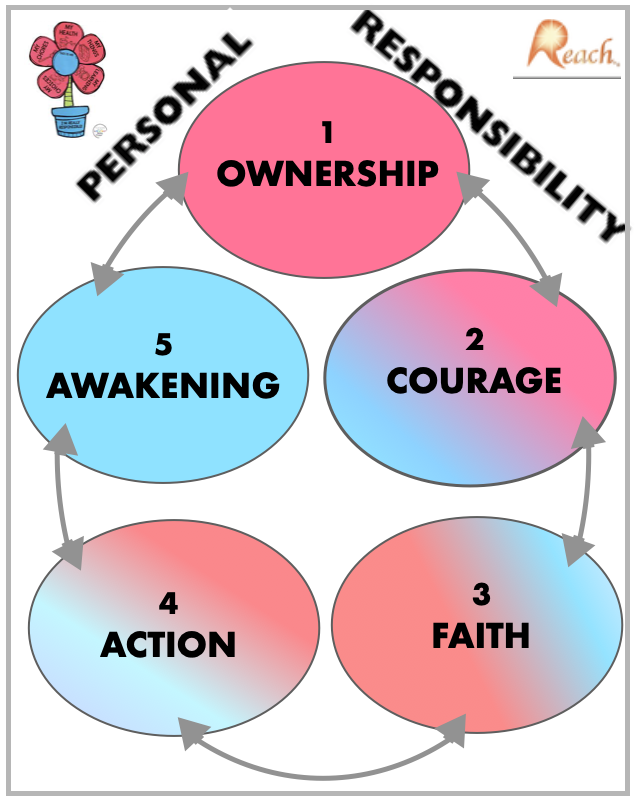
Basically, adult Responsibility (R) is:
★ honestly admitting to ourselves what we feel, think & have done -or- not. (T.E.A.), without judgment, shame or guilt.
MOST of ALL – without mental torture.

✒︎ Healthy R. includes regularly acknowledging both our limitations AND our gifts, our ignorance AND our knowledge. (POST: “The 10th Step“)

This def. applies to us now, as adults.
We are not / were NOT responsible for who our parents are or what they did!
SITE: “Great Responsibility Quotes for Kids” & the WIC

NEXT: SELF-HATE & ACoAs (#2)