BEING TOO NICE – High Cost (#2)

I’M PROUD OF WORKING
harder than everyone else!

PREVIOUS: Being too nice #1

SITE: ☀︎ “Too agreeable’?
☀︎ Childhood Trauma Recovery ARCHIVE

See ACRONYM page for abbrev


The HIGH COST of ‘too nice’ (cont)
Co-Dependence & Anger have a reciprocal connection. Some people compensate for their fear/terror of rejection – for having their own needs, opinions & emotions such as anger – by using people-pleasing tactics. They may not have started out angry, but the longer they have to suppress their own needs & feelings, the angrier they get.  ‘Fake-nice’ has its limits, so when we can no longer hold down the rage that’s been building, we can explode outward – at others, OR or implode – on ourself, getting depressed, physically ill &/or suicidal.

Michelle Ferris (LMFT) offers 3 Co-Dep traits that breed anger & resentment
 – while trying to soothe internal pain, & avoid feeling shame, loneliness & emptiness :
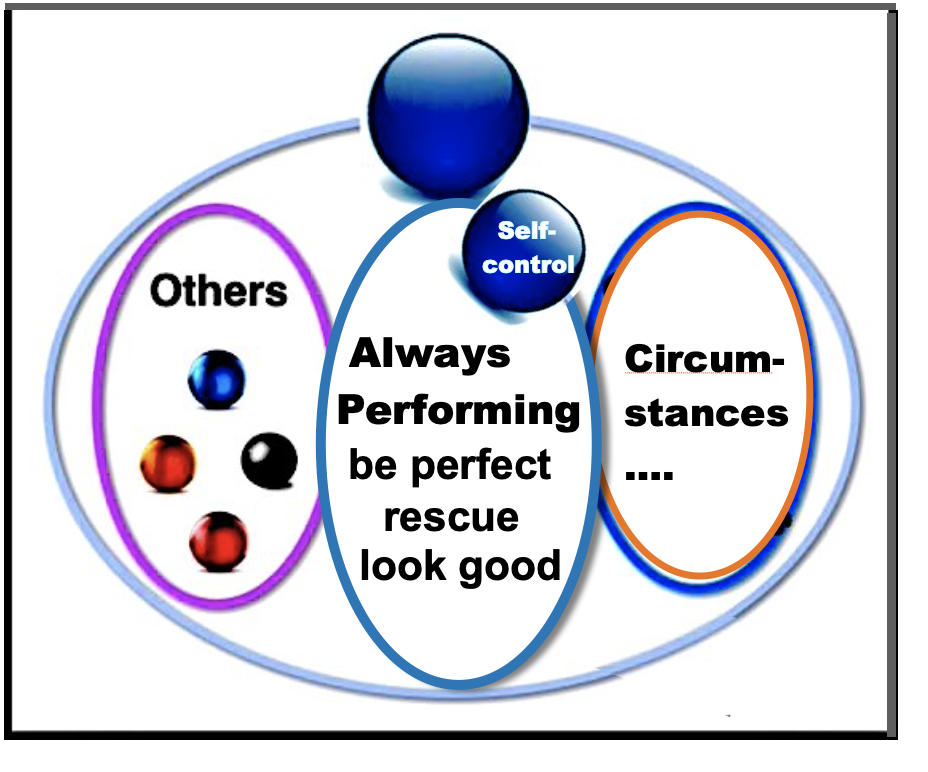
1. The Illusion of control — over others (the Serenity Prayer backwards)
2. Being a Superhero — always over-giving, never asking for help
3. The Lie of being FINE — superheroes aren’t supposed to be vulnerable, have weakness or needs

Active Co-deps have not yet learned that:
• it’s normal for everyone to experience anger, being part of the kaleidoscope of emotions we’re born capable of
• it’s imperative to find legitimate, effective outlets for anger, so it doesn’t get vented in situations that can harm ourself or others
• there’s a difference between the WIC’s anger from S-H’s beliefs & unrealistic demands of others vs. appropriate anger at being victimized by family & others
• the best way to manage anger is to deal with it as soon as we can, each time we feel it – so it doesn’t have a chance to build up
• we can give ourselves permission to feel & deal with all emotions
(‘Anger & Co-dependency‘. Great site by Dr. Irene)

GIVER or TAKER??

In their book “The Givers & Takers“, the authors Evatt & Feld point out that – ironically – Takers are more ‘desirable’, in spite of & because of being less available, less forthcoming & less sensitive. When they do give – it’s more reluctantly, sporadically & for calculated reasons. They’re the ones who lean back  instead of forward in their chair when having a conversation, who seem not to need anything, who have an air of mystery. Yet, they’re considered more sexually & socially attractive, while Easy/Soft is considered uninteresting & un-sexy!

The authors believe these are the Introverts of the world, while the Givers are the Extroverts. There may be some validity in that, because Introverts don’t need or want as much contact & interaction with others.
But it’s not the whole story.
Introversion is an inborn characteristic & is not a sign of emotional damage.
On the other hand, dyed-in-the-wool Takers are more likely to be trying to compensate for childhood damage – withholding, arrogant, insecure & narcissistic – hiding behind silence, while feeding off of the others who chase them.

Now, if you are the co-dependent Giver type, unavailables are like catnip to you – BUT you don’t want to be one of them! You’re too driven to give, sacrifice, be needed, rescue & fix – to be aloof. HOWEVER – if you are indeed an extrovert/ connector type by nature, you really do have a good heart, so it’s imperative you learn to moderate how much you give & to whom – if you want mental health & true safety.
Of course, to be psychologically heathy and a giver- we have to have clear, firm boundaries, which means knowing your needs.. (Healthy Helping).

Not the Real you? Angry-niceness is a damage-trait, like all other character defects. The big mistake many of us make is to think these patterns represent our real personality, murmurin g: “Well, that’s just who I am, I can’t help it.” Actually, it’s a manifestation of the False Self, rather than written in stone. So the good news is that it can slowly be changed, or at least greatly modified.

NEXT: INTERNAL High Cost, #1
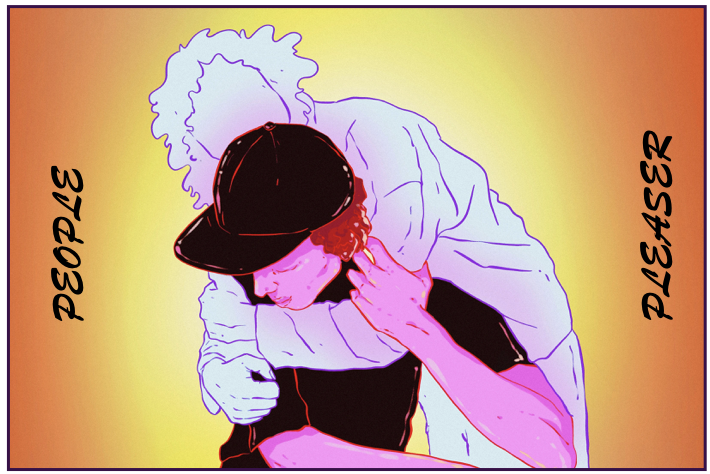
Co-Dep Angry-Nice UNDERPINNINGS (Part 2)

I’LL DO ANYTHING
to keep you happy! 

PREVIOUS: Co-Dep Angry-Nice UNDERPINNINGS (#1)

SITE : 11 thing Codependents do unintentionally (scroll down)

BOOK: “Deceived” by Claudia Black, includes 3 types of anger

REVIEW : From LovetoPivot
“The anger or rage that codependents often experience arises from various factors related to their tendencies. The problem is that codependents are frequently drawn to relationships where their anger is perpetuated. A key reasons for the anger is the discrepancy between their expectations & reality.
The complexities of codependency can cause resentment as they may find themselves in relationships where their needs are not met, promises are broken, feel disappointed or betrayed. These experiences can trigger anger as a normal & healthy reaction to unfulfilled needs or compromised trust….. ”

Co-dependence UNDERPINNINGS (cont)
YOU HAVE:
• X-ray vision – inside your personal Fun House, you’re looking into the eyes of everyone distorted mirrorelse trying to figure out who you are, but only seeing other people or distorted versions of yourself thru their eyes

• Filters – you weed out anything positive about yourself, positive opportunities, your actual accomplishments….. including the people who actually do recognize value in you, who are willing to help you to help yourself…..

• Fuzz – like a grey TV screen – whenever extreme terror shuts down your frontal cortex, i.e.. the ability to think at all, OR just that familiar vagueness that comes over you, especially when it’s for your own benefit. Favorite phrases are: “I’m overwhelmed / I’m confused / I don’t know”. It’s easier to vegg out with favorite distractions than admit what you really feel & need

Magical thinking – you’re sure you have the ‘love’ & the will to fix broken people, & sure you’re doing it out of the goodness of your heart.  But actually – it’s to make them well enough to provide you with all the things you want for yourself but don’t have a right to get directly

• Pitch Fever – frantic to get everything done you’ve committed to, exhausted but never wanting to disappoint anyone, rushing from one task to the next, & feeling guilty for even thinking you need a break!

• Mommy Issues – careening thru life looking to finally be rescued & taken care of, secretly scanning everyone you interact with: “Are you my mommy? – Are you my mommy?” Even if you think you only have Daddy issues (yes, they may be very real too), you still needed a strong, healthy mother back then, but where was she???

Nose – even in a room full of ‘normal’ people, if there’s one sick or needy person, you’ll ferret them out to latch on to or seduce – whichever works, It’s mainly to stave off your loneliness but looking to be their savior so heel needed.  This is in spite of feeling barely a few inches higher off the ground than them yourself, so you can feel a tiny bit less unlovable. Or because you assume none of the others would want to be with you??

Reverse logic – getting the Serenity Prayer backwards. Instead of: “God grant me the serenity to accept the things I cannot change, the courage to change the things I can & the wisdom to know the difference”, you compulsive try to do the impossible & keep putting off the things you really can doput up walls

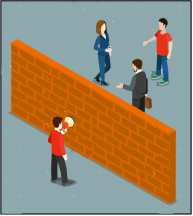
• Walls – in spite of a desperate need to connect, you’re so terrified of intimacy that you compulsively pick emotionally unavailable friends, mated, jobs…. their harmful patterns keeping you at arm’s length, to guarantee that no one gets too close.
If they did, you believe the only thing they’d ‘find out’ is how worthless you are – according to the PP in your head! Unfortunately, your WIC agrees, even through H.P & others do not!

NEXT: Negative results – Intro

Hidden ISSUES for Angry ‘Nice’ People (Part 2)

I’M SO CONFUSED! Which one do I do?

PREVIOUS: Issues for co-deps, #1

SITE: ANGER is the KEY – not love!


SHOW ANGER INDIRECTLY
–  See Symptoms in Us and Toward Others

COVER-UPS (Defensive Styles)
a. Avoider: Never lets others see their anger, or “see them sweat”
b. Container : Knows they’re angry but holds it in, hoping it’ll blow over

c. Denier: They are so suppressed they don’t feel anything
d. Helper – with strings
• they do & give too much: time, energy, worry, $$, gifts
• only have sympathy for underdogs, listen to everyone’s woes
• always worried, too involved with/concerned for anyone who is suffering

e. Internalizer: Full of S-H, they blame themselves for anything unpleasant that happens to them, absorbing the anger they really feels toward others
f. Rejecter: They grew up around verbal & physical rage, which was painful & terrifying, so now they’re determined never to get let themself get angry

g. Self-Blamer: They’re used to being condemned for everything that goes wrong, so they assume the worst about themselves, living with guilt & depression
h. Shocker: Swinging from silence to attack, they hold all their anger in for so long that it finally explodes, unexpectedly, usually at anyone less powerful
i. Stuffer: As children they had to swallow anger at abusive & neglectful parents, & feel guilty for still being angry at them, especially if a parent now wants to be ‘friends’!

j. Submerger
• they have weak boundaries, never ask for own needs, suffer in silence
• have fear of authority, tolerate many indignities, only do what others want
k. Underhander: They deny being angry because they see it as an ugly trait & want to avoid push-back. But then they take it out on others: the wife & kids, the passing cab, the store clerk, the dog…..  (MORE….)

🚩 🚩 🚩 🚩 🚩

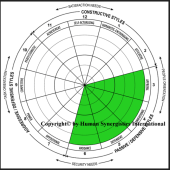
From Human Synergistics Int.- the Circumflex, with adaptive vs. non-adaptive styles, is used in business to show help companies improve functioning. Their framework can also be applied to individuals.  Read overview
📈🔑 Consider the “Leader”as yourself, & the “Culture” as the PPT you choose to surround yourself with. The difference between the Constructive vs other 2 is márked.

PASSIVE-DEFENSIVE third:
P=A quadrant
Position #3 Approval Tying one’s self-worth to being liked & accepted by others. Too much – try very hard to please others, make good impressions, be agreeable & obedient  (‘simple’ Co-Dep type)

#4
Conventional
 Preoccupied with conforming / blending in with the environment to avoid attention. Too much: rely on set routines & procedures, keeping the status quo, wanting every part of life to be secure, predictable

#5 Dependent need for self-protection, believing they have little direct or personal control over important events. Too much: let others make decisions for them, depend too much on others for help, & willingly obey orders

#6 Avoidance have anxiety, a strong need for self-protection, & a tendency to withdraw from threatening situations. Too much:  play it safe, minimize risks, shy away from conversations or group activities, are indecisive & non-committal in most situations

AGGRESSIVE-DEFENSIVE third:
#7 Oppositional – great need for security seen by questioning & being cynical. Criticism is use to get attention & blame is used to deflect mistakes

#8 Power – need for prestige & influence, using control to bolster self-image. Too much: dictate (not guide) others’ actions, try to run everything themself, treat others with aggression & force

#9 Competitive – need to protect their status by comparing self to others, out-performing them, & never seeming to lose. Too much: look for recognition & praise from others, see even non-competitive situations as contests or challenges, & maintain a sense of superiority

#10 Perfectionistic – need to always get flawless results, avoid failure, equate self-worth with reaching unreasonably high standards. Too much:  preoccupied with details, making excessive demands on self & others, show impatience, frustration & indifference toward others’ needs or feelings

CHART  Segments – click on “CONSTRUCTIVE” third & the 3 outer rings
Also read: ‘Excuses’ & Comments

NEXT: SYMPTOMS of Hidden Anger (#1) 

Co-Dependent Anger-Niceness (Part 2)


I NEED SUPPORT

from ‘availables’!

PREVIOUS: Co-dep angry-nice #1

SITE: 6 Basic human NEEDS

Remember: we are “Damaged, not defective”!


NEEDS:
  As young, vulnerable beings every one of us had legitimate needs that were supposed to be met by caretakers, in order to flourish. Instead, many of us kept getting the message that our need were annoying, overwhelming, unacceptable, even ‘evil’. But since normal human requirements don’t go away, we had to find other ways to try to supply them.
As a result Co-deps & Passive-aggressives (P-As) interact with others from the False Self, both styles trying to get our disavowed needs met indirectly, while hiding fear & rage from early abandonment.
AND we also adopt these styles in an unconscious effort to ‘protect’ others from the WIC’s rage, which is murderous.

A fundamental human need is for connection, but unfortunately angry-niceness, in any form, prevents that very thing, keeping us from fulfilling our needs, wants & dreams.
Sadly, ACoAs tend to surround ourself & stay in relationships with un-recovering addicts & other narcissists – who take their damage out on us.

NOTE the difference between needs & obligations:
a. NEEDS are qualities, necessities & situations that are universal – see Maslow’s pyramid. There are also needs specific to you, based on your unique personality (using EnneaType, Myers-Briggs Type, Signs, Numbers, Learning Style, heredity…..)

b. OBLIGATIONS are activities that relate to functioning in the world as older children (homework, chores….) and as adults. People tend to say “I need to do the laundry, to get to work, to call my doctor, to finish this project, to do my taxes, to walk the dog….”. These are important but not your personality needs.


1. Co-Dependent version : one of their Toxic Rules is : “Everyone else’s needs are more important than mine (always)”. The obvious implication is that we should not have any needs of our own.
So co-deps focus all our energy on tasks & obligations, as if we could earn our way to heaven – the heaven of our family’s love! We take on too much – of everything – & then pile on the tasks of others as well, trying to do it all without help! No wonder we get sick, feel depressed, overwhelmed & angry!

2.  Passive-Aggressive version : one of the P-As’ toxic rules is “The world is a dangerous, dog-eat-dog place” so we have to protect ourself at all costs, hiding how angry we really are. P-As find it hard to take care of basic maintenance self-care tasks, or to honor outside obligations, like doing work they’re being paid to do. They show anger indirectly by stonewalling, or “forgetting”. It’s the WIC saying – not just “I don’t wanna” – but flat-out “I won’t! & you can’t make me! You don’t care about me so I don’t care either”, but we’re still waiting for magic. 

As adults we’re afraid to honor the need to set boundaries, & afraid to admit the need to be treated – at the very least – with respect, much less kindness. Asking directly for better responses from others is very hard for us, because WE :
• have been trained to not deserve better, so we think it’s selfish
• keep asking the wrong people when we do try
• refuse to admit the obvious — that unhealthy, narcissistic people only care about themself, don’t want to change, might retaliate in some form…..
• are convinced heathy people will ignore us !

Even so, we need to ask!  but from our ADULT, not from the WIC.
We may get some false promises from them, but even if you get thrown an occasional crumb, don’t let that keep you on their hook! It’s much better to stop chasing,.gather your resolve, back away & temporarily suffer crumb-withdrawal!

While most un-recovered people truly do not have the capacity to provide emotional connection (compassion, empathy, understanding, love….), we can still clearly state how we want them to behave toward us, ★ which is about actions, not emotions (T.E.A.). Otherwise, we end up feeling more & more confused, frustrated & hopeless, wondering why all our efforts aren’t paying off.
Speaking up from our True Self also benefits our Inner Child – no matter what the response is from others ! 

NEXT :

Secretly Angry “Nice” People (Intro-b)

I CAN NEVER LET GO 
no matter how bad it is!

PREVIOUS: Intro-a

SITE:You’re Not Allowed To Have Feelings” (in our culture)


UNHEALTHY ‘Nice’ People have low self-esteem. They are: EITHER co-dependent (Co-dep): over-doing for everyone else, rescuing, self-sacrificing, the ‘good’ one, always ‘up’
OR passive-aggressive (P-A): resistant, obstructive, deliberately forgetful, plotting, ‘innocent’, pretend-incompetent

When we go thru something difficult or painful, and haven’t learned appropriate ways to cope with the Es that come up (usually fear, &/or anger), we’re either not aware of them at all, or dismiss what we’re feeling & find ways to distract ourself. This stifling is a continuation of how we tried to protect ourself as kids because we kept being punished for expressing those Es. Now it just keeps us stuck in our own emotional mud.

Aggressive Anger is obvious – shown as verbal threats, screaming, physical blows, breaking / destroying objects or property…. The consequences are usually harmful to someone or something.

Hidden Anger, on the other hand, is subtle & manipulative (Co-dep or P-A), but also comes with its own risks & negative outcomes. Behaviors can be so indirect, often not related to anything that’s currently happening, that others either can’t easily catch on, or will be puzzled by it. Angry-nice people may seem like victims but are actually perpetrators, acting out their hidden rage in ways that insure they can keep denying it, keeping their ‘good-guy’ status.

🔸 If the anger is so deeply suppressed that it’s now unconscious, the person will not be able to acknowledge that certain actions or non-actions are a sign of being ‘triggered’ (hurt, scared, frustrated)
🔹 If the anger is conscious but concealed, then the unhealthy patterns are deliberate, & may be vindictive : planned to sneakily annoy, hurt or destroy someone they blame for their own shame or guilt.

Either way, ignoring our anger cuts us off from a vitality that could give us the power to forge ahead on our own behalf, leavings us feeling powerless.
Yet many ‘nice’ people are so dedicated to their carefully constructed facade of ‘OK-ness’, they refuse to feel their anger directly & deal with situations that caused it. This prevents any resolution or growth.

ACoAs

For those of us who suffered a great deal of PMES abuse by our family, it’s only natural to have built up a backlog of anger towards drunk, raging, selfish parents, abusive siblings & unsupportive relatives.  As kids we gradually suppressed some or all of that anger (A.) & rage (as well as other painful Es), for 3 major reasons:
1. We were humiliated & abused if we had the nerve to get visibly angry at adults
2. It was (& may still be) too overwhelming to consciously face that our parents truly were/are unsafe, cruel, crazy, addicted, neglectful….
3. We were afraid that our anger would literally harm them – because  children think their emotions have magical powers to injure or kill others
(BOOK:So the Witch Won’t Eat Me“, Dorothy Block. Intro explains it)

Shutting down on painful Es was self-protection.
If we had to severely stifle our anger, it was because our parents (see ‘ACoAs & Anger‘ post) :
— believed it was disrespectful or a ‘sin’ to be A.
— didn’t know how to deal with strong Es
— didn’t want us A. at them (their Co-dep & FoA)
— only they were allowed to be A.
— refused to be held accountable for what was hurting & therefore making us A.
— wanted to look ‘good’ to everyone else
— they were too weak, sick, ‘delicate’ to bear having us challenge / disobey them
— they weren’t allowed to feel their own A.

Sadly, most of us were taught to not have any Emotions. For some of us – being sad / crying was punished, made fun of, ignored, while for others – & our anger was the biggest no-no. So now many of us either refuse to acknowledge that we do indeed get angry, or are so shut down that we actually believe we never are.
 Instead, we may recognize experiencing some of the following, which are all versions of ANGER:
annoyed, blaming, cranky, impatient, irritated, jealous, ‘justified’, outraged, resentful, self-blaming, over-reaction to being treated unjustly / unfairly, ‘touchy’, vindictive…

NEXT: Intro-c

ACoAs: DIS-comfort & Comfort (Part 3e)


I WANT TO LIVE
in my comfort zone!

PREVIOUS: Discomfort/Comfort #5a

SITE: <—- CHART & All about Comfort Zones

“Being Comfortable in your own skin”  (Women)

QUOTE: “If we are happy within ourselves, we don’t accept or demand that our partner should fulfill every need. We need to be comfortable with our own company.”~ Nathaniel Branden, PhD

2. Positive DIS-Comfort

3. POSITIVE COMFORT (cont.) ➕➕
More def: “Emotional comfort is a composed of pleasant positive feelings, a state of relaxation, & an optimistic approach to life where a person feels happy & their mood is high in spirits. Emotional comfort is also associated with less physical dis-comfort.”

Kanishka Patil , Calcutta : “The state of psychological comfort is one of the powerful states in which the mind exists, transcending its positive effect on the other spheres of life. It’s when you experience the free flow of self-confidence, which lets you drive more initiatives at the workplace, engaging in deep emotional investments, announcing bold decisions & taking riskier bets but much needed ones you always doubted.

You are the intrinsic source of energy, radiating positivity in the extrinsic layers…..One has to achieve the state of comfort first, & later cherish whatever comes or doesn’t come the way. Source of power is shifted from ‘externalities’ to ‘oneself’, hence, making the state just a function of “you” and nothing else.” (More….)

INNER COMFORT is protected & maintained by healthy attitudes & actions. The goal is to live well, to the best of our ability ODAT (one-day-at-a-time) – never to seek perfection, since it does not exist.  It is liberating, allowing many other wonderful opportunities & relationships to occur. REVIEW what it includes :

☼ PSYCHOLOGICAL
— Step away from your childhood (home, friends, town) & explore the world.
— Never speak negatively about yourself to others. Stop apologizing. Recognize the harm of being your own worst critic and find a healthy balance
— Become comfortable with your own company without using technology as a crutch. Become comfortable with silence.
— Accept imperfections, yours & others’, while striving for excellence. Maintain an air of mystery
— Admit all needs. Embrace your unique qualities
— Make laughter a bigger part of your life.
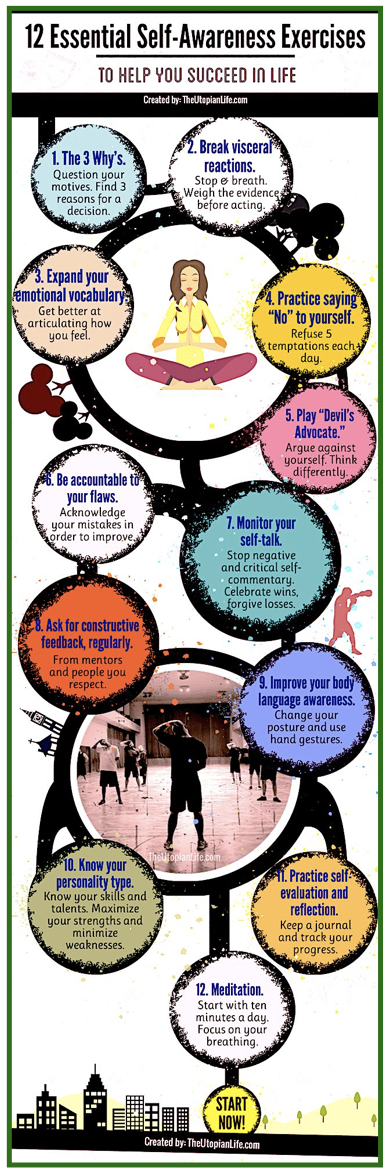
CHART —->Self-awareness exercises explained

SITE : 12 Questions to Test Emotional Comfort in Relationships

☼ MENTAL
— Think of yourself as a beautiful person. Honor your strengths.
— Think positively. Speak with confidence. Express your creativity
— Become an insatiable sponge for knowledge. Dream big & out loud
— See each day is an opportunity to grow & evolve. Keep a gratitude journal
— Take time out to reflect, process & feel. Pray, meditate, read Scripture

Mental Exercise as reminder & re-enforcement:visualize
Give yourself 5 minutes of loving kindness every day. You’ll feel an inner softness develop as you keeping practicing. Place your hands over your heart & say :
“May I be safe / May I be happy / May I be healthy /May I live with ease”

Say it 4x in a soft & gentle tone, aloud or silently. Then gently direct your attention to any part of you that feels disconnected & say 4x each: “May that part be filled with loving kindness” & “May my whole body be filled with loving kindness”. End by repeating:
“May I be safe, May I be happy, May I be healthy, May I live with ease.” (MORE….)

☼ SOCIAL
— Stop tolerating! Stop trying to impress others
— Tactfully walk away from people who will never understand social skills=older
— Realize that relationship status doesn’t determine one’s contentment, rather a content person determines their own contentment
— Spend time with people who make you feel good
BOOK: Enhancing Social Skills in Older Adults, 

☼ PHYSICAL
— Treat your body with respect & take care of physical needs. “Like your body” (women) . Exercise, walk, dance…..
— Learn the art of dressing your body and for your life. Look confident to feel confident   ( Modified from:  Be C. in your Skin and Comfortable Woman)

«
«
NEXT: Multiple intelligences, INTRO, #1a

ACoAs: DIS-comfort & Comfort (Part 3c)

I ONLY HAVE CONTROL
over my own life

PREVIOUS: Dis-comfort & Comfort #3b

SITE: “If You Ever Cry During Movies, It Reveals A Stunning Secret About Your Inner Self”


2. NEGATIVE DIS-comfort (cont.) ➖➖

3. POSITIVE DIS-COMFORT (cont.) ➕➖
🔹
BENEFITS of Healthy Dis-comfort
(cont)
— Healthy things that can make us UN-Comfortable (cont.)

Letting Go of CONTROL     
One of the big dis-comforts in Recovery is letting go of trying to control external PPT, & shift to being in control of oneself. The more familiar 3 Cs of Al-anon are about ‘letting go’: I didn’t cause it / I can’t control it / I can’t change it.
The  intensity of our need to be controlling is in direct proportion to how much anxiety we carry, which is caused by sitting on our backlog of pain. instead of getting it out safely.

The Q is “Where is your Locus of Control?” ACoAs have been trained to only focus externally on others. So as adults who are still run by the WIC, we don’t want to be our own motivator – because that would mean giving up the illusion that our family – or someone – will eventually take care of us.  (CHART )
BUT – the only way to Heal & Grow is to gradually change from an External (Reactive) to an Internal (Proactive) source of Being.  (MORE….)

These concepts mainly apply to our dealings with others – their addictions, their damage, their distress.  This implies that we mind our own business (“Keep the focus on yourself”) and work on self-care. Following thru on these ideas can be a daily challenge for co-dependents who are used to taking on the responsibility for other people’s needs, self-destructiveness & suffering.

But they can also apply to some things for ourselves:
✱ I did NOT cause my damage (damaged NOT defective). Yes – we have lived out the toxic training, which is inescapable without recovery. We are responsible for changing but not for the source – without blaming ourselves for our imperfections & pain.

✱ I can’t control the process of recovery. Healing our heart & mind is a slow & difficult process, requiring patience & perseverance. Also, we can’t control how others react to changes in us as we heal.

✱ I can’t change the time & opportunities lost to the disease, (If only I had known this before, if only I’d left home sooner, if only… if only….). Recriminations are a waste of time & energy. Mourn the loss & focus on self-esteeming acts today.

Going forward, another 3 Cs can be even more of a challenge:
I can Change / I can Cope / I can Celebrate!letting go

 ➤”I can change” seems daunting if not impossible to many ACoAs because the WIC is going by a whole life-time of actual experiences, both as children & as adults – acting out our damage. Also, if we are convinced that how we’ve always been is our real personality (see part 1) then there is nothing to change.
BUT, what many recovering ACoAs have found is that when we finally find Program, doctors, therapists, ministers, mentors …. who recognize our suffering & offer genuinely helpful solutions, we actually can get relief & have a chance for a better life. They become our “Positive Introject“!

➤ “I can Cope” feels impossible – to the WIC. But this is not a problem for our Healthy Adult. As children we were put in daily impossible situation & expected to handle everything as if we were already grown up, and demanded that we ‘fix’ the things that were wrong with the adults – which was truly impossible. BUT with Recovery today we can indeed cope with many things “that used to baffle us” (#11).

➤ “I can Celebrate” – for most of us this is a big no-no. We’re very uncomfortable if we get any attention – even tho’ the Child in all of us longs for at least some. YES – we need to celebrate our very existence, as well as our gifts & accomplishments. Until we get used to the idea, we can celebrate privately, in our thoughts, in our journal…. but eventually it’s very important to share it with others who can be happy for us, with us.  People who care for & love us want to acknowledge their admiration & pleasure in knowing us!

NEXT
: Comfort/Discomfort #3d

ACoAs: DIS-comfort & Comfort (Part 2b)

SOME THINGS BOTHER ME
a lot more than others

PREVIOUS:
Dis-comfort & Comfort #2

BOOK : “Compassion & Self-hate : an Alternative to Despair” by Theodore Ruben

** See ACRONYM page for abbrev.
SITE: Answer Qs : Are you happy in your own skin? (Body issues)

1. NEGATIVE Comfort ➖➕

2. NEGATIVE DIS-comfort (cont.) ➖➖
 UNDER ‘feel’ (Part 2a)

⚑ OVER ‘feel’
At the same time, having so much of our energy tied up in denial we’re the ‘walking wounded’, leaving us with very little reserve for dealing with anything unexpected. So when something big does hit us, we withdraw, fall apart, get sick, get belligerent….. & generally take a long time to get over it.

over-reactingPrecisely because of our pain backlog, many ACoAs’ default setting is to make everything into a big drama. We can over-react to even ‘minor’ frustrations more than is called for – as if they’re life & death events. “Touch me & I bleed!”

We get too angry, too impatient & frustrated, too easily insulted, take things too personally….. no matter the size or importance of an issue in reality, including situations that have nothing to do with us. Losing a favorite object can feel just as terrible as losing a loved one!

BTW – This intensity tells us that no matter how trivial something is – if we’re triggered (have a very strong emotional reaction) – the very fact that it upsets us is absolute proof that it is similar or identical to something that happened to us over & over in childhood (an emotional/ mental/ verbal /sexual abuse or neglect…), either a literal copy or representing an underlying negative message.

Discomfort can be separated into:
— the nigglies – ongoing ‘minor’ irritants which represent a lack of self-care, copying the way our parents neglected themselves & us
Biggies, the many ways we harm ourselves & let others harm us –  visible (to others, but not always to ourselves) in how we interact with gum on heelpeople, events & situations (PPT).

a. The Nigglies
— are the many annoyances we tend to ignore, usually short-term & could easily be dealt with, but which chip away at us if we don’t, either physically or emotionally :

• always do things the hardest way
• be impatient with ‘normal’ daily delays

• don’t protect yourself from noises (loud or annoying)
• don’t take care of personal business, until too late
neg-neg• don’t use bathroom when needed
• don’t write things down & then forget

• ignore household chores, so they pile up
• let things slide & then obsess about them
• live in your mind rather than taking actions
• live with bad shoes, small aches (bad chair), ‘wrong’ clothes/ not warm enough …
• live or work in unclean & ugly environments

• make jokes about something painful
• not leave somewhere when you want to
• not mend torn clothes, live with broken things at home
• ruminate about someone ‘ignoring or dissing’ you
• stay on the phone too long

b. The Biggies
— are long-term, difficult to correct & weigh us down
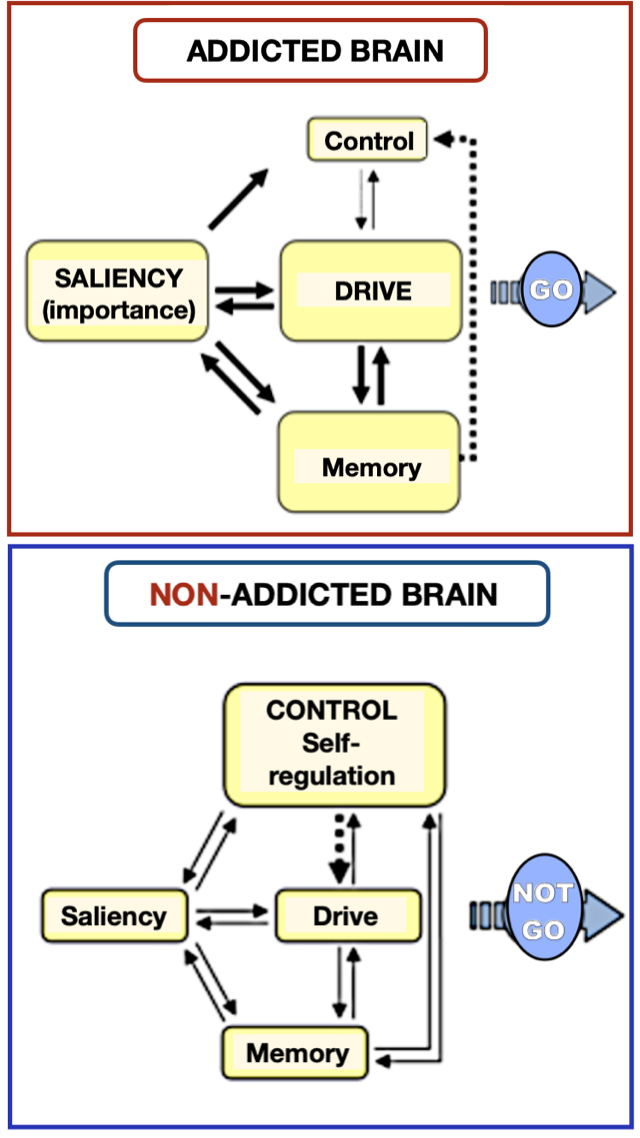
• all forms of addition (<—–chart )
• be in the ‘wrong’ profession or, stay in a bad job too long
• compulsive denial & suppression of emotions
• compulsive isolation, thereby ‘starving’ oneself of positive experiences

• deliberately hurting other people /animals
• deny childhood trauma (abuse & neglect)
• don’t get help when you really need it – or never
• don’t get medical attention for persistent ailments/ pain/ disabilities

• fear of intimacy, so pick unavailable or dangerous friends & partners
• habitual procrastination
• ignore or dismiss successes, accomplishments
• live in deprivation of many needs & wants
• over-spending & debting, living in over-whelming clutter
• persist in self-hate thinking – esp. when we know better
• poor eating & sleep patterns
• put of getting medical attention or fun & rest….

• sabotage possible good relationships / jobs / gifts / opportunities…
• self-sabotaging actions when trying to get a disallowed need met
• self-injury   (Chart ➡️) (Myths)
• sexual anorexia or promiscuity
• social anxiety from negative beliefs (SAS site)
• stay in abusive, dangerous relationships
• suicide attempts / neglecting any mental health issue

More SITES:
13 Things All Self-Destructive People Need To Stop Doing
How to STOP S-d behaviors
How to Overcome Self Destructive Behavior

 NEXT : Dis-Comfort #3a

ACoAs – Set GOALS to MEET NEEDS (Part 1b)

lots of ideasPREVIOUS: Getting needs met (1a)

SITE:Understanding Self-Sabotage

POST : Category #2 = “Personality Needs

☀︎ ACoAs Manipulating Self & Others – #1

1. GOALS (cont.)
ACoAs : Needs 
In order to get our needs met we must first identify what those are, have internal permission to pursue them, & then search out & use as many resources as are available to us to  provide them. We can not wait for or depend on others to meet all our needs – others are only meant to be a support & company on our life’s journey – not substitute parents!

While we may not always know what we want to do “when we grow up”, taking any positive action can get our engine started – especially if the activities are things we have been interested in since childhood we stopped or never pursued. Taking a class or joining a ‘topics’ group (such as in MeetUp) may lead us to new ideas, possibilities & friends or mentors.
Setting goals is a fundamental part of getting our needs met, first the cognitive component (idea), managing our anxiety (emotions), & then taking the necessary actions. (T.E.A.)

Most ACoAs either :no needs for WIC
⇒ have a lot of trouble making decisions – we aren’t allowed to know or admit what we really need & want
⇒ can’t afford to risk making a mistake lest we get punished, & we want to avoid being disappointed yet again
⇒ OR make decisions impulsively, without considering results – the possible consequences to ourselves or others – ☂︎ all based on childhood brain-washing.

• So many of our childhood needs were not met – correctly – which left us with the clear message that we’re not supposed to want or need anything for ourself! Even if we did get some Physical ones (roof, food, clothes, schooling….) – which was a plus & allowed us to survive – the good things were undermined by all the neglect & abuse in the other PMES categories, especially Emotional. And for many of us even the P category was contaminated by beatings, incest, lack of basic provisions….

• This damaging background has created a great dilemma for us, a double bind that keeps many of us stuck WE:
a. are not allowed to have needs, especially emotional ones, BUT
b. still have them ALL – we can not get rid of needs – no matter how hard we try to ignore & suppress them!
EXP: As mentioned before, a newcomer to Al-Anon figured out in a 4th-Step meeting that her belief was: “My biggest character defect is my need for love!” WHY? because she grew up feeling unloved, yet still desperately longed for it. Wasn’t it foolish to want something she was sure she had no right to & would never get?  (See “Unrealistic Expectations”)

what goals?• Our childhood experience was of endless ‘sameness’ – the same drinking, the same unfairness, the same neglect, the same loneliness, the same terror…..
NOW we still live as if we have no options.
So to form deliberate, conscious goals is not easy for many ACoAs – even for those of us who’ve achieved some success in career, yet also subtly recreate early family patterns in both work & personal life.
Ironically, most ACoAs are best at what we like to do the least! There is less threat of it being taken away.

As Adults we’re still trapped in the hopelessness of ever being able to reach our TRUE goals, whatever they may be. For many of us, the idea of possibilities was not part of the mental vocabulary in our family , WE:
— didn’t have the option of using our imagination for ourself, except maybe as a way to escape the pain we were constantly in, AND
— used our creativity to figure out ways to keep our parents, siblings, mates, children… from total self-destruction

This makes it imperative to remember “I know what I know”, since we have our own native wisdom! The Healthy Child has always known a great many things which never got acknowledged or have been too painful to remember. Now in Recovery the Good Parent we are developing can listen to our still small voice, available to redirect the decision process to help us get the best outcomes. (See RIGHTS & Self-esteem posts)

Robert Sharma’s 5 Steps for Goal Setting
1. Celebrate: write down – in detail – things you’ve done in the past year you can appreciate yourself for. What are your big AND small achievements?

2. Education // 3. Clarification  // 4. Graduation // 5. Visualization

NEXT: Goals to meet needs  (1c)

ACoAs – Set GOALS to MEET NEEDS (Part 1a)

GOALSPREVIOUS:
ACoAs Manipulating
Self & others, #3b


SITE: LIST of Personal Needs

SEE ACRONYM page for abbrev.


Process
includes 3 PARTS : GOALS, Implementation &
People.
In terms of T.E.A., this topic focuses on the A. (actions), since just thinking (T) about what we want is not enough, althought it is the starting point.  THEN we have to act on our own behalf.
1. GOALS
Psychologist tell us that people who make consistent progress toward meaningful goals live happier, more satisfied lives than those who don’t.

PURPOSE: Goal-setting is absolutely necessary & appropriate in order for us to be  successful – when it’s grounded in our Rights as human beings AND in our own personal interests. Goals are a normal part of Adult thinking, providing long-term vision & short-term motivation.
Clearly defined goals:
bulls eye- goal• potentially minimizes procrastination & confusion (but doesn’t eliminate it, since they still has to acted on)
• can help to organize our time & resources
• let us know what additional info we need to gather, if any
• allow us to observe & acknowledge progress as we go along, even if the process is hard work & it takes a long time to ‘arrive’
• help us measure & take pride in successful outcomes, which raises self-confidence

Before taking an action, especially when the outcome is important to us, the questions we need to be clear about are : —> “What is my surface goal? then —> what’s under that? & then —> what’s my motivation? then —> under everything, what’s my deepest, perhaps unconscious, desire/wish/hope in this situation?”
Every action we take – or inaction – is driven by a goal – to find food, to not get fired, to buy something we want or need, to hang on to a relationship, to avoid pain, to please an authority, to learn something new, to entertain ourselves, to express creativity, to be accepted, protect loved ones……
and all goals are based on some need, normal human needs such as acceptance, attention, achievement, comfort, connection, knowledge, love, safety, shelter, validation….. needs in all 4 PMES categories.

Each action aimed at reaching a goal:
• is a decision, often unconscious (3 Posts)
• which is based on our individual idea about how to achieve that (procedure)
• which in turn is formed by our most basic beliefs / rules about ourselves & how things function in the world.

EXP: Goal : To cross the street
〰️ Beliefs / rules — I can get to the other side safely, always look both ways, don’t run into traffic or you can get hurt or killed, jay-walking will get you a ticket (in some places), if you’re with someone else make sure they’re safe too …..
〰️ Procedure – Stop at the corner, wait until the light is green, then go

• Appropriate goals & healthy ways of achieving them are based on knowing who we are & our Human Rights .
Recovery EXP: 15 minutes before an evening lecture in a big auditorium a janitor is buffing the front vestibule floor, with the door wide open – so the noise is quite disruptive to the waiting audience. Bev goes out to ask the man to close the door. He completely ignores her, even though she stands there briefly to make sure he’s heard her. Nothing. She goes back to her seat. A minute later a man from the audience does the same – & the janitor closes the door!

noiseQs: ACoAs – If you were Bev:
— How would you be feeling – anger, resentment, S-H, shame…. ? and,
— What would you be thinking? “That <**☹︎**>, how dare he ignore me?…. / I should have been more forceful / I shouldn’t have bothered him / he’s a chauvinist pig….”
— Would your goal have been to get the noise down PLUS be validated, respected, honored – as a female, by a hostile male?

What was Bev’s goal? ONLY to dampen the noise. She was willing to make the effort, which was appropriate, but how it got done did not matter to her!
When we function from our True Self, with enough validation & support in our life from ourselves & from legitimate sources, we don’t try to get it (or demand it) from people who can’t or won’t give it!

NEXT: Getting needs met (1b)