Types of ABUSERS (Part 2)

THEY SAY THEY LOVE ME
but I still feel trapped

PREVIOUS: Types of Perps (Part 2b)

See ACRONYM Page for abbrev.


ABUSER STYLES

1. EMOTIONAL PREDATOR
🧩 These are the chameleons, who can be all things to all people – smart & sneakily manipulative.  At first you – the Victim (V) – feel important, seen, heard, understood – but after a while you realize you’re caught in a web – you’re the slave, the child, the worshiper – but never an equal, never separate, as your own person

☻ Perpetators (P) have a natural instinct for sensing people who are vulnerable or sensitive, that have low self-esteem, have weak emotional & sexual boundaries, are sexually frustrated, lonely, needy, bored, desperate for a relationship, on the rebound, ignored, wounded… so the predator can take advantage

exciting charmer☻ If you are their mark, they’ll watch your eye & body language, & listen carefully to what you say – especially when you’re least aware – all before spending enough time to actually know all of you. THEY :
♢ are a smooth talker saying all the right things to make you feel good
♢ use their observations to act like they have all the same interests as you
♢ seem to magically know you right away – so they sound insightful, ‘deep’ & the soul mate you’ve been waiting for!

☻ To sweep you off your feet – they come on fast & strong, create a lot of excitement & fun, while keeping an air of mystery about themself
♢ are overly helpful, comforting & understanding – as they take over every aspect of your life by becoming adviser, parent figure, spiritual leader, mentor
♢ ‘magically’ fulfill your physical, financial, emotional needs
♢ move in or want to get married too quickly
♢ push right away to get every detail of your life & most private info (bank accounts, family connections….)

2. MENTALLY / EMOTIONALLY ILL
mental illnessa. Medical : Active chemical Addictions, Manic-Depression, Schizophrenia, OR any illness used as defense, to exploit someone or as a stick to keep others in line
They :
• are currently being treated for a psychiatric disorder such as Manic-Depression, are on any kind of heavy-duty psychiatric medication
• are on disability for a mental condition, usually long-term
• have been jailed for illegal or ‘crazy’ behavior &/or hospitalized for emotional problems or life-threatening acts
• have been / are under the supervision of a case manager with community mental-health services

b. Personality Disorders  – many of these abusers were taken to counseling as a child with no improvement, & have not been helped or changed with adult counseling or medication
⚑ Dramatic/ erratic: Antisocial, Borderline, Histrionic, Narcissistic, Passive-aggressive PDs
⚑ Fearful / anxious: Avoidant, Dependent, Obsessive-compulsive, Paranoid, Schizoid (NOT schizophrenic) PDs
They :
• always bring the conversation around to themself
• are inflexible & have trouble being spontaneous. Use B & W thinking
• believe or act as though rules are for everyone else except them
• engage in daredevil /dangerous behaviors, think they’re special, unique – and should be treated as such
• have trouble keeping a job, relationships, a place to live….

3. PARENT SEEKER – THEY:
• are passive aggressive : expect or demand that you make choices for them, & then blame you for being controlling, & complain / whine when they don’t like what you picked
•  claim they want / need you to do things for them because it makes them feel good – AND you’d want that, right?. Pout or guilt-trip if you don’t wait on them hand & foot
• don’t have & don’t want outside friends, relationships, or interests
They
• expect special treatment because they’re ‘needy’, wounded, damaged, suffering… 
parent seeker• expect a parent figure (mentor/caretaker) to handle all areas of their life
• need constant reassurance they’re OK
• may have had several failed relationships, all with a history of being rescued, kept, or protected in various ways – ie. infantilized
They 
• underachieve to avoid responsibility or the possibility of failure
 • want you to make all big life decisions for them, be told what to do, act incompetent (they’re really not) & need direction to get anything done
• want to be waited on, & refuse to do even basic things for themself or help with adult chores
(Modified from : Stop Abusive Relationships“)

NEXT: Abuser Types #3

Types of ABUSERS (Part 1)

I DON’T KNOW WHAT TO BELIEVE –
they’re so hard to pin down!

PREVIOUS: Type pf Perps #1


SHORT FORM – Abusers are typically:
Charming, controlling, critical, emotionally disconnected, hypersensitive, jealous, inconsistent, insincerely ‘repentant’, manipulative, narcissistic, victim, vicious & cruel.

NOTE: Anyone who was damaged in childhood is capable of being a Perpetrator, sometimes. However, here the focus is on people who are abusive as a ‘life style’, consistently, long-term & with everyone – whether you’re aware of their behavior with others or not.
If YOU fall into one of these categories, you too will have been exposed to unhealthy behavior throughout childhood.

Re. THEM (P = Perpetrator)
a. All abusers repeat what was done to them – in their own style – burned into their cortical pathways, a mirror image of their earliest Abandonment experiences

b.
All abuse is an expression of the P’s Self-Hate & Pig Parent (Introject). S-H tries to protect against feeling Abandonment terror, expressed in the form of Character Defects (selfishness, lack of boundaries, dishonesty, gossiping, impatience, being judgmental, raging, immaturity….).

being abused✶ Understanding this does NOT excuse or exonerate bad or cruel behavior in anyone, since each adult is responsible for their own actions. But keeping these facts (a. & b.) in mind reminds us that when someone acts out ‘at’ us, it tells us about them – not about us.
❣️ What is about us is how we respond, whether or not we stick around for it, & for how long.

Re. US (V = Victim)
✶ When observing or being subjected to bad behavior, we must NOT let the WIC’s damage (co-dependence) use our natural empathy & understanding toward the P to put up with their ‘crap’. ACoAs feeling sorry for others may seem like a kindness & empathy, but it only allows a P to get away with being harmful

• Not leaving the abuser is ‘taking care of’ their feelings, abdicating responsibility to ourself. Instead, we always need to :
– balance understanding the source of the abuse (background)
– with our right to refuse to be it’s victim (self-esteem)
Neither their rights nor their suffering are greater than ours!

Perp’s PERSONALITY TYPES
ACTIVE ADDICT
• Often comes from a family with addictions. Can have multiple addictions themselves, either to a chemical, an activity, or both Drunk Gossip
• use their ‘drug of choice’ (agent) – daily, in binges or in cycles
• devote most of their time, money & focus to it – even when not using
• don’t want to discuss it, are very protective – lie about using it, how much & where
• won’t admit or talk about the effect on themself or others
• rarely get any kind of help to stop. May try a program or rehab, but keep slipping back, OR switch to another addiction

• People are secondary to their favorite agent – losing relationships, jobs & other important things when active
• have mood swings or changes in attitude with too much or too little of the agent, & have had / will have a host of physical & mental health problems
🧩 Their addiction & all its consequences cause others around them to feel shame, fear, worry & be in physical danger

OVERLY NEEDY
• may have an unusual relationship (symbiotic, incestuous, co-dependent…) with mother, father or other parent figure
• can’t stand to be without you. Begs, cries, pleads, pouts, guilts you into changing your taste, needs & wants or any plans you have without them

needy• sees self as a victim, has had multiple relationships & other “discouragements” in life
you are their only focus – they have few, if any, close friends or outside interests
• blames you for their vulnerability, while convincing you their neediness IS love

• wants constant assurance you still want them, not interested in other partners, & demands promises you won’t reject them
• threatens self-harm if you ever leave, & sometimes does

• sets you up to feel sorry for them, & puts self down, waiting for you to make them feel good – while never taking in what you do offer
• won’t make decisions, is passive aggressive, blaming you if they don’t like choices you make for them

🧩 You end up feeling frustrated & suffocated when around them for too long

NEXT: Types of Abusers (Part 2)

TRAITS of Abusers – General

IT’S HARD  FOR ME TO GET
how sick they really are!

PREVIOUS: Traits of Victims #3

Article: LIST of Characteristics

ALL Perpetrators ARE:
• deeply insecure, so are extremely jealous
inconsistent – can do well at work & in many social situations, but sulky or cruel in private with unpredictable mood swings
terrible communicators – especially about Es (rather talk with their fists), think in B & W, use distorted logic (CDs)
very touchy – easily insulted, take everything personally
AND :
• have poor impulse control: use addictions, go into rages, hurt children & animals, batter their spouse, are unfaithful
• need to control everything, because of Fear of Abandonment (FoA)
• take no personal responsibility – always blame everyone in the whole world – for their troubles. Perps don’t care about the effect of their actions on the V. since no one else really counts but themself (narcissism).

PMES CHARACTERISTICS – rather than behaviors (<—- See posts “DIRECT Abusers “):
 PHYSICAL = • are an active addict
• can use chronic physical illness or disability to manipulate everyone or just one significant other
• may be mentally ill, have some type of psychological or emotional disorder
• often have a history of family violence – between the adults, & adults to children, sometimes between siblings

MENTAL – They :
• are loyal to their Toxic family Rules and Roles, needing to convince others of their CDs (cognitive distortions)
• believe in rigid gender roles, to keep everyone ‘in their place’
• blame others for their problems so they don’t have to be responsible for their actions, or their underlying but unconscious feeling of vulnerability
They :
• have tightly protected defense mechanisms, self-deception is well-developed
• are in denial about their own wounds/ & the effect they have on others
• have unrealistic expectations of self, others & what relationships are supposed to provide. The Perp puts a burden on others to fulfill needs they didn’t get from their family, instead of healing themself

shitting out LOVEEMOTIONAL 
Psychological disturbances :
co-dependent, borderline, bipolar, co-dependent, depressive, narcissistic✶ (see below),paranoid….
Love addiction – They :
• are extreme jealous
• can be calm, charming & convincing – in public
• get involved too quickly, become ‘instantly’ symbiotic
• see mate as a symbol of a parent or other authority figure, especially when the P. is angry, rather than as a person in their own right
• very good at deceiving others, may have many other relationships, all are superficial.  (⬆️IMAGE: They take in your love & eject it as pollution)

Self-Hate (hidden from most people) – They :
• are full of anxiety, guilt & shame
• are hypersensitive to the slightest disrespect or insult, even when it’s not intended or there is none
• blame others for their emotions, deny need for help or growth
abusers S-HThey :
• either use others to keep self-image from collapsing, or they isolate
• refuse to be responsible for their actions, (incest, drunkenness, violence…) even in the face of severe consequences
• push away true intimacy (there’s never enough to fill their inner emptiness) & can’t believe anyone can be there for them….

✳️ Narcissism is not self-esteem – at all – but a condition that’s a distorted sense of power, & includes:
• constantly looking for & demanding attention
• getting very angry & feeing deeply ashamed when criticized, or if any personal imperfections are pointed out
unpredictable• grandiosity, overestimating their importance, talents & achievements
• inability to put themself in someone else’s shoes (empathize)
• manipulating others, especially partners – with blame, guilt, distorted ‘logic’, bribes,  threats….
• mental obsessions & compulsive actions to hide real or imagined flaws  (estimated that 85% of narcissists are male)

SPIRITUAL – They :
• can use ‘religion’ / spiritual teachings as a way to beat up & control others, especially children
• don’t have a clear moral compass, so are too easily swayed by their own greed, revenge, fear, cowardice…. Easy for the P. to lie, cheat, steal … even if it’s just a little, & secretly… ORfake spiritual
They:
• may not have a strong -or any- Spiritual belief & practice TO :
♝ cope with & heal deep-seated trauma
♝ fall back on in hard times
♝ trust that they’re taken care of & safe
♝ know that all is well & that there’s enough love to go around!
AND:
• may not have genuine concern for the suffering of others (rather than people-pleasing or grand-standing). Any ‘generosity’ is self-serving – to seem important, feel needed, look good, cover S-H, be lauded….

NEXT: Types of Abusers, #1

TRAITS of VICTIMS (Part 4)

PREVIOUS:
Victims #3

Victim = (V)
Perpetrator = P 

CHARACTERISTICS (cont.)
1. Psychological / Spiritual
2. Physical
3. Emotional

4. MENTAL (Toxic beliefs, CDs)
a. re. Self – They :
• accept total blame & guilt for violence from the P, believe social myths about battering
• actively defend against hearing any criticism about the abuser
• always apologize for something – blaming themself for never doing things right or well enough
• aren’t able or willing to speak up on their own behalf (their rights)
They
• aren’t aware that they allow abuse to occur (not the same as causing it!)
• believe in stereotypical sex role requirements
• believe they don’t deserve to be respected as human beings
• blame themself for other people’s problems, or blame problems on the world, life, luck or a given situation – but never the P
They 
• deceive themself into thinking that -one day- magically, the abuser will change, that “Things will get better if I just try harder”
• have unrealistic expectations of the relationship & themself
• think they need to be controlled (or “protected”) by others

b. re. Abusers – Victims :
• always seem confused & surprised by other people’s insensitivity…. even when knowing someone for a long time
• believe they need the P. because they don’t think they’re capable of managing or succeeding by themself
• can’t ask directly, so expect others to just “know what I want/ need.” Being disappointed so often as kids, they stopped trying
bad bossThey
• don’t express opinions, make comments, admit desires
• have a hard time setting boundaries/ limits, and saying “No”
• make up stories to others about how good their relationship is (not!)
• repeatedly make excuses for & forgive their partner’s (elderly parent, adult-child….) unacceptable behavior, allowing it to continue

COPYING the Abuser
All long-term abuse Victims in emotionally volatile relationships create defenses which sometimes turn them into the abuser – the way children mimic their parents. “Hurt people hurt people” Harmful defenses may also be used as a preemptive strike for protection, aimed :
a. Toward Others: before someone can do you in, you do them first (treat others the way you expect to be treated) – criticize, stonewall, demean, abandon….
b. Toward Self: tell everyone how terrible, bad, weak you are – before they find out for themselves AND leave – which S-H says is inevitable!

UNHELPFUL – In spite of the reality that Vs consistently under-estimate & under-report harmful behavior, many ‘helpful’ people give exactly the wrong advice when listening to a V.
They may :
• insist the V. be self-righteous, without taking any responsibility in the relationship (‘Take the high road”)
• completely dismiss the V’s perspective & have no empathy for them
• define the P’s essence using negative labels (pig, bitch…), rather than correctly identifying their actions as abusive
• minimize or justify their own aggressive behavior so side with the P.
• never help the V to acknowledge any good things the ‘other person’ does, & identify all their behaviors as negative (B & W thinking)

HELPFUL – Counter-intuitive suggestion to the V – THEY: 
• can leave the P as a compassionate act – for the abuser’s own good by removing the opportunity to act out their pain on someone else
leaving them• can have compassion for the abuser, WITHOUT white-washing / minimizing their actions.  This helps the V. to see the damage the abuser does to themself – who may feel ashamed but believes they’re powerless to resist being abusive

Helping the V. to LEAVE
• must build up their psychological strengths, expanding the good things about their basic nature, which will ensure their safety & growth
• it will provide stress relief, lessening the V’s highs & lows of abandonment pain
• V. can know their reason for leaving is justified & legitimate – the purpose is to preserve their dignity, & stop adding to their pain
• leaving with minimize rage & resentment can prevent a volatile ending
• using this adult attitude, a neutral or respectful closure from the V. may prevent the abuser from wanting revenge, by not being humiliated with cruel words as well as from the hurt of losing the relationship
• it can lessen or eliminate personal attacks & aggressive behavior from the Perp, which makes many Vs go back to the abuser – out of guilt & shame.

NEXT:  Traits of abusers – General

TRAITS of VICTIMS (Part 3)

TOO PROUD to ASK FOR HELP
AND I don’t trust anyone to come thru

PREVIOUS: Traits of Victims, Part 2

QUOTE: “I am a victim, I have no qualms with this word, only with the idea that it is all that I am.”
Chanel Miller, Know My Name: A Memoir

VICTIM (V) CHARACTERISTICS Preconditions (cont)
1. PSYCHOLOGICAL / SPIRITUAL (cont.)
a. re. Self  – Part 2

b. re. Abusers (P=perpetrator)
VICTIMS
• consistently compromise their ethics, values & beliefs in favor of the P.
• gain a sense of worth by care-taking the abuser. With a deep need to be needed, they become the P’s parent substitute or domestic slave
• have the illusion they can do something to fix the P. to make them less unhappy & therefore  –> be less dangerous, AND be well enough to take care of & love the V
Vs
• live in a fantasy world of “If only ____ (Perp) would do / be_____”, things would be OK between us
• pick inappropriate mates & friends – men & women both have a strong need for a relationship to validate themself, but expressed it differently
• use the P as their Higher Power, but often deny the reality of a Loving God or Benign Universe

social anxiety2. PHYSICAL
a. re. Self  – They :
• avoid almost all social interaction OR can’t stand to be alone
• are compulsive: get stuck in a course of action & can’t seem to shift out of it, even when given a good alternative
They
• have one or more addictions, used as self-medication (food, sex, drugs, alcohol, exercise….)
• have various phobias (of dirt, of going outside, of being noticed…)
• may exhibit obsessive-compulsive behaviors (pulling out hair, rocking, excessive cleaning…..)
They
• often have -very real- long-term stress disorders (auto-immune disease, back pain, migraines….), OR psychosomatic complaints (not physically based)
• afraid to start something positive, OR start things but never finish
• think about, plan or attempt suicide, or periodic self-harm (cutting, hitting / banging their head…..

b. re. Abusers — Victims
• allow Ps to invade their physical boundaries
• are available to be told what to wear, what to eat, how to sit, how to behave in public, where to look (eyes down)…
• ‘make it easy’ for & be available for the P to insult their speech, accent, vocabulary, tone of voice….
• put up with their physical appearance & body characteristics being made fun of or disparaged
• tolerate physical abuse OR physical neglect

chained to perp3. EMOTIONAL

a. re. Abusers – Victims are :
• likely to blame all their problems on others, both Ps & non-Ps – to not have to take responsibility for their own life – BUT (ironically) — they’ve ‘learned’ that no one is safe, so they say they can’t trust anyone
deeply loyal to the abuser, even with constant proof that the P. does not deserve it, & is never loyal to the V.
• emotionally dependent on the good-will & validation of others (just like the P), while believing that NO one can love them
• terrified of any form of disapproval, anger or threat of being left

b. re. Self – Victims are:
• afraid to see any good in themself, take in compliments or value their accomplishments
• convinced they’re incapable of ever being able to love others
• depressed (overtly or covertly), even numb, &/or visibly nervous, subject to periodic anxiety attacks
are :
• driven by guilt (not doing everything right) & shame (not being sin-less)
• intensely fear-based, but hidden under a facade so can become control-freaks
• not allowed to be comfortable or comforted
• overwhelmed by S-H & FoA (fear of abandonment)
have:
• a submissive attitude & style of interacting (not the True Self), always feel inferior to others even when it’s hidden by competence or bravado
• great difficulty expressing anger, tend to internalize it & then act it out indirectly (passive-aggressive)

OUTCOME : Not being allowed to feel or think clearly for themself, Vs become gullible & therefore easily deceived, cheated & controlled. They attach to bullies, or hide from everyone. Not all look like Vs on the outside. They can act weak & incapable, or hide their vulnerability behind anger, hyper-activity & head-knowledge. But their personal life will usually tell.

NEXT: Victims #4

TRAITS of VICTIMS (Part 2)

I NEVER HAD A CHANCE
to be successful!

Previous: Traits of Victims (#1)

P = Perpetrator / V=Victim


REVIEW – Emotional Abuse
E.A. is an ongoing pattern of behavior designed to control, manipulate & defeat another, usually occurring behind closed doors.  It’s any non-physical behavior or attitude that intimidates, demeans, punishes or psychologically enslaves another.

It devaluates, humiliates & terrorizes, by yelling, screaming, name-calling, or with subtler tactics such as isolating a person from family & friends, invalidating their thoughts & emotions, & refusing to be pleased with anything.

Vs are ABUSED by any Perp WHO :
⚠︎ is habitually cruel or overbearing (even in the guise of friendship or caring), especially to smaller or weaker people
⚠︎ looks for the V’s ‘tell’ – a weakness they can exploit – and does
WHO :
⚠︎ hates certain categories of people (children in general, gender preference, ethnic or religious groups…)
⚠︎ has an authoritarian personality, combined with a strong need to control or dominate
WHO :
⚠︎ uses emotional, verbal &/ physical tactics to force their ‘wants’ on others, either by aggression & intimidation or subtler forms of coercion
⚠︎ uses their position to make themself feel more important BY humiliating others, keeping them ‘in their place’ (MORE…..)

• Whether in a family, on the playground, on the street or at work, bullies and criminals don’t usually target their Victims at random.
abuse passed downCHILDREN victimized by family:
💭 the child who is naturally compliant & wants to please is easily singled out by a Perp who know that that one can more easily be manipulated to do what the bully wants OR
💭 it’s the child who is too clever & insightful that they’re a threat to the P’s power & so must be crushed!
ADULTS Abused
 by anyone:
While its NOT the Vs fault, their past history of trauma can make them more vulnerable. They may BE:
☀︎ anxious, insecure, not able to defend themself verbally
☀︎ envied for their appearance, intelligence, talent & achievements
☀︎ too needy, clingy, eager to please
☀︎ withdrawn, seem odd, don’t fit in with their work or social culture

PS:
 Naturally, fully functional adults can be victimized as well, but are more likely to escape the abusive person or environments as soon as possible. They know & use many options the other types don’t, & will actively look for solutions, however long it takes.
💔
CHARACTERISTICS** – preconditions for being abused, rather than innate weakness. The following PMES categories (Parts 2-4) are the resulting emotions, beliefs & behaviors that come from prolonged exposure to Ps.
** Defense Mechanisms created by the False Self trying to survive years of mistreatment – NOT the fundamental & unique traits of the True Self.

1. PSYCHOLOGICAL / SPIRITUAL
In early life — came from various combinations of emotional, mental, religious, physical, &/or sexual oppression & abuse ( Laundry List)
a.  re. Self – as adults
• are afraid of being visible, so don’t share much about themself
• are impulsive with poor self-control, do whatever they feel like at the moment without thought to options or consequences
HAVE:
• a chronic feeling of emptiness / nothing is enough to fill the void
• a very sketchy awareness of who they are fundamentally (personal characteristics, abilities, skills, talents….)
• trouble relaxing & enjoying themself, take themself too seriously or not seriously at all
THEY:
• believe they’re a fraud & will eventually be found out. Lie when it’s not necessary
• can’t identify needs, or don’t have internal permission to own & provide their basic human rights, needs & desires
• feel responsible for others’ actions/ reactions, but don’t face their own
• lack internal motivation – only do what others want, or think they need

• never seem to get it together to leave the abuser (while endlessly thinking & complaining about it) OR keep leaving, but always go back OR pick another similar P
• project their disowned needs /desires onto others, without realizing it
AND
• may end up with a personality disorder – such as Anti-Social, Co-dependent, Dependent, Love &/or Sex addict, Paranoid, Passive-aggressive …

NEXT: Trait of Victims – Mental & Emotional (#3)

TRAITS of VICTIMS (Part 1)

MY POWER IS EATEN AWAY
by the bugs in my head!

PREVIOUS: Dealing with Abusers  – #3

QUOTE: “Some people wonder why others often fail to treat them with respect — not realizing they’ve signaled that it’s not necessary to treat them with respect.”  ― Nathaniel Branden, Six Pillars of Self-Esteem

V= Victim // P= Perpetrator (abuser)

VICTIMS – There are 2 broad categories :
Voluntary (for a principle or religious belief, in war, to save a loved one….)
Involuntary – anyone who suffers continual harm from another – as a child, as an invalid or the elderly, & not by choice.

Involuntary V. Sub-types 
a. Passive – most common
• Internal : depressed, hopeless, lonely, needy, self-hating, unhappy
• External : easily react to being baited, easily hurt, try to placate or be overly helpful, not able to use humor to diffuse conflict, justify themself,  few or no friends, socially awkward (no matter how intelligent)

b. Provocative – rarer (will have some, but usually not all these traits)
Attitude: resists rules, no patience for delay
Behavioral : fights back & keeps at it, but always loses with frustration & upset
Emotional : easily angered, frustrated, irritable, in great distress, over-sensitive
Internal : immature, impulsive, restless – but gifted!
Physical : may have learning disability (ADD, dyslexia, autism …)
Social : misreads social cues, poor interactive skills, reacts aggressively to authority, teases others & doesn’t know when to stop &
• can be very annoying or irritating , & so will be easily avoided. Gives off the unconscious message “Kick Me” (see Games PeoplePlay – Eric Berne)

Vs are ABUSED by Being:
• emotionally tortured, & mentally disorientedvictim
• ridiculed, punked or teased, the continual target of someone’s anger
•  punished for the errors or stupidity of others
• tricked, swindled, manipulated or taken advantage of
Being:
• the focus of unrealistic & excessive expectations
• physically neglected or injured
• subjected to attacks, oppression, hardship & other mistreatment.

• As a result of long-term abuse, usually started in childhood, a person will continue the original Victim role. It’s the feeling of helplessness, being passive in the face of current or future ill-treatment or misfortune – called “learned helplessness” —> see Artwork #3victim

• Vs who need to be in a relationship – at all costs – will gravitate to some type of abuser. They may be of either gender, high or low functioning, underprivileged or highly accomplished.
EXP: Many famous & talented men & women have been victims of domestic violence, such as Carol Channing, Whitney Houston, Tina Turner, Reba McEntire, Madonna…. AND Phil Harman, Kelsey Grammer, Abraham Lincoln, Stephen Hawking (by his wives), Bill Clinton (in childhood)….
We know from reports that some stayed with their Perps long-term, (Ms. Channing, Pres. Lincoln…) while others got themself out. Some chose better the next time, & some repeated the harmful pattern – as in the list below. (the Men….) (the Women….)

BTW (in our culture)  • Generally, men do need & want relationships, but tend to get their basic sense of identity from work & career, academic achievement, athletic success &/or material gain. So their vulnerably to bullying is more likely to come from outside the home.
• Women tend to base their whole identity on the number, quality & intensity of their personal relationships.
Because of that, they’re more vulnerable & more likely to be abused by ‘loved ones’. The need to be a ‘good’ daughter, wife, mother, friend, co-worker…. makes them willing to do just about anything to maintain those connections, often to their detriment.

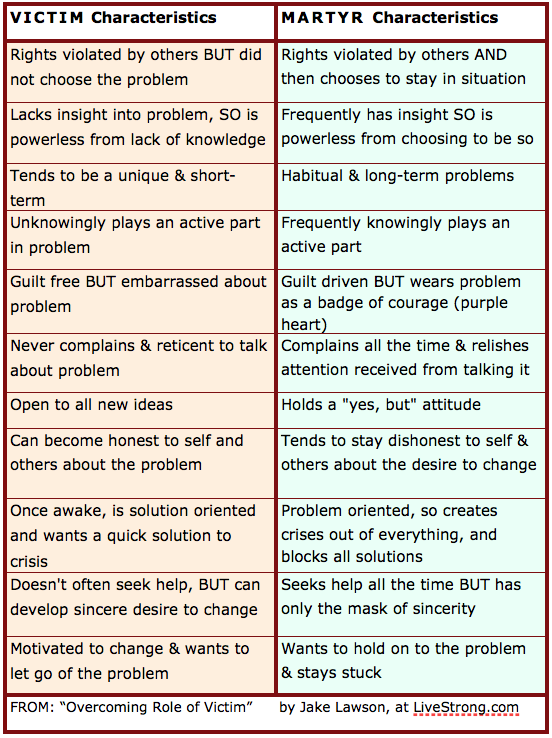
MARTYR vs VICTIM  : This distinction is naturally about ‘functioning’ adults, who make conscious or unconscious choices regarding a bad situation they find themself in. The difference between the two is that Martyrs are self-aware (sort of) & Vs are in denial – at least to start with.
«

«
NEXT: Traits of Victims – (Part 2)

ACoAs dealing with ABUSERS (Part 3)

IS IT ME, OR –
are they the crazy ones?

PREVIOUS: Dealing with Abusers -#1

SEE post: “They did the best they could”


1. ACoA Silence (Part 1 & 2)

2. SPEAKING UP
a. “Wrong” Talking
Unhealthy – over-explaining or justifying ourself, pushing our opinions, trying to be heard & be ‘right‘. It can be in the form of ranting, repeating the same thing over & over, having a tantrum or being preachy.
It’s most likely to happen when we’re with someone who clearly is not interested in what we feel or think – but we refuse to accept it, & keep trying!
“Maybe I can wear them down OR figure out the ‘right way’ to say it!” It’s classic ACoA to try getting our needs met from the very people who can’t do it!
b. Healthy Talking
Taking care of ourselves includes having to ASK for something (don’t expect mind-reading), or just expressing our point of view.  It’s important to let others know what we want, but this must be done…communication

i. ….once we’re sure we know what our real need is in a given situation (respect, stopping an abuse, getting info or a service….).
That way we can be direct & clear, rather than assuming someone should know. That’s only legitimate for infants, who can’t talk yet.
FROM :
ii. ….our Adult ego state, not from the WIC. It means short, to the point & unemotional. This works most of the time!  Reasons for us to speak up to abusers are :
• putting the Perp on notice that we’re not available to be their Victim (V), which represents our self-esteem, knowing we deserve respect
UNIT ego state• standing up for our WIC and the Healthy Child. It’s the job of the Loving Inner Parent, especially since no one did that for us, growing up.
Our attention is best focused on what’s appropriate for us rather than trying to control others. We’ll not be speaking up for the P’s benefit – ever! It does not matter that the P. will not be able to hear you, much less willing to change. The WIC can hear you. Be your own champion!
BY :
iii. ….asking the right person :
• If it’s someone you already know well, always check in with yourself first : “Can they provide what I’m asking for, or am I barking up the wrong tree?”
DO NOT chase a hope-filled fantasy. We just diminish ourself, get furious, feel ‘bad’, then hopeless.

• If you’re asking a stranger (like ‘Customer Service’) & you don’t get what you need from one person, hang up & keep trying until you get someone else who knows what they’re doing, & can provide an answer or service – if it’s actually possible & realistic! It may take 3 or 4 calls, but it works!

BOTTOM LINE
Silence or Denial?  Can you save yourself from getting run over by a car if you’re blindfolded & wandering in the street? NO!
ACoAs keep suffering – unnecessarily – as long as our eyes are tightly closed to the damage others do to us, even inadvertently. Yes, sometimes we are the source of our pain – from the WIC or the PP – which can be corrected with compassion & eliminating harmful self-talk.

But when someone else is being mean, selfish, crazy or cruel toward us, it causes us pain – just as it would for anyone. But it’s even more so for ACoAs because of our earlier wounds.  By recognizing when the pain is coming from (our damage vs another person’s), we eliminate much of our Self-Hate.

PONDER: You get shot by stray bullets in a nearby gunfight you have nothing to do with. You don’t die, but are left having to deal with severe injuries that take a long time to heal. You didn’t do the shooting, so you didn’t cause your wounds – even if you unfortunately happened to be in the vicinity.

So why do ACoAs blame ourself for the abuse we got from our sick parents & now from others who spray their mental / emotional illness over everything?
REMEMBER : we were not the source of the original mistreatment!
It’s not our fault that the other person chose to act in a certain way. The clearer we are about who is responsible for what – theirs vs. ours – the kinder we can be to ourself, & the better our life becomes.

NEXT: Traits of  Victims #1

ACoAs dealing with ABUSERS (Part 1)

I’M TOO SCARED  to tell!

PREVIOUS:  Denial & Acting out

SITE: 15 Secret Signs You’re Actually Really Insecure

Post: ACoAs Getting Controlled (1 & 2)


1. ACoA SILENCE

ACoAs are more than reluctant to speak up for ourselves. We hold it in & hold it in, then eventually explode at others, OR implode – into illness, depression & isolation.
We’re equally mute with people WHO:
• are actually abusive, whether they know it & don’t care, or have no idea what effect they’re having
• we just think they are hurting us by something they said or by not reading our mind (giving us what we need without us having to ask for it), but they’re really not harmful – they’re just pushing a button in us
• are not being abusive at all, but we’re afraid of hurting their feelings, scaring them away or -god forbid- make them angry at us!

Validation – We may need sane sources to help us identify ‘who did what’ but don’t go to the Perp. They deny or confuse. Al-Anon stresses “Detach! Let go” – with love, with hate, with humor… any way possible!
You wouldn’t demand that a person blind from birth should see colors! Don’t chase abusers – for anything, especially to admit they’re wrong!don't talk

REASONS 
a. The ACA “DON’T TALK” rule   (they = parents / community), ABOUT WHAT :
• is actually going on in the family itself – don’t air dirty laundry – it’s no one else’s business (family shame = family secrets)
• you need & want, since they can’t or don’t want to provide them
& ABOUT WHAT:
• you feel emotionally – they don’t want to hear it, they’re already in enough pain & don’t know how to deal with it, so don’t need yours too!
• your personal opinions, values & observations are – if they don’t fit in with the ‘party line’ (the ‘story’ created about the tribe we all belong to).

🤐 No matter how twisted, it’s our family & we protect it at all costs. These messages prevent some ACoAs from going to 12-Step programs &/or therapy – seeing it as disloyalty.

b. Co-dependence
Of course most people don’t want to ‘be in trouble’ with others, so we learn what’s appropriate to say or not say, especially in public.
But for ACoAs it’s always about FoA (fear of abandonment). Even as adults we’re afraid of unpleasant reactions from others – when they get angry at, dislike, make fun of – or worse – ignore us!

• Our co-dependence (needing others’ good-will to feel OK about ourself) drives us do anything we can to prevent anyone from expressing even slight disapproval, which will set off our S-H.
The WIC believes: “I’m so unlovable, no one really wants me & sooner or later will leave. Unless I can con them into accepting or at least  tolerating me – I’ll die”. So we think lying or silence is safer.

REALITY: MOST of how people respond to us has nothing to do with who we are – but the child’s narcissism takes everything personally. In the present, anything that seems like an abandonment feels like punishment,
✎ ✐ rather than others just having their own feelings & opinions, OR are acting out their damage.
SITEFrom Parent-Pleasing to People-Pleasing 

c. Controlled
Another reason we’re silent is the brain-washing we received growing up. We were trained so thoroughly to ignore what we heard, saw & experienced – that we end up not seeing many things that are in front of us (”What insult?”), misreading a situation (“I’m sure they hate me”) or unable to respond to a painful comment (“I wish I had said…..”).
POST: “ACoAs over-controlling ourself”

EXP:  No matter how articulate some of us are when we’re comfortable, there are times we get emotional brain-freeze.
It’s so-o-o frustrating that when we’re with someone who is being inappropriate, mean, insulting….  it triggers a childhood wound & we instantly shut down with terror, the reminder of family abuse being in total control.
At that moment we’ve lost our internal computer screen – it goes blank & we can’t think, much less talk. Yet as soon as we’re alone, the computer comes back on automatically & we know what we should have said! Darn, darn!

SITE: Emotional Complexity (Habituation, Inhibition, Constriction….) 

NEXT: Dealing with Abusers (Part 2)

DENIAL & ACTING OUT


I HAVE TO BE IN LA-LA LAND
to suppress the pain

PREVIOUS:
Deliberate or not? #2

See ACRONYM page for abbrev.


REVIEW: Most people are capable of some emotional abuse (E.A.) because most people have experienced E.A. as children. Sooner or later, we treat others the way our family treated us – acting out our parents, just as we act out the WIC.
The focus here is on breaking out of the ACoA’s denial about how & when others act badly toward us, which we have a habit of ignoring, mis-identifying or not noticing, because it’s so familiar.

ACTING OUT 
a. Any compulsive behavior you don’t consciously choose & so can’t seem to stop yourself from doing, OR compulsively not doing….
b. …. which expresses intense emotions you’re not actually feeling at the time, but that are rumbling under the surface

• This term is usually assumed to mean overt actions, against oneself or towards others – getting drunk, starting a fight, being late for work, being promiscuous … ♼ But it just as often the NOT taking :
✂︎ specific actions that would be good for you (walking out on a bad date)
✂︎ legitimate actions you planned on (making a call, going to a job interview), but “forgot”

spacing outEXP: You’ve made an appointment with a new therapist & consciously – you’re looking forward to it. It’s on your calendar & you remind yourself of it the day before. Then you go thru the whole day of the appointment without going – totally oblivious – until late that night as you’re falling asleep. “Oh No! I forgot all about it, & I really meant to go!”

😱This is an EXP of the WIC’s un-felt but intense fear of being vulnerable with a new authority/ parent figure who may or may not be safe.**
✶✶ When we’ve done or neglected to do something that seems baffling, inappropriate, even out of character, we can figure it out : Identify what emotions we were spaced out on (dissociating) but which desperately needed to be expressed – somehow!

DENIAL
Denial allows us to look for & stay with abusers, which is potentially life threatening, & definitely damages us psychologically!

a. MIS-USED: ‘Denial’ is typically meant as – Deliberately ignoring something we know but don’t want to deal with. This is not Denial.
When people say “I just won’t think about it. I’ve put it out of my mind… ” they’re referring to ‘suppression’ – a conscious decision.
Of course, if what we’ve push away was traumatic, that emotional pain will be festering in a dark corner, & eventually comes out in some others form – as hidden or direct rage at others, &/or self-destructive behavior.

b. GENUINE psychological ‘Denial’ is NOT deliberate. It’s a defense mechanism to “not acknowledge an unacceptable truth or emotion by not allowing it into consciousness.” = meaning that we don’t know we don’t know (something)! – either about ourself or someone else, even though it may be perfectly obvious to others.

This ‘skill’ comes from years of childhood training, hardened into Toxic Family Rules & Roles, as well as our human need for emotional survival. As an adult, it usually takes a lot of work to bring up long-buried traumatic experiences & associated pain into awareness, but once in a while some life-event can force a chunk of it to shake loose & shoot to the surface, like an erupting volcano, possible accompanied by overwhelming panic.

PAY ATTENTION• We can counter Denial & Suppression by carefully paying attention to what we see & hear every day in the present.  People tell us about themselves all the time, which we would pick up if we were allowed to listen to our intuition & intelligence. Repeatedly ignoring what’s in front of us is wounding to our sanity & our soul!

In recovery – once we become aware of abusive patterns we will notice them everywhere – in songs, movies, our family & friends, at work….
The opposite of Denial is ‘Being in the now’, or ‘Mindfulness’, making it easier TO:
♡ notice of what we’re needing, wanting, responding to, feeling – every day…. AND
♡ keep us awake to who others are, how they act, what they’re saying…. & how we feel when we’re with them.

NEXT: Dealing with Abusers #1