Enneagram Humor (Part 2)

S.America manPREVIOUS: Ennea Humor #1

SITEs : Obnoxious questions to ask EnneaTypes
• MORE cartoons
Smiley/Emoticons for Type WINGs (12/2/11)

⬅️World costumes : Phillip Martin


MORE TYPE JOKES

Top 10 Signs that You’re a TYPE 1 (Geenius at Wrok)
10. You consider the word “that” in the above title to be crucially important, so it’s not ok to be left out
9. You’ve forever felt yourself “burning with the fires of righteousness”
8. All your life, you’ve dreamed of being a building inspector

7. All the cereal boxes on your shelf are turned so when you grab one, the opened end of the inner bag will be opposite your hand for easy pouring
6. You express brand loyalty when buying reference books
5. You can’t understand why the deli-man keeps putting the onion on top of the cheese, when putting it between the meat and the bread would keep it from sliding out all the time

4. You actually take your sandwich apart to fix it
3. The Scout Law seems, well, kind of OBVIOUS
2. You read “Walden Two” & thought Skinner was really onto something
1. You actually wrote 57 entries for this list, but the other 47 just weren’t good enough

🕶 A 2, a 5 and a 9 go to play golf & end up queuing behind three men who can’t play well – at all. After 30 minutes they’re so annoyed they decide to complain to the golf course manager, who explains :
“These men are blind but they donated so much money to charity that the city decided to reward them by allowing them to play free occasionally”.

The 9 & the 2 are both emotionally moved: “Sorry, we didn’t know & now we feel bad for getting mad a them”.  The 5, however, gets even more upset: “Then why the hell don’t they play at night ??”

😇 How many feeling types (#2, 3, 4) does it take to change a light bulb?
Five: One to turn on the bulb (#3), while the 2s & 4s to relate to the experience.

CARTOON TYPES  

The PERFECTIONIST
type 1 cartoon
Some famous 1s: Hilary Clinton, Tom Brokaw, Harrison Ford, Judge Judy, Martin Luther, Barack Obama, St Paul, The Lone Ranger, Pope John Paul II, Martha Stewart
EXP:
Zina’s #1 mother often said “Of course I’m perfect!” about herself, AND “Look ashamed!” to her little girl when she wasn’t  (just being a normal kid)

Twisted Affirmation
I am grateful that I am not as judgmental as all those censorious, self-righteous people around me.

Fun Quote: Franklin P. Jones
“The trouble with being punctual is that nobody’s there to appreciate it”

Walking in to a party: Point out to the host that they shouldn’t have put the food so close to the door – it’ll get cold
💠
The GIVER
Some famous 2s : Alan Alda, Barbara Bush, Monica Lewinsky, Madonna, Mr. Rogers, Nancy Reagan, John Travolta
Screen Shot 2015-05-17 at 6.47.25 PMEXP:
In her 20’s & 30s Zina (a #8) distanced herself from her unhealthy #2 sister, who would complain to their mother: “Why won’t Zina talk to me? Why doesn’t she love me?”. Now in their 40’s they’re finally good friends.

Twisted Affirmation
As I learn the innermost secrets of the people around me, they reward me in many ways so I’ll keep quiet

Fun Quote: Gordon R. Dickson
Some people like my advice so much that they frame it on the wall instead of using it.

Walking in to a party: Suss out who’s the most influential person in the room & offer to get them a drink

NEXT: HUMOR #3
Enneagram (serious?) Humor

enn humorNEXT:
More humor

3 Cartoons:
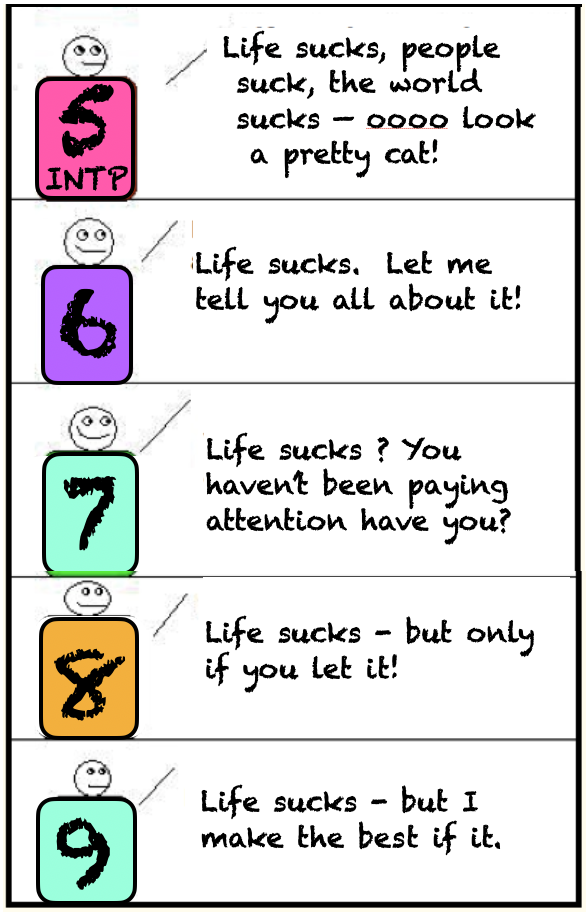
Enneagram &
Life Sucks
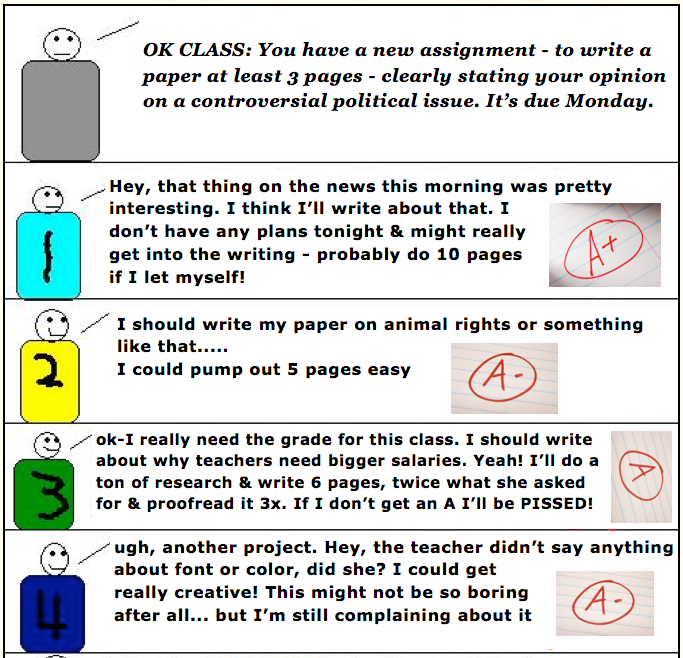
• Enneagram at School

• Enneagram &
Leadership
COMPLAINERS
Enneagram in BIZ  


Enn - school humor 1

Enn school humor 2


ennea group LEADERS

ACoAs & BLAME (Part 3)

PREVIOUS: Blaming #2

REVIEW: Satir’s BLAMER Role

Posts on “Emotional abuse


The OPPOSITE of blame is ACCOUNTABILITY – to be responsible for one’s thoughts, emotions & actions – as adults (TEA).
➼ Holding ourself or others accountable for actions is not blame. It is acknowledging what is true, rather than covering it over or denying it altogether.

• So now when we’re hurt, instead of blaming, we first need to identify the childhood abandonment button that got pushed, validate the anger & sadness, then have a safe place to express those emotions & talk about the experiences.

Using Accountability in a healthy way is :
US – taking responsibility for everything about ourself without S-H or perfectionism, accepting that it takes a lot of time/ It’s trying to do our best, while allowing for mistakes, & also making time for rest or fun. AND:
OTHERS – noticing & admitting what we observe about someone else – their beneficial or harmful personality traits, patterns, way of treating us & others – so we can figure out :
who’s safe to be around & who’s not
• what we can & can’t expect of someone, realisticallyScreen Shot 2016-06-01 at 4.05.21 PM.png
• what suits us about them & what doesn’t

• if we can benefit from a connection, need to stay at arm’s length, or it’s best to just leave
• when to call them on treating us badly, being disrespectful, careless…. or when it’s safest / smartest to drop it

• if / how we’ve gotten involved in their life when we shouldn’t have
• if we’re over-reacting to something that’s not abusive at all

This is all in the service of ‘seeing’ who others really are, instead of who we want them to be. It’s about knowing what’s neutral, what’s normal & what’s mistreatment.
Then we can take in the good stuff, pass by the neutral & gather the emotional strength to stop ignoring or white-washing the bad stuff, & have the guts to do whatever is best for ourself, no matter the fallout.

NOTE: Since ACoAs don’t trust our own judgement (T) or our feelings (E), it helps to realize that angry, narcissistic, abusive people regularly treat others badly too, so it’s not personal to us, even though we always think everything is always about us!
If we asked around – we’d find someone who also knows them, & is willing to admit: “Yes, that person really is like that / They’ve done that to me too / Everyone knows that about him/her…..”).

HOWEVER – If someone seems normally appropriate or kind to everyone else except toward us,
• we may be pushing an old button in them, accidentally ‘stepping on their toes’
Screen Shot 2016-06-01 at 4.07.01 PM• they may be appropriately responding to our damage-behavior or poor communication style
• we may be pushing them away or into a reaction (being passive-aggressive, marginalizing, being insensitive to us….) because that’s what we’re used to doing or receiving

• they may just be having a bad day/week, OR
• we’re ignoring the red flags of their dysfunction – since people tell us about themselves all the time. So maybe they’re really aren’t as healthy as we thought

➼ ACoAs always think we need others to validate our experience, perception, opinions….To some degree we do – to get corrective mirroring.
BUT we also need to keep saying “I know what I know!” The more we acknowledge what’s really going on AND take care of ourself, the less we find reasons to blame – anyone!
SITE: Animated short & Commentary re.Blame

Self-compassion: When upset, first listen to your thoughts & check what emotions are located in the body.
Identify each disturbing situation & decide whether it can be corrected / modified / resolved…. or not.
Applying the Serenity Prayer (don’t get it backwards!), we can take responsibility for what we can do & let go of what’s not in our power to fix.

If there’s truly no positive outcome possible, we need to walk away.
If something can be changed or modified, be willing to :
• do whatever it takes to find a solution
• change strategies when something isn’t working, AND
• if on the right track, have the patience to see it thru, no matter how long it takes!
This eliminated the need for blame.

NEXT: Enneagram humor #1

ACoAS & BLAME (Part 2)

Blame the victim TO BLAME OR NOT TO BLAME
is that the right question?

PREVIOUS:
 ACoAs & Blame (#1)

SITE: Fixing Blame & Nurturing Resentments


NOTE:
Emphasis is on this ‘flaw’ being used consistently

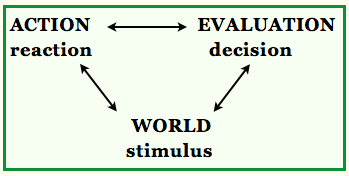
SET UP: In everyday life – outside events trigger us to respond. When we do act, we then decide if our response got us what we wanted.
Screen Shot 2015-03-17 at 4.55.44 PMNormal FLOW is always 2-way: Red light <–> Stop <–> Be safe.

BUT – what if our action didn’t produce the desired result?

BLAME – the opposite of praise.
In general : it’s assigning responsibility for having a fault, for doing something wrong, or for causing someone’s pain. Used correctly, it’s a way to hold oneself or others accountable.
ALSO: It can be making negative statements about a person or group, saying that their action/s are socially or morally irresponsible – and therefore bad.

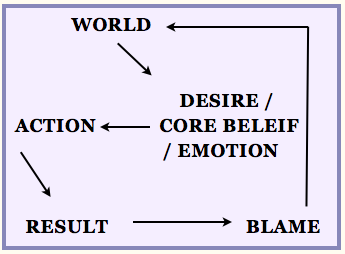
The BLAMER’S ‘reality’ is based on over-emphasizing themself, using a one directional cause-&-effect ‘radar’ scan (the WIC ego state in charge).
The only things in life that seem to register as blips on their ego-screen are those that affect themself & their emotions – good or bad – which they use to justify unhealthy actions. (MORE….)

blame cycleBecause of this narcissistic, self-centered focus, habitual blamers either don’t notice or don’t care about the negative effect their words & actions have on others, or how they come across (arrogant, stupid, outrageous…..).
Since their view of reality feels normal & logical to them (ego-syntonic) – they don’t recognize the pattern as dysfunctional.
CHART :
• IRONY – the blamer’s unconscious core belief (“it’s not my fault!”) is based on their own S-H & shame – that they don’t deserve care / respect / help….
• Their emotion is rage at the unfairness of all their unhappy experiences. Under that is fear, loneliness, hopelessness….
• The desire (as compensation) is for everything to go their way, regardless of what’s real & possible, ignoring that others also have needs which may be different from their own

This combination (belief-emotion-desire) results in the blamer-victim’s insistence that all bad outcomes are always someone or something else’s fault. They’re dedicated to protecting the illusion that the world is against them.
It reinforces their ‘position’ —
• that they had nothing to do with things going wrong (running across the street against a red light, staying in a damaging relationship….)
that they should not have to cope with adversity (don’t know how to self-soothe & don’t want to, anyway)
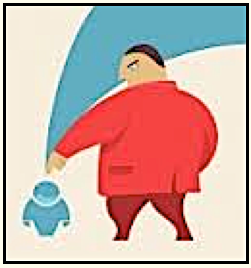
bully blaing childthat it’s NOT up to them to make things better

🚫 ACoAs who habitually use blame as a defense hold ourself & others responsible for our life problems & emotional unhappiness – everyone except our family!
It’s a way of never having to look at one’s own self-defeating beliefs & life patterns – to avoid doing the hard work of growing & changing.

• But underneath, chronic blaming is also a way of expressing ACoAs’ sense of powerlessness – convinced we’re unable (not allowed) to get our needs met.
So we rely on others to make up for & provide us with all the things our parents couldn’t or didn’t want to.
Then we can accuse people of letting us down – when they ‘don’t come thru’ – even though what we expect from them is totally unrealistic & inappropriate!
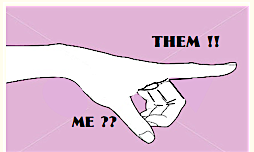
<— IMAGE: The Al-alanon handshakeAnon handshake: one finger pointed at another, BUT 3 pointing back at ourselves.

CRUCIAL : When considering this character defect, it only applies to adults, not children. Also, there’s a difference between what’s legitimately pointing out a problem or abuse, & what’s not.
Legit’ blame (assigning responsibility), is on behalf of Children :
parents & other adults ARE answerable for the pain they caused us growing up – whether they think they had a choice to do so or not (physical & emotional abusive, or abandonment because of mental illness, divorce, death…).

Not Legit’ blaming OTHER adults, or about any group :
Only the unhealthy parts of us indulge in this attitude.  Blamers look at everything that happens to them in the world thru the internal filter of their WIC (fantasy excitement or abandonment depression), but react externally as their PigP (superiority or finger-shaking).
And for the covert blamer, both filters can be well-hidden until something doesn’t work out the way they want.

NEXT: ACoAs & Blame (Part 3)

ACoAs & BLAME (Part 1)

the BLAME GAMETAKING RESPONSIBILITY
is a healthier way to live

PREVIOUS: Revenge #2

SITE: “Blame – What’s the Use?” Psych & religious

PostSatir’s BLAMER Role


BLAME as a ‘social disease’
– by Carl Alasko
“Deeply embedded throughout our society is the destructive psychology of blame. We tend to view it as a necessary behavior, a way to seek justice, a synonym for accountability or responsibility. It is none of these.
In fact, blame is a four-headed beast that attacks our very spirit.

We can launch these behaviors separately or fuse them into an assault that can annihilate the intended target. Painful emotions can & do kill. Consider those who commit suicide when battered by just one of these toxic tactics – that of humiliation. Indeed, blame is so unrelentingly harmful exactly because its primary function is to injure.

• There’s also an unacknowledged psychological paradox embedded in blame that preserves its vampire-like longevity : Screen Shot 2016-06-01 at 4.04.05 PM.pngHuman beings are hard-wired to dump their uncomfortable emotions on to others. So blame helps reduce our anxieties by externalizing our fears & stresses.

Naturally this does not excuse or condone it, since humans are also capable of learning how to accept & deal with our inner ‘demons’.

We see how political candidates temporarily surge in popularity when attacking an opponent, which reinforces the ‘value’ of the tactic. Then the opponents responds in kind, & the cycle continues. This dynamic is also at the root of bullying, whether in school or on the street. The bully’s internal anxieties are relieved by debasing another person or group. Thus blame feeds the roots of every form of bigotry, sexism and racism.”

🌀 🌀 🌀

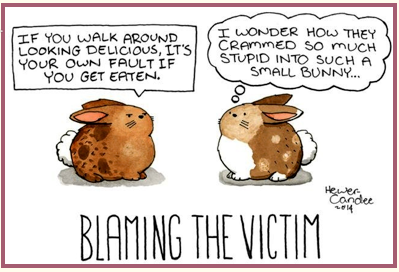
ABUSE / cruelty : ‘Blaming the victim’ is holding someone responsible for pain they have or are suffering, especially when they did not cause it & had no way of preventing it
EXP: Born with some defect, illness, deficiency…..

Adult Blamers, in the present : the mental decision (conscious or not) to accuse someone of causing our suffering (even if accurate), WITHOUT acknowledging any possible part we may have in the source of our pain (sticking around for it, misunderstandings….)

Damaged parents often blame their children & the whole world for their own short coimages-2mings & life stressors (“Your made me hit you! If it weren’t for you I could have…..”). Then it’s only natural that as children we take on the blame. So we learned to:
• hold ourselves accountable for what was not our responsibility, AND
not hold others accountable for their bad behavior, and/OR
• blame others for our troubles, the way our parents did

SELF-HATE is the result – incorrectly blaming ourselves when anyone hurts us, even though we have nothing to do with causing it.
ACoAs IRONY:
While easily pointing out other people’s shortcomings (as it affect us, of course), <—-> being hurt by them triggers our S-H, to deny feeling vulnerable.
Actually, we have it backwards – we blame ourselves for the source of our pain to avoid holding our parents accountable for those original wounds.

Reality : We did not deserve being blamed as kids, & we don’t deserve our S-H now, which is simply agreeing with the Perpetrators. In many alcoholic & other unhealthy families, no one recognized or took responsibility for their abusive or neglectful ways, & certainly never for their twisted thoughts & disowned emotions.

• It’s imperative for ACoAs to identify when or if someone is actually doing something harmful, neglectful, abandoning – to us or to others. If we are not sure, we can start by making a list of all the ways & times various people have hurt us or our loved ones, & look for common threads. (22 POSTs : “What just happened?” re. Noticing Painful Events)

This inventory is a sincere effort to clarity what we’ve experienced, especially when at the hands of someone who is taking out their damage on us.
The legitimate motivation for this kind of writing has to be the desire to identify & distinguish between:
• when we’re angry because of unrealistic expectations & assumptions, vs.
• breaking denial about harmful relationships we hang on to, so we can outgrow the addiction to abuse

NEXT: Blame #2

Rebellion vs COMPLIANCE (Part 2)

compliance
I HAVE TO GIVE IN or I won’t be liked!

PREVIOUS:
REBELLION vs Compliance (#1)

See ACRONYM page for abbrev.

REBELLION
1. HEALTHY (Part 1)

2. UNHEALTHY
(cont)
b. Over-coerced (cont)
✶ Our reaction
THEN: For ACoAs in this group, being rebellious or resistant was an attempt to hang on to a fragile developing identity, in the face of our parents’ active, daily effort to obliterate it.
It was a desperate effort to resist ‘psychic murder’. As long as we were living with our family, this defense was a necessary & partially successful survival boundary

NOW: Many ACoAs from this background will become the overtly Rebellious type – at work, in relationships, everywhere.
In this case the rage at our abuse is obvious. It’s the WIC’s punforgicingowerlessness in childhood – being ineffectual at actually making any changes for the better.

But the reality of not originally having had an effect on the environment created a double bind :
“I can’t have an effect (for myself) and I must have an effect (on them).”
This often leads to socially unacceptable behavior, sometimes ending in trouble with a variety of authority figures.

These ACoAs are more likely to be:
• counter-phobic – acting like nothings scares us, & believing it
• oppositional – needing to say NO to almost everything we didn’t think of ourself, often saying “Yes, but…”

• in a relationships to feel powerful – being aggressive, controlling, the rescuer
• terrified of real commitment, choosing obviously ‘unavailable’ partners & friends, being promiscuous, not staying long, finding fault…..

Ultimately – being rebellious is not a successful or appropriate adaptation for most careers or relationships.
The whole world is not like our family – only the part that we’re attracted to or are able to ‘see’ – in order to continue relating to others in a familiar way – called the ‘repetition compulsion’.
(Post: REVERSE Laundry List & Recovery)

* * * * * * * * * * * * * * * *

COMPLIANCE
This is the opposite extreme defense – used also to protect oneself from psychic murder, & from ongoing mental, physical  &/or sexual abuse.

THEN:
It looks like these ACoAs totally agreed with their parents & never tried to stand up for their own opinion & needs. Not doing so was imperative in many households, because to have had any individuality (like objecting to the abuse, or identifying the ‘elephant in the living room’) was so severely punished. These children had to be ‘good’ to just survive.

EXP: Think of Marvin Gaye, who as an adult finally stood up to his alcoholic father – to stop him from beating his mother. His father’s response: he murdered Marvin in his sleep!giving in

NOW: This compliance as adults may look like the passive resistance of rebellion, but there is a difference. These ACoAs :
• hide their rage under either cuteness & humor, or sullen withdrawal
• are often in a relationship with a bully &/or control freak
• look to others to tell them what to do & who to be
• may complain endlessly about being abused, but won’t risk a change
• are the ‘invisible’ ones around us, fading into the background
• have a greater tendency to severe depression, physical illness & suicide attempts than other types
• some can be pushed to the wall & then explode, but rarely

EXP: One compliant woman stayed married to a controlling bully for over 30 yrs. Everyone, including her kids, told her to leave but she never would. When he husband finally died, her friends thought: “Finally, she’s free. She can have a life of her own for the first time.” Wrong. She died within a year of being widowed!

• On the surface, this defensive style may result in lessening friction in the world, BUT is not respected by most people AND will cause the compliant person to slowly die inside. (Posts:Secretly Angry NICE optistic?People

RECOVERY
• It’s important to remember that these are DEFENSES, not our real personality, no matter how much it feels like it!

✶ BOTH styles are being run by the WIC in reaction – first to the original family – & now to the internalized Negative Introject.

✶✶ But much healing can be achieved to counter these defenses, with love, patience & the right kind of info.
(Posts: “My Rights // S& I – Healthy individuation“)

NEXT: ACoAs & BLAME #1

REBELLION vs Compliance (Part 1)

 YOU CAN’T MAKE ME! (OR)
I’ll do whatever you want, so you won’t leave me

PREVIOUS: Wanting Revenge #2


REBELLION

1. HEALTHY

• This is normal for the teen years, when you’re trying to figure out who you are, what you want to do ‘when you grow up’, so you’re not a carbon copy of your parents (yuck), wanting to be part of your peer group….

• In a reasonably healthy family you’re given a certain amount of leeway in this, to grow & stretch. Healthy parents are not threatened by this stage – even if it makes them uncomfortable & a little nuts. They know you’re a separate person & will find out for yourself
• It does not mean they neglect you, ignore what you’re doing or just can’t be bothered. It means they’re watching & waiting, and caring, not overly imposing themselves – but also not OK letting you get into trouble!Screen Shot 2016-06-12 at 5.16.58 AM

• When you’re allowed to be different from your folks, can disagree with their politics, religion, philosophy of life, or just plain – what to wear – eventually you get to find out what you really like & don’t like, who the real you is!

• Kids with this kind of freedom eventually (usually by their 20’s) find they do in fact agree with much of what they grew up with – the values, tastes, lifestyle… even if expressed in their own personal way.
AND ways they are different from family is accepted & maybe even admired – or at least respected.

2. UNHEALTHY
However – if you’re reading this, you probably didn’t grow up in that kind of family!  As ACoAs:
a. Neglected : if we were ignored, unguided, un-nurtured – we would, of course, be left with a lot of anger, sadness, loneliness & a deep sense of hopelessness. As kids, we would Screen Shot 2016-06-12 at 5.16.16 AMconclude that we didn’t matter, were invisible, had no reason to do anything for ourselves, & are incompetent anyway.

• Maybe a relative, a neighbor or teacher took an interest in us & helped some – but it’s not the same as having our parents explain things, show us by example & help us try out things. Everything from personal hygiene, cooking, house repairs, arts & recreation, social skills – to homework, relationships, spiritual practice….

Our Reaction
THEN
: We spent a lot of time alone, daydreaming, hiding out, reading, studying, maybe hanging out in the library, with a friend – but not likely.
NOW: ACoAs in this group don’t accomplish as much as they could, have trouble pursue dreams, goals, talents, interests … in spite of being just as talented, intelligent & capable as any other human being.
After all, if our parents couldn’t be bothered to teach us how to do all the things kids need to know, so how can we possibly manage anything ourself ? !

• This may not seem like rebellion – but it is.  It’s passive resistance: “If they didn’t take care of me, I’m not going to take care of me!”.  True, there’s fear, a deep sense of not knowing how, but the refusal to try comes from rage, which underpins the passivity.

Even so, some of us were told that they love us – even though they rarely or never acted like it. In stead, WE are the ones who love them – desperately, no matter how cruel & neglectful. We’re the ones who don’t want to let go!

b. Over-Coerced : At the other extreme, many of us were bullied, over-controlled, Screen Shot 2016-06-12 at 5.15.41 AMmanipulated – forced to do & be whatever one or both parents (& other caretakers) wanted, with little or no regard to our individual personality.

• As kids we were considered ‘tabula raza’ – that’s Latin for blank slate. Parents of the baby boomer generation (& before) were taught that children come into this world with no identity or personality OR that they’re born bad, & it’s up to the parents to form them according the what’s ‘right’ – to write on the slate as they wished.

• Alcoholic & other narcissistic parents, who by definition had low self-esteem & fear of abandonment (FoA) themselves, could not tolerate any sign of individuality in their children, ⚡️which they stubbornly assumed to be disobedience, deliberate disrespect, even perversion!
☀️Such parents / family ruthlessly suppressed the reality that every child is born with their own specific personality type, & genetic makeup (even twins) which needs to be acknowledged & nurtured.

NEXT: Rebellion vs COMPLIANCE (Part 2)

ACoAs WANTING REVENGE (Part 1)

little devilsMAKE THEM SUFFER !
The same way they made me suffer!

Post: ANGER CATEGORY #12 – Retaliatory

POSTS: Parents Blaming Us / ‘Shame’ / ‘Guilt’


DEF: REVENGE
, Vengeance, Retribution, – injury inflicted as punishment in return for abuse received
• To plot revenge – the bitter desire / obsession / plannimg to injure another for a wrong done to oneself, a loved one or others like oneself
• To avenge – actually exact satisfaction for a sense of injury, following a wrong received. Any form of personal action against an individual, institution, or group for some perceived harm or injustice.

1. AS CHILDREN
😡 Many of us hated one or more parents for their neglect & cruelty – but that was to-o-o dangerous to admit! We wished they were dead or that we were.
BOOK: “So the Witch Won’t Eat Me” by Dorothy Bloch (NY psychoanalyst) gives an excellent explanation in her intro.

a. External CAUSES
Growing up, our parents & other adults:
• neglected, attacked & humiliated us, assumed the worst of us… blamed us unfairly for everything
• AND didn’t allow us to defend ourself, never bothered to ask for our point of view or experience, didn’t believe us, weren’t on our side nor defended us

b. Internal –
As children WE:
• are vulnerable to & at the mercy of our caregivers
• think in B & W, simple cause & effect, so a believe in JUSTICE – that the world SHOULD be fair
• AND, assume we’re the center of everything, therefore everything that happens to us is about us (good or bad)!
SO
It makes sense to a kid’s mind that, when our parents hurt us —
• they were justified in what they were doing to or not doing for – us
• somehow we caused it, even if we couldn’t figure out what we did wrong
• we deserved whatever was dished out: “The gods punish us for our own good (a lesson) & because we deserve it (being bad)!”
BUT
• we were in constant, intense pain.  Even though we had no choice but to accept blame, still – we wanted it to STOP! Of course.
• no one else seemed to notice or care – no one helped (maybe someone did try, but it didn’t work out & we stayed trapped)
• we couldn’t get any justice from them (they didn’t care how their abuse effected us)
• they got away with it – were never held accountable! UNFAIR
AND
• we tried & tried – to figure it out, to change ourselves and get them to change, to protect ourself & others in the family
• but nothing got better, so we got more & more frustrated and hopeless
• failing to MAKE adults stop hurting us, our sense of danger never left

whivoodooch led to getting angrier & angrier. Being powerless in an unsafe family, especially one that was actually life-threatening – will always generate RAGE
• and after all – fair is fair – eventually we began to have fantasies of REVENGE, to even the score, so the world would be in balance again.

Without help, comfort or a way of escape, we had to suppress the pain as best we could, but our fantasies scared us.
We could’t attack our parents directly, because —
– we were too dependent on them
– they had some positive qualities we used so as to deny the bad ones
– it wasn’t safe to rebel outright (severely punished if we did try)

We needed to deny our fury at them. We weren’t big or strong enough to punish ‘those mean, stupid adults’ the way they deserved, so we did the next ‘best’ thing :
• Masochism, Revenge in REVERSE – some took it out on ourself (self-mutilation, fantasies of being hurt/ tortured, tried suicide either directly or by dangerous activities….) as a way to punish our abandoners

Sadism – directly abusing others : As kids, some of us hurt smaller, younger, weaker things, such as:
— an older child hitting, hurting or even killing a new child in the family
— physically torturing birds, cats….
— stealing, hiding or breaking other’s toys & possessions
— bullying (at home, neighbor kids, at school, later – on line….)
— making fun of someone’s disability…

NEXT: Wanting Revenge #2

PARENTS BLAMING US (Part 1) 

being blamedWHY IS IT ALWAYS MY FAULT?
No matter what I do, it’s wrong!

PREVIOUS: Rebellion vs Compliance #2

SEE posts : What is Guilt?
What is Shame?
• ACoAs’ Need for Revenge


INTRO

There is a lot of talk in the ‘spiritual’ community about forgiveness, ie – that we should not be blamers.
Not blaming ourself (S-H) or others (attacks) is a good rule for us in the present – now that we’re adults. And that’s a discussion for another post.

However, those same teachers & preachers never talk about what was done to us as kids – that among many other types of harm, our parents unfairly, inappropriately blamed us for all kinds of things – and what that did to our tender & vulnerable developing sense of identity!

This post is about what happened TO US as children. A hallmark of alcoholic & other emotionally unhealthy families is the mistreatment of their children in all 4 of life’s aspects: Spiritual, Emotional, Mental, Physical (PMES).

😿 Parents blaming their children for ANYTHING is ABUSIVE. Blaming us is the same as holding us responsible for their deficiencies & unhappiness.

Remember – abuse is not just Physical, in its various forms. Abuse encompasses all the ways people harm others – especially their children – by injuring another’s rights, self-esteem, mental clarity, sense of safety, emotional equilibrium & boundaries. So Blame fits into the other 3 categories – M, E & S..

👥 A variation on parental Blame is a constant and negative COMPARISON of a living child to a dead or other living sibling, another relative, a famous person….  “Why can’t you be more like ____”

1. IN OUR CHILDHOOD
✅ Damaged parents blamed YOU for things WHICH :
a. were NOT your fault
• your difficulties because of a learning disability, like dyslexia or ADD
• the illness or death of a parent; a parent being left by a lover or spouse..

b. was a projection
of what the parents were guilty of being (fearful, irresponsible, lazy, feeling unlovable, risk-averse….)

c. you were not doing
what you were accused of
• being a ‘whore’ when you were too young to have had sex at all OR
• of seducing a parent’s lover/ spouse, when that adult was actually sexually abusing the child
• of using drugs when you never did – at least not at the point…) Screen Shot 2016-06-12 at 5.07.37 AM

d. you could not do, especially without any instruction, & then accused of being stupid
• when you legitimately couldn’t know something (fixing a car or other machinery, shopping by yourself, def. of a big word…)
• ‘getting’ a hard school subject
• expected to know how to fix a parent’s personal, sexual & financial problems
• forced to take care of a drunk or crazy parent, alone…
WHICH
e. were truly no one’s fault. EXP :  • an act of God
• being born with a physical or mental limitation
•  getting severely ill or having an accident…

f. you were held responsible for –
 something one of your siblings or other child did, especially if you were the Hero or Scapegoat (start a fight; steal or break something; get into trouble at school…)

g. your parents were jealous of, because they couldn’t do something you could, even as a youngster (a natural skill or gift), so they made that ability stupid or a bad thing

h. was mostly not true
always lying (“Kids always lie so we can’t believe anything they say”)
always being stubborn, selfish, too sensitive, difficult, disobedient, stupid….

➼ This last category are a group of normal childhood characteristics which:
√ sick parent cannot tolerate because of their own issues
√ occur sometimes as a defense in the child because of family abuse & neglect…
√ happens occasionally because kids are human ie. imperfect.
Those behaviors & attitudes then get demonized – which make them a ‘sin’ and more likely to continue, causing the child to TRY becoming perfect’. We CAN’T WIN in a sick environment.

NEXT: ACoAs’ need for revenge

ACoAs – “Being Negative” (Part 6)

PREVIOUS : Negative thinking #5

SITEs: Types of Negative Thinking (Cognitive Therapy)

100 Positive Thinking exercises


OUTGROWING NTs (negative thinking) – Writing Exercise 

Keeping a Thought-Record every day for a few weeks will help change – or at least modify! unhealthy thinking. Once you can spot the NTs quickly, you can start changing them into better alternatives.
#1-6 help to understand the NT, & the last 4 develop better thinking:

1
. The SITUATION
Briefly describe a situation you wish you’d handled better – so you can review it later
EXP: “I made a mistake at work. It made me anxious & reminded me of all the other times I messed up”

2. INITIAL THOUGHT
What came to mind first? Probably an automatic thought you’ve had many-many times before (S-H)change to positive
EXP: “I feel like a failure. If people knew the real me, they wouldn’t like me. I can never do anything right”

3
. DISTORTION
Identify the cognitive distortion (CD) behind your initial thought. #2 is a combination of Self-labeling & Disqualifying the positives

4
. SOURCE of Toxic Beliefs
Trace it back to a person &/or repeated events (family, school, religion….) Try to connect with the fear, sadness & hopelessness
EXP: “I can hear mom or dad saying that I’ll never amount to anything,
I’m a failure, a disappointment, dumb….”

5
. CHALLENGE the Thinking
Stand back from the inner drama & list the pros & cons of your thoughts. Make sure you see the whole picture. What:
• What did you learned from similar experiences?
• How do other people handle the same situation?
• What strengths & experience do you also have?
EXP: “I’m way too hard on myself, & get overwhelmed when I try to be perfect. I don’t always succeed, but sometimes I DO..
People have complimented me on my work. I keep getting hired….”
6
. Consider the CONSEQUENCES
What are the short- & long-term results if you continue Negative Thinking?  Look at the physical, psychological, professional & emotional ones – some of which may already have happened
EXP: “I’m damaging my self-esteem. If I continue to think like this it’ll affect my relationships & possibly my health. I’m always exhausted”

☛ 1-6 helps you pay attention to what’s actually going on in your head, & makes you more receptive to corrections. 7-10 focus on CHANGE

7. ALTERNATIVE thinking
Write down realistic options to your negative beliefs. Get help if needed
EXP: 🔅“I’m being unfair to & unrealistic about myself
🔅My identity is not ‘BEING a failure’. It’s not possible to be perfect!chisel positivity
🔅 I can’t succeed / achieve – every time & try!
🔅 Mistakes can be my lessons, not my downfall
🔅 I’m capable of modifying & changing my NTs

8. POSITIVE statements
Write the healthier beliefs you want to grow into. At first you’ll have to act-as-if to believe them.
Keep repeating them every day until they come naturally.
They need to be tailored to your WIC’s specific beliefs, NOT just a pat-on-the-head

EXP: A mistake is not failure. I am successful in many ways.
“God grant me the serenity to accept the things I cannot change, the courage to change the things I can, & the wisdom to know the difference.”

NOTE – ACoAs get the first 2 lines backwards – then wonder why we ‘fail’.  Instead – we need to do what we can, rather than the impossible!

9. ACTION PLAN
What action can you take to support your new thinking? Make a point of going to kinder, smarter people for positive mirroring & encouragement!

EXP: “The next time I make a mistake, I won’t obsess about it. Instead I’ll focus on what I can learn – if anything – & look at my list of past successes. I’ll call a sponsor or good friend for reinforcement

10. IMPROVEMENT
With repetition, notice if you feel slightly better or more optimistic. Appreciate & validate any improvements – no matter how small – by writing them down & the sharing them with a ‘positive’ person.  Keep the list with you so you won’t forget them.   This step reinforces the psychological truth that if you change your thinking, your mood & eventually your actions will improve.

NOTE: Changing an action to fit the new beliefs may be breaking a toxic rule. At first this will not feel good, but with many repetitions & support – it will become the new norm &be comfortable. DON’T GIVE UP!

NEXT: Parents blaming us