ACoAs – Fear of Commitment (Part 6a)

dating DATING IS HARD WORK!
I always have to be ‘on’

PREVIOUS: FoC – #5


2. RE-ENACTING (a-j)

3. SELF-SABOTAGING re-enactment
There are also POSITIVE things that interfere with our willingness to Commit, such as :
a. Fear of self-careTo the WIC, C. to ourselves means having to give up the fantasy that someone will come along & rescue us.
12-Step Programs remind us that to truly progress, we need to put our Recovery first, before all else – particularly true for newcomers.

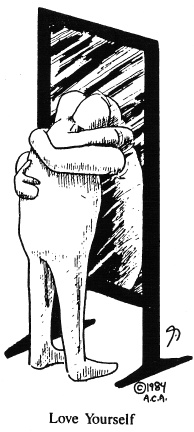
♥️ Commitment to ourself:
• requires the guts to go against all our early training, managing the resulting guilt & backlash
• means re-defining terms like ‘selfish, normal, fair, family, love’….
• means talking to the WIC every day, Meetings, 2-handed writing, books, therapy…. as much as possible.
Once our Inner Child trusts that we’ll consistently show up for it, making a commitment to others won’t be so scary
self-care
➼ If you’re in Integrity – true to Deepest Self – & are accused of Selfishness, it simply means you’re not doing what the other person wants.
Don’t let someone guilt you into betraying your values, observations & beliefs. You can comply with their wishes if it suits you, but not from FoA

b. F of being treated well & loved. To the WIC, C. to anything or anyone positive, means having to feel the contrast between the suffering our family (& others) put us thru – against – now being seen & heard for who we are, treated with kindness & respect. We start to understand what could have been, in a saner family. Painful & enraging.

• BUT we don’t want to be disloyal to our parents, afraid to hurt them. After all, they said/say they love us, right? How can we admit otherwise?Yet many of us actually believe that wanting to be loved is a character defect!  Infer all, if they couldn’t – how dare we still want something we have no right to?!

But being loved is a fundamental & universal human need, which we had very little of when we needed it the most! So now we’re attracted to & stay with PPT that are either blatantly bad for us, not actually bad but unsuited to our True Self, or which only partly meet our needs. Screen Shot 2015-08-22 at 7.21.10 PM

• We’re afraid to  grow up, afraid to be ‘vulnerable’.
Being treated with consideration, patience, admiration, encouragement…. forces us to FEEL the abandonment we grew up with – how much we missed out on, & to think: “I could have had a V-8!” – which means : “I didn’t cause the pain I grew up in. With healthier parents I would have been safe & loved!” 😢

c. F of our Power – To the WIC, C. to our own strength means eclipsing family members, so in some way destroys them. 
🔥 Any sign of ‘stepping into our power’, being smart, knowing our rights & being able to shine was considered arrogant, presumptuous, even sinful.  Beside all the verbal & physical abuse for just being a normal kid, many of us got smacked down badly if we ever let some of our natural strength out.

😡 The other down side of showing competence & strength as a kid was that one of more of the damaged adults used it – like a nightmare octopus – to feed off of us! (Post: “Personal Power”)invisible
So, between being abused and used – we had to hide most of who we truly were, & adapt to what would get us through.
Expressing our strengths as a kid would actually have meant being :
– a disruptive threat to the whole dysfunctional system
– a signal they might no longer be able to ‘mess’ with us
– an attempt to disengage the symbiosis, triggering THEIR FoA
– highlighting the adults’ weaknesses & limitations
– usurping the narcissists’ limelight

That left us invisible to ourself – not knowing what we’re inherently capable of, unable to commit or connect in a genuine way. And our co-dependence tells us that if we outshine others, we’ll be bad for making them feel bad about themselves. Then they won’t like us, plus we’re terrified of their envy-backlash.

🌀 And, now – If we do get an inkling of our healthy power, so foreign & undeserved, it can set off panic – at first . To let others actually SEE us feels life-and-death dangerous. But as we continue to inhabit our natural skin, we become more & more comfortable.

NOTE – Unhealthy responses from others & our resulting terror ONLY happens when dealing with very wounded / abusive people!

NEXT: FoC – #3a

ACoAs – Fear of Commitment (Part 5)

PREVIOUS: FoC #4

QUOTE: “If you don’t make a total commitment to whatever you’re doing, then you start looking to bail out the first time the boat starts leaking. It’s tough enough getting that boat to shore with everybody rowing, let alone when a guy stands up & starts putting his life jacket on.” ∼ Lou Holtz, football coach

2. RE-ENACTING (cont)
f. Fear of being vulnerable / g. F of the Truth / h. F. of making mistakes

i. F of S & I – To the WIC, C. to anything or anyone means that no one will ever take care of us. ACoAs are addicted to our sick family & their way of functioning in the world. Being symbiotically intertwined with parents &/or siblings, we still believe everything they implied or told us about ourself & the world making everything unsafe, so we mistakenly believe we might as well stay with what we know. (Posts : S & I”, and Toxic Family RULES”),

The WIC wants safety even more than love, and it thinks that what is ‘safe’ is what it learned at home. In that way we’re indeed committed, but not to ourself or to mental /emotional / spiritual health. (EXPANDED in“ACoAs – Being Responsible”)

j. F of Compromise. To the WIC, C. to anything means alwayMY WAYs having to giving in to others – yet again! Having had to give up so much of our core identity as kids, ACoAs fiercely cling to whatever shreds of ourself we’ve pieced together over the years. This is usually based on S-H, Toxic Rules, our family Role , plus a few genuine aspects of our Natural Child.
In AA those shreds are called “Self-will run riot”, (character defects) which really means our WIC – using it’s defense mechanisms to survive, but assuming they’re our real personality.

• Not having actual boundaries, we can’t bear meeting someone even part way, for fear of disappearing completely. We ‘can’t afford’ to take into account all the ways they’re different from us – their personality, idiosyncrasies or woundedness – because it might mean modifying some of our habits or way of thinking – to get along.
It feels like loss of freedom, so the child panics, sure that ‘giving in’ would be like back home, negating ourself completely – again.

➡️ This pattern is part of another ACoA Double Bind: Giving ourselves away completely, while being rigidly stuck in the False Self
• We’re afraid of conforming to social norms or requirement – a dress code for work, the authority of a boss, a different ‘language’ for different venues…
• We always have to be RIGHT & do things a certain way – which usually turns out to be our family’s way, not actually our own. Al-Anon asks: “Would you rather be right, or be happy?” The child’s answer is: BOTH! But compromise may mean choosing one or the other – some of the time.

If you know yourself well, make 3 separate lists, of THINGS:
1. you absolutely need – can not or will not give up, change, or modify. It’s usually the shortest, base on core values from your True Self, using the UNIT.

2. you like, prefer, even love, but are willing to work around. It means sometimes going somewhere or doing something you want, alternating with things the other person wants. It requires enough recovery to not feel resentful or diminished when you don’t get your way

3.
that aren’t that important or meaningful to you, one way or another – so the other person or situation can have it their way, & it’s no skin off your nose.

NOTE :  LIST things about a person, job, object, locations… which truly harm &/or do not suit you., ever!  Then it’s imperative to eliminate them as soon as possible – not just as a ‘geographic’ escape

💠 REALITY – if we commit to anything we do want, sometimes we’ll have to adjust ourself somewhat to the requirements or needs of that situation or person, BUT without losing ourselves.
Healthy compromise allows for both ‘parties’ to benefit. It is not co-dependence, which would exclude ourselves in favor of another.
(SITE: Compromise in an ADHD Relationship)

NEXT: FoC – #6a

ACoAs – Fear of Commitment (Part 4)

foc WHENEVER I MESS UP
my whole world collapses

PREVIOUS: FoC – Part 3


QUOTE: “Commitment unlocks the doors of imagination, allows vision & gives us the ‘right stuff’ to turn our dreams into reality.” ∼ James Womack, founder of Lean Enterprise Inst.


2. RE-ENACTING
(cont)
c. Fear of being trapped / d. F. of responsibility / e. F. of losing control

f. F of being vulnerable To the WIC, C. to anything is leaving
oneself open to all kinds of danger
. As long as the WIC is in charge of relationships (of any kind), it believes that letting someone in to see the ‘real us’ – leaves us open to being left alone again.

VulnetableOf course the tragedy is that without enough Recovery, it is exactly that ego-state which chooses our relationships – always unsuitable, unfulfilling or outright dangerous – which inevitably does add to our suffering!

This fear leads to over-protecting ourselves, which can create a Double Bind – we’re damned if we pick someone to stay with (symbiosis), we’re damned if we keep everyone away (false boundaries).

g. F of the Truth. To the WIC, C. to our growth & Recovery means admitting we failed – somehow!  Also, it thinks we’ll have to feel all that pain – & then we’ll go crazy or die!
ACoAs are intensely resistant to admitting how traumatic our childhood really was, & how severely damaged we are as a result.
We love our family & don’t want to face how abusive & emotionally unavailable they were. Review DMs re. ACoAs. “Denial is not a river in Egypt!” (de Nile) says the pun. Denial prevents us from healing our wounds, which then keeps us from finding & keeping nourishing relationships.

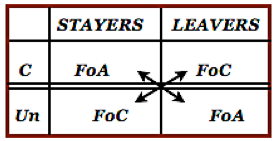
One way this is expressed is seen in the chart.
When we continually act out either STAYER or LEAVER ‘position’, as a form of false protection, we know that our WIC is in charge. “Leaving” isn’t just about walking away.
stay/leaveIt’s any form of being withholding, distant, ‘cool’, emotionally detached. Both groups are equally terrified of commitment, but it’s more visible in Leavers. C = Conscious // Un = Unconscious // FoA = fear of Abandonment //  FoC = fear of Commitment

h. F. of making mistakes. To the WIC, C. is not possible because we’ll never be able to ‘do it’ perfectly. 
☁︎ Punished / rejected continually, for things we :
— were never taught /  took too long to ‘get’
— simply too young to know / couldn’t possibly have known at any age
— were deliberately left out of /  had difficulty learning …..

So now we can’t take the chance of not knowing everything & being seen as ‘frauds’. If commitment means intimacy, then letting someone inside our defenses means exposing how imperfect we are, & then they’ll punish or leave us!

☁︎ Greed: Being deprives of so much growing up, the WIC now wants everything at once, & can’t tolerate being told NO about anything. So, when there’s a decision to be made among 2 or more options, we want to do them all, afraid to choose one & have to let go of the other(s), afraid of picking the wrong one & being disappointed – again

☁︎ Confusion: It’s not knowing our True Self at all or well enough to choose among options or possibilities – whether picking the right kind of mate, the right kind of career, the ‘right’ spiritual path, even down to the right kind of food, clothing & entertainment. It’s not being allowed to admit what we want or need. So many opportunities for making mistakes!mistakes

☁︎ Failures: Not having a Loving Parent & access to our True Self, we’ve already made many unhappy life choices – of friends, lovers, jobs, homes, hair cuts…. so we’re convinced we’re doomed to never do any better.
We keep forgetting (or don’t know) that our ‘picker’ has been a combination of the WIC & the PigP.
However, when those 2 ego states no longer run our life, we can choose better, & so can commit to safe, suitable PPTs.

NEXT: FoC – Part 5

ACoAs – Fear of Commitment (Part 3)

FoC I KEEP TRYING TO CONNECT – but no one seems to want me!

PREVIOUS: ACoA – FoC, #2


SITE: Commitment Phobics – playing out a dysfunctional family role

Some REASONS for FoC

RE-ENACTING (cont.)
a. FoA /  b. F of leaving family / c. F of being trapped

d. F. of responsibility
as kids To the WIC, commitment (C) meant we had to be responsible for everyone & everything, & no one taking care of us. We were forced to be responsible (R) for our unhappy angry, crazy, drunk parents, & sometimes our siblings. Many of us had to be the ‘designated adult’ even when we were very little, because of their incompetence, selfishness & addictions. We got the RULE loud & clear “Everyone else’s needs are more important than mine”.

e. F. of losing control – OPPOSITE of being ‘in control’, of ourself & our life, which eliminates being able to fully commit. To the WIC, C. to anything  -means many ‘unbearable’ things :
— accepting how things really are
— having to move on
— ‘allowing’ others to be different from us
— giving up absolute autonomy or of getting our way….

We violently resist the middle “A” (Acceptance) or any suggestions to “let go – with love, let go & let God, let go – with sadness, disappointment, anger…” – any way we can, but LET GO.

We believe that WE have to be constantly alert to preventing others from having power over us, and to stop the ‘craziness’ of addicts from falling apart and narcissists from engulf us. Many of us kept trying to do this in our original home – without success. And some of us still do, no matter how futile or unnecessary!

ACoAs project our S-H & paranoia out on the whole world, perpetuating our deep fear & mistrust. As adults, being controlling is a substitute for having real boundaries – mental & emotional walls the WIC thinks will protect us from actual or imagined dangers.

• If we were raised in an uptight, controlling environment – we’ll either rebel & want no limits at all, or follow the family pattern & be uptight, rigid & overly-fussy..
OR
• If we were raised in great physical & emotional chaos, many of us will expend all our energy as adults trying to keep people-places-things (PPT) in a tight grip. The assumption is that if we don’t, everything will spin out of control, even if the present day circumstances are actually much more manageable.

In any case, which ever style our personality leans toward – will be greatly influences by birth order & our Toxic Family Role (Hero //  Placater), but will also have a great deal to do with our native Type

Needing to control everything & everyone in our environment is both a way to prevent others from getting too close (intimate), as well as trying to keep them attached to us.
🔉 Overtly: Telling everyone what they should be doing, feeling & thinking – that it’s our way or the highway.

Being pushy, aggressive, ‘difficult’, demanding…. is presumptuous & insulting – the controller’s conviction that they’re the only one who knows how to do things, knows what’s best, what’s RIGHT, & how things should be done!    See Posts: “Controlling & Abandonment” //  “ACoAs – Getting controlled

🔇Covertly: Many ACoAs are sure they’re not controlling, because they don’t recognize how they do it, since it’s indirect & sneaky – by omissions, withholding & people-pleasing.
in controlSome ways:
– BY consistently denying oneself (needs emotions, opinions…) in favor of another. It’s a way to manipulate how someone behaves & how they feel about us, or prevent them from leaving (abandoning us).
– BY withholding – affection, communication, decisions, preferences….
– BY always being a victim, sickly or incompetent, so others have to take care of us or clean up our messes
– BY rescuing, people-pleasing…., trying to change someone or something into what we want, so we won’t have to leave & start over

NEXT: FoC, Part 4

ACoAs – Fear of Commitment (Part 2)

acoas fearI DUMP ON ANYONE who tries to love me

PREVIOUS: FoC – ACoAs #1

SITE:10 most common fears” & more….


1. ORIGIN

2. RE-ENACTING (cont.)
As stated in Part 1, besides ‘close’ relationships, Fear of Commitment (FoC) also shows up as not giving our all at school or work, at home or in public…. It’s a fear of giving our best, convinced that our best will always be considered “not good enough”. That leaves us ashamed, lonely & scared.

Q :  ‘Not-good-enough’ & always being wrong – according to whom???
Ans : Original family, maybe peers, religion…. As long as our WIC is running things (via beliefs & emotions) we’re stuck in the past, assuming everyone will treat us exactly like our family did/does, even when we’ve had positive experiences to the contrary.

Many ACoAs long for a loving, steady relationship & a better over-all life. Yet no matter how hard we try we keep missing the brass ring. The WIC’s terror of reproducing the dangerous intimacy of our original Parent-Child bond is so strong it prevents us from finding the safety & acceptance we crave.

❤️ What stops us from creating our own strong, internal Loving Parent ? The kind who will pull the WIC away from the PigP, form a connection to a loving H.P., & prove there’s another way to bond with others – safely ?

Some REASONS for FoC
a. Fear of abandonment (FoA) – our most basic fear.
A = not getting enough of our legitimate childhood PMES needs met
, AND being abused in each of those 4 categories. This created the belief that we’ll always lose what we need & love.
So there’s no point in setting ourselves up for more pain by committing (C) to something we truly care about.  It’s one reason ACoAs are ‘best’ at what we like or love to do – the least.

It’s inevitable that FoA creates lack of trust. SO – if our parents & other important caretakers neglected & assaulted us, how can we possible believe anyone else would be dependable or care for us?

b. F of leaving family of originwe can’t C. to anything we need or like, if it takes us away from ‘them’. IF WE:
– are so ‘under their thumb’ that we’re not allowed to make our own choices, or let family pick for us (mates, career, where to live…)
– have emotional-incest ties to a parent, so we can’t have our own dyad
– are still dealing with a parent who’s an active addict, mentally ill or otherwise impaired, so we feel compelled to keep taking care of them, instead of ourselves

c. F of being trappedTo the WIC, C. to anything means :
— never being able have our own space to breathe, nor
— get out of any situation that doesn’t work out the way we hoped.

As kids we were chained to ‘them’, & the adults were trapped with each other – in dead-end jobs, with relatives they hated, & most of all trapped in their own damage. We swore we’d never let that happen to us, so now we never commit to anything or anyone.

♻️ Instead, we make our own prison because of :
• NO Options: not allowed to choose (lovers, friends, mates…) for ourself, so whoever wants us gets us, whether we actually want them or not

come here-go away• NO Boundaries – automatically disappearing / losing ourself when around others, especially a mate. Not having access to our True Self, we don’t know what our needs, wants or tastes are, so we go along with whatever others expect, want, demand, imply….
This makes us feel suffocated, ‘swamped’, overwhelmed when we / they get too close.

• NO Freedom: we’re stuck because, along with our own FoA, we’re not allowed to leave one of our toxic family rule: “If you don’t like you have to stay”.
ACoAs react in one of 2 ways:
– either stay way too long in bad or unsuitable situations OR
– compulsively come & go, isolate or just keep running
⬆️ “Come here-Go away” dance of FoC (see ‘Boundaries’)

NEXT: FoC – Part 2b

ACoAs – Fear of Commitment (Part 1)

chasing the alcoholic I REALLY WANT TO,
but I just can’t get myself to do it!

PREVIOUS: Fear of Commitment – general (#2)

QUOTE: ‘The worst thing isn’t fear of commitment – the worst thing is being with the wrong person because of fear of loneliness”. ~ ANON


1. ORIGIN
– the basis for this fear (FoC) is the fear of intimacy, ie. “in-to-me-see”.
• In general, INTIMACY is the mental & emotional closeness between 2 people which allows each to know the other person behind their defenses or socially acceptable mask. Sexual intimacy may or may not be included.

a. But initially, it’s the intimacy between a child & its mother. From the very beginning of mother-childlife, each child is totally dependent on its primary caretaker(s), & therefore totally vulnerable to the adult’s plusses & minuses.

If the mother (or substitute) is an active addict, controlling, cruel or crazy, depressed, ill, distracted, insensitive, manipulative, raging, scared, (usually some combination) —
— then the child will be in an intimacy double bind:
☼ on the one hand, desperately needing the parent to love it, protect it & take care of all its needs
☼ on the other, emotionally & intuitively aware that the connection with that person is totally unsafe & therefore terrifying.

🌀 In this case the child is trapped in this most intimate of all relationships, which is truly dangerous to its well-being, but inescapable. Being raised with unreliability & chaos inevitably creates a lack of trust, which then becomes the model for all future relationships, creating a deep terror of intimacy.

b. In most cases we witnessed one or both of our parents:
— be unable to make a commitment – to each other, to their children, to work, to personal growth…. OR
— be committed to work instead of relationships (us), to their spouse but not their children, to their addiction & nothing else!……
…… so we didn’t have a role-model for the emotional & spiritual requirements needed for consistent reliability

• Sometimes a child has another parent, older sibling or other relative who are more available & attentive than the primary. But if they are part of the same family, they too will have narcissistic damage & be limited in how much emotional safety & love they can provide. Often this ‘better’ person will either leave, die or turn on the child at some point – multiplying the abandonment pain.

All roads lead to Rome” was a familiar statement to the ancient Romans, & still is to all roadsmodern-day History students.
The ACoAs version is: “All roads lead to Abandonment!”. This fear is the bottom line for us, governing all our responses to the world. So much so that we can even feel abandoned by the end of a book or movie we feel intensely connected to!

• Whenever we beat ourself up, feel distrustful, hopeless or obsessive, are terrified something bad will happen to us…..  we’re tapping into old abandonment pain (E).
Given how much abuse & neglect we experienced as children, it makes sense that the WIC would believe (T) that Ab. is the only possible outcome for us, forever!
SO – why bother committing to anything, if we’re always going to mess it up or have it taken away??

2. RE-ENACTING  (F=fear)
➼ Healthy : Making a commitment to something or someone means showing up regularly, being self-motivated, taking risks, not knowing everything, asking for help along the way, having rights…. all the things we’re not allowed!

confusion• The ACoA’s WIC has a whole trunk-full of reasons for FoC, even when we don’t have words for it or are aware of the WHY.
As adults, this fear is perpetuated by Self-Hate & weak or missing Boundaries. We can apply the following issues to PPT (people-places-things), even though the focus here is mainly on relationships.
It shows up as:
– Confusion (I don’t know what I want, who I am)
– Indecisiveness (should I or shouldn’t I?)
Perfectionism (I have to know it all & do it right – the first time!)
Procrastination (maybe later, but secretly – maybe never)

NEXT: FoC – Part 2

Fear of Commitment – General (Part 2)

love distancingI WANT TO STAY WITH HIM but he only wants freedom

PREVIOUS: Fear of Commitment (#1)

POSTS:Relationship Stages” // “Unrealistic expectations

SITE: Overcome fear of commitment
(+ Hypnosis tapes)

⚑ 
GENERAL: Fear of Commitment (FoC)
⚑ WAYS of AVOIDING Emotional Commitment

⚑ SYMPTOMS of FoC
 When reading the following list – & holding your WIC – picture something you find hard to commit to – not just relationships, but anything you’re afraid to do or continue with. How many of these items apply? but without S-H!

1. IN OURSELVES
a. Mental (including CDs)
• Compulsion: overwhelming impulse to flee the situation, although the assumed danger is only in your mind – tough to understand or resist
• focus on bad / scary images & movies about the subject shown
• obsess about the subject (whatever you’re avoiding)
• trouble thinking about anything other than ‘it’
OR
• are sure you have a fatal illness (aids, cancer…) but don’t
• no motivation, can’t make decisions, confused
• scared of fainting, losing control or going crazy
• feel “unreal” – detached, not yourself

b. Emotional
• Anticipatory Anxiety – persistent worry about upcoming events that involve any form of commitment
• Moods: high levels of anger, sadness, fear, hurt & guilt
• Physical Apathy: lethargic, depressed, sleepy
• Terror: constant overwhelming fear of the ‘issue

c. Physical
• Breathing : shortness of breath, smothering sensation, feeling of choking

• General: hot or cold flashes, temporary muscle weakness
• Gut: nausea or stomach distress, diarrhea
• Head: dizzy, unsteady, light-headed, faintfear-sick
• Limbs: trembling, shaking, tingling, joint pain
• Physical Apathy: lethargic, depressed, sleepy
• Torso: palpitations, pounding heart, or numbness, accelerated heart rate, chest pain or discomfort

♥︎ Relationships
Gamophobia – fear of getting married, assuming it will inevitably be harmful. It’s found more often in men, because the real or potential trouble they’re afraid of may have greater consequences socially, financially, legally & personally.
Of course, FoC a very common fear is all types of ACoAs, & can extend to any relationship, even those we’d like to have.

• Old ➕ New painful / traumatic personal experiences, as well as observing the negative effects of domestic violence, divorce, parents never married…. in others – can lead to FEAR of being trapped & abused, an inability to trust, abandonment terror, depression….

• Long-term inability to be feel SAFE /vulnerable & show one’s ‘weak parts’ is a sign of a gamophobiapersonality disorder. In severe cases, we may like or love someone, but IF the other person returns our affection & wants to be together permanently, Gamophobes can easily change our attraction into fault-finding, disdain, even hate.

This happens more often unconsciously, using the other person’s ‘limitations’ as an excuse to push them away. Turning love into hate, or over-valuing & then under-valuing a partner – without a legitimate reason – is a defense mechanism. Often, the sufferer knows their fears are unreasonable or exaggerated, but feels powerless to change.

2. IN OTHERS
FoC in Women – While they’re often portrayed as ‘commitment hungry/crazy’, changes in social & moral rules make it easier for them to act out this fear, no matter how well disguised. (More….)  (“She Won’t Commit”).

Women who are socially awkward, have social anxiety, fear of being trapped, or in the closet – can now stay single & not be judged (except by conservative people & communities!).
➼ Biggest hint that a “Stayer” type woman is also commitment phobic – is repeatedly choosing & then clinging to ‘unavailable’ partners!
(Love a commitment-phobe? Dating Tips For Men)

NOTE: In Part 3 – some of the symptoms for men apply to women as well, so go through them with that in mind.

NEXT – FoC – ACoAs (Part 1)

Fear of Commitment – General (Part 1)

fear of commitment I WANT TO MOVE FORWARD
but he/she doesn’t

PREVIOUS: Feeling Sorry for #3

QUOTEs: “Commitment is healthiest when it’s not without doubt, but in spite of doubt.” ~ Dr. Rollo May, psychologist
• “If you deny yourself commitment, what can you do with your life?” ~ Harvey Fierstein, actor, writer, director

DEF of COMMITMENT:
• an attitude of working very hard to do or support something
• a promise to do or give something, to be loyal to someone or something ongoing or permanent – if at all possible (‘Til death do us part’)
• an instance or the state of being obligated or emotionally driven
• an agreement to perform a particular activity at a certain time in the future, under certain circumstances

POEMby Ashbash 1/13/2005
happy old coule• Commitment is what transforms the promise into reality
• It’s the words that speak boldly of your intentions, & the actions which speak louder than the words
• It’s making the time when there is none
• Coming through time after time after time, year after year after year
•  Commitment is the stuff that character is made of
•  It’s the power to change the face of things
• It’s the daily triumph of integrity over skepticism
➼ When I say I love you, I mean that I’m committed to loving you even when it’s hard.

⚑ GENERAL
 Fear of Commitment (FoC) is usually about relationships. However, the issue is much broader than that.
Lack of commitment shows up by not pursuing or completing :  education, career, hobbies, work projects, ones hopes & dreams, ideals & ethics – as well as relationships…. anything we’re procrastinating about, or avoiding.

“Putting things off” may  :
• be something we want very badly but which our unrealistic or inaccurate beliefs (CDs) keep us from pursuing
• come from trouble deciding on anything – where to go on vacation, what to eat in a restaurant, which courses or job to take, go to the party or stay home….
…. because we don’t know ‘who we are’, wanting to do everything at once, afraid someone will be mad at us, afraid to make the wrong decision…. (Posts: Putting things off // Procrastination)

⚑ WAYS of AVOIDING Emotional Commitment (using T.E.A.)
1. Mental (Thoughts)
• afraid to lose out on other (possibly better) options
• afraid / refuse to talk about a future with a partner
no in love• compulsively having one foot ‘out the door’, thinking or saying “I can always leave if you….”
• focus on the negatives of the other person, continually criticizing / hurting our partners

• have a long list of impossible requirements, too high expectations
• make unrealistic assumptions about that we’ll get from the other person or from the relationship

2. Emotional (Emotions)
• always depressed, needy or angry, keeping others away
• always looking for / chasing new sexual partners, no matter how unsuitable, unhealthy, unstable (even when in a relationship)
• form attachment only if no long-term demands are put on us (moving in, marriage, children…)
• not being worthy, afraid to make any mistakes
• over-reactions, mood swings, unwilling to talk about emotions
• only have a series of superficial relationships that can’t go anywhere
• unjustified jealousy, always worrying about ‘being left’
• unwilling to risk — trying new things, moving out of ones comfort zone

3. Physical (Actions)
• date only ‘unavailable’ people (addicts, married, narcissists, long distance…), &/or people they’re ashamed of
• frequent job/career changes, &/or address changes

• isolate & avoid situations where they could meet potential dates/lovers… from fear of criticism, loss of freedom &/ or identity
• leave too soon, before giving it a change – find fault with everything, run at the first sign of conflict or power struggle
• often backing out of plans at the last-minute

NEXT: Fear of Commitment (#2)

ACoAs ‘FEELING SORRY For’ (Part 3)

I CARE ABOUT OTHERS IN PAIN –
but my first responsibility is to my own!

PREVIOUS: “Feeling Sorry For” #2

See ACRONYM page for abbrev.

1a. For OTHERS – POSITIVE
1b. For OTHERS – Negative

2. For OURSELVES
FEELING SORRY for oneself can be healthy or unhealthy.

HARMFUL, coming from others
When we express genuine pain, we often hear cruel reactions 
from ‘authorities’, family or so-called friends (some 12-step members, religious communities, various self-help gurus / books), saying :

“Get off the pity pot , You’re JUST feeling sorry for yourself , Don’t wallow in your pain , Don’t live in the past , That was a long time ago , Are you still going on about that? ….”

These comments come from wounded people in denial about their old wounds (even some in Program) & not working to heal them. Instead, they’re clinging to & protecting their own defense mechanisms & don’t want to be reminded of their damage by our sadness.

However,
we have our own version of “feeling sorry for”, in 2 forms.
a. Negatively (self-pity) endlessly rehashing old traumas, as a way to :
• not care for ourself & stay in damaged-child modeself-pity
blame others, instead of focusing on what we can do now
• stay in the anger – which is ‘safer’ than feeling the pain underneath
• not have to grow up & ‘leave home’ (S & I) — escaping the responsibility of being in charge of our life.

b. PositivelyFirst & foremost, we need to have great compassion for ourself – for what we endured as kids, & also as adults. Feeling sad for & comforting our WIC is NOT selfishness, as we were told. Gaining the trust of our WIC is the main way to heal.

As kids, our suffering was ignored or punished & we were expected to suck it up. Even then, ‘they’ said we were being a baby, too sensitive, over-reacting, making things up, being crazy….

This left us with a tragic inability to be kind & understanding toward ourself!  We’re as unsympathetic as our family was – indeed, just as cruel in the way we talk to & treat ourselves! (Self-Hate)

SO, ‘healthy’ feeling sorry for -ourself- includes:
gain WIC's childrenclearly understand exactly what happened to us in childhood. As long as we don’t / won’t identify & acknowledge it, we’ll keep repeating it
• having others validate our experience, without blame or judgment, because we never got the right kind of mirroring growing up (a crucial aspect of our damage)

• going over & over the traumatic events of childhood in order to get to the emotional pain which they caused – to process it & get it out of our body
• crying, raging & mourning – in safe places, with safe people – so we don’t have to carry it around anymore or take it out on others

This process can take a long time, because there’s such a huge backlog of pain which can’t be accessed quickly or easily, plus our resistance to change.

EXP:  Rob was working on connecting with his Inner Child for several years.  While sharing in an ACoA 12-Step meeting, he suddenly visualized his kid sitting on the floor, hunched over – with knives sticking in him, all over. That’s what all that early verbal abuse had felt like! Rob started to cry.
compassion for WICIn that moment he saw & felt the terrible distress his kid was in but which he hadn’t been allowed to object to or express.
Now his Loving Parent self was able to feel a great rush of sorrow & compassion for his younger self.
After that he couldn’t allow himself to linger in cruel self-talk from the PigP or WIC any more.
It was a turning point in his Recovery.

• Remember : The only source of self-esteem is unconditional love. Having a strong, positive identity means treating ourself with loving kindness, patience & perseverance.
We do need to ‘feel sorry for’ our wounded part – the real-life child we were, who suffered unfairly & alone thru endless days & nights, in our home, school, church & neighborhood – without people noticing, caring or helping!

• If we – as the Loving Inner Parent to our WIC – can feel genuine sorrow for what we endured, through no fault of our own, we can begin healing those wounds.  The child part of us is waiting to be heard!

NEXT: Fear of commitment- #1

ACoAs ‘FEELING SORRY For’ (Part 1)

THEY NE-E-E-ED ME! How can I turn my back on them?

PREVIOUS: HUMOR #6

SITE: Meditation for compassion (“loving kindness”)

1-a. For OTHERS – POSITIVE
Feeling sorry for” someone may be generated by any situation we personally identify with, or simply caring about the plight of others who are less fortunate. We may or may not be able to do anything practical for the millions who suffer, but on a one-to-one basis, at the very least we can LISTEN to someone who needs a caring heart & ear, without advice or judgment

☆ Empathy : a visceral / emotional experience of another person’s emotions – an visceral mirroring, like tearing up at a friend’s intense sadness or deep loss

☆ Compassion:
  “a human emotion prompted by the pain of others. More vigorous than empathy, it gives rise to an active desire to alleviate another’s suffering. It is often, though not inevitably, the key component of altruism ….”rescuing

☆ Altruism: an action that benefits someone else without expecting repayment.
BUT – does not automatically include personal empathy or compassion, like making an anonymous donation for tax purposes

DEF : ☼ Doing good to others, regardless of self-concern, a behavior that costs the Giver while benefitting the Receiver.
☼ A traditional virtue in many cultures, & a core aspect of various religious traditions”, it’s considered the highest form of love (Agape) – putting aside our own needs to help someone else.

For this type of ‘feeling sorry for’ to be legitimate – the recipient of our concern must be truly in need of help AND not have the ability to do for themselves – at least temporarily.
This is not always easy to determine, especially is it’s someone we care about, if they’re still acting out of the victim role.
SeeRescuing” -vs- “Healthy Helping.
💙

1-b. For OTHERS – Negative
For ACoAs, the core problem is that we feel sorry for the wrong types.
While we may have a strong caring & compassionate side, which we use for others instead of for ourselves, we misplace our sympathy by focusing it on narcissistic people (parent, spouse or lover, BFF, sometimes a boss, teacher…) who are a bottomless pit of needs.

i. WHO: Anyone who is
☛ emotionally & practically irresponsible. This can not be emphasized enough!  These are people who are unwilling to use available resources needed to help themself, hooking us into do it for them! This can be in practical ways, but most often they want to be taken care of emotionally

☛ abusive, abandoning, narcissistic (but often charming) – because they prey on our desperate need to stay attached & feel special. It allows them to “feed on” us without having to give back.

☛ who acts like they need / love / value us, but if we take care of ourself before them  by setting boundaries or disagreeing, they’ll throw us under the bus in a heartbeat!
This way of being treated is so familiar from childhood, we think it’s normal & there’re acceptable, so we suppress our angry at the betrayal!

• POTENTIAL does NOT count – when it has to do with others!  We’re attracted to selfish people because they’re familiar, & we can rescue them & feel superior.
BUT as long as they refuse to develop their latent capacities – we end up drained, feeling inadequate, disappointed & angry – just like we did as kids.

ii. CAUSE
• our damaged need to feel special (counter feeling powerless)
• copy what we learned from a para-alcoholic parent (usually mom)
• don’t want to face who this (current) person really is, because then we’d have a different relationship with them, or have to leave

iii. WHAT
Their unhealthy behavior patterns TRIGGER our WIC to:
• (E) feel sorry for them (they’re manipulating this), the way we felt sorry for family members who we tried & tried to fix, but never could

• (A) act out our pre-programmed training to rescue & enable them
• resonate our WIC with theirs, feeling their pain – so we take on the Good Parent role, for them – but not toward ourselves

Instead, we need to be with people who are ALREADY in the process of taking care of themself, & therefore can be available to us without causing a lot of drama & stress.

NEXT: Feeling Sorry for – #2