GRANDIOSITY and ‘NORMAL’ (Part 2)

PREVIOUS: GRANDIOSITY and ‘NORMAL’ (# 1)


REMINDER:  All posts on ABUSE will have a lot of repetition.


1. NORMAL

2. GRANDIOSITY (G) (cont)
kid flyinga. KIDS: This is a legitimately ‘normal’ characteristic of small children, all the way thru the teens – thinking they can do much more than they actually can (fly – with their arms, keep playing without having to eat or sleep, get away with misbehaving, doing something big – like driving or having sex – without guidance or training, not needing help “I can do it my-self!”….). It’s a self-focused survival mechanism – preventing children from being crushed by fully realizing the extent of their vulnerability.

b. ADULTS (a G / Gs = people who act grandiose)
This refers to someone who has a sense of uniqueness, superiority (not a ‘puny human’) – the belief that few others have anything in common with themself, & that they can only be understood by a few or very ‘special people’.
Sound familiar?  This is a form of narcissism which is normal in children but is supposed to be outgrown by adulthood.

For ACoAs it’s a continuation of that early psychological defense, not having yet developed a healthy Adult Ego State. As long as our WIC runs the show we use that same protection to hide our sense of vulnerability – which now comes from being stuck in our frightening past.  EXPs:

Self-Hate : All of S-H is a form of grandiosity – in negative terms: “I am the ‘worst’, the most hopeless, I don’t have the capacity to love, I’ll never get better, I have to give up the hope of finding someone right for me….”
EXP :  Always feeling separate – “I never fit anywhere”, different – but negatively or superior – “I don’t have any problems”, while acting out Victim role. “You just don’t understand!”overlapping

No Limits : Not having boundaries – “I’m the same as you, you are me, we feel & think alike…” the state of an infant that we need to outgrow.
EXP:  Pushing ourself until we collapse. or going beyond normal limits – especially when in a weakened condition. (Run on an injured leg, over-use hands, over-do exercise, go to work when very sick, try to rescue our Perps or other Victims, mind other peoples’ business ….)

Perfectionism : Yes it shows up everywhere!
This is an impossible goal, regardless of some spiritual teachings. Yet we try to compensate for the continual inner & outer sense of danger by trying to know everything & never make a mistake – instead of healing the wounds that cause our fear.

We’re convinced that anything about us or our actions that’s not 100% ideal (distorted, unrealistic standards) IS: perfectionism
• our failure to make up for our ‘unwillingness to be good’ (please our parents), which we use to beat ourself up – & then try again to be inhuman
• ‘proof’ of our inherent & permanently flawed identity, making us unworthy of anything positive in life. Since we believe we’re defective, we can easily be thrown away. Our imperfect-ness is assumed to be our fatal flaw.

As the WIC says:
“No one loves or takes care of me, so I might as well die”!  PS: This is not being dramatic – to a small child. AND it’s:
• the reason why we don’t even bother trying many things we’re actually capable of doing, lest we ‘fail’ (to be perfect).
What an illusion. What a waste of possibilities!

Finished with an Issue
This is the extreme opposite of “I’ll never get better”. Most common in early Recovery – we think we’re DONE with a character defect or childhood pattern that we worked on for a while.
OR – we think we should have gotten over our ‘issues’ by now (in Recovery, at our age, with so much therapy….)

Problem : When that same old (“cleaned up”) emotional reaction or unhealthy behavior inevitably resurfaces, usually under stress – we feel defeated, full of S-H & fall back into : “I’m hopeless at this growth stuff. I might as well not even try!”
Reality : Repetition & Process lead to improvement – NOT perfection!

GIVING UP Grandiosity?
To let go of this defense we need to know all our needs & rights, as well as our limitations.  It’s finding a healthy balance between :
🏵 realistic optimism based on acknowledging all examples of our progress ➕
💔 a realistic understanding of the depth of our wounds & the ongoing nature of process.
Healing & growth will take the rest of our life – no matter how successful we become. That’s what it means to be human.  Al-anon slogan: “Progress, not perfection”!

NEXT: What is Emotional Abuse? #1

GRANDIOSITY and ‘NORMAL’ (Part 1)

I CAN HANDLE EVERYTHING –
I’m not weak or wounded!

PREVIOUS: Victim or not? #2

Review posts:Rescuing”  //  “Process


DISTORTED  COPING 
(P = Perp / V = Victim)
As long as ACoAs have trouble facing the trauma of being a Victim IN childhood, we can’t outgrow that state -because it lives in our WIC & keeps getting acted out all over our life.  Another ‘backwards’ ACoA pattern :
while we do many destructive victim-y things to ourself & let others do them to us, we also are masters at trying to cover up the inner wounds, the same way battered people try to hide broken bones & external bruising.

1. NORMAL
a. Normal can mean what is average for any location or situation, but may be positive or negative & is never absolute
EXP
– It’s the norm for :
▫️people in a bar to drink a lot
▫️men in prison to be raped
▫️children of addicts to be scarred
OR It’s the norm for :
▫️country air to be healthier than city air
▫️money to make life easier
▫️great teachers to produce some excellent students.

b.
Normal can also mean anything that is the opposite of unhealthy, & is only positive.  NORMAL is being:
▫️a whole human being, by taking care of ourself
▫️part of a community & helping others
▫️happy & productive, with satisfying relationships
Normal is for Love to heal broken hearts & minds…..

ACoAs desperately want to be ‘normal’, as in ‘b’, while not wanting to admit being damaged / wounded (NOT defective), with all it’s weaknesses, so not having to do the hard work of Recovery to become healthy.  This false-normal is a facade to cover our lack of self-esteem & to quiet the bad voice (the PP), rather than being genuinely OK at our core.
normalMany of us don’t want to ask for any kind of help, or be in groups that focus on healing, because “They’re all crazy & I’m not like them!”  But Al-anon reminds us that “You’re only as sick as your secrets.”  It’s one thing to feel empowered & be able to face life’s difficulties with equanimity & guts. It’s another to over-compensate for our un-acknowledged & unhealed history with grandiosity.

EXP: Trish was never taken care of as a child, even in basic ways, & was eventually left by her weak father to take care of her violent, mentally ill mother. In spite of not having any self-esteem or knowledge about self-care, in her early 20’s her talent as a performer got her periodic jobs in small venues.

One day she found out she was pregnant, but wasn’t ready for motherhood & scheduled an abortion – for the same day that she had a gig in a local mountain club. She went to the doctor in the am – alone, & that afternoon drove up to the resort to sing – still alone & in pain.
It never occurred to her to have the operation on a different day, to have someone go with her, or that there was anything amiss about combining the 2 events – until pointed out to her by a therapist 20 yrs later. To her it was all normal !

2. GRANDIOSITY – at its simplest, it’s how a person sees themself as bigger, better, more capable than they really are. It often leads to putting oneself in jeopardy, as big as extreme physical activities, taking unprotected financial or sexual risks, or as ‘small’ as always crossing the street just as the cars start moving forward, smoking for years….
They act as if they’re invincible, magically untouched by the laws of nature or common sense.
BTW : ‘Normal’ grandiosity does include the person having a degree of insight into their overblown ideas – aware their behavior is unusual or unrealistic – just not crazy. But those with grandiose delusions lack this capability for reality-testing.

MAIN CHARACTERISTICS
IRONY: It’s typical of many ACoAs, using it as defense to hide intense unworthiness. Gs:
1. believe they don’t need other people
2. don’t recognize normal human limitations, nor their own
3exaggerate talents, capacity & achievements, are boastful or pretentious
4. feel unique, special or superior, compared to others. May not admit it even to themself, because it’s not part of S-H
Gs :
5. live in grand fantasies, without taking realistic actions
6. look down on others who won’t take the same chances – as weak or cowardly
7. generally criticize, nit-pick & downgrade other people’s projects, achievements, ideas & dreams – as ‘small’

IMP: Grandiosity hurts ourself AND is abusive to others

NEXT: Grandiosity #2

VICTIMS or NOT? (Part 2)

PREVIOUS: Victims or Not? #1

QUOTEs:  • “Never be bullied into silence. Never allow yourself to be made a victim. Accept no one’s definition of your life. Define yourself.” ~ Harvey Fierstein

•  “You can either be a victim of the world or an adventurer in search of treasure.” ~ (from Eleven Minutes’, by Paulo Coelho)


🌋 VICTIMs or NOT?  (V = victim , P = Perpetrator / abuser)
a. Victim (Part 1)

b. Stoic: At the other extreme are the ACoAs (often in the Hero role) who can’t admit anything bad happened to them. These believe we were not abused & that everything was fine.  Even if we do sometimes say it wasn’t all great, we believe it was our fault. We walk around with emotional stab wounds, bleeding from unseen trauma & pretending we’re fine. Just fine, thanks over much!

Our closest & ‘dearest’ can carelessly spew their damage at us, YET we blame ourself! We say: “But, they didn’t mean it / They didn’t know any better”….
What we mean is : “Since they didn’t mean to hurt me, I can’t be angry at them! So there’s no reason to be upset (I don’t want to feel anything)”. Phew!
grief rcoveryThis reasoning is SO flawed because all ACoAs are in fact sad, lonely, disappointed, hurt & angry – under whatever defenses we’ve cobbled together!

It’s not healthy for us to ignore what’s going on – inside or outside. Denying that we were wounded by our family and that we have many & complex emotions – is a way to victimize ourself – adding to the original pain.
If most ‘normal’ adults are enraged by being mistreated over time, how much more so are children, who are dependent, vulnerable & powerless.

Abuse & neglect are terrifying & humiliating, no matter what the reason for it or motivation of the P. As kids, the longer we had to ignore bad behavior, the angrier we got – which often got suppressed & then acted out on ourself & others. EXP: Reason for the murder of Martha Moxley, seen near the end of the TV movie “Murder in Greenwich (2002).

Re. Pity for others
One way stoic ACoAs can feel superior & also deny our pain – is to feel sorry for others, especially our parents & mates. It may seem like a show of kindness & empathy on our part, but all it does is allow our Ps to get away with being inappropriate & stay unhealed.
Feeling pity for incompetent, addicted or abusive people is a way to disguise our anger at them for not taking care of themselves & not carrying their weight in the relationship.

REVIEW why we don’t want to “know what I know”
Because • we figure the situation is futile – since we can’t change it – so why even notice  (this is NOT the healthy Powerlessness of Recovery, ie. Letting Go). AND —
— WE would have to:
• be ‘forced’ to feel that old fury, & we’re not allowed to be angry at ‘them’ OR to weep about it!
• give up the illusory power of our S-H “I can fix people-places-things so they’ll stop hurting me”
• give up the WIC’s hope / demand that they will get better, love us, turn things around, connect with us
• feel the depth of pain from how badly we’ve been treated
• S & I (reject the Introject), be our own Parent, give up the WIC’s desperate wish to be taken care of

♦ We are not only protecting ourself from past & present Reality, but also protecting our Perpetrators. Not speaking up about how their mistreatment has affected us is self-destructive, and abdicates responsibility to ourself. It’s giving the P permission to continue neglecting us, beating up our Inner Child & disrespecting our Healthy Adult.

Not feeling ALL our emotions a little at a time (the high achievers, isolators, rescuers, caretakers, Heroes & Mascots….), especially the old sorrow & rage, has a high price. It makes us internally ‘dead’ & externally alone, a numbness that has become a wall, even if we keep busy, busy & have lots of relationships.
RECOVERY is about moving out of the Victim Role into our True Self.

NEXT:  Grandiosity & Normal #1

VICTIMS or NOT? (Part 1)

HOW BAD WAS IT?
It’s hard for me to know!

PREVIOUS: Victims or Not?

REVIEW: “Feeling Sorry For….

See ACRONYM Page for abbrev.

VICTIMs or NOT?  (V = victim , P = Perpetrator / abuser)
Victims can be of any age or gender & from any socio-economic level. While standards differ by culture, it occurs in every country. Because being a V. is often created at an early age, being abused (learned helplessness) is passed from generation to generation like a family disease, called the “inter-generational cycle”.

Victim’s reaction to abuse is great confusion. 
“Do I have a right to say, or even think, that what’s happening is really Abuse? I doubt it. After all, sometimes the other person is nice to me & fun to be with, says they can’t live without me, & tells me they’re sorry. And their actions aren’t always obvious to others, so I may just be making it all up!  Is feeling overwhelmed (self-doubting, drained, fearful, angry, frustrated, hopeless …) about what they are doing, or am I just over-reacting?”

ACoAs often get things backward: (S-H vs Truth)
OLD/NEWThe distorted logic of our self-hate says :
1. it wasn’t all that bad (although some part of us know it was)
2. they DID love us / they did the best they could
3. we were NOT really Victims – just annoying, needy, selfish, weak, bad, flawed kids – & will be forever!

Actually, sanity tells us the truth
✺ We did go thru a terribly painful, chaotic childhood – very real Victims of our home, neighborhood, school, religion, & playground.  We had no choice & very few options at the time. We were Vs then, BUT don’t have to be Vs any more.

YET, as long as we hold on to the S-H lies as our main internal reality, we’re stuck & can’t fully heal. Before Recovery – & sometimes long into it – ACoAs’ reaction to early trauma is either Perpetual Victim or Stoic.

a. Perpetual Victim:  Many ACoAs are still actively living in the old destructive patterns set out for us, & refuse to give up the V. role.
Their attitude is: “I was then & am forever a casualty of my family / school / church…..  I just can’t cope with life, so you can’t expect me to function. I can’t do anything differently now because I’m so debilitated by those experiences. Someone has to take care of me”….
We stay “sick” to stay loyal to our Parents, so we don’t have to:
• do the lifelong hard work of healing our wounds (feel the old pain, change CDs)
• fully take care of ourself as healthy adults, especially if we had to do that for a parent & siblings when we were kids. “Been there – done that”

The is one of many ACoA ironies:
🔶 we cling to deep denial – the abuse & neglect didn’t affect us!
BUT
🔷 we won’t try to heal & be comfortable because we’d lose the proof of what did happened to us back then! “If I get better, no one will ever know how bad it was, & I want everyone to see it & feel sorry for me!”.

This partially comes from a sad reality that most people in our culture assume that if someone ‘looks good / does well’ it means that :
the person is healthy, always had it easy, must have come from a good home, don’t have any problems & never needed to overcome anything.

So, ACoAs who desperately long for external validation for our trauma – from everyone – believe we can only get it if we stay miserable.
This keeps us torturing ourselves unnecessarily – a great shame. We DO need validation, from a few legitimate sources, but then it has to be internalized, so we always “know what I know” in any setting. (re. ACEs – w/ Tree)

re. Self-Pity – from John W. Garner (HEW Sec.)
“Self-pity is easily the most destructive of the non-pharmaceutical narcotics. It’s addictive, gives momentary pleasure, & separates the victim from reality.” For ACoAs – IT’S:
NEGATIVE: being perpetually immersed in the “poor-me’s”
POSITIVE: having deep compassion for ourself – not wallowing. (POSTs “Feeling Sorry for“).
We do have to mourn the loss of all the needs we never got met – a crucial part of Recovery, & the beginning of Transformation. (More…. re. image)

«
NEXT
: Victim or NOT (Stoic)  #2

Considering Abuse

I’M SO UNHAPPY BEING WITH THEM
but it must be my fault!

PREVIOUS: Principles of    Character

SITE: re. Categories of abuse

NOTE: This series will have many lists of abusive behaviors, in many categories, & from different perspectives, so there will be a lot of over-lap in headings & examples. This is deliberate. As kids we HAD to ignore, trivialize or forget what was done to us, & then act out those self-destructive patterns in our adult life.

We must identify exactly what happened before we can change it, & repetition is useful in breaking thru our denial. Also, reading or hearing something in different wording & context can more easily get past our defenses. The main (but not exclusive) focus of these posts is on Emotional Abuse.

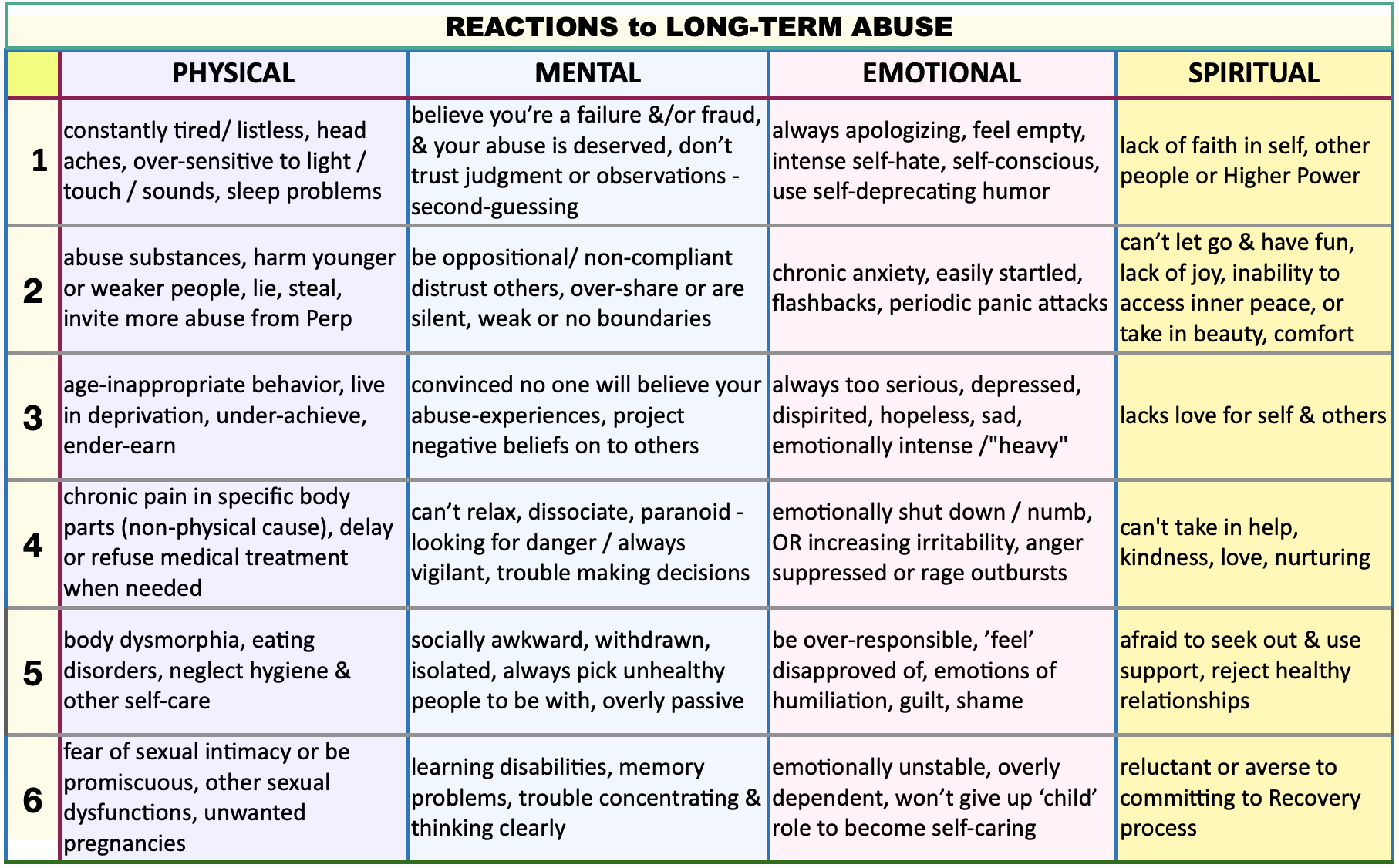
DEF : Abuse – are all the painful things done to us & around us as kids, & comes in each of 4 PMES categories,
and Neglect – are all the good things we didn’t get, growing up

ABUSE : In general, it’s any communication or behavior designed to control & enslave someone. In alcoholic & narcissistic families it was to keep us ‘in our place’, to prevent us from leaving home, to punish us for not being who or what the Perpetrators expected, or wanted!
It is & was done by causing continual fear, humiliation, intimidation, guilt, coercion & manipulation.

Its any form of intrusion into another’s psyche, including :
• a desire to to denigrate, to ignore, to causes pain
• financial, intellectual or spiritual tactics, ranging from mild to lethal
• ignoring or making fun of another’s basic needs & interests
• verbal, physical, sexual &/or emotional attacks
• not respecting privacy, being brutally honest with a sadistic sense of humor, consistently tactless, expect too much

⚙︎ Most people automatically assume ‘abuse’ only refers to physical harm – yelling, hitting, beating, broken bones …. so will firmly state: “I was never abused growing up”. However, because human beings are made up of 4 interlocking categories (PMES = Physical, Mental, Emotional, Spiritual) we can be wounded OR encouraged in many ways at each level.

Being abused can happen just once with someone, or when subjected to a bully for a short time. But usually it’s a long-term pattern of behavior by a severely damaged, cruel, angry &/or mentally ill person who uses their position (as parent, boss, teacher, mate, older sibling or friend, community leader…. ) to:
▷ intimidate others who have less personal or social power, OR
▷ take advantage of those who by nature or training are more accommodating, compliant & sensitive

While most people on occasion act unkindly, even cruelly, when provoked or under great stress, what we’re looking at here is ongoing attitudes & actions that tear us down, body & soul. Even when they seem intermittent, over time they wear at us !
Therefore ACoAs can honestly say that we were severely & regularly abused by our damaged parents (& other authority figures) , especially re. emotions (Es). Genuine Es are NOT widely recognized, valued or encouraged in our society, much less in dysfunctional families. So we ended up ignoring or minimizing them in ourself, as well as in others, especially if we didn’t get physically or sexually attacked as kids.

Most of us never felt loved but blamed ourself for the lack. Regardless of what our parents said or how they felt about us in their own mind & heart – their distorted way of treating us was not an expression of healthy Love.
So to compensate – as adults – we look for it everywhere we go, & from everyone we deal with.
This can make us vulnerable to a subtle form of abuse – being ‘over-loved’, needed & depended on too much, OR being over-protected & infantilized, OR controlled & used.

These are actually ways to treat us as an extension of the person who claims to love us, as an object rather than a separate being, or a means of their personal gratification. It’s never about what the way the ‘beloved’ really needs or wants.
BTW,
LOVE is the emotion with the highest energy vibration. IT:
🔅feels good, because it’s the absence of fear
🔅is an action, not just a feeling, so requires attention
🔅is unconditional, understands & accepts differences
🔅has empathy, no room for jealousy, has wants but is not needy
🔅means putting other people’s needs equal to, or before our own
🔅varies in how it’s expressed & accepted, which can include letting go, so doesn’t demand continuing a relationship that no longer works.

NEXT: Victims or not?

Principles of Character – Outline

self-awarenessTHESE ARE THE QUALITIES
I aspire to, a day-at-a-time

PREVIOUS: “Keep the focus on yourself” means? (Part 2)

POSTs: What is Character ?


PRINCIPLES  —> Values —> Comments useful for Character Education

1. ATTRACTION: Courage, Discernment, Self-awareness
We attract whatever we put our attention to, which makes it bigger. If we don’t do anything to limit destructive impulses, life becomes increasingly difficult for us to control. By staying awake & using discernment, we can see the difference between what’s helping or harming us. Then we need the courage to take steps toward health, by eliminating negative desires that attract chaos into our life. (POST  : ACoAs & Risk“)

2. CAUSE & EFFECT : Accountability, Good Intentions, Restraint
According to the ‘law of the universe’ – for every action there’s an equal re-action. When we realize that we’re accountable for our thoughts, words & actions, we can own what motivates our actions, & recognize the wisdom of reasonable restraint
. calmness(POSTs : “Keep the focus on yourself” and “Fear of Responsibility“)

3. DEVOTION : Concentration, Calmness, Focus
We can connect with Creative Intelligence by taking the time to find our True Self, not the false ego. This can be done by being calm, & concentrating on deeper thoughts, whether through prayer, song, meditation or a walk in the woods. When we focus on Spiritual Principles & actions, we glimpse the Divine

4. FAITH : Trust, Hope, Patience
There is a Loving Intelligence that pervades all things. What’s needed is to hold on to our trust & hope, even when living in the midst of uncertainty. Faith is the willingness to take the next step required without fear or looking back, with the patience to allow Divine Order to work-through our situation without trying to force solutions.. (POST “Lack of Trust and Healthy Trusting“)

5. FORGIVENESS : Compassion, Mercy, Understandingforgiveness
Forgiveness frees us from the damaging image of ourself as a victim. It dissolves the poison of resentment which blocks healing & growth. Choosing a new understanding of our pain & trauma, it gives us the freedom to treat ourself with mercy & compassion, as well as to those who have wronged us. This reconnects us to our Real Self. (many POSTs : …. Forgiveness)

6. GRATITUDE: Generosity, Magnanimity, Appreciation
True Universal Reality provides abundance. When we’re grateful & appreciate what life has to offer, it shows H.P. that we accept whatever’s been given to us, & therefore lacking nothing essential.
To attract more prosperity, feel generous toward all life. This opens the flow of supply into our world – because whatever we give to life returns to us.

7. HARMONY : Optimism, Co-operation, Enthusiasm
copoperationA Universal law : We can choose what attitudes we want to focus on, such as optimism & cooperation, rather than being a victim of painful experiences, It allows being in control of ourself, & having inner quiet.
Enthusiasm means to willingly, happily perform all types of jobs (large or small) which generate beneficial energy, making us far more likely to succeed.

8. HUMILITY : Modesty, Unpretentious, Gentleness
Being modest & un-pretentious keeps us from puffing ourself up with self-importance. God in His own way & time provides us with whatever we need, as we rid ourself of pride, & maintain an attitude of gentleness & acceptance. (POSTs “Humiliation“, and “Arrogance vs Humility”)

9. INTEGRITY : Truthfulness, Courage, Sincerity, Honesty
“Earning future trust by accurately reporting past facts.”
It means to act according to the values, beliefs & principles we claim to hold (internally consistent, opposite of hypocrisy).
The connection to our Inner Self is strengthened when we align our thoughts, words & actions with Truth, & have the courage to act with sincerity & honesty. It’s letting go of “our will run riot”, & honor the Divine Will.   (POSTs Why ACoAs Lie)

10. LOVE : Compassion, Kindness, Nurturing, Self-Esteem, Self-Respect
serenityAll living things need love to survive. We must first take care of our own need for it so we don’t become emotionally toxic. When we shift self-talk from the Inner Critic (Introject) to the Inner Companion (Loving Parent), we increase self-esteem & self-respect. Then we’re free to be the helpful, caring & thoughtful people we want to be.

11. SURRENDER : Acceptance, Freedom, Contentment
When we accept what’s happening to us in the moment as part of a grander plan needed for our growth – we experience a new freedom. We welcome whatever comes into our life, surrendering to a Higher will. This awareness provides contentment & peace.   (POST :Acceptance & ACoAs”)

NEXT: Considering abuse

Positive Character: HUMANITY (Part 2)

THE BETTER MY SELF-ESTEEM
the better my relationships

PREVIOUS: Character: HUMANITY (#1)

See ACRONYM Page for abbrev.


💚 INTEGRITY
(giving our very best)
It’s uprightness of character – decency, honesty, soundness, & being internally complete or undivided (the True Self).
Expressed as – being loyal, faithful, dependable, & dedicated.
Conducting ourself responsibly – to the rules & laws of our community & spiritual beliefs. EXP : Consistent Honesty eliminates guilt & shame, while increasing self-confidence & sense of inner peace.
EXP:
• able to admit to making a mistake  • be dependable & trustworthy
• be fair in our dealing with others & not be manipulative
• be willing to tell the truth even if it costs us money, friends, even our reputation
• don’t exaggerate to make ourself or things seem bigger or better than we are
•  do the ‘right’ thing all the time, even when no one is watching

💚 JUSTICE (rectitude, fairness, uprightness).
adam-and-eve Taking personal responsibility to uphold what is pure, right & true.
 Conforming to the principles of human or divine law, strict performance of moral obligations, integrity in dealing with people, correctly representing facts about their value or demerit
EXP:
• always remain open to reason  • keep our own conscience clean  • never prejudice others  • render to everyone their due or right • have respect for the authority of law   • speak out for what is pure, right & true

💚 LOVE (well-wishing, kindness, self-sacrifice). Screen Shot 2015-07-14 at 8.18.43 PM
The emotion of strong affection & attachment. An unselfish loyal & benevolent concern for the good of another. Can be passionate desire, closeness & intimacy, platonic or devotional
EXP:
•  feel a deep appreciation for everyone we meet because each is unique & special • put a special someone’s needs before our own • see people for who they really are, & still care deeply

💚 LOYALTY (unswerving allegiance)
Show commitment to those we serve or care about, especially during hard times. Hold to our vows, allegiance or obligations towards any person or group. Screen Shot 2015-07-14 at 5.54.07 PM
It’s being supportive, consistent & faithful to a custom, cause, duty, legitimate (healthy) person or ideal that we believe in
It does NOT demand our silence or paralysis when somebody or something is in the wrong, is unfair, unjust….
EXP:
• be of service to family & community  • encourage others in hard times  • don’t mock authorities • point out the good in others

💚 SERVICE (massing on what we receive)
Giving up some personal rights & expectations – temporarily or for the long term – from a desire to serve. Not just providing goods & services as payment, or performing one’s duties.
It’s also helping others to get what they want – actions that don’t involve a return, compensation, or consideration to oneself. Unsolicited help or benefit to someone in need, or doing someone a favor. Also, active devotion to God, through good works & prayer. give a leg up
EXP:
• be humble, but not humiliated!    • be slow to react • be willing to go last, sometimes   •  don’t be boastful  • don’t grumble or complain   •  honor one’s country   • look for ways to help others without being asked

💚 TOLERANCE (towards self & others)
Accept ourself & others just as we /they are, rather than how we’d like ourself /them to be. Appreciate diversity – willing to recognize & respect the beliefs or practices of others. Allow others the right to their own opinions & peculiarities, & to be happy in their own way – if it doesn’t hurt others.
Realize that everyone is at a different stage of their character development, & accept that they express their unique character qualities in varying degrees of maturity. Overlook minor irritants in others. When annoyed, ask ourself “How important is it?” images-6
EXP:
• accept the parts of ourself & other people that are UNchangeable  • don’t confuse what’s popular with what’s right  •  expect the same of ourself as we expect of others or vice-versa   • listen carefully with an open mind, before forming an opinion   • look for ways to help others to grow & mature.

NEXT: Principles of C. Outline

Positive Character: HUMANITY (Part 1)

BEING RESPECTFUL & RESPONSIBLE
makes me a better world citizen

PREVIOUS: Character – Social IQ

SEE: Expanded list of Traits to choose from


💚 APPRECIATION of beauty and excellence
(awe, wonder, elevation):
The ability to admire the masterful design of a person, place or thing, especially if it has many levels of meaning, each layer with a distinct flavor & secret. Notice & value skilled performances & the high quality in all areas of life – arts & sciences, nature & everyday experiences.art appreciation
EXP:
• be awed by the vastness of nature & the intimate details of life • enjoy good craftsmanship  • pause often to take in a view, & look at the sky • understand & appreciate what goes into making anything artistic   • watch people & animals in motion

💚 CITIZENSHIP (social responsibility, loyalty, teamwork
GENERAL: be an active part of a political community, enjoying its rights & assuming duties of membership – which form a distinct sense of identity
SPECIFIC: work well as part of a group or team, be loyal to the unit, do our share, take responsibility for our actionsvote
EXP:
• are troubled by social injustice  • aware of the wider world, with a sense of our role as world citizens  • respect & value diversity  • willing to take actions to make the world a more equitable & sustainable place

💚 GENEROSITY (liberal in giving)
Carefully manage resources so we can freely give to those in need.generosity
NARROW: willing to give money, time, energy, info….to help others, or in order to give them pleasure, and to give more than is expected.
BROADER: be sympathetic in how we deal with people. Tend to see the good qualities of someone or something
EXP:
• give of our time and talents  • not expect anything in return for our generosity  •  praise the good we see in others   • share what we have with others • recycle

💚 GRATEFULNESS  (is NOT like being indebted)
Have an appropriate sense of & value the benefits we have received – at birth, from family, from our environment. Also, a desire to repay  or pass on some of the advantages we were given.
Let others know by words & actions how they have improved our life.  Acknowledge someone for a favor they have done us.  Focus on the positives in our life
EXP:
• be content with what we have  •  count our benefits / blessings, rather than our burdens   • take care of our things    • show helpful people that we appreciate them   • take care of our things  • write “thank you” notes

💚 FAIRNESS
Treating all people the same, according to universal ideals of equality and justice, the same way we want to be treated. Do not make mental evaluations or decisions that unfairly favor or discriminate against others – because of incorrect or inappropriate considerations.
Act consistent with rules, logic, ethics, or in a proper legal manner.  Don’t let personal feelings bias our decisions about others.  Give everyone a fair chance & not take advantage
EXP:
• be willing to give up our share of something for someone who has a lot less  • play fair   • see everyone as having equal rights  • think how our actions will affect others

💚 KINDNESS / COMPASSION (amiable, nurturing, gentle)
Show consideration, personal concern or deep sympathy for others.  The ability to make other people feel comfortable by our inner calmness.  Sometimes putting our own need for attention & self-esteem second to the needs of others. Feel sincere sorrow for others who are stricken by misfortune, accompanied by a strong desire to alleviate the suffering if we can
EXP:
• comfort others without regard to race, gender, faith, age, or nationality   • do a good deed for strangers   • listen when others want to talk • look for lasting solutions  • don’t annoy or irritate people   • have good manners

NEXT: C for HUMANITY, #2

Positive Character: SOCIAL IQ

  positive characterIT’S TIME TO ”ADULT” 
– wherever I am

PREVIOUS:  Knowledge #2

See ACRONYM Page for abbrev.


✿ ACCOUNTABILITY 
“The buck stops here” ∼ Harry S. Truman.
It may be called the ‘ultimate responsibility‘ because it can’t be shared – it’s the obligation to bear the consequences of any action, & especially for failure to perform as expected. It includes striving to express our highest values in whatever we do, aspiring to be our best in all interactions.
accountable
Re. work: each person responsible for the tasks & functions essential to our role or position
Re. relationships: admitting & owning our motivations, words & actions – but not more than that (opposite of co-dependence)
EXP: • being clear & direct  • being trustworthy • not blaming others  • doing things the right way & for the right reason

✿ DISCRETIONdiscreet
Recognizing & avoiding any attitudes, words & actions that could create unpleasant or undesirable consequences. It includes being tactful – avoiding embarrassing situations, not upsetting others, good at keeping secrets, & not attracting inappropriate attention to ourself. Respectful of taboos, not being sucked into what we know is unhealthy or illegal – for ourself or in general
EXP: • choose our words carefully  • don’t make fun of others  • have good manners • thoughtfully consider criticism   • turn down any invitation to do what we know is socially or morally wrong

✿ PERSUASIVENESS (being effective)
The ability to gently maneuver “vital truths around another’s mental roadblocks.” Appeal to someone’s reason, values, beliefs or emotions, in order to convince them to adopt a particular belief or pursue a specific action to their benefit – without doing harm to them or ourself.
Having legitimate influence over others (parent, teacher, boss…. ) allows us to live more in line with what’s suitable, instead of what others want us to do or be
EXP:  • appeal to a person’s conscience in terms of their best qualities  • don’t argue or bully in order to convince someone  • don’t stretch the truth (lie) to make it more attractive  • point others in the right direction   • wait for the best time (have good timing)

✿ PUNCTUALITY
Having a good sense of timing & foresight, with the ability to plan ahead.  Consistently being on time shows that we’re the master of our life & therefore can be counted on.
It shows up as completing required tasks or fulfilling obligations before or by the time it’s due, being on time for appointments AND being prepared on arrival.  It’s knowing when our responsibility ends & someone else’s begins (boundaries), while showing respect for others’ time & plans.
EXP:
• be at the right place at the right time   • don’t make people wait for us  • don’t fall into the trap of “just one more”  • prepare for unexpected delays  • plan a daily schedule and keep it

✿ RECEPTIVITY
receptiveBeing ready & willing to gladly receive all the beneficial & beautiful things life has to offer. Notice whatever positive situation is unfolding in the present moment, taking in what’s available, & making the best use if it. Absorb & hold new suggestions or concepts quickly & easily, open to reasonable arguments, ideas, or changes.  Not having to fight for or be pushy about getting what we want.
EXP:
• accept people for who & what they are   • be grateful for what we have • be willing to receive when it appears  • patiently wait for things to develop

✿ SENSITIVITY / EMPATHY
Show consideration & personal concern for others. Consider things from someone else’s point of view. Be able to pick up on others’ actual attitudes, motives & state of mind (not mind-reading but rather from careful observation).  Understand & identify with the emotions of others – as a direct result of having access to a wide range of our own emotions.in their shoes

Making other people feel comfortable. Being able to fit into different social situations. Don’t decide about someone based only on one interaction, & don’t let our own fears or prejudices get in the way of how to treat them.  EXP:
•  do not feel sorry for yourself • have a deep appreciation for & acceptance of another’s point of view   • make it easy for people to click with us   • read body signals, tone of voice & facial expressions  • say supportive & comforting things to someone in pain

NEXT: Positive C. – Humanity #1

Positive Character: KNOWLEDGE (Part 2)

PREVIOUS: Character – Knowledge #1

QUOTE : “Learning is not attained by chance. It must be sought with ardor and attended with diligence” ∼ Abigail Adams.


◎ CREATIVITY
◎ CURIOSITY
◎ DISCERNMENT

◉ LOVE of LEARNING
It’s the main basis for achieving goals which are important to us : we need to be internally motivated, persist in spite of challenges & have a growth mindset. Love of Learning is related to Curiosity, but goes beyond it – as the desire to systematically add to what we know, & taking joy in the intrinsic value of the process. It includes the effort to master new skills, topics & bodies of knowledge, whether on ones own or formally.thinking it thru

It’s wanting to make sense of things, finding out how things work, gaining competence & control over self & the environment. It’s being open, perceptive & experimental.
EXP: • being excited by new ways of understanding • not afraid to admit ignorance  • open to all types of information  • wanting to know how the world works  • willing to go the extra mile to gather all the facts possible

◉ OPEN-MINDEDNESS
It’s being able to listen attentively to other points of view in order to understand & respect them – without necessarily agreeing.  It includes the ability to hold 2 contradictory thoughts at the same time (ambiguity), while others are taking sides. When presented with a new or radical idea, consider it a possibility instead of looking for points to disagree with or immediately rejecting it.
fairnessWhen appropriate, embrace ideas that can help self-growth & raise self-esteem, which decreases the need to always be right, & also helps to neutralize the inappropriate desire for power. By welcoming the ideas of others (listening without necessarily agreeing), we increase their confidence.
EXP:
• accept the goodwill of others (not being cynical)  • be able to see all sides of an issue  • listen without pre-judgement  • willing to follow where true evidence leads

◉ PERSPECTIVE
The ability to understand how things are inter-related or can be compared – how parts of a topic or situation relate to each other & to the whole. Seeing things from different points of view or re-framing a problem, with or without effort.  It helps to judge distances (like what it takes to move from despair to hope), which also makes it possible to mentally hold comparisons that help manage emotional responses, allowing for  optimism.

It’s best to NOT view a situation or a person using the lens of our past. Proper perspective provides an understanding of what’s happening in the moment, seeing clearly the answer in any situation & the correct next step toward our vision of success. ( re. elephant Parable)
EXP:
• bring our attention completely into the moment  • don’t get caught up in details (forest vs trees) • keep the important things in mind  • step back from a difficult situation to see the bigger picture  • step back and remove oneself from a problem  • take the long view

◉ RESOURCEFULNESS
The ability to quickly, often cleverly, find ways to overcome difficulties & problems, to make things happen when the chips are down & the situation looks bleak.  A unique use of available resources to achieve our goals – people, info, time, money, physical environment – to their fullest potential
quickAcknowledge but never focus on limitations or obstacles. Live in the now, with an eye on the future.  Resourcefulness is different from Creativity : it’s needed when one is already facing a difficult situation that must be resolved – now – while Creativity allows for time to ponder, dream & process.
While we cannot always be able to anticipate every situation, the more we’re prepare ahead of time for the issues we are familiar with, the more resources we’ll have to draw on when faced with a problem.
EXP:
• be able to out-think an opponent   • find practical uses for things others would overlook or discard   • make wise use of our energy, mind, talents & time   • see value in a wide variety of objects, ideas, & people

NEXT: Character – Social IQ