MULTIPLE Intelligences – Intro (Part 1b)

9 styles of IntellI DIDN’T KNOW 
there was so many options

PREVIOUS:
 Multiple Intelligences (#1)

SITEs : Five New Minds for the New Year (Dec. 2012)
Your 12 types of Intelligence


Multiple Intelligences (M.I.) are mainly about our style of learning.
We may have a dominant one, a mixture, or use a different style for different situations. The most well-know ones are based on our senses (eyes, ears, gut, & less used are tongue & nose). Nor are they fixed – less dominant ones can be developed, & preferred ones enhanced.

• In the 1960‘s, Dr. Howard Gardner, a Harvard Professor of Cognition & Education, revolutionized our understanding of Intelligence (I.).
The inspiration for his theory of Multiple Intelligences (M.I.) came from his work with two distinct groups: stroke victims & children. “Both were clueing me into the same message : that the human mind is better thought of as a series of relatively separate faculties, with only loose & non-predictable relations with one another – rather than as a single, all-purpose machine that performs steadily at a certain horsepower, independent of content & context” (Theory development)

Dr. Gardner’s framework for M.I. offers a practical model for identifying the many paths to learning – regardless of content, skills or desired outcome. He believes that the current list is not exhaustive, & he’s added 7 to them since he first started.  I. is much more than IQ, because it requires useful action to be valid. “Intelligence is a bio-psychological potential to process information that can be activated in a cultural setting to solve problems, or create products that are of value in a culture”.

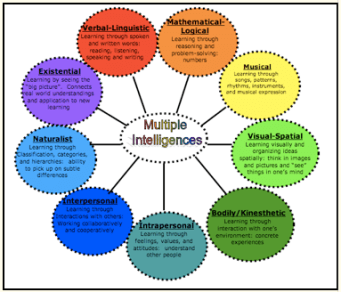
These 9 Is are expanded in future posts:
• Body /Kinesthetic: interacting with one’s environment
• Inter-personal I.: connecting with others
• Intra-personal I.: self-awareness, values & attitudes
Linguistic / Verbal: expression thru the spoken & written word
Logical / Mathematical : problem solving through reasoning
Naturalistic I.: classifying and categorizing data
Rhythmic I.: identifying and extending patterns
Spiritual / Existential: understanding beyond the senses
Visual / Spacial : the ability to see, envision & imagine
NOTE: Only Linguistic & Logical are measured by old-fashioned IQ tests.

• This list is a way to categorize how humans naturally become aware of, understand & process our environment. This helps us figure out where our weaknesses come from, but mainly they pinpoint natural strengths – seen in our preferred learning, behavior & work styles – so we can make the best use of inborn preferences. Sadly, from ignorance or necessity, many people are in jobs that go counter to those natural preferences.

EXP: A highly Body-Kinesthetic person may be stuck in a Logic desk-job, instead of being able to move around, such as a forest ranger, sports coach, physical therapist, gym teacher…..
— or a Visual / Artistic person in a Linguistic position, instead of being able to dance, paint, act….

• Although each of us can access all 9 styles, no two people have the same amount of each.
Some people are Mono-endowed, like being able to speak 4 languages – but takes them awhile to calculate a tip, OR someone who’s a whiz with numbers – but are awkward in conversations. If their single talent is honed & monetized, such people can become celebrated for incredible accomplishments
A few are at the other end of the spectrum, ‘Renaissance’ men or women who can cross-access several Intelligences, superior at almost everything they do
The rest of us have one or two dominant talents, which serve us well if we have the opportunity to freely express them

• Dr. Gardner tells us that I. involves problem solving – creating ‘products ’ (outcomes) when in a context-rich & natural setting. What many scientists used to think were just soft-skills, such as the Inter-/ Intra-personal ones, Gardener realized were actually types of Intelligences.
EXP: Being a math whiz gives the ability to quantify the world, but so does being people-smart, just from a different perspective. So someone with Intra-Personal talent may not be able to calculate the rate at which the universe is expanding, but will easily find someone who can!
The 9 types also provide a way to recognize & own potentials which many of us left behind in childhood (love for art, computers…), & can now take the opportunity to develop.

BOOSTING Intelligence
Since different areas of Is are related to each other, it’s possible to increase it in one area by developing another, because many problems can be dealt with in more than one way. learning options
— One third-grade teacher found her students’ scores on a math test (logic) nearly doubled after giving them training in visual (spatial) skills with a micro-computer program
— “Early music training (for 3-year olds) prepares young brains for spatial & abstract reasoning skills crucial to engineers, scientists & mathematicians.” ~ study from U of Cal. Irvine
— “An enriched environment that helps very young children develop each area of talent or intelligence is one of the best possible investments in their future” ~ Ron Fitzgerald, D.Ed.

NEXT: Multiple Intelligences (Part 3)

MULTIPLE Intelligences – Intro (Part 1a)

AM I REALLY SMART IF I can’t do  math, remember names…..?

PREVIOUS: Comfort & Dis-comfort, 3e

DEF: Intelligence is a combination of the ability to:  (from several authors)
1. Learn – which includes all kinds of informal & formal learning, via any combination of experience, education & training
2. Pose problems – which includes recognizing problem situations, & transforming them into more clearly defined issues
3. Solve problems – which includes outlining solutions, accomplishing tasks, creating products, & doing complex projects


Human Intelligence is the singular, collective ability to act & react in an ever-changing world. Our brain is an ‘equal-opportunity’ organ. The more opportunities it has to develop & apply its many but distinct functions, the better we learn, which can make us complete individuals & better citizens. The brain can go from the practical to the most remarkably creative, from the concrete to the abstract, from detached reason and logic to emotion and attachment – all of which we can draw on as we negotiate our way through life.

BRAIN HEMISPHERES
When talking about Intelligence it makes sense to start by looking at the 2 halves of the brain – the Right giving us our Creativity & the Left our Analytical abilities. This chart suggests the 2 sides contribute to the various types of Intelligences (I.) listed in the next few posts.

However, scientific consensus is that intelligence depends not only on the efficiency or power of various brain regions, but also on the strength of the connections that link them.
Researchers Haler & Jung (New Mexico) attribute our I. to a circuit that links the Frontal Lobes, involved in organization, planning & other highly developed abilities, with the Parietal region farther back in the brain, which integrates information from the eyes, ears & other senses.

They believe this Parieto-frontal Integration Theory (P-FIT) best accounts for the evidence that I. depends on several brain regions tightly linked by axon tracks that form super-highways of info. (Brain basis for Multiple.I.? – gives YES/NO points)

Learning Styles: “Characteristic cognitive, effective & psycho-social behaviors that serve as relatively stable indicators of how learners perceive, interact with, & respond to the learning environment.”
«

« CHART  ▲
Applying this info to eLearning – some dimensions are :
– being cooperative vs competitive
– learning independently vs from an instructor
– more or less introverted vs extroverted
– learn verbally vs visually vs aurally
– perceive or processes concretely vs abstractly, actively or reflectively
– make decisions or judgements by deliberation vs intuition
– learn sequentially or bottom-up vs global or top-down

2 TYPES – from Psychologist Raymond Cattell (1963)
FLUID (Gf) Intelligence
The ability to recognize & identify unfamiliar complex relationships / patterns, make inferences about them & use logic to solve new problems

CRYSTALLIZED (Gc) Intelligence
The ability to use learned knowledge & experience. Consists of: Comprehension, Cultural influence, Experience, Judgement, Learning  (MORE….scroll to 1/18/14)

3 TYPES
IQ – HEAD smarts
Ian Lawton showed that people with high IQs aren’t automatically good at everything, by using a ‘simple’ math problem = Bat & Ball problem :
“A bat & a ball cost $1 and 10 cents. The bat costs a dollar more than the ball. How much does the ball cost?”
— Did you say the ball cost 10 cents? That is incorrect, but that’s OK, since more than 50% of Harvard, Princeton and MIT students also got it wrong.
SOLUTION — Consider that the bat is a dollar more than the ball, which costs .05 cents. Since the difference between the two has to be $1 ($1 -.10 = $.90) then the bat is $1.05. ($1.05-$.05=$1)

3 intelligencesEQ – EMOTIONAL / HEART smarts
Understand feelings & instincts behind the facts. It’s used by 90% of top performers for success in business, & 58% of job performance is based on it.
People with a hi EQ make almost $29K more a year.  We BUY ‘stuff’ using EQ, but most will deny it, insisting their choices were totally logical

SQ – SPIRITUAL / INTUITIVE smarts
Combines IQ and EQ. It’s where moral intelligence comes from, giving us a sense of purpose & wisdom. It has its own way of ‘knowing’, gathered from all our years of experience, combining the best of our emotions, skills & knowledge needed for each occasion   (True Leadership)

ADULTS learn differently from younger students (MORE…)
Malcolm Knowles, Adult Educator identified 6 assumptions about adult requirements. LEARNERS :
Need to know Why – what’s the value of  this info, how will it be a direct benefit
Self-Concept – believing they’re responsible for their own lives, adults need to be seen & treated as capable & self-directed, be independent, but not isolated
adult EdExperience – individuals come with many differences in background, goals, interests, learning style, motivation, needs

Readiness – they’re ready to learn because they need or want to know how to effectively cope with real-life situations
Orientation – being mainly task-oriented & problem-centered, adults look for practical info which can be applied to everyday issues. They learn best through problem-based approaches & actual experience
Motivation – they respond to some external motivators (better job, higher salaries….), but the strongest motivators are internal (desire for increased job satisfaction, self-esteem….)

NEXT: Multiple Intelligences (Part 2)

ACoAs: DIS-comfort & Comfort (Part 3e)


I WANT TO LIVE
in my comfort zone!

PREVIOUS: Discomfort/Comfort #5a

SITE: <—- CHART & All about Comfort Zones

“Being Comfortable in your own skin”  (Women)

QUOTE: “If we are happy within ourselves, we don’t accept or demand that our partner should fulfill every need. We need to be comfortable with our own company.”~ Nathaniel Branden, PhD

2. Positive DIS-Comfort

3. POSITIVE COMFORT (cont.) ➕➕
More def: “Emotional comfort is a composed of pleasant positive feelings, a state of relaxation, & an optimistic approach to life where a person feels happy & their mood is high in spirits. Emotional comfort is also associated with less physical dis-comfort.”

Kanishka Patil , Calcutta : “The state of psychological comfort is one of the powerful states in which the mind exists, transcending its positive effect on the other spheres of life. It’s when you experience the free flow of self-confidence, which lets you drive more initiatives at the workplace, engaging in deep emotional investments, announcing bold decisions & taking riskier bets but much needed ones you always doubted.

You are the intrinsic source of energy, radiating positivity in the extrinsic layers…..One has to achieve the state of comfort first, & later cherish whatever comes or doesn’t come the way. Source of power is shifted from ‘externalities’ to ‘oneself’, hence, making the state just a function of “you” and nothing else.” (More….)

INNER COMFORT is protected & maintained by healthy attitudes & actions. The goal is to live well, to the best of our ability ODAT (one-day-at-a-time) – never to seek perfection, since it does not exist.  It is liberating, allowing many other wonderful opportunities & relationships to occur. REVIEW what it includes :

☼ PSYCHOLOGICAL
— Step away from your childhood (home, friends, town) & explore the world.
— Never speak negatively about yourself to others. Stop apologizing. Recognize the harm of being your own worst critic and find a healthy balance
— Become comfortable with your own company without using technology as a crutch. Become comfortable with silence.
— Accept imperfections, yours & others’, while striving for excellence. Maintain an air of mystery
— Admit all needs. Embrace your unique qualities
— Make laughter a bigger part of your life.
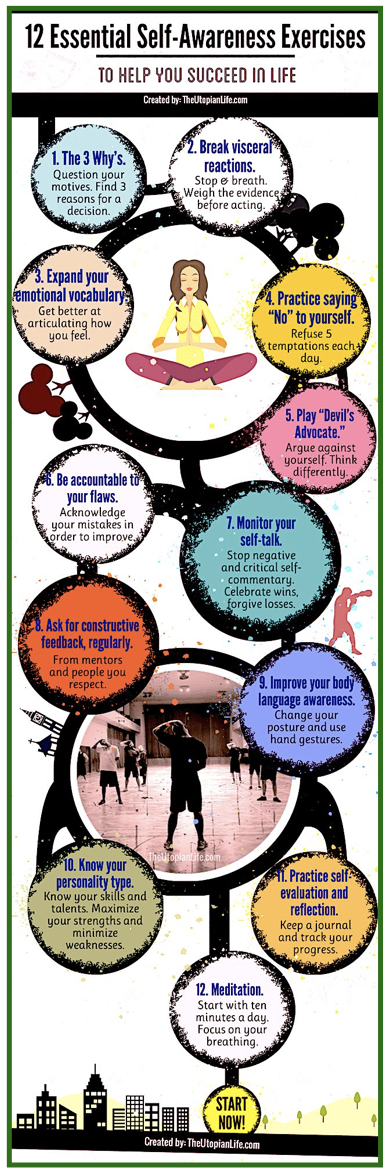
CHART —->Self-awareness exercises explained

SITE : 12 Questions to Test Emotional Comfort in Relationships

☼ MENTAL
— Think of yourself as a beautiful person. Honor your strengths.
— Think positively. Speak with confidence. Express your creativity
— Become an insatiable sponge for knowledge. Dream big & out loud
— See each day is an opportunity to grow & evolve. Keep a gratitude journal
— Take time out to reflect, process & feel. Pray, meditate, read Scripture

Mental Exercise as reminder & re-enforcement:visualize
Give yourself 5 minutes of loving kindness every day. You’ll feel an inner softness develop as you keeping practicing. Place your hands over your heart & say :
“May I be safe / May I be happy / May I be healthy /May I live with ease”

Say it 4x in a soft & gentle tone, aloud or silently. Then gently direct your attention to any part of you that feels disconnected & say 4x each: “May that part be filled with loving kindness” & “May my whole body be filled with loving kindness”. End by repeating:
“May I be safe, May I be happy, May I be healthy, May I live with ease.” (MORE….)

☼ SOCIAL
— Stop tolerating! Stop trying to impress others
— Tactfully walk away from people who will never understand social skills=older
— Realize that relationship status doesn’t determine one’s contentment, rather a content person determines their own contentment
— Spend time with people who make you feel good
BOOK: Enhancing Social Skills in Older Adults, 

☼ PHYSICAL
— Treat your body with respect & take care of physical needs. “Like your body” (women) . Exercise, walk, dance…..
— Learn the art of dressing your body and for your life. Look confident to feel confident   ( Modified from:  Be C. in your Skin and Comfortable Woman)

«
«
NEXT: Multiple intelligences, INTRO, #1a

ACoAs: DIS-comfort & Comfort (Part 3d)

happy w/ myselfI‘VE WORKED A LONG TIME
to have peace of mind

PREVIOUS: Dis-comfort & Comfort #3b

SITEs: ☀︎ Cultivating Self-compassion
☀︎
 Start being comfortable in your own skin
☀︎ Exercises & Meditations for Self-compassion

QUOTE: “A man (or woman) cannot be comfortable without his own approval” ~ Mark Twain
“When there is no enemy within, the enemies outside can do you no harm.” – old African proverb

2. NEGATIVE DIS-comfort (cont.) ➖➖

3. POSITIVE DIS-COMFORT (cont.) ➕➖

ACoA PROMISES

Being willing & able to tolerate the dis-comfort of the Recovery process will lead to achieving at least a fair measure of the Promises. These goals & outcomes are the result of sticking to the hard work of growth through all the frustration & disappointments.  They may seem beyond our reach at the moment, but the 12 Steps offer : “If we are painstaking about this phase of our development, we will be amazed before we are half way through: (from the ACoA site, based on the AA Promises)

☆ We will discover our real identities by loving & accepting ourself
☆ Our ability to share intimacy will grow inside us
☆ As we face our abandonment issues, we will be attracted by strengths, & become more tolerant of weaknesses
☆ We will enjoy feeling stable, peaceful & financially secure.
☆ We will learn how to play & have fun in our lives
☆ Our self-esteem will increase as we give ourself approval on a daily basis
☆ We will choose to love people who can love & be responsible for themselves
☆ Healthy boundaries & limits will become easier for us to set.
☆ Fears of failure & success will leave us, as we intuitively make healthier choices
☆ With help from our ACA support group, we will slowly release our dysfunctional behaviors.
☆ Gradually, with our Higher Power’s help, we will learn to expect the best, & get it

ACA World Service Org . FREE Literature

4. POSITIVE Comfort ➕➕
Dictionary DEF:  • Producing or sustaining physical comfort, support, or ease
  • In a state of physical or mental ease; contented, undisturbed
BE-ing bear

a. ACTIONS: “Do what’s comfortable” does not mean being complacent, being stuck, lazy, backsliding into old ways, giving up hope, settling, or not continuing to grow & expand your horizons.

b. BE-ING : Ultimately, true Comfort is an inside job. It comes from developing a deep sense of self-worth (not arrogance) & faith in a Higher Power. It allows us to enjoy the good things about ourselves & the world. And when difficulties, stressors or pain come our way, we can allow ourself to have a variety of intense emotions (Es), but our thinking (T) stays realistic & sound.

INNER COMFORT is the result of self-compassion, expressed very day, in large & small ways.
< It is not self-pity, self-indulgence or superiority – the latter often based on being special, standing out from the crowd, social position, visible accomplishments & income
> It IS being kind to yourself whether you you’re doing well or not, by accepting your humanness, no matter how messy or complicated.pos-pos

Expressions of Inner Comfort develop from knowing & owning who you are, by identifying your specific needs, likes & dislikes & then providing them for yourself.
** Functioning mainly from our Authentic Self, using the UNIT (healthy adult/loving parent) for self-care, we can say”:
• “I know what I know” & I don’t have to know everything to be safe!
• most of the time I have no S-H (self-hate)
• like where I live, inside & out
• have the job/career that suits me
• can stand up for my rights without being pushy of starting fights
• mainly have relationships w/ people who at the very least respect me, & who are kind – most of the time. And at the most those people who love me, enjoy my company & suit my personality
• find ways to have fun & enjoy myself
• have a sense of humor about almost everything
• have little or no desire to fix, rescue or take care of other people, without guilt, since my anxiety level has gone down to a whisper
**Knowing what I have & don’t have control over.
Say YES to any good thing that comes my way!
See the Serenity Prayer  //// “50 Things You Can Control Right Now”
«

«
NEXT: Comfort /Discomfort #5b

ACoAs: DIS-comfort & Comfort (Part 3c)

I ONLY HAVE CONTROL
over my own life

PREVIOUS: Dis-comfort & Comfort #3b

SITE: “If You Ever Cry During Movies, It Reveals A Stunning Secret About Your Inner Self”


2. NEGATIVE DIS-comfort (cont.) ➖➖

3. POSITIVE DIS-COMFORT (cont.) ➕➖
🔹
BENEFITS of Healthy Dis-comfort
(cont)
— Healthy things that can make us UN-Comfortable (cont.)

Letting Go of CONTROL     
One of the big dis-comforts in Recovery is letting go of trying to control external PPT, & shift to being in control of oneself. The more familiar 3 Cs of Al-anon are about ‘letting go’: I didn’t cause it / I can’t control it / I can’t change it.
The  intensity of our need to be controlling is in direct proportion to how much anxiety we carry, which is caused by sitting on our backlog of pain. instead of getting it out safely.

The Q is “Where is your Locus of Control?” ACoAs have been trained to only focus externally on others. So as adults who are still run by the WIC, we don’t want to be our own motivator – because that would mean giving up the illusion that our family – or someone – will eventually take care of us.  (CHART )
BUT – the only way to Heal & Grow is to gradually change from an External (Reactive) to an Internal (Proactive) source of Being.  (MORE….)

These concepts mainly apply to our dealings with others – their addictions, their damage, their distress.  This implies that we mind our own business (“Keep the focus on yourself”) and work on self-care. Following thru on these ideas can be a daily challenge for co-dependents who are used to taking on the responsibility for other people’s needs, self-destructiveness & suffering.

But they can also apply to some things for ourselves:
✱ I did NOT cause my damage (damaged NOT defective). Yes – we have lived out the toxic training, which is inescapable without recovery. We are responsible for changing but not for the source – without blaming ourselves for our imperfections & pain.

✱ I can’t control the process of recovery. Healing our heart & mind is a slow & difficult process, requiring patience & perseverance. Also, we can’t control how others react to changes in us as we heal.

✱ I can’t change the time & opportunities lost to the disease, (If only I had known this before, if only I’d left home sooner, if only… if only….). Recriminations are a waste of time & energy. Mourn the loss & focus on self-esteeming acts today.

Going forward, another 3 Cs can be even more of a challenge:
I can Change / I can Cope / I can Celebrate!letting go

 ➤”I can change” seems daunting if not impossible to many ACoAs because the WIC is going by a whole life-time of actual experiences, both as children & as adults – acting out our damage. Also, if we are convinced that how we’ve always been is our real personality (see part 1) then there is nothing to change.
BUT, what many recovering ACoAs have found is that when we finally find Program, doctors, therapists, ministers, mentors …. who recognize our suffering & offer genuinely helpful solutions, we actually can get relief & have a chance for a better life. They become our “Positive Introject“!

➤ “I can Cope” feels impossible – to the WIC. But this is not a problem for our Healthy Adult. As children we were put in daily impossible situation & expected to handle everything as if we were already grown up, and demanded that we ‘fix’ the things that were wrong with the adults – which was truly impossible. BUT with Recovery today we can indeed cope with many things “that used to baffle us” (#11).

➤ “I can Celebrate” – for most of us this is a big no-no. We’re very uncomfortable if we get any attention – even tho’ the Child in all of us longs for at least some. YES – we need to celebrate our very existence, as well as our gifts & accomplishments. Until we get used to the idea, we can celebrate privately, in our thoughts, in our journal…. but eventually it’s very important to share it with others who can be happy for us, with us.  People who care for & love us want to acknowledge their admiration & pleasure in knowing us!

NEXT
: Comfort/Discomfort #3d

ACoAs: DIS-comfort & Comfort (Part 3b)

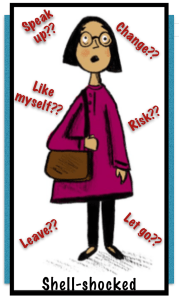
shel shockedI WANT TO BELIEVE
my efforts will pay off

PREVIOUS: Dis-comfort & Comfort #3a

SITE : 10 Uncomfortable feelings that indicate you are taking the right path


1. Negative Comfort ➖➕
2. Negative Dis-comfort

3. POSITIVE DIS-COMFORT (cont.) ➕➖
It’s understandable that trying out new thoughts & actions will create some anxiety. That represents breaking internal family rules, breaking away from old familiar PPT, & moving into unknown territory.

PROCESS  (cont. )
☛ Be around like-minded people.
This is crucial for ACoAs. We’re used to choosing & staying with people who are so wounded themselves they can’t actually be present for us & may even be overtly harmful (mean, selfish, using….). Of course, in order to be with our ‘peeps’ & ‘stick with the winners’ – we have to know who we are, & believe we have the right to connect with other people we’re compatible with. This is not looking for symbiotic clones, but for those who have a good sense of their own identity & also can ‘see & hear’ us without judgement.

Push past your comfort zone. ACoAs can only do this to any degree if & when we feel safe enough to risk making a change. This safety comes from having a measure of self-esteem, better boundaries, knowing our rights, a proper support system…. You don’t have to know everything about it ahead of time and there’s no such thing as perfect – so you might as well give it a go!
«

«
improvementRecognize your improvements – no matter how small! As we learn to trust our intuition, emotions & intelligence AND with the right kind of validation & feedback from a support system – we can enjoy our hard-won achievements.

ACoAs have a hard time acknowledging our growth because we:
— don’t have permission to succeed  (Toxic Rule: “You always have to struggle but never get there”)
— assume that if it’s not the whole package it doesn’t count
— are waiting for it to be taken away from us
— don’t trust that it will last, that ‘it’s an accident or illusion
— are so torn between the old messages & new changes that we can’t be sure it’s real
— are convinced it’s selfish, arrogant, presumptuous….

Embrace the ‘sucks’ (“this sucks, suck it up”). Things don’t always work out. Sometimes we make mistakes, we’re disappointed in the outcome, other people let us down….. That’s realty. That doesn’t mean the”universe is against me”, or that we’ve done something wrong.

Just like we have to embrace our Inner Sadist – without acting on it, we can embrace the parts of growth & change we hate – without falling apart & without giving up. Sharing our frustrations & aggravations with others can ease the loneliness & pain. Others have had similar experiences, gotten thru them & sometimes even benefited. NOTE: Acceptance has nothing to do with liking something – it is simply acknowledging what is real.

“Rinse. Repeat”🙂  The old Russian saying ‘povtorenie mat ucheniya’ means ‘repetition is the mother of learning”. The more we perform the same healthy activity, the more confident we become. Confidence is a tangible thing — from practice & repetition. Outline from an article by Chris Dessi

🔹BENEFITS of Healthy Dis-comfort (➕➖)
— Healthy things that can make us UN-Comfortable:
pos-discINTERNAL Changes
• all forms of intimacy (PMES)
• feel all your emotions as they come up
• following through on a project or task
• get what you asked for
• go for your passion

• leave bad relations (family / mate/ ….
• receive help, encouragement
• take a compliment / being praised
• tell the truth // say what you mean
• things working in your favor

• stand up for yourself – via the Adult
• set limits, say”no”when called for
• stop taking care of others
• Stop mind-reading. ASK QS!  // Stop having to always  ‘be right’

EXTERNAL Changes
• appropriate risking / public speaking / writing for work
• changing jobs / career / get a promotion, commendation
• learning / doing something difficult – that you always wanted to try
• going back to school / graduation / B/day party
• new job/ new home / marriage / baby
• trying out new things / learning a new skill
• winning or inheriting money / receiving gifts ….

More Info:
“5 ways Discomfort can explode your growth” (Explanations), &  a similar version:
“5 Reasons to make Discomfort your friend” (Explanations)

NEXT : DIS-comfort &amp; Comfort (Part 3c)

ACoAs: DIS-comfort & Comfort (Part 3a)

uncomfortable brainI HATE HAVING TO
wait for results!

PREVIOUS:
Dis-comfort & Comfort #2b

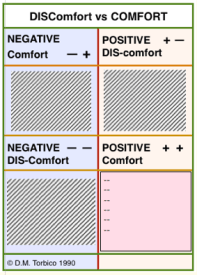
<—- CHART 

SITEsHow to Practice Being Comfortable in Uncomfortable Situations
— 3 Rules for uncomfortable conversations  (excellent) 

QUOTE: “Growth & comfort do not exist” ˜Ginny Rometty, CEO of IBM (Article)

1. Negative Comfort ➖➕
2. Negative Dis-comfort pos-disc

3. POSITIVE DIS-COMFORT ➕➖
Trying out new healthy thinking & actions make us feel anywhere from uncomfortable to highly anxious. It means disobeying each toxic rule, going against our training, dropping off of the family mobile, & bottom line : forcing the brain to find new pathways of functioning.

Too much prolonged stress causes physical ailments & psychological paralysis. That’s why we need to go slowly. Work on whatever issues you can tackle at the moment – ones that are the least scary. As you grow you’ll gain the emotional strength & mental clarity to tackle deeper one – like really ‘getting’ how much damage you have – without S-H or overwhelm, letting go of unsafe family, friends. jobs, locations……

For ACoAs, Growth means leaving behind our unhappy childhood to take our rightful place in the world – living in our True Self.
This is very uncomfortable because our family discouraged & punish any effort to exert ourselves – for ourself. And since personal growth is a slow process. we often live in uncertainty & confusion – between what we’ve always thought & felt, & what we aspire to become. In-between states are always uncomfortable & sometimes scary, but as we keep going we do see positive changes that encourage us. “Easy does it, but do it” (MORE...)

PROCESS  (See post)
☛ Get started. This is often our biggest difficulty putting things off that we actually want to do! as well as those we dread or find too tedious to bear, for all the reasons listed in previous posts (procrastination).  What’s ironic & sad (for ourself) is that most of the time when we finally take the action it’s not such a big deal, doesn’t take as long as we thought, & we usually like the result – or at least are relieved. (see posts re. Action)leaving-home

☛ Don’t Quit. Some of us are over-responsible, over-doers…. & others of us just obsess about doing, but rarely pull the trigger. Then there are the in-betweeners – those of us who start things but never seem to get around to continuing (keep going to the gym, stick to a food regimen, attend meetings….) or finishing  projects. (See postsManipulating – 2b & 2c”). The WIC & the PP get in the way of going for the gold, so we let ourselves get distracted.
The 3 As are useful here:
1. Become Aware of what’s really stopping you from pursuing a positive goal. It will always be something from our earliest training & experiences.

2. Be in Acceptance – allow yourself any emotions the awareness brings up. Don’t try to fix or change deep-seated patterns by brute force (control, S-H, forcing solutions). Continue using all the tools of Recovery programs & remember that re-forming your brain takes time & persistence.

3. Take Actions. Give yourself credit for the actions you are already taking. Don’t fret about what you can’t DO yet If you’re confused about what to do, make a list of the things you used to be interested in &/or still are. Look up what’s available in classes, groups… that can get you started. Some (useful) action is better than none.
If you’re stuck for ideas, talk it over with safe people who know you & can give you suggestion.
Then follow thru. You don’t have to know what the end goal is & you don’t have to like the choice you’ve made – it’s won’t be a life changing mistake – only more info about who you are.

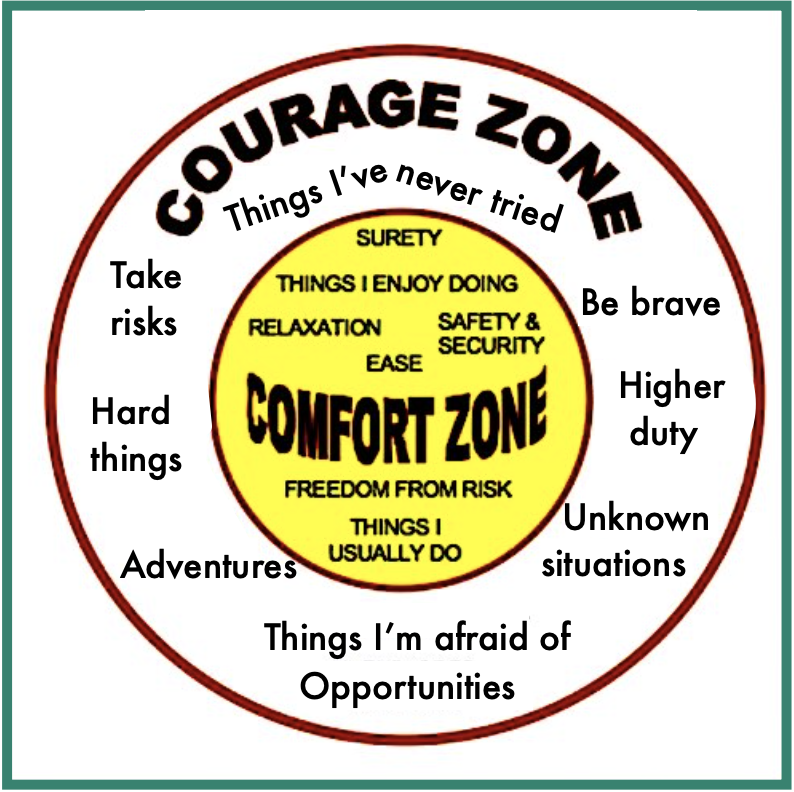
There’s no doubt that all forms of growth (personal, professional…) take courage – which means taking actions in the face of our fear. Courage is not needed if we’re not afraid, but we can’t wait until we’re not afraid to try new things. (⬅️ CHART)

 NEXT: Dis-comfort & Comfort #3b

ACoAs: DIS-comfort & Comfort (Part 2b)

SOME THINGS BOTHER ME
a lot more than others

PREVIOUS:
Dis-comfort & Comfort #2

BOOK : “Compassion & Self-hate : an Alternative to Despair” by Theodore Ruben

** See ACRONYM page for abbrev.
SITE: Answer Qs : Are you happy in your own skin? (Body issues)

1. NEGATIVE Comfort ➖➕

2. NEGATIVE DIS-comfort (cont.) ➖➖
 UNDER ‘feel’ (Part 2a)

⚑ OVER ‘feel’
At the same time, having so much of our energy tied up in denial we’re the ‘walking wounded’, leaving us with very little reserve for dealing with anything unexpected. So when something big does hit us, we withdraw, fall apart, get sick, get belligerent….. & generally take a long time to get over it.

over-reactingPrecisely because of our pain backlog, many ACoAs’ default setting is to make everything into a big drama. We can over-react to even ‘minor’ frustrations more than is called for – as if they’re life & death events. “Touch me & I bleed!”

We get too angry, too impatient & frustrated, too easily insulted, take things too personally….. no matter the size or importance of an issue in reality, including situations that have nothing to do with us. Losing a favorite object can feel just as terrible as losing a loved one!

BTW – This intensity tells us that no matter how trivial something is – if we’re triggered (have a very strong emotional reaction) – the very fact that it upsets us is absolute proof that it is similar or identical to something that happened to us over & over in childhood (an emotional/ mental/ verbal /sexual abuse or neglect…), either a literal copy or representing an underlying negative message.

Discomfort can be separated into:
— the nigglies – ongoing ‘minor’ irritants which represent a lack of self-care, copying the way our parents neglected themselves & us
Biggies, the many ways we harm ourselves & let others harm us –  visible (to others, but not always to ourselves) in how we interact with gum on heelpeople, events & situations (PPT).

a. The Nigglies
— are the many annoyances we tend to ignore, usually short-term & could easily be dealt with, but which chip away at us if we don’t, either physically or emotionally :

• always do things the hardest way
• be impatient with ‘normal’ daily delays

• don’t protect yourself from noises (loud or annoying)
• don’t take care of personal business, until too late
neg-neg• don’t use bathroom when needed
• don’t write things down & then forget

• ignore household chores, so they pile up
• let things slide & then obsess about them
• live in your mind rather than taking actions
• live with bad shoes, small aches (bad chair), ‘wrong’ clothes/ not warm enough …
• live or work in unclean & ugly environments

• make jokes about something painful
• not leave somewhere when you want to
• not mend torn clothes, live with broken things at home
• ruminate about someone ‘ignoring or dissing’ you
• stay on the phone too long

b. The Biggies
— are long-term, difficult to correct & weigh us down
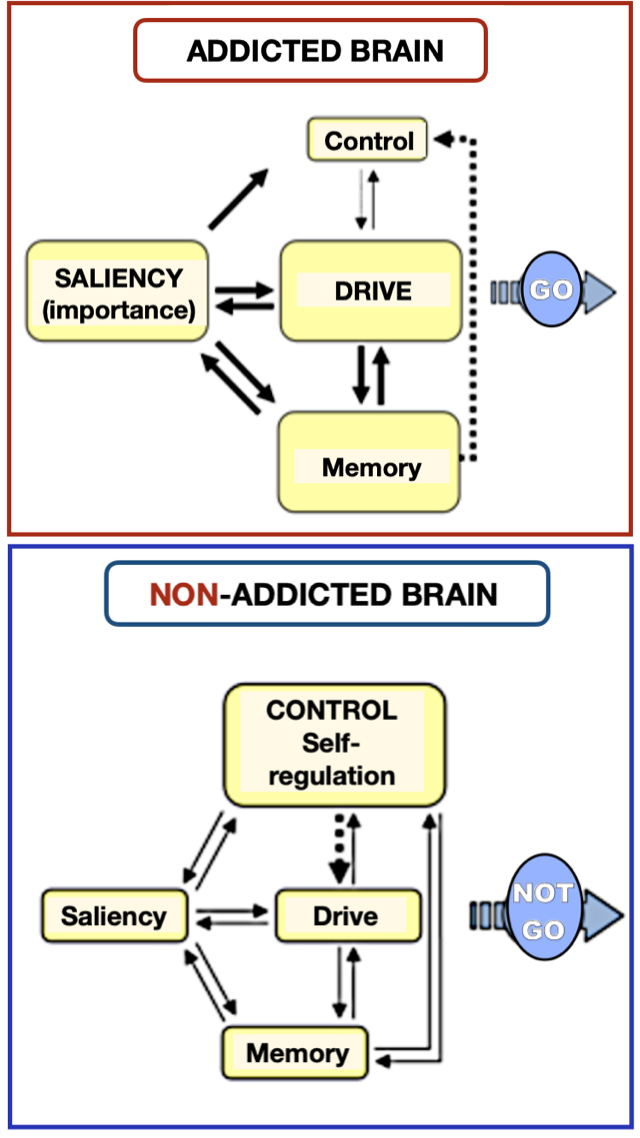
• all forms of addition (<—–chart )
• be in the ‘wrong’ profession or, stay in a bad job too long
• compulsive denial & suppression of emotions
• compulsive isolation, thereby ‘starving’ oneself of positive experiences

• deliberately hurting other people /animals
• deny childhood trauma (abuse & neglect)
• don’t get help when you really need it – or never
• don’t get medical attention for persistent ailments/ pain/ disabilities

• fear of intimacy, so pick unavailable or dangerous friends & partners
• habitual procrastination
• ignore or dismiss successes, accomplishments
• live in deprivation of many needs & wants
• over-spending & debting, living in over-whelming clutter
• persist in self-hate thinking – esp. when we know better
• poor eating & sleep patterns
• put of getting medical attention or fun & rest….

• sabotage possible good relationships / jobs / gifts / opportunities…
• self-sabotaging actions when trying to get a disallowed need met
• self-injury   (Chart ➡️) (Myths)
• sexual anorexia or promiscuity
• social anxiety from negative beliefs (SAS site)
• stay in abusive, dangerous relationships
• suicide attempts / neglecting any mental health issue

More SITES:
13 Things All Self-Destructive People Need To Stop Doing
How to STOP S-d behaviors
How to Overcome Self Destructive Behavior

 NEXT : Dis-Comfort #3a

ACoAs: DIS-comfort & Comfort (Part 2a)

hiding under bedI CAN’T HANDLE
any more stress!

PREVIOUS: Dis-comfort & Comfort #1

SITE17 Habits of a Self-destructive person


1. NEGATIVE Comfort ➖➕

• all forms of addictions, inching ‘addicted’ to religious / ‘spiritual’ pursuits “They’re so heavenly minded they’re no earthly good”
• always complain but never change //refuse to be self-reflective
• always have to ‘be the ‘good’ one
• be controlling (trying to force PPT to be what we want)
• busy minding someone else’s business, rescuing, over-helpingneg-comf

• don’t risk trying new & better ways to live
• isolate / distance everyone // be invisible
• make excuses / blame all difficulties on others, never seeing our part
• look for others to rescue, validate & take care of us
• never rock the boat //  stay in denial // act dumb
• never use direct communication (leave out things, beat  around the bush, don’t stand up for our rights….) // justify, exaggerate, lie

• people-please / don’t say NO when appropriate
• stay connected to unhealthy family & other dysfunctional or dangerous people
• stay constantly busy, over-work / try to be perfect
• stay the victim / be in self-pity / ‘practice’ unnecessary self-sacrifice
• try to avoid everything hard or painful // regularly zone out, over-sleep, over-use internet, games, TV….
• try to “know everything”, be perfect
• use self-injury to ‘cope’ with too much pain

▶︎Think of all the ways you use to escape, & fill in the blue square ⬆️

Keeping these patterns alive, especially once we know better, insures that we stay stuck. It’s the WIC who is in charge of this resistance, & it takes a great deal of determination, correct info,  kind support & unconditional love —->to pry it loose from the toxic family system.

2. NEGATIVE DIS-comfort ➖➖
neg-negIn this category we can look at the Nigglies that are discomforting, & Biggies – that are more obvious. But first let’s review ACoA reactions to experiencing pain over long periods – Under & Over – regarding how we interact with people, events & situations (PPT).

UNDER ‘feel’
As kids we had to clamp down on our emotions because we were punished or ignored for having them, no way of processing them, & had very little or no comforting when in pain.  That taught us to ignore feelings.
BUT they’ve never gone away – they just go underground & pile up until we’ve become one big sore – but blaming ourselves for hurting. The enormity of our accumulated pain is overwhelming, & not knowing that we can process them out, we have to shut down, so the pain turns into depression, or we use them to attack others, & for many of us – we do both.

Being in denial about the abuse we have suffered leads many ACoAs to emotionally & mentally under-react to most stressors. It’s not unusual to observe ACoAs smiling, even laughing, when talking about traumatic events, especially things that happened in childhood.
EXP: Recently Sara stopped in at a fast food joint down town. While eating her sandwich 5 local teens came in & sat at the next table. The were laughing as they compared beatings they used to get at home, one out-doing the others in their descriptions!

Sara wanted so much to tell them that being beaten is not funny, but rather painful, unjust, horrible, truly abusive….., but knew they would not have believed her nor welcomed her interference.
Clearly, they needed to protect the ‘value’ of the family at their own expense. Sara also knows that – at least 4 out of the 5, if not all wounded people – this pattern will be passed on when these teens have their own children, & likely with their mates as well – either as abusers or as victims!

who me?Having to sit on all that disowned pain takes up a lot of psychic energy, making it very hard to pay attention to real difficulties when they occur in the present. So naturally, daily annoyances are more likely to be dismissed or overlooked as unimportant (T)! This makes sense, since we don’t have the inner quiet (serenity) to deal with them. We’re just trying to keep our head above water!

NEXT
: Dis-comfort/Comfort #3a

ACoAs: DIS-comfort & Comfort (Part 1)

minor discomfortI’M DEFINITELY DETERMINED
to ignore my discomfort!

PREVIOUS: DIS-comfort & Comfort (Part 1)

SITE:  Fill-In Qs – Identify your stressors


OVERVIEW
Do What’s Comfortable” is one of the many helpful & profound phrases in Al-Anon. This is a useful suggestion, especially as ACoAs tend to live in perpetual dis-comfort (in the “wreckage of the future or in the misery of the past), subjecting ourselves to almost constant physical anxiety & the endless rumination of self-defeating ‘mantras’ (S-H), sometimes called ‘spinning’.

HOWEVER, we are so used to being uncomfortable that we barely notice, thinking it’s ‘normal’, AND believe we have no other option. So this phrase is incomplete, since ACoAs stick to what we know – no matter how bad – & avoid better/healthier/safer things – as we cling to our abusive family (refuse to S & I), & don’t have to risk being disappointed – yet again!

SOME stress in life is not only inevitable, but also needed in order to gently push us to take actions & grow. As the bell curve shows, there’s the calm state, which is good, & the ‘beneficial’ Eustress, to keep up us alert, motivated & on our toes.
But ACoAs typically live in the far right – in various intensities of distress.

Too much stress tends to paralyze. While there are plenty of external situations in life which can be aggravating, & many things we are truly powerless over, this topic focuses mainly on how we experience & categorize Comfort & Discomfort, negative & positive .

Originally, our harmful life patterns were learned grown up, which we had little or no control over. Now we keep using them :
— because they’re deeply ingrained , & obey family rules
— to avoid deeper painful realizations, anxiety & accumulated terror
— from the belief that we don’t know any better or can’t possibly change.
Still hanging on to them actually comes from the mistaken belief that the way we’ve always thought, felt & acted (T.E.A.) is our actual personality, & therefore no changes can be expected or even attempted. This belief persists even in ‘recovery’ !!

IN REALITY – all ongoing negative behaviors (character defects) are expressions of our False Self, developed in childhood in response to the abuse & neglect of our family & other harmful environments (baby sitters, neighborhood, school, ‘church’….). Therefore, the main goal of Recovery is to shed as much of this made-up persona as possible, in order to uncover, own & live in the REAL Self we were born into before the damage.

To understand why.  read or review posts “Negative benefits of.…”), info about how the brain learns, and “CDs — Info & the brain.
What we experienced from birth on is what makes the most sense to our ‘computer’,  which will fight tooth & nail to keep from having to change – as if we’re asking it to destroy itself!
Remember HAL 9000, in the “2001 – A Space Odyssey” movie?

Changing our programming will create great anxiety – at first. So for some time in our efforts to heal & grow it will genuinely feel more comfortable (a great relief) to go back to doing things the old way – no matter how ‘sick’. Unfortunately. But with persistent repetitions of new thinking & actions, that terror will lessen a great deal.

IRONY: Identifying these dysfunctions as ‘comfortable’, just because they feel ‘natural’, doesn’t mean they promote happiness & calm. While some ACoAs are in such deep denial that these patterns may seem like minor disturbances – from being numb to their long-term consequences – they in fact create endless stress, anxiety, shame, self-hate, frustration, physical & mental illness…. in all of us, whether acknowledged or not.social anxiety

Also, it may seem counter-intuitive that these damaging patterns would be considered comfortable, but it’s because the brain considers them valid, having learned them in childhood & then constantly reinforced in unhealthy environments.

NOTE: in Part 2 – Many of the items on the “Negative Comfort” list also fall into the more severe category of Negative Discomfort (like self-injury, bad relationships, lack of self-care….)

NEXT: Negative Discomfort – #2