ACoAs: DIS-comfort & Comfort (Part 3a)

uncomfortable brainI HATE HAVING TO
wait for results!

PREVIOUS:
Dis-comfort & Comfort #2b

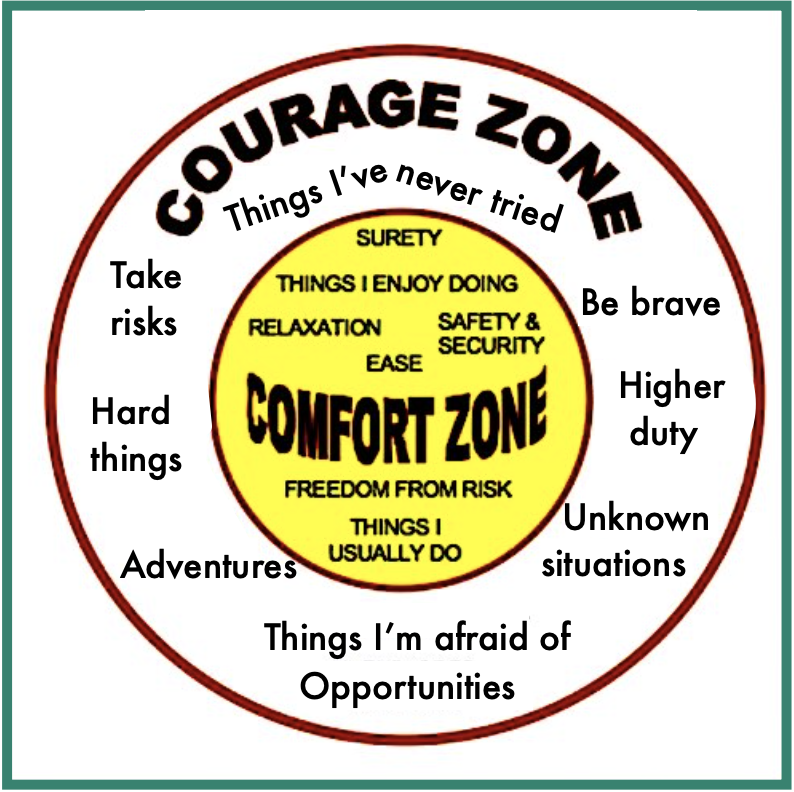
<—- CHART 

SITEsHow to Practice Being Comfortable in Uncomfortable Situations
— 3 Rules for uncomfortable conversations  (excellent) 

QUOTE: “Growth & comfort do not exist” ˜Ginny Rometty, CEO of IBM (Article)

1. Negative Comfort ➖➕
2. Negative Dis-comfort pos-disc

3. POSITIVE DIS-COMFORT ➕➖
Trying out new healthy thinking & actions make us feel anywhere from uncomfortable to highly anxious. It means disobeying each toxic rule, going against our training, dropping off of the family mobile, & bottom line : forcing the brain to find new pathways of functioning.

Too much prolonged stress causes physical ailments & psychological paralysis. That’s why we need to go slowly. Work on whatever issues you can tackle at the moment – ones that are the least scary. As you grow you’ll gain the emotional strength & mental clarity to tackle deeper one – like really ‘getting’ how much damage you have – without S-H or overwhelm, letting go of unsafe family, friends. jobs, locations……

For ACoAs, Growth means leaving behind our unhappy childhood to take our rightful place in the world – living in our True Self.
This is very uncomfortable because our family discouraged & punish any effort to exert ourselves – for ourself. And since personal growth is a slow process. we often live in uncertainty & confusion – between what we’ve always thought & felt, & what we aspire to become. In-between states are always uncomfortable & sometimes scary, but as we keep going we do see positive changes that encourage us. “Easy does it, but do it” (MORE...)

PROCESS  (See post)
☛ Get started. This is often our biggest difficulty putting things off that we actually want to do! as well as those we dread or find too tedious to bear, for all the reasons listed in previous posts (procrastination).  What’s ironic & sad (for ourself) is that most of the time when we finally take the action it’s not such a big deal, doesn’t take as long as we thought, & we usually like the result – or at least are relieved. (see posts re. Action)leaving-home

☛ Don’t Quit. Some of us are over-responsible, over-doers…. & others of us just obsess about doing, but rarely pull the trigger. Then there are the in-betweeners – those of us who start things but never seem to get around to continuing (keep going to the gym, stick to a food regimen, attend meetings….) or finishing  projects. (See postsManipulating – 2b & 2c”). The WIC & the PP get in the way of going for the gold, so we let ourselves get distracted.
The 3 As are useful here:
1. Become Aware of what’s really stopping you from pursuing a positive goal. It will always be something from our earliest training & experiences.

2. Be in Acceptance – allow yourself any emotions the awareness brings up. Don’t try to fix or change deep-seated patterns by brute force (control, S-H, forcing solutions). Continue using all the tools of Recovery programs & remember that re-forming your brain takes time & persistence.

3. Take Actions. Give yourself credit for the actions you are already taking. Don’t fret about what you can’t DO yet If you’re confused about what to do, make a list of the things you used to be interested in &/or still are. Look up what’s available in classes, groups… that can get you started. Some (useful) action is better than none.
If you’re stuck for ideas, talk it over with safe people who know you & can give you suggestion.
Then follow thru. You don’t have to know what the end goal is & you don’t have to like the choice you’ve made – it’s won’t be a life changing mistake – only more info about who you are.

There’s no doubt that all forms of growth (personal, professional…) take courage – which means taking actions in the face of our fear. Courage is not needed if we’re not afraid, but we can’t wait until we’re not afraid to try new things. (⬅️ CHART)

 NEXT: Dis-comfort & Comfort #3b
HEALTHY TRUSTING (Part 2)

TRUST

TRUSTING MY JUDGEMENT  
needs a realistic basis!

PREVIOUS: Healthy Trust (#2)

SITE: re. Trust issues, brief Questionnaire


♟️ High Trust
relationship are built on : Authenticity, Consistency, Empathy, Integrity & Transparency.   (SITECultivating Trust…..“)

♟️ DIMENSIONS :
Main components of Trust
🔑 Assumed = It’s time dependent, built one action at a time. The more consistent your behavior, the more likely others are going to assume you’ll act the same way again.
🔑 Associative =
Others will trust you based on the stories they’re heard / read about you, so you have the least influence or control over this aspect
OR – how you gauge your trust-level is based on preconceived stereotypes you may have (gender, race, wealth….)
OR – how similar or different someone is to you (comfort level familiarity)
🔑 Vulnerable = the fastest path to building trust with someone else is when both people… express vulnerability – the act of exposing oneself to possible harm, rejection, or scrutiny – in an effort to connect beyond a surface level relationship.

♟️ ASPECTS
🔆 Delayed Reciprocity – to create trust use the Golden Rule: ‘Do unto others as you would have them do unto you’. If I do something for you now, I trust (hope, expect) that it will be repaid / returned, in some unspecified way at some unspecified time in the future.

🔆 Exposevulnerabled Vulnerability – in a trust arrangement you may be leaving yourself open to being taken advantage of.  The threat of pay-back from someone or feeling guilty about asking may curb the temptation to exposed your ‘soft side’. We’re looking for fairness. So I feel that “for things to work between us successfully, I need to be able to trust that you won’t make me (or yourself) suffer”.

🔆 Predictability – it’s normal for people to make forecasts, trying to figure out what others will do or what will happen, for ourself personally & in the world in general. We want to spot & prepare for threats, as well as make plans to achieve longer-term goals.  The point of greatest unpredictability is at 50%, so a reliable enemy is ‘safer’ than an unpredictable friend – at least we know where we stand with them.

🔆 Value Exchange – Most transactions in life are based on reciprocity, which works because we each Screen Shot 2015-09-20 at 9.27.35 PMvalue things differently. You need food & have a skill, I have money & need a job done…..  Trust in value-exchange occurs when you don’t know very much (or at all) about them, their intention or what they’re actually going to provide. AND you don’t know exactly if what you’re getting is what you asked for & expected.

HEALTHY – You are trustworthy if YOU :
♦︎ keep other people’s confidential information, secrets & vulnerabilities private (exception = when it’s dangerous to others or illegal)
♦︎ regularly follow through on your commitments & show up when / where you say you will be
♦︎ own your mistakes, offer genuine apologies, & then make amends
♦︎ set clear limits & respect those of others
♦︎ when appropriate, show empathy & provide support without harsh judgment

RECOVERY
re.UNDER-Trusting” post – Consider these positive internal responses in relation those who
are mean to us: Develop the ability & skill to stand up to them when appropriate & not a danger, or stay away from them altogether

ignore us: Teach the WIC that no one can make us invisible! Some can see us & some cannot – it’s not a reflection on us (pun intended)!  When we cover o a True Self we are visible to ourself & to those who have ‘eyes’, knowing that we can’t make “blind people see colors!” Everyone else is only a potential connection, but not a necessary one

• do have good boundaries: It’s not their job to rescue or parent us. The distress that gets triggered by their responses to us is from our old wounds, not their behavior. This pain needs to be owned & dealt with in Program, therapy & our spiritual practice.
🙂 And we can learn from these healthier people to develop our own limits & self-care.  The ideal goal is to surround ourself with people who are genuinely trustworthy that will create a safe present & an even better future.

NEXT: Healthy Trust #3