Ego States – PARENT (Part 3) ACoAs

The CRITICAL INNER PARENT
can take up a lot of space!

PREVIOUS:
 Parent ego state (Part 2)

SITE :  The Child & the Seriously Disturbed Parent (Patterns of Adaptation to Parental Psychosis)

POSTS:Rescuing
Healthy Helping
5 Harmful mothers

WHEN our most important caretakers are mis-attuned, invalidating, emotionally neglectful &/ or physically abusive – they create great anxiety in the child. The resulting desperation triggers an unconscious defense :
❥ the child identifies with ‘the other’ (the -CP),  taking on the character of the abuser & suppressing its own needs & identity, in an attempt to stay attached, bonded and loyal.

In healthy families the P template will have fewer discrepancies with reality, but —>
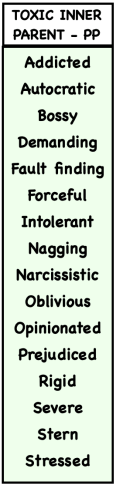
—->for ACoAs, this part of us houses the Negative Introject, also called Pig Parent, gathered from a collection of people who deeply influenced us as kids, & who we now carry around in our head.
It’s the voice the WIC is always listening to, who is terrified of displeasing, is trying to obey -perfectly- & constantly failing!

NOTE – kids pick up just as much subliminal information about the people around us just as much as what’s on the surface. AND what we absorbed was their WIC & PigP, which got mingled with our immature thinking.

🔻Along with our inborn personality, this combination (obvious & hidden) becomes the blueprint for the way to think of ourselves & how to function in the world.
So now PigP messages can be very hard to get rid of, since they’re linked to a great deal of original psychological & emotional trauma still held in the WICs  ego state.

But since each of us also brings our own style to how we express P2, with Recovery, it’s possible to behave much better than our dysfunctional training!

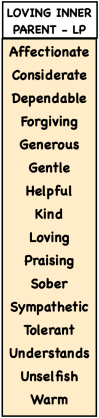
For ACoAs, the Loving Parent (LP) – for ourself – is usually missing, but can be developed in Recovery as part of the “UNIT”.  It requires a measure of Separation & Individuation to be a self-caring, nurturing component in us, capable of empathy for self & others, & can therefore be of help without being co-dependent.
Whenever we notice the OLD voice getting loud or taking over we can ‘de-contaminate the bad Parent’ by calling on the Good P. to help get the Adult back in charge.

Interestingly, many ACoAs do have a version of a Loving Parent, BUT only used for others – in the form of care-taking, rescuing, people-pleasing, AND sometimes being of genuine help (teacher, nurse, leader, parent….) , yet don’t apply that benevolence & skills to our own needs

In RECOVERY the goal is to learn how to always talk to ourself in the best possible way. Harmful internalized messages have to be identified & replaced, & most ACoAs need help hearing what they sound like.
EXP: Sarah was telling a friendly neighbor some frustrations she was going through lately. The older woman was sympathetic, & thought she was helping when she said “You shouldn’t feel that way”. Sarah smiled & replied “I don’t ‘should’ on myself.”
REVIEW  :  Distorted or Missing Parent states
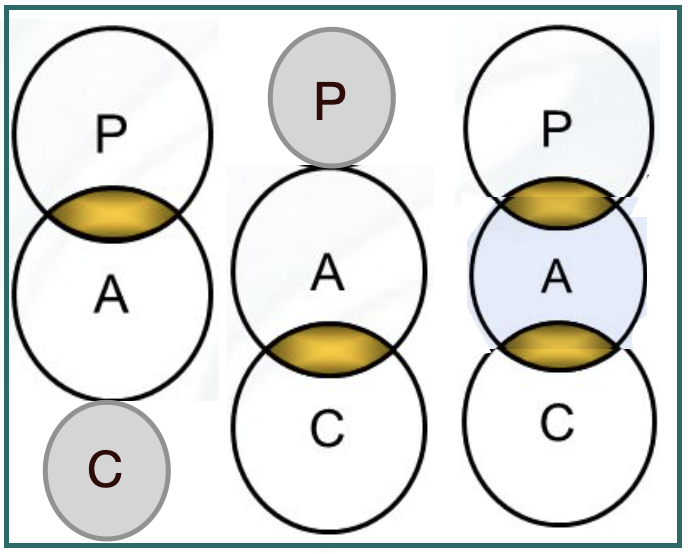
🔻Contamination ➡️
🗯When Parent contaminates Adult & C. is unavailable, the person is stiff, humorless, always ‘correct’
🗯 When Parent is unavailable & C bleeds into A, the person has no regard for others, & is only interested in self-gratification
🗯 When Adult is unavailable to mediate & guide P & C,  the PigParent & WIC are in constant conflict, potentially leading to mental illness

🔻Excluded Aspects
Shows up in stereotyped, predictable attitudes, clung to as long as possible in the face of any threatening situation ⬅️

a. Missing Inner PARENT:  boundaries & limits are not respected, person has a weak conscience, missing rules about how the world works
b. Missing Inner CHILD: the person has shut down memories of childhood, & emotions are suppressed, maybe psycho-somatic disorders – most likely victims of early severe trauma
c. Missing Inner ADULTreality is ignored or denied, producing strange or bizarre ideas, in constant conflict, potentially leading to mental illness

(MORE Cartoons)


POSTS:
4 Parenting Styles //  Replacing Negative Introject  //   Healthy Rules / Rights  //   Self-esteem  //   Talking to the IC   //  What is Self-Control

NEXT : Parent ES #4

Ego States – PARENT (Part 2) Healthy

good paretnPREVIOUS: Ego States – CHILD -#5

SITEs: “Identity & Introjection
▪️Psychotherapy with the PARENT Ego State

POSTS:  The Introject (PP)


Reminder
: Ego states are normal internal parts of ourselves, aspects of our True Self that are supposed to work together for our benefit.

PES = Parental ego state

INNER PARENT
 PES (cont)
Review of PES PURPOSE
❥ To have a strong, safe, loving way to nurture oneself & provide a clear sense of direction in life, based on positive experiences in childhood
❥ To take care of & nurture the next generation, passing on knowledge & skill to help children develop a positive sense of self so they can contribute to society
❥ To express caring behavior toward one’s immediate society & also the world, wherever help is needed – teach, guide, support – to the degree that the person is realistically capable of

🏡 We’re in Parent mode when we evaluate things, make generalized statements about the world, look after ourselves or others. This is OK as long as it’s coming from a Good Parent voice, & the Adult stays in charge

1. Old / Historic ES (Part 1)

2. NEW Parent** voice
family4The experiences, emotions & instruction we got from family were taken in wholesale, without consciously considering whether we really agree with any of it or if it suited us. The PES is now our ingrained voice of authority, combining our native personality with our conditioning. It’s made up of a huge number of hidden + obvious mental recordings.

People from a reasonably safe family will have automatically formed a positive Inner Parent, with accurate rules & regulations, realistic knowledge about the world, knowing how to be appropriately kind, useful, socially appropriate….

But even for such people, as adults some of their parental messages will be out of date & need to changed or modified because:
• they’re no longer children, so some of those rules no longer apply
• in many cases society is different (role of women, technology, working
styles…), making some of the early info limiting or useless

loving parent**Our INNER Loving PARENT voice follows the ‘general guidelines’ for healthy self-care. It is a biological imperative that children require mental, emotional & physical attachment to maintain psychological health.
Some of the things we would have gotten in a functional family (there are no perfect ones) include the need-to-connect common to all children —>
BY:
• having thoughts, emotions, fantasies & our needs validated, so we can do that for ourself later
• providing realistic mirroring, which allows us to know who we are
• giving us opportunities to have an effect / make an impact/ influence others around us
• being listened to, our needs understood & accepted, & at least some of the time wishes / desires provided
BY:
• feeling secure with a safe adult who can be relied on to provide protection, like freedom from humiliation & physical violence
• receiving support & guidance, with physical closeness & positive shared experiences, such as learning & playing together
• opportunities to express our gratitude to & love for good parents & caretakers, received well by them as a sign of bonding & loyal

EXPRESSIONS of GOOD Parenting – PROVIDE :
Physical
security = for
 child’s body & life. Shelter, clothes, nourishment, protection from dangers….
🌺 development = for physical growth. Includes good health habitstraining the body w/ sports, games ….

Intellectual
✿ security =
 conditions for child’s mental growth. If their dignity is safe, with nobody encroaching on the child physically or verbally, then they  freedom have to learn. Includes bonding times, an atmosphere of peace & justice in family, a “no-fear, no-threat, no-verbal abuse” environment

🌺 
development = Intellectual games, with 
opportunity to learn Reading, Writing, Calculating, & the laws of nature.
Includes Social skills & Etiquette, Moral & Spiritual understanding, Ethics, Values & Norms… contributing to the child’s beliefs

Emotional
✿ security
help protect & shield child’s fragile psyche in a safe environment, with Emotional support & encouragement. Includes giving a sense of being loved, needed, welcomed, by emotional attachment, caressing, hugging, touch….

🌺 developmentgive an opportunity to love other people & animals, to help siblings, grandparents…. Includes actively caring for / showing empathy & compassion to younger, older, weaker, sicker people.

TREAT YOURSELF in THESE positive WAYS! (+NP to WIC & +NC)

NEXT : Parent ES, Part 2

Ego States – PARENT (Part 1) Source

PREVIOUS : CHILD ES #7

SITE: REBT & CENT therapies, and
3 distinctions between them


PES = Parental ego state

Reminder: Ego states are normal internal parts of ourselves, aspects of our True Self that are supposed to work together for our benefit.

Main PURPOSE of P: The survival of the Species
a. For US: In general, the PES ego states allows us to function automatically, so we can respond to many aspects of our life without having to think about ‘How or What’ (how to behave in different situation, how to ride a bike or dress ourselves, what we believe, what comes next, what’s right.good mom…). This saves time & effort, freeing up the Adult part of us to make decisions ‘in the now’.

ALSO – the inner P (P2) directs how we treat ourselves, both in inner dialogues & actions. When we ‘hear’ its voice, it’s either loving or abusive (+NP or -CP). Because its purpose is to tell us how we’re supposed to ‘nurture’ ourselves, we need to evaluate it carefully, to check it for toxic content, & then work to correct what’s harmful & reinforce what’s healthy.

⬇️ P1 in this chart indicates the stage when the ‘early parent’ (C’s P) is formed – from birth to about age five (review CHILD – Part 6“)

b. For OTHERS: It functions as PARENT to the next generation (our own children, & anyone else in genuine need), using a combination of our family experiences + our native personality + what we’ve taught ourselves.
The ideal parent is “all-about-the-child”, nurturing & protective

CHILD ES = “Archaeo-psyche” // ADULT ES = “Neo-psyche”

Inner PARENT Ego State (P.E.S.) ‘Extero-psyche’
1. HISTORIC (rooted in the past)
This ES is our Introject  – either positive or toxic, an internal picture of how we saw & experienced our real parents & other important care-givers when growing up.
Children are highly intuitive, with little antenna up all the time to learn about themself & how they’re expected to behave.
Since all children think they’re the center of the universe, they assume everything the adults do & say is about themself, which leads to a limited understanding of & sometimes distorted perspectives on the grow-ups

⬇️ P1 in this chart indicates the stage when the ‘early parent’ (C’s P) is formed – from birth to about age 5 (review CHILD – Part 6“)
P2 :
Then the grown-up Parent ego state starts developing from age 5 to around 20, with continued input from caretaker & authority figures. After that, any time P1 in C2 (Parent in our Child) gets triggered, we tend to reacts just like our original role models.

EMOTIONS: Most of our emotions are housed in the Inner Child E. S. since we start out as children, & the first way we communicate, before we can talk, and The Adult E.S. is non-emotional
🔸But the Parent E.S. definitely has feelings – anger, compassion, concern, enjoyment, frustration, healthy pride, humor, joy, love, patience, pleasure…

DEFENSE MECHANISMS of Ego States (E.S.)
Defenses are maneuvers used by the subconscious mind to protect & serve our various E.S., which can become the way we interact with others & treat ourselves. Not to be used to mediate between conflicts in the subconscious part of ourselves (neural networks), & so reducing anxiety

While they are survival tools, they’re usually not good substitutes for healthy coping behaviors. When over-used & hardened into compulsive life-patterns, defenses become harmful, because they interfere with or prevent us from developing our True Self.

Healthy ADULT – We all need defenses to some degree, & when in this E.S. we use them sparingly & as benefits, in the service of the True Self, such as :
Altruism, Compensation (making up for a perceived weakness), Fantasy (imaging what’s possible or as pleasant diversion), Humor, Sublimation (channeling sexual energy into socially approved activities)….

Damaging PARENT
a. ‘Influencing’ – operates Internally, uses : Denial, Repression, Splitting, Suppression, S-H (negative self-talk)…. (see list of Defenses)

b. Activeexternalizing the PES, can use : Displacement, Projection, Reaction Formation, Rationalization…
ALSO :
If Parent excludes (ignores) A & C, one DEFENSE will be religiosity
 If Adult excludes P & C, it will be intellectualization
 If the Child excludes P & A, then it’s flattering pseudo-compliance

NEXT : Parent ES -#2

Ego States – CHILD (Part 7)

3 girls


PREVIOUS: Ego States – CHILD (Part 4)

SITE: Dictionary of T.A. Terms – (only / all “As”)


FORMS of the ADAPTED CHILD E.S.
We can regress into or take on any one of these variations of the WIC, applying whichever one seems to fit a situation when we feel unsafe.

LOST CHILD
This person is probably an introvert by nature, AND constantly ignored &/or left alone as a child. Their -AC received almost no mirroring, so has little or no sense of who they are. They invisible wherever they are, and rarely speaking up (not sharing or participating ) reinforce that state

COMPLIANT
a. In a less intense version, this state shows up as the ‘good girl or boy’, as people-pleasing, rescuing, care-taking, overly concerned with what others will think / say about them. This ACoA may be highly functional good girlon the surface but needs hidden addictions to cope with the burden of perfectionism. They’re often the hard workers who can’t relax, not from ambition but from being vigilant all the time

b. In the severe form, the ACoA is a milquetoast, the ‘yes’ man/ woman who is run by sheer terror or being disobedient & unacceptable. It’s the kid that always gets bullied, the battered wife, the patsy, the loser ….

Basic characteristics : being amenable, obedient, even submissive.
They dutifully conform to the commands, demands or instructions of parental / authority figures, willing to carrying out orders, requests or wishes of another. They are too easily tested, too open & responsive to advice, criticism, judgment, suggestion

LITTLE FASCISTmean girl
A darker side we try to hide from ourselves & others. Some psychologists believe it’s a primeval survival mechanism that’s become redundant. Berne describes it as the part of our personality that likes to eat flesh. Given the right set of circumstances & long-term stressors, we can all release the Little Fascist, as seen in gangs, bullying of any kind, war crimes…. (More….)

REBELLIOUS
Defiant aspecrebelliont of the AC, the extreme opposite of the Compliant, this Child E.S. is bent on opposing any form of authority, rules & accepted conventions of society. The ACoA feels &/or expresses strong disgust & repugnance for limits & anyone ‘above’ them.
They tends to be argumentative, with a contemptuous, antagonistic attitude. They’ll oppose or retard forward motion, growth, positive change – unless it benefits them. Their agenda may be hidden if they’re an isolator, or expressed in open defiance, or in organized resistance

LITTLE PROFESSOR
a. Child’s version of an Adult, starting around age 5.
It’s filled with some truths, a lot of half-truths, illusions, nonsense & mush. It’s the smart, creative & manipulative part that originally helped us learn how to get what we needed.
In an unhealthy family it functions in the background to gather & store data about what works & what doesn’t – in that environment. Survival is its prime directive, so whatever it takes to survive will become habits that follow us into adulthood

It functions on intuition & instinct with very limited understanding of reality, so it will cause us problem if we little profmistake the Little Professor (L.P.) for a True Adult, because it’s likely to tell us what we want to hear rather than health & truth (which it doesn’t know). In the present, as long as the L.P. is being hollowed, it limits what we assume are possible ways to provide for ourselves & our loved ones

b. On the plus side, it’s the curious & exploring Child part of us, always trying out new stuff, often much to the Controlling Parent’s annoyance. It’s full of creativity & imagination, so we need to give ourselves permission to access all our talents, whatever they are.
Both the L.P.. & the AES are ‘computer’ mode, but the latter has accurate data in the form of experience & wisdom on its hard-drive, which is missing in the L.P. Even so, we can make excellent use of it whenever creativity is needed, like writing, designing, teaching, & making anything new.

NEXT: PARENT ES #1

Ego States – CHILD (Part 6)

 PREVIOUS: : Ego States – CHILD (#5)

PAC = Parent, Adult, Child
ES = ego states

2. ADAPTED CHILD (cont)
2a. BROADLY (Part 4)
2b. SYMPTOMS (Part 5)

2c. A DEEPER look
✿ 2nd Order – review  Basics #5

P1
= Parent-in-the-child —> Adapted Child
C1 = Child-in-the-child —> Natural Child

A1 = Adult-in-the-child —> Little Professor 

These 3 ego-states (P1, A1, C1) develop mainly in the right brain, via the autonomic nervous system (ANS), which could explain the child’s excitement & literal thinking. The Little Professor ego-state (A1) is responsible for decoding the world through intuition & analog thought, that will guarantee physical & emotional survival.

✿ 3rd ORDER (cont)
a. NORMAL development: As a specialized subsystem, C1 is very sensitive to physical & emotional internal stimulation, from birth & even before. While in the womb, along with experiencing their own physical development, the unborn child already perceives “the rhythms of their own body & those of the mother.”

This is when the Child in the Child (C1) begins forming subdivisions Po, Ao and Co. Child Zero is the biological child, with the instinctive part & reflex reactions to stimuli that are common to humans. Co is who we are when we’re born, rudimentarily formed for survival & sociability – the emerging self. 

The substructure designated as Ao begins to develop around the time of birth. It will be responsible for learning through experience. Adult Zero occurs when recognition of certain family stimuli begin, causing a strong enough emotional response to the mother by the Co aspect to be remembered. 

The beginning of the development of Po (Parent Zero) occurs when the baby begins to develop adaptive responses to the environment & it represents the incorporation of the Parent ego-state that relates to the most basic needs of the child. Messages related to Po are usually physical & nonverbal.
(MORE….
[PDF] The Little Professor: Reflection on the Structure, Development and Evolution of the Adult in the Child)

b. WOUNDED  adults : The Negative Adapted Child (-AC) is the network-location of our accumulated trauma.

The PARENT ‘voice’ is always made up of a combination of all our important caretakers, usually one louder than the others. If those original people were very damaged, the 3 PACs of our Child’s Parent E.S (P1) will have unhealthy aspects. As very young children we incorporate their wounds into our version of a parent (Negative introject / PigP), all of which are internalize as if they were us!

X : The Child (C2) carries our original caretakers’ Parent’s (P1) = THEIR “Critical Parent”, the neural map containing all the negative parental rules & cognitive distortions they had about themselves (passed down from our grandparents….).
The younger we were when subjected to this aspect of our family, the more receptive / vulnerable we were to absorbing them…. which becomes our most entrenched Injunctions or Prohibitions (12  DON’Ts)

YAlso in PI our adapted Child (C2) holds THEIR Angry/Defiant Child – the neural network we carry of our caretaker’s frustrated rage about their negative injunctions, reflected in our 8 – 12 yr-old self

Z: Our Child’s P1 includes THEIR Vulnerable Child – an energy map of our caretaker’s youngest self, mirrored by our 1 – 7 yr old, carrying all their woundedness – traumatic experiences, loneliness, self-hate & fear of abandonment

VERY IMP: This hidden set of E.S. (from our actual parents, now living in our PigP (P2) need to be identified & separated out from OUR actual experiences, since those which originally harmed our caretakers may not have happened to us

EXPs: A father orphaned very young, or mentally / emotionally scarred by serving in a war, a mother sexually molested as a child or battered in a relationship…… none of which happened to us.
Yet their unhealed pain & resulting harsh or neglectful treatment towards us were inevitably absorbed – as if we’d lived thru those events too!

🦋 Once we’re clear about what part of the baggage we’re carrying is theirs (P1 & Po), we can ‘pack it all up’ & give it back to them – symbolically. We have enough of our own, thank you very much!
This can be done over & over – until we’re less burdened, via visualizations, in drawings, 2-handed dialogue between Healthy Adult & PP, with Bio-energetics, Primal or Gestalt (2 chairs), psychotherapy, 12-Steps, Prayer….

«
NEXT
: Child E.S. #7

Ego States – CHILD (Part 5)

broken home

 PREVIOUS: Child E.S. (Part 2)

CES = child ego state
AES = adult   ”     ”
PES  = parent  ”    ”

NC = Natural C.  // AC = Adapted C.

2. ADAPTED CHILD (cont)
2a. BROADLY (Part 4)

2b. SYMPTOMS of the -AC
Ways it expresses uncomfortable or painful emotions
Physical – have temper tantrums, roll eyes, shrug shoulders, use a whining voice
AND / OR inappropriately giggle, kid around, laugh, raise hand to speak, squirm, talk behind hand, wink….

Verbal – baby talk, be literal, talk too much. Phrases : “Oh no not again, Things never go right for me, ….worst day of my life, I dunno”….
AND/ OR  brag, exaggerate, pontificate. Use many superlatives (best, most, biggest), ‘big’ words to impress…. Phrases start with :  “I wish, I want, I’m gonna, I don’t care”.
CHART:
In adulthood :  
Three negative adaptations to early trauma, -AC styles, found in C2
These nuances are ways the WIC can act up at WORK or in other groups, expressing “I’m NOT OK” or “I’m not OK & neither are you!” (OK Coral)

• Compliant Child ES
Fearful attitude :“I’ll do anything to please you as long as you don’t get mad at me or fire me”.
This person doesn’t make a good team member (don’t pull their weight), & will be highly stressed if they have to manage others. Often feel depressed, overwhelmed & unrealistically anxious
• Oppositional Child ES
Angry attitude : “No one can control me”  
Reacts against others, whether someone actually agree or disagree with them – as a false boundaries & a temporary sense of power. Negative repercussions are obvious
• Reckless Child ES
Arrogant attitude : “I only do things MY way”. (-FC)
This type has no boundaries & does whatever it wants, no matter the consequences to self or others. The person never / rarely takes responsibility for their actions. If they’re an employee it takes a great deal of management effort to keep them focused & out of trouble. As a boss – they run roughshod over everyone.

NOTE: We can switch into whichever state gets triggered by a current situation, often related to different ages in our past “Compliant’ is usually the youngest Inner Child of the past – age 3-5 . “Reckless / Rebellious” tends to be our teenager….
(⬆️ see the 3 Damaging Parent ES in “Parent – #4”)

FIXATION (see Basics Part 3)
DEF : an attachments to people or things persisting from childhood into adult life. An inability to adopt any different or new perspective about a problem

As long as the original trauma in our past is still lurking in the background as unfinished business, those experiences become psychological fixations – ‘stuck-ness’. So behaviors, beliefs or feelings connected to unhealed buttons can still be triggered by events in the present.
One stressor may throw us back to thoughts, emotions & actions when we were 10, while another event make us feel like a helpless infant

When the -AC E.S. takes over our usual way of functioning, we’re hijacked by something inside, out of our control because it happens so fastold damage – & we’re back in our childhood (regression). This shows us exactly where particular old wounds need to be repaired. (“Cycles of Power” has examples)

Fixations hold up a mirror to the PigP (Introject), not from our True Self which includes the Natural Child (+FC), capable of being comfortable with self & others.
Instead, mal-adaptive Introjects keep our Child part in pain, psychologically trapped in the past. Fortunately we can reprogram the brain.

⚙️ We can be emotionally stuck in the past because of verbally, physically & sexually abusive adults, physical & emotional neglect, unmet developmental needs, & generally unskillful or inadequate parenting. Children get confused when their needs are punished, misunderstood, ignored or trivialized – consciously or not. When it happens often enough, those lacks poison our whole world. (MORE…. examples)

💜 But even with caring parents, some ACoAs can get fixated at a  developmental stage because:
• the child or siblings’ needs were particularly complex or obscure
• unavailable or incompetent social / medical ‘support’ systems
• the family was under extreme stress from various hardships (severe financial or health problems, natural disasters, war / PTDS)…..
….. which under better circumstances 🌤 those parents would have wanted to & been capable of providing 🌺.

NEXT: Ego States – CHILD (Part 4)

Ego States – CHILD (Part 4)

PREVIOUS: Child E.S. (Part 2)

CES = child ego state
AES = adult   ”     ”
PES  = parent  ”    ”

NC = Natural C.  // AC = Adapted C.

2. ADAPTED Child (-AC) (cont)
Distressing &  traumatic childhood experiences which greatly harm the Natural / Free Child (+FC) can be grouped into:
❖ Developmental

• at age 4 : when a sibling was born, you were left behind when mom went to the hospital with no one to explain or comfort. Not knowing what was happening you were scared, alone, confused
• at age 6 : started school, wanting to belong but had trouble fitting in, with some of the same emotions of the 4 yr old – confused, scared, lonely ….

• as a teen : uncomfortable relating to the opposite sex, not being in the in-crowd …. feeling unsafe, shy & insecure, like first days at school
• as an adult :  when sexually attracted to someone, feeling like that insecure teen or scared 6 yr. old again, awkward when talking to them or afraid to approach for fear of rejection, like the 4 yr old whose mother ‘left’ you for another child!

◉ by Specific Events – long series of losses
• age 4: a parent permanently left or died. You didn’t understand, weren’t helped to cope with the pain, felt traumatized & withdrew
• age 7 :  family moved far away, separating you from familiar connections with school, neighbors & friends. Starting over was tough

• as a teen : your best friend left you behind to hang out with other kids, with no explanation. You were devastated, confused, lonely, angry
• as adult : when your mate, best friend of even your child goes out somewhere – without you – you may feel a deep pang of abandonment, fear & jealousy, as if they’re never coming back.
Accumulated abandonments left us either trusting no one or trusting too easily – just to not feel alone.
They can add up, leaving us feeling unwanted, so we become :
⚒ isolated, bitter, angry, even paranoid
⚒ OR create a persona to cover the pain – the comedian, the ‘brain’, the controlling leader, the bad boy…. someone no one can ignore to injure, ever again
⚒ OR the timid soul, the love-addicted, the ‘good one’, so invisible that no one can touch.

🔻 No matter which form the self-protection takes, the PigP or WIC is in charge, with a weak Healthy Adult & a missing Loving Parent.

2a. BROADLY – Natural/Free & Adapted C. are :
• each subdivided into healthy & unhealthy versions
• expressed inward toward self, & outward toward others.

We’re born totally +FC, having gotten all our needs met in the womb. Immediately that starts changing – at every turn we’re required to conform to the world around us. An infant has no choice. child aspects

🔺While the +FC is always our most basic Self –
the +AC is equally important. If our environment is relatively stable & encouraging, we can accept what is expected of us.
It uses learned behaviors to avoid pain & get what it wants/needs without being over-compliant, functioning within set boundaries needed to get along well in its culture without sacrificing the Natural Self

🔻 BUT when our early life is full of danger, disrespect & dismissal, our native personality will tend to choose one extreme or another, either over-conform or over-rebel, as its coping mechanism.
Child’s RESPONSES to Dysfunction:
The -FC refuses to adapt appropriately to society, over-rebelling against early abuse & neglect, to it’s own detriment, while —
— the -AC does whatever it can to conform to the harmful alcoholic / narcissistic environment (details in “Child ES #3”)

As adults, both NEG styles are compulsive, usually unconscious, applying their unhealthy attitudes & behavior pattern to all circumstance, indiscriminately. They’re driven by Toxic Rules, such as “Don’t object to abuse, don’t deserve good things, Be like us, Hurry up, Don’t risk….”
The -AC slavishly obeys them, the -FC denies any rules exist for itself.
They’re in the “I’m Not OK” mode, marked by guilt, helplessness, hurt, loneliness, rebelliousness, shame, terror & a deep sense of inadequacyadapted child

(-FC) Negative FREE / Natural Child :
For some people the Unhealthy FC is the ES that’s in the driver seat most or ALL of the time.
They are selfish – socially & personally irresponsible, in-the-moment doing whatever they feel like, regardless of consequences to self or others. Pleasure is their only goal, but the actual purpose is to avoid any unpleasant / painful emotions or interactions. EXP : someone who makes a joke of everything.

NOTE : Magical Thinking is a form of dissociation coming from the Adapted Child’s Adult (-A1), when it decided that “I can protect myself by splitting my Free Self (-FC) off from the rest of myself”. (Review post re. Disconnected ES parts)

NEXT: CHILD (Part 5)

Ego States – CHILD (Part 3)


PREVIOUS: NATURAL Child ES

SITE: Comfort bags : emotional first aid kit (includes SONGS for the IC)

CES = child ego state  //  AES = adult ES  // PES  = parent ES
NC = Natural C.  // AC = Adapted C.(WIC)

1. NATURAL Child (Part 2)

2. ADAPTED Child (+AC) – It is a normal & necessary aspect of all human beings, the part that learns about & adapts to what is expected of us in our particular society, so we know who we are & how to survive.
It incorporates the lessons of our family, school, society & religion – molded in childhood, every day from every aspect of our early environment.child aspects

Our Adapted Child part learns how to behave under the influence of its family, in ways the parents would like it to be – obedient & precocious, or reserved & scholarly, or aggressive & vindictive….

❇️ For kids from functional homes, it’s formed around healthy rules & values, which then translates into well-adjusted, self-caring grownups who contribute their special abilities to society.

POSITIVE QUALITIES
🔅 Adapts, adjusts, fits in, reconciles itself to its environment
🔅 Absorbs values, mores, rules & restrictions of its society
🔅 Conforms to gender-specific messages & other norms
🔅 Contains the development of social skills & appropriate behavior

IMPORTANT : The Natural & Adapted Self are not automatically in agreement. Even in healthy environments (home, school, culture, religion) the 2 part of us can have different needs, desires & dreams.
EXP: What if the NS is born to be a talented artist / actor…., but the AC is required to be an academic, or macho sports hero, or business leader…..? ☆ How developed the Natural Self becomes over time will determine which one eventually wins out.
🔻          🔺           🔻
For ACoAs, the ADAPTED C.(-AC) ▲  is our wounded part (WIC), in reaction to wounding caregivers. It has to adapt in harmful ways BY rescuing, over-conformed & easily manipulated, being helpless or self-destructive…. It’s made up of our:
Ts – accumulated memories of many traumatic events
Es – all the pain (loneliness, despair, shame, hurt, humiliation….)
As – the child’s coping behaviors (caretaking adults & siblings, fighting, hiding, lying, studying…. )

For everyone, the normal Child includes sometimes being unpleasant – having resistance, hostility or reactivity – when feeling uncomfortable or threatened (a new siblings, a poor school grade, a divorce, a serious illness….), but most of the time they don’t have to worry.

BUT for ACoAs – our sense of dread & anxiety in childhood came from being constantly stressed (neglect, abuse, confusion, losses), so the -AC:
• became our False Self, developed as the only way to cope in childhood
• overshadows the True Self, so we may not even know who we truly are
prevents us from having access to a Healthy Adult
• denies the intuition & emotional intelligence of our Natural Child

All kids come up with strategies to get through difficult situations, but when a child endlessly needs to protect itself, those strategies become a habit, then armor or a wall, the default position used in all situations, no matter what the circumstance.

Characteristics of the -AC ego state
PSYCHOLOGY
• Assumes it is the ‘Real Self’, being the only one a person knows, but is not
• Believes it’s protecting itself, but prevents our normal / universal needs from being met correctly
• Compulsively obeys the Toxic family RULES
• Emotions include anxiety, envy, guilt, rage
• Houses the Toxic ROLES Hero, Scapegoat, Lost Child, Mascot
BEHAVIOR
• Acts from Victim, Rescuer or Bully position
• Can over-compensate, becoming aggressive or rebellious
• Is over-controlled or can be controlling (copying thbad WICe Introject)
• Lacks genuine confidence. Not able or willing to accept balanced, appropriate responsibility
• Weak boundaries, so gives in to unreasonable demands from others – OR
• Walled up, so is always deprived &/or withholding

As the WIC, the -AC reacts to the world around it by either changing itself to fit in (‘good girls/boy’), or rebelling against all forces it encounters (as enemies)

If a ‘normal’ grown-up temporarily regresses to this ego state, they’ll experience inner needs & the outer world as they did in one of their earlier developmental stages. In that state, although seemingly in the present, they’re actually reacting to a current situation thru childhood mental & emotional lenses. But it doesn’t last.

NEXT: Child E.S.

Ego States – CHILD (Part 2)

I’M ABLE TO HAVE THE MOST FUN
when I’m in my Natural Child

PREVIOUS: CHILD E.S. (Part 1)

SITES: Images for T.A. Ego States (very interesting) and Natural Child’ Test

CES = child ego state
AES = adult   ”     ”
PES  = parent  ”    ”
NC = Natural C.  // AC = Adapted C.

REMINDER : Everyone is born with 2 potential Ego States – our Natural self & the Adaptive capacity.

1. NATURAL (NC) or Free Child – in TA terms it’s the part of us that’s on the surface of our consciousness when we’re most relaxed & ourselves – when the Inner Parent (positive or negative) is not telling us who to be or how to act.

• It’s expressed in the way any happy child does – combining curiosity, intuition & creativity – as well as all emotions as they come up, without judgements. The NC is the state which loves, & whenever we play & are fun to be with. When we have a healthy sense of play our life becomes more balanced. Without access to the Natural Child life is quite dull, limited & stilted.

• It represents our True Self, as unique & individual as our fingerprints. It’s what we were born as, our heredity, our native capacities & tendencies, but which often goes unrecognized, unexplored, unappreciated…. or deliberately suppressed! It’s largely un-selfconscious, expressing non-verbal noises such as ‘yahoo, whee’…. It enjoys life, is open, vulnerable & is seen in autonomous, *spontaneous actions.

*Spontaneous: any communication or activity coming from a natural emotion or native tendency, without constraint. Occurring without apparent external influence, force or cause.  REQUIREMENT: a low-level of anxiety, even if only for a little while!

• The CES holds all the caring, enjoyable, helpful &  loving things we received growing up.  It’s the part that loves to giggle, laugh, have fun & enjoy the simple things in life – at any age, like the 70-year-old man sitting in the park enjoying an ice cream cone, or the couple dancing ‘like no one else exists’ – are in their Child state – in positive ways

HOWEVER, because all children are vulnerable, the CES can also be fearful, intimidated, need, selfish and manipulative – showing up as a brat – whiny, stubborn or demanding when it doesn’t get its way. SO, over time it will house all the experiences that caused us anxiety, sadness, rage, shame, terror… as well as creativity, curiosity & joy

• All forms of personality inventory (Myers-Briggs, MMPI, Enneagram…) are basically designed to identify the native characteristics of the NC. This is healthy the part we want to bring forward, encourage to express itself – that part of us that will shine, if allowed!  The Child E.S. can be seen at any age.

NOTE : it’s important to NOT idealize the NC, such as when some people call it the Golden Child, because it puts a burden on it that’s not realistic – to be perfect. Since the NC is our essence, it is by definition: human = imperfect, which is normal.

General NC CHARACTERISTICS
MENTAL
🔅 Brainstorms, is curious, creative, intuitive, has drive, with a great capacity for enjoyment, self-expression & being in the moment
🔅 Very literal, overly-truthful / blunt, insensitive to others’ feelingold hippiess, since it is naturally self-centered
🔅 It is by nature optimistic, idealistic, exuberant, joyful. Its goal is self-actualization & intimacy/ human relating

EMOTIONAL
🔅
Holds our genuine emotions, is not afraid to let others know how it feels, & can ask for what it needs
🔅 Is natively either an Introvert or Extrovert (each person has their own degree of it on a continuum)
🔅 Can be selfish, immature or over-emotional, willful, not liking to share or take turns, out of touch with the real world or naive
🔅 It may be rebellious or co-operative, depending on circumstances & the developmental stage it’s in at the time

ACTION
🔅
Likes to explore, have adventures, and sometimes be impulsive, “leaping before you look”
NOTE: One reason being high or drunk is so appealing to many is that it tends to free the Adapted Child from the Critical Parent’s influence & ‘transform’ the person by releasing them into their Natural Child

NEXT: Child ES #3

Ego States – CHILD (Part 1)

Inner children
I CAN FEEL ALL MY EMOTIONS
when I connect with my Child part

PREVIOUS: ADULT E.S. (Part 3)

CES = child ego state
AES = adult   ”     ”
PES  = parent  ”    ”
NC = natural child / AC = Adapted C.

GENERAL
Everyone has a CHILD Ego State (CES) – the earliest stage of our development, forming our personality in the first 5-7 yrs of life. Similar in many ways to the Freudian concept of id, it operates on the pleasure principle, automatically & persistently aimed at gratifying & fulfilling needs – but available on a conscious level.

We continue in child mode well into our late teens & early 20s, through 7 developmental stages.(“Cycles of Power” by Pamela Levin). For the rest of life the CES is both an influence (what we think & feel inside) & a state (looking & acting like the little person we once were).

CHILD e.s.🌺 It’s called “archaeo-psyche” because it’s a collection of taped & stored info – behaviors, thoughts & feelings held over from childhood.
In T. A. terms, it’s made up of the Natural /Free Child (NC) – our fundamental identity – overlaid by the Adapted Child (AC), healthy or unhealthy, developed in response to our environment which are ‘understood’ as filtered through our natural tendencies (Part 2,3)

Its goal is to feel pleasure & avoid pain – no matter how or at what cost. It’s focused on Self needs only, even when relating to others or trying to being helpful : “I want, Don’t leave me, I refuse, You can’t make me, I don’t wanna, I want you to….”

This does not mean it’s a bad aspect, to be gotten rid of. We need it, since it holds the seeds of our native qualities, as well as the wounds that influence later behavior. It’s just that as adults it’s not healthy to be ruled by the Child. (See ‘Contamination’)

✦ This E.S. is mainly the domain of the ‘felt’ – the Right brain. Before we were able to talk (Left), our whole world was about feelings & sensations!
So most, but not all, of our emotions (Es) – including all the old stored up ones – reside in the C. part of us
brain sidesFor ACoAs, it is our NC that has mainly been suppressed, ignored, almost crushed. Early on it had to go into hiding to preserve itself from overwhelming harm.
However, it shows up anyway, perhaps sideways – when we use our natural talents – in business, in the arts, in science…. BUT without Recovery we don’t believe they have value, assuming we’re frauds. ◎ Healing works to help us own & happily appreciate them.

▶ In CHILDHOOD
Before we have the grown-up components of the Adult & Parent, we develop rudimentary aspects of them – the Child’s versions of them (+FC), along with the basic tendencies we’re born with – the C’s C. Eventually these 3 parts become the essence of the Inner Child E.S. no matter how old we are. (see Second Order E.S. Map).

C. e.s.C’s Parent – sometimes called mother’s ‘Little Helper‘.  Kids, even very small ones, will help a drunk parent up the stairs, rock their dolly to sleep, care for a pet… OR be bossy, lecture other kids, copy their parents’ way of treating their younger siblings…
Electrode (zaps you with a toxic command, causing a knee-jerk reaction), Witch Mother or Fairy Godmother

C’s Adult – trying to do ‘grownup’ things, even before they’re ready, going to the store or school – alone, ‘being in charge’, showing off their cleverness & knowledge… trying to figure out how things work…. BUT without enough info or mature ego states to process everything correctly
The Little Professor

C’s Child – our most basic self, the core of our identity, the most vulnerable part, aspect of ourself which, as adults, has often been suppressed to the point of being invisible.  This part is composed of our physical self, instincts, biological urges, genetic recordings, and how we learn, our level of sensitivity, social preferences, the full range of emotions – from great joy to great pain, down to how we like our eggs cooked! 
Magical Child or Little Fascist

NEXT: CHILD E.S. (Part 2)