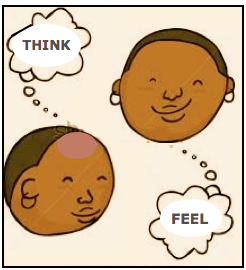
“FEELINGS AREN’T FACTS” (Part 1)

think or feelTHOUGHTS vs EMOTIONS
I’m confused! What are you talking about?

PREVIOUS: Recovery Thoughts


This is a familiar phrase used in 12-Step Programs, but not exclusively. It contains an intrinsic truth and an intrinsic lie.  We have to examine both words – ‘feelings’ and ‘facts’ – to understand.
1. FEELINGS
a. CONFUSION:
• In our language, the word feelings is used in almost every context to mean either thoughts, emotions or sensations, without distinction.
• The main problem is that most of the time people use ‘Feel’ to mean Thoughts, not emotions. This causes confusion for both speaker & listener.
confused• This triple usage may be a clever ploy in our culture – likely unconscious – to suppress Emotions! We’re taught to live in our head & only focus on actions (“Just do it”), which we gladly embrace as a defense against facing our deepest pain.
So, along with many other sources (family, media, male culture, war, sport…) our language encourages cutting us off from an essential part of ourself

b. CLARITY:  We’re not going to change how we talk, but we can understand the 3 uses of the word FEEL, so we can be accurate.
i. Sensations – ‘Feel’ as a Physical experience : I feel hungry, tired, thirsty, sexual…
ii. Emotions: If ‘feel’ as indicating Emotions –  followed only by a single words : “I feel…… sad, glad, mad, anxious, pleased…..”.
AND we can have more than one E at the same time, even contradictory ones.
“I’m happy to see you, but disappointed that Ted’s not here too.” (Posts: Use THINK, not feel)
iii. Thoughts :
 The word “Feel” should never be used to mean Thoughts / Opinions / Beliefs.  Thoughts are always in sentence form, always more than one word. 
When “Feel” is misused, it usually leads with ‘that‘ or ‘like’:
•  “I feel like he wants to talk about something”
•  “It feels like you’re not supporting me”
• “I feel that we should leave soon”
• “I don’t feel that we’re communicating”
•  “I feel like going to the movies”

Stated as such, none of these are about emotions, only ideas – ** even though emotions are implied but not acknowledged. It’s subtle & at best unintentionally, at worst it’s manipulative & dishonest

c. INDIRECTness : Another mix-up occurs when thoughts are expressed in a round-about way. Such statements are clearly sentences, but couched in terms of feeling, which makes the speaker sound unsure of themself. They’re not actually expressing confusion, but rather insecurity by asking for permission to have a voice.

ACoAs are ‘notorious’ for talking around an important point, leaving out crucial info, adding too many qualifiers, justifications & apologies! This misuse comes from not being allowed to own our personal power.
We say:
• “ I hope you don’t mind if I tell you…”
instead of
  “I’d like to tell you something / I need to talk to you about___”

• “Is it alright if I___ , Will you be upset if___ …”
instead of (with a smile, perhaps) “I won’t be able to____ , I need to____ , I’d like to___ , I’m not available for___”

• “I feel like I’m doing better”  instead of “I’m doing better”
• “I feel like I can’t trust them”  instead of “I know they’re not trustworthy”

☑️ Unfortunately, for many ACoAs, being direct is not just considered impolite but actually aggressive! which it is not IF statement are accurate & made without anger.
Sadly, women are more likely to be indirect as a way to not be pushy, which makes staying connected easier, but at a personal price. (BOOK : “He & She” by Chris Evatt)

YES, there is a time & place for careful wording, being respectful of others’ time & space, or for apologizing.
HOWEVER, the above examples of waffling have to do with ACoA shame, S-H, fear of being seen, of punishment or being cut off.

The BEST, clearest way to communicate combines emotions + thoughts in the same sentence : be clear
• “I’m scared you won’t stay with me”
• “I’m so happy that you got the promotion”
• “I feel sad that she’s ignoring me”
• “I’m worried that he won’t like this gift”
• “I’m excited for you & curious about what you’re going to be doing”
• “I’m concerned that you’re going there alone”
This of course implies that we know what we’re feeling (emotions) and have permissions to own & express them.
🔴 Practice verbalizing your thoughts & emotions using declarative sentences, so they come out of your mouth more easily. And repeat, daily: “I know what I know”!

NEXT: “Feelings aren’t facts”, Part 2

RECOVERY Thoughts for ACoAs

lion & lamb
MAKE FRIENDS WITH YOUR INNER JUDGE
– just don’t obey it!

PREVIOUS: My Rights Qs (25-48)

SITE: 5 Major Benefits of Recovery


This is a open-ended review
– which can be used as a set of goals to work toward & to see our progress. Add your own to each category.

♥ Be absolutely sure that you:
• are damaged, not defective. Damage can be healed, & you’re OK
• can be of service to others without being co-dependent
• can say & believe – “I Know what I Know, & I can’t know everything”
• have a right to be alive, and be exactly who & what you are
• have a right to & can achieve a measure of healing & happiness

♥ Be Accepting of:
• all your emotions, no matter how unpleasant or socially unpopular
• other people’s differences. You don’t need them to be carbon copies
• your childhood damage, without constantly repeating it
• the time it takes to work on your issues
OF
• your own reactions to what others do & say to us
• your Inner Sadist (I.S.). The more they hurt us as kids, the angrier we are. If we make friends with the I.S. we don’t have to act it out on anyone
• other people’s kindness, compliments, validation
• our humanity, with it’s beauty & it’s imperfections

outer child♥ Be Aware :
• of your talents, gift, accumulated knowledge & experience
• of the options you have in most situations
• of your effect on others, positive or negative
• of how other people can trigger your old pain (the buttons)
AND
• that you’re not your own Higher Power
• that God is not an alcoholic parent
• that your emotions cannot harm others – only your words & actions
• that others’ reactions to you are about them & are their responsibility

♥ Be healed enough to:
• be able to take care of yourself, reasonably well
• hear what other people are actually telling you about themselves
• not try to fix others, no matter how much pain or trouble they’re in
• no longer be sexually attracted to emotionally or physically inappropriate or dangerous people (rage-aholics, alcoholics, gamblers drug addicts, & other narcissists)
TO:
• stay at a respectful distance from ‘nice people’ who are passive-aggressive, needy, or so shut down that you can’t connect with them
• act appropriately in most social situations – neither from perfectionism nor from rebellion, not from co-dependence nor from terror
• not have to obey your Toxic Rules
• to listen to good advice, but ultimately follow your gut & experience

♥ Be willing to:
• be as emotionally honest with others as you’re capable of, without hurting yourself or them (live in your truth)
• be the Good Parent & Healthy Adult, taking care of the Healthy kid
• express all your talents (skilled or imperfectly)
• follow your dreams, no matter who objects
• keep looking for answers to your difficulties. Don’t be ashamed to ask for help before you collapse!
• listen to the needs, thoughts & emotions of the WIC
• never give up, no matter how hard things are, but it’s good to take breaks
• not let the WIC run your live, nor let the kid do self-harming things

MAJOR RECOVERY TRUTH: A sure sign of mental health & emotional maturity is to know in your very bones that:
Most things being done to us or around us have NOTHING to do with US!
Being convinced that it does – comes from the PP or WIC.

self-love treeTo repeat: Most the time, “It’s not about us = ie – our True Self”!
That includes all the stuff our parents did to us, at us, on us, around us, BUT not about who we are fundamentally!
Even when people react to something we did or said, their behavior is their responsibility. As a reminder, see post on ‘Personal Responsibility’.

NEXT: “Feelings aren’t facts” #1

RECOVERY – What IT IS & IS NOT (Part 2)

Screen Shot 2015-07-10 at 9.30.12 AMLEARNING HOW TO BUILD A LIFE
on the experience of those who know

PREVIOUS: RECOVERY – IS & is NOT (#1)

SITE: “25 Things you do as an Adult when you’ve experienced Childhood Emotional Abuse
(like the Laundry List)


RECOVERY
IS NOT….
❖…eliminating ALL pain from our life
IS...
❧…a combination of gains & losses, fulfillment & disappointment, joy & pain – part of being human, not superhuman.  Only addicts – of any kind – want ‘no pain’ & think that’s an appropriate goal
🦋

IS NOT…❖…trying to get from our family all the things we never got as kids, nor assume we can have a ‘great’ relationship with them – if only we were well enough

IS…❧…accepting there’s no ‘if only’ about our family & our childhood (SORRY!)
no more blame• It was their damage that prevented them from being all we needed.  It was never because of who we are/ were! Yes, it was done to us, at us, with us – but it was never ABOUT us  ie. our essence
and, unless family members have been growing too, or changing enough, we may take more radical steps

We can choose how to deal with them – by :
a. having rare or no contact, to protect ourself from abuse & mind games
b. no contact for a long time, until we are more healed, so our buttons (which they installed) get much smaller :)! Then re-connect & see….

c.
limited contact, to see who they really are, for clarification & validation of how they treated us – which will diminish our self-hate, & allow us to gain some emotional distance from the family drama
d. regular contact, spaced out AND only as friendly Adults.  Don’t expect them to be parental if they can’t. Interact superficially or only in ways that suites everyone. Don’t push for the impossible!

➼ Other people often disappoint, which can make us sad & angry. That’s normal. It just doesn’t have to devastate. NOW it’s truly up to us to become Kind Parent & Wise Adult for ourself, with the help of therapy, H.P., Program & other support systems.
🦋
IS NOT...❖…saying we have forgiven our family, as if it were an intellectual decision, made once & forever, hoping that will wipe out all of the damage they inflicted, & all of our pain

IS…❧…knowing that forgiveness is a gift from H.P. – a ‘letting go’ – as a result of our willingness to do Recovery work to clean out old emotional wounds.
Forgiveness is the end product of that work, rather than a prerequisite for growth, as many tell us. Forgiveness isn’t genuine without healing our rage & sorrow. (9 posts = 4 types)

PROOF : when we try to ‘will’ forgiveness & think it’s all behind us – eventually some life-event will stir up that unresolved pain & bite us in the butt. Besides, some abuses are un-forgivable! But we still have to let go of being a victim of our own rage by feeling the sadness that’s underneath (“Forgiveness Is an Inside Job“)
🦋

IS NOT…❖…getting over our rage, so we don’t have to feel it any more OR not having any more terror, worry, sadness… if/when we get ‘really healthy’Screen Shot 2015-07-10 at 9.38.11 AM

IS... ❧…knowing & accepting that we’ll always have some vestiges of the old pain, fear, rage, shame & abandonment hurt, BUT that those Es doesn’t have to control us
…. being willing to separate internally, from the bad voice & externally, from harmful people. It’s absolutely necessary to get away from damaging situations & negative thoughts. After all, if you kept scraping away at a sore on your skin, it wouldn’t heal, would it?

• At first this ‘letting go’ can bring up fear & depression, but with time, it will allow us to heal old wounds, making us less fearful & angry.
We can find & use new ways to deal with those painful Es – by: learning to accept & comfort ourself & letting them out in safe places & ways. Then we’ll experience pleasant & joyful emotions as well.

NEXT: RECOVERY – IS & is NOT (#3) 

RECOVERY – What it IS & IS NOT (Part 1)

in with the new
OUT WITH THE OLD, IN WITH THE NEW
Dismantling the old patterns

PREVIOUS: What Self-esteem IS

SITEBenefits of a Gratitude List

RECOVERY
IS NOT…❖…expecting to get unconditional love and perfect sanity from any human. It’s unrealistic, but the Wounded Inner Child demands it anyway. Now – when we don’t get it, we accuse others of abandoning us!

IS…❧…understanding that in adult relationships –  each person has their own needs.  Since our parents couldn’t give us unconditional love, when it would have been ‘normal’ & needed, we can only look for it now from ourself, our pets & our Higher Power.  As we interact with healthier people we will receive more appropriate companionship – be mirrored, understood, respected, considered, loved…but never perfectly!
🦋

IS NOT…❖…being free of emotions (Es) that were unacceptable in our family, controlling our Es or trying to have ‘appropriate’ Es. Those are signs of damaged thinking – (CDs) – NOT the same as being in control of our behavior!

IS…❧…accepting all emotions as legitimate. Humans are built with the capacity AND the need to feel. Es are the natural indicators of our reaction to any experience – to let us know whether something is good or bad for us. Re.T.E.A. —
Actions may, or may not, be good, & can be corrected, over time
• Unhealthy Thoughts can be reframed & replaced, when harmful or incorrect
Es just are. They can go from very joyful <–to–> very painful, but are never good or bad! We need to have access to a wide range of Es, with many shades. It gives us a sense of vibrancy & allows us to connect with others.

Only seeing everything in B & W = tv, paintings, walls, clothes….. can become quite boring. Suppressing or narrowing down Es (to 1 or 2, like rage or fear) will make us one-dimensional, possibly cold, hard, distant & ultimately limited.
The intensity & depth of our emotional reservoir of old childhood pain is so great that it will never be completely empty.  Accept this & learn how to manage Es rather than trying to spiritualize them away!
(review “Feelings Aren’t Facts” posts) (MORE re. hand-emotions)
🦋

IS NOT…❖…trying to permanently ‘fix’ our childhood damage, eliminating all character defects, doing is easily it & quickly.  Any effort to fix ourself means we think we’re bad, & that our badness is our own fault, SO we’re responsible for doing anything we can to eradicate it. (BTW, this is one of the reasons why many ACoAs are suicidal & want to be dead)

IS…❧…accepting that alcoholism & co-dependence have left deep scars & emotional hangovers. (Good / bad parenting @ ACoA site). These will take our life-time to gradually heal. Being human means we’ll never be perfect – but Recovery IS truly possible!  Many have proven it.

Humility (not humiliation) is acknowledging our human limitations, with a consistent willingness to evaluate ourself with compassion, in honesty & reality, modifying our thoughts & action when needed to reach our own goals
🦋

IS NOT…❖…being ‘serene’ all the time.
• To always be pleasant, kind, honest, thoughtful…is a disguise for a wide range of emotions we don’t find acceptable (anger, envy, greed….)
• To still be the good boy / girl, in the present, is the symbiotic need for our family’s approval, rather than becoming our own person
• Forever trying to be ‘so good’ is a negation of our legitimate rage & pain of childhood abandonment

IS...❧…gaining genuine serenity, based on a solid emotional, mental & spiritual foundation – from the inside.  This creates the unshakable knowledge that we are ok even when we’re in pain, under pressure, not understood or supported.
We can have upheaval, express intense pain / anger… and still be at peace, deep down.  Serenity is the by-product of knowing & accepting ourself in the moment, trusting our gut, having a great support system & a loving H. P.

NEXT: RECOVERY IS / IS NOT #2

ACoAs: Healthy RULES & Lessons (Part 3)

  new life“AND NOW, PRESENTING…. –
a new life, a better life !!”

PREVIOUS: Heathy Rules, #2

SITE: Healthy Family Rules


MORE GOOD Rules
As mentioned in the last post, these statements are to help the Healthy Adult & Loving Parent parts of our psyche to learn better ways to take care of our Inner Children. Each statement can be used as an inventory:
a. Resistance:
• why do I NOT want to include them in my life?
• what do I think will happen if I follow these ideas?
• what do I need to give up in order to incorporate them?
b. Willingness:many Qs
• what do I need to have / do, before I can use these positive rules ?
• how can I implement these concepts into my life?
• who can I ask for help with them?
• who do I know who already lives them?
c. Results:
• what happens when I do act on these statements?
• how is it different from what I assumed or projected?
• what do I need to do, to increase these principle in my life?
OF COURSE – If you can add questions to this list – please do.
«    «
NEXT
: Safe & Unsafe People

ACoAs: Healthy RULES (Part 2)

Snever give up
YEAH. I WANT TO FEEL SAFE! — Will you take care of me, Good Parent?

PREVIOUS: HEALTHY RIGHTS (#1)

SITE: How To Never Give Up On… (CHART)


HEALTHY RULES
Part 2 & 3 list statement that have been accumulated from years of Recovery experience. They’re geared to the Healthy Adult / Loving Parent parts of our higher self – so we can know how to take care of our wounded and healthy Inner Children, in the best possible ways.
❀ YES, we have a broken heart!  What’s more painful to a child than not feeling loved by their parents?   BUT NOW – to be happy, we need to:
• accept who our family really was & is
• believe in every fiber that we did not cause our abuse & neglect
• accept that now we’re individually responsible for our life
• know that we have the ability to outgrow much of the damage, but not all completely
• consistently apply mental health truths to our life

❀ We all live by rules, whether we like to admit it or not.
• Some ACoAs were so neglected they think they weren’t taught any rules.  No, not good ones, but we did pick up all the Toxic Rules!
• Others of us were so constricted by rules & regulations, we nearly choked to death on them.
In either case we tend to shy away from rules, or have a raging hatred for them. And yet we are run by the bad ones, as long as they stay hidden and we don’t challenge them.

❀ So here are a few Healthy Rules to try out & apply to our every-day living.
Think about each one, carefully.
Pick one & try it out for a month. See what happens. Then try another….
«

«
NEXT : Healthy Rules & Lessons, #3

ACoA : TOXIC Family RULES

Screen Shot 2015-07-09 at 12.10.53 PMTHEY DESIGNED MY STRAIGHT JACKET –
I’m gonna need some help getting it off!

PREVIOUS: Healthy Helping (Part 2)

SITE: Dysfunctional Family (Wikipedia)


RULES: No matter what our family environment looked like, all ACoAs have gathered a litany of TOXIC RULES, which we follow ‘religiously’, even well into Recovery – but hopefully less so with growth!

We absorbed these Toxic Rules from family, school, our community, religion…. They are the underlying beliefs the WIC is absolutely convinced are the absolute ‘truth’ which we are obligated to obey – on pain of death (abandonment)- even if we disagree or hate them. Notice the contradiction & conflict. No wonder we say we’re confused!

The BE and DON’T lists are the short forms, & just mirror opposites. Below are the expanded ones.  This is by no means complete. Each of us can have variations or additions.

INVENTORY: How do we know what our rules are?
a. Overview
As you read thru these lists – notice the ones that hit you the strongest. If you’re new-ish to recovery you may not recognize that you have more of them than you first think. Still confused?
✶ Ask yourself, & then siblings, mate, friends, therapist … for suggestions

✶ Do a Life Inventory, in 3-5 yr increments, listing all the major events you can remember – things that were important, relationships, when you started & stopped things, schools, moves, births, deaths …. choices made, opportunities we didn’t take…..
12065669231219144528Anonymous_work_in_progress.svg.med— Don’t go into detail. Just list things in one sentence each
— Notice the recurring themes, patterns, avoidances… What good things are missing?
— Ask : which toxic rules might your patterns represent?

b. Details
• Pick any one of the phrases that rings a bell & write what comes up.
— Where did you learn this? Who in your family exemplified it?
— How do you act it out in your life?
— How do your friends, lovers, bosses… express it?

• Take it very slow. Spread this exercise out over months & years, if needed. Maybe just write a little & go back to it when you have more info about yourself & your history
GOAL:

• See the toxic family rules you’ve been following – so clearly – that you won’t be fooled any longer into thinking they’re legitimate!
• Slowly disobey them by changing your behavior, an action at a time, a day at a time.

In the beginning – when you do some inventorying – you’re likely to feel fear & guilt. Those emotions prove you’re doing the right thing for your healing. Don’t give up!
• To orient yourself toward healthier goals –  pick out some Healthy Rules that fit your situation, & mindfully, deliberately, use one or more as often as you can (every day, a little?)

✶✶ Breaking family rules can create a lot of anxiety, as the Negative Introject will try to guilt you into returning to the fold – like good sheep.
So the work must be a slow & gentle but with steady process – with lots of support (Al-Anon as one of many resources)

If you read many other posts on this blog, you’ll see references to “Toxic Rules” over & over, so this post will give you a context for thinking about all the other topics & as you work with them. (Post: “Why Are You Stuck?“) .

«
NEXT : Healthy
Rules, #1

ACoAs & Boundary INVASIONS (Part 2)

no limits

PREVIOUS: B. INVASIONS (#1)

ARTICLES: ‘Sexual Abuse / Trauma’
The Incestuous Family” – Roles re sexual abuse


BOUNDARY INVASIONS  
(cont)
2. MENTAL Coercion

3. Family SYMBIOSIS

a. Insecure parents :
push for an ‘us against the world’ attitude, hoping to increase family solidarity, powered by denial of dysfunction, & an unbearable threat to their sense of identity
can be over-protective.  On the surface it may look like love, but they’re only trying to keep us attached by dis-empowering us
📲 The underlying message is that we’re incompetent, weak & have to be afraid of everything

• may attribute the wrong motive to other kids or adults’ unpleasant/ abusive treatment of us, no matter what we actually did (cause trouble or not, be friendly or withdrawn….)
When we complained about the bullies, Mother may say: “Those kids are just jealous of you because you’re so much better than everyone else in the class”, which becomes the twisted thought “The boss doesn’t like me because I’m smarter than her”…. distortion

b. Distortions
 CDs cause many problems for children. IT :
• gave us a distorted view of how the world works, making it hard for us later on to take responsibility for our motives & action
• prevented us from – becoming fully socialize, taking normal risks & learning about the many options available in life
• severely increased our inappropriate school / social behavior, making it easy to be a target for bullying, insuring distance from peers, & forced to stay dependent on the family

Familiar phrases: Blood is thicker than water Never air our dirty laundry in public  ~  No one else will love you like we do
~ You’ll never make it on your own so we’ve got to stick together ~ We’re better than ‘those’ people
OR a childhood taunt:  “You have a face only a mother could love, & she died”!

c. Family Insularity is an attempt to feel safe BUT built on fear-based rules that inevitably lead to constriction, intolerance & an inability to collaborate / cooperate well with others.
Ironically it also creates isolation, scapegoating, unhealthy alliances & splits inside the family, which then get repeated in adulthood.
EXP: A  part of the dysfunctional family mobile, being trapped in a toxic ROLE, (Scapegoat. Lost Child….) had “negative benefits.” It seemed useful by ‘protecting’ a parent from their emotional problems, the consequences of their addictions, & whitewashing outright abuses.
As adults we look for the same kind of payoff when playing out our Role in the larger world (protecting a mate, boss….), which doesn’t work now either, only reinforcing our sense of being a failure.

4. Parental NARCISSISM (N)
a. Boundary invasions
• Ns require that everyone be their carbon copy, with no room for children to develop their individuality
• children need mirroring (reflecting back who the other person be like meis, without adding anything of oneself), but Ns can’t do that since they’re only projecting themself on to the child

Narcissists don’t recognize there are such things as Bs, that others are separate & not extensions of themselves. People either exist to meet their needs or may as well not exist at all. Anyone who provides narcissistic ‘supply’ will be treated as if they’re part of the controller, who demands the victim live up to their expectations (think: spider & fly).

• Some N. phrases:
“What’s yours is mine & what’s mine is nobody’s business”
“Do as I say – not as I do”, “Put a sweater on, I’m cold”
“No son of mine is ever going to…..”
“This is the thanks I get – after all I’ve done for you”
“Do that in the morning when you’re fresh” said by a mother always raring to go at 6 am, to her child who was born a dyed-in-the-wool night person!
Watch ‘Angry-martyr Narcissist” on YouTube

b. Role Ambiguity
Parental N. spawns much identity confusion. Since only their needs count, the children take on a parent role – “I am them”, & many a parent acts like a needy kid – “They are me”.

Family members aren’t sure who’s in or out of the clan, who’s performing what tasks or legitimate roles : Dad acts like a ‘girl’ , Sis is the ‘mom’, little Brother is the family shrink…..

Al-anon IMAGE: A co-dependent decides to kill himself by jumping off the roof of a tall building.  As he’s falling, someone else’s life flashes before his eyes!

NOTE: If you have firm boundaries in the face of a narcissist, the relationship won’t usually last! Good – better for you!

NEXT: B. Invasions (Part 3)

BOUNDARIES & ACoAs (Part 4)

inner conflict 

YOU’RE GETTING TOO CLOSE –
Hey, where are you going?

PREVIOUS: Bs & ACoAs (Part 3)

REVIEW posts: “Separation & Individuation


3. The SYMBIOTIC DILEMMA  (cont)
a. Fear of Engulfment
b. Feat of Separation

A basic requirement for S & I is a sense of efficacy – able to (allowed to) have an appropriate effect on our environment

SYMPTOMS of poor or no Separation & Individuation (S & I) :
• weak sense of Self: the child’s core injury comes from not receiving a meaningful, empathic emotional response from mother
• narcissistic vulnerability is based on shame of having needs : child is injured by being constantly slighted or ignored
• emotional detachment or clinging: abandonment is played out as “come here – go away” in adult relationships

CONSEQUENCES of symbiosis : creates difficulty with —
✓ feeling all our emotions
✓ loving others unselfishly
✓ nurturing our young
✓ mourning the dead
✓ boundaries re. time & space
✓ caring about the human race
✓ dealing with conflict (isolating) & taming aggression….

✶ These problems make it very hard for ACoAs to have healthy intimacy, often relating to others as if we each were inanimate objects, used to fix unresolved infantile issues

‘COME HERE – GO AWAY’  
A common example of the symbiotic conflict is the push-pull syndrome.
While some ACoAs are primarily Stayers & others primarily Leavers, there are some whose conflict is subtle & very confusing because both are acted out in every relationship. Either way, ACoAs don’t realize we’re recreating our early abandonment – again & again

1. Come-Here/Go-Away : ACoAs very much want to have relationships, but don’t acknowledge our deep fear of emotional closeness. We invite people in, let them come close if they approach, & some of us even compulsively chase after anyone we can snag
✶ At the same time, we have an invisible barrier around us used as a substitute for real Bs others cannot see & that we are rarely aware of
2. As someone gets emotionally & physically closer, wants to know more about us, spend more time, be more permanent – we start to panic. Since we’re not allowed to say what we need, want & don’t want, how we feel…. if we let them in we’ll be taken over by their needs & wants

3. As the person moves in, they inevitably cross that ‘line in the sand’ the WIC is hiding behind BUT which we never acknowledge, so can’t verbalize.
Then how can we possible expect others to know when they’ve gotten too close?
We feel invaded, suffocated, endangered – terrified. At that point the need to protect ourselves is much greater than our fear of being alone!

4. As the terror builds we do or say things that are a slap in the face to this person who cares about us – we verbally punch them in the stomach &/or become distant & unavailable.  They are shocked, hurt, confused, appalled! They try to figure out what they did wrong — but their only sin was getting too close to our wounded self! So naturally they back off & then go away!

5. Now it gets interesting! WE have pushed the person away by cruelty or withholding AND then wonder why they withdrew!  Suddenly our abandonment fear come to the fore & we act confused & surprised at the others reaction!  Where did you go?? & WHY?

6. So without understanding what we’ve done – that we set up the painful outcome – some of us will invite, cajole, beg the person to come back to us.  If they do, AND we still cannot identify where our boundaries are, they’ll come too close again, & the cycle repeats!

• This pattern is crazy-making for us & our friends or partners. It makes them sad & eventually very angry.  We are condemning ourselves to an endless round of seduction & loss.  We look like the crazy one, hate ourselves more, blame others, say we can’t trust anyone, think we can’t love or the ‘universe’ is against us….. without looking at our Symbiotic Conflict!good Bs

RECOVERY – As Usual 😔
•  Admit our damage – cut thru denial
• Feel the old rage & terror
• Nurture the Inner Child
• Reduce S-H, CDs & obeying the PP
• Connect with others in Recovery
• Form an alliance with the loving H.P.

NEXT: How ACoAs Boundary Invade

WHAT JUST HAPPENED? – 30 Qs (Part 4)

wondering 

I’M DETERMINED –
I’m gonna figure it out!!

PREVIOUS: What just Happened (Part 3)

Please read / review Parts 1-3 before answering these questions


Suggestions
a. Read all the Qs first & if you feel overwhelmed, leave it overnight. Don’t wait much longer or you’ll lose info.  No S-H allowed!!
b. Write down as much or as little as you can – it can never be ‘perfect’. You can skip any that are not relevant or you don’t know about
c. Go back to it later, more than once if need be, to fill in any blanks
d. Make sure you only take responsibility for your side of the street & no more. Both of you contributed something, even indirectly.
➼ DATE & save all entries.
INVENTORY
Re. YOU
1. What actually happened – list as many facts as you can remember (I did/said… they did/said…) Ask anyone else who may have been there what they remember
2. If relevant, list what was going on with you or what was happening just before the encounter –  what state of mind were you in during the previous few days?

3. If there was any anticipation, what were you feeling & thinking before the event? Was there something you wanted? Were looking forward to? Needed from the person or situation?
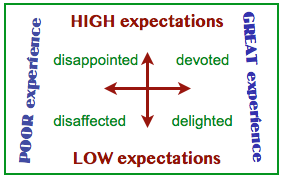
expectations
4. What did you expect would happen on this occasion?
a. Consciously – looking forward to? Afraid of?
b. Semi-consciously – what did you secretly assume or expect?
➼ We can often tell this by intense disappointment!

5. If it was an unexpected & unprovoked encounter (by you), what state were you in at the time? (Vulnerable, needy, generally angry, sad, overwhelmed, in physical pain…)
6. How were you feeling emotionally (E) during the interchange?  List as many Es as you can
OR Ask: If I had been feeling something, what might it have been?

7. What were you thinking (T) during the interchange, that you didn’t say? What do you think / conclude, now, that you’ve had time to reflect?
8. What did your WIC ‘hear’ them saying (an implied judgement, accusations, insult….) which also often came from our family?
It may have been hurtful, OR it’s your interpretation of their comments

9. Are you surprised/ shocked by the event? Is it something you could have predicted or anticipated, based on previous experience?
10. Why do you think they triggered you so much?

Re. THEM
1. What’s your connection to this person, if any?
2. If you do know them, what has your relationship been like, over all? How do you think about them?
3. Did they act in a familiar way? How, exactly?Screen Shot 2016-06-19 at 5.57.35 AM
4. What did you observe about this other person during the interchange?

5. If you didn’t know them, what information did they give you about themselves – direct or by implication? (people always do!)
6. What did your intuition tell you about their attitude, their state of mind, their abilities, their ego state…no matter how brief? Is it familiar?
REMEMBER:  When you know a song well, you only have to hear a few bars hummed to identify it!

7. What did their behavior, emotions & words tell you about who they are (this is about FACTS, not a hatchet job) – Angry, needy, controlling, manipulative…/
8. Who do they remind you of (usually a family member)?
9. What were they actually telling you? This is not a guess. Most people say things with some kind of subtext, altho’ not always unkind
10. What does your gut and head tell you about dealing with them in the future?

CONCLUSIONS
1. Looking back, what did I observe about myself in that situation, old or new?
2. What have I realized, that I’d rather not have admitted –
a. about myself
b. about the other person

3. What actions would I like to take, as a result of this interchange?
a. ignore the whole thing
b. let it simmer some more, need time to calm down before saying anythingScreen Shot 2016-06-19 at 5.57.10 AM
c. need more time to process it myself. May want to run it by a few trusted people.
d. jump right in & let them know what I think! What are the consequences likely to be?

4. Did I learn anything useful, that I can apply to this or other relationships, in the future?
5. What do I need to work on? Improve? Modify or change?
6. What can I take with we for any future conversations?
7. What do I need to practice saying, over & over, to be better prepared for similar situations?

8. Am I proud of anything, in this situation? Did I act or talk better – more self esteem-able, more from the Healthy Adult? Was I more appropriately restrained?
9. Was there anything I enjoyed about the situation, was amused by, found intriguing, surprised by?
10. What does my IC need to hear from my Loving Inner Parent, when thinking (T) about this event?

(© Donna M Torbico, 2011)

No matter what you uncover, do not let the IC go into S-H, nor let the PP beat you up!  This is valuable info for YOUR growth!

NEXT:  Noticing Painful events – #1