

PREVIOUS : ACoAs & Listening #4
SITEs: LIST of articles re. Learning Styles
• When Bright Kids Become Disillusioned
• How Being A Gifted Kid Affects You As An Adult
TYPES of GIFTEDNESS
More than three-fifths of a person’s learning style is biologically imposed (Restak 1979, Thies 1979). According to Joseph Renzulli: “Gifted behavior occurs when there is an interaction among 3 basic clusters of human traits:
• Above-average general &/or specific abilities (practical)
• High levels of task commitment (motivation)
• High levels of creativity
EXP: Many gifted students find logical reasoning & for others linguistics may be their preferred learning style. Language Arts & Math / Science are not parallel abilities. Just because a child is gifted in one they’re not automatically excellent in the other
👩👩👦👦 Some enjoy working in groups where their leadership skills can be exposed & developed. Others prefer to work independently at their own pace
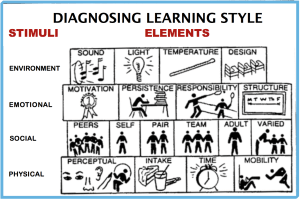 The most prominent unique personal characteristics of the G&T are: being Critical, Persistent & Independent of thought & judgement. Studies conclude that there are at least 18 areas of sensitivity. (CHART by Dunn & Price) Posts: “Adult Learning styles“
👀 Visual is the most common ability, These children understand the world by creating vivid mental pictures, learning best by comparing & contrasting modalities (a passage from literature to a video…), & may also do well in geometry. They thrive in the arts, seeing the beauty in places where others may not, so can seem ‘overly’ emotional & dramatic. With imagination that never stops, these students make prime graphic designers. 
Verbal – masters of word manipulation, they can be quite persuasive. Their command of language gives then a love for storytelling, & a tendency to arguing. These students can have careers in marketing or politics
Kinesthetic – the kids who are highly skilled with their hands. As they develop control of their body, they may become hyperactive. Always on the move, these students must find physically active careers
Existential – these thinkers are focused on issues too deep for other kids to understand, & may be prone to depression as they ponder the meaning of life. Careers involving philosophy & spirituality are a good fit
Logical – those who excel in problem-solving & number manipulation. They may be easily frustrated with anything illogical. These students love to analyze everything, often becoming accountants or programmers
In their BOOK “Teaching Gifted Students Through Independent Study,” Johnsen & Goree recommend independent study as one of the most effective ways to differentiate and individualize (S & I) learning for the G&T, allowing those students to delve deeply into any topic of interest. (MORE..).
Rita Dunn, with colleagues, has done extensive research on all forms of learning styles. BOOK: How to Implement and Supervise a Learning Style Program, 1996
In Chp 1 Dunn writes that adolescents gifted in a particular area – athletics, dance, leadership, literature, music & math – have similar learning styles across 9 cultures.
Her work showed that most of those G&T students preferred to learn either by themself or with an authoritative teacher, & only with a few with classmates. Even in primary grades, gifted 1st & 2nd-graders got higher achievement & attitude test scores when allowed to learn in their preferred way. (See ‘Social’ in chart above).
 Research also documented the influence of time-of-day energy patterns on achievement. Conventional school hours appear to be poorly time for the majority of G&T adolescents, because while a few learn well early in the morning, many more prefer late morning, afternoon, or evening for concentrating on challenging academic studies.
The Gifted Development Center, created by Dr. Linda Silverman 30 years ago, found two main learning profiles, based on brain hemisphere preference:
• Right side dominant are ‘Visual-Spatial’ Learners (VSL)
• Left side dominant are ‘Auditory-Sequential’ Learners (ASL) (MORE...)
Her validated research of children ages 9-13 showed that :
🌱 about 60% are mainly Visual-Spatial
🌱 33% are strongly Visual-Spatial
🌱 23% are strongly Auditory-Sequential
🌱 44% use both styles, with about 30% leaning toward VSL & 15% toward ASL.
QUIZ by Jade Ann Rivera, = to identify a child’s type + other info 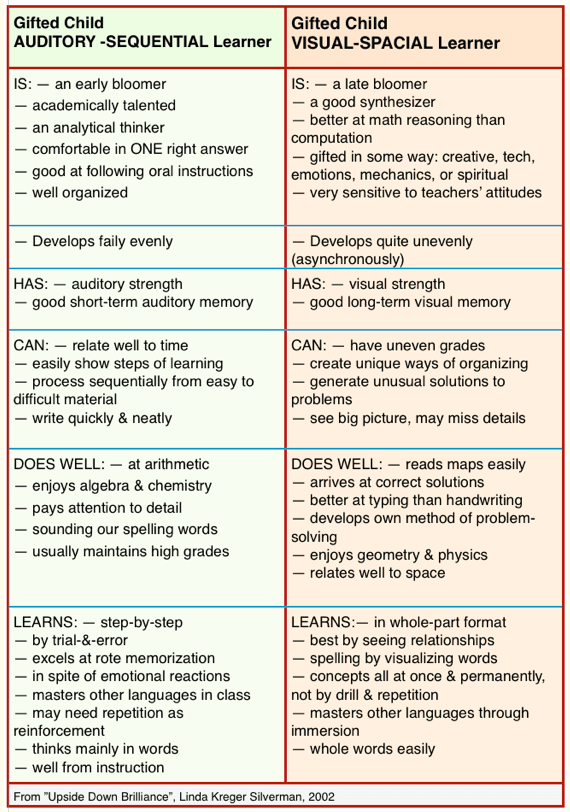
»
«
NEXT : Gifted Types, #1

