Myers-Briggs INTRO (Part 2b)

PREVIOUS: MBTI Basics #2a

OVERVIEW of MBTI dichotomies (cont.)

The 2 ‘INNER’  (S-iN & T-F)

2. SENSING (S) vs INTUITION (iN)
The kind of INFORMATION we prefer to gather & trust.
It can be either Introverted or Extroverted (Si or Se / iNi or iNe) , & each part of the Judging style.  We use both, but to different degrees of effectiveness & with different levels of comfort. 
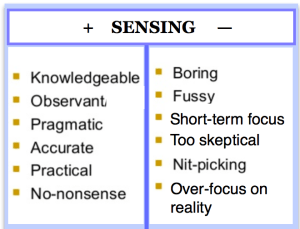
Sensing (S) / Concrete
To be mainly Sensate means that a person primarily believes in the kind of information he/she receives directly from the external world.

They absorb info thru the 5 senses – are detail oriented (micro) types, who prefer to focus on facts & concrete data, wanting to see the hard numbers.
They keep track of available material & resources, appreciate knowing the “HOW” of something, & then do what works. They love to observe, are good at remembering specifics, & understand things piecemeal, working through concepts from the bottom up.

Sensors LOOK for:  how much, how many, how often, what kind….
EXP: When we – taste food / notice a stoplight has changed / memorize a speech / follow steps in a plan / use a map / look up info on Google….

— 🍀
Intuition (N) /Abstract
To be mainly Intuitive means that a person more likely believes the kind of information they gather from their internal, private world.

They’re are highly imaginative, focusing on patterns & the meaning of data, taking in info from impressions, insights & patterns. They start with the big-picture (macro), extrapolating abstract possibilities from a wide variety of ‘real’ sources, understanding concepts using a top-down approach, & data as it relates to other data. They have a grasp on trends, interested in what hasn’t been tried before.

Intuiters ASK: “….for example? / Tell me more, what else should I know? /Why do you say that? “-….  and then echo the response
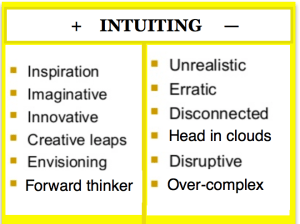
EXP: Those who find a new way of doing something / think about future implications for a current action / ‘get’ the underlying meaning in what people say or do / see the big picture….

NOTE: Of the 4 dichotomies, at their extremes these 2 opposites cause the most emotional difficulty in any relationship. Such people tend to be highly frustrated by & may even feel disdain for each other’s style. It can be particularly painful for a sensitive child -strongly NF- to be raised by a mother who is strongly ST.

Ns use the same concrete / real-world experiences to ‘see’ things as Ss, but much of it is subliminal, so they can’t always put into words how they reached conclusions – they just know.
✓ To the S this is hocus-pocus, since they don’t trust anything they don’t gather from their own experience or from empirical research, & which can be clearly, logically verbalized.3. THINKING (T) vs FEELING (F)
Preferred way of coming to DECISIONS.
 Can be either Introverted or Extroverted (Ti or Te / Fi or Fe) , & each is part of the Perceiving style
We all use both forms, but put more trust in one, some decisions being made entirely from the T or the F side.

What makes some Decisions very difficult is when there’s an intense conflict between head & heart (T & F), in which case our dominant preference will win.
Easier decisions, the ones that feel good, are usually the result of our T & F sides being ‘on the same page’ (in agreement).

• Thinking (T) – These are the analytical/ logic types – but does not indicate how smart one is.  They tend to make decisions in a rational, impartial way, based on what they believe to be correct info, using pre-defined axioms & rules of behavior, as well as Fairness (everyone treated equally).
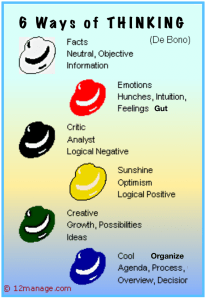
Ts assess & analyze whether the info received makes sense & whether or not something works – such as the concept of gravity. Then decisions come from using cause/effect, if/then, true/false choices to for validity.

EXP: Those who research a product via Consumer Reports, buy the best one to meet their needs, whether or not they like it, do the ‘Right Thing’, form guidelines to follow for performing tasks ….   (Re. HATS ➡️ )

— 💛 —
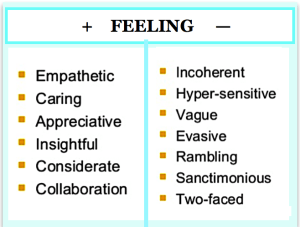
• Feeling (F)
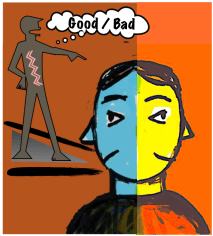
– The importance of info is determine holistically, & perceptions are evaluated based on a sense of harmony, to maintain peace. It’s about making value judgements – whether things are good or bad.
EXP: The person who ‘Feels’ that stealing is right/wrong
NOTE: This MBTI category is not about emotion, but rather a reasoning process handled in the higher brain (cortex). Contrast this with the inner brain’s limbic system which responds to stimuli we (call) experience as emotion.
‘Feelers’ are more empathic (pick up on others’ emotions), make subjective decisions on a case-by-case basis, & use feelings they believe to be right rooted in their own values. Here ‘Fairness’ means that individuals is treated equally.

EXP: When we – buy something because we like it / don’t say something that ‘ll upset another person / decide not to take a job because we don’t like the work environment / decide to move somewhere new to be close to someone we care about….

NOTE:  The Thinking – Feeling level is the only one that generates a gender bias.
The Thinking Woman swims against the current in most areas of life, especially at work. If she’s decisive & objective — she’s branded hard, cold, unfeminine……
The Feeling Male is also disrespected – called soft, weak, a pushover …… for having a caring nature.

NEXT: Intro- Extra-verts

Myers-Briggs INTRO (Part 2a)

PREVIOUS: MBTI Basics #1b

SITE: How Each Myers-Briggs Type Reacts to Stress (& Help!)

NOTE: Each dichotomy is on a continuum, from most….<— to —>most…..

OVERVIEW
The 2 ‘OUTER’  levels (E-I & J-P)

1. EXTROVERSION (E) vs INTROVERSION (I)
Where we prefer to put our ATTENTION, & get our energy from
Extroverts
focus on what’s happening in the real world around them – always in the present moment. Outward-oriented, Es get their mental energy by being around other people & in social situations. They think out loud, so can be quite talkative.

Strongly Extroverted people will gravitate to big events such as rock concerts, have season tickets to sporting events, go to big parties, conferences, loud family gatherings…. energized by conversations, excitement, noise, activities…… After a big events, they’ll look for the stimulation to continue, going on to another location &/or hanging out with friends

EXP: Es can get into a lively discussion or debate while paying attention to what everyone is saying / make a meal for a party / participate in a rally / play a group game / join a study group / lead a class …..
— 💋 —
• Introverts focus on what’s going on inside their mind, which can involve the past, present or future events. They’re usually more private, contained & a lot quieter than Es, but internally very ‘busy’. They get their mental energy from being alone, needing privacy to recharge, preferring to work through ideas by thinking about them first, before expressing them out loud. Large groups of any kind are draining.

Is still need & like people, but want their interactions to be a lot less noisy, less crowded & less chaotic. They can also be found at big events, along with the Es, but after all of that external input they can’t wait to get away & regroup in a quiet environment. If possible, they’ll leave early. And unless they really love it – or if work requires it or family insists – they’re not likely to repeat the experience.

Instead they do very well with 1 or 2 close friends or small groups, because their neuro-chemicals more sensitive. (See Posts ‘MBTI & the Brain’).

This characteristic even shows up in shopping – for an I to be in a store or mall with too many options to choose from  – like ‘Bed, Bath & Beyond’ – can feel just as confusing & overwhelming as being in a boisterous crowd (“Pick me, no pick me., no me…”) !!

EXP:  Is can get caught up in a good book / think about what they’re going to say or do / are aware of how they feel / daydream or imagine / think through a problem to understand it / review & process an interaction they’ve just had ….                                      4. JUDGING (J) vs PERCEIVING (P)
Preferred way of DEALING WITH the world around us,
& can be either Introverted or Extroverted

Judging (J) – These people prefer to be in charge, tend to be highly organized & methodical.
They’re neat, orderly, stable, & like to make extensive use of lists & calendars. They want things to be settled – so they plan & get things done way ahead of time.

EXP: Someone who form & expresses judgments / brings closure to an issue so they can move on / picks places to go ahead of time by doing research / concentrates on reaching goals & ‘doing’ their lists…..
— 👠 —
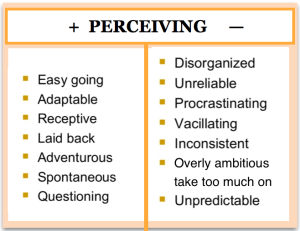
Perceiving (P) – These people prefer to let things play out by themself. They’re usually spontaneous & flexible, having a more open-ended approach to plans, deciding their next move in the moment, & tend to get things done at the last minute.
EXP: People who postpone decisions to see what other options are available / decide what else to do as we’re doing it, rather than forming a plan ahead of time / do things at the last minute / do a lot of research but not act on it because we can’t decide…..
NOTE: The practical differences between Js & Ps are quite noticeable & sometimes cause a lot of conflict.
EXP : A strongly J person can become very frustrated by a P’s careless casualness or indecisiveness, while a strong P can feel limited & controlled by a strong J , BUT even so will may make use of the J‘s extensive planning & preparedness (like on a trip), which can cause the J to feel angry for being taken advantage of!
On the other hand, a ‘mixed’ couple (one of each – friend, spouse, biz  partners…. ) can be complementary if they’re both mature enough to accept their different styles, & use those to accomplish mutual goals.

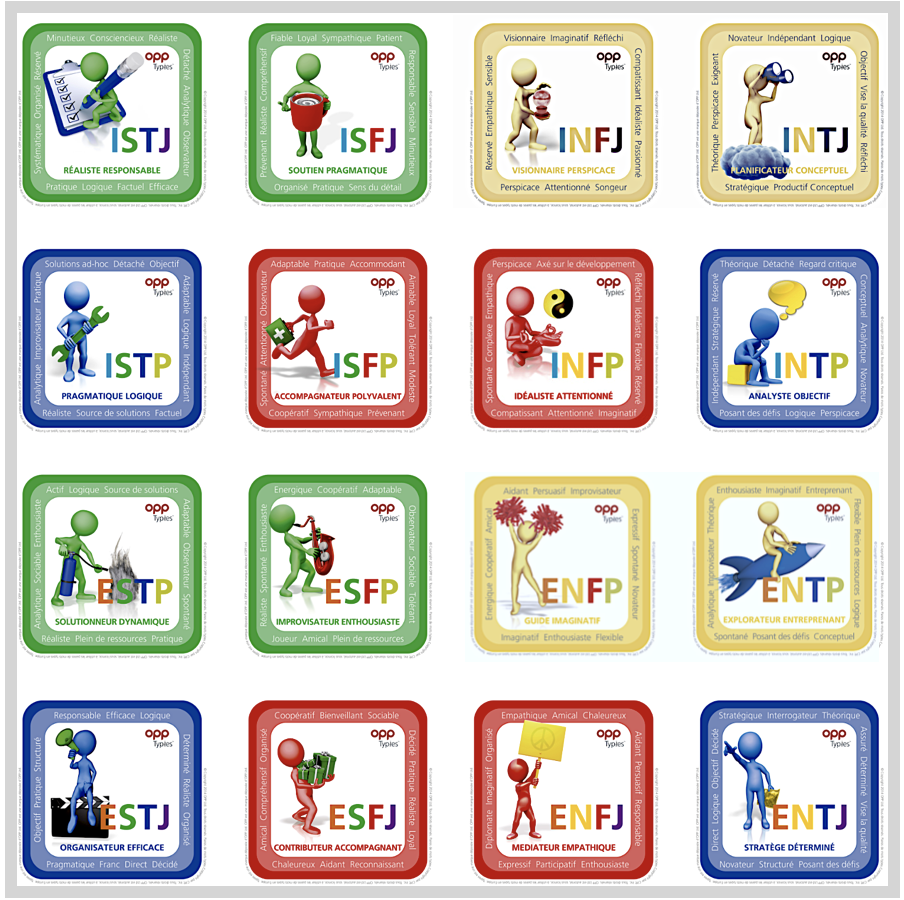
The 4 MBTI levels combine into 16 types, 8 Introverted & 8 Extroverted

«
 NEXT: MBTI Basics #2b

Psychological DISORDERS – Psychotic (Part 6)

I CAN’T TELL
what’s real any more!

PREVIOUS: Disorders 5c

SITE: 12 types of psychosis


3. PERSONALITY DISORDERS
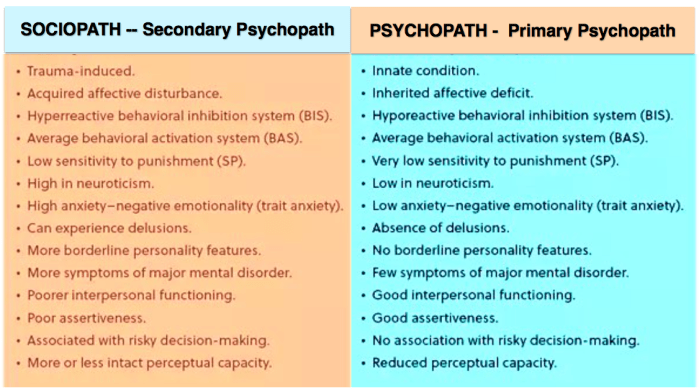
4. SOCIOPATHS & PSYCHOPATHS

5. PSYCHOTIC
Psychosis is a severe mental illness caused by a combination of inherited genes, & things a person has experienced or been exposed to in life (traumatic birth, poison, diseases of the nervous system such as epilepsy & Parkinson’s, syphilis, drug use, severe social changes/ traumatic events…..)

It’s a group of extreme disorders expressed in abnormal thinking & perception – a gradual inability to distinguish oneself from one’s surroundings, ie. losing touch with reality. Psychological defenses become overloaded by stress & the sufferer breaks down, making it hard to separate their thoughts & experiences from what’s going on outside of themself. The most common form is Schizophrenia. (See site above)

Psychosis may or may not be a part of other mental illnesses as well, such as Bipolar, suddenly after a major stress, post-partum depression (about 1 in every 1,000 mothers, within a few weeks after giving birth), when using or withdrawing from drugs….

People in the grip of psychotic disorders experience themselves & the world very differently from psychopaths & sociopaths, who are usually very grounded in reality, understand what they’re doing & the consequences of their actions, but just don’t care.
EXP: A psychopath or a sociopath might kill someone’s dog because they want to cause emotional trauma to the owner
• A psychotic might kill the dog because they thought it was robot sent to take over the world

While it’s not so easy for a person with a psychotic disorder to recognizing their own symptoms, they are acutely aware of experiencing pain & fear, which may cause the person to hurt themself or others. It can be a one-time ‘break’, episodic, or long-term.
As of 2023, around 3% of the people of the United States experience at least one psychotic episode during their lives, mostly teenagers & young adults  (about 100,000 every year)

Disordered thinking
Delusions – fixed beliefs & ideas that are usually false, including religious or persecutory, or a false belief of superiority.
EXP: convinced someone’s plotting against them, that the TV is sending secret messages, seeing a ‘spiritual’ entity, being watched by the police because of the way cars are parked outside the house…..
Thoughts are confused, blurred or difficult to express, can seem to speed up or slow down, or a belief that thoughts aren’t their own. They have memory loss or amnesia, trouble concentrating, following a conversation

Speech is often rapid & frenzied, slurred or jumbled (word-salad)
Suspiciousness – being worried or even scared of everyone they know, including family & friends. Feel uneasy without knowing why
Superstition – belief in the unreal includes: confusion about dreams, thinking that others can read their mind, frequently experiencing déjà vu, thinking that small random events have meaningful connections, & often come up with far-fetched theories about why things happen

Disordered behavior
Physical – disorganized or compulsive behavior, repetitive movements, self-harming, slow movement in activity, or lack of restraint
Reactions can be infantile, prone to insults & swearing. They forget self-care such personal hygiene & housework, will be disoriented
Social impairment – isolated, trouble with social situations, don’t conform to behavioral standards or respond correctly to social cues

Exaggerated /unreal experiences
Hallucinations – false perceptions, affecting the 5 senses, experience more intensely what’s real.  Hear, see, feel something that’s not there, which can cause fear & paranoia
EXP: Interpret everyday sounds as having new or special meaning, hear something louder than it actually is, shadows are seen as human figures…..

Hypochondria an irrational / exaggerated fear of having or getting a disease or illness, causing them health-related anxiety, constantly looking for symptoms, or anything that might harm their health.

Mood changes
Emotions – general discontent, lack of normal emotional responses, loss of interest or pleasure in activities. Tendency to be irritable & aggressive, including anger, anxiety, apathy, feeling detached from self,  inappropriate emotional responses such as easily agitated when being talked to

Shifts in mood often throughout the day, in 2 phases: a manic period (high), feeling happy & energized — followed by low mood, feeling sad & dull, with loss of appetite or trouble sleeping.

NEXT : Myers-Briggs – INTRO

Psychological DISORDERS – Psychopathy (Part 5b)

I HAVE TO STAY AWAY
from the ones who don’t care

PREVIOUS: Disorders #5a

SITEs: “Confessions of a Sociopath…..

• When a Christian meets a Sociopath
(excellent info for anyone spiritually oriented, no matter of what ‘faith’)


3. PERSONALITY DISORDERS

4a. SOCIOPATHS (Ss) (cont.)
(S) GENERAL
• an excellent story-teller, presenting self as the hero with high standards
• can easily manipulate good-hearted but unwary people into feeling sorry for them / worried & afraid / guilty / confused / ‘crazy’
• easily bored & needs constant stimulation
• fun, entertaining, super polite when meeting people
• gives the impression everyone owes them (you)

• has several short-term relationships or marriages
• impulsive, irresponsible, sexually promiscuous
• is a user, taking a lot from & giving back very little
• lacks realistic long-term goals, always scheming but often failing
• never takes responsibility, & turns the blame back on others 
• takes advantage of kindness & empathy, never apologizes
AND : sometimes you suspect they don’t really care about you!

SITEs: “S. def & signs” // “4 Phrases S. use to kill your confidence

(S) EMOTIONALLY
• are volatile – prone to emotional outbursts, including fits of rage
• can be too anxious, leading some to isolate themself
• can feel some caring & guilt, but aren’t strong enough to prevent their impulsivity & erratic behavior (unreliable)
Many writers say that Ss can’t make emotional connections at all, & this is true to some extent, but is usually when Ss& PSs are lumped together. Ss do not have respect for society in general, & won’t feel guilty when harming a stranger or breaking the law in any form.

However, some Ss can become attached & develop loyalty to a like-minded person or group (mentor, gang, parent they’re symbiotic with – no matter how abusive….), so the S. may feel remorse if they do something to hurt those special ones.

(S) SOCIALLY
Sociopaths’ disturbing traits may have been visible from childhood in acts of cruelty to animals, property or people. They make up about 4% of the world’s population – individuals who ruin lives, causing extreme emotional trauma – simply because they don’t care. They disrupt relationships, creating emotional & financial crises. At worst they perpetrate vandalism, theft, rape or murder.

Sociopaths know exactly what they’re doing & know the difference between right & wrongtechnically – but can’t judge the morality of a situation because their inner ‘compass’ is so skewed. They’re social predators who exploit just about everyone they deal with, altho’ most never kill anyone. They have no heart, no conscience & no remorse. Even tho’ their attitude toward others is not necessarily malicious, the outcome of they behavior is, since they treat people as objects.

The very clever ones make great con-men & women, able to act sincere in ways that fool others into believing they both have the same values. Instead, they’re conniving, deceitful, often pathological liars, despite seeming trustworthy & sincere. Without empathy, they take no responsibility for their actions, & can easily turn the tables, without guilt or shame, accusing the other person for causing their own misery.

They are great actors who can mimic emotion & empathy, masters at superficial pleasantness & manipulation – but instinctively rule by fear, at home or at work. This is why they can be so successful in their career – it helps to look the part while not really caring about other people’s feelings. Alternating between being charming & terrorizing, family or work staff are too intimidated to point out their abusiveness or to stand up to them. It’s theorized that the top of the corporate food chain has a higher than average number of sociopathy than in the general population. (MORE…..)

Since sociopaths (& psychopaths) are absolutely sure there’s nothing wrong with them, they are not ‘curable’ – so it’s a waste of time to try. The only option in dealing with them is to insist on putting limits on their actions, OR just staying out of their away.
SITEs: “How to beat a S. at their own dating game
• “6 things to know about dating a sociopath”
5 Things Ps & Narc. do in conversation 

💭  ❎  🗯️
4b. PSYCHOPATHS –
MAIN TRAIT
• “The LIE  (the more elaborate, the better) is the primary weapon used to snare their victims, & the inner justification for their right to cause harm. (like Bernie Madoff)
To a PS, lying is as easy as breathing, since they have no physiological reaction to thinking or expressing falsehoods (no blushing, heart racing, sweating). When caught, they just create more ‘stories’. They can be Narcissist, Victim, Con-artist or Professionals (politics, religion, sales….. )”  Continued in 5c
SEE posts Red Flags from PSs

NEXT: Disorders #5c

Psychological DISORDERS – Neuroses (3c)


MY CHARACTER DEFECTS
are just twisted versions of the True me!

PREVIOUS: Disorders #3b


1. HEALTHY


2. NEUROSES
 – Different  Perspective (cont) a. Enneagram  //  b. Trauma

c. Transactional Analysis  – The IMPASSE
Def : 
A road or passage having no exit, as a cul-de-sac
A situation so difficult that no progress can be made. Deadlock/stalemate

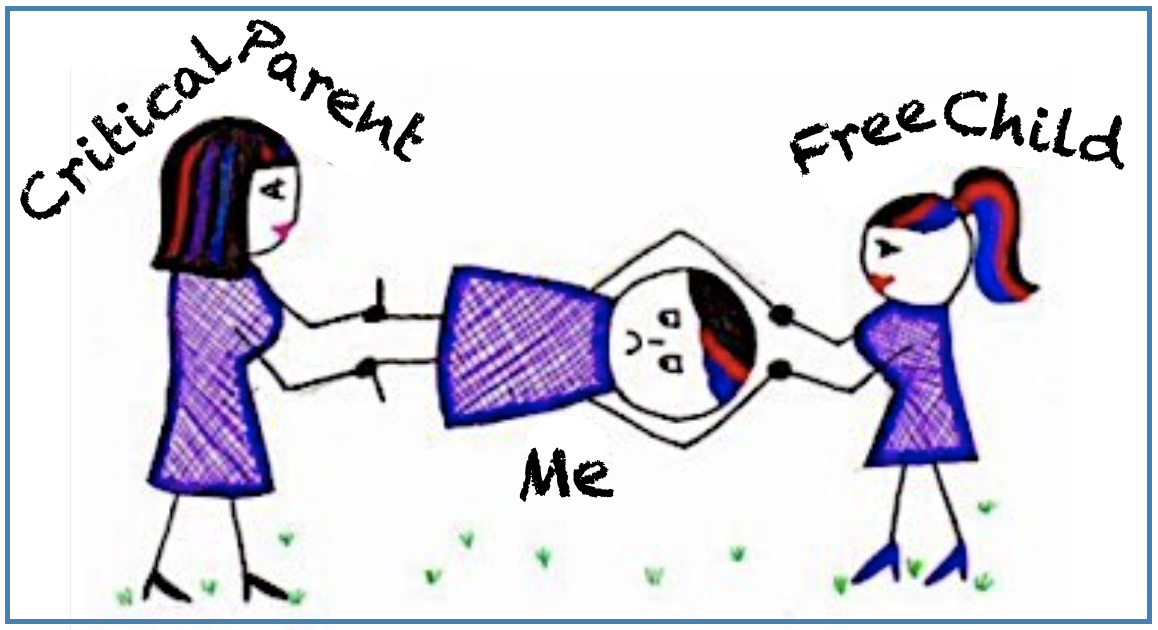
In psychological terms, impasses are formed at Type 1, 2 & 3 developmental stages in childhood ⬇️, when script-decisions are made. Scripts – our unconscious plan for life /internal ‘story’ – are usually based on unmet needs & abuse.
This causes inner conflicts between one’s Parent & Child ego states, & usually experienced by the child first as a personal failure – an internalized sense of inadequacy. Scripts are presented by, repeated & reinforced by parents, wider family & society —

— in some cases positive, but most often harmful. (Gouldings’ 12 script themes – similar to ACoA Toxic Rules)   ✥ This shows the power & active participation of children in their own development.

As adults, we all carry a representation (model) of the world & ourself – where we belong, how we fit in, our work & how we do it, & where we’re headed. If the source of this model comes from a dysfunctional family, it will always fall short of dynamic, ever-changing reality, limiting our S & I growth.  An impasse (being stuck in some area of life) indicates a need for change in order to move forward.
✺ The different intensities of psychological disorders represent various stages & intensities of impasse. (MORE...)

CHART : 3 developmental stages of conflicts between inner Parent (P) & Child (C)
✓ 3rd degree impasse (Po-Co: Birth to 6 months, pre-verbal, even pre-natal)

These earliest conflicts come from the type of connection between mother & child, depending on how they relate day after day. Conflicts will be around the issue of survival, between: abandonment & engulfment, destroying or being destroyed, worth & worthlessness….

EXPIf the mother has an unhealed WIC – stuck in her own impasse – her wounds get communicated to the baby, day after day. If she is insensitive, controlling or brutal – the effect on the baby is predictable.
However – much more difficult to identify later on –  is if h
er grown up Adult & Parent parts are used to activate, even improve her parenting style, but without Recovery her behavior won’t have any affect on her little C1 ego state. No matter how she tries to cover it up, her deepest damage will unconsciously keep re-traumatizing the baby. 

A depressed or angry mother can ‘responsibly’ feed & look after her baby son every day, but he knows / senses his mother is emotionally bereft. He intuits (or is told) that he needs to take care of her – all focus must be on her instead of his own feelings & needs – OR ELSE she may somehow leave (die). So he feels unworthy to be taken care of & worthless for not being able to help her, which causes intense anxiety. So he slowly develops defensive patterns like people-pleasing / isolation / addictions…., which form his False Self.

As an adult,
this earliest impasse continues as deep-seated conflicts in PMES forms such as muscle tension, psychosomatic complaints, immune disorders…. & expressed verbally in symbolic images, such as “I feel as if I’m in a fog, lost, cold & alone, there’s a wall up between me & everyone else” …. 

 ✓ 2 degree impasse (P1-C1:  6 mths – 6 yrs)
Made up of Injunctions (authoritative parental orders) carried by the child’s feelings /emotions. They become internalized, often through non-verbal comman
ds, at a time when the child has only a basic grasp of language. Script-decisions made are basic theme about the child’s identity, such as: “Who am I? // Am I important? // Don’t grow up // Don’t feel”…..
Later on, it’s much harder to remember how these issues developed, so the person usually doesn’t know they’re stuck back there

1 degree impasse (P2-C2 : 6+ yrs old, when they can understand language)
The struggle here is between what the child should & should not do, what behaviors are socially acceptable or not. Internalized verbal
instructions (counter-injunctions) will be things like: “Please others // Always try hard // Be a good boy or good girl // Never get angry”….. These are more accessible to awareness, so later on it’s easier to remember who gave them & in what form. (More….  in ‘Ego States’ posts).

BREAKING the Impasse – options
When the Bad Parent is so strong that it keeps the messages in place, the person gives in & continues to live by the original ‘rules’, keeping the Healthy Child bound.
HOWEVER –
a. When the person’s Wounded Child refuses to go along with its Bad Parent’s messages & is finally allowed to get angry, it liberates the Healthy / Free Child
b. The Bad Parent’s injunctions are agreed with, but the Healthy Child’s needs are ‘redefined’, often in humorous terms. Then both sides win.
EXP = Parent voice: “You’re crazy”  Child: “I may be crazy, but I’m never boring!”:)

NEXT: Disorders #4a

Psychological DISORDERS – ACoAs (Part 2b)

I ENVY OTHERS WHO
easily know how to function

PREVIOUS: Disorders #2a

SITEs : • Help with Organizing your mind

Psychological Disorders:  PowerPoints with Video Links & Lecture Notes
(To purchase. For teachers)

⬅️ IMAGE  : Truman College Wellness Center
UNHEALTHY
Psychiatrist Otto Kernberg (Object Relations Theory) wrote that someone is mentally healthy if they have a well-organized personality, which functions reasonably well because their reality testing is mostly intact. Such people have an integrated sense of Self, with an accurate Self-to-Other concept. This helps to hold opposite feelings about someone – at the same time – without changing one’s realistic opinion of them. (not B or W) . Everyone is experienced as a ‘whole’ entity, with both positive & negative qualities.
NOTE: This does not mean we like everyone!

Using the criterion of personality organization, Dr. Kernberg marked 3 degrees of dysfunctional severity: Neurotic, Borderline & Psychotic states. The more mentally & emotionally disorganized, the worse the person’s functioning. To evaluate, ASK :
1) Is my reality-testing intact? (Explanations)
2) Do I have an integrated sense of self & others?
3) What is the maturity level of my defenses?

ACoAs fall into any one of the Mental Health Levels, depending on the individual’s native personality, the amount of trauma suffered, social environment & spiritual beliefs.  However, all are wounded in some form. Unrecovered, most of us think that our usual way of being is our actual personality (who we were born as) because it’s how we’ve been since childhood.
But anyone growing up in a very damaging family forms a False Self as protection, which combines PP & WIC, & houses the different disorders. Because of living thru’ years of trauma, many ACoAs have a fragmented sense of Self  (not about multiple personality or schizophrenic dissociation).

Our wounded mind stores separate split-off images of ourself & others as being either all bad or all good at any given moment, based on a current event. So, when someone we think we know well and rely on to feel safe is sometimes nice to us & then turns on us at other times (parents, a mate, best friend….), we’re shocked & confused.
When that happens, the WIC actually thinks they’ve now become a totally different person – rather than realizing we’re dealing with one being who’s showing different aspects of their (perhaps unhealthy) personality.

▪️Most of the time it’s actually our internal experience of someone that has changed – in response to their current behavior or mood. This is a reflection of our own B & W thinking, usually believing ourself to be ‘all bad’ & others as ‘all good’. So when they become the ‘bad one’, we get scared. The WIC doesn’t realize that it’s normal to have inconsistencies & accept that the person is still the same, but complex. This distortion prevents us from holding a consistent sense of Self & others across time & in a variety of situations.

EXP: If you smile & are friendly to me, you are a totally good person – in that moment – who I like & feel safe with. If at some other time you hurt my feelings or ignore me, you are then a totally bad person – in that moment – so I absolutely don’t feel safe with you, and blame myself for what happened.

😟 As a way of coping, the brain compartmentalizes traumatic experiences to keep us from feeling too much pain (physical &/or emotional) – creating a dissociation, spacing out. A part of our attention is missing, so we don’t recognize what we’re feeling, not noticing or hearing things around us, or that’s right in front of us all the time.
What’s missing is a connection to some or all of our emotions.

NOTE:  ACoAs can develop mental health by getting the right help & consistency using all the tools available throughout life. With FoO work, most can improve if not totally heal, but not all wounded people are willing to go thru the process needed to Recover.

(CHAT BOT – talk to computer re. moods (Woebot on Facebook Messenger)
«

«
NEXT: Disorders #3a

COMMUNICATION Categories – Ways (Part 6)

NOBODY SEEMS
to be listening to me!

PREVIOUS: Comm categories #5


CATEGORIZING Communication (Comm) cont.
7a. Re. Mechanical Networks  /// 7b. Re. Human Networks  

8. Re. WAYS to ENGAGE in communication
Level 1: Messages into the Ether
Snail mail, email & texting have some things in common. They’re sent out, & a response can sometimes take days or weeks. Since they’re not conversational (back & forth) there can be a high level of misunderstanding, possibly leading to hurt feelings, even fights.

Level 2: Back & forth Messaging
It’s conversational, but still done remotely (IM, text….). Such exchanges are more casual & direct, so confusion is less likely, since one or both can catch distortions or misses with each reply.
However, its bite-size style means it’s not well-suited to discussing complex issues.

Level 3: A Verbal Dialogue
Here participants get to express their opinions directly, plus adding a whole layer of implied info via Para-language. These can hint at excitement, pleasure, peacefulness OR annoyance, frustration, stress…. that are harder to detect in writing. A drawback is that they often require scheduling, but sometimes things need to be cleared up quickly via phone.

Level 4: In-Person Spontaneous Discussion
When something important comes up unexpectedly, we might decide to get together with the others person. Spontaneous discussions can be effective for problem-solving, getting an immediate need met or making a plan. Benefits come from adding a new level of mutual understanding & co-operation. But it doesn’t always work – discomfort with spontaneity, lack of privacy, the other person being too busy or not in the mood…. can get in the way.

Level 5: In-Person Scheduled Discussion
What makes this level special is the mutual agreement to set time aside.
Planning doedn’t have to make the meeting Formal, but gives both parties time to think about the topic. Successful & dynamic interactions (Zoom, Skype, FaceTime… OR office conference, private dinner….) come from combining self-awareness, non-verbal intelligence & privacy, to ensure comfort & trust. (From )

VALUE: Observing admired leaders, we can see that good comm. judgment is very important to their success.
EXP:  knowing what
can be done at Level 2, versus what must be done at Level 5 – & doing it – is a sign of sound leadership instinct, as well as knowing what to expect in personal relationships.

9. Re. PMES Categories
✒︎SOCIAL
: Talking about anything of mutual interest – world news, sports, weather…. It’s superficial but truly useful, allowing us to function among acquaintances & strangers without burdening them with TMI about our life.  It also helps determine whether someone is neutral, a potential friend or enemy

✒︎MENTAL: Talking about facts, helpful tips, ideas, non-controversial beliefs, plans & strategies, as in professional conversations. Unfortunately, some people go out of their way to be the ‘best’ at it, so that no one is smarter, wittier or more knowledgeable, & they never have to be wrong.

The distance between the first two levels is relatively short. Polite conversation can turn into a mentally stimulating one very quickly & then collapse back into small talk or none at all – without discomfort. Except for conversations with a controlling know-it-all, these two levels are safe.

✒︎EMOTIONAL: Here talk is about aspirations, fears, wants, needs & joys. Sometimes eyes well up, lips quiver, & the voice chokes. Other times those same eyes light up, heart pounds & words flow with joy, or fail from awe.

• The distance between #1 & 2 AND #3 is rather wide, because #3 requires intimacy, transparency, trust & vulnerability. Most of us are afraid of being wrong or looking foolish, & absolutely terrified of rejection.
Participating at this level opens us to possible rejection, hurt & being scarred. Over-all, this level is easier for women to navigate, partly because expressing emotions is more socially acceptable, & because a portion of women’s Corpus Callosum is thicker than men’s, perhaps allowing more access across the hemispheres emotions to be verbalized  (MORE….)

✒︎SPIRITUAL. This is the hardest to identify & describe, not only because our culture is so secular, but because few people are willing to drop down into the level of faith – for themselves – much less to speak of it to others.
It melts away push-pull, give-take win-lose, me-you. There are no distortions from emotional mental or social games, allowing for the highest level of resonance, creating an energetic embrace that sustains & heals.

‼️ Understanding all these forms of comm allows us to identify & then choose which is most appropriate for any given situation.
It can be too easy to go down the path of least resistance, but that can get us into trouble, so it’s important to be more thoughtful about how & when we communicate.
It’s better to do it the right way – focusing on our goals & using whichever level will help us get there.

NEXT: Psych Disorders #1

COMMUNICATION Categories – Informal (Part 5)


IT HELPS TO KNOW
what the rules are

PREVIOUS: Comm. #4

SITE: “….How Relationships influence Behavior”

⬅️”BUSINESS MEETING
designed & created by DMT


CATEGORIES of Communication
(Comm) cont…
5. Who / 6. Structure / 7a. Mechanical Networks

7b. Re. HUMAN Networks  (biz, academia, military, even family)
The form of an organization’s comm. networks dictates the method & speed that ideas flow between managers & employees (parents & children). Flow efficiency can be checked by looking at : Nature of task, Leader emergence, Group satisfaction, & Speed of work

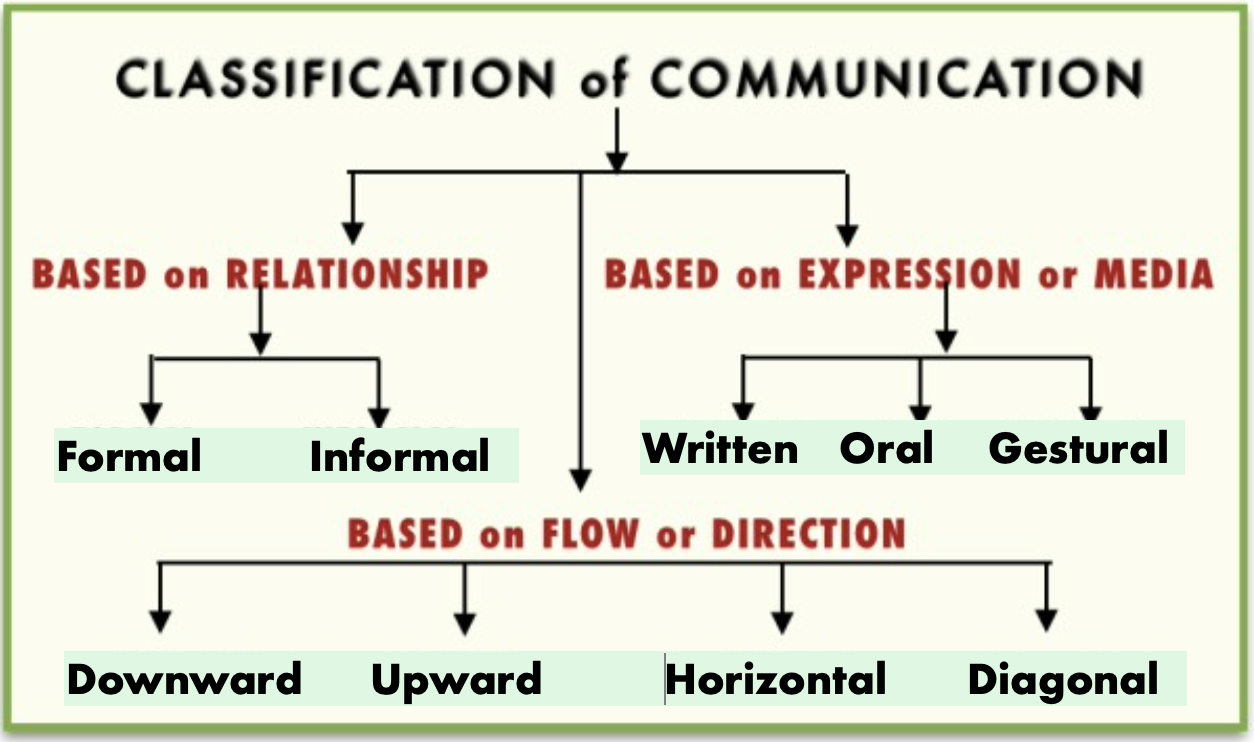
a. MEDIA – Written, oral & gestural. see Part 2

b. DIRECTION
• Vertical comm. – Info is passed between different levels of organizational hierarchy. Orders move down from the top through a formal chain of command, to the person or group who will carry them out. Responses (obedience) & collected info (research….) flow up to the top for review & decision-making

• Horizontal (lateral) Comm. is between any two parts of the organization at the same level – between 2 people, divisions or departments – allowing a greater degree of informality. The purpose is to co-ordinate the activities of the various ‘units’

• Diagonal – Sharing info among different structural levels. This term was introduced to capture the new comm. challenges associated with new organizational forms, such as matrix & project-based businesses.
EXP: It’s when higher level management works with a lower level to tell them about a change in work/ goal objectives (we’re going to grandma’s instead of the mall)

c. RELATIONSHIP (channel)
i. FORMAL Networks
➤ CENTRALIZED
This is when one group member has access to more comm. channels than any other, & so tends to use more info than others in that group, sent out to others based on status & hierarchy.  (Older sibling to younger)
EXP: The boss needs to deal with any negative grapevine comm., or employees will believe the rumors to be fact

• Wheel  – most centralized form, where all info flows from the leader, & other members have little or no comm. link with each other. Here, the boss deliberately controls comm., making sure their wishes reach everyone

• Chain (scalar): People comm. in a set sequence, via the line of command….. proceeding from A to B, B to C ….. or in reverse. This type is slow but carries the most authentic communication

➤ DECENTRALIZED
Here all group members have access to the same number of channels. Info is comm. by any person on the hierarchy scale & can be accessed by other employees. Research shows that decentralized networks or organizations perform better, & have more satisfied members (regular family group ‘conferences’)

• Circle – Here the info is shared equally among all members. Each person gives & receives info from two or more others in the network

• Star – Comm. revolve around a central point. Each person in the outer branches of the star passes on a message to a central authority, who then distributes it to the other participants. A must for groups to promote teamwork, but can limit or inhibit ease of comm. between members

• Inverted “V” – Here subordinates are allowed to comm. with their immediate superior, as well as with that boss’s boss – but it’s effectiveness is limited

• Common (Free-flow / All-channel)the most decentralized, where everyone is connected to each other, so info can flow freely from anywhere in the organization (a commune?)

ii. INFORMAL
Usually deals with interpersonal, horizontal comm. Traditionally it was considered a potential hindrance to effective performance, but that’s no longer true. However, leaders of modern organizations see it as an important way to ensure effective conduct in employees

Informal comm. is via the grapevine, represented by sociograms. These are important since they’re a large part of daily comm. Friendship, usage & efficiency are 3 important parts :

• Single strand
Info flows from one person to the next, until it reaches everyone ….. but generally a less reliable or accurate way to pass on the message. However, it can effectively for urgent / emergency news

• Gossip Chain
There’s usually a central person who looks for, finds & then passes on info to all other members directly (water cooler, lunchtime…..), often used when the topic is not job-related

• Probability Chain
Info passes randomly from persons to persons – when it’s interesting but not important

• Cluster Chain
The most common type – where a person who is the source of a message passes info to a pre-selected group, out of which a few individuals repeat it to other selected groups – until the whole network is covered, like a telephone tree.

NEXT: Comm #6

RED FLAGS from Psychopaths (Part 2)

LISTEN TO PATTERN
of their conversation

PREVIOUS: Red Flags #1

BOOK HOW to TAKE REVENGE on a NARCISSIST: Take your power back by using their secret techniques 

List BASED ON: “30 Red Flags of Manipulative People”


1. RELATIONAL Manipulation (Part 1)

2. SOCIAL Manipulation
Boredom – They focus more on their new activity & ignore other ones with you. They don’t seem to care when you’re not nearby, since they can just as easily move on to the next source of energy

Comparing you with everyone else in their life, including your eventual replacement. When idealizing you, you feel very special by being told how much better you are than ‘these’ people. Later, when devaluing you, they use these comparisons to cut you down

Communicating – texts you dozens of times a day, adding compliments, flattery, songs & poems on Facebook….  You come to rely on this flood of attention as a source of self-confidence

Denouncing – they seem to have an unusual amount of crazies in their past. They bad-mouth previous business execs & personal relationships who ‘abandoned’ them, labeling those people as disloyal, jealous, bipolar, alcoholic….  They’ll trash-talk about you the same way to their next target

Exes, Exes, Exes – it’s the psychopath’s favorite topic of conversation & you’re stuck listening about previous relationships all the time – their names & everything that happened between them – but only the psychopath’s version

In Demand – they surround themselves with former lovers & potential mates, bragging that their exes still want to sleep with him/her, but assures you not to worry. You feel jealous, believing your partner is in high demand

• Isolating – If you try to keep up ties with family & friends outside your relationship, they will be sure to undermine each one until you’re severed. And if you work hard to foster inner peace in your life, they’ll make it their mission to destroy every avenue or tool you try to use

Mind reading. Psychopaths expect you to always be able to know what they want or need, when they’re upset, when they don’t feel well, when they want you to do something – all without saying!

Rivalry – they shift their laser focus from you back to previously denounced exes, using social media to post ambiguous videos & status updates, old songs & inside jokes. They make you doubt your importance to them, but if called out will say it’s all innocent – that you’re paranoid.

Shape shifting. They adopt different personae for different people or groups, transforming their outward personality to match their audience. But sometimes they forget what role they’re playing with you, then slip & accidentally use the wrong mask. You begin to wonder – Who are they really?
Very eerie, but it’s not Multiple Personality Disorder. Each shift is conscious & cleverly molded – all to cover their inner emptiness.

3. GENERAL
• Blaming others – nothing is ever their fault. They spend all their time rationalizing & excusing their behavior rather than improving it

•  Dichotomy – they confuse you by acting like a swaggering street-smarts toughness, alternating with a little boy/girl ‘innocence’ routine (not real!).

• Fake goodness – they may create a ‘saintly’ aura by engaging in phony altruism (volunteering, donating, gift-giving…), & then can’t wait to boast about the great things they do for others – to gain your trust

•  Fake ‘tears’ – their emotions are shallow & short-lived.
— the’ve learned to copy emotions they see in others, so the mask rarely slips – unconsciously, when you get a feeling hint that something’s ‘off”
— you may catch flashes of contempt (feeling superior), unrelated to anything going at the moment. Micro-expressions leak their true opinions
— rage is one of the few Es they actually feel, but even so they can go from ranting to compete calm in a minute

• Fun – they actively search our extreme sports & dangerous activities, from a need to feel excitement via high risk & intensity. Anything from ‘BASE’ jumping to having sex in public, from juggling matches to carelessly cheating on a mate

Overwhelming selfishness – only their needs, desires, opinions, upsets… count

•  Talking style – on the one hand their speech is filled with ‘umm / er / uh’ s… maybe   needing the time or mental effort to come up with the next lie, ‘story’ or way to make a good impression
On the other hand – they can barrage you with endless (sometimes interesting) monologues, like being on stage, but ignore responses or interruptions

• TMI – they love to tell about shady & ‘dirty’ things they’ve done (business & sexual) – as if those were something to be proud of – while giving the impression that’s all in the past for them.    (Modified from “Identifying a Psychopath….”)

NEXT: Psychopath RED FLAGS #3

DEALING with P-As: Managing (Part 5)

I’LL DO WHAT I CAN
but it’s not all up to me!

PREVIOUS: Dealing with PAs – #4

SITE: Confronting P-A behavior
 re. resistance to being confronted = #4


OUR RESPONSES

Set limits, list consequences – then follow through.
CRUCIAL: Identify the P-A’s dysfunctional behavior, & then state what it will cost them to continue it – with you. It’s a powerful tool, throwing down the gauntlet. It says you’re not the pushover they’re used to dealing with. Their maneuvers are basically a power struggle – with the whole world, but especially against anyone they see as an authority figure – in relation to themselves (spouse, teacher, family member, church, governments….) . So you can’t let it pass.

One of the biggest mistakes Receivers make is to be much too lenient. Once you give in to the P-A’s pattern, you’ve lost the game they’re playing. Ignoring or going along with their tactics, or taking on their responsibilities, is enabling & encourage them to continue.

Although you don’t want to provoke an angry confrontation, you also don’t need to be the P-A’s punching bag. Make it clear you won’t tolerate being mistreated. It’s your right to set boundaries. This is equally true about their language & their non-actions, all of which are forms of abuse & therefore damaging to your relationship, & to work outcomes. For most of us it takes practice to be assertive, & sometimes even courage.

Offer one or more serious/ important consequences that you know will matter to the P-A . Said simply & calmly, it may make them think twice about their automatic reactions, & maybe encourage them to modify their behavior – shifting from obstruction to cooperation. READ  7  types of power that encourages positive change.

Make sure the punishment fits the crime. Because P-A patterns are so frustrating, consequences/punishments can quickly go overboard (like in the heat of the moment screaming “I’m never ever talking to you again!”). Taking a time-out for yourself can help you come up with the best response.
AND – you may need to talk to someone else you trust to give you another perspective – or just a word of encouragement to stay strong. There’s nothing weak or shameful in getting support.

EXP
: If this problem has gone on for too long – decide: Do I just need a break, or is it time to end the friendship altogether? / Is this person needed in this job, or should I fire them?….. OR – If someone is habitually late to meet you at an agreed upon time – after the 3rd or 4th time let them know that from now on that you’ll only wait 15 min. & then leave. Don’t keep waiting.

So no matter what their reaction is to being called out, as an Rs you need to stand pat about how much you’re willing to take going forward. Follow through on the limits you set – to let the P-A know you’re not willing to pay the price for their acting out.
If possible, give the P-A a chance to help solve the problem at hand, asking them for constructive, practical solutions that work for them, to improve or fix the situation (at work or at home). BUT if all you get are complaints & criticisms, don’t agree or disagree. Just say that you’ll keep what they said in mind, & go back to the point you were making.

Reinforce appropriate/good behavior – with the goal of increasing its frequency. It can be : punishing bad responses or rewarding good ones – which are harder so notice. So be on the lookout for positive changes – which include expressions of true emotions & any unhealthy tactic not done.

Decide when to detach or avoid the P-A completely. If you’ve given them every chance to ‘correct’, spoken to them reasonable, given them options &/or consequences – AND nothing changes – it’s perfectly reasonable to spend a lot less time with them or end the relationship. Sometimes this can be very difficult & painful, but you have to put your own well-being first. (Self-care)
However, if it’s a casual acquaintance – it’s easier to just avoid them.

What can help you deal with a P-A you care deeply about is to focus on their best qualities. Make a list & add to it if /when you see positive changes. Sometimes reinforcing the best in others will give them a reason to improve themselves.
NOTE: This does not apply to active addicts or other narcissists. Their S-H won’t allow for compliments & their acting-out can not be reinforced or excused.

NEXT: RED FLAGS in Psychopaths