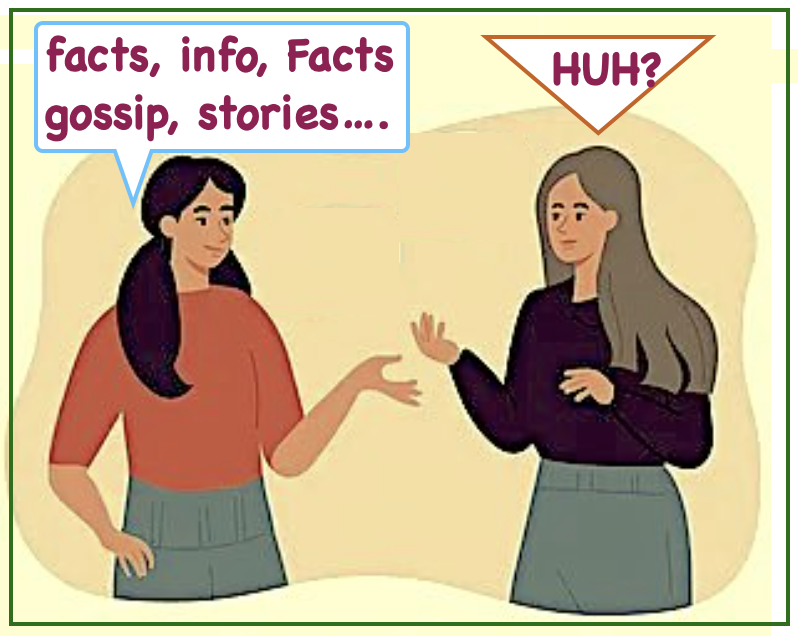
ACoAs Being Controlled (Part 4)

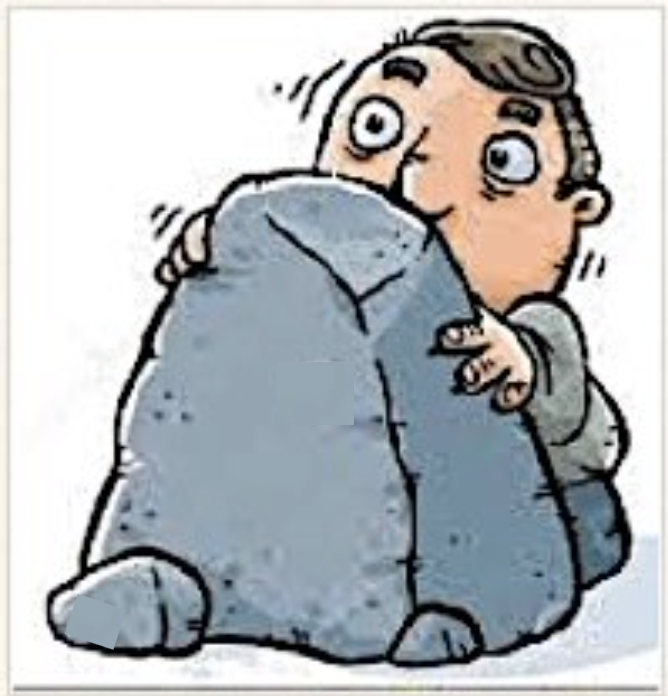
door matI FOLLOW ALL THE RULES,
so why am I still being walked on?

PREVIOUS: Being Controlled (#3)

SITE : Dealing with Manipulative people – from “In Sheep’s Clothing”

🎯 WHO / WHAT we LET Control us
Controlling patterns are the same as Emotional Abuse.  All but one of the following groups can influence us positively OR negatively. It’s up to us to know what suits us best & stick to it!

INNER DAMAGE – everything this blog covers. Also read “Bitchlifestyle” blog : Who Controls You, Your Bitch or Your Brat? (PP or WIC). The more we try to please everyone, we become:
• MORE angry, disorganized, exhausted, frantic, overwhelmed, unhappy
• LESS focused, rested, peaceful, satisfied, pleasant to be with
AND the fewer people we actually do please!

Letting ourself be controlled is giving our power away. Yet we think it will actually:
• GAIN us acceptance, love, continual attention, protection
• PREVENT being ignored, made fun of, punished or left. Unfortunately, it’s an illusion!

 THIS LIST is about how negative relationships can controls us :
CHILDREN – expressing your love for / attachment to them can go too far, being afraid to set boundaries or they won’t love you, or not teach them discipline so they won’t be angry at you

ENEMIESA) people who dislike or hate us for their own reasons. We didn’t cause it, but we can end up wasting way too much time, energy & money trying to win them over or placating them, instead of leaving them alone, praying for them or being neutral
-OR-
B) those we hate – which eats us up year after year – wasting time trying to get even, obsessing about telling them off (but never doing it), or actually putting nasty plans into motion

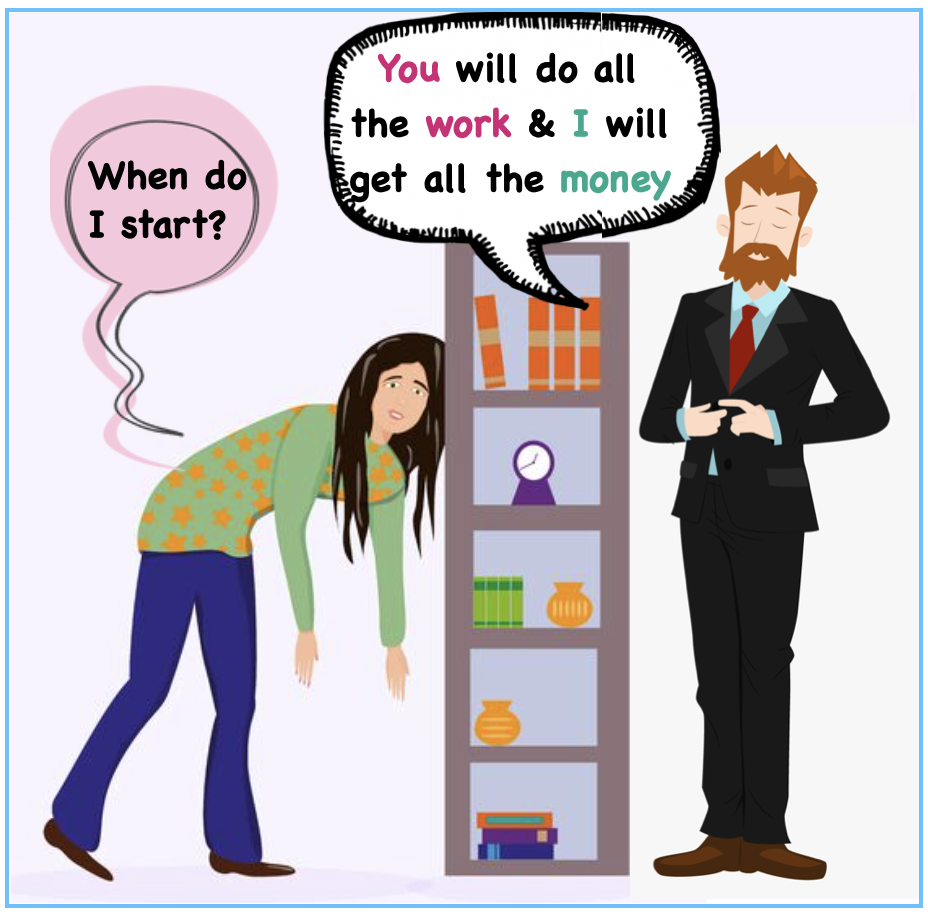
JOBs/ Bosses – their expectations, demands … especially the ones we think have to be fulfilled but actually are unreasonable. After all, aren’t we used to doing the impossible ? – or at least trying like crazy

NEMESES – (people we’re jealous of or in competition with) – we can do many foolish or self-defeating things to stay ahead of them or keep them from winning over us, whether the ‘prize’ is important to us or not. We become obsessed, over-work, cheat, connive, worry… just to shore up our weak ego

PARENTS – wanting their love & approval at any expense, we often twist into distorted versions of our True Self – & still never please them or get what we need from them (see Part 3)

PARTNERS – our fantasy beliefs about what a good relationship or marriage is supposed to be (especially that women have to be the ‘giver’) makes us into servants or slaves

PEERS / FRIENDS – trying to keep up with or out-do them, keep their approval, get their admiration, be in the ‘IN’ group, use them to____ ….

HEROES – because we don’t know the real person, they’re usually one-dimensional, yet we put them on pedestals – so they’re not fully human. We think we could / should be like them, but it’s not automatically true that if they can do or be something, we can too.

• And even if we follow their lead in some way, we may not be able to do it right away, or it may be a lot harder that we thought, or we may not have the same talent or resources…. which can leave us discouraged & self-hating.
We have to be realistic, without giving up, working toward goals that fit who we are!

• We may find positive qualities to emulate, but only with careful assessment & background research. THEY must be people:
— who are actively living the qualities you admire and fit your values, not just talking a good game
— you are genuinely similar to (not just matching damages). REMEMBER – Just because someone else can do or be something does not mean you can or should want to!

NO GUARANTEE:  Being psychologically healthy does not prevent damaged people from trying to hurt us. Also – we know there have been some good people in the public eye that have been vilified, even killed!
Self-esteem + correct info are our best protection – recognizing the people who are very unwell & removing ourself from them.

NEXT: Being Controlled (Part 5)

ACoAs Being Controlled (Part 2)
whisper controlI JUST KNOW SHE HATES MEshe didn’t even look at me today

PREVIOUS: Being Controlled (#1)

REVIEW posts: “Noticing Painful Events

SITE: Over-controlling Parents Irritate Adult Children


Our PARENTS still control our thought & emotions IF we
:
• feel guilty & afraid when we want to reduce contact with them or sever it all together
• spend time or talk to them more from obligation than choice
• find it hard to be emotionally separate from them (feel their Es for them, care too much, assume you know what they need…)

• FEEL intimidated or belittled by how they treat us:
— afraid to express our true E. & opinions to them
— get tense even thinking about being around them
— confused by their mixed messages & double binds
— feel disloyal when we act or feel differently than what they want
— are easily annoyed or impatient with them without knowing why

RESULTS of being over-controlled as a child, NOW 
Emotionally we
• expect everyone to hurt, judge or take advantage of us
• feel chronically empty or numb inside, easily bored, restless
• frantically try to avoid real or imagined abandonment – by clinging, people-pleasing, being invisible….
• are intimidated by or feel enraged at controlling people
• experience temporary dissociation (splitting), disconnecting from self or others
Mentally / Socially we
• feel like we’re always under scrutiny – even when alone
• perfectionistic, driven, rarely satisfied – especially with ourself
• keep isolated from shame & so ‘no one can hurt or leave us’
• lose ourselves in relationships by only considering others’ needs
• over- & then under-value people we get too close to
• find it hard to relax, laugh or be spontaneous

We HAVE:
Emotionally / Spiritually
• mood swings not caused by bipolar disease
• inappropriate & intense anger; difficulty controlling our temper
• trouble asserting ourself or feeling proud of our accomplishments
• trouble finding a spiritual belief, or one that feels right

Mentally / Behaviorally
• chronic obsessive thoughts, without trying solutions
• confused or distorted self-image: “Who am I really?” , “What do I really look like?” (ugly, fat, too thin too short….)
• paranoid thinking – as a usual way of experiencing others
WITH
• the harsh “inner critic” torturing us, especially after a loss
• impulsivity – can’t control our choices & reactions
• compulsive self-damaging behaviors in 2 or more areas of life (eating disorder, addictions, fights, under-achieving….)
• recurring suicidal thoughts or tries

Present-day CAUSES of ‘Abandonment’** PAIN 

• Abusive mate, adult-child, boss, friend, elderly parent
• Inaccurate, harsh, judgmental & prejudicial religious beliefs & leaders…
• Loss of a real or imagined beloved person, animal, thing or place
• Unkind or threatening communications (in any form)
• Unfair or abusive political & social laws, policies, rules.
** Technically, adults cannot be abandoned, unless they’re physically or mentally incapacitated, so the term applies to children.
🦋
MEN & CONTROL
Men who are unconsciously ruled by their unresolved Abandonment (A.) issues are fearful & insecure. They often use rage as a way to cover this up, since they know something’s wrong inside, but don’t know how to or refuse to uncover & deal with it.
In many cultures men are ‘allowed’ to be angry rather than sad, hurt & vulnerable.
Using the male stereotype of maintaining power, they may:
• be charming & clever, but manipulative & self-centered
• withdraw from everyone, to control themself
• control others by verbal, physical, sexual or psychological abuse …. to transfer their emotional pain onto others.

WOMEN & CONTROL
Woman usually have a greater capacity for awareness of their emotional states than men (see post on DIFFERENCES between M & F brains), but still need to learn how to handle them appropriately.  When unresolved A. issues overwhelm, women who haven’t learned to be in charge of their inner turmoil will instead turn to the external world for things they CAN control :
• themself – weight, clothes, shopping, obsessions, self-harm, chemicals…..
• others – jealousy, over-protectiveness, bossiness & nagging, fixing…..
Also, to ‘manage’ their pain they’re more likely to find others to hurt them. But while playing the victim role they can still do a lot of damage, to other adults & especially to their children.

BOOKs by J. Ray Rice:  “Thank You for Loving Me…” (originally for teens in treatment for Abandonment) and “What I Must Give Myself – First!”

NEXT: ACoAs being Controlled (#3)

ACoAs Being Controlled (Part 1)

beggingI’LL BE & DO WHAT EVER YOU WANT –
just don’t leave me!

PREVIOUS: “Controlling” & Abandonment (#2)

SITE: Recognizing…..Control” – extensive list of tactics used by Controllers

See ACRONYM page for abbrev.

BEING controlled by others
People who are easily controlled don’t know there’s a difference between –
a. Natural, appropriate authority. Being IN control is using our power in a positive way – for oneself, or as good leader. The person in control is the main decision-maker, in charge of communication & makes things happen. People choose to listen & follow appropriate authority because they want to learn, connect &/or be taken care of —
— vs.
b. Un-natural, abusive control (mental/emotional coercion). Controllers (Cs) misuse power – they force us to obey them, against our will. They have no regard for our rights, needs or individuality. They use their position to suppress our identity so only their’s is visible. Their main weapon is negative anger, aimed at making us afraid, so we’ll be more compliant

ACoAs ‘letting” ourself BE controlled
• Most ACoAs were negatively controlled as kids by very wounded parents & teachers, & without Recovery we continue playing out the victim role we were originally forced into.
As adults, allowing others to control us copies our earliest experiences. It keeps us symbiotically attached to the ‘source’ of our wounds & therefore emotionally immature, AND ‘protects’ us from having to face our own fear of intimacy (“ACoAs & Boundaries, Part 1 & 2”),
NOW
controlledFirst: We have to be around someone who is a controller – who belittles, embarrasses us in front of others, treats us like a child, tells us what to do or how to be….who is manipulative & intimidating, however subtly.

Second: We have to be available.  While dealing with such a person is unpleasant for anyone, for ACoAs it’s emotionally debilitating – but also emotionally addictive!  We fall into a black hole, regressed to an old familiar space of being a powerless child with no options. We’re trapped & become mute! We’ve been programmed to instantly surrender – as if we have no rights or identity of our own. And then we stay, & make excuses for the controller’s behavior!

T.E.A. (thoughts, emotions, actions)
Many teachers & groups insist that we choose to “feel” the way we do, which is an unfair judgment. Of course the word feel is being used to mean thoughts rather than emotions, which is confusing & harmful, as it leads to believing we should ‘control’ our Es! (see “Feelings Aren’t Facts”, & Using THINK, instead of Feel“)

This is not accurate or realistic. No one chooses their Es, only what we Think & how we Act! And even those are pre-programmed by family. Yes, sometimes changing Ts & As can shift our Es, but not always, especially not when the pain we’re feeling is old & therefore cumulative. That takes time to vent & process out of the body.

• Being controlled is the outward proof of Toxic Family Rules we internalized from childhood. And when we consider those beliefs (a sub-category of Thinking) we find them indeed very hard to change.
As adults — 
— allowing ourself to be controlled is not a conscious choice! It’s a knee jerk reaction to specific people or events that are carbon copies of our family experience.
— it’s a clear indication that capitulating to the will of another means our WIC is in charge

🩸To ‘accuse’ us of choosing to be manipulated (Action) or be miserable (Emotions)…. only adds to our S-H, & is in fact a subtle form of abuse & abandonment.

YES – we are responsible for changing our training – learning new ways of thinking & acting to take back the power we give away.
BUT we can only do this if WE:
— understand what’s actually going on inside
— have compassion for ourself (we didn’t cause the wounding)
— remember that changing deeply-etched brain patterns takes time
— learn what our needs are & use them to practice having boundaries
— ask for help whenever we need it, especially when regressed (child ego-state of being a victim, lost child, scapegoat…)
— develop & continually strengthen the Loving Parent voice

NEXT: ACoAs Being Controlled (Part 2)

‘Controlling’ & Abandonment (Part 2)

feelings
THOSE OLD FEELINGS –
give me acid-reflux!

Previous: Controlling & A. (Part 1)

Review Posts: My Rights – Qs
and
 ACoAs & Having Rights


LONG-TERM Abandonment (A.) experiences, especially in childhood, inevitably creates intense fear & shame in children. Total dependence on caretakers make them very vulnerable, so too much deprivation will feel life-threatening, & in some cases it is!  As terror grows, so does the compulsion grow to control oneself & the environment – to feel a little less unsafe by not being at the mercy of others.

EMOTIONAL A.  Children have to hide the parts of themselves not considered acceptable by the family (see the “Laundry List”) – to not get rejected. We were told what we felt was not true or legitimate, and DON’T make mistakes, have needs, be successful, show emotions …
We heard:  “You don’t have anything to cry about so stop being such a baby. Stop crying or I’ll really give you something to cry about. That really didn’t hurt. You have no right to be angry”…

• Ignored or punished childhood PMES needs cause developmental damage, the same as nutritional deficiencies, like sailors in the past who developed scurvy (internal bleeding, connective tissues weakness & sudden death) from lack of vitamin C in their diets during long trips.

For ACoAs, this will eventually show up as fear of taking appropriate risks, lack of trust, & fear of intimacy, not having a personal dream to follow, lack of healthy communication skills (how to talk to oneself kindly, how to make small talk, how to stand up for oneself), a weak sense of self…..

• Think of accumulated old A. pain (terror & rage) as acid, filling a deep well buried in our unconscious. We may not taste it all the time, but when it bubbles up it’s emotional heart-burn!  When someone or something bumps up against an unhealed wound in our psyche, the lid get blown off the reservoir, releasing a spurt of that old pain (like when – not getting a text back, a broken promise, being left out, accused wrongly or having to wait too long….)

OVER-CONTROLLED
Main hidden emotion is SELF-HATE
Not allowed to ‘be all you can be’ in our family, the very essence of our being was punished & rejected! Slowly we became controlling toward ourself, thinking this would please them

CONTROLLED
Main visible Emotion is FEAR
Not ‘being in our power’ makes us terribly vulnerable to everyone & everything round us, so it’s easy to let ourself be controlled, thinking we’ll be taken care of. All it gets us is more repression & damage

CONTROLLING
Main visible Emotion is ANGER
Not being internally ‘allowed’ to meet our needs pushes us to insist that others do it for us – any way they can. We desperately try to arrange our world to fit an ideal so we’ll feel safer.  We become the ‘control freak we hate so much in others!

BLAMING
In the present, ACoAs often accuse other adults of abandoning us when we feel hurt by some interaction or loss.  What we’re actually experiencing is the WIC’s unresolved old A. pain.
The intensity of our reaction is usually out of proportion to what’s actually happening – now.
Naturally there are real-life situations that make us sad, frustrated, angry… but unless an event is extreme (death of a loved one, a life-threatening attack or illness, a fire…), most situations don’t warrant our level of reaction. Remember “If it’s hysterical, it’s historical”

When others “A.” us: When someone we’re hungry to be with doesn’t respond right back – we feel S-H but also get very angry. We’re as devastated as if they had threatened to take away our livelihood or our home, which are NOT = to being ignored or put off. Yet we get just as scared & blame ourself, wanting to control them to stop the pain.

When we Abandon others: We also have great FoA when we aren’t perfect. Talking too much, asking questions, expressing strong emotions – or standing up for ourself! – are NOT = to punching them, yet ACoAs can feel the same anxiety & self-hate as if we had!  So we over-explain, withdraw or grovel – to stave off being abused &/or left like we originally were at home!

NEXT: ACoAs Being Controlled, #1

‘Controlling’ & Abandonment (Part 1)

baby controling I NEVER GOT WHAT I NEEDED –
so now I force it out of others!

PREVIOUS: Satir’sDISTRACTER Role


SEE
 Acronym PAGE for abbrev.


ABANDONMENT (A.) as SOURCE of Control Issues

• To understand being controlled or acting controlling, we have to know the underpinnings, which come from our original abandonment experiences.  In common usage, a person is said to be A. when someone physically leaves us – moving away, a break-up, divorce, long or repeated hospitalizations, death…..

However, based on ACoA experience we know this definition is too limited. When we observe little kids – ours or others’ – we notice how very needy they are.  This is perfectly normal, in spite of what we ACoAs were told growing up = that we were too much, too selfish, a bother, too sensitive, dramatic …. We got the clear message that at best we were being tolerated!

• A broader & more accurate definition of Abandonment (A.) is: “Not getting enough of our normal needs met in childhood”.  This includes all needs on each of the 4 levels of PMES – Physical, Mental, Emotional & Spiritual. We can also say that A. includes not being loved unconditionally, with the resulting loss of genuine connection to parents so crucial to a child’s sense of well-being & safety.sad/scared

• Picture all children as having 100 different needs in each of the PMES categories (total 400 – an arbitrary number, as example). Then consider the reality that in a severely dysfunctional family each kid only gets a small percentage of those needs met – just enough to survive. Of course some of us got more, while others didn’t even get that much & have died too young as a result!

Depending on birth order, gender & personality,  different siblings received differing amounts in each category. Certain children are favored because their ‘native’ style is similar to the parent, or rejected by the narcissists because the child was not like them!
But over all, most of us were only provided with 30 – 40% of our normal human needs – when we were the most fragile & in need of great care.

EXP: A pathological narcissist “mentally-oriented” father who incested each of his children in varying degrees, (4 boys & 1 girl) was slightly less abusive towards the one child who was also “mentally-oriented”.  This son is the only sibling who was able to forge a decent life for himself (as a doctor), but not without emotional scars. The others became addicts, severe under-achievers &/or criminals.

• With no validation & nowhere to process the emotional pain, it all goes underground & slowly eats away at us.   Toxic Beliefs then get ingrained.
As adults – these distorted rules combined with a great backlog of unmet needs –  has left us with an overwhelming desperation to be ‘fed’ by someone, anyone, along with the deep hopelessness of it ever happening. Pretending we don’t have needs, or suppressing our awareness of them does not make them go away. (Post: “Vicious cycle re needs“)

shadow sideSHADOW : To survive & not ‘go crazy”, many of those ignored childhood requirements get pushed into our ‘shadow’ – made up of every part of ourself that we were taught were so awful – so we have to deny their very existence.

In Jungian psychology the shadow aspect is a part of the unconscious mind consisting of repressed weaknesses, instincts & shortcomings…. “Everyone carries a shadow, & the less it is embodied in the individual’s conscious life, the blacker & denser it is.
It may be (in part) one’s link to more primitive animal instincts, which are superseded during early childhood by the conscious mind” (Jung-Myers Model + A Case Study & chart)

➼ Unfortunately for us, ACoAs not only relegate our ‘unpleasant’ aspects (such as the ‘7 Deadly Sins’) to Shadow, but also many of our good qualities – anything that was not allowed in our family!

We become so terrified of these aspects & activities, that we use a wide variety of defenses & addictions to keep them hidden.  But the more we suppress legitimate needs the more anxiety builds. Sooner or later they leak out or erupt in distorted ways, like being clingy, ‘invisible’, manipulative, irresponsible, vague, needy….. AND/ OR controlling, mean, demanding, domineering, promiscuous, pushy…
Sad IRONY: The more we suppress – the needier (& meaner) we get!

NEXT: Controlling & A. (Part 2)

Satir’s DISTRACTER Role

distracter

I ALWAYS KEEP THINGS LIGHT
so nobody can be upset with me!

PREVIOUS: COMPUTER Role

SITE: Communication Styles & Roles


4. DISTRACTERS
 (D) – a Twisted form of Spontaneity
STYLE: 0.5% of people will typically use this defense. THEY :
• are often unfocused, what they say or do is un-related to what’s actually going on
• at first they seem like a lot of fun, but gradually one notices that everything they do is not quite relevant, not quite to the point
• become easily confused when stressed, don’t know what to do, so grasp at straws instead of doing something positive
• can come across with a ‘who cares’ attitude, are hungry for attention & deflect responsibility from themself, other people & situations
THEY
• can be silly to talk to, funny or confusing, the way young kids act or when people flirt, so are not taken seriously
confused• distract themselves & others from painful emotions & events by getting attention, being amusing &/or a pain in the butt (EXP: pick fluff off a jacket, make ‘deep’ statements, throw objects, tap pencils….)
• ignore Qs or respond by changing the subject, or ask a different Q that’s off-topic. — Others’ reaction : “What’s that got to do with what I just said?”
THEY
• react to any kind of threat by going off on a tangent, investing all their energy in side-tracking, hoping it’ll go away if they tap-dance long enough
• they cycle thru the other 3 Roles when under pressure, to look for some relief – one minute Blaming someone for being rude, next Placate, then to Computer mode & then shut off
• use a range of emotions from anger to guilt to avoid an issue OR to manipulate how others feel
• when talking – they use generalizations, leave out important facts, shift focus unpredictably from present to past, reality to fantasy, physical to mental issues

Energetic Description (by Dr. Bulbrook)
• block Self out / others & current context, so the flow of energy is irrational & the circuitry can’t get wired up properly.  Not grounded, & not connect spiritually
Potential harm to receiver: they give up trying to relate to the D, unable to have a stable or a positive exchange of energy in the relationship. OR get tapped into trying to make it ‘all better’, or trying to make the the D make sense

D’s Statements: “If I break up their concentration, I’ll be safe. If I ignore it, it’ll go away. So, how’s the weather?  Why don’t we just put that aside now & look at something else? Du-du, du-du, du-du… the Martians are coming!” (Earth to Mary?!)

D. Stance: They use kinesthetic cues
• asymmetrical position, one hand up, one down, head cocked, maybe standing on one leg or leaning against the wall
• body in motion, tilting a little to various angles, uneven ‘balance’
• smile wryly, one eyebrow raised, implying “see if you can top this!”
change direction★ takes on body posture of the other 3 Roles when switching modes

Gain Power by : successfully diverting everyone’s attention from unpleasantness
Aim: to evoke a longing in others for fun so the D. will be tolerated

Reacting to a Distracter: (via NLP) You can also use the Computer stance with them until they switch, then recalibrate to Placater or Blamer. Be careful: using the ‘super reasonable’ attitude can also trigger a stronger Distracter response in them

Reality – THEY: • are convinced that nobody really wants them
• don’t believe they would be heard or respected if they said what they really thought & felt
• just want to evade any confrontation
• think this Role is a relief from stress, but actually leaves them feeling lonely & without meaning or purpose (useless)

funNegative :  • ironically – the pattern actually serves to create conflict with others
• their actions are inappropriate for serious situations
• it makes people change the focus of their communication
• it so confuses & annoys others who can’t understand what the Distracter is getting at, that they don’t know how to respond

Positive: • great for flirting & having fun
• can be a powerful strategy in negotiations if the other party is playing hardball, and –
• the D’s stance keeps the other person off balance – their unpredictability makes them worry that the D will grab the desired ‘object’ (person, situation….) without warning.

NEXT: Controlling & Abandonment

Satir’s COMPUTER Role

isolation I’M SAFE IN MY IVORY TOWER – so you can’t touch me

PREVIOUS: BLAMER Role


3. COMPUTERS (C) – a Twisted form of Intellect
STYLE: About 15% of the population uses this defense
✶ At first glance they may seem poised & self-assured, but do not mistake them for someone who is centered, grounded & calm. If they were, Along with being fun of info, they’d also radiate presence, warmth, & compassion. Instead, Computers make others feel put off, cold & distant
THEY :
• are detached, like a machine, talk in a monotone or boring delivery
• are always thinking, evaluating, holding back, reserved, self-protective
• always very correct, very reasonable, very logical & in control – called Mr Cool or StarTrek’s Mr Spock by NPL-ers
• can sound like a dictionary, need to use the ‘right’ words as buffers to hide inner feelings
THEY :
• continually stay in teaching mode OR withdrawn into contemplation
computr type• deflect any personal responsibility, always dissociated from what’s going on around them
• deny the value of everything except ‘facts’ & logical decisions
• focus on & prefer the context of a situation, removing the human element
THEY :
• generalize, omit/ delete relevant parts of a thought, use long abstract words, speak in the 3rd person (“Someone needs to do it”)….. especially when questioned or confronted
• never let anyone know what they think or are up to, never commit to a definite position, afraid to make a mistake or not knowing something
• often make value judgments without indicating whose opinion it is, implying that = naturally everyone would agree

Unfortunately considered an ideal for men who are generally discouraged from experiencing & expressing emotions, so Computers work hard to appear super-cool on the outside, even when churning like mad on the inside.
Suitable for accountants & bureaucrats.

Energetic Description (from Dr.MJ Bulbrook)
• block out others & the situation they’re in, by creating rigid boundaries.  Personality is undeveloped & has energy holes. Spiritually Cold
Potential harm to receiver: the shielding energy of the Computer is so strong it’s likely impossible to have an even exchange. Another’s opinion is not heard, or is over-ridden without considering the value of the other’s input

Statements: “I am ultra-reasonable, calm, cool & collected. I have all the answers.  Rational thinking is superior to emotion. I say the right words, with no feeling, don’t react. Perhaps we should take a moment to step back & review the situation”

Stance: Auditory & digital cues (analytical, disconnected language)
• body is faced square on or may be tilted back a little, resting on rear leg
• head level, eyebrows slightly pulled in, arms crossed under chin to prop head up (like the‘Thinker’)
computer brain• physically separate themself from any issue there uncomfortable with
• can take on characteristics of other Roles as additional protection
• experience tension in neck & shoulders
• sit rigidly, without moving a muscle – pushing away feelings & people
• talk to themself, only learn things by making ‘sense’ of them

Gain Power: by pretending to know it all & making the audience seem dumb.  Similar to Blamers, since they both stress their superiority over others
Aim: to provoke envy & be seen as strong (hide feeling weak) so others will be drawn to ally with them

Reacting to a Computer: (via NLP) if you use a Blamer or Placating stance, they will switch to Blamer or Placater – the reverse of your strategy. Then you can recalibrate. The Distracter stance usually makes them worse

Reality: Computer types feel exposed when showing emotions, maybe because they have a hard time controlling their Es. They were probably shamed, blamed or emotionally overwhelmed as kids for having feelings
• When stressed, Computers desperately try to feel secure by intellectualizing everything, to stop from falling apart in case a real emotion ever broke through

Negative: • assumed to be cold-hearted & insensitive
• bore people to numbness by pontificating & using abstract
language or cliches
• can’t connect emotionally in any relationships
• can’t give love or provide the other’s legitimate needs – causing many problems & end up isolated
• male Computers frustrate any attempts women make to communication feelings, & just can’t understand why “she’s getting so upset when I’m being so reasonable!”

Positive: A good person to go to when needing specific, detailed info on an topic (research, medical, school work, travel…), anything not emotion-related.

NEXT: Distracter Role

Satir’s BLAMER Role

blame child IF IT WEREN’T FOR YOU….
everything would be OK!

PREVIOUS: LEVELER Role

POST: Parents blaming us

ROLES – Blamer, Computer, Placater & Distracter


2. BLAMERS (B)
 – a Twisted form of Power
STYLE :  about 30% of people use this defense. They say NO, regardless of what they really feel or want (it’s the principle of it!)
THEY
• act like they’re superior & make disparaging comparisons
• always think they’re right, & never respect others’ point of view
• are dictatorial, loud, tyrannical & expect everyone to obey them
• bully, shove their thoughts & feelings at others, are more likely to initiate conflict
THEY
• constantly find fault & point out problems or weaknesses in others (sometimes called ‘skunks’ in NLP because they ‘spray’ criticizing language)
• push responsibility for everything onto others, always looking for someone to take the blame when things go wrong, hinting that others ‘are in trouble’
mean blamer• their attitude is oppressive, which can trigger Placating in others out of fear (EXP: they’re harsh when giving a speech —-> to make firm points & elicit guilt)
THEY
• think no one will accept their view of the world unless they yell
• use authoritarian & direct language, with generalizations, to distract & assign blame
• use complex comparisons without proofs to confuse
• want to win at any cost, sometimes will “cut off their nose to spite their face” or win the battle only to lose the war

• no matter how someone replies to their accusations, Blamers will use it to make the other person even more wrong, using a double-bind with a mismatched response (EXP: if you stand up for yourself, you’re arrogant, if you back down you’re a wimp!)

Energetic Description  (by Dr. Mary Jo Bulbrook)
• blamers can operate from malicious OR unintentional intent
• as Sender – their verbal bullets attack with varying intensity at vulnerable spots in another person’s energy system, impacting their energy field, centers, tracts, head line & core
• Blaming causes terror & depression in any receiver who is in a psychologically weakened state, making them vulnerable to outside negative energies
• this receiver will experience varying amounts of pain if they can’t block or shield themself from the Blamer’s targeting, This can create holes, tears, shattering or disruptions in their energy field, blocking or shutting down the chakras & stopping energy flow in the meridians

B Statements: “It’s your fault , You can’t do anything right , I’m the boss! , If it weren’t for you everything would be all right , You never… / You always …./ Why don’t you ever….”

B’s Stance: They use visual cues with breathing, posture & gestures
• body square on, legs apart, head slightly down, tightened neck muscles, leaning forward a bit
• face is screwed up, lips curled, nostrils flared, eyebrows lowered
• one hand on hip, other hand with raised finger & palm down, pointing directly at the other for strong effect (an attack), or at the ceiling (a warning of attack).
• internal tightness of muscles & organs, with increased blood pressure (see Chart in “What about Es, #1“)

Bs Gain Power by their belittling  & guilt-producing ability, as when the Sender of blame uses force to convey a mental / psychological message, and the Receiver acknowledges & accepts the message
Aim : to never feel vulnerable, by dominating so they’ll be obeyed, & provoking fear so they’ll be ‘respected’

Reacting to a Blamer: (via NLP) If you use a Placater stance with them it can shift their attention from their own attitude & context, to your view & your context.
Be careful: it can also trigger an even stronger Blamer response from them, if they get annoyed at you for being gutless (according to them)

Reality: Blamers hide behind a tough mask of invulnerability, but actually feel powerless, uncared-for & alone in the world with no one to help.
When stressed, they compensate by taking charge, bluff their way out, attacking & controlling. This attitude temporarily makes them feel better – when people obey, they feels effective & powerful
Negative Result : they usually end up alone, since nobody wants to be at the receiving end of their blaming, harshness & over-control

 NEXT: Satir’s COMPUTER Role

Satir’s LEVELER Role

leveler I’M ON THE LEVEL –
so you can believe me

PREVIOUS: C0-dep, & the False Self vs True Self

SITE: How to be Assertive without being Arrogant


Virginia Satir’s ROLES
All roles are learned in childhood. The 4 unhealthy ones are created as defense mechanisms but end up a threat to the personality – preventing us from being loved, trusted or being able to fully grow.
Satir gives 7 reasons why we use these patterns:
• I might make a mistake     • I might impose   • They might leave me
• Someone will criticize me      • Someone might not like it
• They’ll think I am no good    • I might be thought of as imperfect

The dysfunctional roles are: Blamer, Computer, Distracter &Placater
The Leveler is the only healthy role

1. LEVELERS
a. Style: Satir suggested that 4.5% of people will typically use this style, but many psychologists think this is optimistic. THEY :
• are comfortable with their emotions & can easily discuss them when appropriate
balanced• are dependable because they are trust & honor their observations & perceptions
• are emotionally balanced, assertive (not aggressive) & can relate to many types of people
• apologize when making a mistake – without shame – & can evaluate the situation fairly, without blaming others
THEY:
• deal with a threat rather than fighting it, sweeping it under the carpet or running away
• engage in honest, direct, clear communication – in real-time whenever possible
• establish rapport before trying to influence others, so can bring people together
• experience few threats to their self-esteem, accept average stress as normal, are comfortable with ambiguous & uncertain situations
THEY:
• have easy, free & honest relationships with reasonable people
• have conscious positive intentions behind everything they do
• hold strong positive but realistic beliefs about themself & others
• look for solutions, work out problems realistically & appropriately, so their communication style helps resolve conflicts
THEY:
• may talk intellectually (like the “Computer”), as when lecturing or explaining something, but their emotions are still available
• operate from strong personal values & a store of positive images
• respond to situations in a consistent but not rigid way – conducting their life with integrity, commitment & creativity
• ‘tell it like it is’, without exaggerating or minimizing situations

b. Energy Fuel (from Mary Jo Bulbrook)
• Levelers are able to hold their ground, clearly communicate their needs, set physical & emotional energetic boundaries
• All chakras are about equal, open & flowing, allowing energy to come in & go out easily
• Potential impact on receiver : Levelers help things grow, & enhance the flow of other people’s energy

c. Statements: “I’m relaxed & comfortable because I‘ve got nothing to hide”.  “I like you”.
An important aspect of leveling is the use of “I” statements, which express what they really mean, describe their feelings & wants, while recognizing the feelings & wants of others

d. Stance – if physically healthy
• body, voice & facial expressions all give the same message
• body faces directly toward others, head vertical, relaxed face, even eyebrows, shoulders & hips level, heels directly below the shoulders so that legs are slightly apart, feet facing forward
honest, fair• both palms face down, fingers out flat, slightly wider than the body – as if trying to level the situation

NOTE : Leveling is a psychological & emotionally healthy quality. It does not depend on physical health. Therefore – mental health is not diminished in people with physical disabilities or advanced age

e. Source of Power: from deep self-esteem, finding the most effective behavior for creative problem-solving & in cooperating with others

f. Negative: they consistently state facts, are straightforward & tell the truth, according to their understanding. This makes some people uncomfortable who may feel insulted & get angry at the Leveler –  arguing & justifying themself, or avoid altogether

g. Positive:  Re. SELF –  Satir found that when people start to level (be real), they connect to their body, heart, feelings & brains, which leads to finding their souls & their humanity.
Re. OTHERS – because Levelers are fair & trustworthy, others can depend on them, so they attract people who are also interested in transparency, & no drama.

NEXT: BLAMER Role

Co-dependence & the False Self

invisible barsTHESE INVISIBLE BARS
have me trapped in the mirror

PREVIOUS: Co-dep & Roles

SITE: False Self, Real Self – the games we play with our identity”

✤ Anatomy of Emotional Warfare (key player is the False Self)

✤ 3 Reasons to Embrace Your “False” Self

BOOK: Is it Love or is it Addiction? ~ Brenda Schaeffer


CO-DEPENDENCE runs us WHEN:
We focus all our attention on the needs, feelings & problems of another person – instead of ourself – including the ones we think someone else has, in order to make that person love us AND never leave us.  So we feel guilty when we don’t tend to their wishes, needs or demands!

The False Self  (FS)
✶ We developed it in our dysfunctional home, where we came to believe we needed someone & something outside of ourself to be complete, to feel safe, to have any worth at all, even to give us permission to exist!

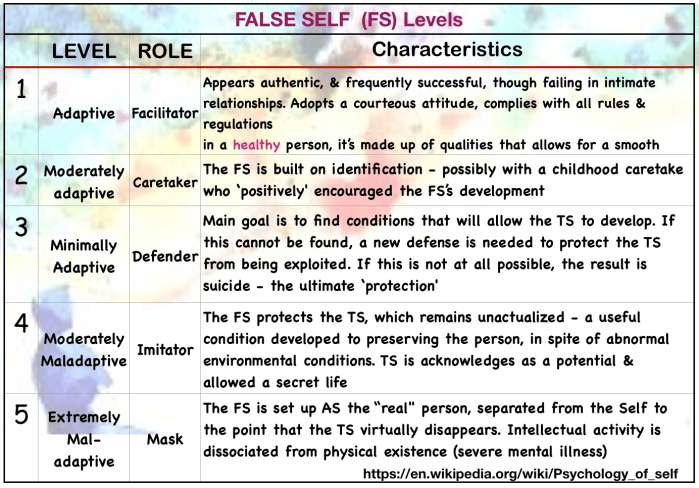
✶ Basing life on a False Self robs us of our dignity & individuality! It’s what the wounded version of the Adapted Child ego state becomes when we’re not properly nurtured in childhood, & which ends up running our life until we do FoO work in Recovery   (CHART  ➡️)

• The concept of the FS was identified in the 60s by Dr. Donald Winnicott, who specialized in Object-Relations psychology.
The FS is motivated by a basic need to survive, starting in infancy – an unconscious choice to change our behavior, repress our emotions & push aside our own needs – in order to fit in with others who cannot accept us as we really are.
It comes out of a desperate attempt to control a person or situation that is actually out of our control.

• It includes 5 USES and 5 levels ⬇️, the most extreme being when the True Self is completely hidden, while the FS appears authentic to the person & everyone else, & may be successful in the world but fails in intimate relationships  & secretly fuels anxiety
➼ In contrast, the True Self is the core of we who are, unshaped by upbringing or society, the person we were born as & still exists inside

CHILDHOOD Causes
☔︎ Attachment Trauma = a developmental shock that may become hard-wired into the child’s brain & personality structures. Desperate longing & emotion-addiction becomes a defense mechanism against the anxiety of too early or difficult separation from mother

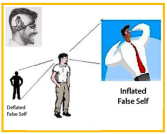
☔︎ Toddlers = Defiant & oppositional behavior persisting beyond age 3 may indicate an attachment disorder.  Child can develop other “upper defenses” to maintain this separateness (over-independence), which support the inflated False Self.

☔︎ Co-dependent = Children create a False Self (FS) as a reaction to not having enough emotional & social support in order to become emotionally & psychologically separate from parents (grow up)
☔︎ Counter-dependent = child blocks feeling of the shame of only being ‘loved’ conditionally or not loved at all.  The FS prevents being totally traumatized by the abandonment & abuse. This defense typically shows up as the child (& later the adult) seeming to be strong & capable, while not feeling that way inside (like a fraud)

☔︎ Addictions = Later on – develop addictions in the areas associated with specific separation trauma (use ‘uppers’, work, quick sex, traveling & over-consuming…. ). These are inadequate & unsatisfying substitutes for deep union with the Divine who created the True Self, just like the unavailable emotional connection with the mother.
Unfortunately, it often takes people a long time to discover that unresolved developmental trauma is the cause of many of their adult problems.

«
CHART a
. False Self created by absorbing Negative Introject

«
CHART b.
True Self as the integrated authority of a fully developed, emotionally intelligent grownup (by Roland J. Schuster)

Also read  “What Represents True Self“?

«
NEXT: Satir’s LEVELER Role