Enneagram – Type ‘DEFECTS‘ (Part 3b)

enn defects 3b


I WISH I DIDN’T HAVE TO
deal with these defects

PREVIOUS: Enneagram Defects, Part 3a

SITE: Everything Enneagram book


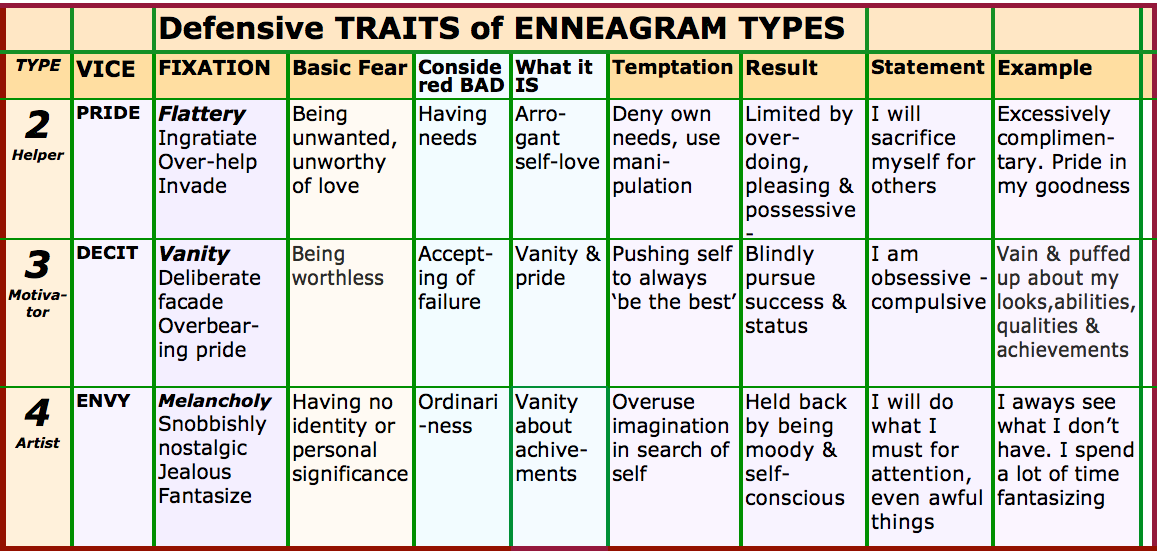
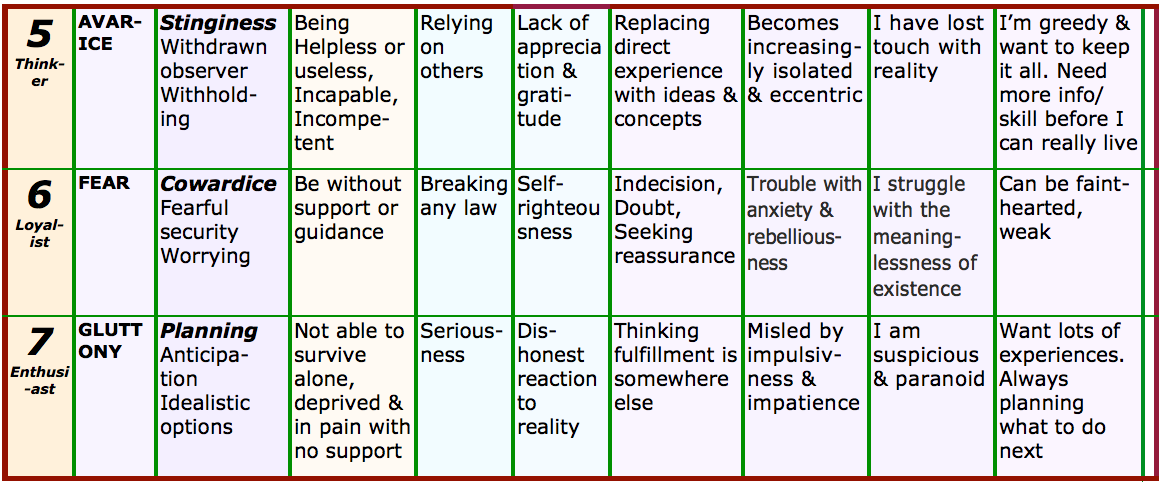
TYPE 4 – The INDIVIDUALIST (also 3w4 & 5w4, somewhat)
FEAR: of being insignificant, unseen, without identity – so they become moody, hypersensitive & pretentious
INTERNAL Story: “I must always be unique”

WEAKNESS : Being ordinary is experienced as boring, but also makes them ‘feel’ like a nobody, so they’re jealous of other people-places-things. Insist on having all of their emotional needs met at once
DEFENSIVE PATTERN: ‘Introjection’ – to avoid ordinariness & keep self image of being authentic. Internally they magnify a positive ideal, & obsess on self-blame for any painful outcome ​

HIDE from others: “I’m not as sensitive as I appear to be.”
Envy/ jealousy that others seem to have more & are treated better than themselves – so 4s to develop an aura of emotional hyper-sensitivity. They want special treatment, thinking it’ll compensate for all the unfair treatment they’re experienced

PROJECTION: Being ‘Common’ is projected onto others, who individualistare seen as detached, insensitive, overly cheery, plain, predictable, rude, shallow AND not terribly interesting or refined.
4s think they unique & interesting, but always misunderstood. So they think it’s up to them to restore class, refinement & sensibility to the culture

MANIPULATE by: being erratic, temperamental, hard to get’, making others “walk on eggshells”
Create CONFLICT by: being dramatic, emotionally demanding, moody, pretentious, self-absorbed, self-indulgent, temperamental, withholding

✥ ✥ ✥

TYPE 5 – The INVESTIGATOR (also 4w5 & 6w5, somewhat)
FEAR: of being helpless, useless & incapable, of be emotionally overwhelmed, so avoid as much contact as possible with the world
INTERNAL Story: “I must always be detached”

WEAKNESS: Their urge to know everything on a topic or situation helps avoid a sense of emptiness. Insist on personal space & non-interference
DEFENSIVE PATTERN: ‘Isolation’ – withdraw to avoid feeling small & helpless, & keep self-image of being all-knowing. Provides the space to develop a sense of structure & try to understand their ‘problem’

HIDE from others:“I’m not as smart as I appear to be.”
Holding back / isolating prevents 5s from having to share their emotional life with others – mainly relating by their intellect. Their source of strength is in accumulated knowledge, using it to keep others away

PROJECTION: Project their 1d1319272f56a3120542ebd0cfc1112flack of all knowledge onto others, so feel like they’re surrounded by a “confederacy of dunces” (Sherlock Holmes). Others are considered emotional, foolish, overly effusive and chatty, myopic, oblivious, shallow-minded, stupid.
5s can either avoid others entirely, OR research & discover TRUTHS, & then enlightening everyone else

MANIPULATE by: staying preoccupied with thoughts & projects, distancing emotionally from others  (Forum….. )
Create CONFLICT by: being detached, extreme, high-strung, impractical, isolated, preoccupied, provocative, unconventional, uncompromising

✥ ✥ ✥

TYPE 6 – The LOYALIST (also 5w6 & 7w6, somewhat)
FEAR: of never having support, & not being able to survive on their own, becoming defiant, defensive & suspicious
INTERNAL Story: “I must always be secure”

WEAKNESS : Anxiety, doubt & worry lead to a lack of trust in themselves, so are indecisive & procrastinating. They fluctuating between a need for be close & a need to be alone, between self-distrust & over-reacting
DEFENSIVE PATTERN: ‘Projecting’ – their feelings on to loved ones & authority figures​ – to avoid feelings of rejection & to keep a self-image of being loyal

HIDE from others: “I’m not as committed as I appear to be.”
Fear of being punished & disapproved of, from an internal or external authority figure, drives 6s to be overly-responsible & loyal. This makes them seem committed to any given cause, which is mainly to their own need for securityloyalist

PROJECTION: project rebelliousness & power onto others, who are seen as flighty, isolated, overly trusting, negligent, reckless, threatening, & trying to get away with something

📌 For fearful 6s the world is experienced as disappointing & unsafe, so it is up themselves to create certainty, order, safety & security everywhere
📍 Counter-phobic 6s (not conscious of their great fear) project ambivalence onto others, especially authority, seeing them as inconsistent & untrustworthy – so they must scold or train others to be consistent & fair

MANIPULATE by: being evasive, complaining, testing others’ commitment to them
Create CONFLICT by: blaming, being defensive, doubtful, evasive, negative, pessimistic, reactive, suspicious, worried.

NEXT: Defects – Part 3c

Enneagram – Type ‘DEFECTS’ (Part 3a)

defect part 3
I HATE TAKING MY INVENTORY
it makes me feel hopeless

PREVIOUS: Enneagram ‘Defects’ (Part 2)

QUOTE: “ People are wonderful; people are difficult. The Enneagram helps us make sense of both” ~ Peter O’Hanrahan


EACH TYPE develops their 
own way of coping with life’s stressors, but not always helpful.  'defects' Part 3This chart shows how how each type’s WIC reacts to the lack of positive nurturing.
w = each Type has 2 wings – additional modifying characteristics – one number on either side, with one as a preference


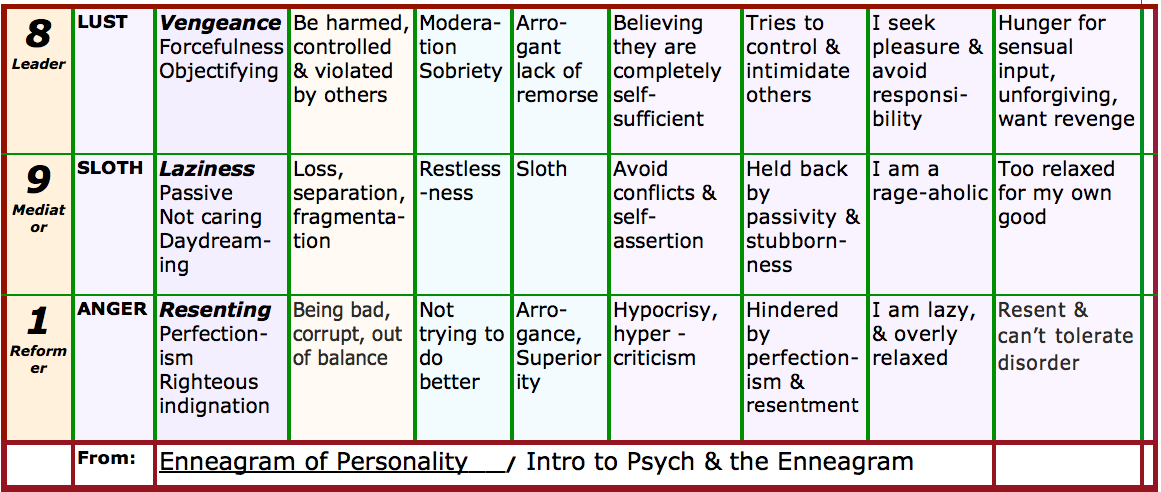
TYPE 1 – The REFORMER  (also 9w1 & 2w1, somewhat)
FEAR: of being corrupt & “not good,” so they refuse to recognize their mistakes, & take even mild suggestions as criticism
INTERNAL Story: “I must always be perfect”

WEAKNESS : Get frustrated & angry when things or others don’t meet their high standards. Insist on being correct at the expense of connecting with others. Al-Anon asks: “Do you want to be right, or be happy?”

DEFENSIVE PATTERN: ‘Reaction Formation’ – an opposite or unrelated reaction to an authentic feeling – to avoid direct anger, & maintain the self-image of always being right

HIDE from others that  “I’m not as perfect as I appear to be.”
Anger & frustration in part comes from 1s being resentful for having flaws. They’re convinced that if they’re seen as less than perfect they’ll lose their position of the moral authority & arbiter of logicperfectionism

PROJECTION: Since 1s avoid their own anger & flaws, they project those onto others – who they see as critical & angry towards themselves.  In general, the world is considered careless, flawed, frivolous, imperfect, messy & wrong. They must clean it up, straighten everyone out to get them back on the road to perfection (to feel ‘safe’)

MANIPULATE by: constantly correct others, playing on others’ sense of guilt & inadequacy, insist others share their standards
Create CONFLICT by: being opinionated, critical /self-critical, impatient, irritable, judgmental, rigid, perfectionistic, sarcastic


TYPE 2  – The HELPER  (also 1w2 & 3w2, somewhat)
FEAR: of being unloved & unappreciated, so they play favorites, judging some people more worthy of their attention than others
INTERNAL Story: “I must always be connected”

WEAKNESS : Poor boundaries, helping others instead of self-care. Insist on exclusivity & ever more nearness

DEFENSIVE PATTERN: ‘Repression’ of personal needs & feelings to avoid looking needy (which they are), to maintain a self-image of being all-loving, & gain approval 

HIDE from others: “I’m not as caring as I appear to be.”
Pride prevents 2s from showing their needs, so they try to get them met indirectly, secretly. Believe that by being constantly helpful, others will automatically reciprocate – as if their good deeds are vouchers to be cashed in later. But others don’t know that’s the deal & so keep disappointing the 2helper

PROJECTION: Since 2s avoid their own needs, they project that out onto others, who are seen as cold, critical, heartless, indifferent, mean, prickly, selfish, withholding AND needing help.
So 2s think it’s their job to identify & empathize with the needs of others, then fit them, to make themselves indispensable

MANIPULATE by: mind-read what they think others need or want, & then provide it, un-asked
Create CONFLICT by: being clingy, flattering, ingratiating, insincere, people-pleasing, possessive, seductive, self-important, self-deceptive, worried


TYPE 3  – The ACHIEVER  (also 2w3 & 4w3, somewhat)
FEAR: of being worthless & unappreciated, so they create a too-good-to-be-true image & push to achieve, at any cost
INTERNAL Story: “I must always be outstanding”

WEAKNESS : Believe they must present an image of success, rather than express who they really are. Insist on career & social status over people

DEFENSIVE PATTERN: ‘Identification’ – to avoid failure & keep a self-image of flourishing, ignoring their True Self 

HIDE from others: “I’m not as together as I appear to be.”
Self-deception causes 3s wear a ‘I have it all together’ mask, as anything less would not meet their need to shine. They can’t face the possibility that others might seachievere them as a failure or incompetent

PROJECTION: 3s avoid failure & inefficiency, which are projected onto others, who are seen as being aimless, the source of all failures-inefficiency-ineptness, in danger of entropy, limited, losers, wall flowers, AND in need of assistance & guidance from the 3

MANIPULATE by: charming others, taking on / adapting to whatever image will work to keep up appearances
Create CONFLICT by: being “appropriate” instead of sincere, boastful, competitive, grandiose, overly-driven, self-promoting, taking advantage

NEXT: Type Defects (Part 3b)

Enneagram – Type ‘DEFECTS’ (Part 2)

448355-p011_3
AM I WEAK? AM I BAD?
I just want to forget it all!

PREVIOUS: Type Defects, #1

SITE: Enneagram for spiritual transformation – we love & hate it


SELF-AWARENESS:  Deep & honest introspection provide AHA! moments, to see the truth about our unhealthy side. We can think back to what we were like in our teens & 20s, when our reactive style was in full bloom.
What was our overall behavior & attitude toward people-places-things? AND – is it how we still deal with life now? 
Richard Rohr says a rule of thumb is: “Whoever is not humiliated has not yet found his or her ‘number’!”

😓FATAL FLAW”
It’s important to make a distinction between each Type’s perceived Fatal Flaw & the very real acting-out of damage, via ones Passion/Vice.  Everyone wants to see themselves & be seen by others in a certain light. To hold onto our idealized self-image & keep it up in public, we have to completely deny admitting 
the thing we’re most afraid we are or might be. It’s the specific weakness that would bring us the greatest S-H if revealed – the real OR imagined flaw we take great pains to conceal, sometimes even from ourselves 

⚠️ This ‘flaw’ generates a painful emotion specific to the Enneagram’s 3 sub-divisions: 2, 3, 4s feel Shame / 5, 6, 7s feel Fear / 8, 9, 1s feel Anger (more later).

Also
, each Type has a ‘Core Emotion’ (from the
7 Deadly Sins + 2) :
Type #1 = Anger🦯 #2 = Pride 🦯 #4 = Envy 🦯 #5 = Greed 🦯 #7 = Gluttony,
#8 = Lust 🦯 #9 = Sloth 🦯 + Type #6 = Fear  &  #3 = Deceit

Denying our limitations, we often gravitate to people & things not in our best interest or that are outright dangerous.  Each type tries hard to avoid experiencing  :
🔓 2  Insignificance — 3 Failure  — 4 Ordinariness
🔓 5 Ignorance — 6 Irresponsibility —  
7 Emptiness
🔓 8 Weakness — 9 Hostility — 1 Unworthiness

IRONICALLY, none are real defects! They only seem so to the person, while other types will not consider it such a bad thing, & may even find it laughable. All are various expression of being human – realistic limitation common to all. Only the grandiose IDEAL of each type sees it as a personal weakness!

PROJECTING our Passion/Vice 
Because the Gift-turned-Vice makes us see the world through partial & distorted information lenses, each protective style also creates a
projection – causing the person to use their own defense against others.
The saying: “If the only tool you have is a hammer, then everything is a nail” implies that we must not use just 1 way of responding to all situations, & that some things are injured by being pounded on, such as delicate emotions.

EXPs:
❖ It’s not OK to: ✦ talk away someone’s emotions (5) ✦ try to make others be perfect (1) ✦ control everything around us (8) ✦ tell a sad or angry person to lighten up (7)….
❖ A healthy #2 is naturally loving & helpful but not intrusive, but
— a wounded #2 is co-dependent, clingy, manipulative, overly-solicitous, 2-faced…. all in the name of being ‘nice’ & not wanting to hurt others.

TRAIT 2-4

TRAITS 8-1

TRAITS 5-7

Ennea-ILLUSIONS (Ginger Lapid-Bogda, PhD)
THAT :
2s – being so focused & intent on others means they themselves actually can do no wrong
3s – doing what they think they want is usually what they think they should want
4s – being so ‘in touch with feelings’ & pondering them with such continual intensity means they’re real (Not)
THAT : 
5s – they don’t know or experience their feeling states (but are actually pure)
6s – by focusing on serious issues & bearing down on a problem with great intensity, confronting it will somehow get it solved or resolved (Not)
7s – they’re forever forced to live with a deep hole inside (but it is ALL inside)
THAT :
8s – they don’t dare let their guard down, or something terrible will happen to them or their loved ones
9s – they’re being consistently kind & nice eliminates all their hidden anger
1s – being so completely self-controlled will give them the satisfaction & joy they want as a reward for being soooo good (Not)

NOTE – Do not be ashamed of your inherent protective style – a necessary part of our psychological makeup. The problem comes from overuse & then rigid adherence.
Once we own it, we can work on healing original wounds, so the defense is progressively less needed – & turned back into the GIFT it was meant to be! Your Type provides parallel discoveries of hidden & rejected positive qualities.

NEXT: Enneagram ‘Defects’ Part 3

Enneagram – Type “DEFECTS” (Part 1)

enn weaknessI DON’T WANT TO ADMIT TO
my biggest weak spot!

PREVIOUS: Enneagram Basics (#3)

SITES: Enneagram Videos
The Enneagram of Individuality

• ‘Spiritual Desire & Blocks’
Karen Horney & the Enneagram

‘DEFECTS’ / Defenses:  In trying to identify our own Type, most people will choose the number that makes us look good & reject the one that indicates our Shadow side. However, the ‘normal’ defense of each number is the most direct indicator of our True Number, so it’s best to start with the list of the 9 Grand Passions. Even though we share a portion of all nine qualities with everyone else, determining our type will depend on the main motivation for our behavior, & the Passion gives us that. 

The PASSIONS/VICES are the characteristic defensive styles each Type is born with to cope with life’s stressors. Each VICE/Passion with its accompanying Fixation the opposite of the 7 Virtues (+ 2) – can also be called character defects, main Emotional Issues, Mental Habits, defensive styles, used here interchangeably.

Our Enneagram Number tells us who we are (Nature),
along with our basic reactive style (Nurture),
shown by how we habitually
react (Es) & what we do (As) – especially when stressed. CHART —>

◆ The Passion is the form of self-protection which we automatically gravitate to, based on our fundamental personality – originally a positive way of Being we can call our gift. This gift is a necessary & effective strategy for our survival as children, used to cope specifically with an unhealthy/unsafe upbringing, & in general with the universal difficulties of growing up.

• For most people the Passion gradually becomes a warped version of our Basic Self, exaggerating & twisting the very quality that is supposed to be our cushion & shield.
Instead, prolonged childhood damage turns the gift into a burden. It becomes a chronic internal preoccupation & counter-productive driving force, putting us in a ‘type trance’, with limited & distorted ways of understanding & dealing with reality.
EXP: The Passion of #1 is Perfection, the emotion is Resentment, & the Mental Fixation is Judging.

Enneatype & Fixations
The Enneatype is the tool for human expression free of longing & searching. It can be described as an imaginary
membrane between fixation & freedom, the basic energetic pattern of human potential before it becomes perverted.

Fixation is being stuck in a Freudian psycho-sexual stage of development (oral, anal…), as a result of the child feeling ‘not enough’, incomplete, & therefore separate, not connected. This separated self is a physical/mental contraction which tightens up into the Type’s fixation, creating all inauthentic or unnatural behaviors, driven by desperate longing, & a search for the impossible.   (Fixation CHART)

The Passion develops in a 3-stage process:
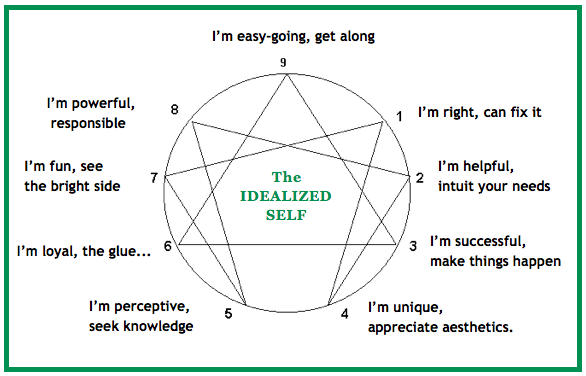
a. IDEAL: Karen Horney, in Neurosis and Human Growth says that “gradually & unconsciously we create an idealized image of ourselves, which entails self-glorification, & gives us the much-needed feeling of significance & superiority over others.”  This eventually leads to type-specific character defects.
EXP of Types uncomfortable with the Enneagram:
— 4s, the romantics who don’t want to look at the negative side of others
— 7s, the narcissists who never want to see their own negative side

Enn Ideal Slef

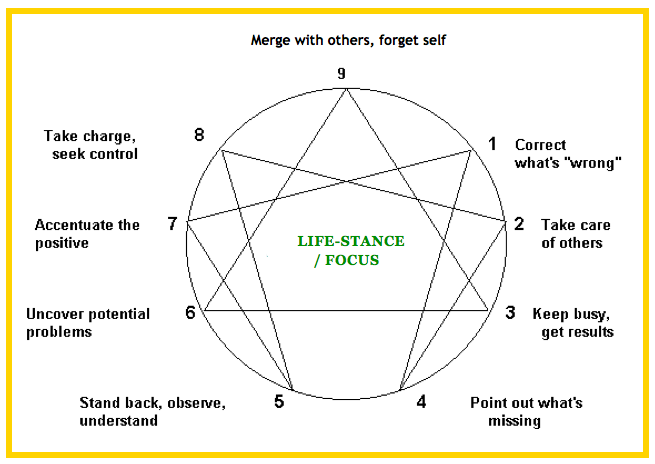
b. LIFE STANCE: Our preoccupation with this self-image prevents us from allowing anything to seep into our awareness which would contradict or negate it. According to Horney, if we only look at the world thru ‘idealized glasses’, then our primary concern is not about what we truly feel, but whether or not we are safe.
To feel safe – from being discovered as imperfect – and be able to stay inside the idealized bubble, we develop strategic but artificial ways to cope with life that override & bury our genuine emotions, wishes & thoughts.

Enn Life-Stance
c.
UNDER STRESS: In addition to our ‘regular’ in-authentic mode, when we have to deal with stressful situations, especially in the long-term, our fixation gets darker, turning into the negative Passion/Vice. We act out a twisted version of our self-image, adding to our burden. Over-reacting may be a temporary but characteristic flare-up, or the way we usually deal with people-places-things, even when not directly faced with a problem. Either way it separates us from others instead of drawing us closer together – causing more stress!

Enn Under Stress

NEXT: Ennea “Defects” (Part 2)

Enneagram – BASICS (Part 3)

ennea people
I
’M SO CONFUSED!
there’s too much to know

PREVIOUS: Ennea Basics (#3)

SITEs: Re. Wings & Arrows’ 
Enneagram Dimensions  MANY Articles

BOOK : “Are You My Type, Am I Yours?, Relationships Made Easy Through the Enneagram” ~ Renee Baron & Elizabeth Wagele

We can say the Enneagram is:
♦︎ a mirror, reflecting the truth of who we really are
♦︎ a map, guiding us toward growth and liberation
♦︎ a catalyst, speeding our journey of self-knowledge & transcendence.

• Although everyone has some aspects of all 9 numbers, we are each born as one basic type, with the others operating in the background to drawn from throughout our life.
Based on this foundation we then develop a ‘passion / fixation / weakness’ as a reaction to our earliest experiences. This problem attitude governs our outlook & behavior until modified or corrected.

OUTLINE of Enneagram Symbol parts
The information & internal connections between the numbers of the Enneagram are complex & subtle. In addition to the meaning of each Type, there are many other things to look for. 

TRIADS There are several kinds, & this is not a complete list:
✤ Core Centers tells us each group’s main goal. Each has its own intensity, emotional focus & physical center:
2, 3, 4 = Heart & Love-Shame
5, 6, 7 = Head & Fear-Anxiety
8, 9, 1 = Gut & Anger-Rage

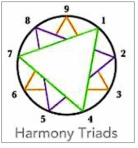
✤ Harmonics: 4s, 6s, & 8s are Reactive / 2s, 7s & 9s Have a Positive Outlook / 1s, 3s & 5s focus on Competency

✤ Importance: 1s, 4s & 7s feel Smaller than the world  / 3s, 6s & 9s adjust themselves to the world  /  2s, 5s & 8s feel Bigger than the world
✤ Instinctual Sub-types are how they function best in the world – Social, Self-preservation & Sexual/Intimate, each Type expressing all three in their own way

✤ Object Relations connections: 3s, 6s & 9s Attach (join) / 1s, 4s & 7s Frustrate (are ambivalent) /  2s, 5s & 8s Reject (push against)

✤ Social ‘Movement’ (interaction), instinctive style: 2s, 6s & 7s go Toward others / 4s, 5s, 9s move away from others / 1s, 3s & 8s go against others

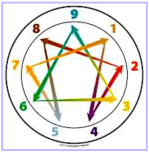
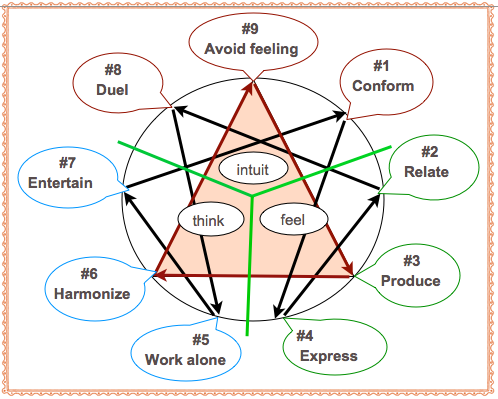
ARROWS – The six-pointed figure showed the relationships between the steps in the process
EXP: Step 1 is influenced by steps 4 & 7 via connecting lines. Each Type relates to 2 other numbers, at the opposite end of their connecting lines, usually at the far side of the circle.
— When we’re relaxed, one of these numbers enhances us, as we add some of those positive qualities to our
— When we’re stressed the other weakens us, as we add some of those negative qualities to our native style.

DESIRES & FEARS – Each type is drive to gain their Heart’s desire & to avoid – at all costs – their greatest fear. People living at the lower Psychological Levels are run by their fear & sadly their dysfunction coping mechanisms often increase it. As one moves up to higher levels, the Desire begins to be the stronger motivator for our actions & interactions with others.

LEVELS – each Type will also be expressed in 9 psychological levels, from most damaged to healthiest. While the goal is to improve oneself, the levels do not automatically imply moving upward, and not everyone starts out from the lower 3. Most people live in the middle 3 – the ‘Average’ range – & some are able to function in the top 3.

STRENGTHS & WEAKNESSES – Each Type is most easily defined by their “Passion” or negative defense, & their whole life is built around it. EXP: the 3’s Flaw/ Vice is Deceit, the 9’s is Sloth…. The goal is to grow into our Type’s highest potential, the positive version of your number

WINGS – These are the numbers on each side of every Type & we tend to choose one or the other to modify our own.
EXP: We can be a 1 with a 9 wing (1w9) or a 1 with a 2 wing (1w2)…. Each has a ‘title’ & allows for easier connections to people of that adjacent Type, who they may not otherwise understand or get along with.
EXP: Type 8 (intense, easily angered, dominant) is extremely different from a #7 (lighthearted, rarely serious, irresponsible), so the 8 with a 7 wing (8w7) is lighter, & can can get along with a 7w8 reasonably well since many traits overlap. (WINGS….)

NEXT: Enneagram Intro #4

ENNEAGRAM Basics (Part 2)

9 type peopleTHIS IS SO INTERESTING!
I’d like to know more

PREVIOUS: Ennea Basics (#1)

QUOTE:  The Ennead “flows around the other numbers within the Decad like an ocean.” – Nichomachus 0f Geresa


OVERVIEW
Ancient mathematical philosophers called NINE the “finishing post” and “that which brings completion”.
“The NINE holds within it a powerful resonance of our holo-fractographic, base-10 reality.  It’s the largest number in the decimal system, really the largest number of all, as every other number thereafter is a reflection of the Ennead, expressing itself in scalar expansions & contractions of 10.

TEN is the combination of something with nothing. ’10’ is not a number but more of a concept, or you could say it’s Nature’s way of organizing herself.   The Pythagoreans considered there to be only 7 numbers in reality.  Unity & duality, 1 & 2, were not considered numbers.  Numbers began at 3 & ended at the most auspicious of all, NINE” (MORE…. extensive info)

#1 Reformer / Perfectionist – (Terrier) SELF IMAGE: I am perfect.
• The GOOD person, highly responsible, fixated on improvement : orderly, principled, rational idealist, reasonable, self-righteous.
— Driven to do the ”right’ thing. Often critical of self & others, with an over-developed sense of responsibility, & prone to repressing their anger

#2 Helper / Giver – (Cat) SELF IMAGE: I am helpful.
• The LOVING person, who needs to be needed : caring, concerned, generous, nurturing, manipulative, possessive, well-meaning.
— Will go the extra mile to please others at the cost of self-care. Gives a lot & proud of it, but strings are often attached

#3 Motivator / Performer – (Peacock) SELF IMAGE: I am successful.
• The EFFECTIVE person, focused on looking successful in order to be validated: adaptable, ambitious, arrogant, goal & success oriented, image conscious, pragmatic.

— Efficient, achievers, goal-driven & focused on being a “winner”. Concern is with appearances, style over substance, often refusing to be introspective / self-aware, they crowd out family & friends

#4 Individualist/Romantic – (Basset Hound) SELF IMAGE: I am unique
• The ORIGINAL person, seeking identity, who feel special & different : artistic, aesthetic, depressive, intuitive, self-absorbed, sensitive, withdrawn.
— Crave self-expression & emotional depth. Sensitive to beauty & meaning, prone to melancholy, they feel inadequate & envious

#5 Thinker / Observer – (Fox) SELF IMAGE: I see thorough.
• The WISE person, who tends to withdraw & observe: analytic, cerebral, eccentric, innovative, original, perceptive, provocative.
— Recognize & synthesize information in new ways. Are emotionally detached, protecting their privacy & personal resources

#6 Loyal Skeptic – (Rabbit) SELF IMAGE: I do my duty.
• The LOYAL person, with a major conflict between trust & distrust : anxious, cautious, committed, engaging, hardworking, responsible, traditionalistic.
— A teem-player OR rebel-vigilant, they’re always scanning for threats from the environment. Are loyal & engaging, but full of contradictions, which create self-doubt & indecisiveness

#7 Enthusiast / Epicure – (Monkey) SELF IMAGE: I am happy.
• The JOYFUL person, pleasure-seeking, always planning – something – in search of distraction : accomplished, excessive, hyperactive, manic, uninhibited, versatile
— Having a perpetual surplus of new schemes & goals, they’re eager for experiences &/or material goods. Habitual optimism covers a fear of boredom and pain

#8 Leader / Challenger – (Rhinoceros) SELF IMAGE: I am strong.
• The POWERFUL person, taking charge in order to not be controlled : authoritative, challenging, combative, confident, decisive, determined, executive, powerful, self-sacrificing
— Driven to control self & environment, they’re capable of both domination & protectiveness. Vulnerability & a tender heart are hidden under a tough exterior

#9 Mediator / Idealist – (Elephant) SELF IMAGE: I am content
• The PEACEFUL person, creating harmony : complacent, disengaged, easygoing, optimistic, phlegmatic, receptive, tolerant.
— Good at seeing all points of view, trying to be a peacemaker – while easily distracted from noticing personal needs & priorities. Avoids direct confrontation & can be passive & immovable.

Using the BEST qualities of the 9 Types to form a successful ‘Product’ in business, one would need:

# 8 The Leader / Maverick, with vision and confidence
# 4 The Individualist, for a well-designed product, and a sensitivity to its emotional impact on the public

# 5 The Investigator, for technical expertise and innovative ideas
# 1 The Perfectionist, for ethical standards and quality control

# 3 The Achiever, with promotional and communication skills
# 9 The Peacemaker, to bring the team together by listen to them

# 6 The Loyalist, for teamwork and self-regulating feedback
# 2 The Helper, to serve people and anticipate their needs
# 7 The Enthusiast, with energy and optimism

NEXT: Enneagram – Basics (Part 3)

ENNEAGRAM Basics (Part 1)

ENNEAGRAM

FINDING OUT MY TYPE
makes me squirm

PREVIOUS: ‘Keep the focus on yourself (#3)”

SITEs:
♦︎ Multidimensional Enneagram Immersion  

♦︎ The Enneagram, Jung & MBTI

BOOK: “3 Keys to Self-Understanding” – Pat Wyman, combines the MBTI, Enneagram & Inner Child Work

INTRO
Essentially the Enneagram shows us how we CAN BE, at our best, as well as how we ARE – including our weaknesses. It is a merciful delusion-buster that opens us to the truth of our experience by
the use of radical awareness and compassion

• It is a Map of Wholeness. Its primary purpose is to study the universal Human Soul expressed in each of us, to connect us with what is deeper than our outer persona – legitimate but limited – and toward what does not come from our ego-fixations (weakness to be overcome).

QUOTE: “Always remember that it is your birthright & natural state to be wise and noble, loving and generous, to esteem yourself and others, ➡️
The Wisdom of the Enneagram, Riso & Hudson (p 41)

• It’s a “nature/nurture” system, with both social & genetic components for each Type. They are psychological templates tied to brain development, as well as the influences of our environment, & so can be considered ‘programs’ or life-scripts. They also point to Carl Jung’s 9 psychological processes of consciousness & 9 distinct versions of the his Shadow archetypes, all of which makes the Enneagram a powerful system for self-understanding.

• The 9-point diagram gives us nine different sets of values & filters through which we can view the world, a way of describing inner experience as well as conscious self-image. But it goes enn SYMBOLdeeper, indicating unconscious motivations as the source of thoughts, emotions & actions. It can help people recognize & expand the boxes they’re already in, & ultimately be a way to dissolve those boxes.

• The Enneagram SYMBOL is an ancient form to describe the path of self-development. It can be traced at least as far back as the Greek mathematician Pythagoras (c. 500 BC), improved on by Christian & later Sufi mystics (c. 500-1000 AD).
It was re-introduced in the 20th cent, starting with the Armenian mystic George Gurdjieff (a controlling Type 8), the founder of an influential Inner Work school, who drew from Sufi tradition & focused on sacred dance, using musical notes for each type.

• Then Oscar Ichazo, the South American student of ancient wisdom, formed the Arica School, updating the Enneagram by creating a system of Types using Gurdjieff’schief feature as a starting point. More recent writers, including Claudio Naranjo, Don R. Riso, Russ Hudson & Helen Palmer, have developed the Enneagram further, adding a psychological emphasis to its spiritual base.

The symbol is made up of :
♦︎ A circle, representing the whole experience of life & the container within which we live our lives. It’s used AS:
– a Process, when moving around the circumference
– an Experience, if taken as a whole
– a Point in time. It speaks to the cyclical nature of change – death follows life, life follows death – with its progression through time  (CHART  ↖️ )

♦︎ A triangle, dividing the ‘ONE’ into 3 parts, which introduces things outside  influencing the Process (movement), with internal intentions & connections to each other.
The points touching the circle (9, 3, 6) are where external energies provide the fuel needed to drive any procedure, including needed Change. It represents the universal Law of Three (man-woman-child, Body-Mind-Spirit, the physical-emotional-intellectual body)

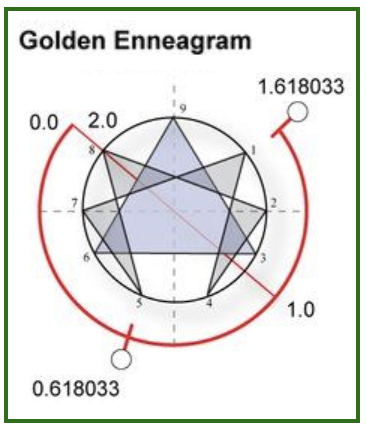
♦︎ The Six straight Lines show the relationships between the steps in the Process, which overlap & are coordinated. They are the ‘one’ divided by 7, which equals a repeating fraction is .142857142…,**,  not including the triangle points. ➡️ (Chart) scroll down (ALSO…..in Wikipedia).
** The Enneagram has been associated with the invention of the decimal system.

Placing these decimals around the rim form the 6-line web showing the essential internal movement of the universe, & gives us the direction of our personal growth-work as we move around the outer circumference.
The “missing” 7th line is the point in the center of the circle.

EXP: Step 1 is influenced by steps 4 & 7 via their connecting lines (arrows)

NEXT: Enneagram Basics (Part 2)

“KEEP the FOCUS on YOURSELF” means? (Part 2)

Screen Shot 2016-01-17 at 7.11.01 PM
PREVIOUS: KFY (Part 1)

POST:  Healthy Helping


1. KFY is NOT a justification for our narcissism!
(cont.)  
Review Part 1

2. KFY may mean FACING the pain that YOU:
• had a traumatic childhood you’re afraid to admit & deal with
• know it’s time to let go of some illusions, but are still hoping
• don’t like yourself very much, altho you’re ‘supposed to’
• feel like your life is way out of control, but don’t know how to fix it
• want to take risks, but sure you’ll make mistakes or be rejected
• think your friends only like you because you do so much for them
THAT you :
• hate your job, but afraid to change, holding on until retirement
• hate salads, even though you eat one every day for lunch
• want a divorce, but are afraid to leave & be alonesad woman
• want to change but don’t know how.
Your life is a mess.

It could also mean YOU’RE:
• depressed, & have been for decades
• exhausted from anxiety, even though it doesn’t seem you’ve done much today
• ‘supposed’ to love parent/ mate/ child/ friend…. but don’t (or not anymore)
• terrified of commitment, but also terribly lonely
• not getting any younger, & have so many regrets……
Adapted from Karen R Koenig

“Keep the Focus on Yourself” requires positive Self-honesty :
It’s about always looking for & admitting OUR motives & emotions that propel our thoughts & actions! (without shame, guilt or S-H).
They may come from the WIC, Bad Parent OR – UNIT.
So they’re not always negative. We can legitimately have ok motives, (not co-dependent), which must include our own needs & values

WAYS to KFY
a. Mind your own business
KFY is mainly about staying out of other people’s lives (fixing, Rescuing other adults) – no matter how dysfunctional they may be, how much we think we can help them, AND no matter how much we love them.
In almost all cases, they’ve had many opportunities to get the help we think they need, but ignored or blatantly rejected every one. Stay on your side of the fence.

EXP – Unhealthy: A mother is ‘hele-hovering’ over her daughters’ actions & feelings because she feels guilty for the girl’s problems (not mainly from loving her & wanting her best)

b. Be your own Motivator
Make decisions, choices & take actions based on who you are – your needs.
ACoAs, Co-Deps & addicts use other people, substances or circumstances to give us a reason to function – or an excuse to withdraw from life. We work, go, help, risk…. only long as it’s for someone / thing outside of ourself.

However, we DO have many of the skills needed to run our own life! We must use them to take care of ourselves first, before thinking of others.
EXP – Healthy: “I took that difficult course to learn more about my career & improve my performance” (not self-motivationto please my boss or make myself look good)

c. Be Responsible for yourself
Identify our Toxic Beliefs, & work on correcting them, so we can be in charge of ourselves & our actions in the world. We don’t have the right to expect anyone else to do that for us – our whole life can pass by waiting for that.

Even if we find someone who would, it always comes with a high price – being controlled, kept immature, prevented from healing & expressing our potential.
EXP – 1/2 &1/2 : “I wanted that bigger car because it makes me feel important” (not just because my wife liked it)

d. Listen To Your Gut
Trust the True-Self Inner Voice. There’s a difference between being jerked around by our PP or WIC’s emotions & obsessions, steeped in anxiety from obeying and also trying to resist the Toxic Rules -vs- information provided by our Core self

It’s that still small feeling in the center of our body that won’t go away – telling us when somethings right or wrong for us. Trust “I know what I know”. Once we get quiet inside (low anxiety) we can hear it. We’ll be surprised how accurate it can turn out to be
EXP – Healthy : “I stopped being friends with that woman because I kept getting that ‘ICK’ feeling in my gut whenever we talked” (even though we had a lot in common).

NEXT: KFY #3

“KEEP the FOCUS on YOURSELF” means? (Part 1)


I HAVE TO TRAIN MYSELF
to be self-aware!

PREVIOUS:
 Confident People #6

SITE: “(Not) Keeping the focus on myself” ~Al-Anon


REVIEW: “Keep the Focus on Yourself” (KFY)
Many sources say to be mentally / emotionally mature we need to be responsible for our own TEAs (thoughts, emotions, actions). This is confusing for ACoAs, because on the one hand:
• we were taught by family & religion NOT to notice our own needs, tastes, ideas, values… only focus on others, which means we’re can’t KFY
AND on the other hand —
• ACoAs take on too much responsibility, for things others are doing or have done (abuse, neglect, carelessness, selfishness….), as well as blaming ourselves for imperfections (limitations, lack of knowledge, mistakes, EVEN good things like emotions, ambition, normal human needs….)

SO, no matter how intelligent or accomplished, without Recovery growth, many ACoAs actually don’t know what KFY means or how to do it. We’re all familiar with the PP’s poisonous voice whispering: “Who do you think you are?”

But that’s exactly the point: In order to KFY, we have to know who & what WE ARE!
But since we didn’t develop that as kids, we have to work on it now – every day. With persistence, eventually it does become the new normal

NOTE: The key to KFY is telling the truth about what motivates our thoughts & actions, which comes from the freedom to BE & express True Self. EXP:
“I’m upset because I’m disappointed …..” said without anger
” I yelled because I’m really scared…. “, without excuse or justification

EXP of not KFY 
Joey forgot to bring home the milk Sarah asked for. She gets angry & calls him a few choice names. The REAL reason she’s angry is not that they need the milk so badly, but she interprets his neglect (T) as meaning that Joey doesn’t consider her important – as a person.
That leads to feeling hurt (F), but she doesn’t say that. it’s easier to attack than be vulnecontrollingrable

KFY is NOT a justification for our narcissism!
It’s NOT:
• saying things like “I think that you should____, If I were you I would/ wouldn’t____” & then proceed to tell someone who we think they are, what they should do or think…. instead of finding out who they actually are, what they want, what they’ve already tried….

• expecting / demanding that others fulfill our needs, just because “I want it” – without considering if they want to help, what state they’re in, if they’re available, what they’re legitimately capable of, what’s appropriate to ask of others….
It’s NOT:
• an opportunity to attack, dismiss /negate or point a finger at others & then excuse it by saying: “It’s just my opinion”
• manipulating others to take care of us, because we don’t want to do it for ourselves
• doing whatever we feel like (jerk others around, lie, attack, be insensitive, undependable, withholding…..), because we’re afraid of being controlled, or want to get back at the whole world for what our family Screen Shot 2016-01-17 at 7.03.27 PMdid to us
It’s NOT:
• convincing someone to go out of their way for us & then change plans at the very last-minute, just because we have something better to do or just don’t feel like it
• use other people to get what we want, to get ahead, to vent our rage
• trying to get someone to be/do what WE want – so we don’t have to deal with ourselves

Al-Anon’s “Courage to Change”, (pg. 29 ):
“I am learning to be honest with myself. I will not use my Recovery as an excuse to justify my efforts to change other people’s thinking.
Trying to control others only gets me in trouble. Instead, I will promptly admit such mistakes & put my energy back where it belongs – by focusing on myladder to heartself.”

NEITHER would “Keeping the focus on Yourself” mean we’re :
• selfish & arrogant, because it takes attention away from ‘them’ (the narcs)
• disobedient when we KFY, because we were taught to only think what ‘they’ tell us to

NEXT: KFY (Part 2)

Being CONFIDENT (Part 6)

IC confidencePREVIOUS: Confident #5

QUOTES: “To wish you were someone else is a waste of the person you are.” ∼ Meelia121
• “Confidence, like art, never comes from knowing all the answers. It comes from being open to all the questions.” ~ Earl Gray Stevens,
UK peer

REMINDER: Do NOT let yourself get overwhelmed by this 6-part list. It’s meant to be a guide, qualities to work towards. Acknowledge when you have expressed a little of any one of these in your daily life, & remind your Inner Child of your progress!

CONFIDENT People (cont)
are free to assume 
“Why not?, Why not me?” True confidence allows people to have access to many PPT, with the right to ask for & get a piece of whatever’s available in their environment – but done fairly & legitimately. They create networks & relationships, often quietly behind the scenes. They choose their own path instead of following the most used one

☼ They know there’s ‘enough for everyone’ (attention, connection, recognition, love….), so they don’t have to wait endlessly for permission to express their ideas or get what they’ve earned – to be acknowledged, chosen, ‘discovered’, given info, helped, hired, promoted….

are shrewd
(clever, crafty – not sneaky). Being practical, savvy & having good judgement creates self-confidence, gives them an edge. They know when to keep going, & when to step away from a situation.
They’re often good at quickly sizing up others, figuring out social hierarchies & potential hot buttons. When they combine being clever with wisdom, they can get a lot accomplished without stepping on toes.

BTW: Crafty means taking an existing idea & turning it into something new, exciting & dynamic, or coming up with fresh ideas at a moments notice, & able to deal with stress in ways most others would never think of doing

 are accepting & respectful. Confident people are often the most accepting of others no matter their shortcomings – even when they don’t like someone – because they respect themselves & know that all humans are part of a larger whole. They can because they:
> know & own their own weaknesses, so don’t judge others
> understand everyone’s different, with their own process
> don’t need others to be a certain way to feel safe
> realize they don’t have the power to change others
➼ They try to live by: “I will do unto others as I would want them to do unto me & my loved ones.”

THEY
trust their judgment.
Instead of focusing on trusting others, they rely on their experience & observations to identify who’s safe & who’s not. They rarely second-guess themselves, because they know their rights as human beings, as well as their personal tastes & opinions

celebrate their successes, & those of others. They’re proud of their accomplishment & appreciate any ‘good luck’ that comes their way. Even when they ‘lose’ to someone (fairly), they’re truly happy when others do well, especially loved ones, because it allows them to be surrounded by accomplished & happy people. So they don’t mind when the spotlight shines on others.
🌈
THOUGHTS: Confidence is one of the most attractive & powerful traits we can have – when it’s grounded in self-esteem & respect for others. People are drawn to those who are comfortable with themselves.
• Confidence does not automatically come from genius or beauty, but by the way we think & feel about ourselves & the world. That means anyone can become confident. (YOU too!)

• Confident people search out & make use of all the resources available in their world to improve life for themselves & others

• Confident people are not ‘up’ all the time, which would be unhealthy & unrealistic. When they’re ‘down’, stressed, confused or it won’t be forever :
> they’re able to find a way under, over or around the discomfort, either by themselves or with help
> they can balance Emotions with realistic Thinking, not ignoring either side

NO ONE has all these positive characteristics – at least not 100% each. Confident people will have many of them – but in varying proportions, with some showing up early in their life, others not until much later.
REMEMBER: Progress, not perfection!

NEXT: Keep the Focus on Yourself, #1