EnneaTypes Language – GROWTH (Info)

Screen Shot 2015-05-18 at 12.10.08 AM


I CAN CHANGE HOW I TALK
& also use it to own my True Self

PREVIOUS: Talk Types #5

REVIEW: Intro explanations 1-4


GROWTH for all Types
Everyone wants to be understood, yet in most cases both senders & receivers have built-in limitations they bring with them to any interaction, which includes their Enneagram Type.

Listeners have ‘hearing distortions’ – prejudices in their way of thinking & feeling, that prevent receiving someone’s intended message
• Of course, Senders can distort their presentation, which interferes with how well they’re understood.

BOTH express themself from unconscious habits
√ Body Language: face, hand & body movements, voice & energy level…
√ Blind Spots : ways of acting & sounding we’re not ware of but others can be (clear throat, say ‘um’ all the time, don’t look others in the eyes…)
√ Filters : our own distorted listening, so our responses will be inaccurate, unhelpful, over-reactive ….

CORRECTIONS
We can start by asking trusted friends & co-workers what they think our communication style is. If possible – tape yourself giving a talk, or when just hanging out, & then listen to / watch it, alone or with others, to identify your patterns.

◆ Actively listen to yourself all the time (NOT critically) to identify tone of voice, & possible CDs (cognitive distortions).
When listening to others, paraphrase both the facts & emotions you hear from them, as a reality check on your accuracy

◆ Because most people tend to live in their head, improving your style of communication bad communicationcan be helped by moving from most conscious to least conscious behaviors:
√ Observe & rework your Speaking Style —>
then notice your Body Language —>
then correct your Blind Spots —>
& clean up the Distorting Filters.

Once you’ve identified your bad (verbal) habits – review the Negatives of your EnneaType. Make a written list of them & periodically thru the day ask yourself: “Which action, belief or talk style did I just express – again?”

◆ Find a knowledgeable & trustworthy person as your ‘talk coach’ to give feedback & respectful suggestions for improvement.
SITE: Chomsky’s Theories on Language

MATCHING our Communication to others
In NLP-speak, the thinking patterns that influence our language & actions are called Meta-programs, the way we perceive & filter our experience of the world, rather than objective reality.

Our language patterns – the words we choose & the way we say them – are all expressions of our internal image & dialogue (emotions, beliefs & experiences), that add up to how we act & react to any current event.

◆ Some people use very ‘specific’ language (lots of words) when describing something, paying lots of attention to the details of a situation or location.
EXP: The dress was black, white & red, sleeveless, with a long skirt, a V neckline, buttons down the front…..

Others use ‘general’ terms, which convey an overview, with few words.
EXP: Her dress was sexy & brightly colored.

Noam Chomsky found that most people modify & distort the information they’ve gathered – sobasic triads what gets passed on to others is only 1 or 2% of the original experience.
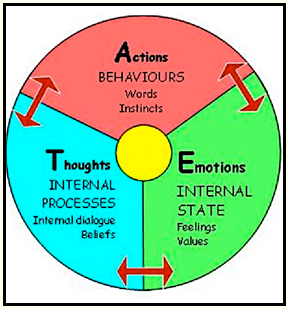
Roger Bailey’s “Words that Change Minds” LAB profile (Language And Behavior) shows how & why people make these transformation.
It teaches how to Listen, Reflect & Communicate effectively, developing the skill to match what we convey —> to another’s preferred way of receiving info, which then influences their response & behavior.

◆ No matter who we’re interacting with, but especially when dealing with someone who is psychologically unhealthy, matching has to do with understanding their thinking process & their language pattern, rather than being sucked into their negativity or falling into a fight.
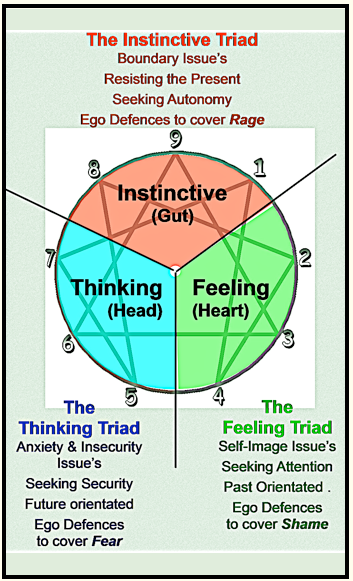
triads expandedThis can be done by taking careful note of someone’s TEAs ⬆️ – which follow the outline of the Enneagram’s main triads – as each has its own language peculiarities. Then we can use similar words & images to get our point across in a way the other person can ‘hear’ us. (Charts….)

EXP: Amy is a thin, blond, pretty AND fussy woman, very concerned with her image (a Leo & Ennea-type #3).
Her friend Elaine (fashion designer, F.I.T. graduate) is helping her look for fabric to make a new dress.
💜 Amy makes some inappropriate choices (for her physical type) & asks for an opinion.
🧡 Rather than saying those fabrics are ‘loud’, ugly or dowdy, Elaine says they are not elegant. Amy immediately moves toward a few that Elaine suggests. 🙂
NEXT
: Language – GROWTH (#2)

EnneaTypes – Language STYLES (Types 8, 9)

type 8 boss


I CAN INFLUENCE OTHERS

by how I communicate

PREVIOUS: Talk Types 6-7

REVIEW: Intro explanation in # 2


TYPE 8s give COMMANDS, DIATRIBES, LAY TRIPS

Self-talk: ‘Do this my way’
Words : chain of command, ground zero, rally the troops, remember
are about: bossing, control, justice, in charge, my way or the highway, power, right/wrong, strengths / weaknesses
Public Speaking Manner: Commanding

Style: 8s speak confidently & clearly, with boldness & authority, not holding back their opinions. They like arguing as a way of asserting dominance. They often take the opposing stance, not necessarily because they care about the topic, but just enjoy the clash.
THEY:
type 8 • Blame others if they feel accused or blamed unjustly
• Easily use profanity or body-based/crass humor
• Express anger directly, & as a defense
• Look at the big picture, impatient with detail
• May say very little or be talkative
• Use statements to structure or control situations
ARE
• authoritative, direct & firm, but also zestful
• oriented toward fairness, justice & truth
• strategic thinkers & can see the big picture

Pitfalls: Can get too confrontational, insense & pushy. Too attached to “My truth is The Truth” with no room for disagreement or argument. Go too much on gut, without enough facts to back up reactions

Use language to
: argue, debate, oppose, make parting shots, score points, take aim, use military metaphors
Others can experience 8s as intimidating, loud, controlling

MANIPULATE / create CONFLICT by : throwing their verbal weight around, bluffing, making big gestures – to dominate, demanding others think & act their way. Can also be sentimental, a teddy bear
BLOCK others by : intimidation – scaring people into agreeing, capitulating or submitting to them

CONFLICT style
: Blustery, dismissive, rageful, unemotional, uncaring, vengeful, violent.
8s are triggered by feeling controlled or dominated by others,
OR by disloyalty, & feeling abandoned. Then can become domineering, aggressive or incredibly cold

For BOUNDARIES: need ‘intimidation’, actually – assertion, to forcefully end a conversation on the spot when it’s not going well (not argue)
To FLOW in conversation, need TRUST : by fostering equality & with benevolent leadership

To RESOLVE conflicts with 8s:
• Stand your ground & don’t waver in your opinion. They’ll ‘joust’ with people they love – to test their strength. They want someone who can hold their own against them
• Set ground rules in an argument with them, & don’t be afraid to let them know if they hurt your feelings (this often surprises them)
• Try not to react to their intimidation tactics, but don’t egg them on either

✥ ✥ ✥ ✥ ✥ ✥ ✥ ✥ ✥

TYPE 9s give CHRONICLES, EPICS, SAGAS
Self-talk: ‘Nice ’n easy’
Words : listen, mediate, mindful, negotiate, reasonable, responsible
are about : being calm, different points of views, process, procedures,  systems
Public Speaking Manner: Epic or Conciliatory

Style: Like their appearance, 9s usually use a soft voice, relaxed & friendly, though they can easily take on qualities of those they’re around for a while, so can sound silly & giggle or proper & stiff, or…. type 9

THEY:
• Are warm, other-focused, non-confrontational
• Give highly detailed info in a sequential style
• Make an effort to be fair by presenting all sides
• Often say yes – but mean no
• Talk about both feelings & facts
• Use agreeing words : of course, sure, yes, uh-huh

Pitfalls: When giving a talk or in conversation, 9s use irrelevant details & unimportant info, which clouds their message. It may have no focus, holding all points of view, & without a conclusion.
Some 9s can have a slow, boring way of talking that puts people to sleep. Passive, indirect phrases that don’t seem to mean anything will lose the listener (“How leadership happens to you”) ??

Use language to
: day-dream out loud, generalize, launch into epics & sagas, verbally meander, voice vague notions, wonder
Others can experience 9s as indecisive, overly agreeable, scattered, unclear

MANIPULATE / create CONFLICT by: “checking out”, passive-aggressive resistance, shirking responsibility, barely talking at all, use one-word answers or talk in an air of resignation
BLOCK others by: withdrawing rather than staying engaged / connected

CONFLICT style
: clueless, occasionally explosive, pacifying, placating, sleepy, stubborn, unaffected.
9s are triggered by feeling internally chaotic or can’t escape painful emotions. They may go to sleep re. a problem, or suddenly become angry & belligerent like 8s or scolding like 1s (their ‘wings’), & then calm down soon after

For BOUNDARIES: need to ‘withdraw’ physically, emotionally or mentally when faced with discouragement or distress
To FLOW in conversation, need ACCEPTANCE: being available, present & welcoming

To RESOLVE conflicts with 9s:
• Acknowledge that you know they want to find some point of agreement with you
• Assure them your ‘upset’ doesn’t mean you don’t like/ love them anymore (unless of course you don’t) but what’s important is to resolve this issue
• Don’t attack or use a blaming tone, or they’ll tune you out. 9s will be afraid of your anger, so can become stubborn or withdraw if you get aggressive.

NEXT: GROWTH – Intro

EnneaTypes – Language STYLES (Types 6, 7)

fun talking


TO CONNECT WITH OTHERS WELL
it helps to know everyone’s style

PREVIOUS: Talk Types 4-5


TYPE 6s give CAUTIONS, CAVEATS, LIMIT SETTING
Self-talk: ‘But what if …’
Words : But… have you thought of? No. Not possible, Not today – maybe.
are about: tomorrow, real / reality, what about….? worst-case, why?
Public Speaking Manner: ‘Shotgun’ OR Apologetic

Style: 6s have a nervy, quick style of talking which can be witty & giggly, OR pejoScreen Shot 2015-05-19 at 6.20.05 PMrative & grouchy
THEY:
• Are engaging, information-oriented, thoughtful
• Alternate between staccato, hesitant speech -&- bold, confident speech
• Can use emotion-laden language OR talk in short shotgun blasts
• Freely discuss worries, concerns, & “what ifs”
• Start with analytical comments, but ask a lot of questions

Pitfalls: Either doubt their own message, so soundly confused & unclear OR push their cause down everyone’s throat
Can be overly negative: “It’ll be doom & gloom if you don’t change your…..”
They assume hidden motives & danger where there are none. Can use shock techniques because of ambivalence toward authority.

Use language to
: defend, question, second-guess, trouble-shoot, warn
Others can experience 6s as challenging, contrary, doubting, pessimistic

MANIPULATE / create CONFLICT
by: testing other people’s commitment to them by endless complaining or being evasive. Need to set the record straight “just so you don’t misunderstand….”
BLOCK others by: automatically negating a person or their idea

CONFLICT style
: blaming, cross-examining, distrusting, quick, relentless, vacillating, victimizing
6s are triggered by feeling mistrustful or being blamed. They can become terrier-like & questioning when feeling insecure or abandoned.

For BOUNDARIES: need to ‘reject’ put-downs & excuses
To FLOW in conversation, need AWARENESS – of thoughts, choices & emotions in self & others

To RESOLVE conflicts with 6s:
• Admit any ulterior motives you may have
• DON’T ever tell a 6 to calm down!
• Don’t get lost in their circular arguing , & if it feels like a marathon – walk away
• Don’t try to win – it will only escalate the argument. Instead, try to find common ground & allay their fears of abandonment or anger
• Hold your opinion but don’t be stubborn about seeing their point of view
• Stay calm but do not dismiss them, insult their intelligence, flatter or appease them

✥ ✥ ✥ ✥ ✥ ✥ ✥ ✥ ✥

TYPE 7s use ANECDOTES, BRAINSTORMING, STORYTELLING
Self-talk: ‘On a lighter note’.
Words : “I / me, ‘yes’, more, let’s go
are about: deals, fun, ideas, option, opportunities, plans, travel, trapped
Public Speaking Manner: Enthusiastic storyteller

Style: 7s want to enjoy everything, so they’ll use wit, storytelling & a dramatic tone to heighten their pleasure when talking
THEY:
• Avoid negative topics about themself (or others)
• Re-frame negative info so it seems positive
• Shift from topic to topic
• Tell engaging stories & can be very funny
ARE
• analytical & idea-oriented
• charming, exuberant, fast-paced, sociable, spontaneous, upbeat

Pitfalls: Can get too attached to their own stories, like making a saga out of a mundane trip to the post office, & not relevant to the current topic.
Can be idealistic, use too much humor or put too much emphasis on fun, so the listener won’t believe or trust them. They know a little about everything, but little or nothing in depth

Use language to
: change topics, check out, deflect, entertain, imagine, joke, laugh, move on, sample, shift gears, tell stories
Others can experience 7s as indifferent to others’ input, making excuses, quickly changing topics, self-absorbed, undependable

MANIPULATE / create CONFLICT by : distraction & being entertaining to get what they want, insist that others meet their demands. Being a wheeler-dealer, a know-it-all. Making light of serious situations
BLOCK others by: going in too many directions, not focused on the person they’re talking to, use diversions

CONFLICT
style:  act arrogant, condescending, disinterested, disappearing, insensitive,  mocking, with tantrums.
7s are triggered by feeling trapped or limited, so usually try to get away from conflict, or react explosively to escape negativity.

For BOUNDARIES: need to use ‘distractions’ / being broad-minded – to open themselves up to new possibilities
To FLOW in conversation, need JOY: grow into the wonderful possibilities of being alive

To RESOLVE conflicts with 7s:
• Don’t harp too much on what they’re doing wrong or they’ll shut down
• Equally – don’t sugar coat things but re-frame problems so they can take in the your point without feeling too threatened
• Give them space but hold them to a time when the conflict can be resolved. Ask them to set aside time for you to discuss it (5s like this too)
• They’ll flee any difficulty, so let them know how this affects your relationship

NEXT: TALK types (Types 8, 9)

ACoAs ‘FEELING SORRY For’ (Part 3)

I CARE ABOUT OTHERS IN PAIN –
but my first responsibility is to my own!

PREVIOUS: “Feeling Sorry For” #2

See ACRONYM page for abbrev.

1a. For OTHERS – POSITIVE
1b. For OTHERS – Negative

2. For OURSELVES
FEELING SORRY for oneself can be healthy or unhealthy.

HARMFUL, coming from others
When we express genuine pain, we often hear cruel reactions 
from ‘authorities’, family or so-called friends (some 12-step members, religious communities, various self-help gurus / books), saying :

“Get off the pity pot , You’re JUST feeling sorry for yourself , Don’t wallow in your pain , Don’t live in the past , That was a long time ago , Are you still going on about that? ….”

These comments come from wounded people in denial about their old wounds (even some in Program) & not working to heal them. Instead, they’re clinging to & protecting their own defense mechanisms & don’t want to be reminded of their damage by our sadness.

However,
we have our own version of “feeling sorry for”, in 2 forms.
a. Negatively (self-pity) endlessly rehashing old traumas, as a way to :
• not care for ourself & stay in damaged-child modeself-pity
blame others, instead of focusing on what we can do now
• stay in the anger – which is ‘safer’ than feeling the pain underneath
• not have to grow up & ‘leave home’ (S & I) — escaping the responsibility of being in charge of our life.

b. PositivelyFirst & foremost, we need to have great compassion for ourself – for what we endured as kids, & also as adults. Feeling sad for & comforting our WIC is NOT selfishness, as we were told. Gaining the trust of our WIC is the main way to heal.

As kids, our suffering was ignored or punished & we were expected to suck it up. Even then, ‘they’ said we were being a baby, too sensitive, over-reacting, making things up, being crazy….

This left us with a tragic inability to be kind & understanding toward ourself!  We’re as unsympathetic as our family was – indeed, just as cruel in the way we talk to & treat ourselves! (Self-Hate)

SO, ‘healthy’ feeling sorry for -ourself- includes:
gain WIC's childrenclearly understand exactly what happened to us in childhood. As long as we don’t / won’t identify & acknowledge it, we’ll keep repeating it
• having others validate our experience, without blame or judgment, because we never got the right kind of mirroring growing up (a crucial aspect of our damage)

• going over & over the traumatic events of childhood in order to get to the emotional pain which they caused – to process it & get it out of our body
• crying, raging & mourning – in safe places, with safe people – so we don’t have to carry it around anymore or take it out on others

This process can take a long time, because there’s such a huge backlog of pain which can’t be accessed quickly or easily, plus our resistance to change.

EXP:  Rob was working on connecting with his Inner Child for several years.  While sharing in an ACoA 12-Step meeting, he suddenly visualized his kid sitting on the floor, hunched over – with knives sticking in him, all over. That’s what all that early verbal abuse had felt like! Rob started to cry.
compassion for WICIn that moment he saw & felt the terrible distress his kid was in but which he hadn’t been allowed to object to or express.
Now his Loving Parent self was able to feel a great rush of sorrow & compassion for his younger self.
After that he couldn’t allow himself to linger in cruel self-talk from the PigP or WIC any more.
It was a turning point in his Recovery.

• Remember : The only source of self-esteem is unconditional love. Having a strong, positive identity means treating ourself with loving kindness, patience & perseverance.
We do need to ‘feel sorry for’ our wounded part – the real-life child we were, who suffered unfairly & alone thru endless days & nights, in our home, school, church & neighborhood – without people noticing, caring or helping!

• If we – as the Loving Inner Parent to our WIC – can feel genuine sorrow for what we endured, through no fault of our own, we can begin healing those wounds.  The child part of us is waiting to be heard!

NEXT: Fear of commitment- #1

ACoAs ‘FEELING SORRY For’ (Part 1)

THEY NE-E-E-ED ME! How can I turn my back on them?

PREVIOUS: HUMOR #6

SITE: Meditation for compassion (“loving kindness”)

1-a. For OTHERS – POSITIVE
Feeling sorry for” someone may be generated by any situation we personally identify with, or simply caring about the plight of others who are less fortunate. We may or may not be able to do anything practical for the millions who suffer, but on a one-to-one basis, at the very least we can LISTEN to someone who needs a caring heart & ear, without advice or judgment

☆ Empathy : a visceral / emotional experience of another person’s emotions – an visceral mirroring, like tearing up at a friend’s intense sadness or deep loss

☆ Compassion:
  “a human emotion prompted by the pain of others. More vigorous than empathy, it gives rise to an active desire to alleviate another’s suffering. It is often, though not inevitably, the key component of altruism ….”rescuing

☆ Altruism: an action that benefits someone else without expecting repayment.
BUT – does not automatically include personal empathy or compassion, like making an anonymous donation for tax purposes

DEF : ☼ Doing good to others, regardless of self-concern, a behavior that costs the Giver while benefitting the Receiver.
☼ A traditional virtue in many cultures, & a core aspect of various religious traditions”, it’s considered the highest form of love (Agape) – putting aside our own needs to help someone else.

For this type of ‘feeling sorry for’ to be legitimate – the recipient of our concern must be truly in need of help AND not have the ability to do for themselves – at least temporarily.
This is not always easy to determine, especially is it’s someone we care about, if they’re still acting out of the victim role.
SeeRescuing” -vs- “Healthy Helping.
💙

1-b. For OTHERS – Negative
For ACoAs, the core problem is that we feel sorry for the wrong types.
While we may have a strong caring & compassionate side, which we use for others instead of for ourselves, we misplace our sympathy by focusing it on narcissistic people (parent, spouse or lover, BFF, sometimes a boss, teacher…) who are a bottomless pit of needs.

i. WHO: Anyone who is
☛ emotionally & practically irresponsible. This can not be emphasized enough!  These are people who are unwilling to use available resources needed to help themself, hooking us into do it for them! This can be in practical ways, but most often they want to be taken care of emotionally

☛ abusive, abandoning, narcissistic (but often charming) – because they prey on our desperate need to stay attached & feel special. It allows them to “feed on” us without having to give back.

☛ who acts like they need / love / value us, but if we take care of ourself before them  by setting boundaries or disagreeing, they’ll throw us under the bus in a heartbeat!
This way of being treated is so familiar from childhood, we think it’s normal & there’re acceptable, so we suppress our angry at the betrayal!

• POTENTIAL does NOT count – when it has to do with others!  We’re attracted to selfish people because they’re familiar, & we can rescue them & feel superior.
BUT as long as they refuse to develop their latent capacities – we end up drained, feeling inadequate, disappointed & angry – just like we did as kids.

ii. CAUSE
• our damaged need to feel special (counter feeling powerless)
• copy what we learned from a para-alcoholic parent (usually mom)
• don’t want to face who this (current) person really is, because then we’d have a different relationship with them, or have to leave

iii. WHAT
Their unhealthy behavior patterns TRIGGER our WIC to:
• (E) feel sorry for them (they’re manipulating this), the way we felt sorry for family members who we tried & tried to fix, but never could

• (A) act out our pre-programmed training to rescue & enable them
• resonate our WIC with theirs, feeling their pain – so we take on the Good Parent role, for them – but not toward ourselves

Instead, we need to be with people who are ALREADY in the process of taking care of themself, & therefore can be available to us without causing a lot of drama & stress.

NEXT: Feeling Sorry for – #2

Enneagram Humor (Part 5)

pakistan_woman

PREVIOUS: Ennea Humor #5

SITE: Enneagram of CUTE PUPPIES

(⬅️ World Costumes by Phillip Martin)


Top Ten Signs You’re a TYPE 8 ~ Suzyn Smith

10. People tend to salute you, but you’re not in the military
9. It looked like it was going to be a tough race, but after you ran the smear campaign, you were elected president of the garden club with ease
8. They’re still looking for the last guy who insulted your mother

7. You consider binging on an attractive alternative lifestyle
6. You frequently threaten people with castration (with a look?)
5. You used to pass time in dull classes by arguing with the professor
4. You often talk about having sex in casual social conversation

3. You were captain of your college rugby team (& you’re a girl)
2. Konrad Lorenz’s “On Aggression” reads like your autobiography
1. The #3 sitting over there could get elected, but YOU could run the country

A #5 went for a walk in the park & ran into his #5 friend, riding a bike.
“Hey Joe, good to see ya’. Nice bike you’ve got here. I haven’t see it before. Where’d you get it?”
“Well Sam, you won’t believe it. I met Julia riding this very bike, & when she saw me a strange thing happened. She took all her clothes off & said “Hi Sam, take whatever you want!”
“Wait, she was naked & you took the bike ????”
“Well, yeah…” Joe thought about that and finally said:
“Oh well, I think you made the right choice, her clothes wouldn’t have fit you anyway…”
Post by Mort Sahl (2001)

Two Enneagram drunks go into a bar.
A: “What’a’ya gonna have, Joe?” / B: “Scotch on the rocks”.
A: ” Too 7ish for me” / B: “Lissen bud, scotch is a 6 drink”
A: “Whad’ya mean? I drank that stuff last night, got in my car & drove 95 mph”
B: “I drank that stuff last week & thought the world was out to get me”
Bartender: “What are you guys gonna have?”
A: ” a 7and7″ / B: ” a 6wing7″

The BOSS
Some famous 8s: F. Lee Bailey, Lucille Ball, Bogart, Kirk & Michael Douglas, Indira Ghandi, Saddam Hussein, Queen Latifah, Rush Limbaugh, Grace Slick, Sinatra, Mike Tyson, John Wayne, Debra Winger.
EXP: type 8 cartoon
My ‘growing’ #8 friend who hated his narcissistic abusive boss decided it was best to leave his intense wish for revenge up to Higher Power to dish out, instead of saying what he felt & then get fired!

Twisted Affirmation
When someone hurts me, forgiveness is cheaper than a lawsuit, but not nearly as gratifying.

Fun Quote: Anonymous
Those who live by the sword get shot by those who don’t.

Walking in to a party: Mention a better party down the road, & take everyone there

The MEDIATOR
Some famous 9s:  Loni Anderson, Yogi Berra, Sandra Bullock, Bill Clinton,Kevin Costner, the Dalai Lama, Dan Quayle, Ronald Reagan, Gloria Steinem
type 9 cartoonEXP:
When Terry asked a #9 friend to make her ‘kind, helpful suggestions’ fit with who Terry actually is (a self-aware #8), rather than trying to rescuing or people-please her (“Why don’t you….”),
the #9’s response was “That’s too much work. You’re asking a lot. Now I have to walk on eggshells with you!”

Twisted Affirmation
False hope is nicer than no hope at all.

Fun Quote: Unknown
Dolphin-safe tuna? Yeah, that’s great if you’re a dolphin. But what if you’re a tuna?

Walking in to a party: See that the room is empty & apologize for showing up on the wrong day

NEXT: Ennea humor #6

Enneagram Humor (Part 3)

Croatia girlPREVIOUS: Ennea Humor (#3)

SITE: EnneaType foolishness at work

(⬅️ World Costumes by Phillip Martin)


Top Ten Signs You’re a TYPE 5 by Dave
10. You call your plants by their Latin names
9. The more excited people around you get, the more drained you feel
8. You spend time at a party reading the books in the host’s library
7. You communicate almost exclusively by text
6. Most of your friends are on social media, & you haven’t met any of them face to face
5. You consider it a good vacation if you can stay at home with your computer, books, videos, & garden for a week

4. You would like to do point 5 for a living (or already are)
3. You’ve actually read Darwin’s “Origin of the Species” & think it would make an interesting movie
2. Someone asks you how you feel about someone/ thing, & you say you’ll let them know next week after you’ve had time to think about it

1. You bite into a Snickers bar, immediately seeing the correlation between the dissolving chocolate/peanut mixture
AND:
◆ quantum electrodynamics & the potential existence of dark matter in the universe
◆ the association of Mozart’s unfinished symphony & the cryptographic origins of ancient Sumerian linguistics
◆ how the right-handed Cartesian orthogonal system of coordinates aligns with mitochondrial cellular respiration, giving you a new understanding of the role of derivatives in modern financial portfolio analysis
◆ the ennea-grammatic functions inherent in Microsoft’s Windows 98. AND when you try to explain this simple relationship, people have no clue what the H– you’re talking about.

CARTOON TYPES
The PERFORMER
Stype 3 cartoon
Some famous 3s : Truman Capote, Tom Cruise, Cindy Crawford, Anne Coulter, Johnny Cochran, Demi Moore, many CEOs, Oliver North, Oprah Winfrey, Tiger Woods.
EXP:
Sara’s #3 mother’s only response to her #4 daughter – who was in extreme fear over money worries – was: “Your hair is a mess. Why don’t you fix it?”

Twisted Affirmation
To have a successful relationship, I must learn to make it look like I’m giving as much as I’m getting

Fun Quote: Anonymous
You can’t leave footprints in the sands of time if you’re sitting on your butt. And who wants to leave butt prints in the sands of time?

Walking in to a party: Makes sure everyone knows where they went to college, & that they made a million dollars last month

The TRAGIC ROMANTIC
Some famous 4s:  Marlon Brando, Nicholas Cage, Eric Clapton, Ann Rice & her Vampires, Michael Jackson,
Vincent van Gogh, Dennis Rodman, Thomas Merton, Shakespeare, Allen Watts.
EXP:type 4 cartoon
Mitzu’s #4 girlfriend often rants about how women go out in public without putting their face on! “Don’t they know they’d look so much better with makeup?!!”

Twisted Affirmation
I can change any thought that hurts into a reality that hurts even more.

Fun Quote: Kigichi Ishiritari
If life gives you lemons – make grape juice. Then sit back & let people wonder how you did it.

Walking in to a party: Sit by themselves somewhere, & look mysterious.

The OBSERVER
Some famous 5s: Buddha, Dick Cheney, Rene Descartes, Joe DiMaggio, Albert Einstein, T. S. Eliot,
Bill Gates, Lenin, Timothy McVeigh, Jackie O., Sartre, Scrooge
Stype 5 cartoonEXP:
Even tho’ Benny knew his #5 father loved his family, dad spent most of his time locked away in his little office writing & studying, rather than talking to or doing things with the kids – or protecting them.

Twisted Affirmation
I have the power to channel my imagination into ever-soaring levels of suspicion & paranoia

Fun Quote: Garrison Keillor
Intelligence is like four-wheel drive. It allows you to get stuck in more remote places.
Walking in to a party: Look for the exit!

NEXT: HUMOR #4

REBELLION vs Compliance (Part 1)

 YOU CAN’T MAKE ME! (OR)
I’ll do whatever you want, so you won’t leave me

PREVIOUS: Wanting Revenge #2


REBELLION

1. HEALTHY

• This is normal for the teen years, when you’re trying to figure out who you are, what you want to do ‘when you grow up’, so you’re not a carbon copy of your parents (yuck), wanting to be part of your peer group….

• In a reasonably healthy family you’re given a certain amount of leeway in this, to grow & stretch. Healthy parents are not threatened by this stage – even if it makes them uncomfortable & a little nuts. They know you’re a separate person & will find out for yourself
• It does not mean they neglect you, ignore what you’re doing or just can’t be bothered. It means they’re watching & waiting, and caring, not overly imposing themselves – but also not OK letting you get into trouble!Screen Shot 2016-06-12 at 5.16.58 AM

• When you’re allowed to be different from your folks, can disagree with their politics, religion, philosophy of life, or just plain – what to wear – eventually you get to find out what you really like & don’t like, who the real you is!

• Kids with this kind of freedom eventually (usually by their 20’s) find they do in fact agree with much of what they grew up with – the values, tastes, lifestyle… even if expressed in their own personal way.
AND ways they are different from family is accepted & maybe even admired – or at least respected.

2. UNHEALTHY
However – if you’re reading this, you probably didn’t grow up in that kind of family!  As ACoAs:
a. Neglected : if we were ignored, unguided, un-nurtured – we would, of course, be left with a lot of anger, sadness, loneliness & a deep sense of hopelessness. As kids, we would Screen Shot 2016-06-12 at 5.16.16 AMconclude that we didn’t matter, were invisible, had no reason to do anything for ourselves, & are incompetent anyway.

• Maybe a relative, a neighbor or teacher took an interest in us & helped some – but it’s not the same as having our parents explain things, show us by example & help us try out things. Everything from personal hygiene, cooking, house repairs, arts & recreation, social skills – to homework, relationships, spiritual practice….

Our Reaction
THEN
: We spent a lot of time alone, daydreaming, hiding out, reading, studying, maybe hanging out in the library, with a friend – but not likely.
NOW: ACoAs in this group don’t accomplish as much as they could, have trouble pursue dreams, goals, talents, interests … in spite of being just as talented, intelligent & capable as any other human being.
After all, if our parents couldn’t be bothered to teach us how to do all the things kids need to know, so how can we possibly manage anything ourself ? !

• This may not seem like rebellion – but it is.  It’s passive resistance: “If they didn’t take care of me, I’m not going to take care of me!”.  True, there’s fear, a deep sense of not knowing how, but the refusal to try comes from rage, which underpins the passivity.

Even so, some of us were told that they love us – even though they rarely or never acted like it. In stead, WE are the ones who love them – desperately, no matter how cruel & neglectful. We’re the ones who don’t want to let go!

b. Over-Coerced : At the other extreme, many of us were bullied, over-controlled, Screen Shot 2016-06-12 at 5.15.41 AMmanipulated – forced to do & be whatever one or both parents (& other caretakers) wanted, with little or no regard to our individual personality.

• As kids we were considered ‘tabula raza’ – that’s Latin for blank slate. Parents of the baby boomer generation (& before) were taught that children come into this world with no identity or personality OR that they’re born bad, & it’s up to the parents to form them according the what’s ‘right’ – to write on the slate as they wished.

• Alcoholic & other narcissistic parents, who by definition had low self-esteem & fear of abandonment (FoA) themselves, could not tolerate any sign of individuality in their children, ⚡️which they stubbornly assumed to be disobedience, deliberate disrespect, even perversion!
☀️Such parents / family ruthlessly suppressed the reality that every child is born with their own specific personality type, & genetic makeup (even twins) which needs to be acknowledged & nurtured.

NEXT: Rebellion vs COMPLIANCE (Part 2)

ACoAs WANTING REVENGE (Part 1)
little devilsMAKE THEM SUFFER !
The same way they made me suffer!

Post: ANGER CATEGORY #12 – Retaliatory

POSTS: Parents Blaming Us / ‘Shame’ / ‘Guilt’


DEF: REVENGE
, Vengeance, Retribution, – injury inflicted as punishment in return for abuse received
• To plot revenge – the bitter desire / obsession / plannimg to injure another for a wrong done to oneself, a loved one or others like oneself
• To avenge – actually exact satisfaction for a sense of injury, following a wrong received. Any form of personal action against an individual, institution, or group for some perceived harm or injustice.

1. AS CHILDREN
😡 Many of us hated one or more parents for their neglect & cruelty – but that was to-o-o dangerous to admit! We wished they were dead or that we were.
BOOK: “So the Witch Won’t Eat Me” by Dorothy Bloch (NY psychoanalyst) gives an excellent explanation in her intro.

a. External CAUSES
Growing up, our parents & other adults:
• neglected, attacked & humiliated us, assumed the worst of us… blamed us unfairly for everything
• AND didn’t allow us to defend ourself, never bothered to ask for our point of view or experience, didn’t believe us, weren’t on our side nor defended us

b. Internal –
As children WE:
• are vulnerable to & at the mercy of our caregivers
• think in B & W, simple cause & effect, so a believe in JUSTICE – that the world SHOULD be fair
• AND, assume we’re the center of everything, therefore everything that happens to us is about us (good or bad)!
SO
It makes sense to a kid’s mind that, when our parents hurt us —
• they were justified in what they were doing to or not doing for – us
• somehow we caused it, even if we couldn’t figure out what we did wrong
• we deserved whatever was dished out: “The gods punish us for our own good (a lesson) & because we deserve it (being bad)!”
BUT
• we were in constant, intense pain.  Even though we had no choice but to accept blame, still – we wanted it to STOP! Of course.
• no one else seemed to notice or care – no one helped (maybe someone did try, but it didn’t work out & we stayed trapped)
• we couldn’t get any justice from them (they didn’t care how their abuse effected us)
• they got away with it – were never held accountable! UNFAIR
AND
• we tried & tried – to figure it out, to change ourselves and get them to change, to protect ourself & others in the family
• but nothing got better, so we got more & more frustrated and hopeless
• failing to MAKE adults stop hurting us, our sense of danger never left

whivoodooch led to getting angrier & angrier. Being powerless in an unsafe family, especially one that was actually life-threatening – will always generate RAGE
• and after all – fair is fair – eventually we began to have fantasies of REVENGE, to even the score, so the world would be in balance again.

Without help, comfort or a way of escape, we had to suppress the pain as best we could, but our fantasies scared us.
We could’t attack our parents directly, because —
– we were too dependent on them
– they had some positive qualities we used so as to deny the bad ones
– it wasn’t safe to rebel outright (severely punished if we did try)

We needed to deny our fury at them. We weren’t big or strong enough to punish ‘those mean, stupid adults’ the way they deserved, so we did the next ‘best’ thing :
• Masochism, Revenge in REVERSE – some took it out on ourself (self-mutilation, fantasies of being hurt/ tortured, tried suicide either directly or by dangerous activities….) as a way to punish our abandoners

Sadism – directly abusing others : As kids, some of us hurt smaller, younger, weaker things, such as:
— an older child hitting, hurting or even killing a new child in the family
— physically torturing birds, cats….
— stealing, hiding or breaking other’s toys & possessions
— bullying (at home, neighbor kids, at school, later – on line….)
— making fun of someone’s disability…

NEXT: Wanting Revenge #2

PARENTS BLAMING US (Part 1) 

being blamedWHY IS IT ALWAYS MY FAULT?
No matter what I do, it’s wrong!

PREVIOUS: Rebellion vs Compliance #2

SEE posts : What is Guilt?
What is Shame?
• ACoAs’ Need for Revenge


INTRO

There is a lot of talk in the ‘spiritual’ community about forgiveness, ie – that we should not be blamers.
Not blaming ourself (S-H) or others (attacks) is a good rule for us in the present – now that we’re adults. And that’s a discussion for another post.

However, those same teachers & preachers never talk about what was done to us as kids – that among many other types of harm, our parents unfairly, inappropriately blamed us for all kinds of things – and what that did to our tender & vulnerable developing sense of identity!

This post is about what happened TO US as children. A hallmark of alcoholic & other emotionally unhealthy families is the mistreatment of their children in all 4 of life’s aspects: Spiritual, Emotional, Mental, Physical (PMES).

😿 Parents blaming their children for ANYTHING is ABUSIVE. Blaming us is the same as holding us responsible for their deficiencies & unhappiness.

Remember – abuse is not just Physical, in its various forms. Abuse encompasses all the ways people harm others – especially their children – by injuring another’s rights, self-esteem, mental clarity, sense of safety, emotional equilibrium & boundaries. So Blame fits into the other 3 categories – M, E & S..

👥 A variation on parental Blame is a constant and negative COMPARISON of a living child to a dead or other living sibling, another relative, a famous person….  “Why can’t you be more like ____”

1. IN OUR CHILDHOOD
✅ Damaged parents blamed YOU for things WHICH :
a. were NOT your fault
• your difficulties because of a learning disability, like dyslexia or ADD
• the illness or death of a parent; a parent being left by a lover or spouse..

b. was a projection
of what the parents were guilty of being (fearful, irresponsible, lazy, feeling unlovable, risk-averse….)

c. you were not doing
what you were accused of
• being a ‘whore’ when you were too young to have had sex at all OR
• of seducing a parent’s lover/ spouse, when that adult was actually sexually abusing the child
• of using drugs when you never did – at least not at the point…) Screen Shot 2016-06-12 at 5.07.37 AM

d. you could not do, especially without any instruction, & then accused of being stupid
• when you legitimately couldn’t know something (fixing a car or other machinery, shopping by yourself, def. of a big word…)
• ‘getting’ a hard school subject
• expected to know how to fix a parent’s personal, sexual & financial problems
• forced to take care of a drunk or crazy parent, alone…
WHICH
e. were truly no one’s fault. EXP :  • an act of God
• being born with a physical or mental limitation
•  getting severely ill or having an accident…

f. you were held responsible for –
 something one of your siblings or other child did, especially if you were the Hero or Scapegoat (start a fight; steal or break something; get into trouble at school…)

g. your parents were jealous of, because they couldn’t do something you could, even as a youngster (a natural skill or gift), so they made that ability stupid or a bad thing

h. was mostly not true
always lying (“Kids always lie so we can’t believe anything they say”)
always being stubborn, selfish, too sensitive, difficult, disobedient, stupid….

➼ This last category are a group of normal childhood characteristics which:
√ sick parent cannot tolerate because of their own issues
√ occur sometimes as a defense in the child because of family abuse & neglect…
√ happens occasionally because kids are human ie. imperfect.
Those behaviors & attitudes then get demonized – which make them a ‘sin’ and more likely to continue, causing the child to TRY becoming perfect’. We CAN’T WIN in a sick environment.

NEXT: ACoAs’ need for revenge