HEALTHY TRUSTING (Part 3)


THE MORE I TRUST MY JUDGMENT
the better my discernment

PREVIOUS: Healthy Trust (#2)


Trust CHARACTERISTICS (using T.E.A.) All 3 must be prescompetenceent, to some degree, for optimum trust to exist – whether referring to personal or business relationships

1. Competence / Results / Ability

Mental: The conscious ability to evaluate & discriminate among various “people, places & things” in order to identify which ones are to be trusted, to what extent, & in what arenas. Quote : “Reading reality truthfully in order to respond responsibly.”

Practical: The demonstrated ability to get results – a combination of practical knowledge ➕ adapting to circumstances, allowing a person or group to deliver on promises

2. Character / Integrity / Valuesintegrity-
Mental: This is when a person or group is clear about their beliefs, attitudes, feelings & perceptions, without accepting what other people project on to them. They know that self-understanding & development are important, tracking how they express their values in every-day life

Practical:
The internal agreement between their values & actions make them reliable & therefore trustworthy. When things don’t go well they acknowledge & figure out what happened, taking responsibility for their part – without S-H, & work positively to improve future outcomes

3. Compassion / Concern / Benevolencedoctor

• Being aware of one’s connection to & inter-dependence with others, which inspires agreement & caring actions
• It’s based on genuinely valuing & respecting others. The emotional investment in people allows them to reciprocate, not out of obligation, but from appreciation & gratitude

• The extent to which a person has the best interests of another in mind, which is not ego-driven or primarily profit-oriented
• Includes a high level of empathy, which shows up as genuine caring for & help toward a person or group

HEALTHY TRUST (H.T.)
H.T. is knowing who & what can be relied on – or not. Legitimate trust comes in large part from experience, so it’s imperative for ACoAs to not jump too easily or quickly into new situation or with new people
H.T. allows us & others to be human – with weaknesses & strengths, while having a generally favorable outlook on life

H.T
. assumes things usually work out, but can also deal with frustration, delay & loss without falling apart –  because we won’t automatically react from FoA
H.T. allows us to ‘trust the process’ of life, participating in an activity (like Recovery or learning a skill) without knowing the outcome, since we can’t predict the future, no matter how much we wish we could

H.T
. takes time to develop. ‘Instant trust’ is a symptom of symbiosis &/or being in fantasy
H.T. is based on being awake in every situation, evaluating what’s really going on, by having access to our gut feelings (the YEAH or ICK factors). It’s when we’re emotionally clear enough to tell when someone / thing is suitable or unsuitable specifically for us, OR when they are objectively harmful, neutral or beneficial

NOTE: This is opposite to that ACoA addictive ‘high’ we get from being with someone whose damage fits ours hand-in-glove, someone enough like our abusive family that we’re sure we found our soul mate! 
Yuck!
This lala trance-state comes from the WIC, heading us to disappointment & danger, because the high hides our FoA, lack of Boundaries, & ultimately our Longing for an idealized mommy

TRUSTWORTHY People WILL :
• accept us for who we are – rather than what we sound like, how we look, what we do or have
• affirm & encourage us in troubled times  (VS. ignore or criticize)
• appreciate our personal talents as well as accept our limitations
• balance the good they see in us against our mistakes & flaws

• confront us directly when they need to, in a loving, sympathetic way (not shaming or being insensitive)
• listen to us with compassion, when we need to vent (not try to fix / solve our problems)
• respect our choice of friends, activities, & spirituality (neither object nor automatically agree with)

• respect our needs, opinions, habits, and beliefs – equally with their own – even if they conflict
• respect our limits & boundaries, including times when we need privacy or solitude  (not seen as a rejection)
• understand & empathize with us, within their capacity.

NEXT: Healthy Trust (Part 4)
HEALTHY TRUSTING (Part 2)

TRUST

TRUSTING MY JUDGEMENT  
needs a healthy foundation!

PREVIOUS: Healthy Trust (#2)

SITE: re. Trust issues, brief Questionnaire

TRUST (T) is valid when:
• we’re clear about the ‘rules’ of T – rather than being in fantasy
• the prerequisites for T exist – we’ve done some due-diligence
• we assess who or what does NOT warrant our T – so we don’t waste time & energy on them
• we experience a positive outcome from trusting someone (feel calmer or relieved / get the introduction we were told about / receive the money we were promised / enjoy a shared experience ….)
fia-color
EXP
Faith – the trust-er believes that their chosen path is pre-ordained by a Higher Force, so whatever happens is fated & therefore welcomed. This removes a great deal of worry about what the outcome of faith-based decisions will be, whether successful & joyful or unpleasant & tragic

DIMENSIONS of TRUST
Delayed Reciprocity – a simple formula for creating trust is the Golden Rule: ‘Do unto others as you would have them do unto you’ which suggests that if I give you something now, I trust (hope, expect) that it will be repaid / returned, in some unspecified way at some unspecified time in the future.  In a flexible environment I can get what I need when I need it, without having to pay right away, with the assumption that I’ll return the ‘favor’ when asked. Since this arrangement creates uncertainly, trust (& obligation) play a big part.

Exposevulnerabled Vulnerability – in a trust arrangement I may well be leaving myself open for my vulnerabilities to be taken advantage of.  The threat of pay-back or feeling guilty may curb the temptation to abuse my exposed ‘soft side’. But if you do use something against me I get hurt, end up with the shorter stick, & may punish you. SO for things to work between us successfully, I need to be able to trust that you won’t make me (or yourself) suffer.

Predictability – it’s normal for people to make forecasts, trying to figure out what other people will do or what will happen, for our ourselves personally & in the world in general. We want to spot and prepare for threats, as well as make plans to achieve longer-term goals.  The point of greatest unpredictability is at 50%, so a reliable enemy is ‘safer’ than an unpredictable friend – at least we know where we are with them.  If we can surround ourselves with people we trust, then we can create a safe present and an even better future.

Value Exchange – Most of transactions in life are based on reciprocity, which works because we each Screen Shot 2015-09-20 at 9.27.35 PMvalue things differently. You need food & have a skill, I have money & need a job done. Trust in value-exchange occurs when we don’t know exactly whether what we’re getting is what we asked for & expect. It means making an exchange with someone when you don’t know very much (or anything) about them, their intention or what they’re actually going to provide.  (MORE…)

RECOVERY re.UNDER-Trusting” post – here are some healthy internal responses we can develop for our own benefit, in relation those who
• ignore us: Teach the WIC that no one can make us invisible! Some can see us & some cannot – that is no reflection on us (pun intended)!  When we have a True Self we are visible to ourselves & those who have ‘eyes’, knowing that we can’t make “blind people see colors!” Everyone else is only a potential connection, but not a necessary one

• are mean to us: We can develop the ability to stand up to them when appropriate & not a danger to us, or stay away from them altogether
• have good boundaries: It’s not their job to rescue or parent us. The distress that gets triggered is from our old wounds, not their behavior. This pain needs to be owned & dealt with in Program, therapy & our spiritual practice.  And we can also learn from these healthier people to develop our own limits & self-care

NEXT: Healthy Trust #3

HEALTHY TRUSTING (Part 1)

catching myself

PREVIOUS: Patterns of Mistrust #2


“TRUST” comes from the German word “trost” meaning ‘consolation’, which implies feeling comfortable. In this context it’s relevant to remember that ACoAs almost never felt comforted growing up.
It’s one reason we were never able to trust! And now, as adults, we don’t realize how much we still need to be comforted, so we’re ashamed when we feel vulnerable, needy & ‘feeling sorry’ for ourselves

Genuine trust is first & ultimately foremost about being able to trust ONESELF, a quality we cultivate via our True inner Voice. As an adult, it’s trusting your own judgement, knowing from experience & mindfulness that you will get what you’ve asked for – rather than being afraid & hesitantthumbsUp

A major factor for trusting others IS picking the right person, location, opportunity… that suits us & is do-able, staying away from those that are not.
While there’s a certain level of risk because people & life can be unpredictable, if we’re emotionally balanced, it’s possible to be confident enough to handle setbacks & disappointments

• ACoAs need & want safety above all else – even more than love – neither of which our parents provided enough of, so we believe we’re not entitled to it
• But we can’t feel safe if we can’t trust. AND we can’t trust as long as we’re flooded with Self-Hate! The Al-Anon preamble says “…..we will love you until you can love yourself”.

Healthy trust is not about who or what others are. This is hard for ACoAs to internalize because of co-dependence & S-H.  ACoAs need to find people & / or groups that are safe enough to help us heal so we can become kind to ourselves (via the Loving Parent) & trust that “I know what I know!” (via the Healthy Adult)

Assumption: ACoAs usually think of trust only in the  POSITIVE – ‘I can rely on X…… I can expect Y to…..’, which is true but only unrealiablehalf the story, & encourages Over-Trusting

HOWEVER
Balance: Healthy Trust also includes knowing who & what is NOT reliable. The characteristics & patterns of Damage are just as predictable & consistent as those of Health, but will only cause problems.

• We can trust that a specific person will continually abuse or disappoint us, based on their consistent pattern of behavior (patent, ‘friend’…)
• We can trust that a specific location will usually be unsuitable or dangerous (bars, some neighborhoods….)
• We can trust that a type of event is the wrong one for us……

Once we know what to look for we can see it all around us, & depend on the outcome to be harmful or just a waste of time – without having to be hit over the head each time!

EXP: If you’re not paying attention when you go into a room & sit down on the first chair that looks comfortable – you may be shocked & maybe injured if it collapses & you land on your butt – because you assumed all chairs are equally well made & sturdy

🍋 Yet that’s what ACoAs often do with people & situations – we don’t pay attention or evaluate who or what we’re getting involved with.  Many times we accept friends lovers, jobs, pets, invitations, apartments …. without asking: “What do I want? Is this something I’m interested in? Does this suit my needs or fit my personality?
AND: “What is this person/place telling we about themself?”

TRUST (T) is valid when:
• we’re clear about the ‘rules’ of T – rather than being in fantasy
• the prerequisites for T exist – we’ve done some due-diligence
• we assess who or what does NOT warrant our T – so we don’t waste time & energy on them
fia-color• we experience a positive outcome from trusting the right person or info (feel calmer or relieved / get the introduction we heard about / receive the  promised money / enjoy a shared experience ….)
EXPFaith – the trust-er believes that their chosen path is pre-ordained by a Higher Force, so whatever happens is fated & therefore welcomed. This removes a great deal of worry about the outcome of faith-based decisions will be, whether successful & joyful or unpleasant & tragic.

NEXT: Healthy Trust (Part 2)

ACoAs: PATTERNS of Mistrust (Part 2)

mistrust
I’LL NEVER GET WHAT I WANT
so I might as well end it

PREVIOUS: Patterns of Mistrust (Part 1)

See ACRONYM page for abbrev.


PATTERNS
(cont)
c. PARANOIA // d. OVER-TRUSTING
e. MIND-READING
We’re always trying to figure out:
• WHY someone did or didn’t do what we wanted (“Why hasn’t he called me back?”, “Why did thmindreadingey leave?”…). We think that if we can figure it out, we can fix ourself so they won’t leave us, or so they’ll come back

• WHAT they’re thinking in general, & specifically about us, so we know where we stand, what they want from us, how we should behave ……
Our co-dependence makes us assume that if they like us we‘re allowed to live, but if they disapprove or are angry at us we should be dead! & this happens over & over with each person, so we’re emotional yo-yos

f. BACK-DOOR
At the same time we build-in a defense strategy in relationships to manage our FoA by automatically looking for flaws in others, which we can use as an excuse to escape the minute we feel disappointed. back doorThey’re bound to fail our tests by — not reading our mind, not rescuing us, not symbiosing with us….
It’s our ‘fear of commitment’, so we never quite have both feet firmly in the relationship, BUT then complain that we can’t connect / don’t feel close / aren’t valued….

• An extreme version of this is when we really do want to get out of a relationship but don’t have the right or the courage to do it directly — we create drama (fights, an affair, constantly pressuring them….), pushing the other person away in order to force them into doing the leaving. BUT then we feel abandoned, unloved – & angry!

g. TESTING
On the one hand we have created a set of rules for others to follow (no matter what kind of relationship), often unconsciously AND which we don’t tell the other person about.  Our rules are THAT OTHERS:
• treat us in the the positive ways we say we’d like, but are not allowed to ask for directly or do for ourselves
• fulfill our expectation & demand they be the good parents we didn’t have
• are the measuring stick we use to know what to expect – so we won’t be cotestingnned & not feel so vulnerable

💔 THEN we wait to see how many of our ‘rules’  they provide or which ones they violate. When they inevitably fail, we feel justified in our anger & disenchantment with them – & all of humanity!

h. The THIRD DEGREE
On the other hand, we may try to be safe by asking endless questions, probing to see what’s really going on, to see if the situation is safe, what do they like, want, need…..
NOTE: Information about who people are is legitimate & necessary – but here we’re talking about frantic, incessant interrogation because we can’t trust our perceptions, or other people, & can’t letting things unfold slowly

i. PREEMPTIVE STRIKES
a. Verbally attack or threaten physical harm ahead of assumed danger, especially if someone has inadvertently pushed one of our old buttons, like accusing us wrongly or acting needy
EXP: A young woman threatened each new lover with bodily harm on the first date if he ever did or said anything to scare her

b. Since we assume we’ll be abandoned sooner or later, WE:
• can’t wait to tell others about how messed up we arepreempt love
• act obnoxious & immature
• never respond to anything seriously, using ‘clever’ phrases
• stay very impersonal, only talking from the head, only about actions
• insult others, have a hostile attitude most of the time, answer civil or ‘innocent’ questions with ridiculous or angry retorts
EXP: A young woman reacted harshly when a new boyfriend asked if she was going to make him breakfast. She spit out “I wouldn’t be caught dead cooking!”
• One girl was asked by another if she liked her dress. The first answered:  “I wouldn’t wear it, but it’s ok on you”

NEXT: Healthy Trusting (Part 1)

ACoAs: PATTERNS of Mistrust (Part 1)

protect heart
I HAVE TO PROTECT MYSELF AT ALL COSTS
– even if it keeps me from being loved!I

PREVIOUS: UNDER-Trusting (Part 3)


IMP:
We are not to blame for being deeply mistrustful of everyone.
But we also need to be clear about how we perpetuate the patterns created by our trauma so we can stop beating ourselves up, feeling ashamed, & limiting our options. (CDs: INFO & the Brain)
Instead, we can try out new internal beliefs & external actions.

• We have experienced many, many betrayals by the important people in our life – from family, friends, spouse, school, church or government. Some or all of these betrayals are so extreme we may never be able to forgive, regardless of what the ‘gurus’ tell us.
This is not to deny the benefits of forgiveness – just that if we can’t do it (yet) but believe we should, ‘or else’, we unfairly add to our self-hate & sense of failure.

PATTERNS* of Mistrust
* All of these are being generated by the WIC in an attempt to protect ourself from further harm, but are totally unsuccessful, since they prevent us from getting the closeness & love we so desperately need – AND have a right to. And all are forms of control – based on trying to stave off more PMES abandonment.

a. FAKE MEWIC pretending
We clearly got the message that who & what we were as a child was unacceptable to our parents. So as adults, when interacting with others, the WIC in dress-up tries to ‘improve’ our personality by twisting in unnatural avatars – into something we think some present-day person or group is going to want or find acceptable

• We spend a lot of time trying to figure out “how I should feel”, “what I should wear”, “what I’m going to say”…… & never get it quite right, because it’s artificial. Of course, if we’re being run by our WIC, we don’t know who we are or how to relate from a place of empowerment, so it’s very hard to be healthy and safe at the same time

b. LABELING
Some of us decide at the beginning of a relationship (potential friend or lover) what kind it’s going to be, without having enough information about the other person or giving it enough time to develop organically.
We may think: “THIS ONE IS :
• just going to be a friendship
• just for sex
• isn’t going to last
• just casual
• permanent  / ‘the one’
• the one I can’t live without
• I’ll love forever”……

Again, we’re trying to control the outcome to be prepared for the inevitable abandonment we expect.  Preconceived notions may –
• actually create a self-fulfilling prophecy of loss because we prevented it from growing into something positive
• shock us with unexpected results, if we have illusions about it
• severely disappoint all unrealistic expectations
• occasionally surprise us by turning into something better than hoped for

c. PARANOIA
Because we were so often hurt as a child, we conclude that for the rest of our lives everyone** will inevitably do us harm, sooner or later.  So we assume the worst of anyone we meet, men and women, although some of us may be more afraid of one gender than another, depending on which parent was more consistently damaging or crueler.paranoid

• We actually scan our environment for the potential danger we’re sure is there & – of course – we find it.
• We ALSO ignore all the neutral or positive people & things around us, so we can maintain our ‘story’ that “The whole world is dangerous”, in order to validate our childhood trauma

** This is our reaction even with people who have consistently proven to treat us well, making it hard to benefit from anyone who can be there for us – in healthy ways

d. OVER-TRUSTING (recent post)
Everyone tells us about themselves, subtly or not, yet we ignore all the unhealthy things we hear & experience about people we ‘need’, staying too long at the party & getting trampled. Then wonder why we can’t trust!

NEXT: Patterns of Mistrust (Part 2)

ACoAs UNDER – Trusting & Brain (Part 3)

untrustworthyI DON’T WANT TO BE ALONE
but I’m afraid to let anyone in

PREVIOUS:
Under-Trusting (#2)

See post: ”Lack of Trust

QUOTES: “Our distrust is very expensive.”  ~Ralph Waldo Emerson
“….but you will live in torment unless you trust enough.” ~Frank Crane
“He who does not trust enough, will not be trusted.” ~Lao Tzu

INFO
A perception of competence is the belief that when we need to cooperate with other people, we’re capable of giving each other what we need. In abusive situations, perhaps the most obvious violation of competence is the neglectful parent.

A perception of intentions – in a trusting relationship – is when we believe that everyone’s working towards a shared desire, & no one’s going to be exploited. However, we can’t / shouldn’t trust someone we think or know is trying to use us for their own benefit    (MORE….)

🔶 WHY ACoAs DON’T Trust (Part 2)

🔶 RESULTS of UNDER-Trusting (UT)
EMOTIONAL
• we don’t experience the joys & challenges of intimacy because we never let our guard down, AND don’t find out what’s really going on w/ someone else
• it makes us bitter & cynical about others, because we miss out on great friendships & love – which can heal
• we miss out on fun, camaraderie, which alleviates some of our loneliness, AND provides relaxation

PERSONALdeprivation
• Keeps us isolated: we start out suspicious / paranoid from childhood, then the isolation makes us more so – because we don’t know what’s really going on around us
• Makes it hard to fulfill our potential, because we don’t trust genuine praise, OR helpful info from friends, bosses, teachers….

SOCIAL
• Don’t let others know who we are – really, not just our needs but our abilities, SO don’t get the mirroring, validation we need
• Lose respect & ‘street cred’ at work for not being more social or a team player
• Miss outlonely-senior on available info, opportunities which could help us advance, or find a new direction in life we’d prefer
• People don’t easily come to us for our knowledge, expertise, help…SO we don’t always get the admiration & honors we’ve earned & wish for
• Possibly lose loved ones, friends, even jobs – by being stingy, suspicious, unfriendly, uncommunicative

BEHAVIORAL
• Deprivation – we end up having to do everything ourselves & what we can’t do alone gets left undone – even if it’s important
• Keeps us from risking (which takes a certain trust / faith in the possibility of good outcomes), because we don’t have help when needed (sick, moving, fired, divorce, kids…)

spiritual disconnect

• On a broader scale, under-trusting separates us from the world at large. It can make us suspicious of anyone ‘not like us’, potentially leading to anti-social behavior

• UT makes it hard to have a spiritual connection, which prevents us from having a sense of belonging to the human race, leaving us ‘out in the cold’ just like we were in our family

*    *     *    *    *
🟩 The BRAIN & Trusting
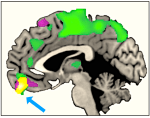
1.recent study (2015) with 82 participants showed differences in brain structure according to how trusting people are of others.
The most important finding was that the ventral medial prefrontal cortex was larger in people who tended to be more trusting of others, the region that serves to evaluate social rewards.

Another finding was that the volume of the amygdala was greater in 2 groups – those who were most trusting & those who were least trusting of others. This brain structure helps code & remember things that are emotionally important to us.

2. Many decisions we make hinge on how much we trust others, built on past dealings with a person OR their reputation.
A study used MRI to brain-scan participants while playing a Trust Game with various partners who – by social reputation – were pre-labeled as fair, unfair & indifferent, in order to make trust-based decisions together.

Any activated part of the brain uses more oxygen, so the more oxygenated blood that flows into an area, the stronger the signal.
The images showed the brain area called the caudate (deals with decisions & responds to reputation) “lit up” most strongly in the ‘trusters’ when dealing with unfair or indifferent partners, but not with the fair ones.

NEXT: Patterns of Mistrust – #1

ACoAs UNDER-Trusting (Part 2)

001c0405llALL AUTHORITY IS BAD& determined to keep me down!

PREVIOUS: UNDER-Trusting (#1)

REVIEW: “Unrealistic Expectations
🔶 UNDER-Trusting (UT) (Part

🔶 WHY ACoAs DON’T Trust (cont.)
a. Abandonment // b. Self-Hate

c. Shame  
• We feel such deep shame about being unlovable, the bad seed, a mess, too damaged…. that we withdraw from others, not letting them see who we really are & what we need
• OR we compulsively tell everyone all the things that are wrong with us
& then feel ashamed for exposing ourselves – but keep doing it

It’s generally true that our culture does not value or respect vulnerability – only a ‘stiff upper lip’. So if we talk to the wrong person about our pain, they’ll make fun, dismiss, judge, say we’re overreacting, it’s all in the past, we should be over it by now…… but the most common thing we’ll hear is : ‘Don’t be negative” – which is about thinking, not emotions! ➡️

NOTE: This is not the same as sharing about our inner wounds in meetings or therapy, where it’s appropriate, even though we feel shame & fear of punishment & rejection in those places too

EXP – Angela borrowed $35 from a recovery friend. She was going thru a very hard year & kept putting off repaying. Then she moved to another city & lost touch. The woman finally tracked her down & angrily demanded her due, saying Angela was irresponsible & not to be trusted.

Angela was very upset, knowing she was in the wrong, but also realizing that trying to always look good on the outside, she had been too ashamed to tell the woman her troubles, which would have helped her ‘friend’ understand the delay

d. Unrealistic Expectations
Even though many ACoAs can’t or don’t want to be honest, dependable or fair (#3 on the ACoA Laundry List) we have a desperate need for unrealisticeveryone else to be.  AND we’re too literal (normal for children, but not realistic as adults) – so we assume / need to believe that people mean exactly what they say. If we hear:
✦ “ I’ll bring you the book tomorrow”, we look forward to getting it the next day
✦ “I’ll call you right back”, we sit around & wait, & wait…..
✦ “Let’s get together soon”, we want to know exactly when

THEN if they don’t come thru, ACoAs get very upset, leaving us:
• deeply disappointed, so our mistrust gets reinforced
• feeling S-H, convinced that it’s personal (NOT), that it’s our fault, we weren’t likable, assertive, clear enough….

REALITY – The other person may:
• be a people-pleaser, just being polite, so the ‘promise’ is not sincere, but not malicious
• have meant it at the time they said it, but got busy, forgot, got distracted or delayed….
YES, occasionally we run in to a narcissist or sadist who is just messing with us (maybe like one of our parents or classmates…) but that will be rare, unless we’re still living with someonreation to authoritye like that!

e. Authority
ACoAs automatically distrust all authority figures because the first ones in our life were cruel or weak – which then gets extended to the ‘ultimate authority’ – God.  Now we react in one of 3 ways, by:
being victims & people-pleasers, rebelling & fighting or withdrawing & isolating

• This is understandable as far as early experience is concerned. However, as adults we’ll continue fearing all authority ONLY as long as we’re not yet empowered ourself.
If we’re still interacting with the world mainly as a WIC, then we continue to depend on others, & so are always vulnerable to bad parent figure – teachers, bosses, therapist, doctors, politicians….
🔺With a True Self, healthy self-esteem & good boundaries, we can be on an equal footing with others

UNHEALTHY: Some ACoAs need to be ‘the authority figure’ so:leadership
• we can punish others for what was done to us
• no one can take advantage of us
• we can put others in their place (down)

HEALTHY: Some people are born to be leaders, entrepreneurs, self-motivators, & can learn to take on the mantle of power without misusing it.  Not everyone is born to be ‘under’ someone’s authority (working for others).

NEXT: Under-trusting (Part 3)

ACoAs UNDER-Trusting (Part 1)

one eye open ALWAYS KEEP ONE EYE OPEN –
you never know where danger lurks!

PREVIOUS: OVER-Trusting (#2)

REVIEW post: ‘What is Shame


🏴 MISTRUST
= Suspicion
SO the lack of trust rests in ourself, by not using our intuition, observation, experience….  which causes a general sense of unease toward someone or something, but without proof (yet) — WHEN :
• you have no reason to think someone will do the wrong thing, but you don’t have a reason to trust them either
• OR: a person or situation seem questionable, but you intuition is picking up a hint from their words, action or manner
• OR: there’s actually no reason to be suspicious, so your mistrust is not deserved (paranoia)

🏴‍☠️ DISTRUST = Certainty, SO the lack of trust rests in ‘them
• when you have good reason to not trust someone based on your experiences with them, usually more than once
• are given reliable information about someone or something which lets you know they’re not safe / trustworthy

🔶 UNDER-Trusting (UT) as Adults (cont.) 
The way we think & react emotionally to how others behave – not paranoideven necessarily toward us – has a direct impact on our lack of trust (our Ts – CDs and Es – FoA).
It’s usually based on a combination of all our unhappy past adult relationships, but mainly those with our parents .

This can easily lead to a subtle, underlying paranoia that colors everything. What’s necessary for mental health & peace of mind is to see & understand who people are individually, & not lump them together as all bad or unsafe.

REALITY : We incorrectly ‘mistrust’ some people who —
•  are simply not interested in us – nothing personal – we’re just not a good fit, or they’re caught up in their own little world
•  really are insensitive, mean or otherwise unavailable, which hurts
•  are just taking care of themselves instead of focusing on us – at the moment – it feels like they’re turning their back, because we’re expecting them to be the good Inner Parent as our comforter & companion

Without a Healthy Adult ego-state the WIC can’t tell the difference between these 3 groups – so when disappointed, we regress into that old ‘slough of despair” (Pilgrim’s Progress), where “all is cloudy, hopeless & no one is ‘good’!”

🔶 WHY ACoAs DON’T TRUST
a. Abandonment (too many PMES losses)cling /rejected
In spite of the fact that we were raised by untrustworthy people & we still long to be taken care of, as adults WE —
— continue to cling to people, places & situations (PPT) which do not have to the inherent capacity to provide even our most basic human needs, much less compensate for all we missed out on in childhood. The combined of old & new deprivation adds up, which can be deadly for us & to those around us.

The less we’re treated with respect —> the more abandoned we feel —-> the more wounded we get —-> the more demanding the WIC becomes —> getting angrier & angrier.

When this core button is pushed we may use familiar character defects:
• withdraw, sulk, withhold          • be paranoid & accusatory
• get controlling & micromanage     • be clingy & desperatefreaked out

AND when our anxiety reaches a level of hysteria. we can’t stop ourselves from making a painful situation worse, setting others up to fight with or withdraw from us, increasing our sense of loss & mistrust.
Then we say “I knew it all along – no one is there for me!” even though in some cases we contributed to it

b. Self-Hate – As a result of original abandonment, WE:
Internally: • don’t know who we are, fundamentally
• can’t identify most our needs (even the basic, normal human ones) much less havwrongEllie the right to get them met
• are convinced we don’t deserve to be treated well, so don’t notice or reject anyone who is actually capable of being kind
• don’t trust our own knowledge, experience & observations

Externally: • we stay too long with unhealthy people
• don’t trust that anyone will ever be able or willing to help us
THEN – we say “I hate everyone, no one likes me, I don’t belong anywhere”….

NEXT: Under-Trusting (Part 2)

ACoAs: OVER-Trusting (Part 3)

promise the moon WHAT’S WRONG WITH PRETENDING
everything’s just fine?

PREVIOUS: Over-trusting (Part 1)

See ACRONYM page for abbrev.

POST: “People should treat me better, BUT I won’t let them
🔷 We trust TOO EASILY when we…. 
(Part 2)

🔷 WHY DO WE OVER-TRUST?  (cont)
a. FoA (fear of abandonment)
b. Self-hate

c. Co-dependence — a form of “Delayed Stress Syndrome” or PTSD
• we use people as substitute parents instead of being our own, so we can’t afford to notice flaws or limitations in them, no matter how glaring
• we don’t have the right to object to other people’s b.s., so naturally we would never think of calling them on it

• we depend copdepon the opinions & values of others too much, convinced they know things we don’t, so EVEN when we have knowledge or intuition about a person or situation – we ignore it, especially if someone else disagrees
• we don’t want to, god-forbid, hurt anyone’s feeling by ‘suspecting’ them of being less than trustworthy – as they blatantly or subtly do us in!

EXP: Social conformity: As adult, if we need to be part of a group where trust is expected / demanded – by a parent, teacher, boss, gang leader…..- no matter how irrational, unfair, evil, illegal…., we have to go along, otherwise we’d be severely punished, labeled coward &/or ostracized
OR:
Despair: Being in a hopeless situation we can’t get out of (like a child in an alcoholic home) – then trusting whoever’s in charge is the lesser of 2 evils, as a way to survive

d. Illusions
Constant disappointment in our family makes us long for everyone else  we can depend on, to make up for it, so we put people on a pedestal:
• If our parent was mentally ill, we idealize anyone who sounds ‘normal’ & functional – even tho they may be selfish or controllingidealize sickness
• If our parent was violent, we idealize anyone who seems calm, even tho they may be emotionally numb & unavailable

• If our parent was verbally cruel, we idealize people who are ‘nice’, even tho they may be a people-pleaser & therefore not totally genuine
• If our parent was absent, we idealize people who ‘want us’, even though they may just be using us to take care of them …..

e. Confusion
• Our family didn’t model appropriate behavior, seeing everything in B & W – drama, extremes, deprivation…. so we evaluate the world using the same lens.
We have trouble distinguishing nuances of good vs bad behavior & don’t consider proportion. Instead of looking for relationships made of 70 – 80% positives with only 20 – 30% negatives (which is reasonable), we settle for the crumbs of only 10 – 30% positives – if that – & ignore a huge pile of crap!

• When people hurt & disappoint us, especially someone we love & / or admire, we sweep it awaytend to push away whatever we feel & think – sweep it under the carpet & say nothing. Instead, we hold in our anger & get depressed.

They may or may not be in the wrong, & we may or may not be overreacting – even when they are off-center. The important point is that we need to process any rage & CDs we may have, then talk to the person about the situation, but only from our Healthy Adult.  If done correctly, we will feel much relief, whether they hear us or not!

• And sometimes we have friends, family members, co-workers & acquaintances who are basically OK, on our side, or at least neutral – BUT who we secretly accuse of being unsafe because:
◇ they’re not 100% perfect in their interactions with us – OR
◇ their positive regard for us is too much to take in, so we dismiss it
◇ they do admire us, at a distance, but are not actually friends, so we don’t trust they can see & appreciate us …..since they’re not ‘taking care’ of us

REMINDER:  As long as we’re being run by the Wounded Inner Child, we find it very hard to separate people who are permanently unsafe from those who are only unsafe some of the time, from those who are genuinely trustworthy.

NEXT: ACoAs – UNDER Trusting (Part 1)

ACoAs – OVER-Trusting (Part 1)

being conned THE WORLD IS ONLY SAFE –  if I pretend to not notice the bad stuff!

PREVIOUS: Trusting #2

SITE: 10 Warning Signs of being too trusting

QUOTE: “Never trust anyone completely but God.” ~ Lawrence Welk

OVER-Trusting  (OT) – as ADULTS
DEF: Ignoring information you already know about a person or situation (or a potential one you’ve been told about) that screams:  “I’m NOT safe. I’ll get you as often as I can. Don’t trust me” AND that everyone else – except you – can see!

📌 A therapist suggested to a client why she needed to be more discerning & less trusting:  “Some people you don’t let in the bedroom, some people you don’t let into the living room, & some you don’t let in the front door!”

🔷 WRONG reasons for trusting:
Impulsiveness : chasing something or someone the WIC very badly wants, putting all our inappropriate hope & trust in how it will turn out (the way we ne-e-ed it to), without admitting what we know, & not considering the consequences – including thinking through possible danger to ourself or others

Masochism : We tend to search out confirmation of prior expectations. ACoAs expect abandonment.
For abuse survivors with little or no Recovery – reinforcing the pain of unjustified hope & unfulfilled trust (PMES abandonment) is often chosen over safety & pleasure.
We repeatedly trust the wrong people, guaranteeing disappointment, by fulfilling our self-destructing assumption – that there are no positive outcomes for us.

Risk-taking : Being desperate, or as an adrenaline junkie, we pursuimpulsivee a situation or person even knowing that the danger of going ahead is great (re. love, money sports….).
If we subjectively think the possible gains far outweigh any possible loss (coming from the WIC), we’re willing to take the gamble, sometimes even with our life.

All of us ACoAs experienced years of trauma in childhood – at home, at school & in our neighborhoods.  We were deeply scarred by those experiences, but each of us handled it in our own way, depending on our basic personality AND our Toxic Family Roles.abuse / fantasy
Those wounds were beyond anything we could bear, so we developed our own defensive posture:
• some have become overtly tough, angry, bitter
• others hide away from everyone
• some try to rescue & fix others to feel safe
• others escaped into a world of fantasy & have stayed lost, needing to see everyone thru rose-colored glasses!

THIS last defense mechanism is a thick blanket of vagueness to soothe the ache in our heart, BUT it makes us endlessly vulnerable to emotional, mental & physical vultures who can smell our ‘out-to-lunchness’ a mile away!

ACoA IRONY : Regardless of which protective style we act out, we’re trapped in another dilemma. Trying to mask how afraid we really are of everyone underneath, some of us carelessly trust everyone, especially the most damaging people! It’s so automatic we don’t even realize we’re being too credulous because we need it as a safety blanket, & because it’s passive.

EXP: Josie hears a new acquaintance say she has trouble with friendships – they usually end in serious disagreements. Josie is starving for companionship & overlooks this vital information. Unconsciously her WIC is thinking: “She wouldn’t do that to little ole’ meeee – I’d never hurt her or make her feel bad, I care too much, I’m so sweet…..”

Yet, sure enough, at some point Josie says or does the ‘wrong thing’ & the friend gets mad at her – attacking, accusing, withdrawing ….. Josie is shocked, then hurt, confused & of course blames herself for the problem (as if this outcome wasn’t totally predictable!)

We excuse our blindness by saying:blind-see
• I’m just trying to be a good person, I’ll give them another chance
• it’s wrong to judge others, & besides – they’re trying
• ‘they’ don’t mean to hurt me / can’t help how they are
• you don’t know their ‘good’ side, their good qualities
• …but they say they love me, give me money, ne-e-ed me
• I can’t make it without them
• & it’s my fault anyway, I deserve how they treat me  …

NEXT: Over-Trusting (Part 2)