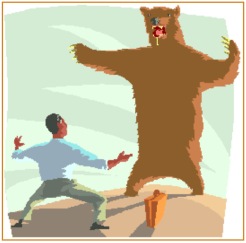
Anger & CO-DEPENDENCE (Part 4)

PREVIOUS: Anger & Co-dep #3

BOOK: “When Anger Scares You: How to….

QUOTE: “If you’re not pissing someone off, you probably aren’t doing anything important” ~ Oliver Emberton (Excellent serious cartoons)


2. OTHER PEOPLE’s Anger
(cont.)

WHY we’re afraid:
• Other people’s anger reminds us of one or more raging adults we grew up with. Those terrifying experiences effected our developing, sensitive nervous system. (“Trauma & child’s Brain“)
Unless we’ve done a lot of rage-discharge-work, our body is still warehousing all the old terror those adults (& siblings) continually caused us. (“The Body Keeps the Score” synopses)
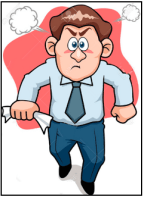
angry dad
So now, whether someone is angry directly at us OR just being near someone who’s very angry, our fear can get activated so intensely, it feels like every nerve is on fire!
AND –
• we assume we will get hit, or worse – the way we were as kids
• we don’t know what to say – don’t have clever comebacks, or logical responses (See: “Effective Responses” )
• it triggers our own hidden anger that we’re trying to keep down  (posts: Anger & ACoAs)

MORE ACoA dichotomies
• Co-deps are microscopically focused on what others are saying & doing, to figure out what they want from us. We think that if we can & then provide it, it will ensure a continued connection (because of our FoA).
🧊BUT: this is our narcissism, & desire for symbiotic acceptance – not actually trying to understand who someone else actually is

• Because of very real trauma we grew up with, we experience everyone & everything in the world as dangerous.
🧊BUT: because it was so overwhelming, to survive we trained ourselves to avoid seeing danger – anywhere – a turtle with its head pulignore warningsled in.
So we’re oblivious to all kinds of cues from other people in the present – a kind of emotional Asperger.
We miss hints that someone is:
• belittling, insulting or making fun of us
• anxious to leave, but too polite to say
• angry, annoyed, bored, hurting, scared, upset…..

FACIAL SIGNALS

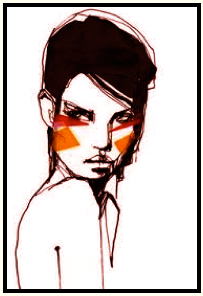
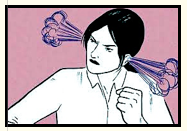
ANGER: Eyes down, narrowed, tense, or staring, furrow between eyes, brow pulled down, lips drawn tight or raised in squarish shape – muscle movements show when we feel aggressive, frustrated or threatened. Researchers think we make this ‘face’ to protect itself in a physical conflict (furrowed eyebrows protect eyes….)

CONTEMPT: when we literally look down our nose at someone with suspicion or in derision – lowered brow or eyes looking to the side. The main feature is that only one side of the face is pulled tight. (If both sides are / were pulling, we’d be swallowing or salivating)

DISGUST: Here the muscles above the upper lip are pull up, raising it the mouth, wrinkling the nose & narrowing the eyes – as if smelling something foul. Often the mouth opens & the tongue comes out, as if needing to throw up.

USEFUL
– know the difference in motivation, between:
BAD anger-expression: used to control others thru intimidation, OR anger at oneself to control other emotions we don’t want to feel,
vs.
HELPFUL anger-expression: to protect ourself from some external danger, OR to indicate that we’re not thinking / acting in our best interest (have somehow abandoned ourselves)

POSITIVE
BUT
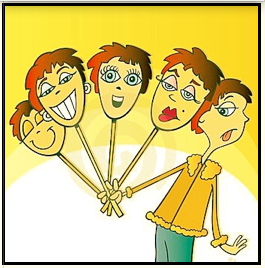
we also miss positive responses which could heal us. Being ‘oblivious‘ + S-H prevents us from seeing the available benefits all around us which we could accept from people who :
– are available to encourage, help, play with, support, teach….us
– honor, complement or validate us
– are appropriately sexually or socially interested in us

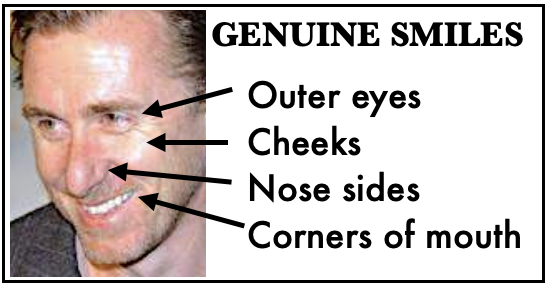
• ⬆️ FACE: Lie to Me” TV series actor Tim Roth – w/ more micro expressions

Interesting:  French neurologist Duchenne de Boulogne figured out how to tell a real smile from a fake one.
REAL: requires both zygomatic major cheek & orbicularis oculi muscles be active (raised cheeks + outer part around the eye socket that pulls down eyebrows & skin below), especially since very few people can voluntary contract those eye muscles.   (More…)

ARTICLEs: Fear of anger //How to stop absorbing other people’s emotions” // Micro-expression Training video // How We Read Emotions from Faces + brain // (QUIZ re. 20 Emotions

NEXT: Anger – ways to react #1
Anger & CO-DEPENDENCE (Part 3)

angry girl
IF I PAY ATTENTION
I’ll be able to know how I feel

PREVIOUS: Anger & Co-D (Part 2)

SITE:3 Phrases That Will Instantly Calm Angry or Emotional People


1. OUR Anger  –
 in Parts 1 & 2 (cont.)
a. MISSING Emotions
b. INAPPROPRIATE anger/rage
(cont.)

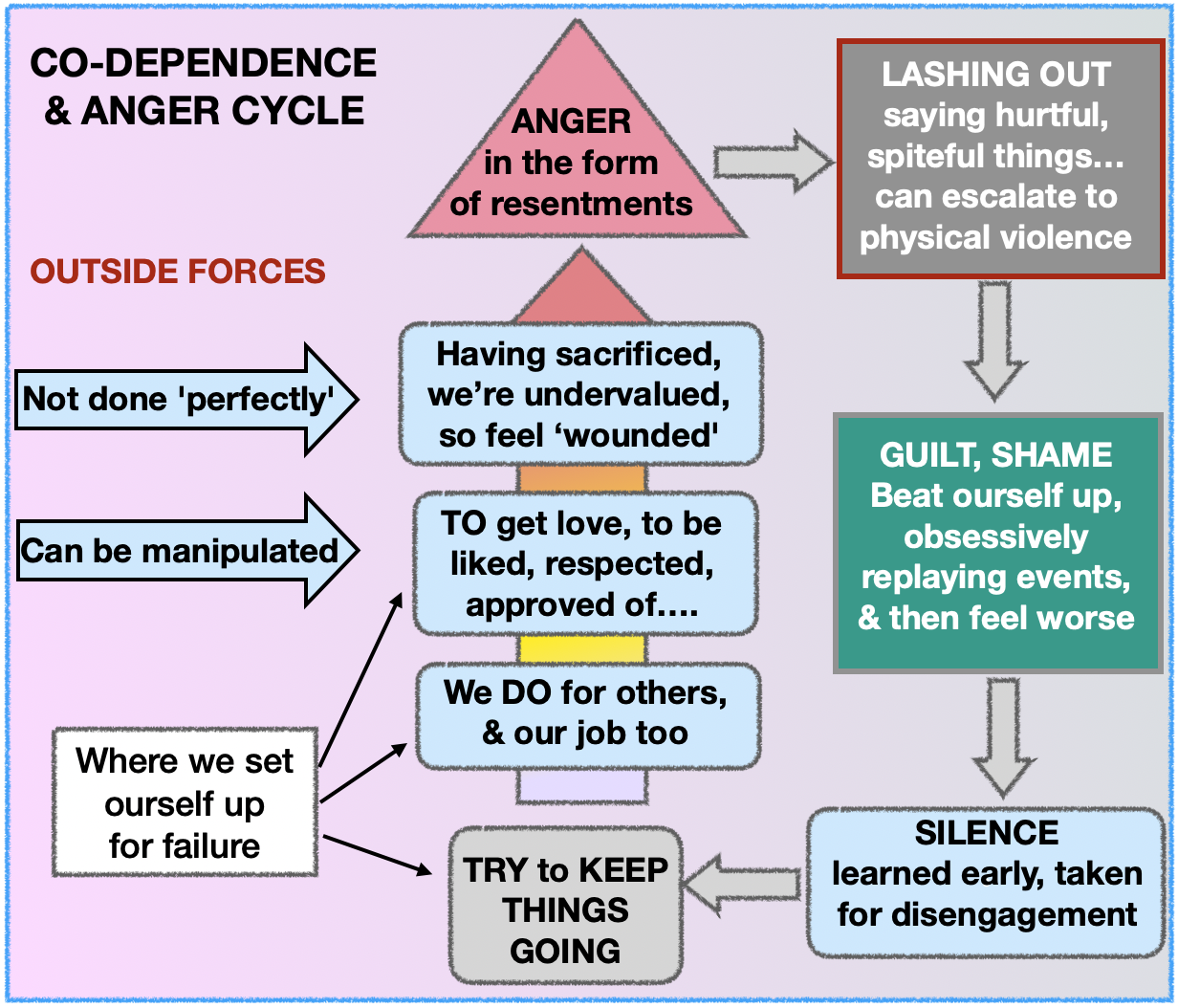
🔹As adults, people-pleasing and not getting our own needs met for too long – is draining & enraging.
BTW – your anger at any of the situations in Part 2 “Sudden Flashes” (add you own) may not show for a long time, yet could be burning you up inside – until it boils over.
But even when Co-Dep anger is released, it’s only an escape valve. Without FoO (family of origin) Recovery, it doesn’t solve the underlying issues, so we end up filling the POT again.

• In adversarial relationships, if we act out anger against an abuser, no matter how well deserved, things can escalate, often making things much worse. This can leave us even more frightened, guilty & helpless.
WITHOUT acceptance of reality, we waste a great deal of effort. IF we keep trying to fix a problem by expressing anger over & over (to restore our sense of control) but the bad situation is not fixable, eventually we become depressed or apathetic.

And no matter whatever healthy, kind people tell us to the contrary – the WIC part of us still believes the Toxic Rules — “it’s always been my fault & always will be / nothing good ever comes of trying / I’ll never get it right / I always mess up…. so why bother, if I’m just going to get disappointed or battered anyway?”

Unfortunately, the stronger & deeper these false assumptions are (T), the harder it is to leave unhealthy PPT & find safer environments (A). Without a clear awareness of our needs – & permission to provide them – many of us avoid anger alltogether, staying trapped & hopeless (3 posts re. NEEDS)

2. OTHER PEOPLE’s Anger
Co-dependence comes in many flavors. While people-pleasing is one of it’s hallmarks, it’s not always in the form of over-niceness. It can also be camouflaged by surliness or isolation. Co-deps who tend to crankiness or bursts of rage are just as approval-driven as the more obvious types.

REMINDER: Co-Dep is a defense mechanism which:
♟ supposedly ‘protects’ against feeling overwhelming fear of abandonment
♟ assumes that the power to act is not within us, but only in other people & things
♟ is a way to bury feeling lost & worthless, living in our False Self
♟ prevents us from having our Rights

ANOTHER ACoA dichotomy is that
we confuse assertiveness with attacks.
❤️ Being assertive includes standing up for oneself, with healthy boundaries & valuing Rights, ours & theirs — vs.
💙 Being confrontational, which is fueled by underlying hostility – is the need to push someone around, to get our own way, suppress the other person’s point of view, to punish…..

ALSO :
• Co-deps are secretly angry, raging inside, convinced that any sign of disagreement is an attack, which we fanatically avoid. Not true.
• At the same time, most co-deps can not bear having anyone be angry at or be disappointed in us.
This makes it easy for others – if so inclined – to take advantage. The more approval we need, the less likely we’ll notice the extent our self-sacrifice is in favor of taking care of other people’s needs, want & demands, ignoring our own

Being used, abused & then thrown away – is very painful, creating depression & S-H, in a vicious, downward spiral. Without doing FoO & Inner Child work, we have no way of knowing who we truly are, so we co-dependently look to others to tell us.
It’s an attempt to get the legitimate mirroring our parents should have provided.  (More…. as adults)
Instead, we compulsively go to narcissists & other wounded people to ‘see’ us, who can never reflect back to us who we are. They can only project their False Self, trying to make us like them!

Conflict-Avoidance is about:
US – terrified of our own enormous anger, the loss of control that we think will destroy others, causing loss of acceptance or love  (More
AND
OTHERS – the assumption that everyone becomes unreasonable (out-of-control-crazy-violent) when they’re angry, which we won’t know how to handle. Actually – what we’re used to is rage, which we believe will destroy us!

NEXT: Anger & Co-dep #4

Anger & CO-DEPENDENCE (Part 2)

co-dep angerTHERE’S NO WAY
for me to win!

PREVIOUS: Anger & Co-D (#1)


1. Re. OUR Anger (cont.)
a. MISSING Emotions (cont.)
i. Numb
ii. Disconnected
And then there are the times we FEEL something – that punch in the gut or the stab in the heart, BUT don’t know where it came from.
Our body’s legitimate reaction to abuse is disconnected from our mental center (cortex) because of years of involuntary denial. So —
√ we blame ourself for the pain, thinking we’re making it up, over-reacting / too sensitive, it’s hormonal….
AND
√ if we do make a vague association between our discomfort & a particular person, we justify & excuse it by thinking “they didn’t mean anything by it, it’s just the way they are, she/he DOES love me….”
cat collarIt’s as if we’re wearing one of those animal medical collars: we can see over the top of the stabbers face, but can’t see the knife in their hand as they shove it in!
However, if we take the collar off, & ask the Inner Child how it feels around that unhealthy parent/ friend /boss/ lover….. & if the Child is willing to respond – we find out exactly what’s going on!

So when denial starts wearing off, we’re shocked – first by the pain, & then realizing that all this time our thinking has been way off!
That’s liberating but also very scary, seeing that we’ve built much of
our world on mental sand.
We have to revamp our whole concept of reality, which can leave us with a lot of anger, realizing how great the abuse really was.

For a long time we may hate our parents, the rage coming in waves. We still want them to be what they can’t & never could be.
Eventually we can accept that we no longer need them to take care of us – we are our own parent NOW, so we can learn to deal with them realistically – whatever that means for each of us.
BOOK: “Coping w/ Codependency” ~ Kay Marie Porterfield

b. INAPPROPRIATE anger/rage
Self-Hate: As co-dependents (Co-Ds) we are brutally critical of our own imperfections, even when they are absolutely normal for being human – whether making a mistake, not knowing something or making an error in judgment.

We also rage at ourselves any time we don’t get a need met or feel hurt – taking on the responsibility for other people’s limitations or unhealthy behavior.
At the same time – we sabotage opportunities for getting those very needs met – to stay loyal to our early training. (“People should treat me better, but….“)

🔹Repressed
In Claudia Black’s book “Deceived”, she places Co-Dep anger on a continuum: Avoidance <– Sideways anger — Anger –> Rage
At the far left it’s sometimes described as feeling dazed & defeated, often part of low-grade chronic depression. For many people (more often women), avoidance is a learned response to stress over time, starting in childhood, along with long-term painful / abusive adult relationships.

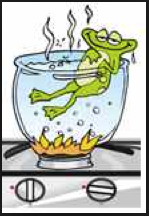
🔹Boiled frog syndrome
If placed into a pot of boiling water, a frog will immediately jump to safety rather than burn to death. However, if the frog is placed in a pot filled with room-temperature water, which is then very slowly brought to a boil, it will happily do the backstroke until it’s cooked from the inside out.

boiled frog syndromeCo-Dep anger can be like that as well. In a volatile situation we may fight back or just leave. But if we let our emotions accumulate in the POT, we end up stewing in our own juices until it feels like we’re choking.
Then the anger (& all the pain underneath) bursts outward in harmful ways, or inward with silence, uncontrollable crying, anxiety, constant fidgeting, physical illness…..

🔹Sudden flashes
On the other hand, unexpected burst of anger at others can be a sure sign of co-dependency at its tipping point – in reaction TO:
• always considering what someone else needs AND they rarely / never reciprocate
• being constantly disappointed, but still depending on narcissists to come thru for us – against all evidence
• hearing a correction or suggestion as criticism, triggering S-H
AND / OR
• not being able to get thru to someone, no matter how often we try
• someone not reading our mind – about what we need or want (so we don’t have to ask)
• trying to force someone to be or do something they either don’t want to do, or simply are not able
• trying very hard to please someone who will never be pleased, but we keep trying
• wanting someone to take care of us, but they won’t (& shouldn’t)

NEXT: Anger & Co-D – #3

Anger & CO-DEPENDENCE (Part 1)

codep anger OF COURSE I’M ANGRY –
everyone disappoints me!

PREVIOUS: ACoAs & Anger #2

SITEs: • Caring or Co-dependent?

• “Characteristics of Codependent People

• ”3 Phrases That Will Instantly Calm Angry or Emotional People


IMPORTANT
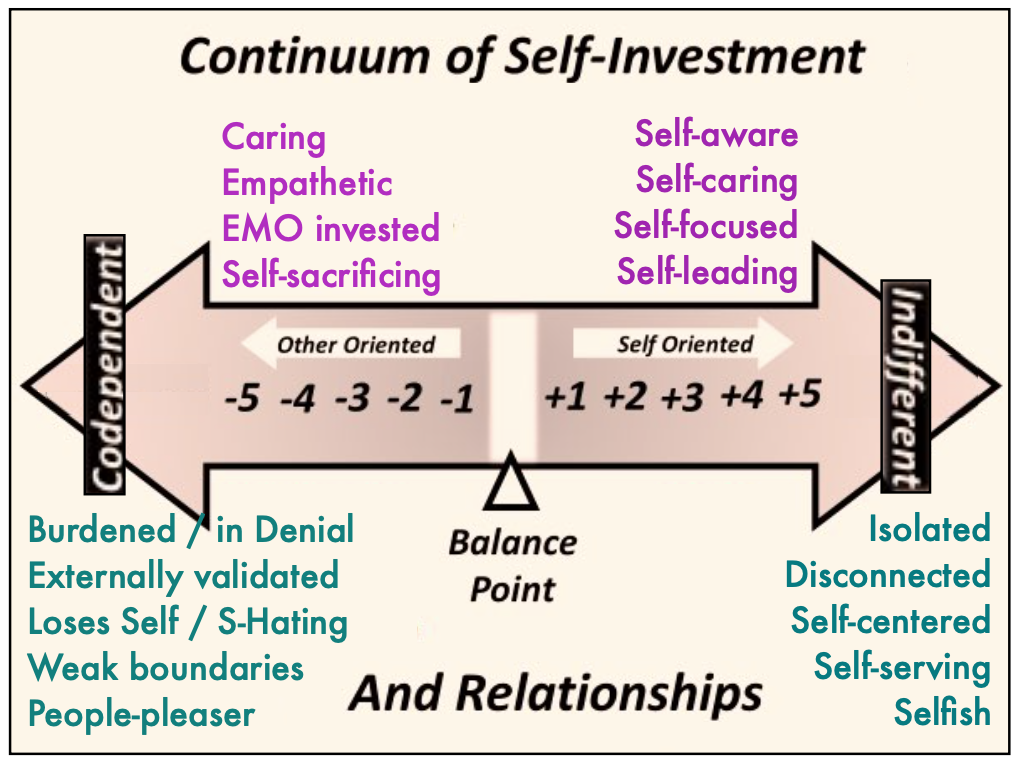
: If you haven’t already, please read the above articles to acquaint yourself with the basics of co-dependence (Co-Dep), so you can put the topic of anger in perspective (Continuum CHART)

Internal characteristics : Co-Deps have DIFFICULTY with:
• self-esteem & self-care
• setting boundaries
• knowing & accepting all reality
• being moderate & balanced
• self-regulating emotions & behavior

Co-Deps (ACoAs & Addicts) are fundamentally ruled by buried shame, having had to cut ourself off from our internal world.
We rarely know how we actually feel – under all the spinning & drama.

The truth is that we don’t want to know, because it’s painful & we never learned how to develop an inner soother for such occasions. It’s ‘easier’ to stay on the surface & pretend things are just fine, rather than deal with what’s really going on inside – which is emotional starvation.

We may be very busy caretaking the world, but barely provide for ourselves. While it seems that we’re only focused on others, Co-Deps actually spend a great deal of time obsessing – on ourself! – on what we don’t have, what we wish we had, what we did wrong, what others are doing to us, what we/ they should be doing…..

Having to maintain the Co-Dep facade is exhausting, but it started so early in life, we think it’s the real us. Sadly, the performance gives us no satisfaction or relief because it feeds on & is maintained by S-H, anxiety & perfectionism. (Shame & Co-Dep)

1. OUR Anger – We generally think of Co-Deps as being weak, dependent victims. This is how a large portion of us act, even though we’re really not that weak, having survived many horrors, although not very well.

Others will express it as intense counter-dependence (Reverse Laundry List), even to the point of being self-deprivational (need-less & want-less), along with arrogance & grandiosity, our damage spilling out over everyone/ thing.

Many Co-Deps are not aware of our anger, so are often surprised when others react with annoyance to the ways we express it (tone of voice, teasing, unprovoked irritation…..) because we ‘didn’t mean it like that’ – consciously.  Dr Irene, on her excellent “Verbal Abuse” site, notes that:  Co-Deps misplace our anger – we get angry when we shouldn’t, & don’t get angry when we should.

a. MISSING Emotions
i. Numb: Co-Ds are so used to abuse, insensitivity & disrespect, that we have trouble consciously feeling the hurt inflicted on us by unhealthy people.  But the Inner Child does register every single verbal / emotional punch, stab, slap…. delivered by them. (Posts:  “Dissociation“)

Now we not only swallow the venom of those encounters, but add self-blame to the already tremendous reservoir of pain we’ve been carrying since childhood. Like mercury or lead poisoning, we continue to let ourselves be toxified!
NOTE: Fear of our own anger is called Angrophobia (not very original!)

Emotional numbness comes at the very bottom of the Feeling Continuum (but before death 😦 ), because the pain is so-o-o great that we’ve had to cut everything off, so it represents the most distressing level of feeling.
Co-Deps who are still in denial will often say they had a happy or OK childhood. The way we can tell if it was NOT is by listening to how we talk about ourselves – blaming ourselves for not getting what we need & vin life. Emotional Body’ chart

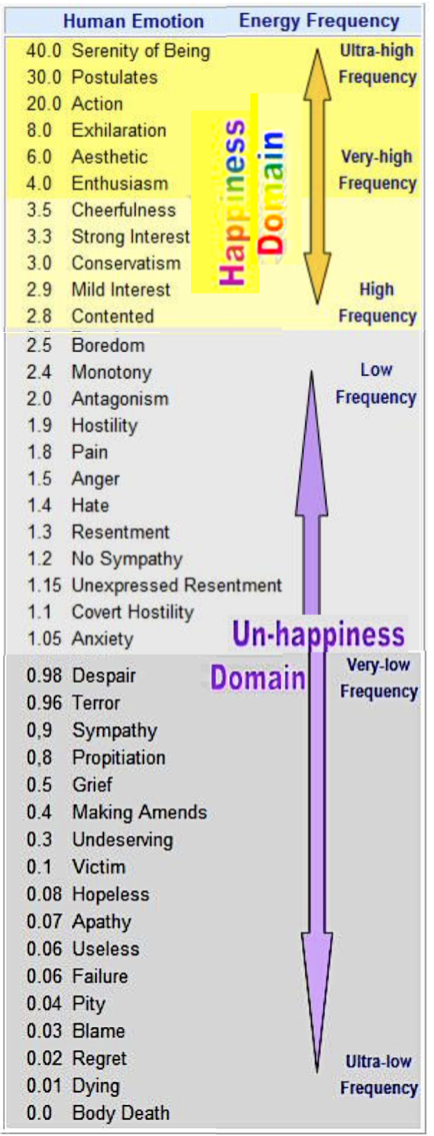
CHART ⬇️


NEXT: Anger & Co-D (Part 2)

ACoAs & Anger (Part 2)

angry expressionsANGER CAN BE EXPRESSED in many different ways!

PREVIOUS:
ACoAs & Anger – #1

SITE: Anger Management Source MANY articles

QUOTE: Anger is the feeling that makes your mouth work faster than your mind. ~ Evan Esar

1. ACoAs are terrified of anger (even the angry ones of us!)
a. of OUR own, afraid if we let it out we might kill someone (since we really want to).
It’s a deadly combination of their anger which we absorbed, along with what we built up in response to being neglected & abused. So our emotion POT gets stuffed to the gills, & we do our best to bury it all, then sprinkle it with the pretty flowers of fake niceness. Even so… it leaks out!

b. of OTHERS’ anger, because the WIC assumes they/ it will kill us. It makes sense, since many of us grew up with raging adults (especially when drunk), as well as that of siblings or other family members.
We may also have been stuck with other adults who were too weak & fearful to protect us against those ragers.
And there was no one to sooth us when hurt & terrified, or explain that none of their behavior was our fault.
So we never learned to comfort ourselves. (See also 8 other posts)

We were also never shown or taught how to handle our anger – neither how to think about upsetting situations nor how to behave successfully. We were left alone with our pain, and punished for any display of our reactive anger.

not allowed angerWe may have chosen to copy the long-suffering parent, forever living in fear of everyone’s disapproval & anger.  But ACoAs who are still in their victim role are just as intensely angry as the overtly volcanic types.
While anger may be pushed out of our awareness, it still shows up as :
◆ staying with others who are always subtly displeased, emotional manipulative, or blatantly attacking, who blow up too easily (see Emotional  Abuse )
AND :
◆ relentless S-H & deprivation in all PMES areas, copying our original abandonment, then fueled by a current helpless, hopeless rage aimed in the wrong direction – at ourselves

And if we were designated the Hero child / ‘Good One’ / Golden Child – in the family, then we definitely were not allowed to be angry.
Added to that, many of us received religious injunctions against such an ‘evil’ emotion!

It’s not surprising then – that we have trouble even knowing we’re angry, or that we should be angry when mistreated (T), much less actually feeling it (E). Instead it gets ‘intellectualized’ into resentments – several steps removed from the actual bodily experience of the anger itself!

2. ACoAs – who are SO angry 
• dome of us grew into overt ragers ourselves, copying the dangerous adults
• we may still be walking around in a fairly constant slow burn
• Some know that we are, with varying degrees of acceptance about it, OR
• are genuinely calm & peaceful much of the time with only occasional flare-ups – from doing a great deal of FoO & rage work

3. ACoAs – who DENY being angry
who me angry?Many will insist they’re just not angry, or have gotten past it all, that they’ve forgiven the family, & moved on.
OK, THEN check how accurate you are :
Qs: How do you talk to yourself, internally?
How good is your practical self-care?

❖ Are you consistently comforting, kind, loving, patient, self-respecting, validating ….. toward yourself?
OR is the PP inner voice harsh, impatient & perfectionistic, while you ignore the WIC completely?

❖ Do you take as good care of yourself, each day, as you do other people & pets in your life?
OR are you only focused on others, co-dependent & people-pleasing?

❖ Do you stand up for your rights & ask for what you need – from your Adult ego state?
OR do you over-react when something doesn’t go right
OR passive-aggressively wait for someone else to figure out what you need?

❖ Do you feel comfortable in business & other social settings, because you are calm & confident?
OR are you anxious when in certain social /business settings? 
OR do you isolate & assume everyone is going to judge you? (projecting your anger out on to others)

❥ If you are more like the second half of these questions, then you’re still very angry – but suppressed – sitting on a volcano & taking it out on yourself & others (depressed, passive-aggressive ?), while pretending you’re not in a rage at all.

NEXT: Anger & Co-dependence, #1

ACoAs & Anger (Part 1)

walled up angerI WALLED UP MY ANGER –  now I’m afraid to open it up

PREVIOUS:
Anger Triggers (#3)

SITEs: “8 reasons why we’re afraid of anger (scroll down)

ACoAs: For those of us who grew up with physical or sexual abuse, &/ or others kinds of verbal & emotional cruelty – snide remarks, making fun of, insulting, dismissing…. most of us will do anything to not be like ‘them’.
Even as kids we figured that if we could just be a good enough “good-girl or boy” we could tame the troll (us), to get the love & safety every kid craves. But no matter how hard we tried, we never succeeded in assuaging the beast (them), never feeling truly safe.

CHART  –  a shorthand way to look at the range of possibilities – from the most frightening (chaotic) to the safest kind of parenting. For most of us it wasn’t just one parent causing all the problems, but some combination of many adults we were stuck with.(“Parenting styles”)

No matter what personality we were born with, all children need stability, to have a reliable base from with to experiment, learn & risk as they explore themselves & all the newness of the world.
BUT most of us lived in chaos, which was terrifying.

Terror inevitably creates anger, & if the scary, painful, unfair, crazy-making circumstances go on for years, the child’s anger at the abuse & neglect will eventually turn into rage. Living in chaos is always harmful to children, regardless of our family’s intention. 

Re. US – ACoAs BELIEVE THAT:
• all anger is bad / dangerous & inevitably leads to violent behavior
• being angry at anyone means we are bad
• our anger can kill others, even if we don’t express it – just by feeling it – so we can never be angry at our parents, no matter how hurt by or frustrated with them we feel
• we have to protect others from our rage, no matter the cost to us
• if ‘they’ knew how angry we were they’d never love us, & then we’d die, floating alone in the cold outer reaches of black space!

AND some of us have had the experience that expressing our anger at them got us beaten, hit, old-shouldered, verbally attacked (“How dare you ___! Don’t talk to your___like that!”)….. So we shut as much of our anger off as we could, & stuffed more hurt into the POT.

Re. OTHERS – We assume anger PROTECTS us IF WE:
• are angry all or most of the time (keeps people away)
• are angry first, to preempt anger from others
• retaliate with personal attacks
• cut ‘them’ out of our life completely
OR:
• play the victim to make others feel guilty
• tell others how awful this person is (for being angry at us)
• say it’s ok if someone’s angry & then punish them when they do
• are SO good that they can never find anything about us to be angry over (we think)
• insist /demand that others never get angry at us, because we’re too delicate / can’t handle anger / it’s un-spiritual (not pleasing to God) / we don’t deserve it…

IN CONVERSATION, when someone gets angry at us, ACoAs may:
• Completely ignore both the anger & the issues, & change the subject
• Respond stoically, logically, ‘deal with it’, placate (“I understand / Oh that’s OK….)
• Immediately feel guilty, take all the blame, apologize profusely & repeatedly. Try to make up for being ‘bad’ or hurting the other person
OR
• Feel such terror that we blank out & can’t think at all (dissociate), so don’t answer, but only think of something to say when it’s too late & then hate ourselves for being stupid or a wimp
• Feel terror but try to justify our position, thinking: “I know I’m too sensitive, I’d never do what you’re accusing me of, No one else feels this way about me”
OR
• Be defensive – over-explaining (most common ACoA response to criticism, anger, insults….)
❥ That’s not what I meant, it’s just that_____
❥ No, really, I tried to ______
❥ The reason I sangry dog chasing manaid that was because____
❥ I couldn’t because _____
❥ Well, you see _____
OR
• Be defensive – throwing it back on the other:
⚡️ Why didn’t you tell me before?
⚡️ You’re just jealous, selfish….
⚡️ Well – YOU did ______ to me
⚡️ You’ve been sitting on this for how long?
⚡️ You’re just confusing the issue
⚡️ You’re not making any sense

NEXT: ACoAs & Anger, #2

Anger – Triggers (Part 3)

angry robot

TOO MANY THINGS
can go wrong every day!

PREVIOUS: Anger Triggers  #2

SITE:Anger: Moodjuice Self-help guide


MORE Anger Triggers, set off by OTHER people or circumstances
🚹 Noise • construction work, babies crying, dogs barking
🚹 Overload when too many stressors happen at the same time, so our coping capacity is exhausted (caregivers, working mothers….)

🚹 Pet Peeves lazy, sloppy, dirty, chaotic people or places
• violation of personal rules/ values
• social irregularities, political issues
🚹 Powerlessness
• not able to fix or change someone/ thing that hurts us (so we don’t have to leave)

🚹 Stealing • lover or mate taking $$ or other things / ID theft / break-ins / business frauds
🚹 Stupidity rules that make no sense
• not having or not using common sense
• government incompetence or deliberate harm
• favorite sports teams losing
🚹 Unfairness
• discrimination because of age, race, religion, gender, looks….
🚹 Unreliability
• broken promises, lateness, lies, repeated cancellations
• being let down when needing someone specific (disappointments)

STUFFING triggered EMOTIONS
Life is made up of energy ebb & flow, expressed, contained or withheld.
We take in – food, love, nature, beauty, affection….
We let out – art, exercise, emotions, sex, sports, talk…
…. a cycle of building & discharging vibrations, which only stops at death

🔻 Relaxed muscles are in low energy, but also anything that’s a road block keeps us tense
🔺 High energy that’s not moving tightens the muscles. People who are very afraid – will unconsciously hold their breath, so their lungs are always over-inflated, making them sigh a lot

When energy gets either too high or too low, people get more & more anxious. Then they try to find ways to dampen it or pump it up (over-eating, compulsive sex, fighting, smoking, drinking….)

• Our society (& unhealthy families) tell us what we’re allowed to express emotionally, & to ‘control’ how much to let out. We’ve been taught to be afraid of showing anger, loneliness, fear, mourning, insecurity – even too much joy or excitement (except @ sports or concerts)….. told to “calm down” & contain emotions rather than letting them out in healthy ways.

The energy of each unexpressed emotion gets stuffed into an imaginary POT. One way to tell how full it is – is by noticing the tension in our muscles – tight jaw or shoulders, having IBS, overall stiffness….

⬅️ Al Turtle’s CHARTS start by assigning each ‘provoking’ external event as 5 units, with a corresponding emotional response of 5 units, & then going up from there: trigger 50 = response 50, 500 = 500….
He calculates that by the time we’re age 20 most of us have at least 35,000 units of backed up energy in our body, which can use up tp 20 to 80% of our calorie intake – just to keep it all inside the POT.

No wonder we’re tired – suppressing emotions takes a great deal of effort, piling up until we implode (depression) or explode (rage)

Re. Anger – usually the amount of anger felt is in proportion to the provocation (trigger), so the larger the input (stressor), the larger the output (emotional intensity).
A child will explode as much as it needs to, then it’s over, & they stops. This is normal.
But adults have learned to cut too many of their feelings off. Then we end up with a very full POT,& it doesn’t take much of an external trigger (5 to 10 units worth) to set off a very big response (100 -1,000 units)! So a little thing that would “justify” a little anger often results in a huge amount of expressed rage.

RELIEF – The ONLY thing that relieves suppressed emotional energy is venting it appropriately – as a way of ‘completing’ / ending the emotion – so it does’t hang around. Nothing else works.

Regularly emptying the POT  – a little at a time, in small doses – actually gives us more energy because we’re releasing the tremendous effort needed to hold it in.
Many of us are not aware of how hard we’re working to sit on emotions, because consistently tight muscles become numb after a while. That’s why doing emotional-release body work is so important as part of Recovery.
SITE : Polyvagal Theory, a Ladder of  Nervous States the mammalian autonomic nervous system provides the neurophysiological substrates for adaptive behavioral strategies.

BOOK: “The Body Keeps the Score” ˜~Bessel van der Kolk, M.D. (Overview & chapter summaries)

NEXT: Anger & ACoAs,  #1

Anger – Triggers (Part 2)

many triggers I CAN ONLY COPE WITH
but so much stress!

PREVIOUS: Anger Triggers (#1)

SITE:Aggressive Driving & Road Rage
Anger Worksheets – Checklists


1. Internal (in Part 1)

2. EXTERNAL Triggers
Triggers are all the PPT that make us uncomfortable – causing emotional distress of some sort.
Anger is only one response to negative external experiences. The most common is fear, in the form of dread or anxiety. It can also be sadness, frustration, feeling abandoned…..
The defenses that have helped us survive can also cause intense painful reactions – when it seems that someone’s not respecting or valuing what makes us special

We get triggered when the brain thinks we will be or have been deprived of a positive need that’s important to us. Then we quickly rationalize & justify our anger or fear-behaviors so we don’t look so bad. (see LIST of NEEDS). Of course, when we can access the Healthy Adult voice we can catch the over-reaction, giving us time to discover if the threat is real or not.

REMINDER – While there are ‘universal’ things that annoy most of us, it’s important to figure out what our particular buttons are, so we can deal with them differently or at least better – mainly for our own benefit
(see post re. Damaged Needs)
ALSO – there are situations which legitimately SHOULD make us angry – such as physical, mental & emotional boundary violations & abuses

BUT, much of the time our anger stems from our harmful past :
• things family, school, church…. did to us when we coulSTRESS listdn’t stand up for ourselves (“If it’s hysterical, it’s historical”)
• AND, our reactions are based on what we were / were not allowed, as well as watching how adults dealt with their anger, hurt, frustration….

STRESSORS predispose us to anger, & the amount of stress we’re under at a given moment determines if we ‘let fly’, & to what extent
The following Anger Triggers come from other people or circumstance. They may not all apply to you, so focus on the ones that do, & go back to Part 1 to see what might be under your anger/rage.

🚹 Abuses = all PMES forms (“Emotional Abuse”)
🚹 ‘Bad’ parents = drunk, controlling, insensitive, manipulative, mentally ill, narcissistic, negative, unavailable, unreliable…..

🚹 Betrayal  • a cheating spouse
• anyone going behind your back to cause you problems
• someone passing on private info to others / using it against you
• ‘friends’ spreading malicious gossip
• taking credit for your ideas or work
🚹 Boundary invasions • someone going thru your stuff
• being woken prematurely (in the middle of a REM cycle)
• continual / repeated loud noises, music, neighbors
• telemarketers / tv ads / popups

🚹 Breakage / breakdowns
• equipment failure (esp. when most needed)
• tech complications or malfunctions
• destruction of a favorite or prized object/possession
🚹 Concerns
 worrying about family members (health, finances….)
• wondering what might have happened to them
• not able to help someone in trouble (powerless)
• worry about possible injury to self or a loved one / health problems

🚹 Communication problems
• being put on hold – especially for a long time
• dealing with incompetent “customer service” calls
• not heard, words twisted, ideas misunderstood or used against you
• given the wrong instruction or info (esp. when important)
🚹 Delays / Interruptions
• obstacle to reaching goals (the closer to an important goal when interrupted – the greater our anger)
• prevented from completing any ongoing task, especially if meaningful
• interference with planned fun / entertaining activities
• long lines, slow service
• waiting for something you badly want right now

🚹 Disrespected / Embarrassed / Humiliated / Shamed
• being treated as unimportant, invisible, stupid….
• not obeyed when you’re in authority (parent, boss….)
• belittled, called on the carpet…. especially in front of others
• being with someone who acts badly, as a reflection on you

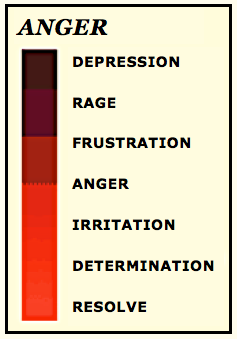
Anger- red range 🚹 History • annoying or painful behavior someone repeats & repeats – even when asked many times to stop. Over time will accumulate frustration & then become anger
🚹 Lack of consideration
• often texting when with you, anywhere
• loud cell conversations in enclosed spaces
• talking at movies, concerts….
🚹 Losses • of illusions or of hope
• of a relationship, job, home, health…..
• death of a loved one, friend, pet…

CHART ↗️  : Anger colors + 8 other Emos  

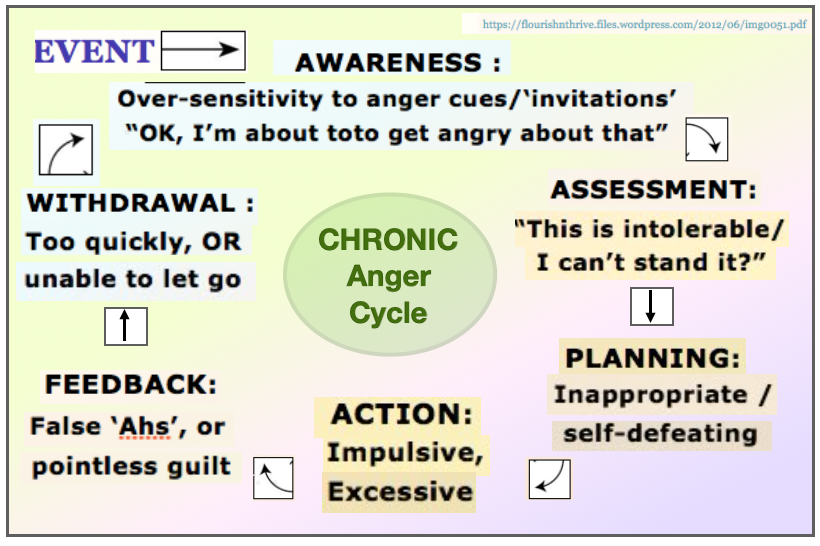
⬇️ ANOTHER look at the Anger Cycle comes from Ronald Potter-Efron’s best-seller “Angry All the Time” – Normal vs Chronic anger


ALSO: See an expanded behavior cycle – applied to anger & other dysfunctional patterns (from “Anger management for Kids”)
NOTE: This site includes other links, which may help ACoAs teach our Wounded Inner Child how to deal with our anger.

NEXT: Anger triggers (#3)

Anger – TRIGGERS (Part 1)

THERE’S NO END OF THINGS
that can set me off!

PREVIOUS: Negative Uses (#2)

SITE: Anger TRIGGERS Qs

Series of POSTs : “What Just Happened? – Noticing painful events”


WHAT GETS US MAD?

a Trigger + our point of view about it + our personal temperament = anger (but not always or for everyone)
Our Anger reaction to PPT is usually a combination of internal & external factors. Sometimes external events that bother us are actually positive or neutral, but because of internal damage (WIC & PP) we automatically get angry.  EXP – for ACoAs:
√ being accused wrongly enrages us
√ being accused rightly terrifies us (then we get angry or defensive)

• While there are legitimate reasons for reacting, under the anger are ‘sensitive’ emotions we may not want to admit to, such as loneliness, need, loss, abandonment pain, fear, sadness….. making us feel too vulnerable.

Everyone has some triggers, based on our personality & childhood experiences. Anyone interested in personal growth needs to identify their specific buttons, to better manage verbal & physical responses. (Iceberg)

1. INTERNAL Triggers
a. EMOTIONALLY , the Big-3 inevitable triggers – are:
HURT – to our feelings, our integrity, an important loss, an insult to anyone / anything we love…..
• SCARED – Physical or emotional danger
EXP: Man on bike with little son on the back almost gets side-swiped by a bus pulling to the curb, making him yell & hit the bus with his fist as he turns that same corner
FRUSTRATED – whenever someone /thing blocks us from reaching a goal (big or small), especially if it’s very important to us, or if it’s been for a long time

b.  Our own PERSONALITY – as mentioned elsewhere, genetics plays a part in our temperament. Some are more easily revved up when something goes wrong for them. (Enneagram 8s, certain astrological  ‘Squares’, or positions such as Mars in Scorp……)

c.  EXPECTATIONS – too High or unrealistic (re. others)
When held as demands, they usually create a lack of frustration-tolerance, leading to inappropriate anger-expressions, including :
√ a deeply rooted belief that our circumstances & people ‘have to / need to’ be exactly as we want
√ a tendency to lecture people on how they ‘should’ / ‘should not’ behave (MORE….)

d.  DISTORTIONS – cognitive (CDs) & Toxic Beliefs S-H
such as : awfulizing, blaming, discomfort-intolerance, mind-reading, filtering, perfectionism….. At best they will lead to disappointment & frustration, at worst to Self-Hate & rage.
False beliefs cause anxiety, & sometimes aggression, in an effort to ward off perceived threats to our well-being OR self-image

CDs cause us to misinterpret facts, events, or other people’s actions as threats to achieving our goals, or as attacks on our dignity, rules or property. This ends in wrong conclusions, leading to harmful reactions (DRAWING)

e. IMPULSIVENESS (poor emotional control)
While some of us are naturally more ‘sensitive’ than others, impulsive reactions can usually be traced back to our WIC, filled with anxiety from past trauma. The more anxiety, the more easily stress gets expressed as bursts of anger.
Some only let it out around people we’re close too, others only toward strangers. But instantaneous over-reactions tell us the Amygdala is in charge, not the Cortex. That’s why it’s considered psychologically immature.

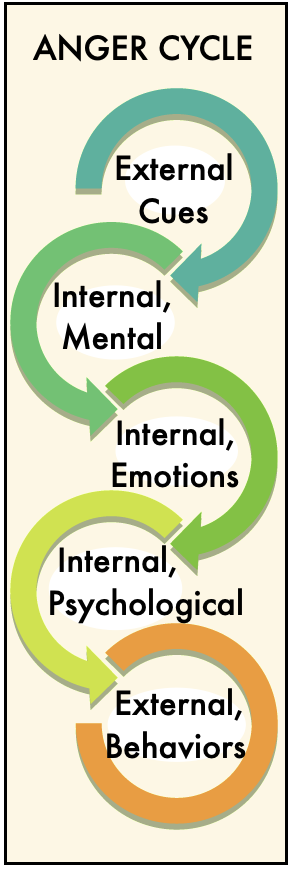
🔥ANGER CYCLEunhealthy responses to events which hurt, frustrate of scare us :
1. Trigger – by a loss, words, actions or anything that will set off anger
2. Internal Reaction – pain, letting us know that something’s ‘wrong’

3. Intensification –  a chemical flush released in the brain, which dramatically increases heart rate & breathing.
This can give a volatile person an excuse to justify how they’re feeling, but most of the time the anger is from distorted thinking.

4. External Barrier Break – some obvious signs of anger can be clearly seen by others, such as crying, angry gestures, shouting verbal threats….
5. Explosive Peak – a verbally &/or physically violent expression of anger. Dangerous to others, but also to ourself – by saying or doing things we may not really mean but will get us in trouble

6. Exhaustion & Withdrawal – when the anger / rage had died down or dissipated, then intense self-judgment follows
7. Final Stage
a. Remorse & Apology : with some people – when they realize they’ve over-reacted – will admit their error & apologize
OR
b. Intense Justification : others (especially narcissists) will not admit they’ve done/said anything wrong, & find a ‘good’ reason for their behavior, including blaming others for causing their upset

REPEAT the above pattern – Whether one is a chronic or occasional rager, without Pattern Correction, this cycle will continue.  (From DAMBREAKER)
(⬆️ Anger Cycle chart from extensive ClinMed article)

NEXT: Anger triggers (Part 2)

Anger – Positive USES (Part 1)

k7607080I CAN CONTROL EVERYONE
if I’m just ‘nice’ enough

PREVIOUS: Negative Uses #2

SITE: “The uses of Anger” + Richard Prior story

BOOKs: “8 Keys to Eliminating Passive Aggressiveness– Andrea Brandt

BASIC purpose of anger: To manage internal & external stimuli (PPT) and as a response to situations that produce fear, hurt or frustration.
Fear is for keeping us safe
Love is for bonding
Anger is for righting wrongs – so the emotion of anger is never the problem, only how we act.

HEALTHY anger
When psychologically healthy people put off solving a problem or difficulty, they don’t waste time & energy endlessly mulling over being wronged, having limitations, frustrations, illness…..
Instead, they figure out what their realistic options are, & then move on to something else, waiting for the right time to act – if at all possible.  If not, they accept reality, acknowledge their anger & then let go!

CONSTRUCTIVE anger usually involves both parties in a dispute, not just the ‘original’ angry one. In best-case scenarios, the angry person expresses their grievance, the target person listens, & then responds appropriately.

If the anger is justified & the response suitable, the mis-understanding or problem is usually corrected. The Q. then is not “Should I express anger or should I suppress it?, but rather “What can we do to solve the problem?” (MORE…..)

• In our culture, on one hand, anger is respected as a sign personal strength & self-confidence.
On the other hand, most people are afraid of someone being angry because it’s associated with aggression & violence.

However, bad behavior is not automatic or inevitable. Anger can actually help reduce violence in many social settings, because intimidated people become more obliging, who will placate the angry one, thus minimizing the other’s upset, which prevents escalation.

— Authors Howard Kassinove PhD, & Chip Tafrate, PhD, tells us that
“In fact, anger seems only to be followed by aggression about 10% of the time, & a lot of aggression (action) occurs without any anger (emotion)”.
— James Averill, PhD, from U. of Mass. says that
“When you look at everyday minor episodes of anger, as opposed to more dramatic ones, the results are usually positive”.  (MORE…..)

NEURO-PLASTICITY can correct negative Beliefs , which will modify painful Emotions:
The brain is like putty – it can be trained & repeatedly reshaped. Since stressful emotions AND uplifting emotions occupy the same ‘real estate’ (the amygdala), we can use anger to tell us what difficult experience, bad news or disappointment will trigger our inner Green Hulk.

EXP: Getting stuck in heavy traffic often generates frustration & rage. It’s not the delay that creates those emotions – but rather what we’re saying to ourselves:
“Get out of my way you jerks, I’m going to be late, Everyone’s always causing me problems, This is going to screw up my appointment, Why does this always happen to me?….”.
Being angry every time we feel trapped strengthens a specific neural pathway, cementing the emotion. (ALSO: Humor & Negativity)

• When there’s nothing we can actually do about the delay, in that moment it would help to notice & then change what we’re saying to ourselves, which can change how we feel.

If we redirect our attention to something soothing – very time we’re on the road (remembering a beloved pet or a recent success, talking to the Inner Child, listening to Scripture….) – eventually we’ll form a more pleasant emotional response.
We can start linking traffic with stillness or comfort. We can listen to interesting tapes, sing along to our favorite music, think thru a knotty problem or create/ design of something we can make later.

stuck in traffic CHANGE:  Because the Amygdala holds memories associated with various emotional responses, it will remember the positive changes we make when we combine a careful observation our own personality traits situations that set us off  a willingness to change our automatic responses (T,E,A,s).

It takes patience & repetition to form new pathways, so by not using the old one (neural inhibition) the brain is slowly rewired.
As we keep practicing, being able to feel more peaceful gets easier & more natural. Practicing self-evaluation & making beneficial changes create self-mastery, which give you a sense of empowerment, key factors in feeling safer & more content.

NEXT: Positive uses #2