ACoAs – “Being Negative” (Part 5)

positive thinking

 EVERY DAY I REMEMBER TO FOCUS
my thinking on the good things I already have!

PREVIOUS: Being Negative (Part 4)

SITE: The science of Happiness (“Happify” Website)


TROUBLE letting go
of negative thinking /talking – WHY?
• it’s strongly imprinted in our brain from years of ‘practice’
• it would require S & I from the family, which is never easy
• denial: we have a hard time noticing how often we think / talk that way

• it gives us a sense of false ‘control’
• no one would know how bad we had it growing up
• we get something out of it (Post: Negative Benefits)

• we don’t see the value in thinking/speaking positively, believing it’s for wimps, pollyannas or dummies (who don’t know what’s real!)
• we think it would be denying / our pain & suffering
• we use it to punish ourselves for being imperfect

CONSEQUENCES of Negative Thinking (NT
a. MENTAL: • it leads us to assume that any mistake is a failure, which will expose us to criticism/ judgment, like in our family
• tells us we should be able to make big strides quickly & easily, & that since we can’t – we lazy, stupid or hopelessly stuck
• it prevents being able to think of alternative solutions to problems
• when the brain tries to deal with a complex task, being inundated with NT slows down its capacity to process information & think clearly – by as much as 50%  (More…)

b. EMOTIONAL• can easily lead to depression, assuming we have to be perfect, & to being trapped by our own unrealistic standards
• can cause anxiety, leading to unhealthy coping mechanisms

c. PHYSICAL: • it’s harmful to the body, since negativity lowers its defenses & subtracts from our energy

• because NTs are so painful we can easily turn to addictions to escape (food, money, sex, alcohol/chemicals, relationships….)

d. PSYCHOLOGICAL: • is an obstacle to personal growth, making any change feel too overwhelming & painful
• it makes it hard to see & acknowledge the small steps in progress we DO make
• it denies or ignores possibilities that would improve life, & prevents receiving abundance
• it wastes time & energy, which could be used to heal old wounds & pursue healthy goals
• it convinces us that any form of risk is ‘life-threatening’

e. SOCIAL: • causes many personal, social & work problems
• has a downer effect on others we’re regularly around
• prevents us from relaxing & let our guard down, always second guessing ourselves  (Cognitive Therapy Guide

OUTGROWING NTs – change/modify things that contribute to it:change to positive

• start with AWARENESS of what you’re saying to yourself, what’s causing the ‘stinking thinking’, & the harmful effects it has on your life (& on others)

• slowly clear up practical problems which you have some control over (changing college course, job, spouse…., pay off debts, go to 12-Step meetings, do something creative/artistic….)

• try not to actually speak any negative thought out loud (develop personal boundaries instead of giving in to S-H).
If you feel the urge to criticize or get angry about something, shift to another topic if you NEED to talk

• accept/believe that positive thinking/speaking is a big plus, personally & socially. It does NOT mean being mushy, drippy, girly, sacrificing your opinions/ tastes/ values, or never objecting to something ‘wrong’
•  if you’re depressed, get the help you need to deal with it

• become acutely sensitive to the fact that some topics you’re interested in are intensely emotional (illness, jail, abuse, death, loss, war, politics, putting anything or anyone down….)

By your logic, these topics may be ‘perfectly normal’, interesting, current…. .
But when they’re inherently unpleasant, it is not respectful to foist them on others. It can easily sour the mood of a group, bring up old pain for someone or hurt someone’s feelings.

Naturally, such topics are appropriate in a group specifically designated for that (therapy group, 12-Step programs….)

• Notice how you feel when around another person who’s always a ‘downer’. Be willing to admit you may sound like that, & work on changing your own pattern – from the inside out.

NEXT: Being Negative #6

ACoAs – Being Negative (Part 4)

negativityISN’T IT CRAZY TO TALK TO MY BODY? 

PREVIOUS: NT (#3)


Negative Thinking (NT)
(cont)
1. re. OURSELVES
2. re. Personal RELATIONSHIPS

3. re. Our BODY
UNREALISTIC
a. At an extreme some ACoAs are hypochondriacs —  with the disorder that makes a person believe that body ‘feelings’ are signs of a serious illness —-> even when medical science can prove otherwise.
It’s their preoccupation with health, misinterpretiimagined illnessng a physical sensation (gas, muscle ache, headache….),  making it something it’s not.

Illness becomes a part of the hypochondriac’s identity, causing relationships & work problems. It occurs in men and women equally.
Relentless NT about the body is a substitute for / defense against feeling the huge backlog of hidden painful emotions we’ve buried. And long-term, it harms our immune system (Psycho-Neuro-Immunology).

b. Body Dysmorphia (BBD) – the distorted, unrealistic image of one’s physical appearance (ugly, fat, too thin… ). Most often it’s the result having been sexually abused as a child. In extreme cases the person cannot “see” their body, only their head, even in the mirror.

ACTUAL – However, many ACoAs suffer real physical problems, FROM :
• years of addictions, self-abuse & neglect
• being under constant emotional, mental & spiritual stress as kids, plus physical/sexual abuse, later creating very real medical conditions = the auto-immune diseases

• hereditary factors in alcoholic families: birth trauma, childhood ailments, mental illness, bad teeth & gums, depression, bipolar disorder, dyslexia, ADD, SAD, EDS, severe food allergies (wheat, sugar, nuts…), environmental illness & other chemical imbalances
SITE:“…severe childhood trauma can alter developing brain”

➼ Whether inherited or self-inflicted – it’s imperative to not use NT toward our bodies. We must never, ever curse our cells or wounded parts!
If we stay fearful, worried, & project the worst, OR rage at our organs, limbs, nervous system… the body absorbs that negative energy & may take longer to heal or maybe not at all. (Cartoons re. responses to Physical vs Mental illness)

Healthy EXP: Jody had a motor-bike accident which damaged a muscle group just above one knee & caused a limp. Along with Feldenkreis & Brain Gym, she spent time doing Positive Inner Dialoguing. Pictured the injury, she talked tenderly to her leg – “I love you & am so sorry you’re hurt. I can see the cells repairing themselves using the healing energy I’m sending you. You’re important to me & I need you. I want you to be strong again… ” While the muscle took longer to heal, the limp cleared up right away & all of the damage was eventually repaired.

5. re. THINGS
• This is a more subtle form of NT – saying bad things about objects, places, events…. anything not alive. Many people think it’s perfectly ok to call things insulting names : ‘Damn that stupid chair! I stub my toe on it every time!’ or ‘My car is such a piece of shit. It’s always breaking down.hate things

• What’s wrong with that? They don’t have feelings, so what’s the big deal? Well, it’s more of the same – projecting our painful childhood experiences onto objects, putting out more negative energy, which can get reinforced by others around us.

NOTE : Negative Reciprocal Attraction :  one person does something harmful to someone else, who then returns “the favor” with an action that’s similarly harmful (attack<–>revenge // glare<–>frown // ignore<–>snub… ). This explains why some people keep moving in the wrong direction, ie. away from ease, comfort & safety.

Reality Check
• Since the chair is inanimate, stubbing your toe may have to do with where it‘s placed, and/or the way you move thru space. In her autobiography  Nancy Friday tells of constantly getting black & blue from bumping into things. In therapy she learned that she was unconsciously punishing herself for her (repressed) rage at her mother

• And the car may be old & breaking down, but it’s not the car’s fault – maybe of the manufacturer, or yours for not taking better care of it – or it’s time to replace it but you’re mad & ashamed because you can’t afford to!

ACoAs tend to get things backwards, blaming things instead of identifying the real source of our pain. To be emotionally & mentally clean we need to identify & own:
😣 our disowned emotions (anger, hopelessness, disappointment, fear…) which then deny / ignoreget projected on to PPT

😡 that we ignore experiences which actually were harmful, then redirect our anger & hurt back on to ourself or at innocuous objects

Blatant negativity is hard to miss, but ours can be so hidden that others may never realize how often we’re thinking that way.

NEXT: “Being Negative” (#5)

ACoAs – “Being Negative” (Part 3)

EVERYTHING & EVERYONE sucks up my air!!

PREVIOUS: Negative Thinking (#2)

SITE: ▪︎ Complaining Rewires Brain for Negativity.… 


YOU’re thinking is too negative IF YOU :
• are always complaining about things, even when it’s in a rational, logical-sounding way, “This —- is an interesting tidbit to mull over”
• constantly notice the flaws in things (people, activities, ideas)
• have a tough time seeing the bigger, overall positive picture
IF YOU
• get a secret pleasure being negative along with someone else, or tearing something down
• see a flaw in something & just have to let everyone know, getting a little rush from being ‘right’ & superior
• think positive people are naive or fake, have low standards, easily impressed

YOU’re too negative WHEN:
• even a trivial flaw in something (good) will ruin it for you
• someone suggests an activity or product, & you’re quick to point out why it won’t work or why it’s a bad idea
• things get under your skin &you  ‘have to’ rant about them to anyone who will tolerate listening
negativityWHEN :
• others talk about the positive aspects of something – you just have to say, “Yeah, but…” pointing out its limitations or weaknesses
• something’s realistically going well, but you’ve got plenty reasons why it’s dumb, no good, won’t turn our well, is impractical ….
(from SuceedSocailly.com)

NEGATIVE thinking can come from copying our family, a personality trait that gets over-expressed, or seen as a ‘useful’ trait.  YOU:
• picked up a negative style from people we grew up with or around
• rely on negativity as a crutch in conversations. You wouldn’t know what to say if you weren’t complaining about or trashing something
YOU
• romanticize negativity, thinking it represents being a deep, complicated, tortured soul
• often get worked up about things & then vent, because it feels great
 –OR-
• are a little too rational. Not in touch with your own emotions, & don’t realize negative comments are harmful to others
YOU
• think that getting others caught up in your personal troubles is a reliable way to ‘stay connected’
• think you’re being ‘intellectual’ – as if pointing out flaws in everything (unsolicited, unprovoked) is proves analytical ability & honed critical thinking skills
YOU
• associate negativity with having refined tastes, as if putting down ‘mediocre’ things would show how discerning you are
• connect being cynical & overly skeptical about life with being ‘in the know’ or aware of how the world really works
• may think it’s just your style of humor – a way to be a clever, observational comedian or commentator. NOT!

Negative Thinking (NT)
1. re. OURSELVES
• Anyone reading this blog & other self-growth material, going to 12-step meetings & therapy – knows this category of NT is a core issue for ACoAs. It’s called self-hate (S-H) – powerful, deadly & tenacious! If our parents were unable to love us unconditionally OR not at all (no matter that they said), we concluded it was because we weren’t worth it

✶ So, our WIC is still sure that if the family didn’t make us feel wanted, safe & accepted, why would anyone else?
We think cruel things about ourself & even say them to others, while secretly being smug about being victimized by the whole universe!
Playing the role of the victim -now- allows us to not be responsible for our own life, while protecting the illusion of coming from a loving (or at least an ok) family.

2. re. Personal RELATIONSHIPS
NT (S-H) tells us we’ll NEVER:
• deserve love, validation, respect, peace, joy, success….
• even know what love is, even though we have indeed loved (children, animals, mates, activities, careers, locations, certain foods / arts …)
• be liked (much less valued) by healthy ‘normal’ people
• be able to leave bad relationships because it would condemn us to being completely alone (forever)
NEVER
• have the right to healthy, loving connections (family, friends, lovers…)
• have anything positive to offer others (personality, skills, experience..)
• have the right to look for & interact with accomplished people & other peers who we could enjoy & benefit from
SEE “The 12 Worst Relationship Mindsets (based on CDs)

NEXT: “Being Negative (#4)

ACoAs – “Being Negative” (Part 2)

I ALWAYS HAVE TO BE ‘GOOD’ – or no one will like me

PREVIOUS: Dealing with criticism #1

<—– Adult coloring book


NEGATIVITY
» Basic SOURCES
It’s the “bad things” that grab our attention, stick in our memories & often influence the decisions we make.

1. Fearful ACoAs
– overtly terrified ACoAs think everyone is dangerous, laughing at us, shutting us out, shunning us….
✏️ ACCIDENTAL ‘abandonment’- some people may in fact not be there for us because they’re just living busy lives, or are depressed or not feeling well, narcissistic or otherwise dysfunctional, from another culture where relating styles are different…. BUT it’s not personal

✂️ ‘DELIBERATE’ – if we’re in fact being mistreated OR ignored, it may be that we ARE :
• with ‘people, places & things’ that are definitely unhealthy, OR simply not appropriate for us, but we stay & complain
• so full of fear & S-H that we make ourselves invisible, so others can’t connect
• depressed, needy, whiny, negative… OR bossy, controlling, micro-managing, angry or secretly superior – so others stay away

2. Angry ACoAs – oppositely, we who are constantly rageful assume everyone’s an idiot, out to get us, not doing the right thing (by us) – so we just don’t like anyone, we’re better off alone….. but we hate that too!
We’re very angry that:
• we can’t seem to get away from trouble
• others have ‘entitlement’ – to good things that we don’t
• we can’t seem to get it together to have a life when everyone else is moving forward
• everyone gets ‘away with murder’, sometimes in general, sometimes at our expense, & it’s not fair
• we’re convinced everyone’s thinking about us & it’s all bad…

NEGATIVITY in Angry & Scared ACoAs comes mainly from:
• projecting what our parents did to us (& maybe still doing) onto ‘innocent’ people in our environment
• choosing & staying with unavailable or unkind people
• constantly disappointed by our unrealistic expectations of others
• NOT asking for what we need, want or don’t want
• not having permission to pursue our goals & dreams….

BOTH fearful & angry types need to :
• identify & acknowledge our CDs
• take back our projections (own our damage)
• learn what healthy vs unhealthy behavior is
• learn & accept our Human Rights
• identify who is genuinely safe & who’s not!

‘Spiritual – At the OTHER EXTREME are the ‘good girl / good boy‘ ACoAs who can never allow themselves to think (much less say) anything bad about others – no matter how rotten someone treats us! It’s fine for others to abuse us but we can’t even think they might be wrong, much less be upset with them! If we do, we feel ashamed, guilty & berate our lack of compassion

We believe that if we let ourselves think badly of others (who have earned it) that it would make us just like our parents who were mean to us & we don’t want to be anything like them!

So we try to be ‘above that’ by excusing others’ bad behavior, while judging our negative thoughts (& anger) by saying :
it’s not nice, it’s not being fair to them, they’re hurt too
 it’ll hurt their feelings, they didn’t mean it, they can’t help it
it’ll come back on me (like a boomerang), it’ll cause bad karma ….. mental health

🙏🏼 There are plenty of religious & self-help teacher who reinforce these distortion. It’s called ‘taking the High Road’, BUT …
✶…. for us – it’s just used as a form of denial, a way to not acknowledge & accept that there are inappropriate or unhealthy people we need to stay away from

Ignoring the selfishness, rage, abuse & disrespect we experience from others keeps us from leaving them as soon as we first notice it. We stay attached to abandoners & abusers, validating our victim status & adding to our pain

👎🏽 This type of ‘being-positive’ thinking is harmful to us because it ignores a huge chunk of our reality. It actually white-washes mistreatment.
✶ Clearly seeing and naming toxic people & situations is not a form of Negative Thinking!
It is what mentally clear / emotionally healthy people do, automatically & easily. It doesn’t always need to be said out loud, but it does have to be acted on – by staying at arm’s length or staying away.

NEXT: Being Negative #3

ACoAs ‘Being Negative’ (Part 1)

negativityI FEEL STUCK – could it be what I’m thinking?

PREVIOUS: Dealing with criticism #3

SITEs  ▪︎ Depression & Letting go of Negative thoughts
▪︎  Positive Power of Negative Thinking (balancing view)

See ACRONYM page for abbrev.


NEGATIVITY BIAS
– is the tendency to register unpleasant stimuli more quickly AND to focus on these events.
People pay more attention to the negative as we try to make sense of the world, so we feel the sting of a rebuke more powerfully than the joy of praise. (More….)

T.E.A. : Negative Thinking is used as a defense mechanism against painful Emotions, & is a way to obey the Toxic Beliefs, which generate unhealthy Actions

OVERVIEWA very IMP distinction
When ACoAs express emotional distress of any kind, we are often told: “You’re just being negative”.
This is absolutely an incorrect evaluation. The scolding phrase actually refers to our thinking, never to emotions!
Yes, cognitive distortions (toxic beliefs) do create painful emotions, but the thoughts come first, and NO emotion is negative, no matter what the ‘teachers’ say!

CONSIDER: Anything negative is by implication bad.
But emotions are not bad, because they give us tremendously important info about our experiences. Don’t try to change emotions, only toxic thoughts (& the negative behaviors that follow)!

ALSO: Now when we’re in deep pain because of some current event (death of a loved one, loss of a home, a serious health problem, re-experiencing an old trauma….) it’s imperative to not let anyone tell us to “snap out of it / you’re being dramatic / be grateful for X / let go of the past…..”
❣️ We have a right to feel whatever we’re feeling!
What needs to be monitored is our thinking, and stop any based in bitterness, blame, hopelessness, guilt, panic, rage, S-H, shame ….

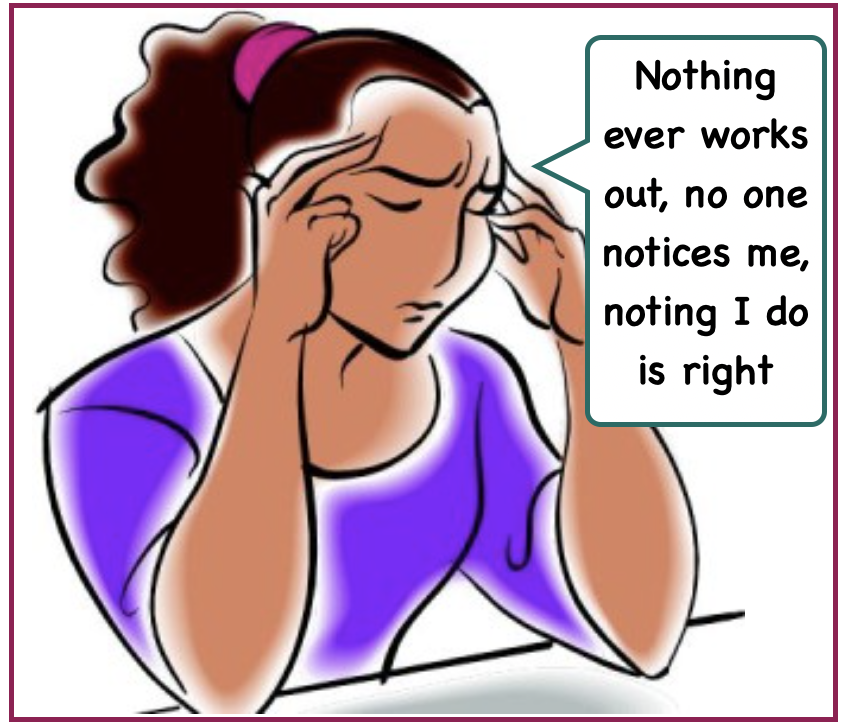
Negative/toxic thinking (NT) is a form of torture, like self-cutting!
It’s based on Toxic Rules (reinforcing our S-H) and in CDs. It’s when we:
– assume the worst     – believe everything is hopeless
– are surnegativitye we can’t do a lot of things
– think it’s too late, we’re too old….
– can’t see or imagine possibilities
– ignore available options
– limit our vision & dreams
– lose self-respect & confidence

• When we’re in a negative state of mind (obsessive NT) we give off a vibe of fear & powerlessness that brings us & everyone around us down.  It shows in our overall presentation:
⛈ our words -of course-, body language, being emotionally distant, mentally distracted, not listening to others, emotionally distant, antsy, surly….
Being constantly in a negativity space encourages the attraction of other miserable people & situations, while obviously repelling anyone or anything happy, positive & forward-looking.

• For ACoAs, it also reinforces our sense of ‘not belonging’ & feeling disconnected – ie. abandoned, which then make us even more pessimistic! It acts like an underground warren of termites, eating away at the foundations of our self-esteem, sense of purpose & love of life.

ACoAs still living primarily from the WIC’sego state get most things backwards – we’re emotionally dyslexic! What is generally safe in the world we ignore or think is dangerous, while being drawn to what is actually dangerous or inappropriate, often considering it acceptable, exciting or ‘feel good’. Identifying what is & isn’t NT about others is a must.

NEGATIVITY (focused on the bad side of things) can be about:
• ourselves (S-H) & future prospects (“I’ll never be happy…..”)
• events (“That party was painful”, “This dinner is going to be dull.”)
• other people (“I’d have friends, but everyone I know is so boring.”)
• people’s actions (“He made the lamest joke”, “Wow, she’s shallow”)

• general groups (“I hate hipsters. They think they’re better than me because they listen to crappy obscure bands.”)
• larger, more abstract organizations or institutions (“My city is so shallow”, “Everyone in this company is so selfish”, “I have nothing in common with my society”)
• any form of art, by being overly critical, nitpicking, never appreciating or enjoying anything (“I couldn’t get into that movie”, “No one writes good music anymore”)

NEXT: Being Negative (Part 2)

ACoAs – Dealing with CRITICISM (Part 3)

PREVIOUS:
 Criticism (#2)

SITE:  “How to give Constructive Criticism


Getting VALUE out of Criticism

Whatever style of communication being ‘sent’, remember you’re not responsible for what others say, but only for how you react.
Using our Adult ego state, we can have our internal feelings of hurt, anger, disappointment, confusion…. but it’s more self-esteeming if we don’t justify, over-explain, attack, or cause a scene. If we challenge the other person, it may escalate into an unnecessary & possibly damaging argument

Ultimately, if the constant criticisms are in fact judgmental, controlling, manipulative, attacking our character…. then it’s wisest to walk away, or be very brief in our response (See “Effective Responses” & “Useful, Clever responses”)

😣 Suggestion : No matter what – it’s not empowering to be defensive or try to ‘make them see’ – which comes from the WIC. (see ‘ACoAs & Anger’ post). This is especially important when dealing with family, a mate, friend or boss – IF those people are in the habit of being emotionally abusive.

However, if the person offering criticism is reasonably fair-minded & genuinely wants to be helpful, you can :
1. Think of the criticism as a ‘suggestion’ rather than a condemnation or a command. Consider what you’ve been told carefully, thinking it over & looking at it from different angles.
KEEP in MIND: If you’re having a rage or S-H reaction then it’s an old wound, so it’s best to process that first (in 2-handed writing, therapy, Program….).
ASK yourself:Self diagnosos
• is the criticism accurate & I’m ashamed of being exposed?
• is it similar to what I heard a lot growing up?
• is the ‘thing’ being criticized related to a deep need or longing in me?
• is my criticized behavior the result of my damage, or a disability (ADD, dyslexia), because of a recent trauma, a change in meds?…..

OR are you actually being misjudged & you just want to kill?  ACoAs :
• get enraged when accused wrongly –  growing up there was no justice, no one took our side or wanted to hear an explanation of our reality…. AND
• feel terrified when accuse rightly! – as kids we got severely punished, often unfairly, leaving us feeling deeply alone. Nor did we get the right info to learn what we did wrong & how to correct it!

2. With due consideration, decide what you think of the criticism
a. If you do not agree, either wholly or in part, take the time to form your reasons, based on intuition, experience & positive information. You may or may not choose to express this to your critic, depending on how important it is to your well-being or to your work, & depending on whether the person is dangerous or not – to your livelihood or health

CONSTRUCTIVE CRITICISMb. If you do agree, hopefully you’ll have dealt first with any negative fallout from you WIC or PigP.
No one can be perfect – it’s not human! Agreeing with the other person is not an admission of failure or worthlessness!

Double check:
• ASK yourself if there’s any reality to what I’m being told
is the Sender simply telling me about themselves – nothing to do with me? Or are they seeing me clearer than I can see myself?
• Did the ‘sender’ provide any alternatives? Were they useful?
If you’re not sure, ask someone else – who is safe & trustworthy.

•  if there is some truth in it, am I interested in making a change?
• if they may have a point, do I have the courage to ask for more information & suggestions?
• if I don’t agree with the criticism, can I keep my ‘center’ & either not evaluatingsay anything, or just say Thanks & drop it?

IMP:  Consider how you can apply the offered suggestion to your actions or way of communicating.  Whatever you choose to change must be suited to your personality, abilities & current circumstances.
• Once you’ve made a change, note how it has helped or hindered you. Was it a good, neutral or bad outcome? How does it feel?
• If one revision didn’t work very well, don’t give up. Try others

ACoAs have a hard time knowing the difference between the + & – types. In either scenario always try to remember that you can use criticism to your advantage.

REVIEW posts:‘What to do when confused” // “Victims or not?
What just happened?” // “Noticing Painful Events” //
Positive Responses to Painful Events 1-5” // “Actions – Healthy opposites

NEXT: ACoAs Being Negative #1

ACoAs – Dealing with CRITICISM (Part 2)

being criticized

PREVIOUS:
 Criticism (#1)

SITE:  “Varieties of criticism”(Aesthetic, Moral, Practical….)


Managing CRITICISM
Any form of criticism challenges our thinking, behavior or skill, so it’s normal to feel uncomfortable.
When we are dealing with actual criticism we need to understand what we’re hearing : not just when feeling judged, nor when our essence is being attacked, even just a comment about / disagreement with our ideas or actions.
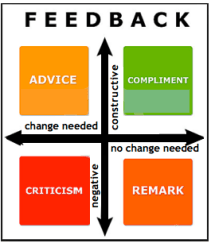
Is it legitimate vs. negative ‘feedback’? Are the comments constructive or destructive?

1. Are we receiving
Hurtful criticism? This is most likely a form of thoughtlessness, not consciously meant to injure, but can nevertheless be insulting or just insensitive. It’s usually ‘perpetrated’ by garden-variety narcissists who are simply expressing their point of view, as if it’s a given that others will see the world the same way. (“That’s a stupid thing to say” // “I can’t believe you didn’t know that”…..).
They’re generally unaware of their effect on the listner’s emotions & sensitivities, since only their own feelings & ideas are real to them

Destructive criticism? This type is a direct attack on someone, generally given with the intention to harm, belittle & destroy the other’s creationcriticism, prestige, reputation &/or self-esteem.
It’s malicious & harmful, meant to show that the person or object being attacked has no worth or validity, so no practical advice or suggestions for growth are included.
Naturally, this can do a lot of damage, & in some cases trigger verbal or physical retaliation.

While anyone is capable of this kind of attack – occasionally, & under great stress – here we’re talking about people who use this style as their main way of communicating about anything they don’t like or don’t approve of.

Generally, they’re the angry, controlling narcissists, who may or may not even notice other person’s feelings, and don’t care. They want everyone to be like them & can’t stand anything that isn’t.
Under the facade of superiority they’re deeply insecure, so bringing others down boosts their False Self, & temporarily satisfies their ego.
EXP: “You’re wrong. You’re always wrong! // You shouldn’t dance – you’ll just embarrass yourself // You have lousy taste”……

2. OR are we being offered:
• Constructive criticism? The Sender also points out ‘issues’, but without attacking the Receiver’s identity, AND may include practical advice on how something can be corrected.
That way the Receiver can choose to improve – but only if they agree with the solution AND if it suits their personality.

When using gentler language, constructive criticism aims to help the Receiver function better in the future, by kindly suggesting what to work on, & without arrogance (as in “do it my way or you’re stupid”). Therefore, it allows the Receiver to consider.

EXP: “I like your painting. Would you consider adding brighter colors?” // Your Math grades would improve if you let a tutor help // Practice keeping your back straight so you’ll feel stronger & more confident….”

HOW something is said is just as important as what. Suggestions & alternatives are offered without the Sender being manipulative, insistent, or superior – as if only they have ‘the answer’.  This usually makes it easier to accept, even if it may still hurt a little.
As a Sender:
📌 FIRST, be sure it’s appropriate to put your 2 cents in
◆ if you feel the need to tell someone a harsh truth, be sure it’s not offensive
◆ make it clear it’s your personal taste, & just your opinion – even if it’s based on first-hand knowledge or hard-won experience
◆ if you’ve tried your best to be respectful, but it’s still taken badly, then it’s not your responsibility to fix their hurt feelings or pride

As a Receiver:
a. If you get negative criticism you can say :
• “Thank you for sharing”
• “Ouch, that hurt, now say it nicely”
•  OR – just shake your head, change the subject or walk away.
Do NOT try to convince them they’re wrong, or get into a fight. It never works.  If the comment is simply not relevant to who you are – just say “Thanks for the info” or “That’s not helpful” & move on

b. If you get helpful / constructive criticism:
❥ always take it positively. Think about it, & if it applies, use it to grow. Remember that anyone willing to be careful in how they talk to you is reasonably healthy, & likely care about you as well, so take it as a sign of love or at least of goodwill .

NEXT: Criticism (Part 3)

ACoAs – Dealing with CRITICISM (Part 1)

being judgedPREVIOUS: ACoAs Being Disappointed #4

SITE: ”7 Realizations to Help You Deal with Feeling Judged


DEF:
➖ Being Judged – (Usually) being told / have it implied that there’s something terribly wrong with your fundamental identity (Mother to daughter: “You’re not smart enough to become a doctor” / “You’ll be the death of me yet” …)

➖ ‘Negative’ Opinions: When someone says what they think or feel about something or someone – having nothing to do with the object or person of their criticism (I hate that hairdo / That’s being done backwards / That’s no way to….. )

➖ Being criticized – when a mistake in our behavior is pointed out – OR when our behavior or communication is disliked by the criticizer.
The critic may or may not include telling you how you ‘should’ do do/say it correctly. But it’s often done with anger, disdain, superiority – in order to control & manipulate.
In rare cases it’s done with caring & good will, if the person is healthy & you’ve agreed to learn from themcriticism styles

🟰 Given a suggestion
– When we’re offered a better way of doing something – to make it easier or better for us, or our environment
EXP: “If you added an aspirin to the water, the flowers would last longer / When you travel, why not take less luggage?…”).
Done with kindness, respect & from a genuine desire to help

➕ Having Good Judgement : realistically choosing —
☆ between an objective positive or negative alternative
EXP: That fruit is spoiled, I’ll take the fresh one / The left trail is safer than the right one….)
OR
☆ between things that do or do not personally suits you
EXP: I’m allergic to sugar, so I use honey / I regularly watch comedy shows but never horror movies)

✔️ Being judged vs. legitimate criticism
★ Judgmental comments are about the essence (being) of something or someone, & is generalized to the whole category (Blue is ugly, all men are pigs….) , while —
☆ Legitimate Criticism is aimed at someone’s behavior (doing)(hitting your little sister is not OK & not allowed) or the state of something (that house is a mess, & needs a lot of repairs)

Children & wounded adults rarely make the distinction between BE-ing & DO-ing. So – it’s imperative for ACoAs to ‘hear’ whether we’re being told something about our behavior (speech or actions) vs. our identity.
Attacks on the latter is absolutely not acceptable, & healthy adults don’t stoop to this low blow anyway (usabuse vs criticismually), nor tolerate it from others

ACoAs confuse criticism with abuse
Legitimate criticism is an ‘evaluation of the merits or weaknesses of an action, choice, decision, thought process….’ , & at its best used as a method of correction.
It is NOT a de-valuation of our whole being or identity! as ACoAs feel/ believe.

We confuse or blend the two because:
a. In the past – our family almost always judged & misjudged, attacked & humiliated us. There was little or no balance provided : no praise, encouragement or patience – when we couldn’t do something the first time, or perfectly – and without guidance or when we were too young

b. Now, having absorbed the original abuse into our PigP, it has become the essence of our S-H. So any slight ‘disapproval’, or even a correction from others is taken as a personal indictment

OUR confusion, because of a Double Bind: (see D.Message)
★ on the one hand we agree with them
Any time others are not positive & supportive, S-H flares up because it mirrors what our PigP has been saying/ implying all along, AND which the WIC believes as absolute truth.

When someone points out something they consider to be our imperfections – even when it’s only their opinion or projection – we feel exposed & worthless, endlessly obsessing about what we did wrong

♦︎ on the other hand we’re resentful
We hate the person who hurt our feelings, or makes us feel disrespected…. We’re depressed or rageful, BUT on our high-horse, thinking “Who do they think they are saying that to me, judging me, ignoring me?” ….
We ruminate about what we should have said, what we will say or do to get back at them, that we’ll get them to see how wrong they were, wanting to justify ourself to them….. we go round-&-round, digging our hole even deeper, getting nowhere.

NEXT: Criticism (Part 2)

ACoAs & Being DISAPPOINTED (Part 3)


PREVIOUS:
Disappointment #2


EXPECTATIONS (cont)
1. COVERT (Part 2)
2. OVERT Types of Disappointment
The less we take care of ourselves, the more needy we are, yet may reject or ignore the help & resources available.
We pick people to ‘rely’ on who either don’t have what we need, or are too self-absorbed to reciprocate, especially if we’re acting the Rescuer / People-pleaser. That drives the WIC to desperately keep look outside of ourselves to provide, for as long as we aren’t willing to take on the Loving Parent role.

• We believe whatever a particular person says, especially things we want to hear (like promises, compliments or endearments) – even though they’ve consistently proven themselves not trustworthy or dependable.  EXP: “I’ll call you tomorrow” but never does. “I love you”, but is needy & selfish, or withholding & critical

• If we have the courage to actually ask for something, & are ‘promised’, but then they don’t come thru, we’re disappointed. We’re angry, even withdrawn, but are afraid to ask “What happened?”

📣 If you’re an extrovert, & feisty, you’ll try to get more of what you want from the person or situation, but angrily, maybe even attacking (the teacher, the belief, the procedure) – & then leave, or keep trying to “force solutions” (in the Al-Anon intro)

Disappointment (D) works like this wedge ⬇️
If our self-esteem & safety depend only on our circumstances, we’re in trouble, because circumstances are always changing. There are too many variables for them to remain the same.

• Too much Disappointment as kids left us Discouraged & frustrated. We didn’t have that many options, & even when we did try to get our need met, most of the time they were thwarted &/or we were punished.

• Slowly the wedge was driven deeper, & we began to be Disillusioned. For many of us this happened very early in life. The more disenchanted – before we could handle the reality of not having a safe family – the greater the need for illusion.

ACoAs have an over-developed fantasy life, based on hopes & wishes without permission to achieve them. This type is not not productive. However – healthy fantasy can be used to fuel our dreams, which then need to be put into FORM

• As Disappointment invaded our psyche even deeper, it lead to Depression. This D. is about loss, whether something we once had, or about all the things we were deprives of.

• Ultimately we end in Defeat. It’s the “Learned helplessness” syndrome. The WIC  thinks that if we’re going to keep getting disappointed, there’s no reason to keep trying.
This is how many ACoAs plod along – barely surviving ‘quiet lives of desperation’. And it all started with years of Disappointments!
SITEs: Christian perspectives 1=Response // 2=Dealing with 

DISAPPOINTMENT & the BRAIN
The pain in our brain after a disappointment is realm because it processes unhappy experiences as events that undermine our balance & well-being. The basic reason is that disappointments are processed in the limbic system, the brain structure linked to emotions.

We know that the body releases endorphins to relieve pain as much as possible when receiving a blow, cut or burn. The brain reacts instantly to the message sent by injured receptors.

However, the same doesn’t apply to psychological “wounds”. Even though the brain interprets disappointment as an ‘blow’ to emotional balance, it doesn’t respond with endorphins. Instead, we experience frustration as physical pain, such as headaches & muscle tension, as the levels of helpful neuro-transmitters decrease.

Neurologists say that the mechanisms of depression share processes & structures with those responsible for disappointment. A neural “jolt” happens before every disappointment. There’s a sudden decrease in serotonin, dopamine & endorphins. So, all those molecules responsible for well-being momentarily stop.

NOTE: We can reduce the impact of these experiences by re-directing them to our cerebral cortex. That is, we must use reason, focusing on the unfulfilling experiences more objectively, correcting negative thoughts.

NEXT : Disappointment- #4

ACoAs & Being DISAPPOINTED (Part 2)

disappointedEVERYONE LETS ME DOWN – so I stay away from everyone

PREVIOUS: Disappointment – Part 1

SITEs: • “How to Cope with Disappointment

▪︎ Psychology of Disappointment

EXPECTATIONS (Review posts – Over and Under)
No matter which form it takes, expecting others to fill our empty heart & mind, instead of being pro-active, means:Screen Shot 2016-05-31 at 10.13.44 PM
• the WIC is still running our life, waiting to find the ‘right’ parent – magically – so we don’t have to care for ourselves

• we’re functioning from our narcissism – always from the point of view that “Everything is about me!” (and against me)
This assumption was not true about the abuse we grew up with, & it’s not true about what people do to us & around us – now. (ACoA 3 Cs : I didn’t cause – the chaos & trauma”)

We know this because when WE change, in Recovery, those same hurtful responses from others seem to bother us much less!
ARTICLE: “Managing Negative Expectations” w/ chart

ACoAs get disappointed (D) by so many things, because the WIC desperately wants the world to be a certain way (to meet all its needs) rather than our Adult noticing AND accepting the way things are – both good & bad – in our environment.

IRONY: With reality in clear view, we can get our needs met by choosing among the many options that are actually available in the present!

1. COVERT Types of Disappointment
Because we’re not allowed to know our wants, needs & emotions, NOR to ask for anything, we imagine (silently expect, demand) that others will read our mind & provide for us – which comes from the WIC

• We truly believe that if we want something a certain way – without saying it – it will automatically happen
EXP: Your B/day (or any holiday that’s important to you) is coming up & he hints that you’ll do something together. You have it all planned out – exactly what you want to do, how it will look & feel.
But you never say any of it.

Then the day comes & it turns out Screen Shot 2016-05-31 at 10.12.55 PMvery differently – maybe not bad, but not what you imagined. Now you’re angry at him, unappreciative, cranky, attacking – OR you decide he doesn’t really love you at all, you don’t feel the same about him…..
OY! You’re deeply disappointed, but how was he supposed to know?

• We naively assume that everyone means what they say, OR will do what they promise. To ‘feel’ safe we need to believe that others are as literal (& ‘responsible’) as we are
EXP: Josie says she’ll bring the book to work tomorrow that you’ve been wanting to borrow. You not only believe it, but count on it, looking forward in anticipation. Tomorrow comes & she’s ‘forgotten’ the book. You’re angry. You’re convinced she’s messing with you, she lied, she…..

• When going into a new situation (class, work, relationship), the WIC presumes they will be safe, needs the people to be helpful, informative, consistent, appreciative, respectful…. & then they’re NOT. Sometime it/they turn out to be very ‘bad’, but most of the time they’re just not what we secretly (unconsciously) needed & expected.

We’re disappointed, so we get depressed or really mad.
📢 If you’re an introvert, or still in Victim mode, you’ll just sulk, withdraw, not participate, sit in misery, or leave without saying anything

NEXT: OVERT

Positive  HUMOR  from Grant Snider

NEXT:    ACoAs  & CONFUSION